
Generally, bids for an automatic transfer switch are requested towards the end of a project after the generator has been ordered and suppliers have been invited to submit pricing. Unfortunately, your final price will depend on several different factors and if you request pricing from one supplier you may be setting aside a budget based on a price that does not represent your actual budget.
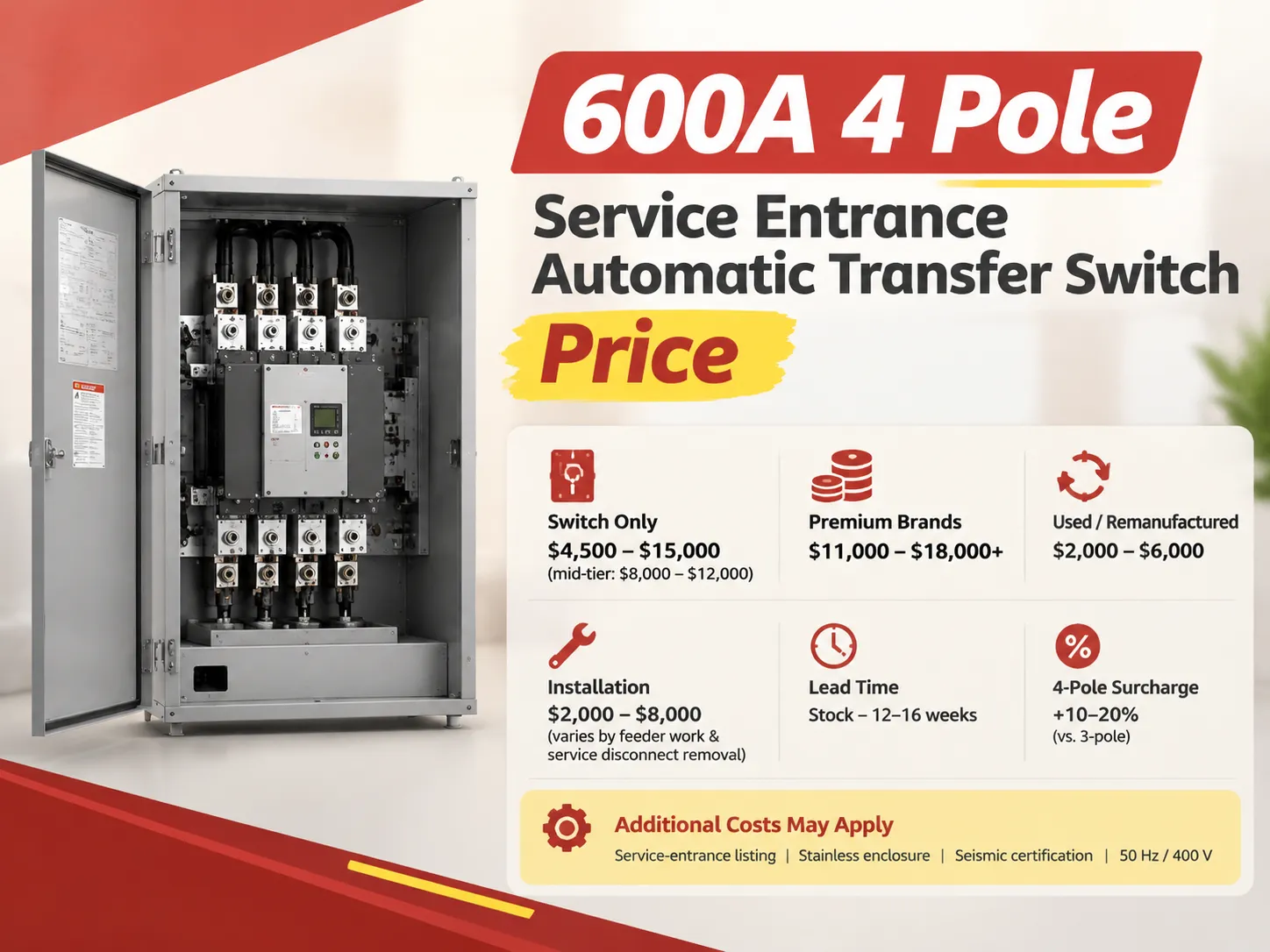
Essentially, to purchase a 600A 4-Pole (Switched Neutral) Automatic Transfer Switch (ATS) expect to pay between $4,500 to $15,000, with an average retail price ranging from $8,000 to $12,000, as people typically pay in this price range. Generally, value and import brands are priced around $4,500 while the highest quality brands with service networks will be priced between $11,000 and $18,000. Prices for used or refurbished units are between $2,000 and $6,000. Prices for installation range from approximately $2,000 to $8,000 depending on feeder work to be completed, and whether or not the service disconnect will need to be removed. Lead time for delivery can vary and can be from a week to eighteen weeks depending on what is ordered.
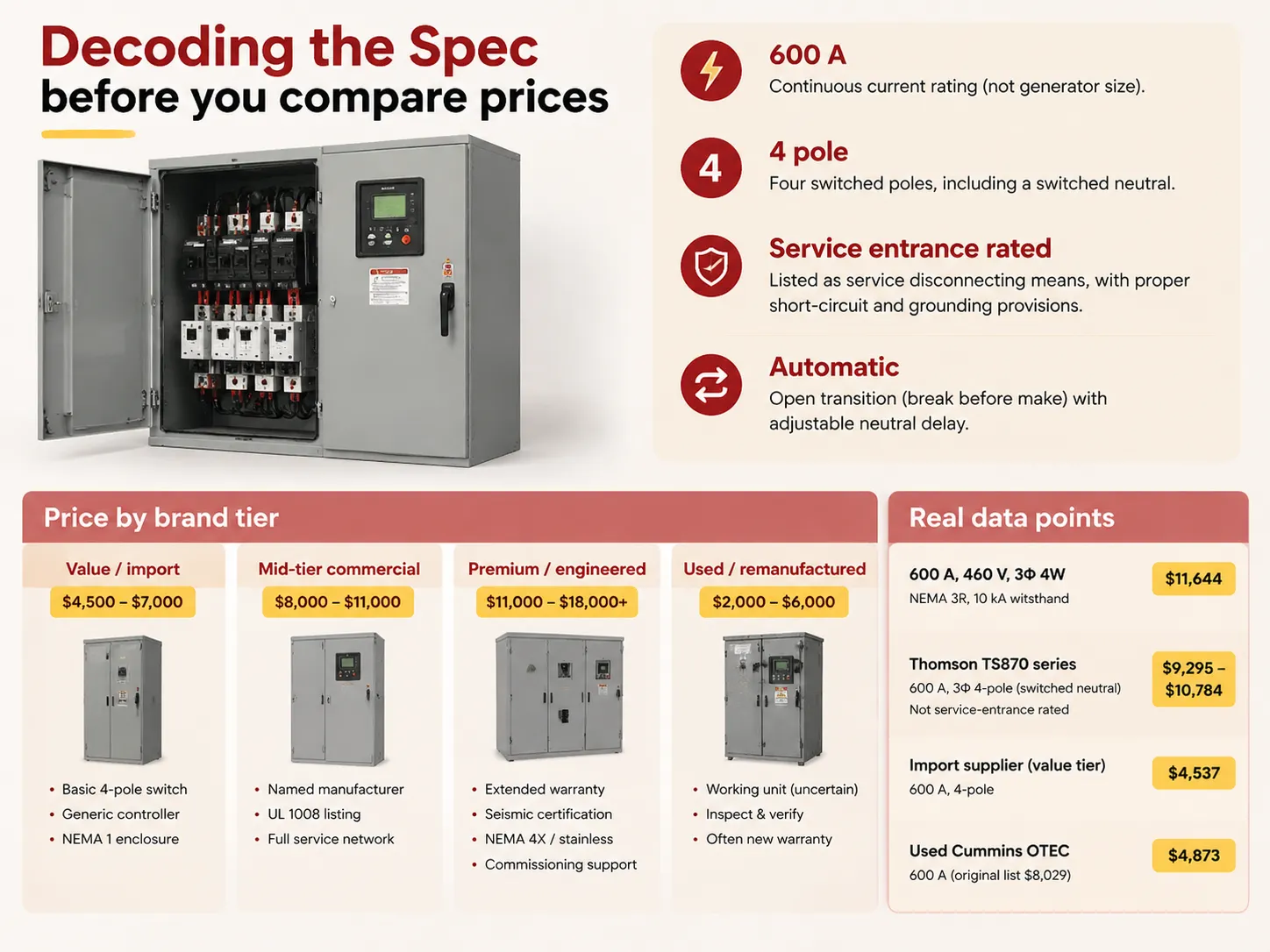
Decoding the spec before you compare prices
Each term in that product description has significance, and for the two statements to be equal, each aspect must correspond.
- 600 A – it defines continuous current rating for switching devices, not for any generator. A switch rated 600 A can work with a generator that has only a small part of its capacity because the switch has been designed to fulfill its function, not to fit the generator.
- 4 pole – 4 switched contacts, but it usually means switched neutral. The 4th pole is responsible for the neutral and operates together with phase poles. This condition is necessary for the systems which require isolation of the neutral when transferring the currents, namely, in order to carry out ground fault detection or in case of any other enclosure construction, and this feature is the most considerable difference from a 3-pole model.
- Service entrance rated – the switch has been certified for use as service disconnecting device and has recommended short circuit current ratings along with appropriate neutral/grounding functionality. Service-entrance-approved equipment is usually more expensive than other devices, and various documents often indicate that the equipment is “not service entrance rated”.
- Automatic – open transition with adjustable neutral delay function which is the feature of the standby generator systems. Closed transition is when both sources work together and is more expensive solution.
The reason to write all five down is that the cheap quote is almost always the one that quietly dropped one of them. A published specification — amperage, poles, voltage, listing, transition mode and enclosure stated as facts rather than adjectives, the way a three-phase automatic transfer switch specification lays them out — gives you the template for your enquiry.
Price by brand tier
These figures are taken from a recent survey of 600 A class four-pole or equivalent units available through various distributors and manufacturers. Treat this as an illustration of the market instead of an affirmation.
| Tier | Representative pricing | What you get |
|---|---|---|
| Value / import | $4,500 – $7,000 | Basic four-pole open-transition switch, generic controller, NEMA 1 enclosure, documentation varies |
| Mid-tier commercial | $8,000 – $11,000 | Named manufacturer controller, full service network, UL 1008 listing, published lead times |
| Premium / engineered | $11,000 – $18,000+ | Extended warranty, seismic certification, stainless or NEMA 4X enclosure, application engineering, commissioning support |
| Used / remanufactured | $2,000 – $6,000 | Working unit of uncertain provenance; requires inspection, controller verification and often a new warranty arrangement |
Some specific data points from registered listings allow us to compare. A 600 A, 460 V, three-phase four-wire open-transition device in a NEMA 3R enclosure with a 10,000 A withstand capacity is priced at around $11644. A Thomson TS870 series 600 A three-phase four-pole switched-neutral device can be bought at a price ranging from around $9295 to $10784 depending on its voltage and enclosure. It is to be noted that this device is not rated for service entrance classification. A value brand imported four-pole 600 A switch is priced at approximately $4537. A previously used Cummins OTEC 600 A unit was just advertised with a price of $4873, as compared to its original price of $8029, which is a good example showing the depreciation value of the used market.
Why service-entrance rated costs more than the same switch without it
This is what buyers tend to mess up the most, as the two products appear the same in a picture.
A service-entrance-rated transfer switch can be used as a service disconnecting device, meaning it has been certified for the available fault current of the service point, has the required neutral and equipment-grounding features, and does not need a separate service disconnect upstream. In a typical standby application, it saves money on a second enclosure, a second lug set, and a second terminal set — while the switch is more expensive and its short-circuit current rating must be equal to the available fault current at the service.
Getting it wrong in either way can be costly. If a non-compliant switch has been specified in place of a service-entrance-rated device, the inspector would stop work on the job and one would have to buy the switch two times. On the contrary, buying a service-entrance-rated switch for the installation powered by a downstream panel wastes money on something unnecessary.
What actually drives the price up
| Feature | Typical price impact | Notes |
|---|---|---|
| 4-pole vs 3-pole | +10% to +20% | Switched neutral adds a fourth pole and mechanism complexity |
| Service-entrance listing | +10% to +25% | Adds fault-current evaluation and disconnect-capable construction |
| NEMA 3R or 4X enclosure | +$500 to +$3,000 | Stainless 304/316 for 4X moves this further |
| Advanced controller | +$800 to +$3,000 | Event logging, programmable I/O, remote monitoring, load-shed contacts |
| Higher withstand rating | +$500 to +$2,000 | Driven by available fault current, not preference |
| Seismic certification | +$500 to +$2,500 | Required in some jurisdictions and by some insurers |
| 50 Hz / 400 V construction | +5% to +15% | Export markets; not a stock item in North America |
| Bypass isolation | +60% to +150% | Allows maintenance without dropping the load; a different product class |
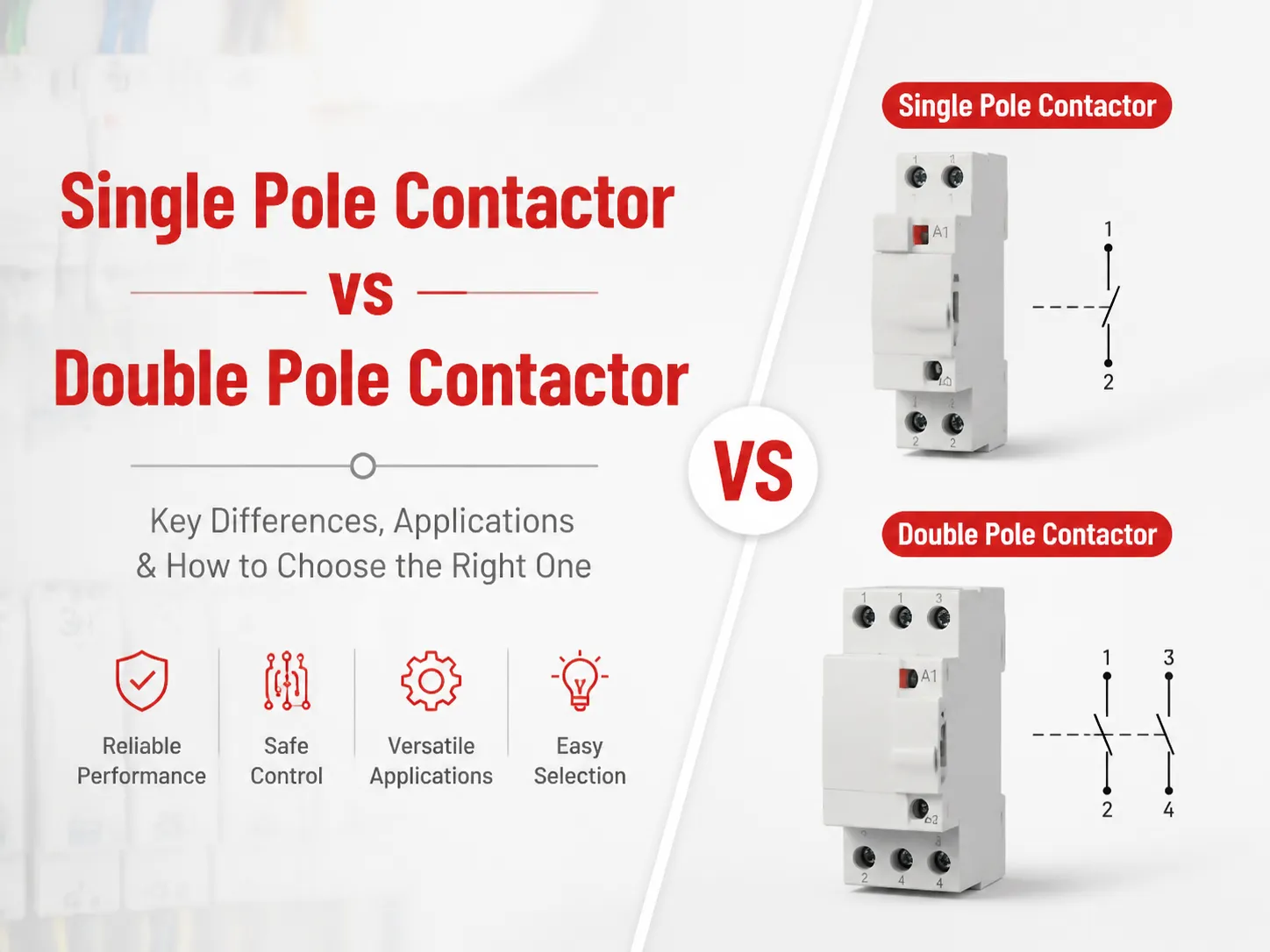
It’s worth pondering the pole count question because it is the question we think we know best. A three-pole switch means that three phase wires are cut but the neutral remains intact; a four pole switch means the neutral is also cut.Choosing between them is a system design decision about where the neutral is bonded and how ground-fault current returns, and the underlying logic of pole count in protective and switching devices is the same reasoning that runs through the difference between single-pole and double-pole devices. Get it wrong and you either create an unintended parallel neutral path or spend money on a pole you will never operate.
Three-pole versus four-pole: the money question
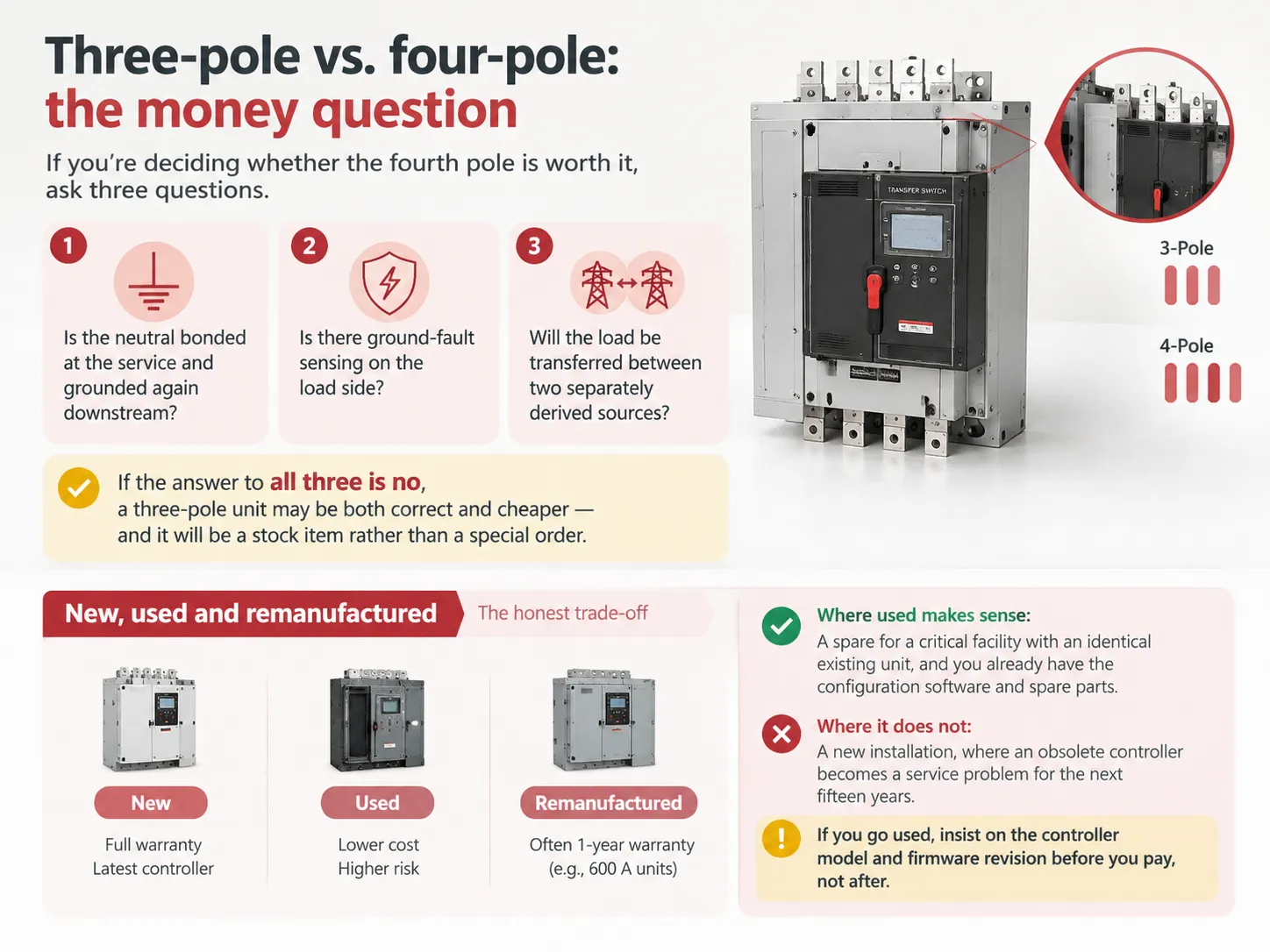
In the circumstance of the fourth pole must be taken into account, please answer the following three crucial queries.
- Is the neutral grounded at the source and ungrounded down the stream? If there are two connections to the neutral on either side of the switch operation, then solid neutral refers to providing a returns alternative circuit and it is necessary to break that parallel circuit via the device with the help of four poles.
- Is there ground fault monitoring at the load margin? Switched neutral is a very popular method of achieving fault current alternatives for each source configuration.
- Whether the load will be shifted from one independent origin to another? This is how four poles work.
If all the answers have been negative, the proper and money-saving solution is a three-pole device. Besides, this will be the thing available in stock.
New, used, and remanufactured: the honest trade-off
The market for second-hand transfer switches is both real and valuable, and there is a valid reason for the bargain!
A transfer switch is a machine which has a limited life expectancy defined by the number of cycles it can do its job, and the controller is the part that will probably be outdated already. Buying used means accepting the fact that the controller can be outdated, the firmware and all necessary software can be uncontactable, and there is no warranty at all unless the dealer decides to give one. As seen in the ads for remanufactured 600 A units, such units come with a one-year warranty, which shows that the dealer prices in a part of the risk connected with the unit’s failure.
When buying used makes sense: in the case of a back-up device for a very important object where there is an existing similar device and where one already has both the software and spare parts for it. When buying used does not make sense: in the case of a new device, which will have a problem with the outdated controller. When buying used, one needs to find out the type of the controller before making the payment.
Installation cost, and what it includes
| Scope item | Typical cost | Notes |
|---|---|---|
| Removing and replacing an existing switch | $1,500 – $3,500 | Reuses feeders and conduit where feasible |
| New installation with feeders and conduit | $4,000 – $8,000+ | Feeder size and run length dominate |
| Reworking the service as part of the job | $2,000 – $6,000+ | Panel work, grounding, labelling, inspection |
| Generator control interface and testing | $800 – $2,500 | Control wiring, exercise timer, load-bank test |
| Concrete pad, marking, permits | Varies by jurisdiction | Site-specific; often overlooked in early budgets |
The component that impacts the estimate the most is feeder work. The 600 amp, 4 pole switch is a large device and the conductors are large as well. And if the conduit already present cannot be re-used, installation of new feeders may cost more than the switch itself.. Get a site visit before you accept any installation number, and confirm the available fault current that the new device has to withstand — whether the protection ahead of it is adequate for that duty is the same question that governs the interrupting ratings certified breakers are tested against, and a switch with a 10,000 A withstand rating is a problem in a location with higher available fault current.
Regional price differences
The price of the same switch can vary from place to place, and the reason for this difference lies more in structure than in competition.
- Voltage and frequency. North America standard voltage and frequency is 480V – three phase and 60 Hz; while the 400/415V – three-phase and 50 Hz is the standard in Gulf countries, Africa, Europe, and many parts of Asia. As a result, the availability of a 50Hz unit is not seen in the US and mean special order with a longer waiting period for arrival.
- Freight and duties. A 600A four-pole switch, for example, is a heavy steel enclosure with an estimated weight of about 200-1100 lbs based on the type of construction. Therefore, shipping, insurance, and import duties account for 15–40% on top of the unit’s cost after arrival from abroad.
- Certification regimes. A switch required for a project needs to meet specific regulatory requirements. The paperwork can vary from one manufacturer to another.
- Local service. That may be extra expenses in the markets where a manufacturer presence is thin that is the payment for the availability of an engineer.
That last point matters most on larger installations where the transfer switch is one component in a designed distribution scheme — the kind of project where the whole assembly has to be coordinated rather than bought piece by piece, which is the territory covered in enterprise-scale electrical distribution systems. On those jobs the switch price is the small number; the interface with everything around it is the real risk.
How to get a quote you can actually compare
- Before making the inquiry, make sure to jot down all eleven specification items: amperes, poles, voltage, frequency, phases, wires, transition type, enclosure, service-entrance rating, withstand rating, and controller features.
- Clarify what fault current is available. Without that, the manufacturer won’t know if the standard withstand rating is good enough, and you will get a less expensive number that could be unacceptable.
- Ask for specified listing and certificate number, rather than the phrase “UL listed.”
- Ask what is not included. Usually excluded items are lugs, neutral bars, auxiliary contacts, control wiring, shipping, commissioning and warranty terms.
- Compare lead times of switchgear with the schedule of switchgear, not the generator. The switch arriving when the gear is already in place is a very expensive switch.
- Make honest pricing for the alternative solution. If a solution with a 3-pole device is technically acceptable get the price too, it can be both cheaper and faster.
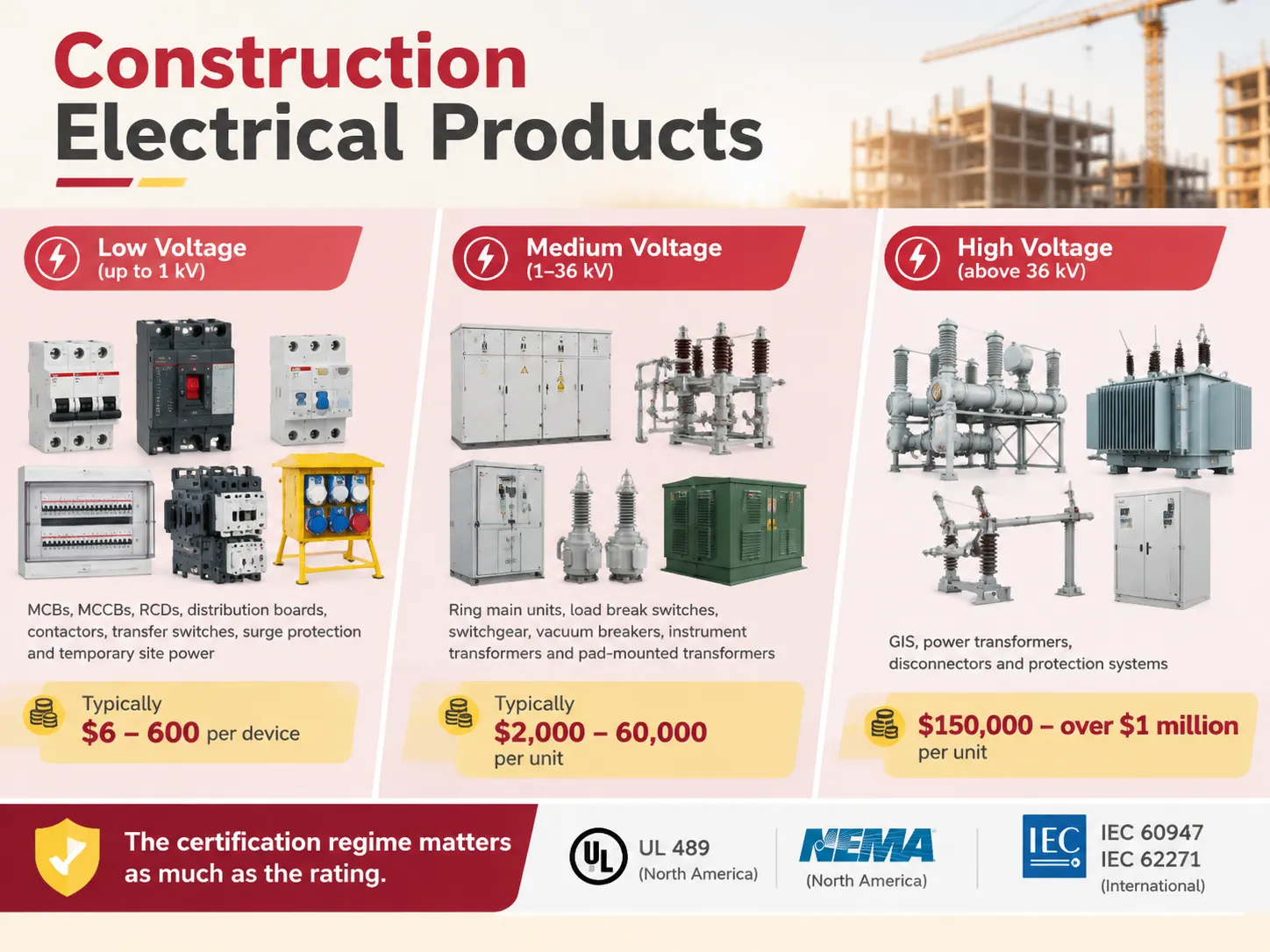
When you specify the voltage class, remember: a transfer switch does not modify voltage levels, but it is useful to be aware of the fact that a transfer switch operates within the electronic framework determined by the voltage class, which defines the distance between live metal parts, device certification practices, and the acceptable methods of producing the transfer switch.If the terminology around that boundary is unfamiliar — particularly where control circuits and power circuits share an enclosure — the distinction between high and low voltage equipment is worth settling before the design is frozen, and the difference between high-voltage and low-voltage work covers exactly that boundary.
Frequently asked questions
How much does an automatic transfer switch cost?
From a small 100 A residential unit that costs a couple of hundred dollars to a large 3,000 A service entrance switch that can cost over $40,000. A typical range for a commercial 600 A four-pole switch is from $4,500 to $15,000, while most of its installations are around $8,000 to $12,000 without installation costs.
How much should it cost to install a transfer switch for a generator?
When planning a commercial installation of 600 amps, plan on paying between $2,000 and $8,000 depending on how complex the required feeder installation work and possibly service work is. The price range is so wide because the more complex the job, the more expensive it will be. Residential installations are much cheaper than commercial installations because the switch itself is smaller and is installed next to the panel. Prior to providing a quote on any service-entrance job, a site visit is required.
How much do automatic switches cost?
The price really depends on the performance rating and features of the unit would be assessed, not on the brand name itself. The figures could be summarized as follows: 100–200 amps in residential units with 300–1,500 dollars, 400 amps commercial service units with 2,500–6,000 dollars, 600 amps four-pole units with 4,500–15,000 dollars, 1,000–1,200 amps service with 12,000–30,000 dollars and more power equipment in general. Furthermore, the price could rise or drop about 30% or even more due to the service-entrance capacity, type and capability of the enclosure.
Why is a 4-pole switch more expensive than a 3-pole?
As a result of having a fourth pole made up of current-carrying contacts, arc chute mechanisms and actuator; this pole must be coordinated with the other three electrically and mechanically. The price is likely to increase by about 10-20% to be higher in case the switched neutral comes in the way of setting up the sensing circuit of the controller.
References
- UL Solutions — UL 1008 Standard for Transfer Switch Equipment
- NFPA 70 — National Electrical Code, Article 230 and Article 702
- NEMA — Enclosure Types and Switchgear Standards
- Larson Electronics — 600 A Automatic Transfer Switch Listing
- SteadyPower — 600 A Three-Phase Four-Pole Transfer Switch Listings
Conclusion
Prices for typical 4-pole 600 amp transfer switches vary greatly because they are impossible to accurately estimate due to their many different configurations. However, as a general guideline, you would expect to pay $8,000-$12,000 for a typical 4-pole switch. The range between the lowest and highest pricing represents many variables that create a system’s design/configuration; namely: additional pole(s), the service entrance rating, the withstand rating (per available fault current), the enclosure type, the controller type, and the time needed for lead time. Therefore, it is important to thoroughly research each option prior to requesting installation quotes. It is advised to prepare an accurate specification, provide calculations for the maximum fault currents expected, and visit the installation site prior to seeking quotations for installation.