
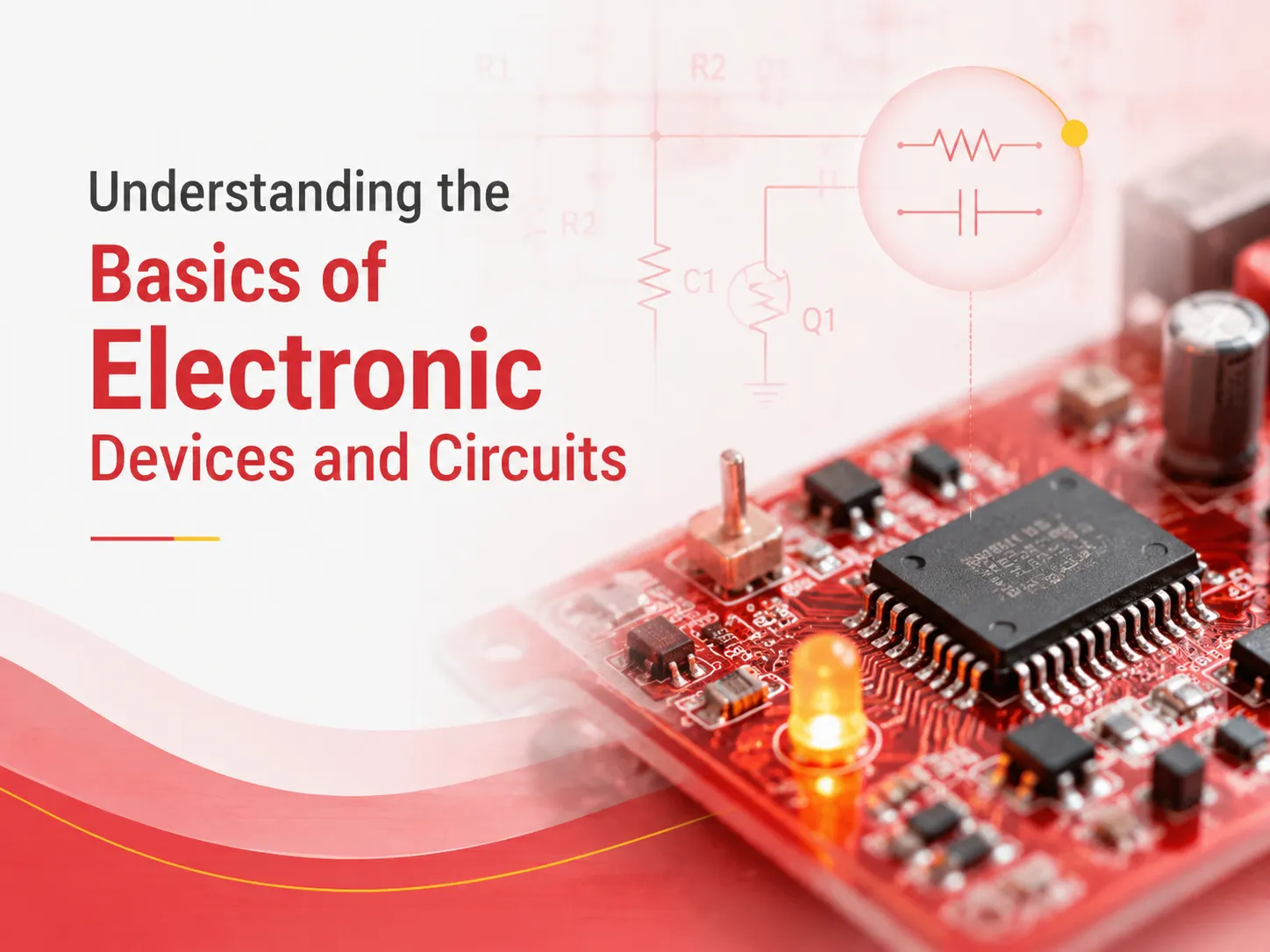
When it comes to upgrading a residence’s electrical panel, rest assured that the electrician is handling devices that make use of circuits, even if their job seems strictly electrical. For instance, the arc‑fault circuit interrupter (AFCI) breaker is advanced enough to analyze the current’s waveform, tell the difference between harmless and dangerous arcs, and interrupt the circuit if a fault occurs (which happens in mere milliseconds). In this case, the breaker can thus be defined as an electronic device. The printed circuit board inside includes a microcontroller, a current‑sensing toroid, and a power supply, constituting an electronic circuit, namely. In fact, knowing such devices’ working principles and features, as well as their components and interconnections, is vital for electricians, technicians, homeowners, and people whose lives are intertwined with advanced electric devices. The present guide provides an exhaustive overview of electronic devices and circuits, as well as information regarding their functioning.
What Is an Electronic Device?
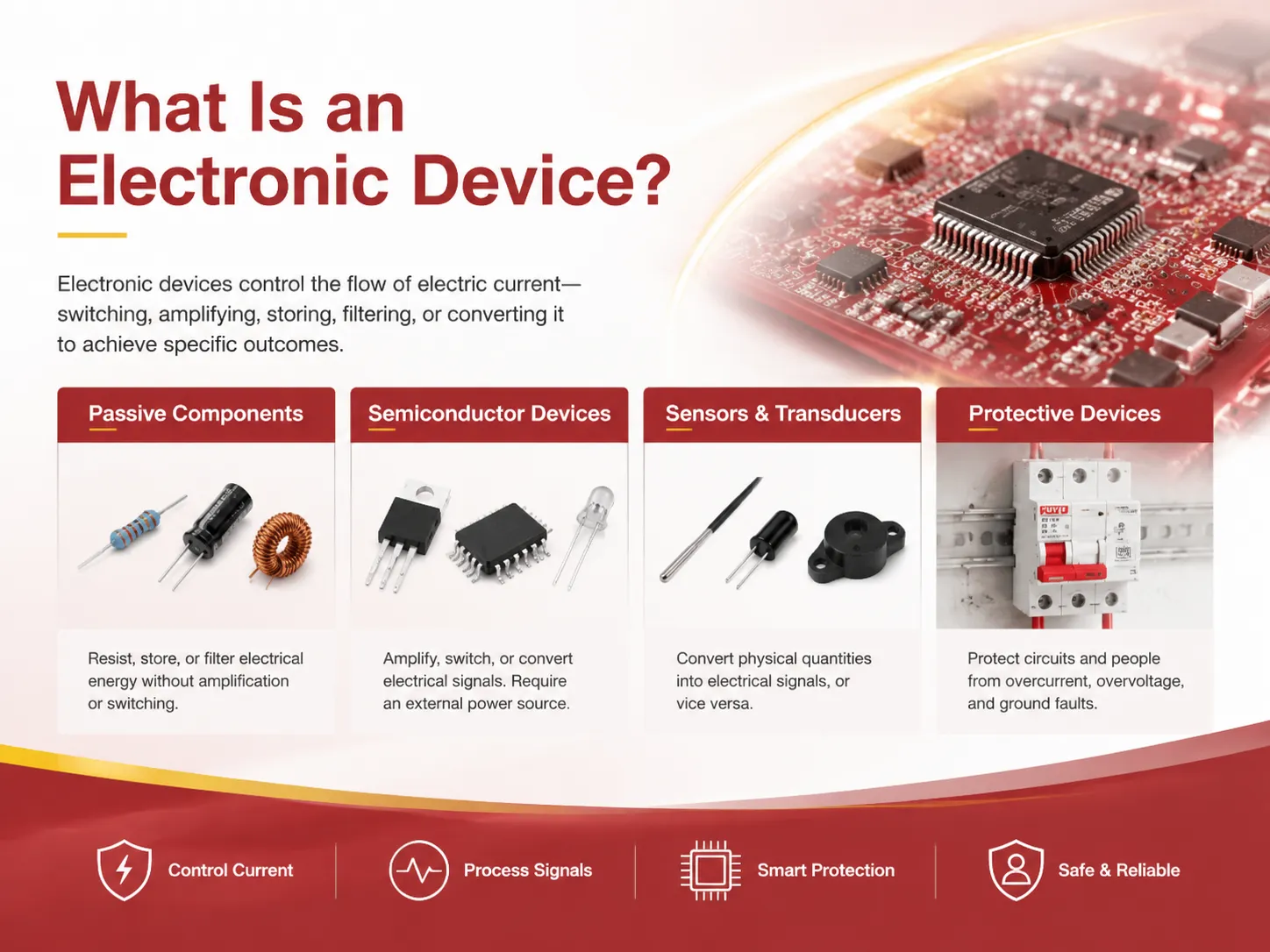
An electronic device refers to a type of device or a set of devices that governs the flow of electric current. This means that it not only allows electric current to travel, like a copper wire would do, but it takes a more active role by managing the flow of electric current one way or another, that is, by switching the current on and off, amplifying it, storing it, filtering it, converting it from one form into another, or any other process that entails directing the flow of electric current according to necessary outcomes. But while the difference between electric and electronic devices is not too strict, it still makes sense in the field of devices. For instance, light bulbs, heaters, and motors are electric devices because they utilize electricity mainly for producing heat, light, or motion. On the contrary, electronic devices deal with electricity on a different level and perform more complex actions such as processing information, controlling processes or transmitting signals. For example, the AFCI breaker is an electronic device since it analyzes the current waveform and makes a decision based on the result. On the opposite, thermal-magnetic circuit breakers respond to current effects passively and hence do not constitute an electronic device.
The following table illustrates the various kinds of electronic gadgets, and which functions they serve and in which situations we use them.
| Device Category | What It Does | Everyday Examples |
|---|---|---|
| Passive components | Resist, store, or filter electrical energy without amplification or switching. They do not require an external power source to perform their basic function. | Resistors (limit current), capacitors (store charge, smooth voltage), inductors (store energy in a magnetic field, filter signals). Found in every electronic product — the power supply of a phone charger, the audio crossover in a speaker, the timing circuit in a microwave oven. |
| Semiconductor devices (active components) | Amplify, switch, or convert electrical signals. They require an external power source and form the active “intelligence” of a circuit. | Diodes (allow current in one direction only — rectifiers, LEDs, laser diodes), transistors (amplify or switch signals — the fundamental building block of all modern electronics), integrated circuits (microprocessors, memory chips, operational amplifiers — combine millions of transistors on a single silicon die). The microcontroller in an AFCI breaker, the processor in a smartphone, the driver in an LED bulb. |
| Sensors and transducers | Convert a physical quantity — temperature, light, pressure, motion, magnetic field — into an electrical signal, or vice versa. | Thermistors (temperature), photodiodes (light), Hall‑effect sensors (magnetic field — used in clamp meters and motor controllers), piezoelectric crystals (pressure and vibration). The occupancy sensor in a smart light switch, the current sensor in a clamp meter, the microphone in a phone. |
| Protective devices | Protect circuits and people from overcurrent, overvoltage, and ground faults. Some are purely electrical; the most advanced are electronic. | Fuses and standard MCBs (electrical), GFCI/RCD devices (electronic — sense current imbalance and trigger a trip mechanism), surge protective devices (electronic — divert transient voltages), AFCI breakers (electronic — analyse current waveforms for arc signatures). HUYU manufactures a full range of these protective electronic and electrical devices, including the RCBOs and AFDDs that combine multiple protection functions in a single unit, such as the HUM18LE‑63 RCBO, which integrates overcurrent and residual current protection. |
What Is an Electronic Circuit?
An electronic circuit refers to a network made up of various electronic components that work together to achieve predetermined goals. Such components are interconnected through conductive materials — copper wires in the case of a printed circuit board, wires and harnesses in case of a wire harness, or even micro aluminum pathways in silicon chips. The functionality of each of the members of the network depends upon certain principles of physics behind it. For instance, a resistor must follow the Ohm’s law in that it will limit the current by some value (V=I*R). A capacitor serves to store the energy through the relationship Q=C*V. A transistor is designed to amplify or switch based on the identified control terminals of the transistor circuit. When an appropriate topology is developed, then it becomes possible to generate operations or functions that were not performed by one component of the network.
Types of Electronic Circuits
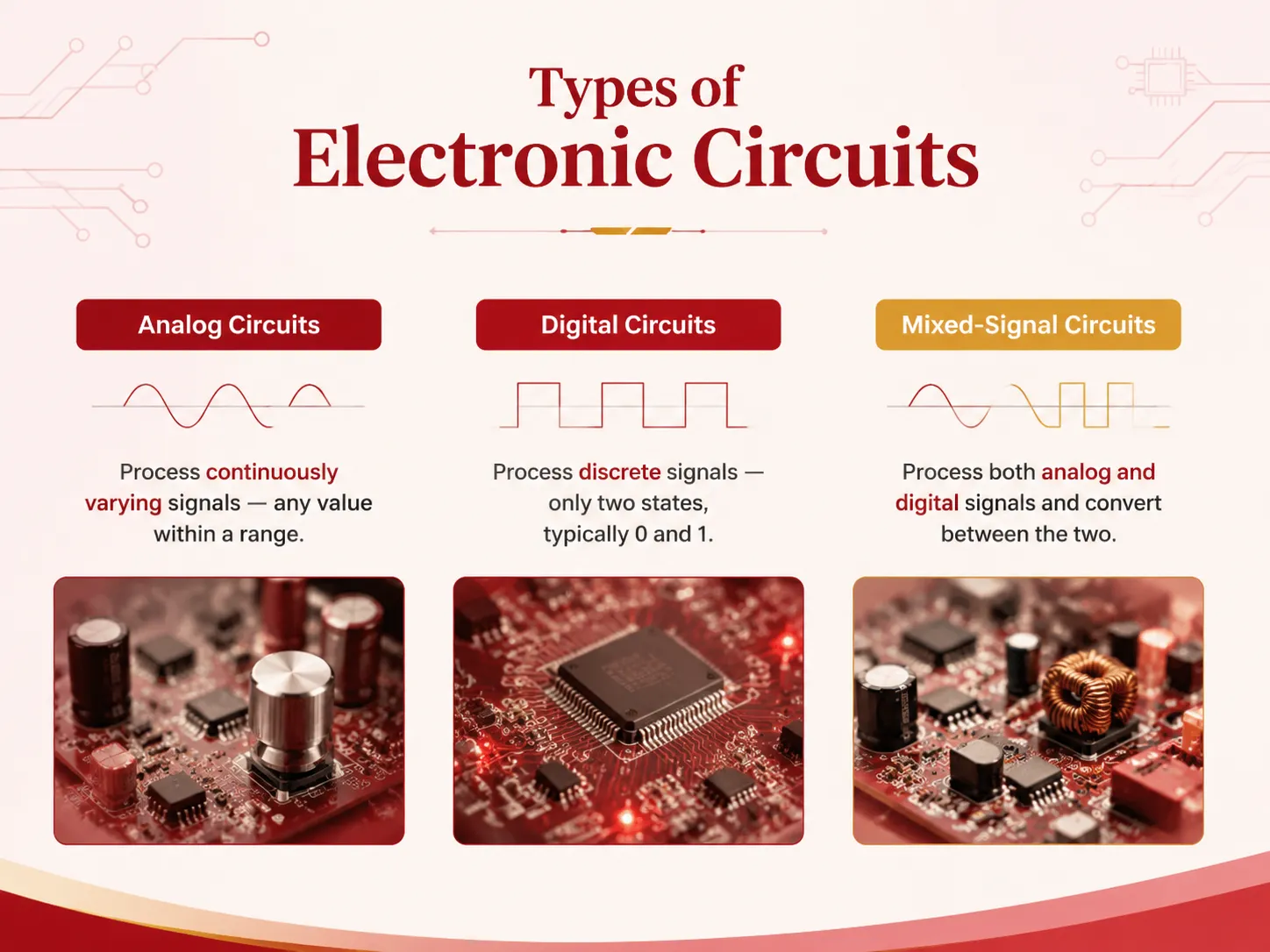
Electronic circuits are broadly classified by the type of signal they process and by their function within a larger system. The three fundamental categories are analog circuits, digital circuits, and mixed‑signal circuits. The table below describes each type and provides common examples.
| Circuit Type | What It Processes | Examples |
|---|---|---|
| Analog circuits | Continuously varying signals — a voltage or current that can take any value within a range. Analog circuits amplify, filter, modulate, or convert these signals without converting them to a digital representation. | An audio amplifier in a home theatre receiver, the power supply that converts 120 V AC to 5 V DC in a phone charger, a radio frequency (RF) tuner in a television, a 0–10 V dimming control for LED lighting. |
| Digital circuits | Discrete signals — a voltage or current that represents only two states, typically 0 and 1. Digital circuits perform logic operations, store data, and execute programmed instructions. | The microcontroller in an AFCI breaker that runs the arc‑detection algorithm, the processor in a smart light switch, the memory in a computer, the logic gates that control a traffic light sequencer. |
| Mixed‑signal circuits | Both analog and digital signals. A mixed‑signal circuit converts between the analog and digital domains and processes both types of information. | The sensing and trip circuit in a GFCI outlet — an analog toroid coil senses a current imbalance, an analog‑to‑digital converter (ADC) converts it to a digital value, and a digital comparator decides whether to trigger the trip mechanism. A smartphone’s audio subsystem — an analog microphone converts sound to a voltage, an ADC converts it to digital for processing, and a digital‑to‑analog converter (DAC) converts it back for the speaker. |
Where Electronic Devices and Circuits Appear in Electrical Protection
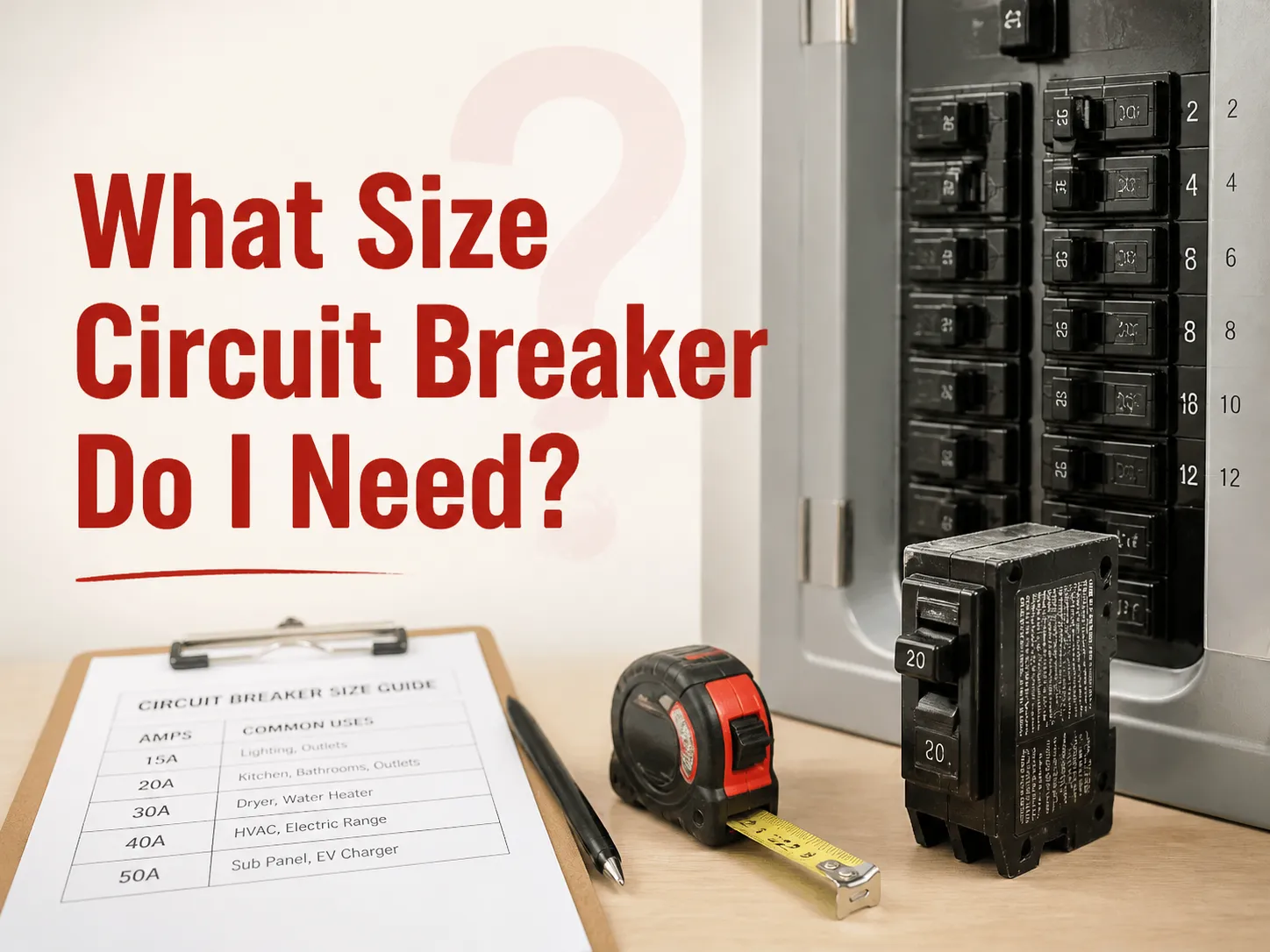
For an electrician, a facilities manager, or a homeowner, the most direct interaction with electronic circuits in the electrical world is through the protective devices in the panel. A standard miniature circuit breaker (MCB) is an electrical device — a bimetallic strip and a magnetic coil that respond directly to current. But the AFCI breaker, the GFCI receptacle, the smart Wi‑Fi switch, and the whole‑house surge protector are all electronic devices. They contain printed circuit boards, microprocessors, sensors, and power supplies, and their ability to protect people and property depends on the reliable operation of those circuits. A GFCI that fails to trip because its internal sensing circuit has degraded over years of service is an electronic failure, not a mechanical one — and that failure is invisible until the TEST button is pressed. Industry resources from the Electrical Safety Foundation International (ESFI) and technical references from electronic design platforms such as All About Circuits provide further depth on the design and operation of these safety‑critical electronic systems. Understanding the basics of how these devices work — that a resistor limits current, that a capacitor smooths a voltage, that a microcontroller runs a stored program — is not just academic knowledge. It is what allows an electrician to diagnose a faulty GFCI, to understand why a particular smart switch requires a neutral connection, and to explain to a homeowner why the AFCI breaker that tripped in the middle of the night did its job and does not need to be replaced. For help selecting the correct protective device for a specific circuit, our guide on what size circuit breaker you need covers the NEC‑based sizing process for both standard and electronic protective devices.
Frequently Asked Questions
What are the electronic devices in a circuit?
Electronic devices are the building blocks of any circuit where they help in controlling, processing, and transforming different electrical signals. Some of these components are passive elements, including resistors, capacitors, and inductors; semiconductor devices, such as diodes and transistors; as well as sensors and protection devices like GFCIs, AFCIs, and surge protectors.
What are the 4 types of electronic devices?
The four main types of electronic devices are passive components (resistances, capacitances, and inductances), semiconductor devices (diodes, transistors, and integrated circuits), sensors (thermistors, photodiodes, and Hall-effect sensors), and protective devices (GFCI/RCD devices, AFCI devices, and surge protection devices).
What are the 7 basic electrical devices?
In introductory classes, under seven elementary electrical and electronic components are either used or included in the training: resistor, capacitor, inductor, diode, transistor, transformer, and relay. With the help of these elements, practical electronic devices like power supply, amplifier, oscillator, timer, and switching devices can be constructed.
What are the three types of electronic circuits?
The three types of electronic circuits are analog circuits (that process continuously varying signals), digital circuits (that process 0/1 discrete signals and perform logic operations) and mixed-signal circuits (with both analog and digital functions on the same substrate or in the same system). Many practical electronic products — smartphone, GFCI outlet or a smart light switch — include all three types of circuits.
References
- All About Circuits — Electronics Textbook and Tutorials. Comprehensive educational resource covering electronic components, circuit analysis, and semiconductor theory.
- Electrical Safety Foundation International (ESFI) — GFCI and AFCI Technology. Consumer and professional guidance on the electronic protective devices that prevent shock and fire.
- IEEE — Institute of Electrical and Electronics Engineers. The world’s largest technical professional organisation, publishing standards and research across electronic devices, circuits, and systems.
- JLCPCB — Basics of Electronic Devices and Circuits. An introductory guide covering components, circuit types, and PCB design fundamentals.
Electronic devices and circuits are the invisible intelligence inside the electrical products that surround us. Electrical components include resistors, capacitors, diodes, microcontrollers, etc. All of them are expert pieces enabling ithit ot manage electric charge. When they are wired together in a specific manner, they form a circuit responsible for conducting an operation — detecting electrical faults, turning an LED on or off depending on the time of the day, processing voice commands to enable operation of household appliances, etc. Knowing how all mentioned devices and circuits work is not only the requirement of engineers; it is a must for everybody living in the world where every appliance, from the simplest switch to the most complicated modern phone, operates with the application of the same knowledge and gets work done. HUYU manufactures some necessary pieces of the circuitry which are vast in protection quality — from totally electrical to partially electrical electronics providing necessary safety for circuits and, therefore, homes and enterprises.