
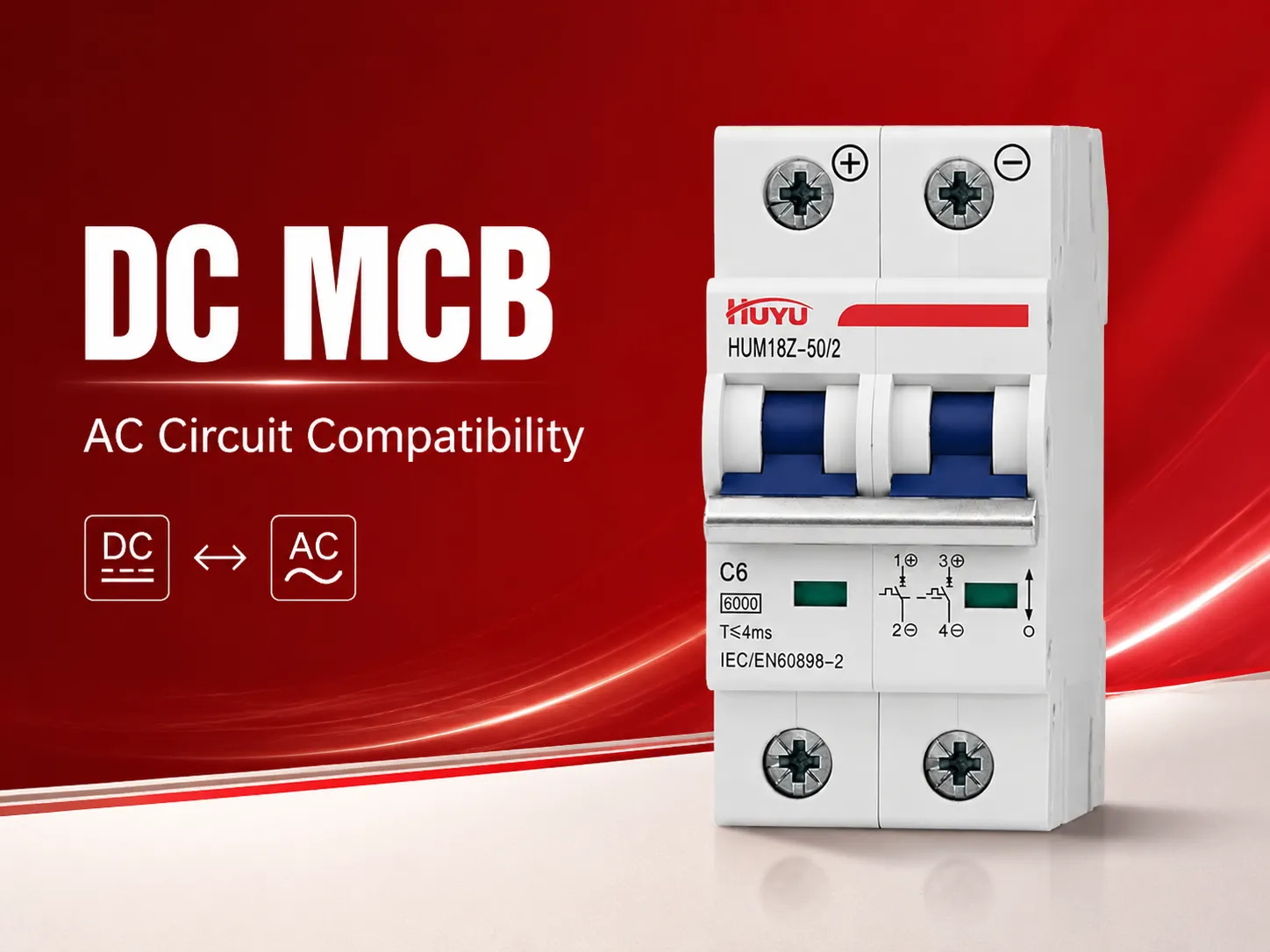
An Arizona residential solar installer has put in a storage battery on a completed installation. The battery bank feeder had a clean installation on the DC side; this was accomplished with an 80A/1200VDC MCB (with the MCB constructed from HUYU’s HUB9NEZ MCB Series) to protect it. The AC side, however, required a breaker to protect the output side of the inverter. Fortunately, the installer had an extra DC MCB (the same frame size) that he installed instead. After operating for two weeks, the inverter’s breaker tripped after the air conditioning unit was under a heavy load, and this time, the internal arc would not extinguish. The contact faces were severed, the breaker was deflected, and the fault current continued down the line until the upstream main circuit breaker opened. What appeared to be a routine interruption of overcurrent ultimately resulted in an extraordinary near fire due to a circuit breaker designed for DC voltage being forced to interrupt AC voltage.
The case described in this field safety report from a major photovoltaic industry organization is an obvious confirmation of why academics shouldn’t address whether or not AC circuit compatibility exists for DC MCB’s. The answer is simple—do not use a DC only rated breaker in an AC circuit or vice versa, regardless of being dual-rated (by the manufacturer) and identified as such.
The unique functionality of the physical mechanisms that extinguish the electrical arc caused by each type of circuit is so fundamentally different, and therefore using them interchangeably will actually defeat the purpose of the device (the breaker) that provides the electrical protection it was designed for.
The Arc Extinction Problem: AC vs. DC Interruption Physics
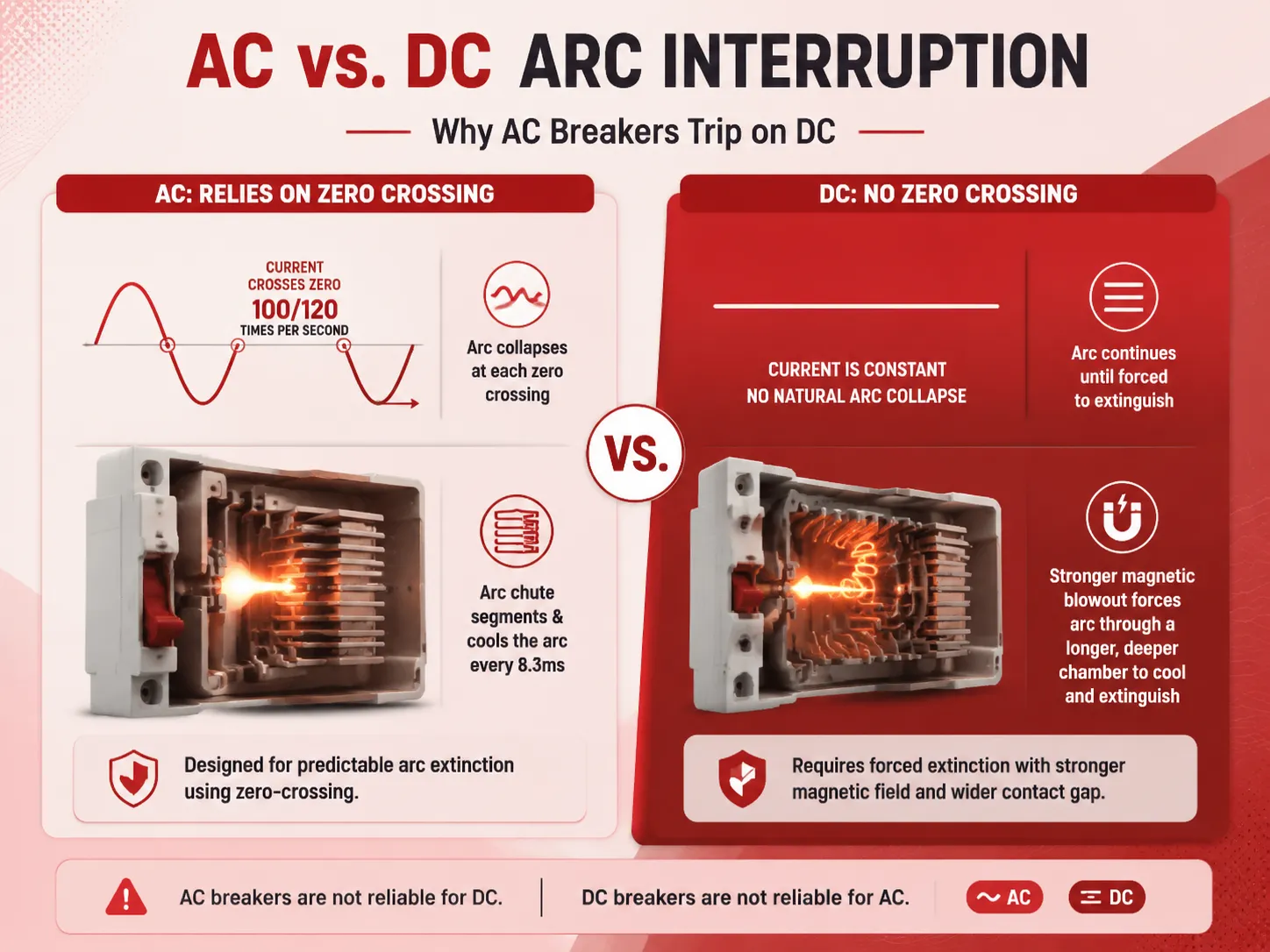
Understanding what caused a DC circuit breaker to trip on an AC circuit requires being familiar with the electric arc. When the contacts of an electrical circuit are opened (separated) while flowing current, the separated contacts produce an arc which itself is an electrically conductive pathway. As the electric arc continues, it becomes an ionized plasma made up of many different elements and is no longer composed of pure gas. The entire current flowing across the open contacts of the circuit produces an arc (similar to an arc welding machine) until the breaker trips; this process occurs in high voltage AC circuits. The means of extinguishing the arc depends upon whether or not the current is AC or DC.
In an alternating current (AC) electrical circuit, current goes through zero 100 or 120 times each second (2 times each cycle or 50 or 60 Hertz). Each time current passes through zero, it briefly (i.e., instantaneously) collapses the energy of the arc. To extinguish the arc and effectively sever it into pieces so that no individual piece has its temperature (i.e., ionization temperature) above at which the arc will re-strike after passing through zero, an arc chute (i.e., a stack of metal plates) is used in an AC miniature circuit breaker to sever and cool each of those segments. Consequently, the entire design of these devices relies on the guaranteed extinguishment of an arc every 8.3 milliseconds, when current passes through zero.
There will never be zero crossing in a DC Current and the electrical current is constant. After an arc is developed the arc will continue to exist until the contacts are separated far enough apart, the arc voltage is larger than the arc plasma has cooled enough that the voltage source can no longer keep the arc active. This means that the MCB used for DC has to have a much stronger magnetic blowout field from either a permanent magnet or series connected blowout coil so that the arc can be forced to travel through a longer path and spiral much more in an arc chamber of much deeper size. The contact gap is wider in DC. The material of the arc chute plate and its shape are different than in AC. Thus when the MCB is used in DC, it functions like a forced extinction device rather than as an extinction device that uses the zero-crossing feature.
The Institution of Engineering and Technology (IET) provided a detailed explanation of the safe use of direct current protective circuits in its tech briefing. There are different ways to test and certify AC and DC miniature circuit breakers because they operate differently due to how arc interruption works. For example, AC-rated breakers have never reliably been able to interrupt a continuous direct current arc while DC-rated breakers have never reliably been able to interrupt an alternating current arc due to the nature of the alternating current’s changing polarity.
What Happens When the Wrong Breaker Is Used
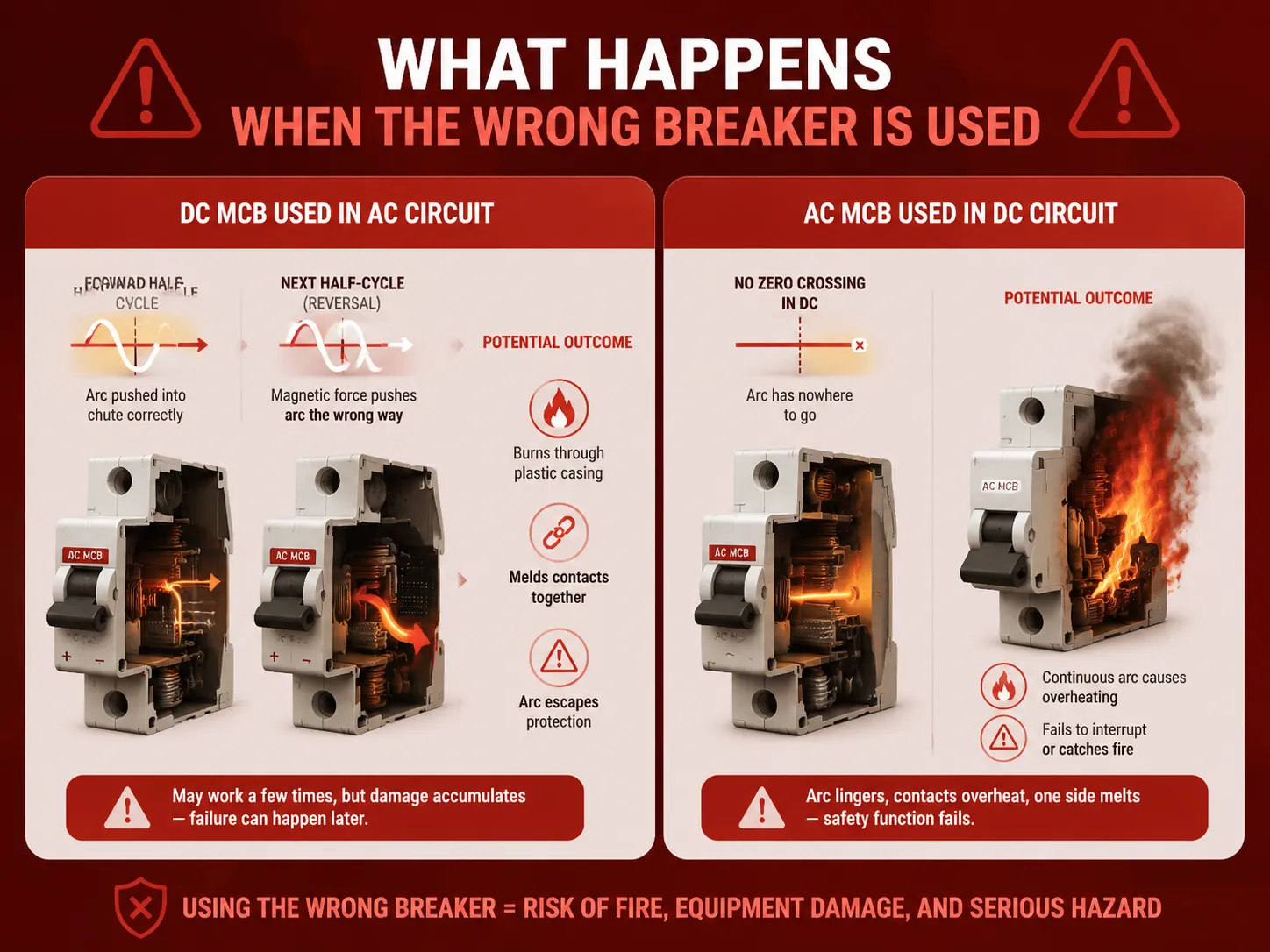
The Arizona installer’s experience is ordinary. When a Direct Current (DC) Main Circuit Breaker (MCB) installation occurs in an Alternating Current (AC ) circuit, there are two ways that it can fail.
On the forward half‑cycleIn DC arc-extinguishing devices, the functionality related to the mechanical behavior of DC arc-extinguishing mechanisms should generally perform as expected. When the mechanical blows out into the chute is activated, the arc is pushed by the magnetic blow out mechanism into position (i.e., cooling is initiated). Conversely, when the next half-cycle of power occurs, the alternating electrical current (AC) reverses direction and causes the permanent magnet (or blow out coil) to push the arc in the wrong direction (i.e., back to the mechanical device (arc-extinguishing device), towards the end of the breaker, and in to a portion of the arc chute that was not created to contain the arc). The arc may burn through the plastic casing of the device, weld contacts together, or escape the protection of the device. The first several breaker operations (trips) may result in successful operation of the breaker, but failure may occur after some period of operation due to accumulated contact damage.
A DC AC MCB will fail more predictably since the arc chute is waiting for a zero crossing to occur that will never happen. Because of this, the arc will continue, causing the contacts to fail due to overheating. The breaker will either fail to interrupt the cycle or it will catch fire. Because there is no magnetic blow out to deal with steady state current, the arc simply lingers in the contact gap until one of the contacts melts. Therefore, both cases have failed to fulfill the basic safety function of the device.
Dual‑Rated Breakers: The Exception That Proves the Rule
There are circuit breakers that can be used for both AC and DC applications. They do not just have AC MCBs that show a DC voltage as an afterthought; they are also specifically made to handle both types of arcs: (1) with zero-crossings assisting in the extinguishing of the arc (AC) and (2) without any outside assistance (DC). The manufacturer should provide type test certificates for both AC and DC. The manufacturer should also indicate that this is a certified dual-rated circuit breaker; for example, “230Vac max. 400Vac max., 60VDC max/ pole.”
When you want a single enclosure for AC and DC circuits at the same time on an installation (like the solar hybrid inverter cabin or telco power rack), a logical option is to use these combination type circuit breakers; however, according to the extensive application guide from EC&M, there are only a limited number of combination-rated devices available and nearly all of the mini circuit breakers are rated and tested for only one of the two current types; therefore, if you have an AC rated device and attempt to use it where a DC rated device is required, you cannot use that AC rated device unless the manufacturer has given you written permission to do so.
Selecting the Correct Breaker for Your Application
The decision between a DC MCB and an AC MCB is driven entirely by the current type of the circuit. The table below summarizes the application landscape:
| Circuit Type | Breaker Required | Typical Product |
|---|---|---|
| AC branch circuits (lighting, receptacles, appliances) | AC MCB | HUYU HUM18‑63 AC MCB (1P–4P, 10kA, B/C/D curves) |
| AC motor circuits | AC MCB or MCCB with appropriate trip curve | HUYU HYM1 MCCB |
| DC PV array string protection | DC MCB, often polarity‑sensitive | HUYU HUM18PV‑63 DC MCB (up to 1000V DC) |
| DC battery bank and inverter DC input | DC MCB or DC MCCB, non‑polarity preferred | HUYU HUB9NEZ‑80 DC Circuit Breaker (16A–80A, up to 1200V DC, UL/TUV) |
| Mixed AC/DC enclosures | Dual‑rated breaker, or separate AC and DC breakers clearly segregated | Verify manufacturer dual‑rating and markings |
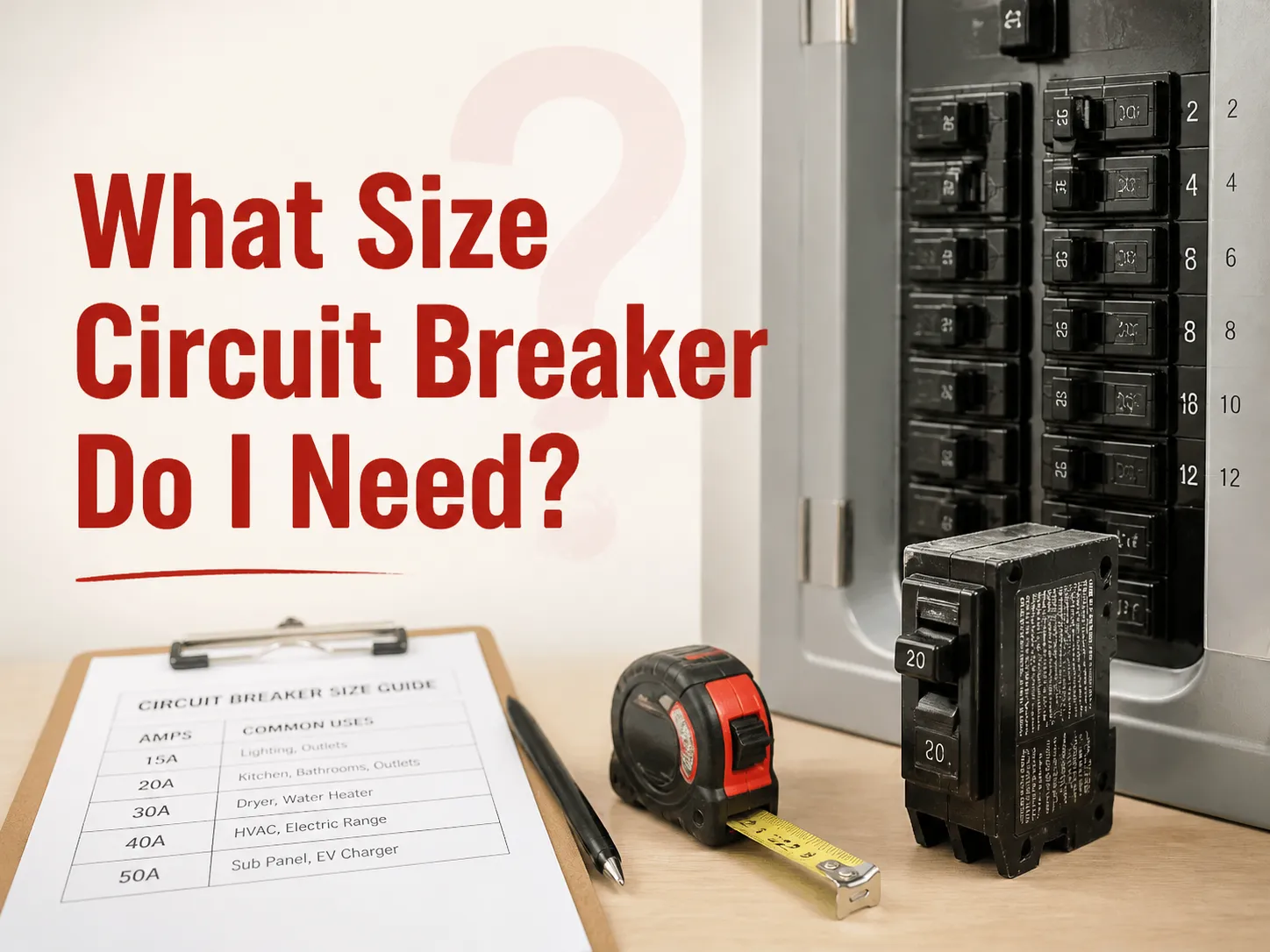
For additional guidance on matching breaker ratings to your circuit, our article on what size circuit breaker you need covers the NEC and IEC calculation methods for both AC and DC loads.
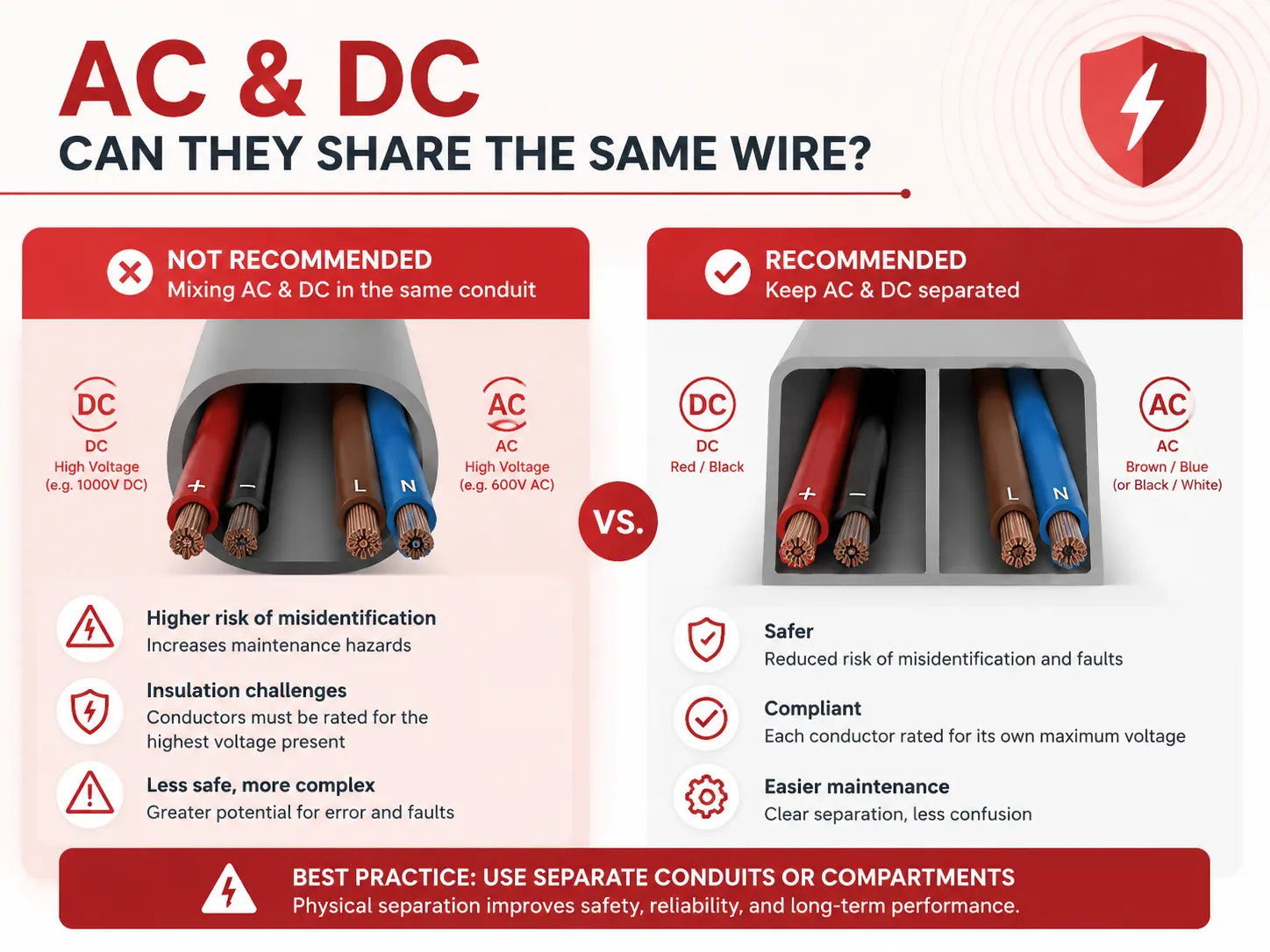
Can AC and DC Share the Same Wire?
Another question with similar importance is the ability of AC and DC conductors to occupy the same enclosure (conduit/raceway/enclosure). Electrical Construction and Maintenance Magazine (EC&M) provides some guidance in their updated practical installation guidelines on the ability of NEC (National Electrical Code) to allow this under limited circumstances; however, it is almost always safer to keep them separated physically. All Conductors Within The Same Raceway Must Be Rated To Handle Maximum Voltage Currently Present (AC or DC). Therefore, DC Conductors Must Be Rated For The Peak AC Voltage, And AC Conductors Must Be Rated For The Maximum DC Voltage.
In practical terms, it generally leads designers to have separate conduits for AC circuits and DC circuits, or have a cabinet with compartments that are clearly separated from each other. Normally, a partition will separate the AC compartment from the DC compartment within a solar inverter cabinet. This is indicated by the DC conductors being insulated with red/black wire, and the AC conductors being insulated with brown/blue (harmonised) colours or black/white (North America). Mixing these conductor types without appropriate segregation causes greater difficulty in insulating the voltage levels, and also creates a higher potential for misidentifying the correct conductor(s) during maintenance.
Frequently Asked Questions
Can DC MCB be used for AC?
No MCB can be used in AC, unless the manufacturer has identified the wiring of the circuit as suitable for use in both AC and DC and, therefore, dual rated and marked. If the MCB was not manufactured with a defined mechanism for extinguishing an arc on AC, then that mechanism could fail on the reverse half cycle of AC, thus causing the contacts to weld closed or to burn through the MCB casing.
Can MCBs be used for DC?
A standard AC MCB should never be connected to a DC circuit unless it is specifically rated and certified for use with DC circuits. An AC MCB relies on a zero crossing in the AC waveform to provide an interruption in the event of an overload. DC current does not exhibit this characteristic, and therefore the breaker will not be able to interrupt the DC fault currents along a circuit, causing a potential fire hazard.
Do AC circuit breakers work with DC?
AC circuit breakers are not designed to operate effectively with DC circuits. In DC there is no point in time where the current crosses zero meaning that the means by which an AC breaker extinguishes an arc, will not be able to cool and extinguish a sustained DC arc. Therefore the breaker might not interrupt the current properly, might overheat and burn itself up, or even ignite a fire.
Can you put AC on a DC breaker?
It is unsafe to use an AC circuit on a DC breaker. The magnetic blowout field used to assist with interrupting DC currents will cause an arc to be discharged improperly during the reverse half-cycle of an AC voltage wave, and cause a disturbance we call a fault. Therefore, a breaker rated for AC must be used on an AC circuit.
What is the difference between AC MCB and DC MCB?
The biggest difference in the operation of AC versus DC MCBs is how they extinguish an arc. AC MCBs use a chute to extinguish the arc by relying on the current going through zero. DC MCBs use a stronger magnetic blowout to extinguish the arc, as well as wider separating contacts and a deeper chute to permit the arc to be extinguished without going through the zero point. DC MCBs are also typically more sensitive to polarity than AC MCBs.On the other hand, in practice, there are usually two independent conduits or physical barriers between AC and DC circuits so that there is no chance of a fault between an AC and DC circuit and to make it easier to identify circuits by their voltages, etc.
References
- IET Wiring Matters — Safe Application of DC Protective Devices — Institution of Engineering and Technology, technical guidance on DC circuit breaker selection and installation.
- EC&M — AC vs. DC Circuit Breakers: What’s the Difference? — Electrical Construction & Maintenance, practical guide to breaker technology and application.
- EC&M — Mixing AC and DC Conductors: Code and Best Practices — Electrical Construction & Maintenance, installation guide covering NEC requirements for mixed‑current systems.
- Electrical Safety Foundation International (ESFI) — Home and workplace electrical safety resources, including guidance on photovoltaic system protection.
The question of DC MCB AC circuit compatibility has a single correct answer: the breaker must match the current type. A DC breaker on an AC circuit, or an AC breaker on a DC circuit, is a protection device that has been asked to operate outside its tested and certified envelope. The consequences range from nuisance tripping to catastrophic failure. In an electrical installation, the label on the breaker — “AC,” “DC,” or the rare “AC/DC” — is the most important piece of information on the device. Respecting that label ensures that when a fault occurs, the breaker opens, extinguishes the arc, and keeps everything downstream safe. At HUYU, we supply AC MCBs, DC MCBs, and dual‑certified breakers, each clearly marked and tested to the relevant standard, because no one should have to guess whether a breaker will work when it is called upon to save a circuit.