
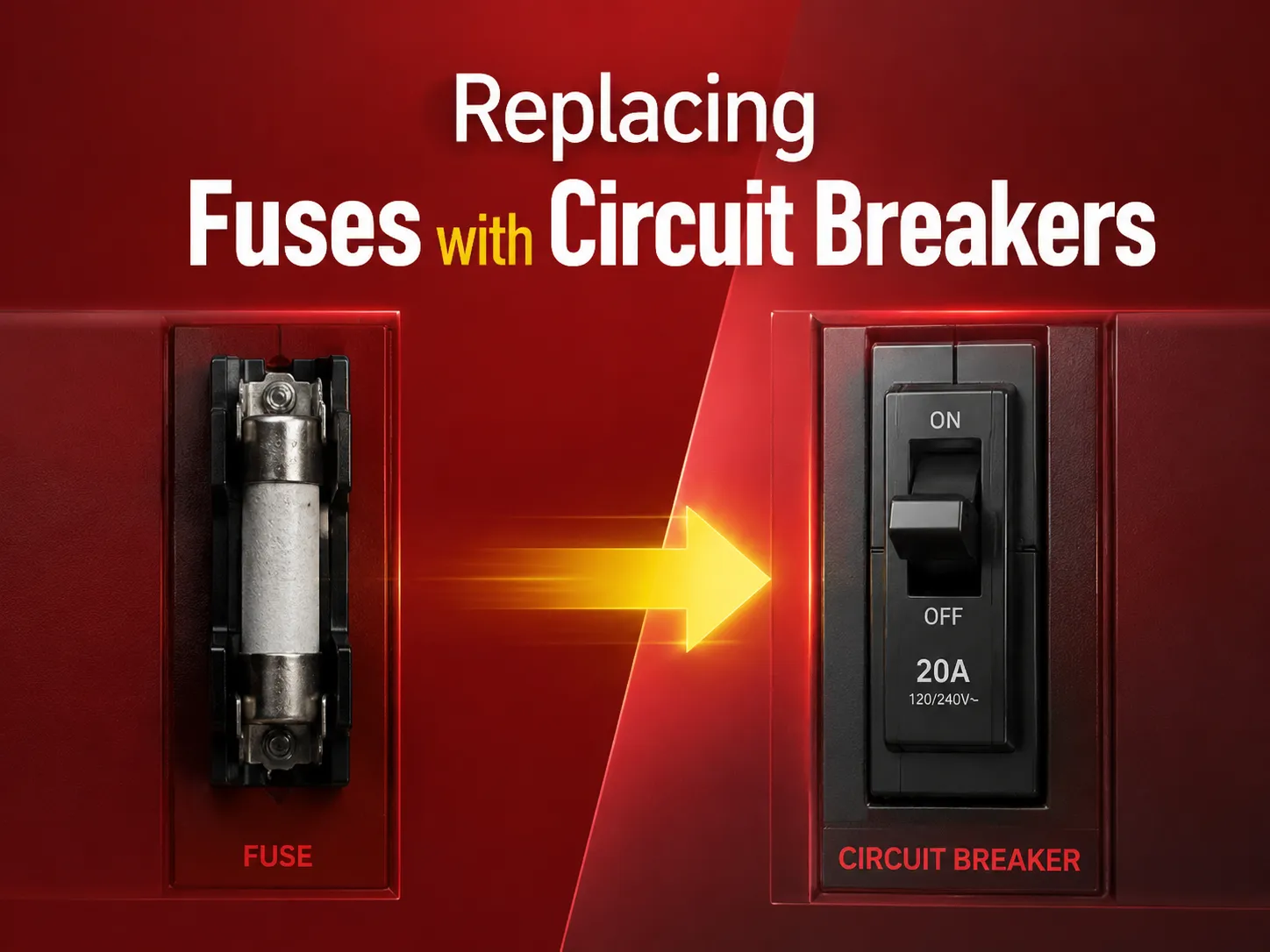
An electrician was called by a homeowner in Chicago in April 2022 for the 3rd time in one week after blowing a 15 amp fuse for her 1950’s era fuse box. As the fuse blew every time the toaster and the microwave were used independently, the desired function had been performed (melt the metallic piece when too much current is drawn). However, it had become tiresome for the homeowner to travel to a local hardware store to purchase another 15 amp Type S fuse approximately every 48 hours. He proposed a solution, to upgrade from fuses to circuit breakers with the addition of a new load center. The new load center (or circuit breaker panel) will provide overcurrent protection in the same manner but with less inconvenience, as circuit breakers are manually reset rather than replaced, and can support GFCI, AFCI and surge protection devices that the existing fuse box does not support.
Her experience symbolizes a dilemma faced by property owners, building managers, and engineers globally; when should a fuse be replaced with a circuit breaker, and when is a fuse still the best option? The response is not “always upgrade”, but is based on the function, the fault current, coordinated requirements, and the level of protection that the circuit requires.
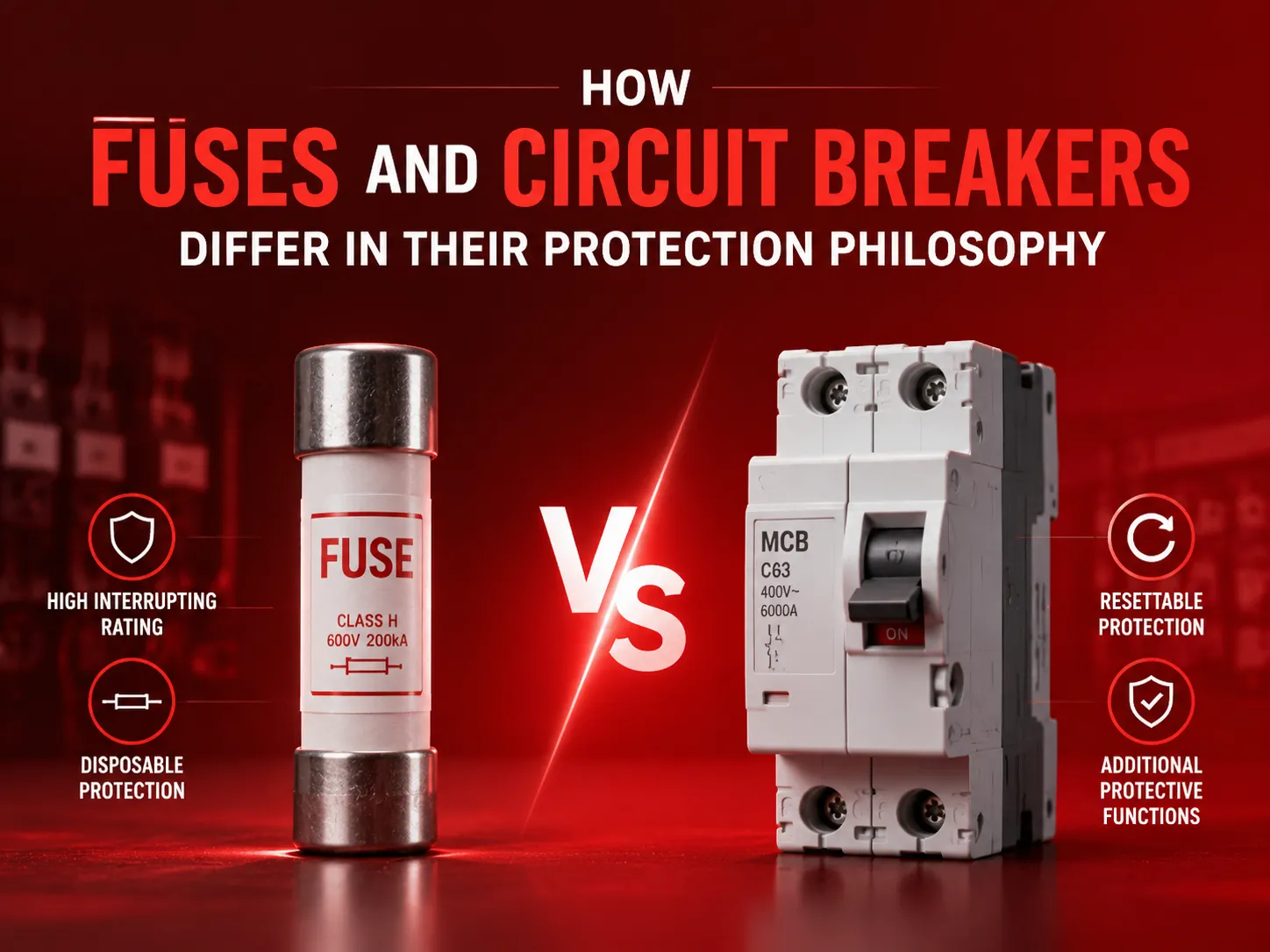
How Fuses and Circuit Breakers Differ in Their Protection Philosophy
Fuse and circuit breaker both provide circuit overcurrent protection; however, they do this through fundamentally different mechanisms, which influence the optimal deployment of each device.
A Fuse is Disposable. Inside the Fuse Body, a metal element is designed to carry Current and once Current exceeds the Fuses Rating long enough will melt the element to create a an open circuit. The melting of this element is determined from the time/current characteristic curve, (will have) can be designed in fast method, delay, or in a dual element way to provide protection for that type of load. After a Fault has been corrected by the Fuse, it must be replaced. This is both the weakness and the benefit of the Fuse because by replacing the Fuse guarantees that the protection system is returned back to its original / design condition with no degradation. Additionally, Fuses have very high Interrupting Ratings, typically 200,000 Amperes and thus are able to be used in locations with very high available Fault Currents; Example: Service Entrance of A Large Commercial Building.
A circuit breaker is resettable. Internally, thermal overload protection is provided by a bimetallic strip, while electromagnetic short-circuit protection is supplied from an electromagnetic coil. When a circuit breaker trips, it opens its contacts; the contacts are held open by an internal mechanism; the resulting arc is extinguished in an arc chute. To reset a circuit breaker that has tripped, you just have to flip the handle back to “on”; there are no replaceable parts; it does not require you to go to a store to replace them or to buy something else instead! MCBs (miniature circuit breakers) and MCCBs (molded case circuit breakers) are the standard for modern residential, commercial, and industrial distribution. MCBs and MCCBs also have various trip curves (B, C, D for MCBs; adjustable for most MCCBs) to suit the inrush characteristics of different types of loads. In addition to trip curves, MCBs and MCCBs provide other protective functions that fuses cannot provide (e.g., GFCI/RCBO ground fault protection; AFCI arc fault protection). HUYU supplies a comprehensive range of these devices, including the HUM18‑63 AC MCB for standard branch circuits, the HUM18LE‑63 RCBO for circuits that require both overcurrent and earth‑leakage protection, and the HUB9NEZ‑80 DC circuit breaker for DC battery and PV applications.
Key Differences Summarized
| Characteristic | Fuse | Circuit Breaker |
|---|---|---|
| Operation | Sacrificial element melts; one‑time use | Mechanical trip; resettable |
| Interrupting rating | Very high (often 200 kA) | 10 kA to 100 kA depending on type |
| Protection selectivity | Excellent; time‑current curves are smooth and predictable | Good; requires coordination study for cascaded breakers |
| Speed of operation | Extremely fast on high faults; can be slower on moderate overloads | Fast on short circuits; follows a predictable thermal curve on overloads |
| Additional protection | None inherently | GFCI, AFCI, and dual‑function options available |
| Tamper resistance | Can be replaced with wrong size (user error risk) | Handle cannot be forced to a higher rating |
| Remote operation | Not possible | Can be motor‑operated or shunt‑tripped |
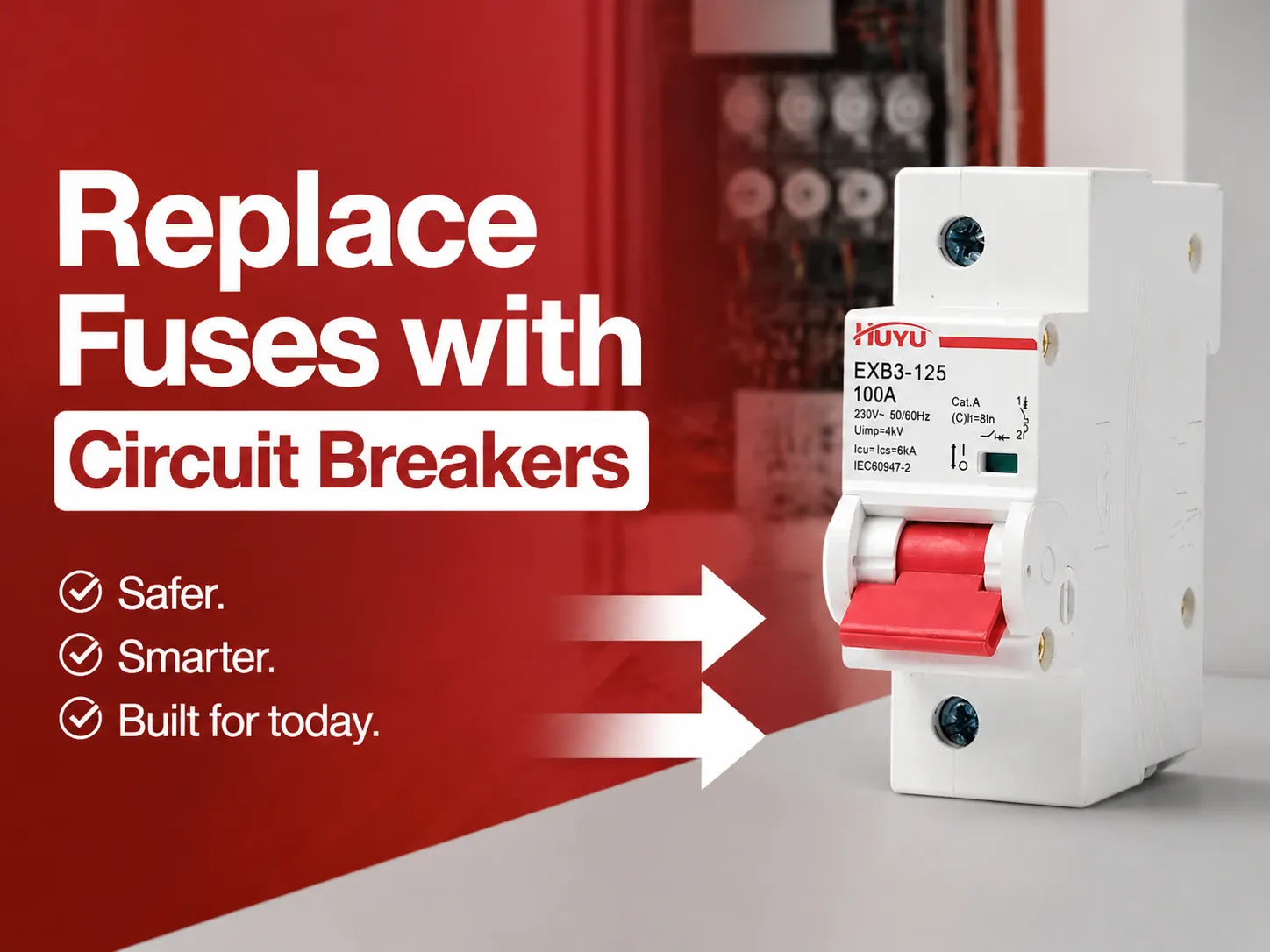
Can You Replace Fuses with Circuit Breakers?
Yes, in most homes and businesses, it is both feasible and advisable to replace fuse panels with circuit breaker panels. The procedure involves the complete replacement of the entire fuse box (i.e., the enclosure containing fuses for overcurrent devices) with a modern circuit breaker panel (i.e., a load center or distribution board). Each existing circuit wire is disconnected from its respective fuse holder, then landed on a new circuit breaker that has the same ampacity as the circuit wire it is connected to (i.e., 15-Amp circuit wires use a 15-Amp circuit breaker, 20-Amp circuit wires use a 20-Amp circuit breaker, etc.). All of the utility service entrance, the grounding electrode system, and the bonding will be brought up to current code as part of this process.
Changing a fuse to a circuit breaker is not as easy as it sounds. There are two totally different designs for the fuse and circuit breaker so they are not interchangeable; you can’t just unscrew a fuse and “screw” (insert) a circuit breaker into the same hole. In one case, the fuse mounts in a holder which is part of the panel assembly; in the other case, the circuit breaker clips onto the main conductive bar (bus bar). Changing out your electrical sub-panel is a job that needs to be performed by a licensed electrician – generally completed in one day (or less) on standard residential electrical services.
There are many benefits to converting your existing fuse box to a circuit panel. First, the homeowner will have the ability to simply reset a circuit breaker with the flick of a switch instead of trying to figure out which fuse to replace. Second, the new circuit panel can support the use of all modern AFCI and GFCI circuit breakers, both of which are mandated by the National Electrical Code (NEC) for most circuits in new construction and major renovation projects in living spaces and wet locations. Third, the risk of overfusing (one of the most dangerous practices in the electrical field; this happens when someone takes a 30-amp fuse and screws it into a 15-amp circuit) will no longer exist because you cannot over-fuse a circuit breaker. Fourthly, young insurance companies require that their clients replace their fuse boxes when issuing coverage policies. Companies with old fuse boxes (for example, Federal Pacific and Zinsco) have been a point of contention for companies trying to insure clients. Lastly, having a fuse box, even if it is well maintained, can send a negative message to an insurance company’s underwriter that the electrical system has been installed prior to the current safety standards.
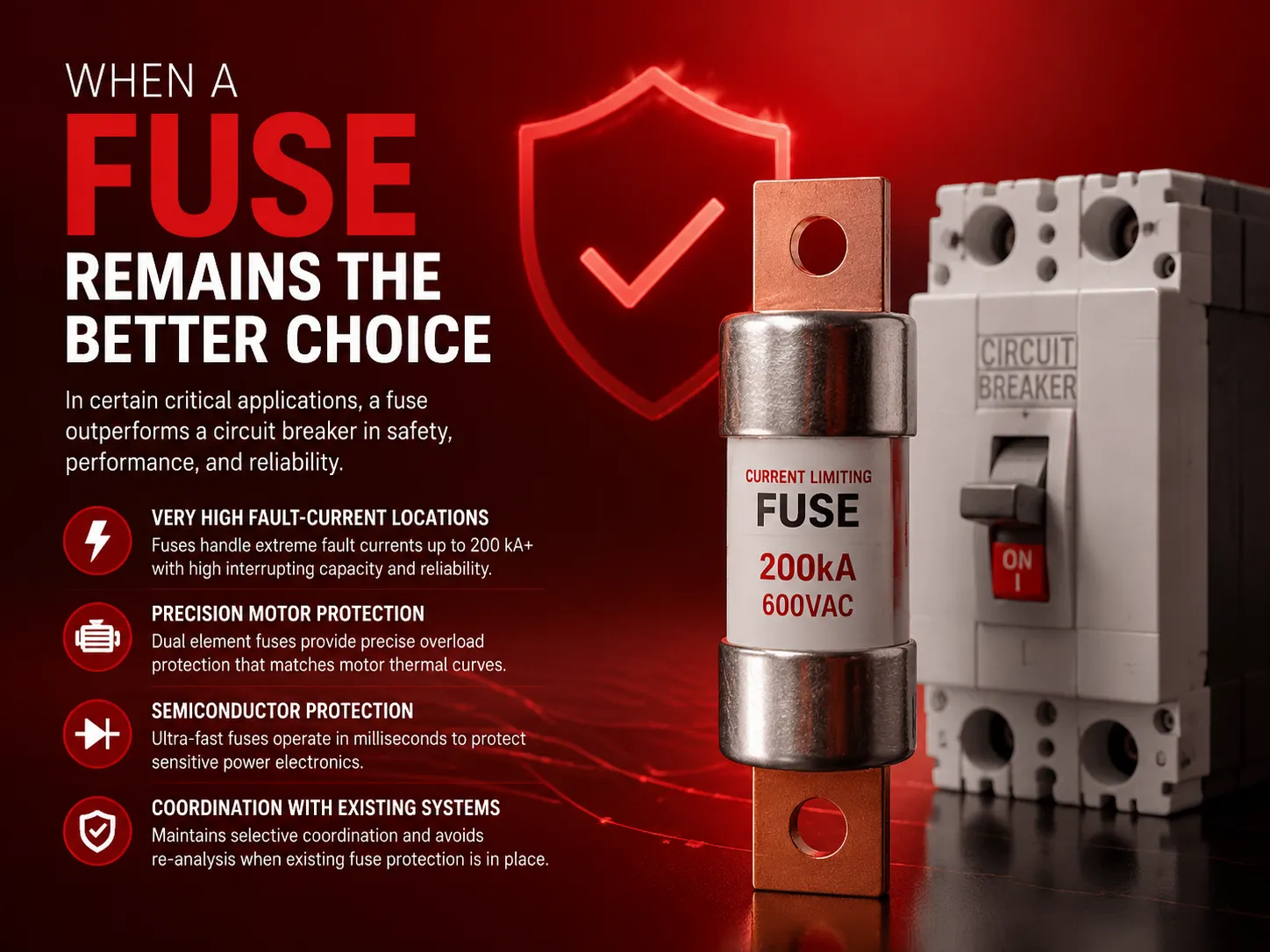
When a Fuse Remains the Better Choice
Even considering that there are many instances where a Circuit Breaker is clearly an advantage over a Fuse, there are certain applications where it is better to use a Fuse instead of a Circuit Breaker; replacing the Fuse with a Circuit Breaker will decrease safety, performance, etc.
Very high fault‑current locations. A service point in a larger commercial or industrial space can potentially be fed from a source having an available fault current greater than 65,000 amps — or above 100,000 amps. Most molded case circuit breakers will have a rating of either 10 kA, 22 kA, 25 kA, 35 kA, or 65 kA. An incoming fuse that has a rating of 200 kA will provide protection for the maximum fault level without having to utilize a 100 kA circuit breaker that would have both high outlay and footprint. Fuses are the primary protection method employed in these types of facilities.
Precision motor protection. Fuses with two time-delays offer superior overload protection for essential motors. A dual element fuse’s time-current curve can closely match an important motor’s thermal damage curve, whereas a thermal magnetic breaker will typically not provide this level of precision. An overload relay (running protection), along with a dual element fuse (short circuit protection), is often used together for industrial motor circuits within MCC (motor control center) buckets. This dual assembly has been successfully utilized for many years.
Semiconductor protection. Semiconductor fuses or ultra-fast (high-speed) fuses operate in milliseconds and are used to protect diodes, thyristors, and IGBTs from an excessive amount of current. There is no way that a mechanical circuit breaker will be able to operate this fast. The conventional protection for power electronics in a variable frequency drive, uninterruptible power supply, or DC rectifier is still a semiconductor fuse.
Coordination with existing fuses. When replacing one of the levels of coordinated fuse/current limiting protection (i.e. main feed/branch) with circuit breakers, this can disrupt or require a complete re-analysis of the coordination study previously completed for the existing fuse-based protection. This is due to an alteration in the device characteristic curves used for selective coordination in the previous analysis due to the engineering changes that were required in the circuit breaker characteristics and/or the installation of new circuit breakers.
When Did the Industry Switch from Fuses to Breakers?
In the years between 1940-1970, there was a shift from fuses to circuit breakers in homes across North America. Although circuit breakers were first introduced into commercial markets in the early 1930s, they were too costly for most homeowners to adopt until after World War II when there was a rapid increase in the construction of homes, rising load demands for electricity, and new technology made possible reliable miniature circuit breakers manufactured in a mass production manner; therefore, by the 1970s most new single-family residences being constructed in North America had circuit breaker electrical systems rather than fuse box systems. Today, having an existing fuse box in a home indicates that it is approximately 40 to 60 years old; consequently, it would be prudent for a homeowner with such a system to undergo a thorough evaluation of their electrical system.
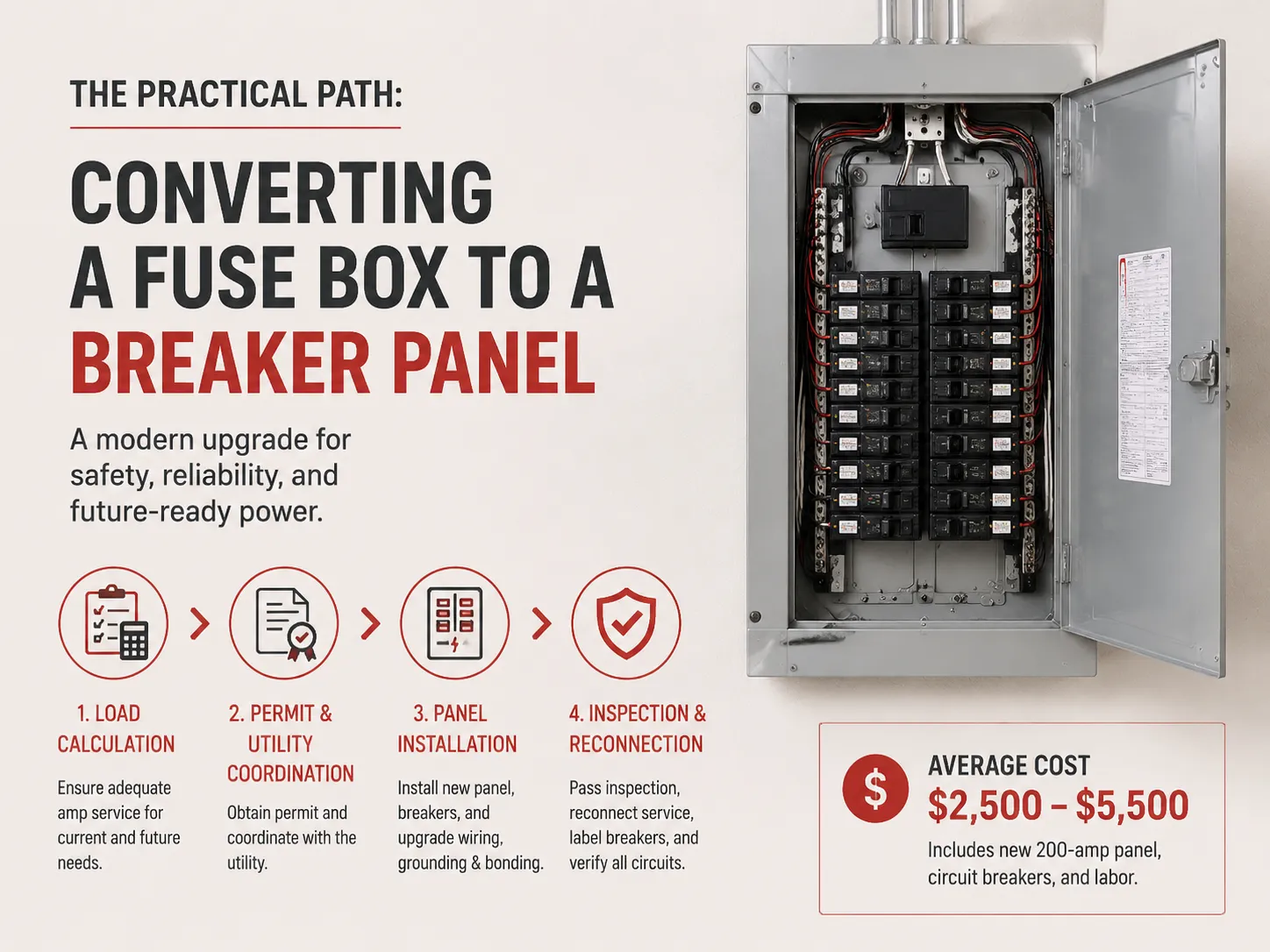
The Practical Path: Converting a Fuse Box to a Breaker Panel
Although switching from a fuse box to a circuit breaker panel is a tried and true method, it should not be an owner-done project. The steps are:
- Load calculation. To see if there is enough amp service from an existing box (usually rated at either 60A or 100A) for current or future home or building usage, the electrician computes an electrical load calculation according to NEC Standards – Article 220. Typically, all new electrical panels installed to replace the old fuse panel will also have a service upgrade to adequate 200A.
- Permit and utility coordination. An electrical permit is issued by the local building department. The utility will be notified when the service drop is disconnected during the electrical panel replacement.
- Panel installation. A new electrical panel is installed and any service entrance cable that is damaged or not large enough for the new panel must also be replaced. New circuit breakers will then be installed and all existing branch circuits reconnected. Finally, grounding and bonding will be upgraded to meet the latest code requirements.
- Inspection and reconnection. A building inspector confirms the work done. A utility company connects the service back up again. An electrician will label each breaker and confirm all circuits work.
The cost of the conversion will vary by region and be dependent on the size, complexity and type of the conversion. The average cost varies from $2,500 to $5,500 and includes a new 200-amp panel, new circuit breakers, and labor costs associated with the conversion. The expense of replacing a few circuit breakers with the equivalent units is low. A full panel replacement is considered an capital investment. Our guide on how to upgrade circuit breakers will walk you through the scope, costs, and permitting requirements in detail.
Can You Use a Circuit Breaker as a Fuse?
From an operational standpoint, circuit breakers act as a substitute for fuses by providing the same level of overcurrent protection. For example, if an individual is using a 14-gauge copper wire that needs to have a maximum load of 15 amps, then both fuses and circuit breakers meet this requirement. However, circuit breakers can be reset versus replaced and, more importantly, ignorant users are prevented from switching from a lower rating fuse or circuit breaker to one with a higher rating for safety reasons. In this regard, while they may provide greater convenience than fuses; circuit breakers provide safer operation than fuses as well.
It should be noted that a fuse can take over the role of a circuit breaker; in fact, in older electrical systems or where there are a lot of fault currents present, a fuse IS a circuit breaker. The choice between these two devices cannot be made based on their superiority, as they have to be matched to the requirements of the circuit they will serve, which include their characteristics such as the interrupting rating, trip curve, selectivity, and maintenance needs.
Frequently Asked Questions
Can you replace fuses with breakers?
A fuse box can almost always be exchanged for a modern circuit breaker panel in both residential and commercial construction. Existing branch circuit wiring will be connected to new breakers with an ampacity suitable for the wire size. Only a licensed electrician can replace a fuse box for you, this usually takes one day to complete the changeover from a fuse box to a circuit breaker panel and brings your electrical system into compliance with applicable safety codes as specified by applicable state or local safety codes.
Can you use a circuit breaker as a fuse?
Indeed, a circuit breaker offers protection against oversaturation as well as that of a fused electrical operating component, due to the fact that too much electrical current has flowed through the breaker. The difference between the two devices is that a circuit breaker may be reset (either automatically or manually), while for a fuse, it has to be replaced. In most applications, circuit breakers are easier for users to operate and have better tamper-resistive capabilities than fuses.
When did they switch from fuses to breakers?
Fuse to circuit breakers for residential buildings slowly changed over time (1950 to 1980). By the mid-to-late 1970s, circuit breaker panels were standard in all new homes built in North America. If you find a fuse box in a home today, it is an older house (approximately 40-60 years old).
Can a fuse box be converted to breakers?
A complete upgrade of an older panel is possible depending on local authority. Some older panels can be converted to modern panels, but require a replacement of the whole enclosure, the service entrance conductors (if necessary), and the overcurrent devices. Most older panels will need to be upgraded to 200amp service, and this requires an electrical permit, a utility disconnect and inspection, which will likely happen concurrently with the upgrade of the exterior to 200 amp service.
References
- NFPA 70 (National Electrical Code) Article 240 — Overcurrent Protection. National Fire Protection Association.
- Electrical Safety Foundation International (ESFI) — Home electrical safety and fuse box replacement guidance.
- UL 248 — Low‑Voltage Fuses — Safety standard for fuse construction and testing. UL Solutions.
- Eaton — Fuse vs. Circuit Breaker Application Guide — Industrial selectivity and coordination best practices.
The decision to replace fuses with circuit breakers is rarely wrong for a residential installation. The convenience, the safety enhancements, and the insurance compliance justify the cost. In industrial and high‑fault applications, the fuse remains an essential protective device — compact, fast, and capable of interrupting currents that would destroy a standard breaker. Understanding where each device excels allows you to make the right choice for the right circuit. At HUYU, we supply the full range of circuit protection — from miniature breakers to molded‑case breakers to DC and RCBO solutions — because every circuit deserves a protection device that matches its demands, whether that device is a fuse, a breaker, or a carefully coordinated combination of both.