Cuando recibe las especificaciones para un proyecto y necesita un interruptor automático de aire, puede que se encuentre buscando “las 10 principales empresas que fabrican y venden interruptores automáticos.” La razón es simple: no importa cuán bien publicitada esté una empresa, usted quiere gastar su presupuesto sabiamente y elegir la empresa más adecuada para su campo de modo que pueda obtener los precios y especificaciones correctos.En este artículo, encontrará un resumen de los diez proveedores más competentes, organizados por niveles de habilidad. Al mismo tiempo, queremos enfatizar lo importante que es verificar las certificaciones válidas porque la falta de una certificación adecuada puede causar que un proyecto falle incluso si el precio es correcto.
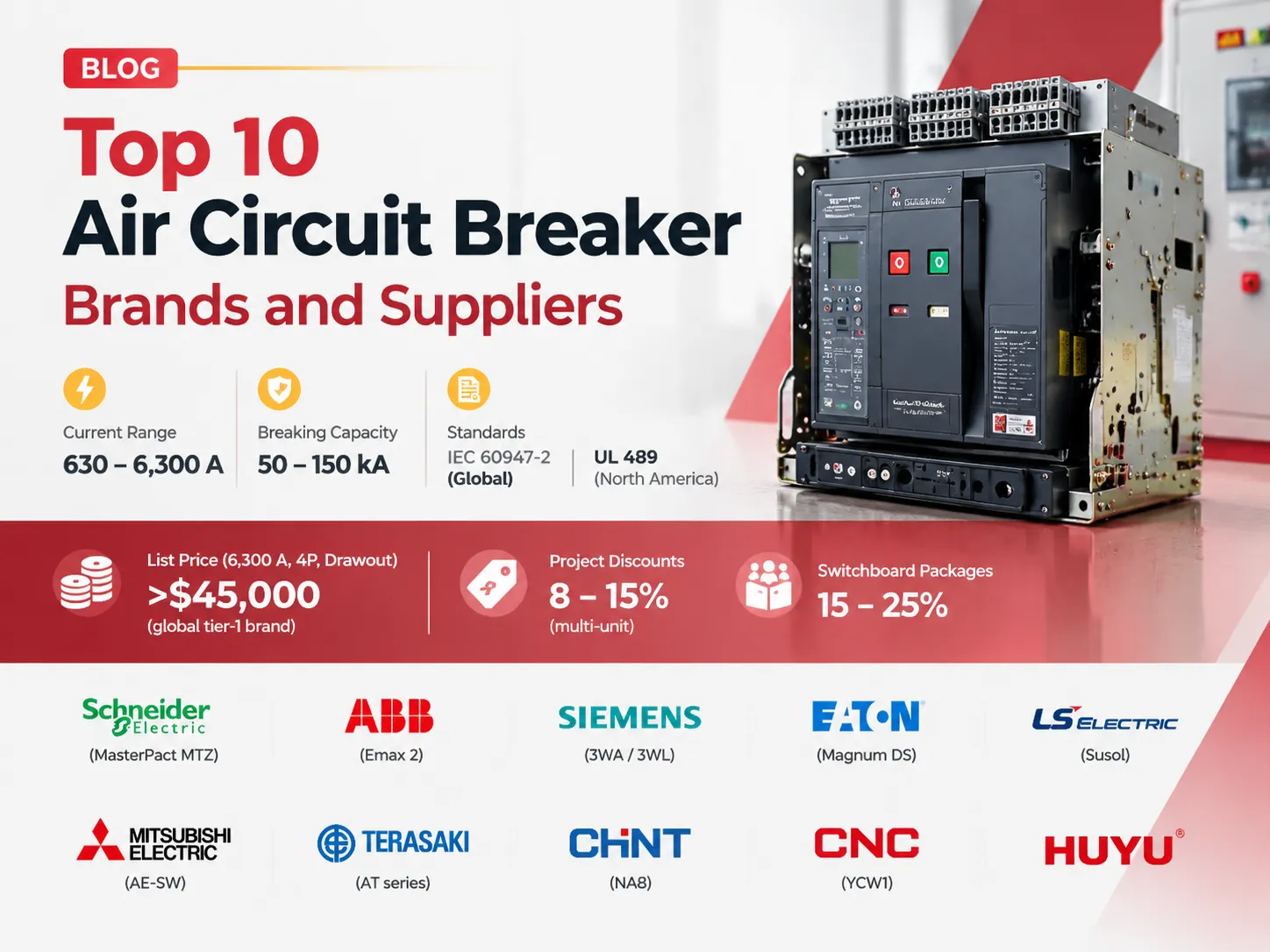
Respuesta corta: Los diez fabricantes y proveedores de interruptores automáticos de aire más comúnmente nombrados en el proceso de especificación para proyectos industriales y de servicios públicos son Schneider Electric (MasterPact MTZ), ABB (Emax 2), Siemens (3WA / 3WL), Eaton (Magnum DS), LS Electric (Susol), Mitsubishi Electric (AE-SW), Terasaki (serie AT), Chint (NA8), CNC / Changshu Switch (YCW1) y HUYU. La nomenclatura normal para estos interruptores automáticos de aire varía de 630 A a 6,300 A con capacidades de ruptura que van de 50 kA a 150 kA. La IEC 60947-2, que es válida en la mayoría de los países, y la UL 489 aplicable a Norteamérica son dos normas que determinan si un interruptor automático de aire es adecuado para su proyecto.
Interruptores automáticos de aire en un párrafo
Un interruptor automático de aire (ACB) es un tipo de interruptor automático que opera utilizando aire como medio para extinguir el arco en lugar de vacío o el método SF6. Los ACB se utilizan principalmente en aplicaciones de equipos de baja tensión que van desde 630 A hasta 6300 A. Generalmente, se pueden encontrar ACB en el equipo de entrada, enlace de barras y aplicaciones de protección de generadores.
Los ACB pueden asumir la configuración “extraíble”, por lo que no han sido desplazados por la competencia de los interruptores automáticos de vacío más pequeños. En el mundo tecnológico actual, la capacidad de extraer un interruptor y reemplazarlo por otro en segundos vale más que el precio del equipo.
Cómo se construyó esta lista
Cuatro requisitos previos, seguidos en esta secuencia.
- Cobertura de rango. ¿El fabricante realmente produce ACB en el rango operativo de 630 A a 6,300 A con capacidad de ruptura suficiente o solo dentro de un alcance limitado?
- Alcance de certificación. ¿Proporcionan la misma familia de productos con los mismos documentos de certificación IEC y UL? El uso del certificador IEC elimina al proveedor de cualquier proyecto en Norteamérica.
- Ecosistema de accesorios y retroajustes. Como unidades de disparo electrónicas, dispositivos de comunicación, cerraduras mecánicas, casetes y bases, y si el interruptor automático puede ser adaptado en un panel existente de un fabricante diferente.
- Realidad del servicio. Disponibilidad de repuestos, servicio técnico en la región del comprador y tiempos de entrega que no se vean completamente afectados por un retraso en pedidos.
El costo se omite intencionalmente ya que está determinado por los cuatro puntos anteriores. Lo que realmente busca es si el proveedor es capaz de seguir las especificaciones de su proyecto. Los asuntos prácticos que desea aclarar con la fábrica, independientemente del número de unidades que se compren, son los mismos. Esa lista de verificación se detalla más en esta revisión de lo que distingue a un fabricante de interruptores automáticos de aire que vale la pena trabajar con.
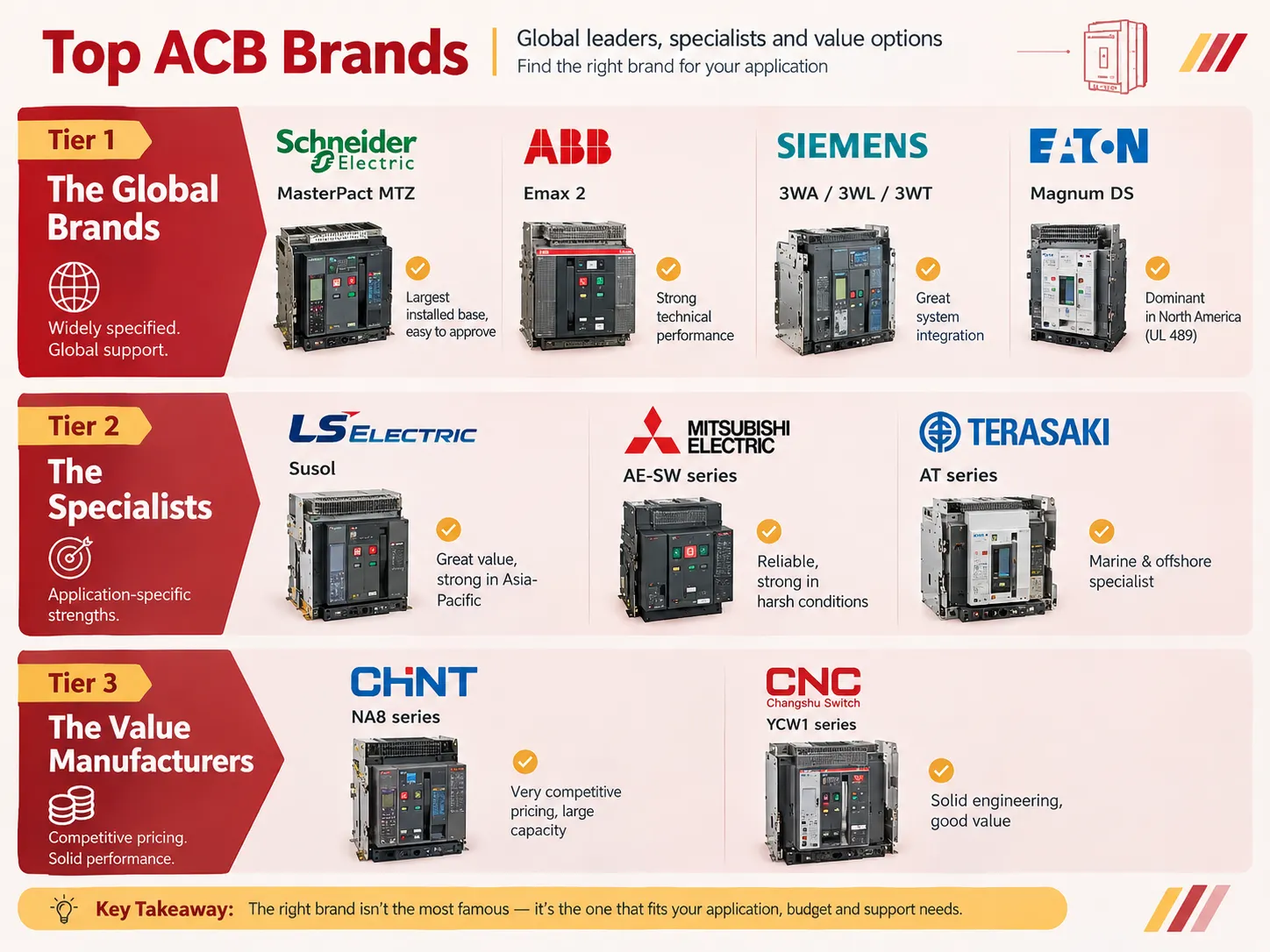
Nivel 1: Las marcas globales
Estos cuatro son el punto de referencia. Si su especificación ha sido preparada por un consultor de Europa, América del Norte o el Golfo, es probable que uno de estos productos sea mencionado en ella.
Schneider Electric – MasterPact MTZ. Esta es la familia de ACB más preferida en el mundo. Viene en capacidades que varían entre 630 A y 6300 A, capacidad de ruptura de hasta 150 kA, y posiblemente el ecosistema más grande de accesorios. Las características principales son proporcionadas por unidades de disparo Micrologic con sistemas integrados de medición y comunicación, una enorme selección de cassettes y un diseño modular que está pensado para ser actualizado in situ según sea necesario. Ventajas significativas: número inigualable de máquinas instaladas, alta disponibilidad de la marca en todo el mundo y facilidad para obtener la aprobación del presupuesto para esta marca en una licitación. Desventajas clave: el precio también está relacionado con la marca y los plazos de entrega para las unidades ensambladas pueden ser bastante largos.
ABB – Emax 2. Esta marca pertenece al competidor directo y es igual en el aspecto técnico. Unidades de disparo Ekip, capacidad nominal de hasta 6300 A y los mismos modelos de construcción extraíble y características de comunicación. ABB ha ofrecido el concepto de marketing “interruptor inteligente” con funciones integradas para la medición de potencia y energía. Ventajas: buena documentación técnica, buenas características para el uso con generadores y equipos de enlace de barras, y buen soporte de producto en el mercado industrial. Desventajas clave: un nivel de precio similar al de los productos de Schneider.
Siemens – familias 3WA, 3WL y 3WT. La empresa ofrece una gama más amplia de nombres de ACB que muchos otros fabricantes, con varias familias de productos. Exitosa en Europa, fuerte en aplicaciones de procesos e industriales, y regularmente encontrada en instalaciones existentes que requieren nuevo equipo. Ventajas: excelente compatibilidad con productos de tableros de Siemens y documentación técnica. Desventajas clave: el nombre de la familia puede ser confuso en la práctica.
Eaton – Magnum DS. Eaton tiene la posición más fuerte en el mercado norteamericano para estos productos, con una familia completa de productos UL 489 y una gran experiencia en centros de datos y plantas de manufactura pesada. Ventajas: la solución más popular en el mercado que requiere UL, excelente documentación sobre el arco de destello y una fuerte red de servicios en EE. UU. Desventajas clave: menor nivel de despliegues en mercados IEC principales y enfoque local para la fabricación de accesorios en comparación con las ofertas de Schneider y ABB.
Nivel 2: Los especialistas
Es notable que estas tres marcas compiten basándose en sus propias fortalezas en lugar de ser solo la marca más reconocida en la industria.
La primera empresa es LS Electric, una marca surcoreana que se ha convertido en una compañía global en equipos de baja tensión y ofrece una amplia gama de ACBs de hasta 6300A, junto con la certificación IEC y UL. FORTALEZAS: buena relación calidad-precio en altas corrientes nominales, fuerte cobertura en Asia-Pacífico y la región de Medio Oriente, calidad de producto decente. DEBILIDADES: cobertura limitada de la red de servicios.
La segunda empresa es Mitsubishi Electric, una marca con larga trayectoria en Japón y Asia. Es conocida por su fiabilidad en operaciones difíciles, como protección de generadores y aplicaciones marinas. FORTALEZAS: márgenes de diseño conservadores, buen historial de fiabilidad, fuerte cobertura en Japón y Asia. DEBILIDADES: precios elevados y gama limitada de accesorios.
La última empresa a mencionar es Terasaki, un fabricante especializado en aplicaciones marinas y otras aplicaciones desafiantes. La compañía cuenta con aprobaciones únicas que la convierten en la mejor y única solución para ambientes de choque, vibración y salinidad agresiva del mar. FORTALEZAS: características únicas y aprobaciones relevantes. DEBILIDADES: fabricante de nicho con precios bajos para soluciones industriales ordinarias.
Es bastante notable que la fortaleza de la marca dependa de la aplicación de los productos más que de la marca en sí. Por ejemplo, si un productor tiene un rendimiento excelente para tableros de distribución comerciales, puede ser inadecuado para barcos y viceversa. Construir una visión de qué marcas realmente entregan en qué segmentos — en lugar de cuáles publicitan más — es el mismo ejercicio que se realizaría para cualquier categoría de componentes eléctricos, y el marco en esta comparación de qué marcas de soluciones eléctricas se adaptan a qué aplicaciones se aplica directamente a la protección de circuitos.
Nivel 3: Los Fabricantes de Valor
Aquí es donde la conversación sobre precios se vuelve muy interesante y donde muchos compradores cometen errores en sus suposiciones.
Chint – serie NA8. Principal productor chino de baja tensión de interruptores, con una gama completa de interruptores automáticos de baja tensión que ahora también incluye las cada vez más importantes certificaciones UL para su serie de productos. Fortalezas: precios bajos y gran capacidad y recursos de producción; debilidad: retraso en la aceptación entre consultores que continúan considerando cualquier equipo chino como algo “dudoso” a pesar de la existencia de certificaciones específicas.
CNC / Changshu Switch – serie YCW1. Fabricante chino de interruptores automáticos con una larga historia y gran capacidad para atender el mercado doméstico. Fortalezas: ingeniería sólida y sensata y buen precio; debilidad: falta de experiencia con la documentación específica requerida para proyectos de exportación y soporte en el extranjero.
La suposición que se puede cuestionar es que “nivel de valor” significa “producto de bajo rendimiento”. Esto no significa esto en absoluto, necesariamente. La tecnología de los interruptores automáticos está altamente desarrollada, y un producto de nivel de valor debidamente certificado tendrá exactamente la misma capacidad de interrupción que un interruptor automático de nivel 1. La diferencia puede estar en cuanto al rango de accesorios proporcionados, el software de la unidad de disparo, el nivel de comunicación y la infraestructura y/o documentación proporcionada.
Dónde Encaja HUYU
Para aclarar nuestra propia posición: HUYU es un proveedor y fabricante en esta categoría, por lo tanto, formamos parte de esta lista y debemos señalar la misma precaución que cualquier otro: pruebe lo que decimos contra sus especificaciones y no dé nada por sentado.
Nos situamos en algún punto intermedio: nuestros ACB están disponibles en el rango de 630 A a alrededor de 4,000 A, cumplen y están probados según IEC 60947-2, con opciones UL 489 para clientes de América del Norte; prestamos especial atención al aspecto que podría ser un problema para los compradores: la calidad de los productos cuando los vuelven a pedir y el tiempo que deben esperar por ellos. Es decir, tenemos muchos clientes con fabricantes de paneles, contratistas, distribuidores y programas OEM que nos obligan a asegurarnos de que todo sea correcto la primera vez, ya que los ingenieros de otros verificarán esto.
Eso significa en la práctica que estamos bien en situaciones cuando los clientes necesitan ACB en producción masiva según una especificación determinada, pero menos bien cuando los clientes tienen una solicitud especial. Si desea ver el alcance del suministro, las configuraciones y los mercados en los que trabajamos, los detalles están en nuestro resumen de suministro y configuración de interruptores automáticos.
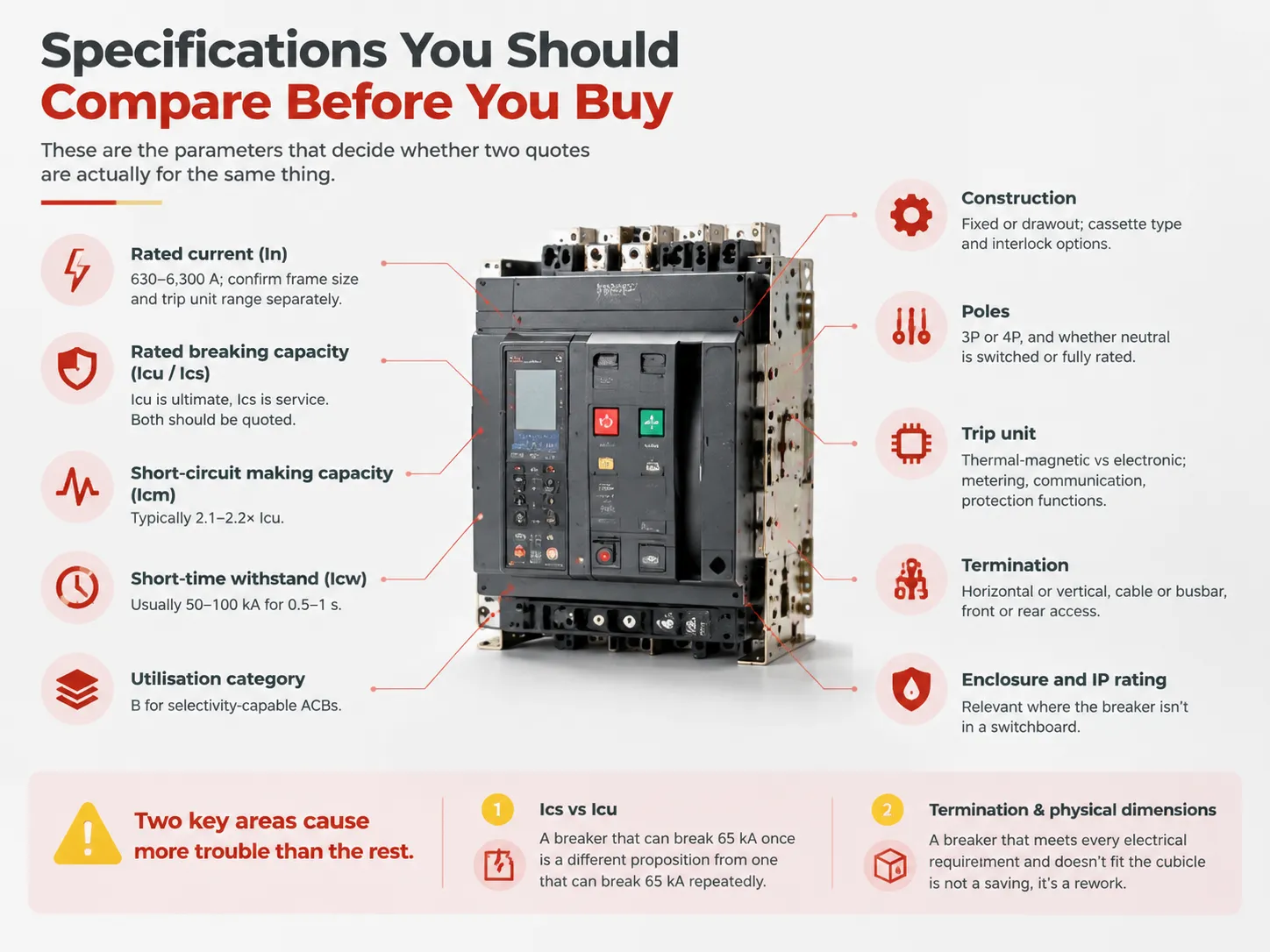
Especificaciones que debe comparar antes de comprar
Estos son los criterios que ayudan a determinar si dos cotizaciones son realmente para el mismo artículo. Sin ellos, comparar precios no tiene ningún sentido.
| Parámetro | Qué verificar | Por qué es importante |
|---|---|---|
| Corriente nominal (In) | 630–6,300 A; confirme el tamaño del marco y el rango de la unidad de disparo por separado | Un marco de 1,600 A con una unidad de disparo de 1,000 A no es el mismo producto que un marco de 1,000 A |
| Capacidad nominal de interrupción (Icu / Ics) | Icu es la capacidad máxima, Ics es la capacidad de servicio. Ambos deben ser cotizados | Algunos proveedores cotizan solo Icu. Ics es lo que puede interrumpir repetidamente |
| Short-circuit making capacity (Icm) | Typically 2.1–2.2× Icu | Determines the peak withstand the switchboard must tolerate |
| Short-time withstand (Icw) | Usually 50–100 kA for 0.5–1 s | Critical for selectivity and for coordination studies |
| Utilisation category | B for selectivity-capable ACBs | Category A breakers can’t provide the same discrimination |
| Construcción | Fixed or drawout; cassette type and interlock options | Drawout is normally mandatory for a main incoming position |
| Polos | 3P or 4P, and whether neutral is switched or fully rated | Full-neutral 4P costing differs substantially from switched-neutral |
| Trip unit | Thermal-magnetic vs electronic; metering, communication, protection functions | The trip unit can cost more than the breaker on advanced configurations |
| Termination | Horizontal or vertical, cable or busbar, front or rear access | The most common source of a product that doesn’t fit the board |
| Enclosure and IP rating | Relevant where the breaker isn’t in a switchboard | Determines suitability for plant-floor or outdoor installation |
Two of them can cause more troubles than the others. The first one is Ics and Icu. The breaker with Ics rating of 65 kA might be good for one instance only while the Icu value will allow to interrupt 65 kA power a few times. The second important factor is very important – the breaker can meet all the electrical requirements and still be useless if it does not fit into the cubicle.
Standards and Certifications: What to Ask For
This is where the battle for project success starts, and while some say it all comes to business strategy, others point out that money wins at this stage.
IEC 60947-2 is an international standard that regulates circuit breakers used in industry. Any manufacturer that claims to adhere to this standard must submit a type test report obtained in an accredited laboratory and not merely a statement saying that the production processes are in compliance with the quality standards.
UL 489 is the North American version of the standard that deals with molded case circuit breakers and air circuit breakers. UL and IEC60947 are not interchangeable, which means that it does not entail that a circuit breaker, which design and testing were made according to IEC60947, will pass all UL requirements. Thus, one of the requirements may limit the potential suppliers even before an opportunity to compare costs has been presented to a customer.
The distinctions worth understanding are set out properly in this explanation of what UL 489 actually covers for breakers, and it’s worth reading before you send out an RFQ rather than after the quotes come back.
In addition to the two essential criteria, please ensure that you ask for:
- Test reports from an accredited laboratory that state the report number and date of issue.
- IEC 60947-2 Annexes where applicable: Annex B for isolation and Annex H for an integrated test method.
- Marine and offshore approvals by the classification societies, if required by the application.
- RoHS and REACH declarations on material contents as required by many European buyers.
- ISO 9001 on the process of manufacture, which is required but insufficient by itself.
- Arc-flash and coordination data so that the protection study can be carried out without guessing.
Make the request for the documents at the quotation stage and not at the time of deliver. A company that cannot provide a type test report within a few days of the request will probably not be able to provide it at all. The manufacturer’s certificate pack is a good indicator of how serious they are about the rest of the process.
Price Ranges and How Discounts Actually Work
List price is close to meaningless in this category. Here’s the structure underneath it.
| Purchase situation | Typical position versus list | Notas |
|---|---|---|
| Single unit, up to 1,600 A | List price, sometimes 5–10% off | Small order; the supplier has no incentive to move much |
| Multiple units, one project | 8–15% off list | The normal commercial band for a project order |
| Complete switchboard or panel package | 15–25% off list | The breaker is bundled with enclosure, busbar and assembly |
| OEM or repeat programme | Negotiated annually, often below 25% off | Volume commitment in exchange for price and priority |
| Tier-1 brand, 6,300 A drawout 4P | Roughly $45,000–$70,000 list | Advanced trip units push this higher quickly |
| Value-tier brand, comparable rating | Often 30–50% below tier-1 | The gap narrows once trip units and accessories are matched |
There are three common misconceptions that purchasers make regarding this issue. The first misconception is that comparing a value-level quote with a basic trip unit against a Tier 1 quote containing a metering trip unit forms an actual price comparison. This simply is not true as it is regarded as a product comparison. Before entering the market it is important to define the exact functions of the trip unit. The second misconception is that it can be assumed that the discount percentage constitutes all the necessary information needed to make a decision. However, one should take into account the very fact that the payment terms, lead time, transportation, spare parts price and warranty help to a much greater extent that a few points of discount over a 25-year equipment life cycle. The third misconception is forgetting that the cassette, cradle and different accessories are usually sold separately, making such additional expenses very considerable in regard to the overall price of the breaker itself.
Choosing the Right Supplier by Industry
The right answer genuinely changes with the application. Here’s how the priorities shift.
| Industry | What dominates the decision | Supplier profile that fits |
|---|---|---|
| Utility substations and distribution | Type test evidence, coordination data, long-term spares | Tier-1 with an established service network and a 20-year spares commitment |
| Data centres | Selectivity, uptime, communication and monitoring | Tier-1 or strong tier-2 with mature trip unit communication and fast spares |
| Oil, gas and petrochemical | Certification, arc-flash documentation, hazardous-area compatibility | Established brands with process-industry references and full documentation |
| Marine and offshore | Classification society approvals, shock and vibration | Specialists in the marine segment; this is not a price-driven purchase |
| Commercial buildings and retail | Price, availability, standard configurations | Value-tier or tier-2 with good local distribution |
| Renewable generation and BESS | DC compatibility, cycling duty, coordination with inverters | Manufacturers with tested coordination studies for inverter-fed systems |
| Industrial manufacturing | Motor protection, selectivity, plant-level spare parts | Tier-2 with strong accessory range and a regional stockist |
| Export projects in emerging markets | Documentation quality, price, delivery reliability | Value-tier manufacturers with export experience and certified paperwork |
The point made in that table notice is that risk tolerance is essentially the main variable at play. A utility that purchases a 40-year asset with an outage cost that is measured in millions an hour is willing to pay a premium to have certainty. A contractor that is fitting out a shopping centre where the breaker is just one of the components in the switchboard is going to make the best decision based on the two main criteria, price and delivery. The error is made by trying to apply the experience gained in one field to another — overspecifying on a commercial project results in waste of budget, while underspecifying on a utility project can result in liabilities that are going to exist after the project done.
The last piece of common sense advice regardless of the sector you are operating in relates to the suppliers. Before you make your shortlist, ask all of the suppliers to provide you with the full documentation pack, which includes the type test report issued by an accredited laboratory, the certification of the rating and the material declaration. How fast they respond to you, and how complete their response is, allows you to judge their discipline.It is also the quickest way to find out whether the certifications and approvals behind a switchgear or breaker product are as comprehensive as the datasheet implies.
Preguntas Frecuentes
Which air circuit breaker brand is best?
The point made in that table notice is that risk tolerance is essentially the main variable at play. A utility that purchases a 40-year asset with an outage cost that is measured in millions an hour is willing to pay a premium to have certainty. A contractor that is fitting out a shopping centre where the breaker is just one of the components in the switchboard is going to make the best decision based on the two main criteria, price and delivery. The error is made by trying to apply the experience gained in one field to another — overspecifying on a commercial project results in waste of budget, while underspecifying on a utility project can result in liabilities that are going to exist after the project done.
The last piece of common sense advice regardless of the sector you are operating in relates to the suppliers. Before you make your shortlist, ask all of the suppliers to provide you with the full documentation pack, which includes the type test report issued by an accredited laboratory, the certification of the rating and the material declaration. How fast they respond to you, and how complete their response is, allows you to judge their discipline.
What’s the difference between IEC 60947-2 and UL 489?
There are two types of standards required by circuit breakers which cannot be substituted for each other. IEC 60947-2 refers to International electrical equipment standard followed in majority parts of the world and UL 489 refers to North American standard for molded case and air circuit breakers. In case of circuit breakers tested as per IEC 60947-2 standards may not be counted as acceptable in UL assembly requiring UL certified products since standards represent quite diverse field and half of regional markets may be unavailable for manufacturers who can work only according to one of the above standards.
How much does an air circuit breaker cost?
The spectrum of prices covers a very wide range because the range of ratings is also quite large. For example, a basic highly-rated pole mounted circuit breaker from a value brand may cost not more than a few hundred dollars, whereas a 6300 A drawout type 4 pole unit made by a global brand and fitted with a metering type of trip unit may cost around $45,000. Generally, the discounts are approximately 8-15% on multiple-unit orders and 15-25% on entire switchboard packages; discounts through OEM programs are negotiated on an annual basis. The main variables affecting price include rated current, breaking capacity, type of pole configuration, drawout vs. fixed type of construction, and, most importantly, type of trip unit.
Can I replace an old air circuit breaker with a different brand?
Prices vary greatly depending on the rated level. A basic brand name pole mounted circuit breaker may cost only a few hundred dollars, while a large global brand 6300 A drawout type 4 pole unit with a metering type of trip unit may cost approximately $45,000. There are average discounts of about 8-15% on the orders for numerous units and about 15-25% on total switchboard packages. Discounts due to OEM programs are negotiated yearly. The key factors determining price are the rated current, breaking capacity, type of pole configuration, drawout versus fixed construction, and, the most important, the type of trip unit.
How do I verify a supplier’s certifications are genuine?
Request documents rather than claims. Keep three main factors in mind. The first issue to consider is the source of the report that should come from accredited laboratory that is independent. The second factor is that the type of report has to be mentioned in the certificate. The last item is that the report must specify the required type of product in order to fulfill your order — for example, a certificate for a 6300 A installed unit will not work for a 4300 A installed unit. It is better to confirm the necessary information directly with the organization that issued the certificate.
Referencias
- IEC 60947-2 — Low-voltage switchgear and controlgear, Part 2: Circuit-breakers — the governing international standard for ACBs
- UL Solutions — certification and listing information for circuit breakers and switchgear assemblies
- National Electrical Manufacturers Association (NEMA) — North American electrical equipment standards and industry reference data
- ABB — Emax 2 air circuit breaker range and technical documentation
- Siemens — low-voltage circuit breaker families including 3WA and 3WL
- Mitsubishi Electric — AE-SW series air circuit breakers
- LS Electric — Susol low-voltage circuit breaker range
- Chint — NA8 series air circuit breakers and low-voltage switchgear
Conclusión
To simplify obtaining an air circuit breaker, you should consider the selection of suppliers. Ten major suppliers fall into three categories for a good reason. Schneider, ABB, Siemens, and Eaton are industry leaders in this respect and are always chosen when a particular brand is mentioned in the specification or a project cannot afford any technical risks. LS Electric, Mitsubishi, and Terasaki always win because of their top-notch advantages – high value, reliability, and excellent marine operation characteristics, respectively. Chint, CNC, and other manufacturers that operate in the low-cost segment, including HUYU, offer good type-tested products at competitive prices.
The figures of importance are: 630 A to 6,300 A, Icu from 50 kA to 150 kA, IEC 60947-2 for the majority of markets, UL 489 for North America, project discounts around 8-15%, and switchboard package discounts around 15-25%.
Nevertheless, price is seldom the deciding factor for making a choice. The decision mainly depends on two questions. Is this supplier able to provide an appropriate certification for the project necessary in its documentation? Will it be able to fulfill the second order in the same quality? If these two issues are resolved, the brand choice will not cause any problems, regardless of the tier the brand belongs to.