
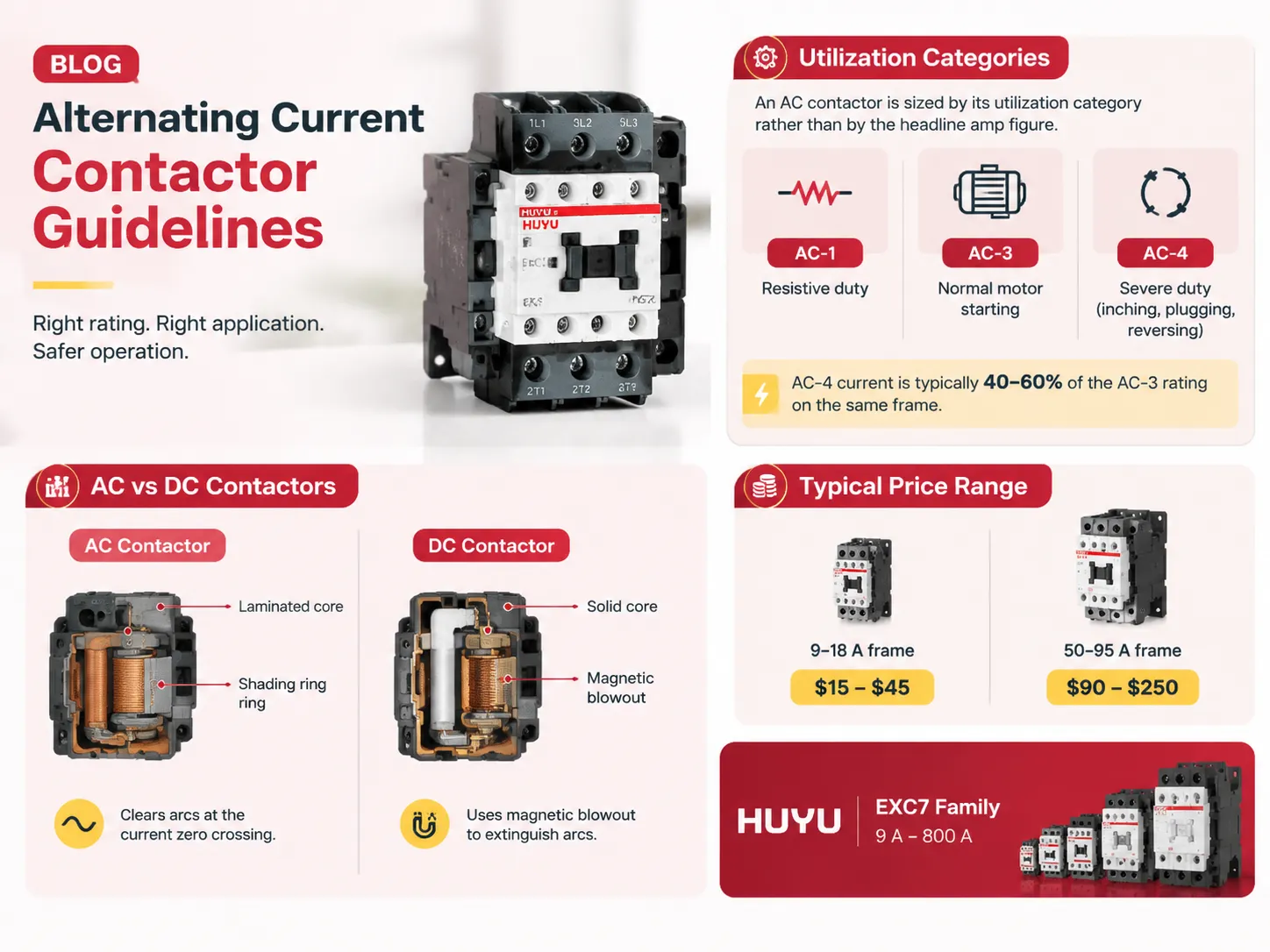
Salah satu bagian utama dari kontrol motor dapat dengan mudah disebut sebagai kontaktor AC. Namun perlu dicatat bahwa konfigurasi kontaktor yang salah juga dapat menjadi salah satu masalah. Misalnya, Amper yang dapat dilihat di sisi kontaktor memberikan informasi tentang karakteristik tipe resistifnya. Namun, jika angka tersebut dikonversi untuk memulai mesin, mungkin akan terjadi titik panas di panel. Oleh karena itu, artikel ini menjelaskan apa itu kontaktor AC, koil yang dimiliki kontaktor AC, apa yang membedakannya dari kontaktor DC, kategori apa yang digunakan untuk menentukan beban dan bagaimana melakukan pengkabelan, jenis pemeliharaan yang diperlukan, dan berapa harganya.
Singkatnya, kontaktor AC berfungsi sebagai saklar untuk mengendalikan beban arus bolak-balik secara jarak jauh. Karakteristik utama tergantung pada bagaimana kontaktor akan bekerja, bukan pada arus, yang hanya salah satu spesifikasi. Misalnya, AC1 menunjukkan penggunaan dalam siklus tugas resistif, AC3 menunjukkan penggunaan untuk memulai motor, dan AC4 menunjukkan penggunaan untuk aplikasi yang sangat berat (misalnya, pembalikan, plugging, inching) di mana arus sekitar 40-60% lebih rendah dari AC3. Kontaktor AC dan DC adalah jenis saklar yang berbeda: kontaktor AC memiliki inti berlapis, teknologi kutub teduh memungkinkan kontaktor AC memutus arus pada titik nol, sedangkan kontaktor DC tidak memiliki inti berlapis dan menggunakan magnetic blowout. Harga kontaktor AC bervariasi dari 15 hingga 45 untuk yang berarus 9-18 A dan dari 90 hingga 250 untuk kontaktor dengan rating 50-95 A. Perusahaan HUYU memproduksi kontaktor seri EXC7 dengan arus mulai dari 9 A hingga 800 A.
Apa yang Sebenarnya Dilakukan oleh Kontaktor AC
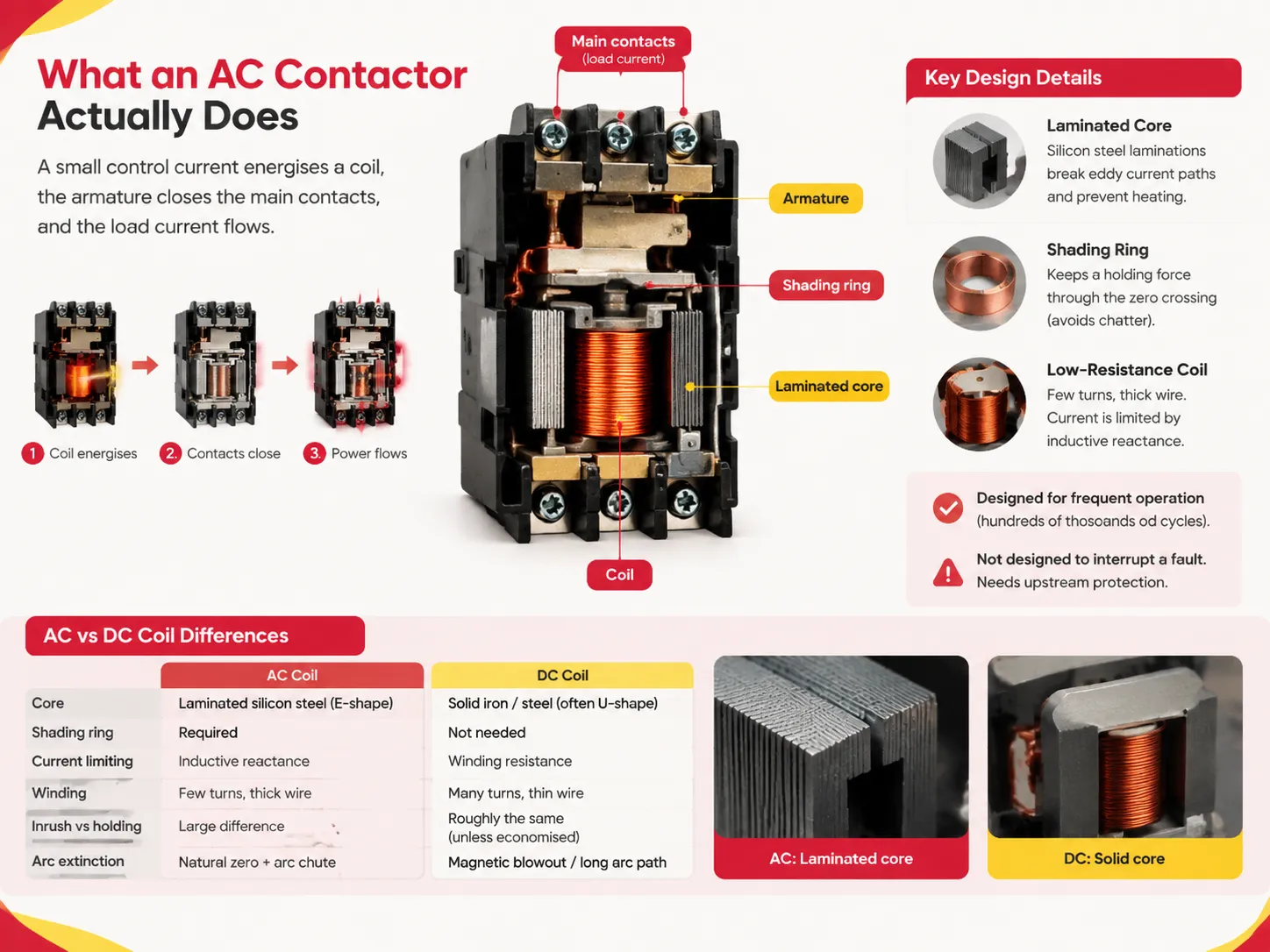
Kontaktor pada dasarnya adalah saklar yang dioperasikan secara elektromagnetik. Ketika kontrol diaktifkan, arus kontrol kecil akan mengenergikan kumparan elektromagnet, yang kemudian menarik armatur, sehingga menutup kontak utama dan memungkinkan arus mengalir. Sinyal kontrol dilepas dan pegas membuka kontak kembali.
Kesederhanaan adalah intinya. Ini dirancang untuk operasi frekuensi sangat tinggi; secara harfiah ratusan ribu siklus on/off selama masa pakainya, sehingga banyak digunakan pada starter tombol tekan, HVAC, pompa, dan panel pencahayaan umum. Ini tidak dimaksudkan untuk trip saat arus gangguan tetapi mengandalkan relay hulu untuk fungsi tersebut.
Cara Kerja Kumparan dan Inti
Operasi kontaktor AC dapat dijelaskan melalui tiga karakteristik desain.
Inti laminasi. Setiap medan bolak-balik yang melewati konduktor padat akan menginduksi arus eddy yang sudah jadi. Jika inti terbuat dari besi padat, maka akan menjadi panas. Oleh karena itu, desain kontaktor AC memungkinkan penumpukan laminasi tipis isolasi dari baja silikon berbentuk E untuk memutus jalur arus sirkulasi. Ini adalah jawaban atas pertanyaan tentang inti yang digunakan untuk relay dan kontaktor AC: baja silikon laminasi dan bukan besi padat.
Cincin shading mencegah chatter. Pada frekuensi 50Hz, arus melewati garis nol 100 kali per detik, sehingga pada setiap lintasan, tarikan magnetik menghilang. Jika tidak ada tindakan, armatur akan bergetar dan bergetar sehingga kehilangan kontaknya. Solusinya adalah cincin shading tembaga yang dipasang pada permukaan kutub. Cincin shading menciptakan jeda waktu terhadap fluks di bagian tertentu tersebut sehingga mempertahankan gaya tahan sepanjang lintasan nol. Jadi ketika sebuah contactor mulai berdengung keras, itu berarti cincin shading rusak atau hilang karena alasan lain.
Kumparan adalah kumparan dengan resistansi rendah dan lilitan rendah. Kumparan AC membatasi arusnya melalui reaktansi induktif daripada resistansi dan oleh karena itu dapat menggunakan konduktor tebal dan jumlah lilitan yang relatif rendah. Ini sangat penting ketika mencoba menggunakannya untuk beroperasi pada DC. Selain itu, arus masuk kumparan jauh lebih tinggi daripada arus tahan. Unit EXC7 memiliki daya tarik sebesar 60-200 VA tergantung pada rangka selama penarikan dan 9-25 VA selama penahanan.
| Properti | Kumparan AC | Kumparan DC |
|---|---|---|
| Inti | Baja silikon berlapis (bentuk E) | Besi / baja padat (sering berbentuk U) |
| Cincin shading | Diperlukan | Tidak diperlukan |
| Pembatasan arus | Reaktansi induktif | Resistansi lilitan |
| Lilitan | Sedikit lilitan, kawat tebal | Banyak lilitan, kawat tipis |
| Arus masuk vs tahan | Perbedaan besar | Hampir sama (kecuali dihemat) |
| Pemadaman busur | Nol arus alami + pemutus busur | Pemadam magnetik / jalur busur panjang |
Kutub, Ampere dan Ukuran Rangka
Contactors ditentukan berdasarkan tiga dimensi sekaligus: jumlah kutub, rating arus dan ukuran rangka. Memahami rentang sebenarnya membuat logika penentuan ukuran menjadi konkret.
Keluarga EXC7 berjalan dari rangka standar dengan rating 9 A hingga 110 A dan rangka arus tinggi dengan rating antara 120 A dan 800 A, semuanya dalam konfigurasi tiga kutub (3P). Tegangan isolasi yang dinilai adalah 690 V pada rangka standar dan 1000 V pada rangka arus tinggi, dengan tegangan operasi 380/400 V atau 660/690 V. Cakupan daya berkisar dari 4 kW pada ujung kecil hingga 450 kW pada rangka 800 A di bawah tugas AC-4 pada 690 V.
Perhatikan perbedaan nilai pada dua kolom dalam tabel di bawah ini. Angka AC-1 adalah arus termal yang dapat dibawa oleh kontak; sedangkan angka AC-3 adalah apa yang sebenarnya dapat dialihkan perangkat ketika motor terlibat. Untuk rangka terkecil adalah 20 A, sedangkan untuk yang besar adalah 9 A. Menentukan ukuran berdasarkan angka pertama dan menerapkannya pada motor yang diperhitungkan adalah kesalahan paling umum dalam pembuatan panel.
| Rangka | AC-1 (Ith) | AC-3 pada 380/400 V | AC-4 pada 380/400 V | Daya AC-3 |
|---|---|---|---|---|
| EXC7-09 | 20 A | 9 A | 5 A | 4 kW |
| EXC7-18 | 32 A | 18 A | 7 A | 5 kW |
| EXC7-32 | 50 A | 32 A | 12 A | 15 kW |
| EXC7-50 | 80 A | 50 A | 24 A | 22 kW |
| EXC7-95 | 125 A | 95 A | 44 A | 45 kW |
| EXC7-225 (bingkai arus tinggi) | 275 A | 225 A | — | 110 kW (AC-4) |
| EXC7-800 (bingkai arus tinggi) | 900 A | 800 A | — | 450 kW (AC-4) |
Bingkai arus tinggi tidak setara karena produsen akan memberikan rating arus AC-3 bersama dengan rating daya AC-4 dalam kW, yang mengharuskan pengguna untuk menentukan faktor derating dari tabel pemilihan bingkai yang relevan daripada membuat referensi silang yang jelas.
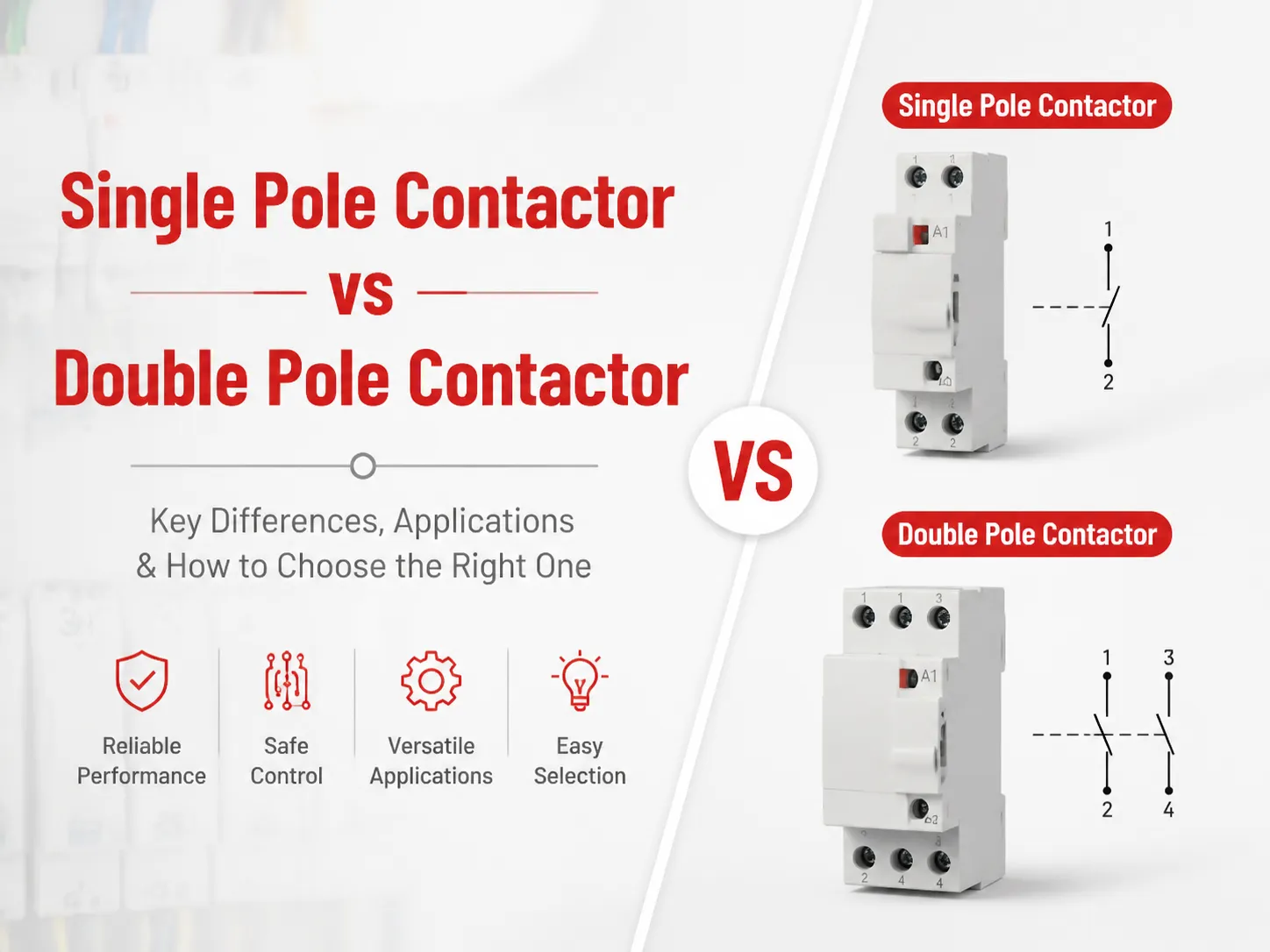
Faktor lain yang harus diperhatikan adalah jumlah kutub. Untuk motor tiga fase, unit tiga kutub adalah standar; opsi satu kutub dan dua kutub tersedia untuk pemutusan netral, beban satu fase, atau dua sirkuit terpisah, dan sangat penting untuk memahami bahwa perangkat dua kutub harus dihubungkan berbeda dari perangkat satu kutub meskipun keduanya memiliki jumlah kutub yang sama.
Selain itu, keluarga bingkai harus diperhitungkan saat mencari aksesori. Blok kontak tambahan dapat dipasang di atas atau di samping, datang dengan kombinasi kontak normally open atau normally closed yang berbeda, mengandung kepala penundaan waktu pneumatik, penutup debu, modul penekan lonjakan, dan interlock mekanis untuk pasangan pembalikan.
Kategori Pemanfaatan: Tempat Penentuan Ukuran Motor Sebenarnya Terjadi
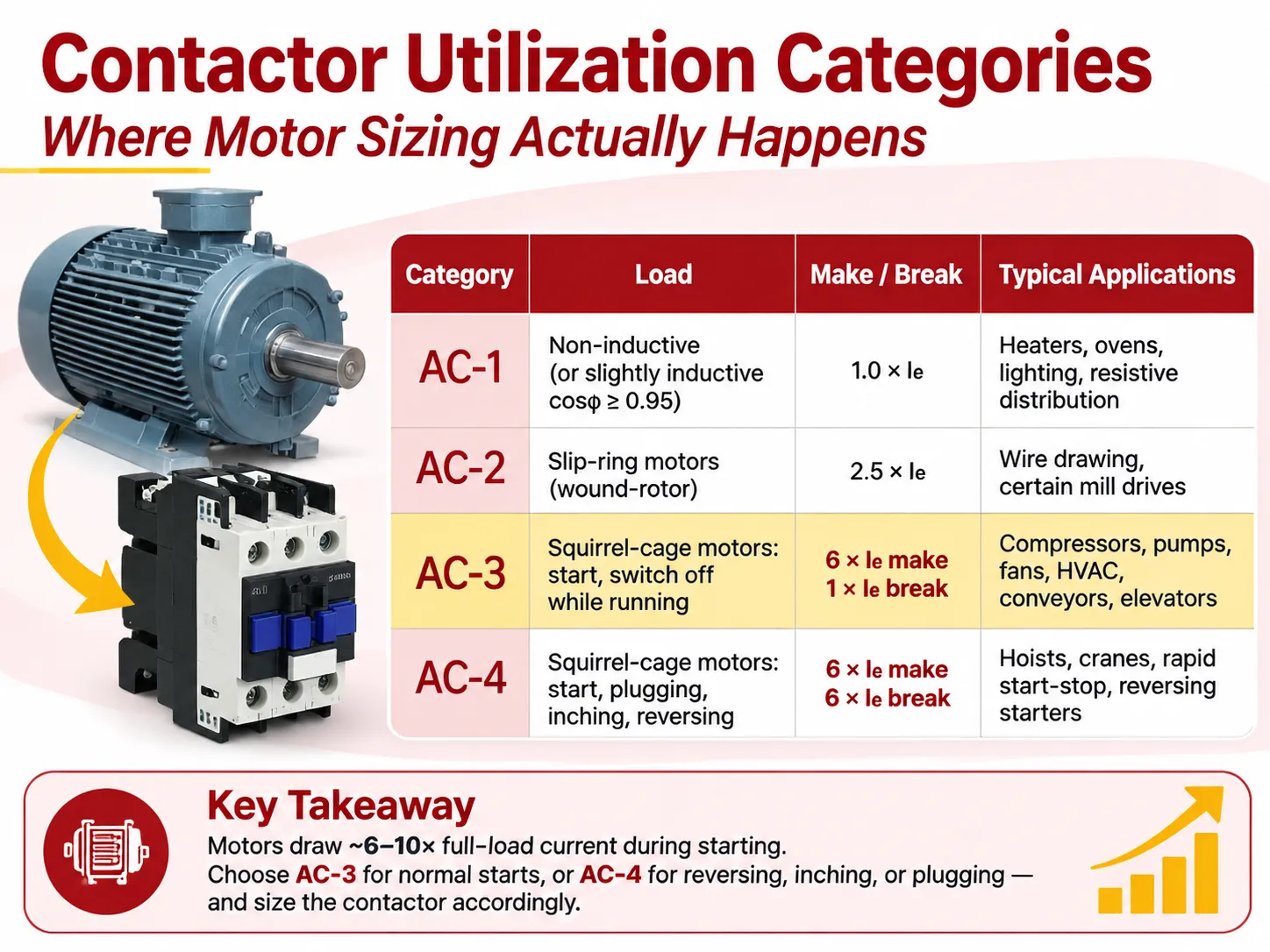
Klasifikasi penggunaan contactor ditetapkan dalam IEC 60947-4-1 dengan menggabungkan kondisi operasionalnya yang harus melalui uji persetujuan tipe. Dari berbagai alternatif, empat yang paling umum digunakan dalam praktik, dan perbedaannya tidak hanya bersifat formal.
| Kategori | Beban | Membuat / memutus | Aplikasi tipikal |
|---|---|---|---|
| AC-1 | Non-induktif atau sedikit induktif (cosφ ≥ 0,95) | 1,0 × Ie | Pemanas, oven, pencahayaan pijar, distribusi resistif |
| AC-2 | Motor slip-ring (rotor lilitan) | 2,5 × Ie | Penarikan kawat, beberapa penggerak pabrik warisan |
| AC-3 | Motor sangkar tupai: mulai, matikan saat berjalan | 6 × Ie membuat, 1 × Ie memutus | Kompresor, pompa, kipas, HVAC, konveyor, elevator, mixer |
| AC-4 | Motor sangkar tupai: mulai, plugging, inching, reversing | 6 × Ie membuat, 6 × Ie memutus | Hoist, crane, start-stop cepat, starter reversing |
Implikasi dalam kehidupan nyata. Motor akan menarik arus sekitar enam hingga sepuluh kali nilai arus maksimumnya saat mulai, dan contactor harus tahan terhadap kondisi ini. Dalam kasus operasi penggerak motor sederhana ketika hanya menghidupkan dan mematikan motor saat berjalan, itu akan menjadi AC-3; jadi, kolom AC-3 harus digunakan. Dalam kasus aplikasi khusus lain ketika motor membalik arah beberapa kali atau sedang diinch, AC-4 akan berlaku dan sebenarnya, perangkat perlu di-upsize karena saat AC-4 memutus, arusnya enam kali lebih tinggi dari arus normal, sehingga perangkat biasanya harus ditingkatkan satu atau dua frame dan terkadang memiliki perangkat proteksi yang lebih besar juga.
Tabel EXC7 menerbitkan kedua kolom sehingga memungkinkan untuk menentukan ukuran perangkat dengan tepat. Misalnya, dalam kasus frame 32 A AC-3 pada 400 V arusnya adalah 32 A tetapi untuk AC-4 hanya 12 A. Inching 12 A pada contactor 32 A diperbolehkan tetapi inching 25 A tidak diperbolehkan.
Contactors AC dan DC Tidak Dapat Dipertukarkan
Ini adalah pertanyaan yang paling sering diajukan, dan tiga alasan mekanis menjelaskan jawabannya.
Busur. Arus bolak-balik mencapai nol dua kali setiap siklus setelah itu busur kehilangan energinya. Jika celah antara titik kontak dan arc chute telah memperoleh kekuatan dielektrik, busur tidak akan menyala lagi. Oleh karena itu, trafo standar menggunakan celah kecil dan arc chute tipe grid. Arus searah tidak mencapai nol, sehingga busur akan terus melakukan tugasnya sampai terputus. Contactors DC dilengkapi dengan koil pemadam magnetik, pelari busur, celah yang lebih besar, dan terkadang kedap udara atau vakum. Jika busur DC diterapkan pada contactor AC, busur akan bertahan lebih lama dari perangkat, menyebabkan erosi signifikan atau pengelasan kontak.
Kumparan. Ini adalah jenis kegagalan yang paling umum. Impedansi kumparan AC terutama terdiri dari reaktansi induktif, yang merupakan fungsi dari frekuensi. Jika kumparan dihubungkan ke DC, frekuensi menjadi nol, reaktansi menjadi nol, dan kumparan akan bertindak sebagai resistor dengan resistansi sangat rendah. Akibatnya, arus akan naik hingga 5-10 kali nilai terukur, dan kumparan akan terbakar dalam hitungan detik. Proses sebaliknya tidak begitu mencolok, tetapi tetap merupakan kegagalan: kumparan DC pada AC tidak dapat beroperasi dengan baik, karena memiliki resistansi yang lebih tinggi.
Inti. Inti padat yang bekerja di bawah DC stabil akan terbakar di bawah AC. Selain itu, inti AC membuang-buang material untuk DC. Ini adalah jawaban yang sering salah dipahami oleh para insinyur: kontaktor AC menggunakan inti berlapis, sementara kontaktor DC menggunakan inti padat.
Meskipun ada kumparan universal AC/DC yang dibuat dengan penyearah dan regulator, mereka masih lebih mahal dan hanya beroperasi dalam rentang tegangan tertentu. Jika label hanya menyebutkan satu tegangan dan jenisnya, anggap itu benar. Pasokan kumparan yang salah adalah salah satu cara tercepat untuk merusak kontaktor.
Ketika Anda membutuhkan kontaktor DC untuk aplikasi switching DAV aktual seperti baterai, string DC surya, stasiun pengisian EV, atau drive DC. Lanskap manufaktur untuk keluarga produk tersebut adalah rantai pasokan yang berbeda, dan tinjauan ini tentang pabrik kontaktor DC terkemuka adalah titik awal yang berguna untuk mendapatkan satu.
Apakah Kontaktor adalah Pemutus Sirkuit?
Tidak, dan kebingungan ini menyebabkan kesalahan desain yang nyata. Tiga perangkat berbeda melakukan tiga pekerjaan berbeda.
| Perangkat | Pekerjaan | Trip arus lebih | Frekuensi operasi |
|---|---|---|---|
| Kontaktor | Pengalihan jarak jauh beban | Tidak ada | Very high (hundreds of thousands of cycles) |
| Relay | Control-circuit switching and logic | Tidak ada | High, but low current |
| Pemutus sirkuit | Fault and overload interruption | Ya | Low (rare operation) |
| Thermal overload relay | Motor overload protection | Yes, via the contactor | Trips once, then resets |
| Motor circuit protector (MCP) | Short-circuit protection only | Magnetic only | Rare |
A contactor isn’t built to handle any short-circuit event, and its contacts will be damaged if it tries. A motor starter has all of the three devices working in synchronization: the contactor does the switching, the overload relay makes sure that there has been sustained overcurrent and opens the circuit of the contactor coil, the disruption of the current in the circuit happens upstream by the breaker or the fuse. That is why we need to know about the coordination Type 1 and Type 2 ratings since they tell us what will happen to the contactor when there is a short circuit with the Type 2 rating meaning that contact welding is not permitted.
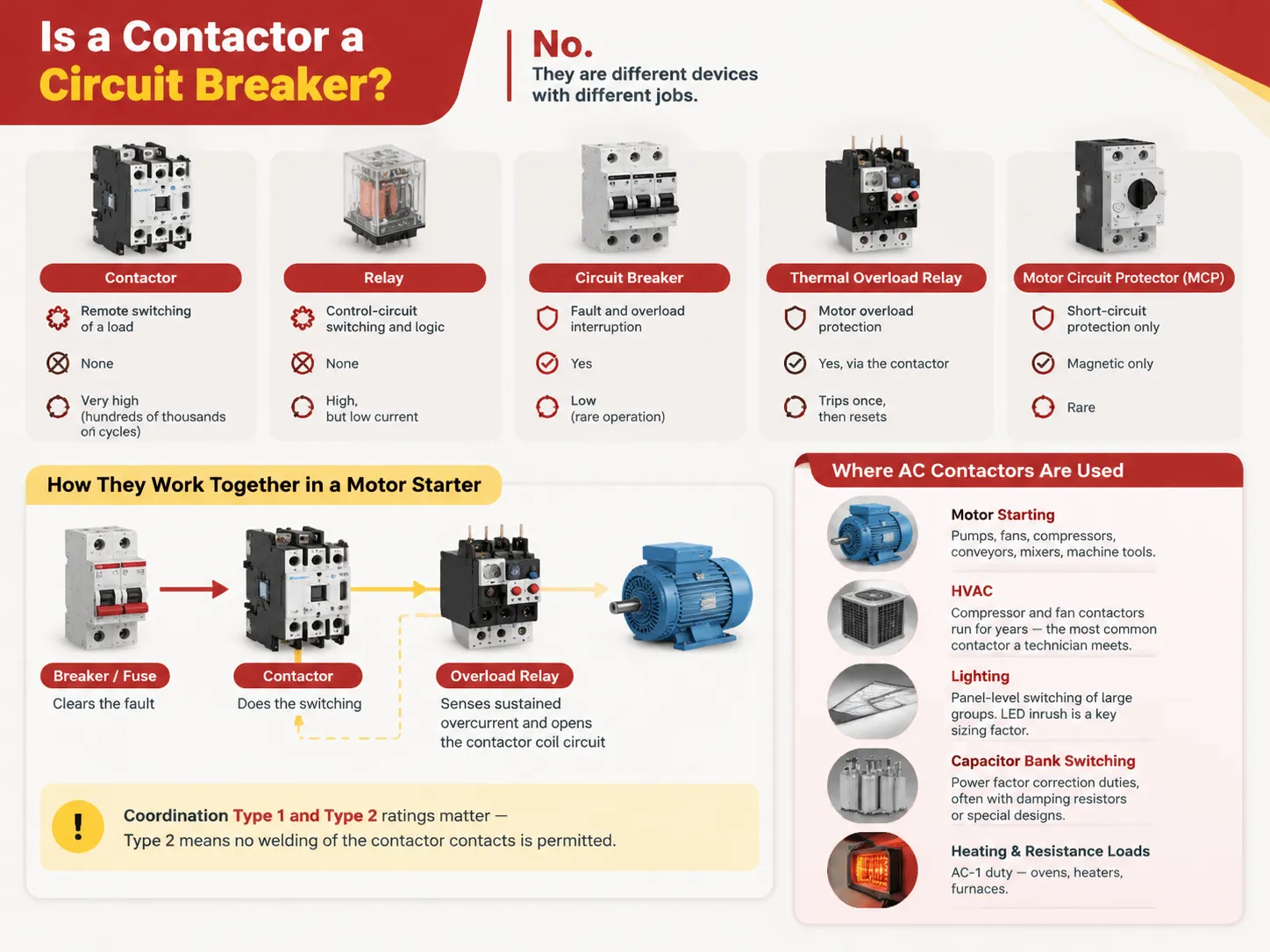
Where AC Contactors Are Used
Five categories of applications account for the majority of the industry.
- Starting of motors. This includes pumps, fans, compressors, conveyor belts, mixers, and machinery where a small motor is either operated directly or in a star-delta combination or via a soft start for larger motors as well.
- HVAC. The contactors employed in compressors and fans operate for many years and are the type of contactor most frequently seen by a technician. How this task affects the contactor after multiple starts and what failures the contactor experiences and which are caused by the refrigeration circuit must be treated separately, and the processes will be discussed in the current clarification of the operation of the contactor for HVAC equipment.
- Lighting. This is related to the control of lighting at the switchboard level where the total inrush is a proper design component due to the new LED lamp drivers.
- Switching capacitor banks. This is a function of power factor correction which involves large inrushes and utilizes damping resistors or special design contactors.
- Heating and resistive loads. This is an AC-1 function which ensures a long service life of the contactor: furnaces, heaters, stoves.
Contactors, Starters and Motor Circuits
The contactor in association with a thermal overload relay functions just like an electromagnetic starter. This combination is what is used in many three-phase motor installations.
- Direct-on-line (DOL). Only a single contactor. It has full voltage during starting. This method is simple and cheap but has its limits beyond which the electrical supply company does not approve the starting current.
- Reversing. It uses two contactors that have physical and electrical interlocks so that both can never be on at the same time. The interlock device is necessary because a control problem can cause both contactors to be closed together.
- Star-delta. This system uses three contactors and also utilizes the timer for reducing starting current while introducing some complications in the station.
- Soft Starter/VFD. This system is used at places where starting current or torque control is important, and in this case, the contactor acts as a bypass or isolation device rather being the main switching element in the circuit.
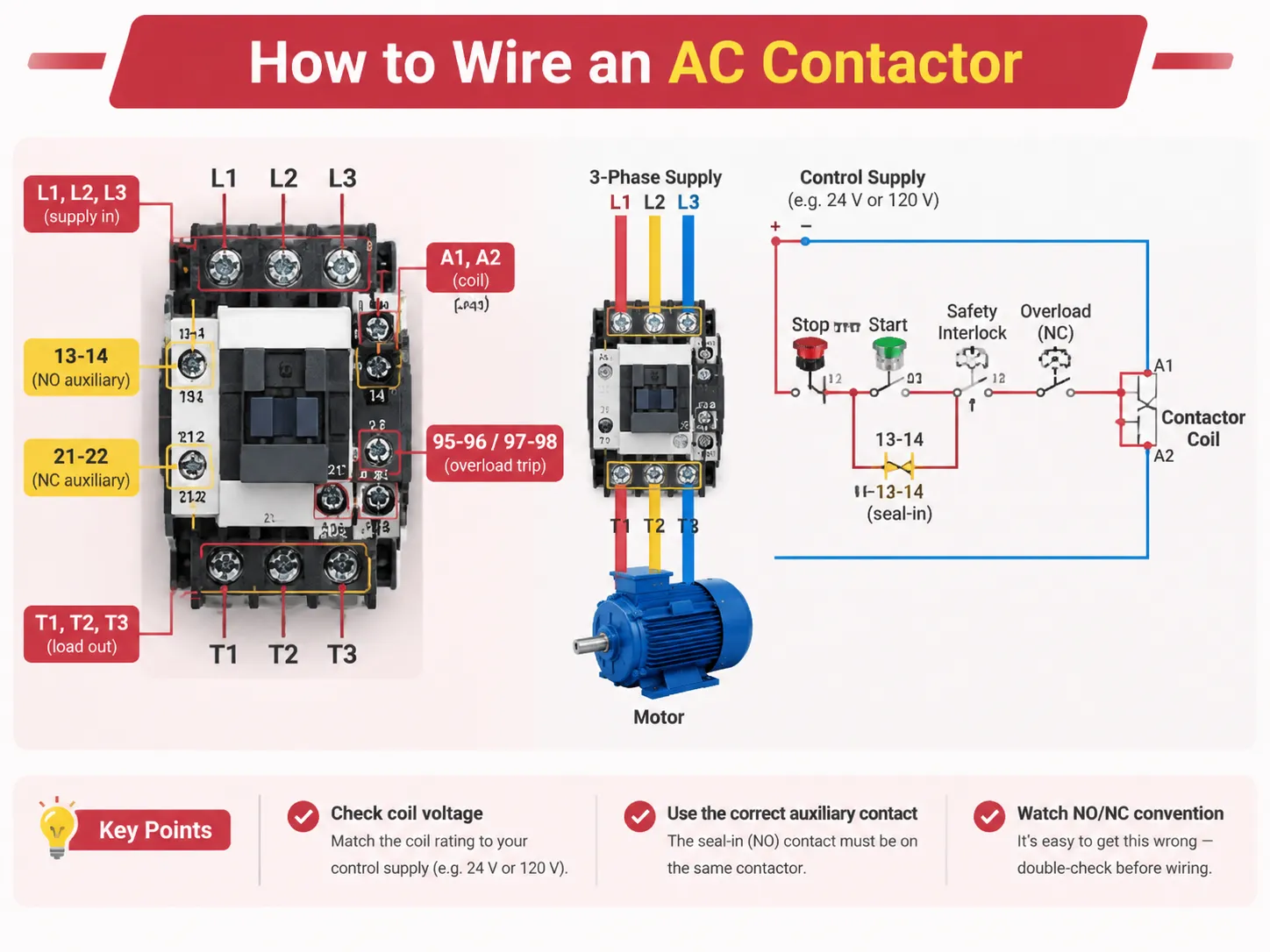
How to Wire an AC Contactor
The standard identification of each terminal should be memorised. If there is a mistake in the identification of any terminal, the contactor may falsely seem to operate but control something else.
| Terminal | Arti |
|---|---|
| L1, L2, L3 | Line side of the main poles (supply in) |
| T1, T2, T3 | Load side of the main poles (motor out) |
| A1, A2 | Coil terminals |
| 13-14 | Normally open auxiliary contact |
| 21-22 | Normally closed auxiliary contact |
| 95-96 / 97-98 | Overload relay trip contact (NC / NO) |
The wiring corresponds to its purpose. L1 to L3 correspond to power supply wires, while T1 to T3 correspond to the motor wires. The control circuit is supplied through A1 and A2 of the start button, stop button, relevant safety interlocks and normally closed contact of overload relay.
A few practical notes. First of all, test the voltage before wiring up the coil as a coil rated for 120 V will not work when connected to 24 V supply. Secondly, make sure that the AUX contact used for seal-in is actually present on the contactor on which it is sealing rather than being part of a separate relay located in the vicinity. Getting the NO/NC convention wrong is common enough to be worth a deliberate check, and the distinction is explained clearly in this comparison of normally open versus normally closed contactor wiring.
Installing and Maintaining an AC Contactor
There are two main factors that influence installation: torque and environment. In the EXC7 family of products, terminals have capacities that vary from 1 to 4 mm² in the smallest frames to 50 to 240 mm² in the largest. The fastening torque ranges from 1.2 N·m to 14 N·m. Most of the field failures of contactors are due to terminals not receiving proper torque—they end up being loose, causing heating, which leads to the failure of the terminal block.
The presence of dust covers is well justified in factories, woodworking shops, or agricultural plants since abrasive or conductive dust would wear the contacts mechanically and electrically much faster than the accessory itself would cost. Surge suppression modules also help out; when you switch a coil, the inductive effect might end up damaging the output of a PLC if not properly suppressed. AC coils often use RC snubbers or varistors while DC coils use the flyback diode or transient voltage suppressor (TVS) though the latter has a downside: simple diodes slow release timing, making them less suitable for circuits where such timing checks are required for safety.
Maintenance is not a complex process: just isolate the circuit and perform the following operations. You need to check the state of wear of contacts and pitting; see if the screws in the terminal are tight; and check the mechanical functioning of the armature and the arc chutes. Then take the readings of the coil. The coil resistance between A1 and A2 should be about tens of ohms if the coil is healthy. If the contactor does not show any odd readings, there will be a low resistance in case of a short. The voltage drop across a closed pole while the load is switched on will be in millivolts but a reading of one volt or higher indicates that the contactor is in danger of overheating.
The most helpful thing a maintenance program can do is to monitor symptoms. Будучиaanut what type of fault occurs when a contactor starts to buzz, trip overload more frequently, or hold the circuit. Collecting those early signals and acting on them is the whole basis of condition-based maintenance, and the pattern of warning signs is set out in this overview of Gejala kegagalan kontaktor AC.
Ultimately, it is important to express life in quantifiable terms. Electrical life is stated in terms of operational cycles and depends on duty: the same frame that supports about a hundred thousand AC-3 operations may only be capable of a fifth under AC-4. In general, mechanical life is greater than electrical life by a factor of ten. If a contactor is replaced more often than indicated by the duty cycle, then the mistake lies in sizing and not with the equipment.
What They Cost and How to Choose a Brand
Here are the prices from US and international distributors in 2026. The gap between a famous brand and a low-cost brand is real. It is visible in the kind of contact materials used to make them, not the plastic.
| Item | Typical price | Catatan |
|---|---|---|
| General-purpose relay, 10 A | $8–$15 | Control circuits only |
| Contactor, 9–18 A AC-3 | $15–$45 | Premium brands at the top of the band |
| Contactor, 25–40 A AC-3 | $40–$95 | Most common motor sizes |
| Contactor, 50–95 A AC-3 | $90–$250 | Frames get heavier; accessories extra |
| Contactor, 120–800 A | $250–$1,500+ | Frame size dominates the price |
| Thermal overload relay | $25–$120 | Matched to the contactor frame |
| Auxiliary contact block | $8–$25 | Per block |
| Surge suppression module | $10–$30 | RC or varistor for AC coils |
When it comes to choosing the right brand, it is no secret that major players such as Schneider, ABB, Siemens, Eaton, WEG and LS perform best when it comes to the type test results and the amount of documentation available to customers. They, however, require you to pay for it. Even though cheaper replicas of such products do exist, they are generally meant for heavier use; however, corners are being cut in the contact part, resulting in short life cycles of the devices themselves.
HUYU is in the second category, having an undeniable advantage of offering an extensive product line instead of a few types of equipment, which puts them at the bottom of the competition. The EXC7 AC contactor range covers 9 A to 800 A in one platform with the same accessory system — auxiliary blocks, delay heads, dust covers, suppressors and interlocks — and the high-current frames use a dual-coil control circuit that cuts holding power by more than 40%, which matters on a panel that runs continuously. What HUYU lacks is the decades of established customers and the native distributor network that a European brand can provide, and for a job in which the name of the brand is specified by some local utility or equipment manufacturer, this discrepancy is decisive.
FAQ
What is an AC contactor used for?
The remote and continual ability to manipulate an alternating current load. This technology is mainly used for motor control, i.e., for starting or stopping three-phase motors of pumps, compressors, fans, conveyors, mixers, machine tools, and HVAC equipment. The remaining four applications include panel lighting switching, capacitor bank switching for power factor correction, resistance heating applications like ovens and furnaces, as well as general remote circuit switching when the operator has to control the load without having the manual switch that carries the full load.
Apakah AC dapat berfungsi tanpa contactor?
Definitely. A contactor is one of many ways of switching an AC load, while smaller loads are usually switched through a manual switch, relay, solid-state relay, or some drive output. If using a contactor it means one is able to switch large currents with a small control signal and at a high rate, and also take care of arc management. If the load is small, seldom switched, or managed already by current controller, the contactor might be useless or limited to isolation functions only.
Apa perbedaan antara kontaktor AC dan DC?
The three differences are: the core – an AC contactor has a laminated silicon steel core with a shading ring whereas a DC contactor has a solid core, since the magnetic flux doesn’t change; the coil – AC coils are characterized by a low-resistance coil of only a few turns and limited by inductive reactance, while DC coils have many turns and their high resistance eliminates the effect of reactance; the function of arc control mechanism – AC uses naturally occurring zeroes of DC has to involve magnetic blowout coils, since the arc does not get extinguished by itself.
What is AC1 and AC3 contactor?
The terms are the usage categories as described in IEC 60947-4-1. AC-1 is used for either non-inductive or slightly inductive loads such as heaters and resistance loads. For AC-1 class, the only requirement for the contactor is to carry and switch the current equal to its rating. AC-3 applies to induction motors, where six times the current rating is required at the start of the motor and at switch-off operation the contactor has the same rating.When selecting the appropriate column for your application, this is one case where a 32 A rating makes sense, where AC-1 gives a rating of 50A while AC-3 gives a rating of only 32A. Thus we should be using a 32 A rated motor, not the higher number indicated on the label.
Can AC contactor be used for DC?
The normal coil does not work perfectly on the first contact or reliably on of the electrics section. An AC coil operated by DC will lose the inductive resistance, as the current will become five to ten times higher than the rated current in a second. If an AC coil is substituted with a DC coil the main contacts still will fail, as the arc chamber is designed for the arc that crosses zero in each cycle, whereas the DC arc will not break up inside the chamber.
How do I know which frame size to buy?
Consult the AC-3 column for the full-load current of this motor at its working voltage and add some margin if inching or reversing is involved; in this case, check the AC-4 column instead. Check that the appropriate accessories exist for that frame. Do not size based on the AC-1 figure or the kW figure alone, since the kW figure is declared at different voltages, hence one frame size would carry more power at 400 V and less power at 690 V.
Referensi
- UL Standards & Engagement — UL 508, Industrial Control Equipment
- NFPA — NFPA 70, National Electrical Code (motor circuits, Article 430)
- NFPA — NFPA 70E, Standard for Electrical Safety in the Workplace
- International Electrotechnical Commission — IEC 60947-4-1, contactors and motor-starters
- WEG — IEC contactor sizing, utilization categories and coordination types
Kesimpulan
Laminated core fitted with the shading coil that also works at low resistance using inductive reactance and arc chute working on zero-cross current basis. The understanding of these principles is essential; everything else is then easy.
The following points must be considered. First, the size should be chosen according to the application type and not based on the ampere rating so that in simple applications AC-3 is sufficient, whereas in some applications such as inverting AC-4 should be used, as this means achieving only half of the load required for the former; second, make sure that an AC coil is not being switched on from a DC supply, otherwise the coil would be burnt in a few seconds; and third, we need to understand that both terminal torque and arc chute and surge protection must be considered as maintenance items, not installation items.