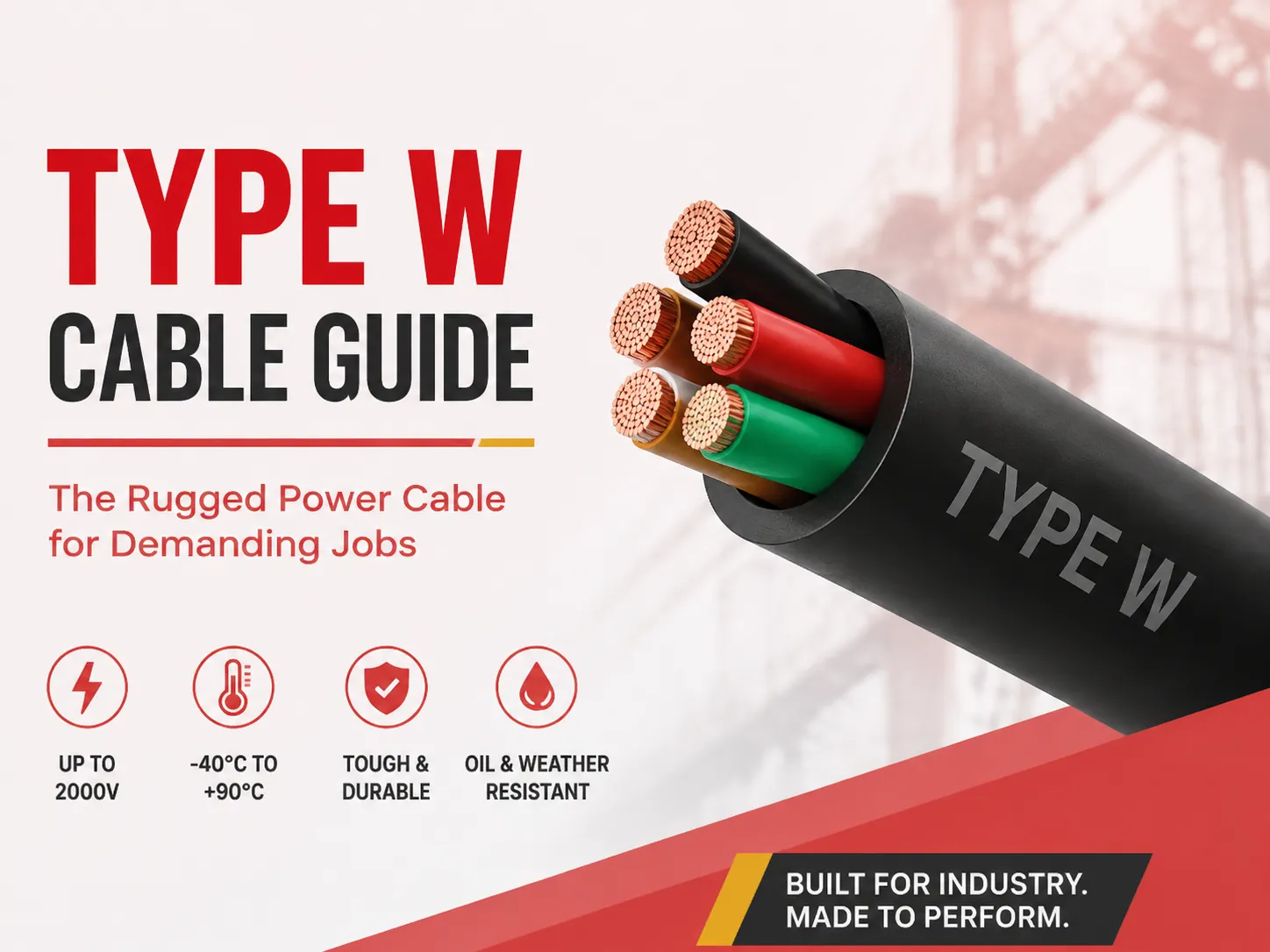
Jika Anda menemukan diri Anda menentukan kabel untuk situs konstruksi, generator, operasi pertambangan atau sistem distribusi daya portabel, Anda mungkin telah menemukan istilah “Type W” dan menghadapi kebingungan yang ditimbulkannya. “W” untuk apa? Air? Cuaca? Kabel? Dan apa bedanya dengan SOOW, yang juga memiliki “W” di dalamnya? Berikut informasi yang perlu Anda ketahui: Type W merujuk pada penunjukan UL untuk kabel daya portabel tugas berat dengan rating tegangan hingga 2000 volt, dibuat dengan isolasi EPDM tebal dan jaket CPE keras yang cocok untuk kondisi industri paling ekstrem. Artikel ini membahas apa sebenarnya arti Type W, aplikasinya, bagaimana membedakannya dari SOOW dan kabel portabel lainnya serta bagaimana memilih yang tepat.
Catatan singkat: Type W berkaitan dengan klasifikasi UL dari kabel daya portabel yang cocok untuk tegangan tinggi hingga 2000V (karena konduktor tunggal juga secara bersamaan menerima rating RHH/RHW untuk 600V). Type W memiliki isolasi karet EPDM termoset dan jaket yang terbuat dari bahan CPE atau CSPE, dan suhu operasi berkisar dari -40°C hingga +90°C, sementara konstruksinya sempurna untuk digunakan di lingkungan keras seperti pertambangan, situs konstruksi, pengeboran rig, atau pada pompa. Huruf ”W” menunjukkan bahwa ini adalah jenis kabel khusus yang tidak boleh disamakan dengan arti ”W” dalam SOOW, karena di sini berarti kabel tahan cuaca. Type W memiliki keunggulan besar dibandingkan SOOW karena memberikan rating tegangan lebih tinggi, isolasi lebih baik, dan daya tahan lebih lama.
Apa Arti “Type W”?
Ditetapkan oleh Underwriters Laboratory, penunjukan Type W mengklasifikasikan jenis kabel yang cukup tahan lama untuk digunakan dalam aplikasi yang lebih keras. Kabel ini juga dikenal sebagai kabel daya portabel, dan merupakan salah satu jenis kabel utama yang digunakan untuk pengiriman daya di lingkungan komersial.
Properti yang mendefinisikan kabel Type W:
- Rating tegangan: Type W dinilai untuk tegangan tinggi hingga 2000 volt AC atau DC (ketika beberapa konduktor digunakan) yang secara signifikan lebih tinggi daripada kabel tegangan rendah standar. Konduktor individu juga memenuhi rating ganda RHH/RHW pada tegangan 600 volt.
- Isolasi: karet EPDM (ethylene propylene diene monomer) termoset menyediakan bahan isolasi yang tahan lama dan tahan suhu tinggi.
- Jaket: jaket CPE (chlorinated polyethylene) atau CSPE memberikan perlindungan andal terhadap bahan korosif dan kelembaban.
- Rentang suhu: -40°С hingga +90°С.
- Konduktor: 1 hingga 5 konduktor (hitam, putih, merah, hijau, oranye) cocok untuk fleksibilitas tinggi; AWG berkisar dari 8 AWG hingga 500 MCM ketika digunakan sebagai konduktor tunggal dan dari 8
- AWG hingga 4/0 AWG ketika digunakan sebagai kabel multi-konduktor.
Singkatnya, kabel Type W adalah kabel yang digunakan ketika kabel ekstensi standar atau bahkan kabel SOOW tidak dapat menahan arus dan aplikasi tegangan yang diperlukan di lokasi kerja, tambang, dll.
Kebingungan “W”: Type W vs W dalam SOOW
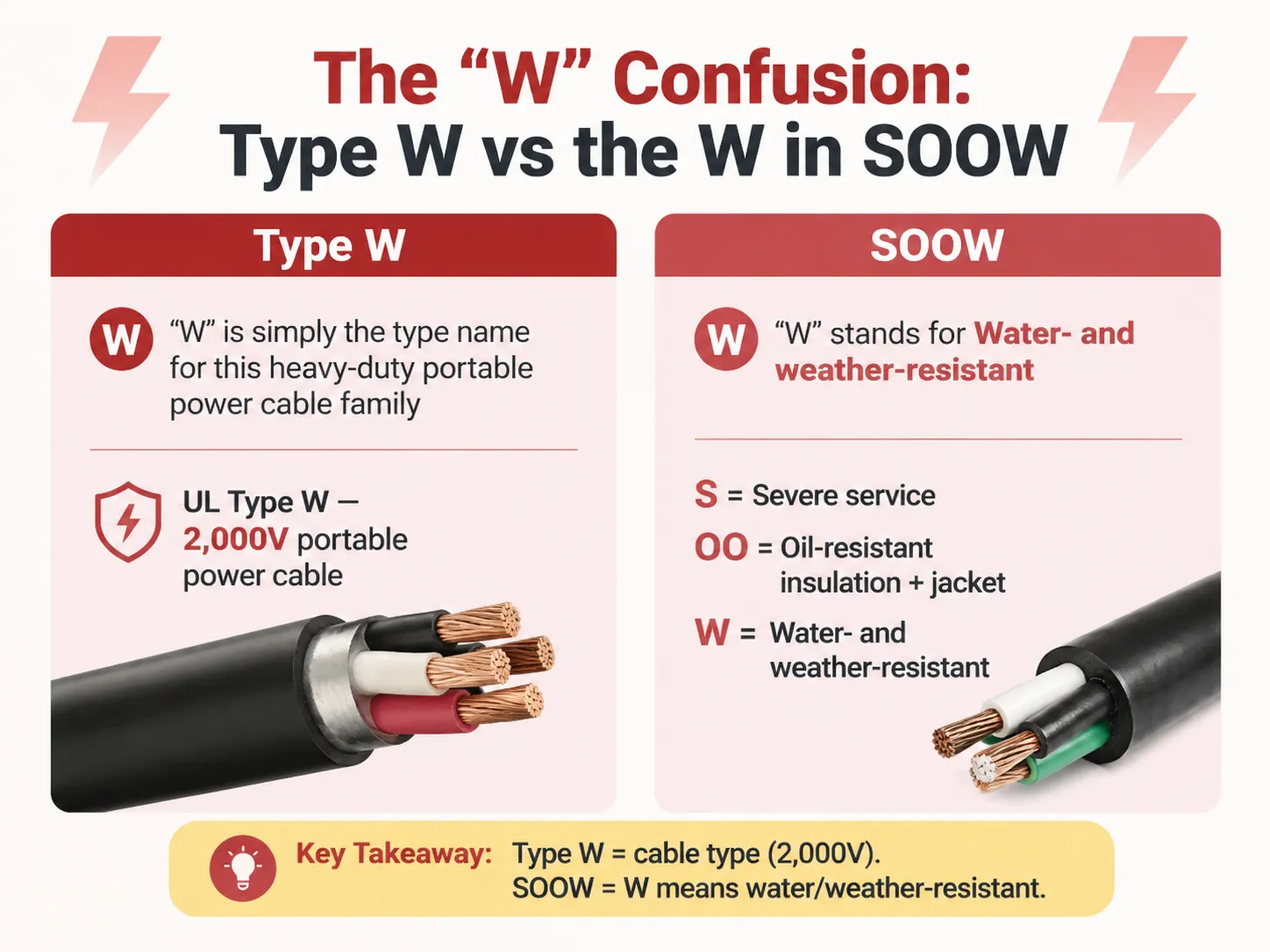
Huruf “W” muncul dalam dua jenis penunjukan kabel yang berbeda dan mereka merujuk pada dua makna yang benar-benar berbeda, menjadikannya area kebingungan terbesar.
| Penunjukan | Apa Arti “W” | Arti Lengkap |
|---|---|---|
| Tipe W (kabel daya portabel) | “W” hanyalah nama tipe untuk keluarga kabel daya portabel tugas berat ini | UL Tipe W — kabel daya portabel 2.000V |
| SOOW (kabel layanan) | “W” berarti Tahan air dan cuaca | S = Layanan berat, OO = isolasi + jaket tahan minyak, W = tahan cuaca/air |
Dengan demikian, meskipun baik “Tipe W” maupun “SOOW” memiliki “W” dalam nama mereka, pada yang pertama “W” adalah elemen dalam nama kabel, sama seperti ada tipe seperti “Tipe G” dan “Tipe SC.” Sebaliknya, dalam “SOOW,” “W” berfungsi sebagai kata sifat yang menunjukkan bahwa kabel tahan air. Oleh karena itu, siapa pun yang mencari “arti tipe w” terkait kabel hampir selalu mencari kabel daya portabel UL Tipe W daripada ketahanan air.
Spesifikasi Kabel Tipe W
Berikut gambaran lengkap dari kabel Tipe W yang khas:
| Parameter | Model |
|---|---|
| Jenis kabel | UL Tipe W (kabel daya portabel) |
| Peringkat tegangan | 000V AC/DC (multi-konduktor); konduktor tunggal dual-rated RHH/RHW 600V |
| Isolasi | Karet EPDM termoset |
| Jaket | CPE atau CSPE |
| Rentang suhu | -40°C hingga +90°C |
| Jumlah konduktor | 1-5 (hitam, putih, merah, hijau, oranye) |
| Terdampar | Tembaga stranded tali (fleksibel) |
| Ukuran konduktor tunggal | 8 AWG hingga 500 MCM |
| Ukuran multi-konduktor | 8 AWG hingga 4/0 AWG |
| Resistansi | Ketahanan abrasi, benturan, minyak, bahan kimia, dan cuaca yang sangat baik |
| Persetujuan | UL 1650, uji api MSHA, uji api UL, ICEA S-75-381 / NEMA WC-58, CSA, RoHS |
The notable features here are the 2,000V rating (approximately 3.3 times that of the 600V SOOW), along with a thick and sturdy jacket that has no trouble with rocks, vehicles or bad weather.
What Is Type W Cable Used For?
Type W is preferred everywhere portable machinery needs high voltage, high current, and strong construction:
- Mining — energizing drills, conveyors, pumps, and transport equipment (MSHA-approved for mining).
- Construction — temporary electrical supply from generators to panels, welders, and heavy machines.
- Rental of generators — connecting generators to distributing boxes and transferring equipment.
- Oil, gas, and drilling rigs — energizing mud pumps, winches, and devices on the drilling sites.
- Marine transportation — providing shore power and heavy marine operations.
- Entertainment — ensuring high-power distribution from production trucks.
- Industry— temporary electrical supply for maintenance, downtime, and transport machinery.
- Pumps and cranes — motors that use a lot of current over a long distance.
Being rated as RHH/RHW, Type W can act as versatile connection wire in conduits.
Type W vs SOOW: The Key Differences
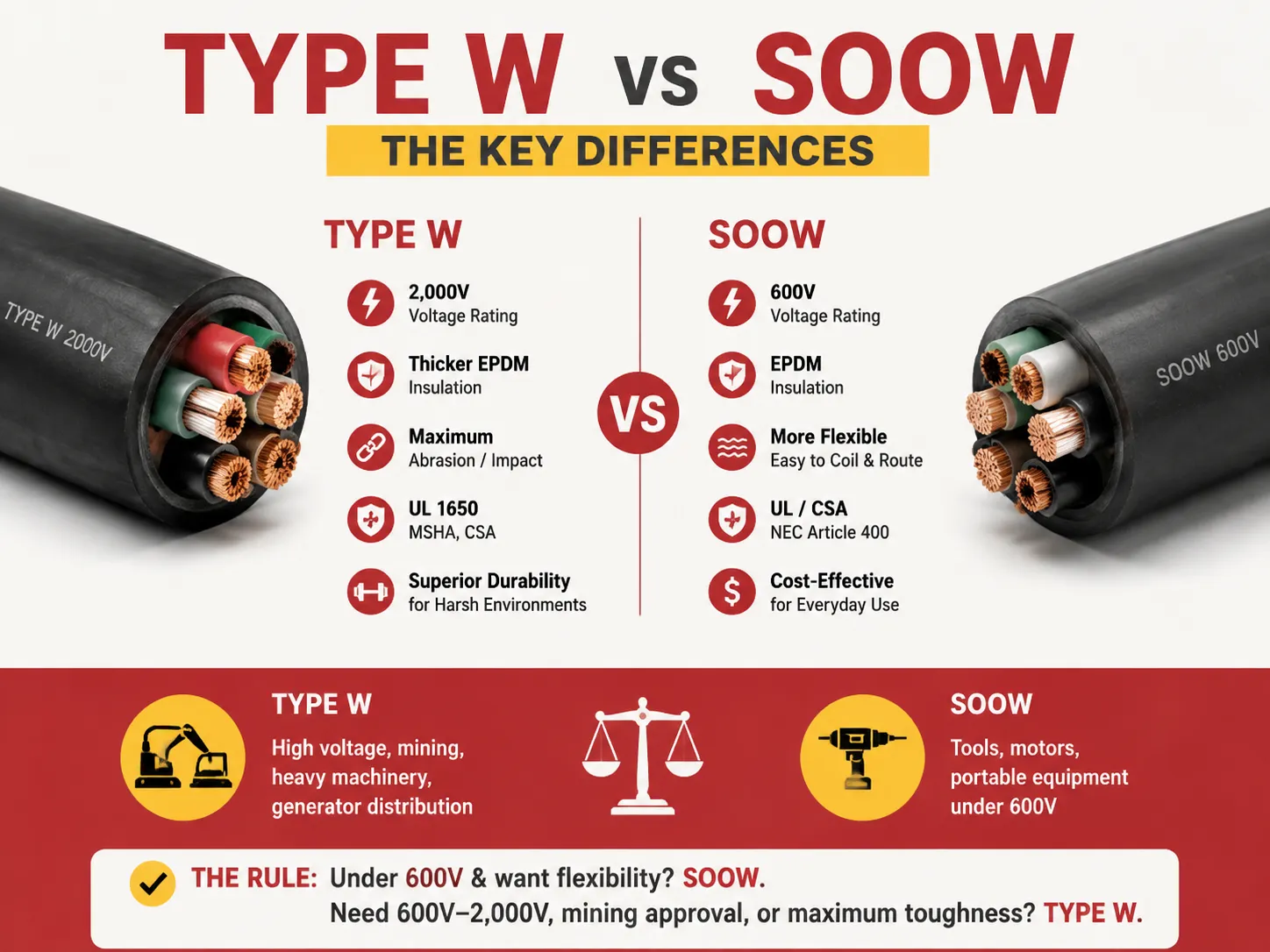
| Fitur | Tipe W | SOOW |
|---|---|---|
| Kategori | Portable power cable | Service cord |
| Peringkat tegangan | 2,000V | 600V |
| Isolasi | Thicker EPDM | EPDM (thinner) |
| Jaket | Heavy CPE/CSPE — maximum abrasion/impact | CPE — tough but more flexible |
| Flexibility | Stiffer, heavier | More flexible, easier to coil and route |
| Durability | Superior — survives vehicles, rocks, crushing | Good — suited to most job sites |
| Typical sizes | 8 AWG to 4/0 (multi-conductor); up to 500 MCM single | 18 to 6 AWG typical |
| Key approvals | UL 1650, MSHA, CSA | UL/CSA, NEC Article 400 |
| Biaya | Higher per foot (more copper + insulation) | Lebih rendah |
| Terbaik untuk | High voltage, mining, heavy machinery, generator distribution | Tools, motors, portable equipment under 600V |
In a nutshell: be below 600V and need flexibility? Choose SOOW; need 600V-2,000V, can afford having its mining suitability certified or functions at its maximum tensile strength? Choose Type W.
Type W vs Other Portable Cables (SJOOW, SEOOW, STOW, Type G)
The portable-cable family has many members; here’s how Type W stacks up:
| Cable Type | Tegangan | Key Feature | Penggunaan Terbaik |
|---|---|---|---|
| SJOOW | 300V | “Junior” service cord — thin, flexible | Light tools, small appliances |
| SOOW | 600V | Severe-service cord, oil + water resistant | General industrial tools and equipment |
| SEOOW | 600V | Thermoplastic elastomer jacket | Freezing environments, extreme cold |
| STOW | 600V | Thermoplastic (PVC) jacket | Consumer-grade extension cords |
| Tipe W | 2,000V | Heavy portable power cable, MSHA | Mining, high-voltage distribution, heavy equipment |
| Type G | 2,000V | Very similar to Type W; ground conductors included in the assembly | Portable power distribution with integrated ground |
Type W and Type G can almost be regarded as siblings as both of them are portable power cables rated at 2,000V, which means they can withstand and endure a lot of wear and tear. What separates Type W from Type G however is that Type G constructions typically come with grounding conductors as part of the package while Type W depends on the conductor arrangement that has been specified to achieve grounding. In most instances high voltage portable work can be achieved through the usage of either dressing; it is just important to check which dressing is most appropriate for the job at hand.
Approvals & Standards
Type W cable possesses numerous certifications that guarantee its success in many applications:
- UL 1650 — This is the portable power cable standard.
- UL Type W listing — Rated for 2,000V in any configuration.
- UL dual rated RHH/RHW — indicates that the single conductors are rated for 600V as general building wire.
- MSHA flame test — Approved for mining use (needed for underground applications).
- ICEA S-75-381 / NEMA WC-58 — They are recognized portable cables standards.
- CSA approval — The Canadian qualification.
- RoHS — This means that the restricted hazardous substances are not present.
If your project is connected to MSHA, you will need Type W cable — SOOW won’t make it through the inspection.
How to Choose: Type W or SOOW?
Proceed to ask the following questions in order:
- What is the required voltage for the equipment? For any voltage greater than 600V, Type W is the choice. For voltages equal to or below 600V, both options would suffice.
- How severe is the working environment? If mining is involved (severe pressure from rocks, equipment being dragged over cables, heavy crushing etc.), it is advisable to go with Type W since its jacket is thicker.
- Do you need permission from MSHA? If the application is taking place underground, choose Type W.
- How flexible should your cable be? If flexing around tight corners, twisting and turning is required, it is preferable to go for SOOW.
- Working under how much money? Type W has a higher price than SOOW, if less than 600V is needed, choose SOOW.
Safety & Usage Rules
- Examine before every use — look for any damage such as cuts, scrapes, compression areas, or exposed wires; Type W is durable, but it is not indestructible.
- Do not use as a permanent building wire within walls — it is a portable wire; for permanent electrical work, the wiring used is THHN/THWN with conduit.
- Do not direct bury unless the construction is designed to be buried — check the jacket markings and local requirements.
- Choose the correct ampacity according to the load — Type W wire can take 2,000V but this refers to the voltage capacity and not the ampacity.
- Prevent damage — use ramps or elevated ways where trucks and cars travel on the cable; avoid putting the cable in standing and stagnant water.
- Scrape off the oil and other chemicals immediately after the cable is overexposed to them — the coat of the cable can be oil-resistant, but it will hold longer without these chemicals.
Prices & Where to Buy
The reason behind the higher price of Type W in comparison to SOOW is that Type W uses more copper and heavier insulation material. Typical pricing estimates per foot for 2025-2026 (for multi-conductor copper wire) is as follows:
| Conductor Size | Typical Price per Foot |
|---|---|
| 8 AWG (3-4 conductors) | $4-$8 |
| 6 AWG | $6-$12 |
| 4 AWG | $8-$16 |
| 2 AWG | $12-$24 |
| 1 AWG | $15-$30 |
| 1/0 AWG | $18-$38 |
Different pricing applies depending on the wiring installation, based on the conductor number, insulation material, and supplier; however, the cost is lowered greatly when purchased in bulk from the wire distributor.For buyers building distribution systems around portable power — generators, transfer switches, and the protection gear behind them — pairing the right cable with the right MCB/MCCB protection and a certified pemutus UL 489 keeps the whole power chain safe and code-compliant — and when a breaker eventually needs replacing, the costs in our breaker replacement guide help you budget the job.
Pertanyaan yang Sering Diajukan
What is the main difference between Type W and SOOW cables?
The differences between them consist of their ratings and durability: Type W has a tough portable power cable rated for extreme use with voltages of up to 2,000V thanks to its thick layers of EPDM insulation and CPE jacket while SOOW is a more flexible and less costly cable rated for 600V use. Type W is also MSHA-approved for use in mines. Use SOOW at less than 600V if flexibility is required; choose Type W for any higher voltage or maximum durability.
Does SOOW cable need to be in conduit?
NO – SOOW is a service cord that makes it possible to operate without conduit’s help in a flexible application (NEC Article 400). Its use for permanent installation is not permitted, and it is not approved for underground installation. Permanent installation requires the use of building wires (THHN/THWN) and conduit, while SOOW can be employed for portable power supply tasks.
What voltage is SOOW rated for?
SOOW has a voltage rating of 600 volts (plus 300V versions referred as junior SJOOW). SOOW cable can be used for applications involving most power tools, motors as well as machinery. However, Type W cable is required for higher voltage systems as well as for mining operations requiring MSHA approval.
Can Type W cable be used as building wire?
Single conductor Type W is a dual rated cable with both RHH and RHW ratings up to 600 volts. For this reason, single conductor Type W can be used as industrial hook-up wire in conduit up to 600 volts. However, while multi-conductor Type W is meant to be used for temporary power, using this type for permanent installation is not recommended. Always check local codes in accordance to the specific use of the cable.
Referensi
- Allied Wire & Cable — Type W Cable Specifications and Applications
- UL — UL 1650 Portable Power Cable Standard & Type W Listing
- MSHA — Mine Safety and Health Administration Cable Requirements
- NFPA 70 (NEC) — Article 400 Flexible Cords and Cables
- NEMA — NEMA WC-58 Portable and Power Feeder Cables
- AutomationDirect — Portable Cord and Type W Selection Guide
Kesimpulan
Type W is the UL designation used for the heavy-duty flexible power cable that is sought after in industrial environments when the task is major and the surroundings difficult: rated for 2000 volts, made of the EPDM rubber material and CPE plastic, able to work in the temperature range from -40 to +90 degrees Celsius, MSHA compliant for mining applications. The “W” refers to the type of the cable and not to the “water resistant” W in SOOW, which is a different cable type working on 600 volts with higher flexibility and lower cost. Use SOOW cable for general-purpose portable tools, and Type W for high voltage power distribution, mining, generators, and heavy machinery — and always combine this cable with approved safety equipment.