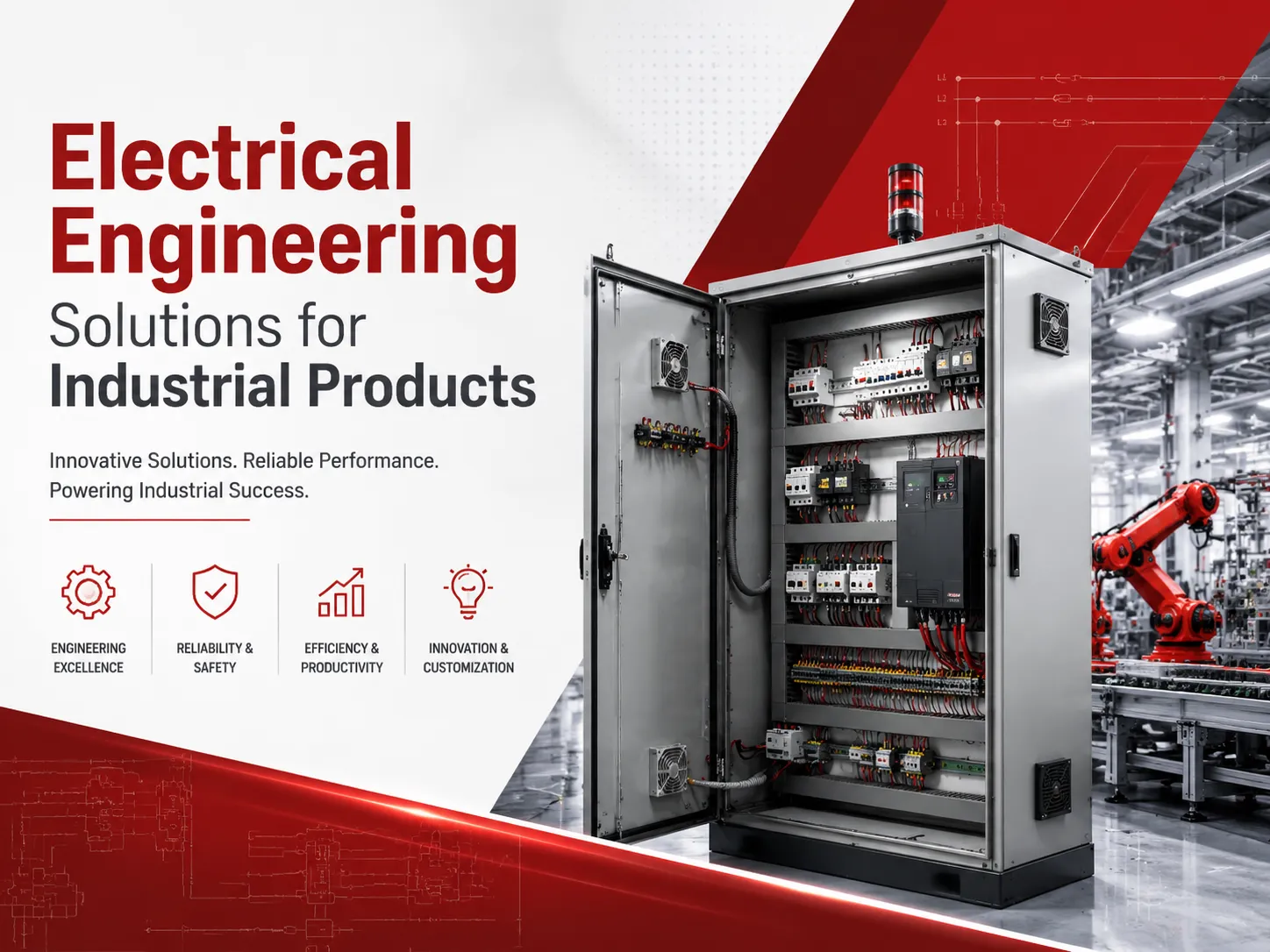

Normalmente, os gestores de instalações não selecionam seu empreiteiro elétrico com base em campanhas de marketing. Eles têm motivações diferentes para fazer a escolha – por exemplo, podem ter um inquilino para adaptar com urgência e sentir a necessidade de selecionar um empreiteiro elétrico ou ter que fazê-lo devido a outro problema, como uma falha na inspeção ou o quadro de distribuição cheio. Ao procurar empreiteiros elétricos para seu projeto, os gestores de instalações têm apenas três fontes para a lista restrita. Pode ser um conselho de um empreiteiro geral, um conselho de um distribuidor ou uma pessoa que ligou logo pela manhã.
O que as empresas oferecem, quais empresas prestam serviços em que nível, quanto esses serviços custarão em 2026, como os licitantes qualificados diferem dos licitantes baratos, por que a resposta pode mudar dependendo se o projeto é realizado na Europa ou na América do Norte.
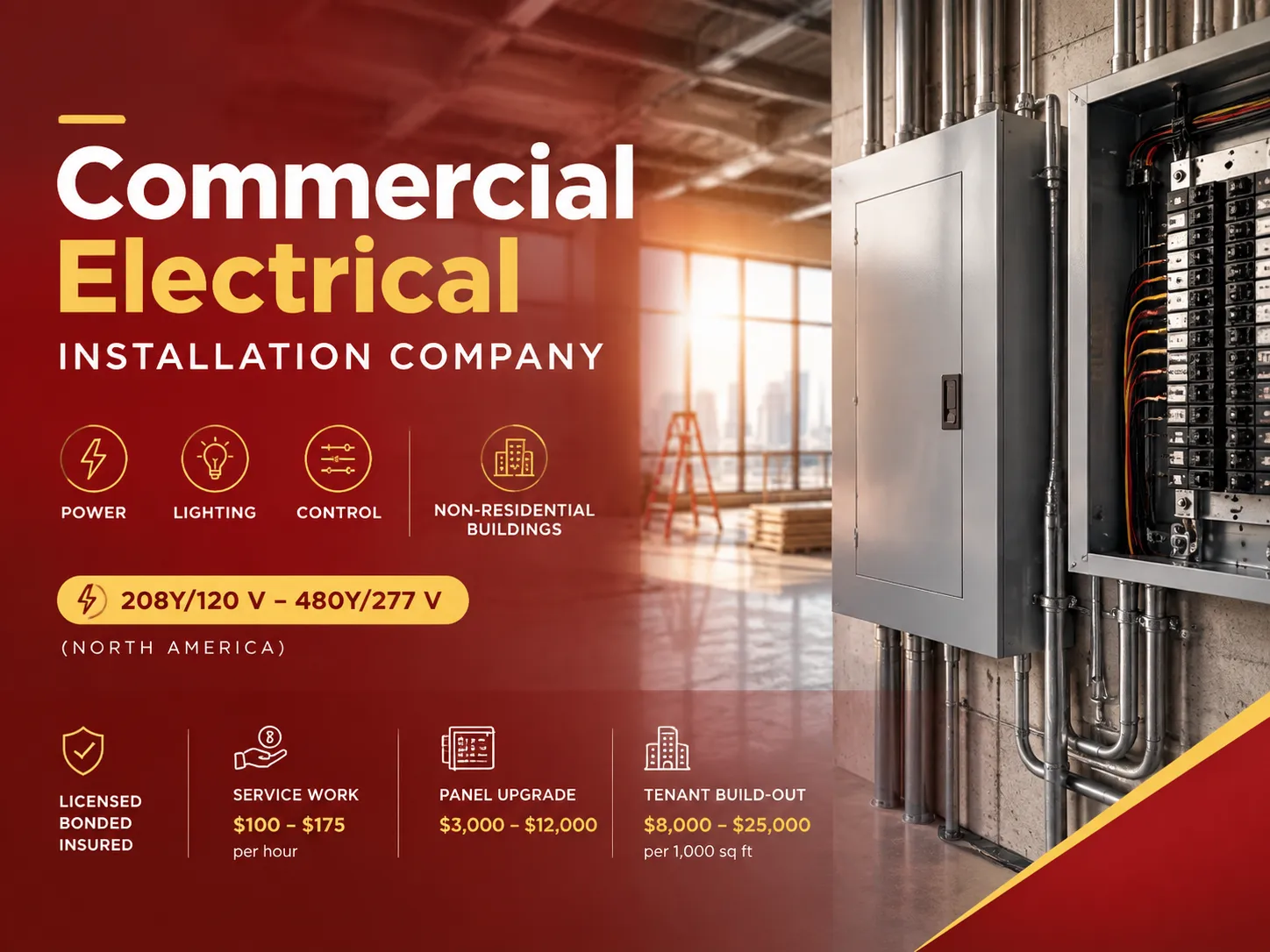
Resposta curta: Um empreiteiro elétrico é uma empresa que realiza o projeto, instalação de equipamentos, testes e comissionamento de sistemas elétricos em propriedades comerciais. Na América do Norte, sistemas de baixa tensão operam dentro da faixa de tensão nominal de 208Y/120 V a 480Y/277 V, o que significa que as empresas devem obter uma licença, caução e cobertura de seguro adequada conforme os requisitos do estado. Os serviços prestados podem custar entre 100 e 175 dólares por hora, sendo que a atualização de um painel de serviço comercial pode custar de 3.000 a 12.000 dólares, enquanto a adaptação para inquilino pode variar de 8.000 a 25.000 dólares por mil pés quadrados de instalações. No entanto, em alguns casos, empresas nacionais podem ser muito caras, já que um licenciado confiável a nível local pode ser mais rápido e barato do que uma grande corporação. Nesse contexto, a HUYU trabalha com a montagem de sistemas de baixa tensão, como sistemas de distribuição, empreiteiros e disjuntores.
O que uma Empresa de Instalação Elétrica Comercial Realmente Faz
É a ocupação que determina o escopo, e não a metragem quadrada. Por exemplo, um consultório médico de 40.000 pés quadrados e um armazém de distribuição que também tem 40.000 pés quadrados são iguais em metragem quadrada e muito diferentes em seus requisitos. O primeiro exigirá tomadas com aterramento isolado, dispositivos de grau hospitalar, circuitos para saída de emergência e algum meio para transferência de gerador. O segundo precisará de iluminação de pé-direito alto, circuitos para niveladores de doca e uma carga substancial de motor.
O empreiteiro está sempre encarregado da entrada de serviço e distribuição principal, alimentadores e circuitos ramificados, energia e iluminação, aquecimento e resfriamento, aterramento e ligação, e supressão de surtos. Usando um modelo de projeto e construção, o mesmo empreiteiro também realiza cálculos de carga, cria diagramas unifilares e desenvolve estudos de curto-circuito e coordenação necessários para conformidade de projeto. No entanto, no caso de modelos de projeto-licitação-construção, esse trabalho é feito por engenheiros, deixando ao empreiteiro apenas o processo de construção.
A distinção entre edifícios comerciais e residenciais está no tipo de sistema utilizado e não na qualidade do acabamento. Edifícios comerciais utilizam energia trifásica: 208Y/120 V em edifícios comerciais e 480Y/277 V em edifícios mais modernos. Além disso, o método de fiação envolve o uso de conduíte e condutores separados em vez de um cabo. Finalmente, o sistema é projetado e dimensionado com base em cálculos de demanda conforme o Artigo 220 do NEC. Os dispositivos e conjuntos dentro dessa linha de distribuição possuem suas próprias normas — UL 489 para disjuntores moldados, UL 1066 para disjuntores de baixa tensão, UL 891 para painéis de distribuição, UL 1558 para equipamentos de manobra — e o conjunto completo está coberto em nosso guia de serviços elétricos comerciais.

As maiores empresas de instalação elétrica comercial
As cifras de escala mostradas são retiradas da lista dos 50 principais empreiteiros elétricos da EC&M e da lista dos 600 principais empreiteiros especializados da ENR, baseadas em ganhos reais anuais de contas. O valor total das receitas obtidas pelos 50 principais empreiteiros no último ciclo atingiu um recorde de $59,5 bilhões, sendo impulsionado principalmente por projetos relacionados a data centers, modernização da rede e fabricação de alta tecnologia. Essa concentração é particularmente importante para os clientes: os principais empreiteiros possuem longas filas de trabalho, o que significa que eles não priorizam projetos comerciais de médio porte.
| Empresa | Sede | Receita elétrica de 2025 | Onde eles são mais fortes |
|---|---|---|---|
| Quanta Services | Houston, TX | $13,5 bilhões | Transmissão, distribuição, renováveis em escala de utilidade |
| Rosendin Electric | San Jose, CA | $3,7 bilhões | Data centers, semicondutores, design-build |
| EMCOR Group | Norwalk, CT | $3,6 bilhões | Institucional, saúde, redes e comunicações |
| Grupo MYR | Thornton, CO | $3,4 bilhões | Linhas T&D mais comercial e industrial |
| Everus Construction Group | Bismarck, ND | $2,8 bilhões | Elétrica utilitária e industrial |
| IES Holdings | Houston, TX | $2,5 bilhões | Serviços industriais, infraestrutura |
| Grupo MMR | Baton Rouge, LA | $2,3 bilhões | Instrumentação e controles, indústria pesada |
| M.C. Dean | Tysons, VA | $1,9 bilhões | Missão crítica, federal, sistemas de segurança |
| ArchKey Solutions | St. Louis, MO | $1,7 bilhões | Tecnologia, saúde, educação |
| Faith Technologies (FTI) | Menasha, WI | $1,4 bilhões | Prefabricação, controles industriais |
| E-J Instalação Elétrica | Long Island City, NY | $1,36 bilhões | Institucional e trânsito da região metropolitana de Nova York |
| Helix Electric | San Diego, CA | $957 m | Multifamiliar, hospitalidade, solar |
Entender como ler a tabela é mais importante do que decorá-la. Quanta e MYR fornecem principalmente utilidades – linhas de postes, subestações e transmissões – que é uma linha de trabalho diferente em comparação com a fiação do hospital. Rosendin, M.C. Dean e ArchKey operam em ambientes críticos onde o custo de inatividade para o cliente é maior do que os custos de construção. Se um projeto envolve a renovação de um escritório de 60.000 sq ft incluindo atualização de painel, nenhum dos três seria competitivo e o empreiteiro competitivo seria um local que você provavelmente nunca ouviu falar. Uma classificação comparável dos maiores players por força de trabalho em vez de receita está em nosso detalhamento dos maiores empreiteiros elétricos nos EUA.
Que Tipo de Empresa Seu Projeto Realmente Precisa
O setor possui cinco modelos de negócios bem conhecidos, cada um licitando de forma muito diferente. O erro mais frequente e custoso nessa seleção é escolher o tipo errado; uma empresa que se destaca em um tipo pode ser estruturalmente incapaz de executar outro tipo.
| Tipo de empresa | Contrato típico | Onde eles vencem | Onde eles têm dificuldades |
|---|---|---|---|
| EPC nacional / empreiteiro de utilidade | Subestações, transmissão, solar em escala de utilidade | Capacidade de garantia, profundidade de engenharia, equipes multiestaduais | Trabalho em pequenos edifícios; tamanho mínimo do projeto o exclui |
| Empreiteiro comercial regional | Escritórios, escolas, varejo, saúde, reformas | Conhecimento do código local, relacionamento com inspetores, preços competitivos | Engenharia interna limitada; pode precisar de engenheiro externo |
| Especialista em serviço e manutenção | Tempo e materiais, acordos de manutenção | Tempo de resposta, estoque de peças sobressalentes, trabalho recorrente de inspeção | Trabalho por licitação; equipes pequenas, sem garantia para grandes projetos |
| Integrador industrial e de controles | Controle de motor, PLC, VFD, energia de processo | Comissionamento, solução de problemas, tempo de atividade da produção | Trabalho arquitetônico e sensível a acabamento |
| Design-build fonte única | Escopo completo do conceito ao comissionamento | Ponto único de responsabilidade, compressão de cronograma | Menor transparência de preço; mudanças de design são cobradas |
No caso de uma instalação que opera continuamente como uma fábrica, sala de servidores ou centro médico, uma das melhores soluções é contratar dois empreiteiros, um para o trabalho de construção e outro para gerenciar equipamentos. Contratar ambos os fornecedores para a mesma empresa geralmente resulta em desempenho ruim em ambas as áreas.

Credenciais Que Realmente Significam Algo
O processo de obtenção de licença para operar como empreiteiro na América do Norte é tratado no nível estadual, provincial ou local, e não no nível nacional. Isso significa que o fato de um empreiteiro elétrico estar licenciado para realizar trabalho em relação a uma determinada atividade em um estado ou província não significa que ele possa operar automaticamente em uma jurisdição vizinha sem precisar de licença. Além da licença, também é importante verificar as seguintes informações:
- Licenciamento de empreiteiro elétrico na jurisdição relevante — por exemplo, uma licença C-10 na Califórnia ou uma licença de eletricista mestre em jurisdições que licenciariam indivíduos em vez de empresas. Tenha em mente que tal licenciamento deve ser verificado no site do conselho de licenciamento relevante, e não no papel timbrado do empreiteiro.
- Associação à NECA — a National Electrical Contractors Association. Esta organização é um indicador de associação aos respectivos órgãos trabalhistas e de normas, mas não significa que o empreiteiro em questão tenha obtido uma certificação de segurança.
- Afiliação ao programa de aprendizagem JATC — o Joint Apprenticeship and Training Committee é responsável pelo treinamento dos respectivos eletricistas e pela coleta das horas trabalhadas no setor. Observe que empreiteiros elétricos independentes podem ter programas de aprendizagem diferentes que podem ser igualmente credíveis.
- Listagem UL 508A — o empreiteiro deve possuir esta listagem se a empresa fabricar os painéis de controle; caso contrário, os painéis não podem ser vendidos sem esta listagem.
- Certificação do NABCEP — isto é aplicável apenas quando o indivíduo respectivo realiza trabalhos em sistemas solares e de armazenamento de energia.
- Registros comprovando a conclusão do curso de treinamento NFPA 70E pelo pessoal do empreiteiro que trabalhará com instalações elétricas. Certifique-se de que lhe seja fornecido o registro de treinamento atual.
- Certificações ISO 9001, 14001 e 45001 — isto se relaciona aos sistemas de qualidade, ambientais e de saúde ocupacional praticados pelo empreiteiro.
- Certificados de seguro e responsabilidade — isto se refere ao seguro de responsabilidade civil geral e à cobertura de compensação dos trabalhadores que o empreiteiro elétrico possui em relação ao preço do trabalho.
Outra qualificação não relacionada à segurança é o controle de custos: esta é a documentação do ciclo de código que sua jurisdição está aplicando. Para uma empresa cuja experiência atual é registrada até as duas últimas edições dos códigos, então eles terão que reaprender o que fazer e como fazer, com um custo maior para seu orçamento. Nossas notas sobre limites de resistência para instalação elétrica em edifícios comerciais mostram quão rapidamente esses requisitos mudam.
O que custam as instalações elétricas comerciais em 2026
Nas pesquisas de preços reportadas para 2026, um aprendiz é cobrado entre $45 e $85, um trabalhador qualificado cobra entre $75 e $165, e um mestre ou especialista industrial é cobrado entre $100 e $225 conforme as tendências de mercado. O valor total pago por um cliente ao empreiteiro consistirá em salários, benefícios aos empregados, seguro e outras despesas. Em projetos comerciais, a cobrança pode ser até 20% maior do que o trabalho residencial realizado na mesma instalação devido a mais seguro, esforços de documentação e duração do pagamento. Empresas com força de trabalho sindicalizada nos estados do Meio-Oeste e Nordeste tendem a cobrar cerca de 20% a 40% mais do que seus concorrentes.
| Item de trabalho | Faixa típica de 2026 | Notas |
|---|---|---|
| Hora faturada de trabalhador qualificado | $100–$175 | Most contractors bill at firm rate, not individual wage |
| Minimum service call | 2–4 hours billed | Often plus a $75–$195 dispatch fee |
| After-hours or weekend emergency | 1.5–2.0× rate | Storm and restoration work quoted on site |
| Commercial service panel upgrade, 200–400 A | $3,000–$12,000 | Rises to $12,000–$28,000 at 600–800 A |
| Three-phase power installation | $5,000–$20,000+ | Utility coordination time is a variable cost |
| New circuit installation | $300–$1,200 per circuit | Conduit and ceiling access drive the spread |
| LED lighting retrofit, per 1,000 sq ft | $1.500–$6.000 | Per-fixture: $85–$285 installed |
| Tenant electrical build-out, per 1,000 sq ft | $8,000–$25,000 | Includes materials, labour, permits, inspection |
| Commercial EV charger, Level 2 | $2,500–$7,500 per port | DC fast charging: $45,000–$120,000 |
| Standby generator, 100–500 kW installed | $55,000–$180,000 | Transfer switch and fuel storage additional |
| Permits and inspection fees | $300–$2,000 | Multi-point inspections add rounds |
| Load study and panel inspection | $500–$1.500 | Cheapest line on the list; most often skipped |
There are three factors accounting for differences between two quotations for a project of the same nature. First is the age of the building and status of the wiring: obsolete feeder sizes, aluminium branch circuits and hidden junction boxes all relate to labour costs. The second is whether the work can be done live or requires a shutdown: a shutdown is a cost for the client as much as for the contractor. The third factor is access: the height of the ceiling, whether it is finished or whether any lift required will be of greater significance than the equipment.Panel and service pricing specifically is detailed in our cost breakdown for electrical panel replacement.
How to Vet a Bidder Before the Contract Is Signed
The sequence to verify that minimizes the number of financial transactions.
- Check the license number with the issuing authority by looking it up on its official records. Compare the license number of the company, its type, and expiration date with those on the license certificate. A valid license that does not have the necessary coverage is worse than not having a license at all, as it will be discovered during the inspection.
- Get a copy of the insurance policy directly from the insurers. The certificates must state the name of the contractor as the recipient. Ask explicitly if the workers’ compensation insures everyone who will spend time on the job, including subcontractors.
- Figure out who is supposed to run the project. The “face” in the sales meeting will not be the one who is in charge. So ask them for the foreman’s name and license class, and how many projects the foreman is currently managing.
- Ask for a detailed breakdown; not just a total sum. The quote must contain all the items such as raw materials, labors, permits, temporary power, etc. For instance, you will get nothing from a quote like “15000 for electric works.”
- Ask for written exclusions. The exclusions usually include drywall repair after wiring completion, painting, coordination work with the utility company, building permits, and the temporary power cost during the construction. Each one of those is going to appear in the change orders later.
- Get at least three quotes and compare them. You will usually find that quotes may vary significantly – on an average they may differ by 30-50%. A quote on the low end of the scale deserves explanation rather than being taken for granted.
- Require necessary test results as a deliverable. Accepting the final outcome without getting results of insulation resistance, earth continuity, polarity, and loop impedance tests creates problems with the installation.
- Check the progress of two reference projects of the same size. Ask the last client two questions: was the final invoice within the 10% of the total sum; and were the inspections passed?
Choosing by Region: United States, United Kingdom and the EU
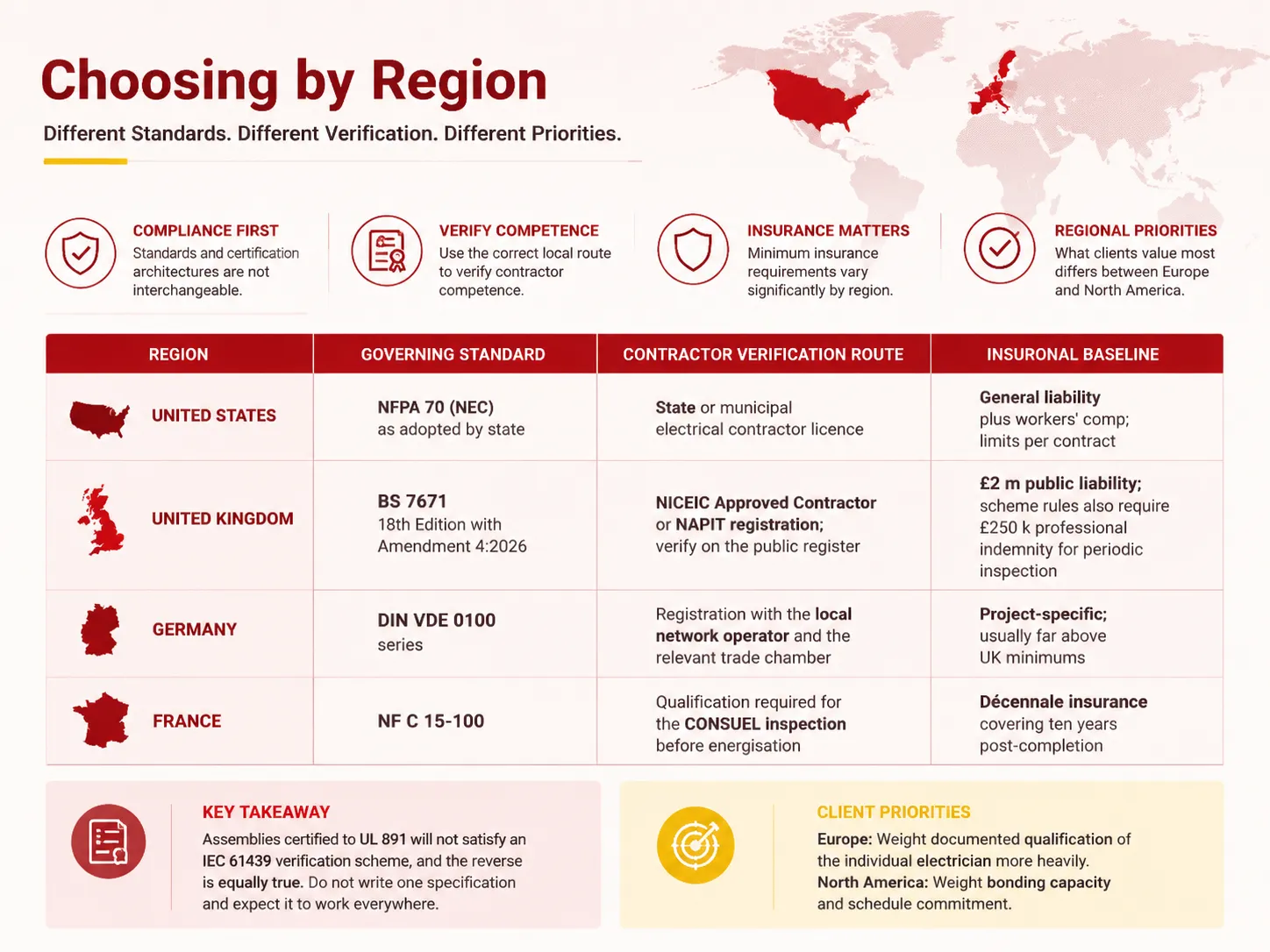
The differences in selection criteria are greater than most consumers believe since the compliance structure is not the same. North America follows the National Electrical Code (NFPA 70), which is adopted state by state with local amendments, and is certified to UL standards, while Europe follows IEC 60364 via its national wiring regulations and certifies equipment using IEC 61439 series which is different than UL 891 and UL 1558 in construction principles.
| Região | Norma aplicável | Contractor verification route | Insurance baseline |
|---|---|---|---|
| Estados Unidos | NFPA 70 (NEC) as adopted by state | State or municipal electrical contractor licence | General liability plus workers’ comp; limits per contract |
| Reino Unido | BS 7671, 18th Edition with Amendment 4:2026 | NICEIC Approved Contractor or NAPIT registration; verify on the public register | £2 m public liability; scheme rules also require £250 k professional indemnity for periodic inspection |
| Alemanha | DIN VDE 0100 series | Registration with the local network operator and the relevant trade chamber | Project-specific; usually far above UK minimums |
| França | NF C 15-100 | Qualification required for the CONSUEL inspection before energisation | Décennale insurance covering ten years post-completion |
Two important outcomes can be noted. Firstly, in the UK the most important filter that leads to registration is the registered competent-person scheme: the NICEIC registers and certifies nearly 33,000 businesses, conducts audits of some works by each company on an annual basis and obliges them to have the most recent version of the wiring regulations in possession. Consequently, public sector clients insist on the fact that only competent-person scheme registered firms can appear on tender lists. Secondly, in France it is impossible to energize any installation until it is inspected by CONSUEL, meaning that the contractor is certified by a third party before the client receives the service, which control does not exist in most regions of the USA.
When purchasing something that might be subjected to various national regulations, take care not to write one common specification. In the USA assemblies which were verified in accordance with UL 891 certification can be considered compliant with IEC 61439 regulations, and vice versa.
Red Flags and Contract Terms Worth Pushing Back On
Very low bids, those that appear more than 30% below the second lowest bid, are a clearly sign of a problem and invariably indicate one of four issues: use of unlicensed contractors, a lapse in the insurance certificate, the fact that permit fees were not included in the estimate, or avoidance of issues to come later due to incorrect substitution of materials after contract award. All four issues impact the owner eventually, with issues related to the latter usually occurring during failure investigation.
In addition to what has been mentioned above, we should also pay attention to contracting firms that would either not do the permitting under their name, answer scope questions without documents but verbally, or require a deposit of sums that are more than the cost of materials ordered. From a purely contractual standpoint, three items deserve scrutiny in the contract. The retainage clause states that part of the payment is held until the project is in compliance with the standards; the change-order clauses determine the payments in advance of the actual work; the completion and testing clause specifies the documents submitted by the contractor as proof of compliance so that the owner can get these documents in the end.
FAQ
How much does an electrician charge for commercial work?
In 2026, it is expected that commercial work in the U.S. cost around $100–$175 an hour for a licensed journeyman, while master electricians and industrial specialists charge $145–225 in areas with high costs. The majority of commercial contractors charge at a fixed rate which covers all the overhead and costs of insurance rather than simply billing for the person’s pay. Normally there will be a minimum charge of 2–4 hours for a service call and an application of 1.5–2.0 multiplier with a trip charge in case of after-hours call the client receives. Pricing for the projects is considered separately where the service of 200–400 A increases the expenses from $3,000 to $12,000, and for a tenant build-out the prices vary between $8,000 and $25,000 for 1,000 square feet.
Why is Romex not allowed in commercial buildings?
Though non-metallic sheathed cable is not completely forbidden, the list of permitted uses is limited. NEC Article 334 describes the requirements for the use of non-metallic sheathed cable. It is outlined in Section 334.10 that it may be used in one- and two-family dwellings, in addition to other types of buildings of Type III, IV and V constructions — that means wood-framed buildings and heavy-timber buildings, but must be used behind some fire-resistant barrier or inside the areas that are unlikely to be damaged. Section 334.12 bans the use of the cable in Type I and Type II construction due to the fact that this included buildings are made of steel and concrete and includes commercial buildings, such as theatres, motion picture studios, garages and battery rooms, including the places that are located above dropped ceilings in non-residential buildings. Additionally, there may not be the possibility to use the non-metallic cable in constructed concrete or in wet locations. The protection is referred to as justification — a non-metallic coat neither provides mechanical protections nor has any fire protection features in comparison to MC cable or conduit. In most cases, when making the buildings of commercial purposes, this cable is neglected due to the type of construction of it.
Is there a difference between commercial and residential electricians?
Certainly, it is structural in nature rather than cosmetic. The work of the residential electricians is nearly all within the basic single-phase 120/240 V systems with the usage of sheath cables and the dimensions of circuits calculated from the standard dwelling load calculation. On the other hand, the commercial electricians operate with the three-phase systems such as 208Y/120 V and 480Y/277 V systems using conduit and individual conductors and determining their services based on the commercial demand. They should also have experience with motor operations, electric generators, transformer systems, etc. The industrial electricians represent the last specialization that is aimed at machines and conversion of electric energy into another type of work. Many middle-sized companies have all three kinds of work but it is worth being sure of the crew you get because the company might have license but the crew on the site might not have any necessary skills.
What are the three types of electrical installation?
These installations are divided into residential, commercial and industrial categories, and they vary in terms of voltage category, type of wiring and type of potential risks. Residential installations include homes and other dwellings such as homes using low-voltage single-phase AC systems with voltages of 120 or 240-volt, armoured cables, distribution boards and systems to charge electric cars. Commercial installations cover operating buildings from offices to hotels, hospitals and schools with three-phase voltage range from 208 volts to 480 volts, trunks for wiring and systems supplying electric energy for CCTV, ventilation and air conditioning. Industrial installations include plants and other heavy industry sites where large amount electrical power used for running heavy machinery results in losses in a case of a power outage.
Referências
- NFPA — NFPA 70 National Electrical Code
- NFPA — 70E Standard for Electrical Safety in the Workplace
- UL Solutions — Product safety standards and listings
- Associação Nacional de Empreiteiros Elétricos (NECA)
- EC&M Magazine — Top 50 Electrical Contractors ranking
- ENR — Top 600 Specialty Contractors
- U.S. Bureau of Labor Statistics — Perspectivas Ocupacionais para Eletricistas
- NICEIC — Approved Contractor scheme requirements
- IET — BS 7671 Requirements for Electrical Installations
- UK Health and Safety Executive — Electrical safety guidance
Conclusão
The ideal commercial electrical installation contractor is one with the proper license for the task, equipped with a competent team trained in the technology used in the facility, and ready to provide the documents necessary to confirm their credentials on the register, not just in a brochure. Size makes a poor indicator of suitability; the top revenue companies are engaged in building transmission lines and data centers, not performing your service upgrade.
Three things must be followed in any project. First, check credentials with the proper authorities before making the first payment rather than after. Second, demand that you receive all “as built” documentation, designs of the panels, and testing results before transferring last payment rather than as an afterthought. Finally, make sure three bidders provide you with the detailed scope of work since differences between the bids reveal the risk associated with a project better than any single price does. If you follow all the above, electrical work will become no more than what it is supposed to be in a project.