
Quando você procura por serviços elétricos nos EUA, encontrará uma variedade de listagens, incluindo a de um conglomerado de infraestrutura Fortune 500 e uma pequena operação com dois caminhões que atua principalmente na instalação de ventiladores de teto. Embora ambos possam estar na mesma indústria, eles não competem pelos mesmos trabalhos, e não haverá semelhança entre seus orçamentos. A indústria de serviços elétricos nos EUA pode ser melhor compreendida reconhecendo que ela é composta por quatro segmentos diferentes empilhados um sobre o outro, e a melhor forma de perder um mês é enviar um orçamento para a instalação de um gerador de reserva de 400 kW para o segmento errado.
O que segue no texto é um guia prático para esses segmentos do mercado: uma lista de dez empresas americanas na indústria de serviços elétricos, sua área de especialização, suas sedes, duração de seus projetos e os custos incorridos para diferentes trabalhos. Também discute um segmento importante que a maioria dos clientes não presta atenção – o tipo certo de fornecedor mais adequado para lidar com seu projeto.
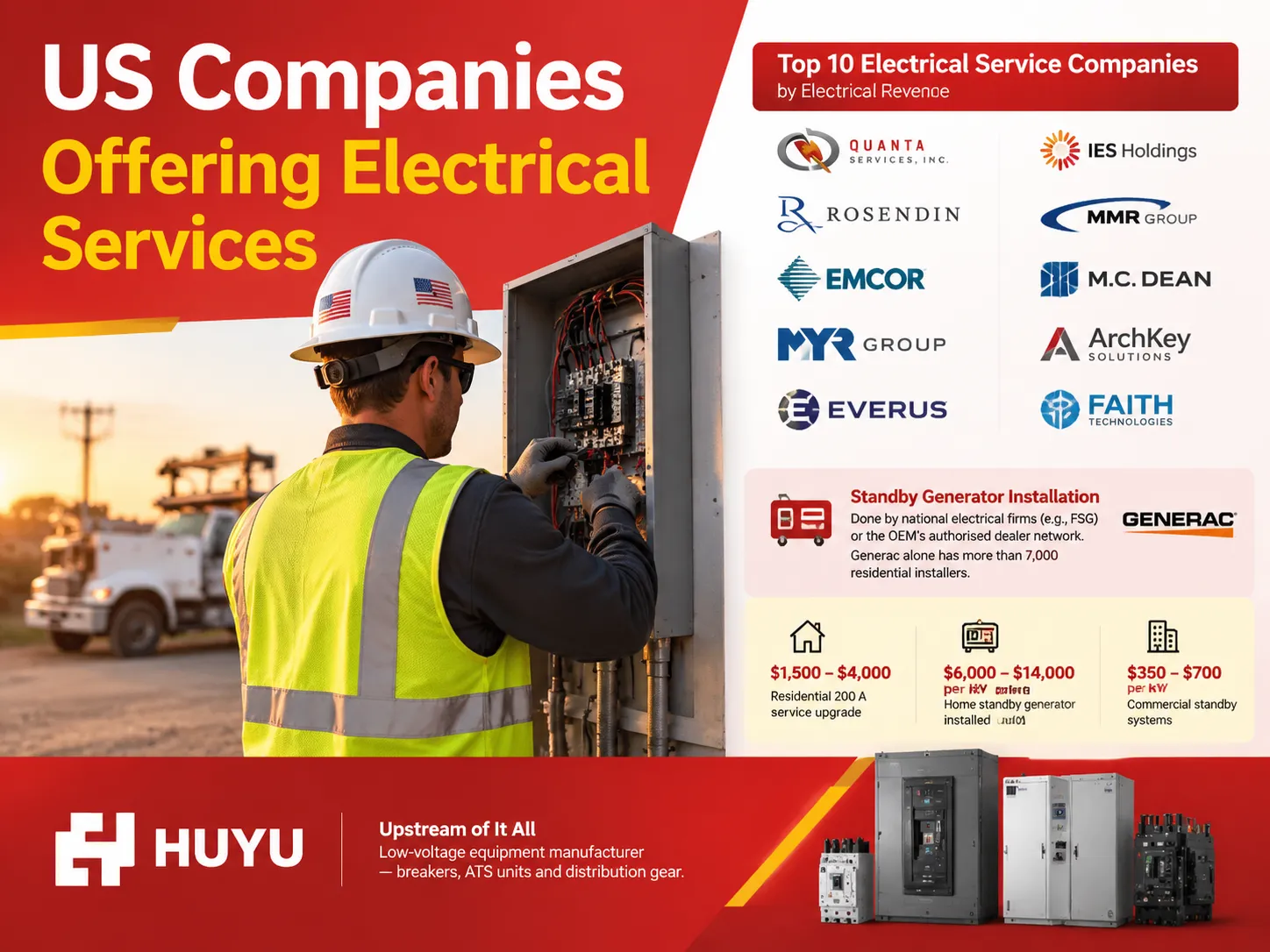
Aqui está a lista dos dez principais provedores de serviços elétricos nos Estados Unidos por receita — Quanta Services (Houston, ~ US$ 13,5 bilhões), Rosendin (San Jose, ~ US$ 3,7 bilhões), o ramo elétrico da EMCOR (Norwalk, Connecticut; ~ US$ 3,6 bilhões), MYR Group (Thornton, Colorado; ~ US$ 3,4 bilhões), Everus (Bismarck, North Dakota; ~ US$ 2,8 bilhões), IES Holdings (Houston, ~ US$ 2,5 bilhões), MMR Group (Baton Rouge, ~ US$ 2,3 bilhões), M.C. Dean (Tysons, Virginia; ~ US$ 1,9 bilhão), ArchKey Solutions (St. Louis, ~ US$ 1,7 bilhão) e Faith Technologies (Menasha, WI, ~ US$ 1,4 bilhão). Eles são players-chave quando se trata de serviço funcional para utilidades, indústrias e empresas de missão crítica. Se focarmos na instalação de geradores de reserva, os trabalhos são realizados ou pela empresa nacional de serviços elétricos como a FSG ou através da rede de franquias OEM como a Generac, que possui mais de 7.000 fornecedores atuando apenas no segmento residencial.
As Quatro Camadas do Mercado de Serviços Elétricos dos EUA
A estrutura vem antes dos nomes. A maioria dos empreiteiros elétricos nos EUA pode ser classificada em uma das quatro camadas, distinguidas entre si pelas especificidades relacionadas a licenciamento, composição da equipe e contratos comerciais.
- Camada 1 – utilidade fornecendo serviços de T&D. Essas equipes são responsáveis pela instalação de subestações, trabalho em linhas de transmissão de 69-765 kV e manutenção de circuitos de distribuição. O trabalho é concedido por meio de acordos-mestre de serviço com utilidades. Exemplos dessas empresas são Quanta e MYR Group. Elas definitivamente não serão úteis para restaurantes.
- Camada 2 – empresas industriais e de missão crítica. Plantas petroquímicas, instalações de fabricação de semicondutores, data centers e hospitais podem ser tomados como exemplos. Existem altas tensões no local, desenhos projetados, estudos de arco elétrico e documentos de comissionamento. Empresas envolvidas – MMR, M.C. Dean e Faith Technologies.
- Camada 3 – construção comercial e setor de serviços. Atualizações de escritórios, varejo, multifamiliares e instituições educacionais podem ser colocadas nesta camada. Tensões envolvidas 120/208V, 277/480V, fiação de conduíte executada internamente e chamadas de serviço. Empresas que operam neste setor – Rosendin, EMCOR, ArchKey e milhares de players regionais.
- Camada 4 – construção residencial e serviços comerciais leves. Em relação a esses serviços, podem ser considerados troca de painéis, carregadores EV e geradores. Os operadores que trabalham nessas empresas são eletricistas Master que gerenciam o negócio a partir de suas vans.
Decisões ruins de aquisição geralmente são tomadas quando organizações contratam empresas da Camada 1 para serviços da Camada 4 e vice-versa. Um empreiteiro de utilidade nunca enviará um veículo para um disjuntor AFCI desarmando, enquanto uma empresa da Camada 4 não pode fornecer um pacote de painel de 15 kV.
Dez Empresas Americanas que Oferecem Serviços Elétricos, Lado a Lado
A lista abaixo é classificada pela receita de contratos elétricos, usando os rankings ENR e Modern Distribution Management que a própria indústria trata como referência. A lista completa de empreiteiros elétricos operando em todo os Estados Unidos vai muito além de dez quando se conta os fortes players regionais — Miller Electric, Guarantee Electrical, Cupertino Electric, Helix Electric e outros todos carregam volume sério em seus mercados locais.
| Empresa | Sede | Receita elétrica | Construído para |
|---|---|---|---|
| Quanta Services | Houston, TX | ~$13,5 bi | Utilidade T&D, subestações, renováveis |
| Rosendin | San Jose, CA | ~$3,7 bi | Data centers, semicondutores, campi tecnológicos |
| EMCOR (segmento elétrico) | Norwalk, CT | ~$3,6 bi | Comercial, saúde, pacotes mecânicos + elétricos |
| Grupo MYR | Thornton, CO | ~$3,4 bi | Linha T&D e subestação, construção C&I |
| Everus Construction Group | Bismarck, ND | ~$2,8 bi | Utilidade, transmissão, industrial |
| IES Holdings | Houston, TX | ~$2,5 bi | Industrial, data centers, construção residencial nova |
| Grupo MMR | Baton Rouge, LA | ~$2,3 bi | Refinarias, instrumentação, turnaround industrial |
| M.C. Dean | Tysons, VA | ~$1,9 bi | Missão crítica, governo seguro, ciberfísico |
| ArchKey Solutions | St. Louis, MO | ~$1,7 bi | Comercial, saúde, educação |
| Faith Technologies | Menasha, WI | ~$1,4 bi | Fabricação, data centers, pré-fabricação |
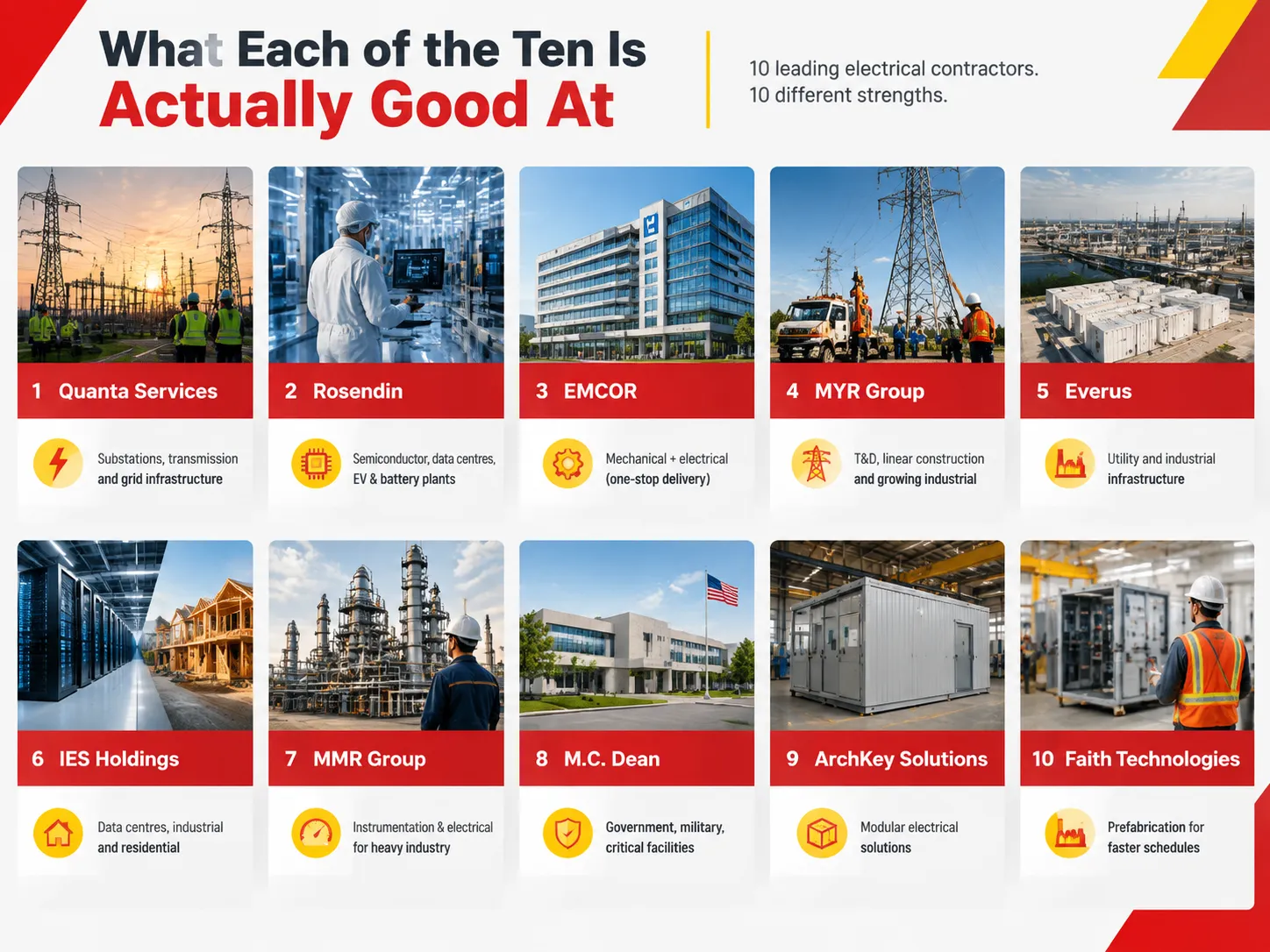
No que Cada um dos Dez Realmente se Destaca
Quanta Services é um grande empreiteiro elétrico nos EUA. A maioria dos projetos da empresa está relacionada à infraestrutura de energia elétrica, como subestações e reconstruções de linhas de transmissão. Faz todo sentido ter a Quanta na lista de empreiteiros, pois a empresa pode mobilizar seus 40.000 funcionários e frota em qualquer lugar. No entanto, há uma desvantagem em usar este empreiteiro em operações de construção; o cliente provavelmente não é grande o suficiente para a Quanta achar o pedido atraente.
Rosendin é uma empresa de propriedade dos funcionários, o que faz com que a equipe trabalhe em grandes projetos com altas taxas de retenção. A competência central da Rosendin inclui trabalhos de engenharia na área de tecnologia da Costa Oeste, como fábricas de semicondutores, grandes centros de dados ou fábricas de baterias. Ser de propriedade dos funcionários significa uma tomada de decisão muito lenta no nível da alta administração.
EMCOR oferece serviços mecânicos e elétricos durante um único contrato. Há uma razão pela qual os clientes optam por essa cooperação técnica; ela simplifica significativamente o processo de construção porque os processos mecânicos e elétricos são bem coordenados sem gastar tempo extra.
MYR Group é um grupo de empresas que fornece serviços elétricos por meio de suas subsidiárias, que estão entre os cinco maiores empreiteiros nos EUA há quase trinta anos. A principal especialização da empresa são as operações de T&D, como a construção de linhas de transmissão de alta tensão e subestações que conectam a energia elétrica do gerador aos consumidores. Os segmentos comercial e industrial do mercado são menos desenvolvidos, no entanto. A empresa se destaca em projetos de construção linear e dificilmente conseguiria encaixar operações de construção volumosas na estrutura da empresa.
Everus surge da MDU Resources e foca tanto em utilidades quanto em infraestruturas industriais. Mais diversificada do que o esperado, a IES Holdings atua no setor industrial e de centros de dados e possui um setor significativo de construção residencial nos Estados Unidos, o que lhes proporciona uma visão única dos ciclos nos mercados imobiliários.
MMR Group é especializada nos campos elétrico e de instrumentação para a indústria pesada. Se sua planta opera com tempos de parada medidos em turnos em vez de semanas, então você está falando a língua deles. Os orçamentos também são moldados pela forma como um empreiteiro é equipado: um empresa de instalação elétrica comercial que executa internamente suas equipes de conduítes e fios manterá um cronograma melhor do que aquela que terceiriza mão de obra, e em uma parada de refinaria a diferença é medida em dias de produção perdida.
M.C. Dean é a empresa que atua em ambientes onde a falha é impossível — centros de dados pertencentes ao governo, bases militares e centros de inteligência. Começou a funcionar em 1949, está localizada em Tysons, Virgínia, empregando cerca de 9.000 funcionários, dos quais 1.000 possuem autorização de segurança. Adquiriu a maioria das ações da Bells Power Group, uma empresa estabelecida no Reino Unido que auxilia no projeto, instalação e manutenção de sistemas de fornecimento de eletricidade desde 1898, mostrando a direção do mercado.
ArchKey Solutions and Faith Technologies occupy the last places in the top ten companies. Faith Technologies stands out due to its method of prefabrication; they manufacture electrical holes in a factory.
Standby Generator Installation: The Layer Most Buyers Get Wrong
The point at which standby generator installation diverges from the actual reality is in clarifying who wants to install a generator. Firms like M.C. Dean, MYR and Faith Technologies are all in the generator installation business. However, they’re likely to refuse any residential contracts using a 22 kW generator.
Indeed, the reality of the standby generator installation market breaks down into three distinct areas:
| Channel | Typical size | Installed cost | Who does it |
|---|---|---|---|
| Residential dealer network | 7–26 kW | $6,000–$14,000 | Generac (7,000+ installers), Kohler, Briggs & Stratton certified dealers |
| National commercial electrical firm | 500 kW–4 MW+ | $350–$700 per kW | FSG, Power Plus, GenServe, regional integrators |
| Mission-critical / OEM direct | 2–50 MW | Project-bid | Cummins, Caterpillar, Kohler, M.C. Dean |
Two statistics lend credence to the cost of the outages. EPRI and Primen estimate the average cost of a one-hour outage for industrial and digital economy businesses to be in the neighborhood of $7,800 per hour, while the EIA data indicates that the average major outage will take about nine hours in 2024—more than double the average in the previous decade. A cold storage facility of 300,000 sq ft loses all its product by the end of the eighth hour.
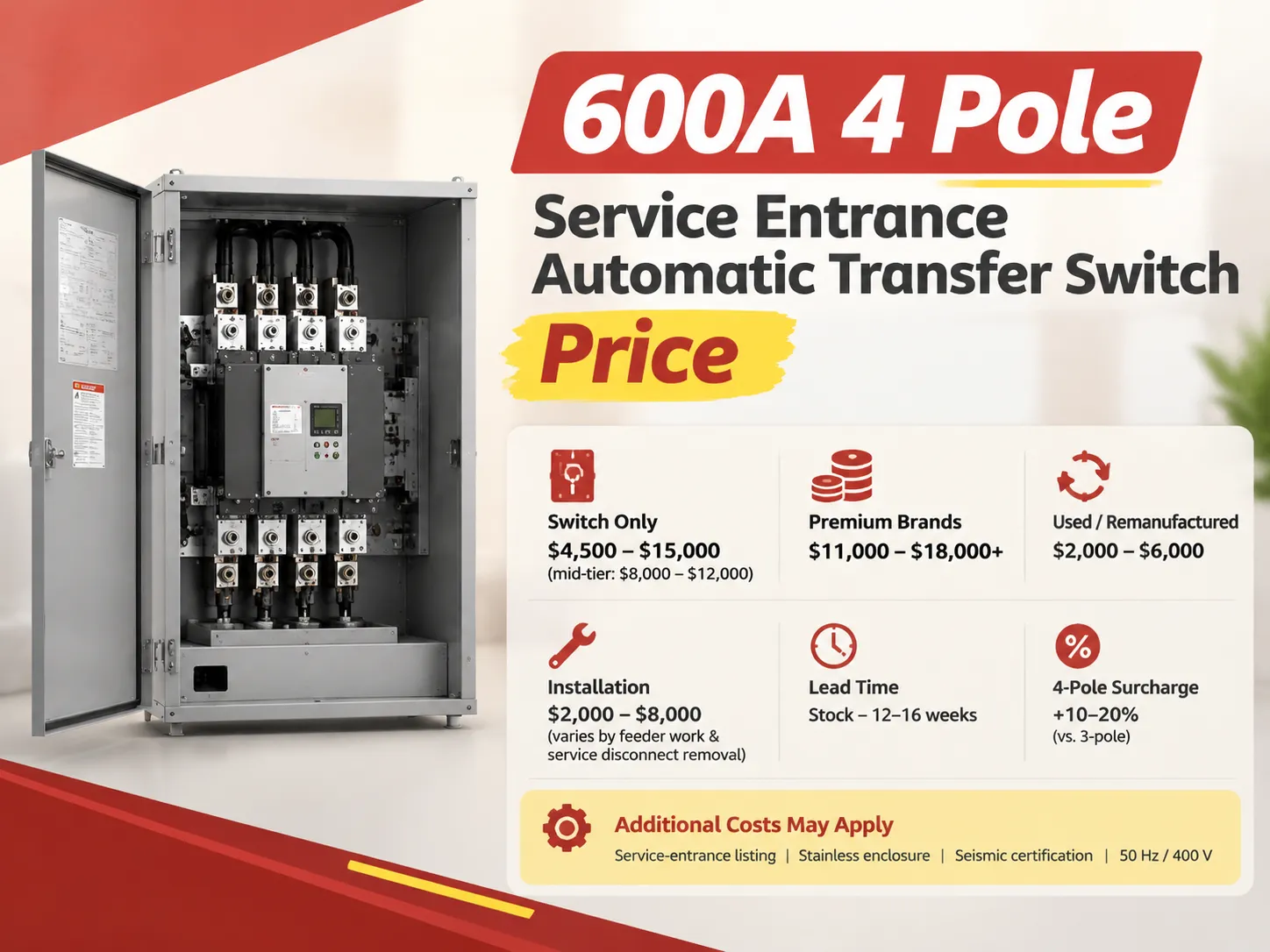
What counts in this context is not the generator but the transfer of power. The load of the data center needs transferring in less than 10 seconds to remain within UPS operating time. Hospitals are held to this same standard under NFPA 99, which also has NFPA 110 Level 1 testing criteria. Commercial and industrial stand-by systems under NEC Article 701 and 702 are allowed as much as 60 seconds.A three-phase automatic transfer switch sized to the full service — not to the emergency load — is what determines whether you land inside that window or outside it, and it is the single most common item buyers under-spec.
The other thing to consider is fuel capacity. The NFPA 110 requires Level 1 life safety systems to have minimum fuel supplies of 24 hours and Level 2 systems, 8 hours. You can also expect trouble if no one has tested the generator on load at least once per month. According to data, idle-only generators fail on demand in 15 to 20 percent of cases, compared to less than 3 percent of failure in the same situation for generators that have been tested for 30 minutes every month.
Delivery Timelines: What “Lead Time” Really Means for Each Layer
In the context of this industry, lead time signifies three different things, and contractors will choose whichever version makes them look most favorable. It is recommended to ask contractors to provide information on all three types of lead time: equipment lead time (i.e. the time from the factory to the site), permit lead time (i.e. the time from application through approval to energisation), and construction duration (i.e. the time from mobilisation to substantial completion).
| Project type | Equipamento | Permit / utility | Build |
|---|---|---|---|
| Residential 200 A service upgrade | 1–2 weeks | 2–6 weeks | 1–3 days |
| Home standby generator (22 kW) | 3–10 weeks | 2–8 weeks | 1–3 days |
| Commercial tenant fit-out | 2–8 weeks | 4–12 weeks | 6–20 weeks |
| Commercial generator, 500 kW–2 MW | 20–52 weeks | 8–24 weeks | 2–8 weeks |
| Medium-voltage switchgear package | 20–40 weeks | 8–20 weeks | 8–20 weeks |
| Utility substation | 30–60 weeks | 12–36 months | 12–24 months |
During the supply crunch of 2022-2023, the lead time for medium-voltage switchgear increased to more than 60 weeks, and while it has improved since, the standard now is still in the range of 20-40 weeks. If your construction schedule is tight, you may not want to waste your time going back and forth with the contractor; instead, order the gear ahead of time or design around readily available equipment.
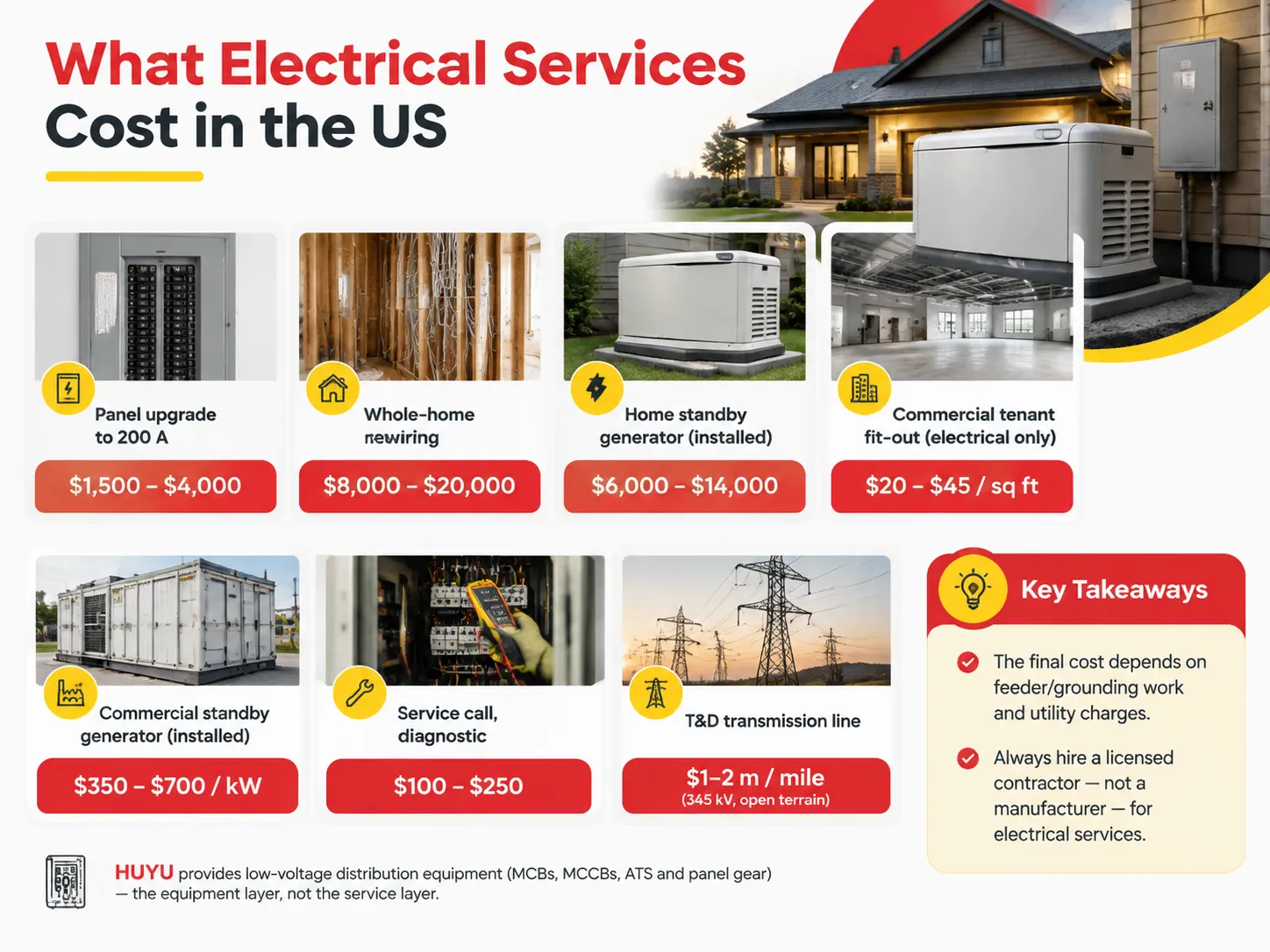
What Electrical Services Cost in the US
The following figures represent the actual levels of cost confronted by American buyers. These figures assume the presence of licensed contractors, the obtaining of permits and the having of standard access.
| Serviço | Custo típico | Notas |
|---|---|---|
| Residential panel upgrade to 200 A | $1.500–$4.000 | Add $500–$2,000 if the utility must replace the service drop |
| Whole-home rewiring | $8,000–$20,000 | Driven by wall access; finished walls cost the most |
| Home standby generator, installed | $6,000–$14,000 | 22 kW class, including transfer switch and pad |
| Commercial tenant fit-out, electrical only | $20–$45 per sq ft | Data-heavy or lab space runs well above this |
| Commercial standby generator, installed | $350–$700 per kW | 100 kW to 2 MW; paralleling gear adds cost fast |
| Service call, diagnostic | $100–$250 | Typically waived if you approve the repair |
| T&D transmission line | $1–2 m per mile (345 kV, open terrain) | Urban routing and river crossings multiply this |
For a residential service, replacing a 200 A electrical panel usually lands between $1,500 and $4,000, and the spread comes almost entirely from two things: how much of the existing feeder and grounding electrode conductor has to be redone, and whether the utility charges to disconnect and reconnect. Get those two answered in writing before you sign anything.
One important thing that explains a lot about pricing in the USA is the fact that many pieces of equipment behind the wall are imported. HUYU produces low-voltage equipment, including MCBs, MCCBs, automatic transfer switches and switchboards. HUYU only plays the role of equipment supplier but does not provide any services.
How to Choose a Provider for Your Scenario
Identify the layer corresponding to the task, and after that, find out the things that go wrong in that layer.
- The first filter that identifies which class of license is required is a voltage one. The line between high voltage and low voltage in the NEC sits at 600 V nominal, and crossing it changes who can legally perform the work, what drawings are required, and how much the insurance costs. A contractor who is excellent at 480 V building work may hold no qualification at 13.8 kV.
- When it comes to homeowners and the installation of standby generators, it’s crucial to ensure that you go through a factory-authorized dealer. That way, your warranty won’t be voided and you can be sure that the dealer will take care of the load calculation and sizing. Also, ensure that the dealer provides the transfer switch model in the quote.
- If you are dealing with a commercial contractor about a fit-out or service, make inquiries about the superintendent, including how many projects they are currently juggling. This knowledge gives you the ability to know whether the contractor is likely to be attentive to your project or if their attention might be diverted.
- It is important to ascertain whether industrial contractors offer arc-flash study capability, coordination study deliverables, and have a commissioning plan in writing.
- When you deal with mission-critical contractors, you should ask them about their experience with NFPA 110 and NFPA 99 standards. You can also obtain a load-bank report from another job that is similar to your own. It’s important that you don’t deal with hospitals that refuse to provide you with commissioning contracts.
- When it comes to utility or generation interconnections, find out if the contractor has an existing agreement with the utility and whether they self-generate or subcontract the work. Subcontracting usually means that the contractor has scheduling problems.
Regardless of your choice of contractor, you need to ask them three critical questions that will determine whether they can satisfactorily do the job. You need to ask them who their superintendent is and how many projects they are working on currently. This gives you a sense of how much attention they can devote to your project.
FAQ
Who is the biggest electrical contractor in the USA?
Quanta Services is located in Houston, Texas, and its electric power segment has given it a revenue of about $13.5 billion each year. This means that Quanta makes more than thrice the revenue earned by the next biggest electric contractor, Rosendin, which earns close to $3.7 billion in revenues. Quanta mainly focuses on utility transmission and distribution, substations, and renewable interconnections as compared to commercial buildings. While measuring total electrical revenue, including service work, the next companies waiting in the line behind Quanta Services are EMCOR’s electrical segment and MYR Group.
Who is the largest electrical supplier in the US?
Whether the question is about the distribution of electrical equipment or its manufacturing defines the answer completely. WESCO International is the largest distributor of electrical supplies with an annual revenue of around $23.5 billion, followed by Sonepar North America (~$19.0 bn), Grainger (~$17.9 bn), Graybar (~$12.9 bn) and Rexel North America (~$10.1 bn). These distributors are used by contractors to purchase breakers and switchgear supplies. With regard to manufacturing, countries and manufacturers within the industry are divided according to their product specialties, for example, Schneider Electric, Eaton, ABB and Siemens are considered leaders in medium voltage distribution and switchgear production, while HUYU’s products comprise low-voltage breakers, ATS units and distribution boxes.
Who are the major electrical contractors in the US?
The leading companies in terms of revenue in electrical contracts are Quanta Services, Rosendin, EMCOR, MYR Group, Everus Construction Group, IES Holdings, MMR Group, M.C. Dean, ArchKey Solutions and Faith Technologies. Right under them is the exceptionally strong second tier of regional players with substantial market strength. The second tier is made up of local players such as Cupertino Electric and Helix Electric from the West Coast, Miller Electric from the southeast region and Guarantee Electrical from the Middle West region. For most building owners, the second tier becomes more relevant than the first ten as these companies are the ones which actually bid for medium-sized projects.
Is there a shortage of electricians in the USA?
Indeed, this is a more permanent situation rather than a temporary one . As per Bureau of Labor Statistics, the employment opportunities for electricians are going to grow rapidly in the next ten years. This might mean approximately 81000 job openings each year! Out of this, 20000 will be created due to retirements alone. The earnings of the electricians have also been growing which was $63190 median earnings in May. The highest paid top 10% of the employees earn at least $108510, showing the ongoing wage growth occurring along with shortage situation. According to the estimates of Associated Builders and Contractors, construction industry will need to find about 349000 workers by 2026. Most of the workers in the construction industry (around 20%) are already over 55 years.
Referências
- U.S. Bureau of Labor Statistics — Occupational Outlook Handbook: Electricians
- U.S. Bureau of Labor Statistics — OES Wage Data for Electricians
- M.C. Dean — Corporate Site and Capability Statement
- MYR Group — Investor Materials and Segment Reporting
- Quanta Services — Investor Relations and Annual Report
- NFPA 110 — Standard for Emergency and Standby Power Systems
- NFPA 99 — Health Care Facilities Code
- NFPA 70 — National Electrical Code (Articles 700, 701, 702)
- U.S. Energy Information Administration — Electric Power Monthly and Reliability Data
- Global Market Insights — U.S. Stationary Generators Market
Conclusão
The electrical services sector in the United States has distinct levels of buyer knowledge. At the substation or interconnection level, consumers should focus on the service agreements and switchgear required by Quanta, MYR and Everus. At the data center or hospital level, buyers consider the commissioning documents offered by Rosendin, M.C. Dean and Faith Technologies. When it comes to home panels or stand-by generators, consumers should find a licensed electrician or an authorized dealer, who can conduct load calculation and transfer switch sizing.
There are three main takeaways here. First, separate equipment lead time, permit lead time and build duration into your schedule because the number that will halt the project will rarely be the one that the contractor tells you. Second, make sure to spec the transfer switch for complete service, not just for the emergency load. That’s where the failure of standby generator installation gets uncovered by the authorities, and therefore, this is where the 10-second rule is won or lost. Third, ensure the licenses and permits are in order because every year millions of American homeowners pay for the panel upgrades that the utility never authorized, since nobody bothered to pull the necessary permits first.