
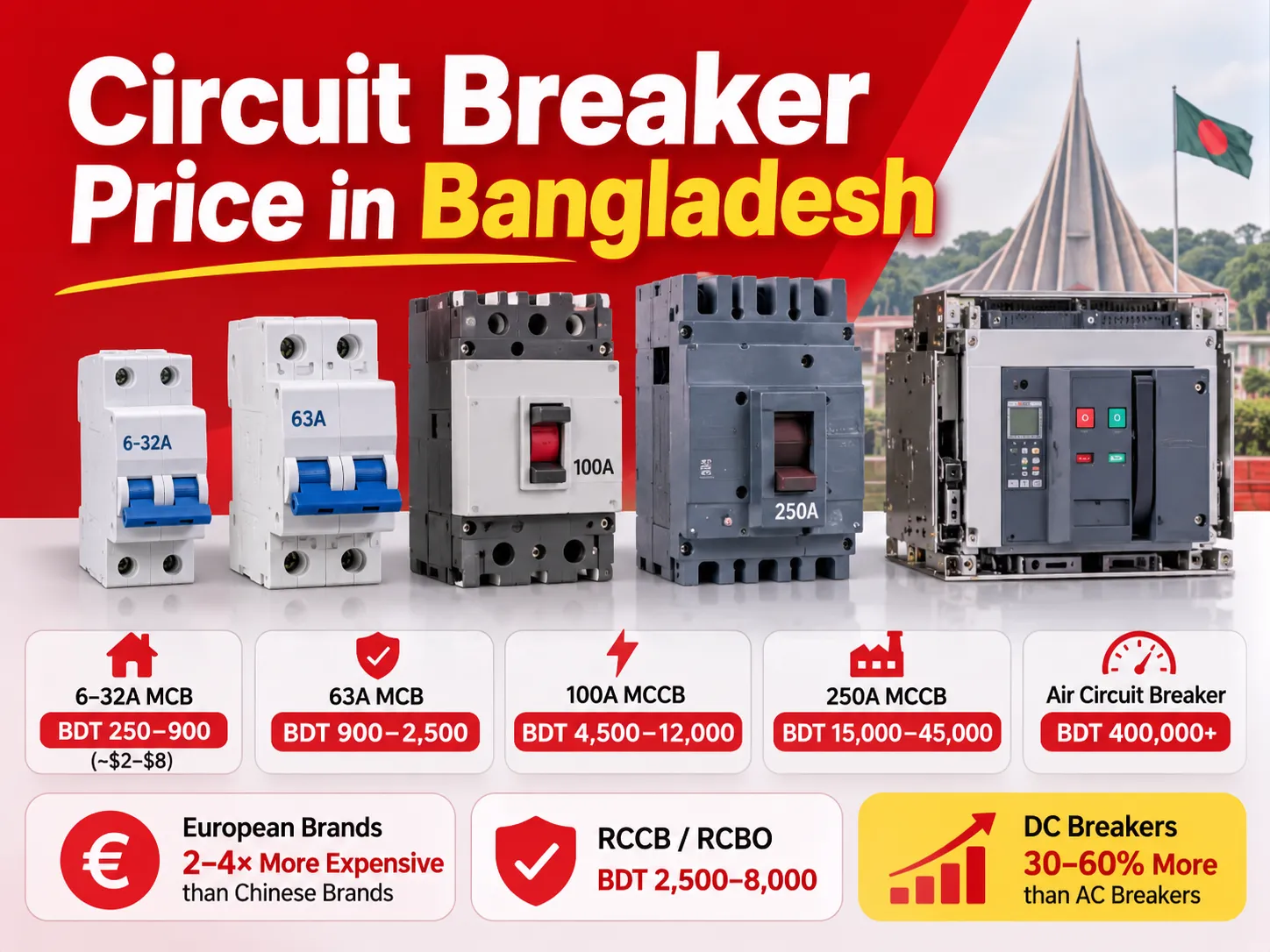
O preço dos disjuntores em Bangladesh em 2026 é determinado principalmente por três fatores que não dizem respeito ao disjuntor em si: o imposto de importação, a margem de distribuição local da marca e se o disjuntor foi importado por meio de um canal autorizado ou do mercado cinza. Portanto, por exemplo, um disjuntor miniatura de 32 A pode ser vendido por 250 Taka em Dhaka e 900 Taka em Dhaka, e ambos os vendedores podem obter lucros.
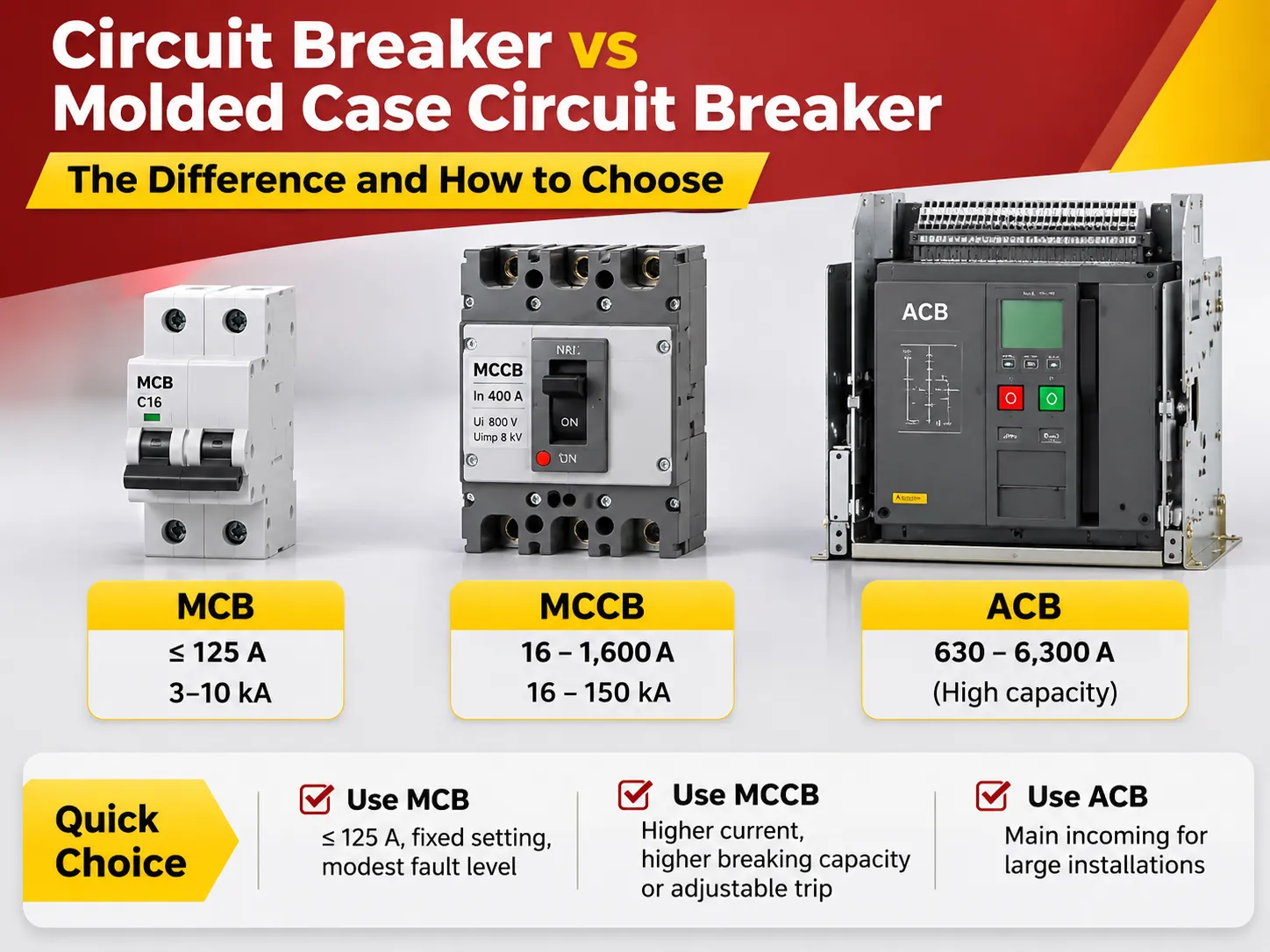
Em resumo, um Disjuntor Miniatura de 6 a 32 A custa cerca de Taka 250-900 em Dhaka; um MCB de 63 A é vendido por aproximadamente Taka 900-2.500; um Disjuntor Moldado de 100 A pode ser encontrado por Taka 4.500-12.000; Taka 15.000-45.000 para um MCCB de 250 A; e Taka 400.000 e acima para um Disjuntor a Ar. RCCBs e RCBOs custam entre Taka 2.500-8.000. O custo dos produtos europeus de marca é tipicamente de duas a quatro vezes o dos produtos chineses comparáveis, pois o prêmio é para um serviço local e um certificado verificável, e não para um mecanismo melhor. Disjuntores DC normalmente custam 30-60% mais do que disjuntores AC da mesma corrente nominal.
As seções seguintes fornecem custos para disjuntores por tipo, corrente nominal, tipo de marca, tipo de corrente e o custo total, incluindo taxas de conformidade e impostos. A seção final discute os pontos de falha dos disjuntores baratos e como estimar orçamentos de projetos.
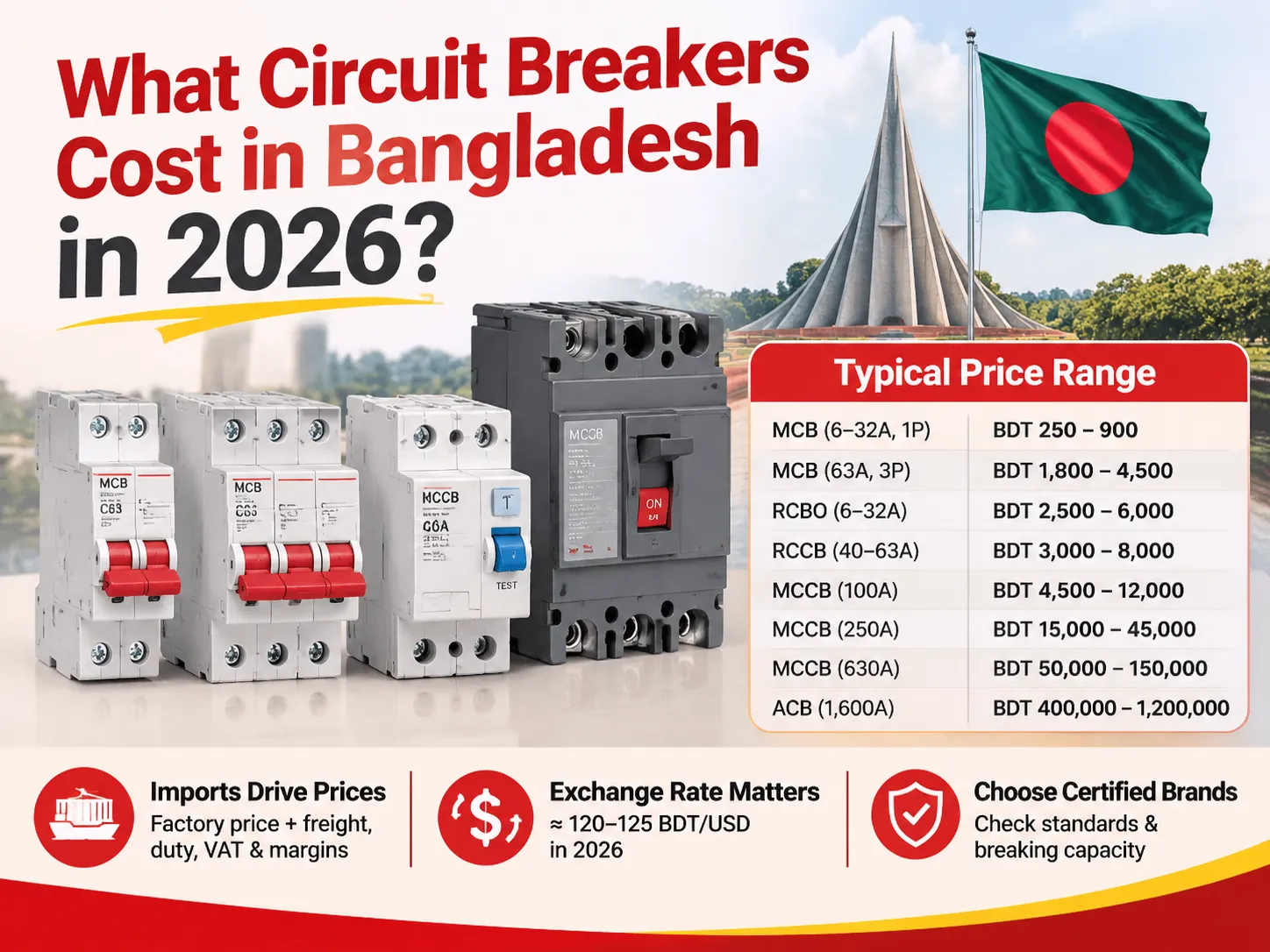
O Custo dos Disjuntores em Bangladesh em 2026
A maioria dos disjuntores em Bangladesh é importada. Seu custo inclui o preço do fabricante mais frete, imposto, IVA, a margem do importador e do varejista. Portanto, um disjuntor em Dhaka normalmente custa 40-60% mais do que seu preço FOB e, assim, comparar cotações locais com ofertas do Alibaba pode ser enganoso.
A taxa de câmbio do BDT para USD desempenha um papel igual aos impostos. Em 2026, espera-se que a taxa de câmbio seja aproximadamente BDT 120 a BDT 125 por USD e, portanto, um disjuntor cotado a USD 6 FOB custará cerca de BDT 730 antes de qualquer imposto e o preço final de venda no varejo (entre BDT 1.100 a BDT 1.300) é razoável, não inflacionado.
Existem três tipos de segmentos de compra no mercado elétrico. Os setores residencial e comercial compram disjuntores miniatura em lojas de suprimentos elétricos em Dhaka, Chittagong e Sylhet. Projetos industriais compram disjuntores moldados e disjuntores a ar de distribuidores autorizados com base em especificações. O setor de utilidades e o setor governamental compram equipamentos elétricos por meio de licitações competitivas contra uma especificação que inclui normas, categorias de marca e certificação de testes.
Cada linha na tabela abaixo compara o preço de produtos individuais pelo preço mais baixo de um produto ao preço mais alto do mesmo tipo. Em todos os casos, a proporção entre o produto com preço mais baixo e o produto com preço mais alto varia de duas a quatro vezes. As diferenças decorrem principalmente do nome da marca e da certificação, em vez das capacidades inerentes dos produtos. Por exemplo, o Miniature Circuit Breaker (MCB) de 32 A com preço mais baixo fabricado por um fabricante respeitável pode ser capaz de interromper 6 kA no máximo.
Portanto, todo MCB de 32 A fabricado por um fabricante de qualidade é capaz de interrupção de 6 kA, no entanto, a consistência da calibração, a qualidade do revestimento e se você pode validar a certificação variam muito entre os fabricantes. Portanto As gamas de MCB que publicam tanto sua tolerância de calibração quanto suas classes de capacidade de interrupção são mais fáceis de fornecer comparações do que as gamas de MCB que apenas publicam suas classificações de corrente.
Preços por Classificação; Dentro de um Tipo
Para uma família de produtos individual, o aumento da corrente não proporciona aumentos proporcionais de preço para o mesmo produto. Conhecendo os passos incrementais de preço dentro de cada tipo de produto, você pode orçar sua compra com mais precisão.
| Passo de Classificação | Efeito no Preço | Motivo |
|---|---|---|
| MCB 6 A a 32 A | Quase constante, 10-25 Taka | Caixa idêntica, mecanismo idêntico, calibração diferente |
| MCB 32 A a 63 A | Dobra | Caixa maior, contatos mais pesados, classe 10 kA |
| MCB 63 A a 125 A | Triplica novamente | Estrutura diferente, principalmente três polos apenas |
| MCCB 100 A a 250 A | Três vezes | Tamanho da estrutura, capacidade de interrupção, unidade de disparo |
| MCCB 250 A a 630 A | Três/quatro vezes | Opção de disparo eletrônico, conexões de barramento |
| Benefício de Preço do Disjuntor de 6 kA vs. Disjuntor de 10 kA | +30-50% | Chaminé de arco mais pesada, contatos maiores |
| Benefício de Preço do Disparo Termomagnético vs. Eletrônico | Duas a três vezes | Transformadores de corrente, processador, ajustes de configuração |
As implicações práticas são tais que um quadro contendo muitos circuitos pequenos é menos caro do que um quadro contendo poucos circuitos grandes. Um exemplo disso é o custo mais baixo de um quadro doméstico de 12 vias contendo mini disjuntores em comparação com o custo de um disjuntor moldado de 250 A. Esta é uma consideração importante ao preparar e dividir o orçamento do projeto. Outro exemplo é o disjuntor moldado na extremidade superior da escala, que tem a capacidade de cobrir a faixa de 16-250 A em uma única estrutura com um disparo termomagnético ajustável, permitindo a criação de um subquadro com um cronograma acessível versus uma lista de inúmeros dispositivos individuais.
Por que os Disjuntores AC e DC São Tão Diferentes em Preço
O custo de um disjuntor DC comparado a um disjuntor AC é 30-60% maior devido ao arco.
Em um circuito AC, existem dois meios ciclos ou cruzamentos por zero para cada ciclo completo, momento em que o arco se extingue naturalmente; portanto, o arco só precisa ser impedido de ser reativado pelo disjuntor. Em contraste, um circuito DC não possui cruzamentos por zero, então um arco deve ser extinto por meios externos de alongamento do arco, resfriamento do arco e divisão do arco entre múltiplos eletrodos; portanto, o canal de arco para um circuito DC deve ser maior, deve haver mais eletrodos e forças magnéticas mais potentes devem ser usadas para separar os arcos, tudo dentro do mesmo espaço de um circuito AC.
Em Bangladesh, as aplicações solares para energia DC cresceram rapidamente, e o aumento no preço para aplicações solares pode ser visto no preço dos disjuntores DC. Por exemplo, o preço de um disjuntor DC com corrente nominal de 32 amperes usado em um combinador de string varia de 1200 a 3000 BDT, enquanto o disjuntor equivalente, classificado para AC, tem preço entre 400 e 900 BDT; assim, novamente, a diferença de preço se deve ao design dos disjuntores classificados para DC.
Com relação à segurança, disjuntores classificados para DC não devem ser usados ou substituídos por disjuntores classificados para AC porque eles são incapazes de extinguir arcos e podem ser fechados inadvertidamente quando o disjuntor AC falha. Infelizmente, substituir disjuntores AC por disjuntores DC é prática comum em pequenas instalações de energia solar; daí a razão para as marcações distintamente diferentes encontradas em dispositivos classificados para DC.
Categorias de Marca e o que o Premium Oferece
Marcas europeias premium oferecem aos consumidores de Bangladesh três vantagens específicas: suporte técnico local, certificações verificáveis através do banco de dados do fabricante e estoque prontamente disponível. O suporte técnico local é importante ao lidar com esquemas de proteção; enquanto o certificado é exigido por consultores para conformidade com regulamentos locais; e o estoque é mantido para mitigar problemas causados por falhas de disjuntores, especialmente em hospitais, onde o prazo esperado para entrega de disjuntor de substituição pode ser de até três semanas.
Embora os preços das marcas chinesas de primeira linha e de montagem local possam ser mais atraentes para residentes e pequenas fábricas, o fator mais importante ao selecionar um dispositivo é saber com certeza que há uma certificação válida e rastreável. O dispositivo também deve possuir um certificado de calibração verificável porque esses dispositivos têm o maior potencial de falha, o que cria a necessidade de substituição rápida dos disjuntores se a carga ultrapassar 100 amperes. Neste ponto, o processo de tomada de decisão sobre o fornecimento de disjuntores moldados torna-se cada vez mais complicado, devido principalmente ao número de dispositivos adquiridos individualmente versus embalados juntos.
Between the factory and the retail shelf, there are three costs that account for most of the difference between an FOB price and the retail price in Dhaka.
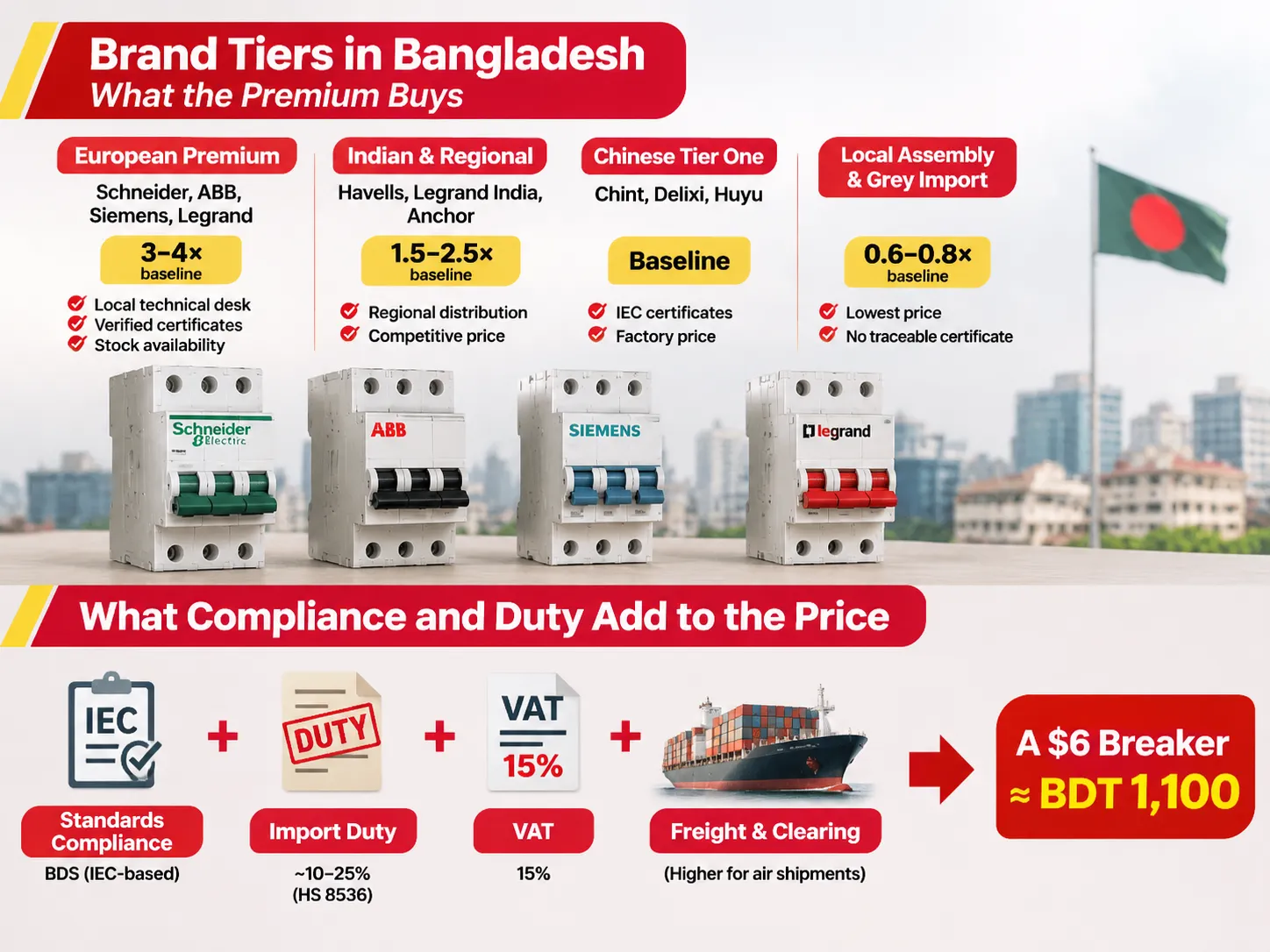
What Compliance and Duty Add to the Price
The compliance with International Electrotechnical Commission (IEC) standards has been adopted for Bangladesh using Bangladesh Standards and Testing Institution (BSTI) equivalent(s). The BSTI certifies circuit breakers to allow them to be sold in Bangladesh; therefore, a circuit breaker needs to have been tested for compliance against the appropriate IEC standard in order to be deemed compliant, regardless of the label the manufacturer uses, and a test certificate serves as proof of compliance.
Import Duties on Circuit breakers fall under the Harmonized System (HS) classification of HS 8536. The import duty percentage rate applied to circuit breakers depends on their specific HS classification/subheading as well as whether or not the importer has an import concession and will range from approximately 10-25% of the Custom Invoice Value (CIF) amount; therefore, it is important to confirm the classification/subheading prior to shipping, rather than after shipping.
VAT is applied to an assessed value of 15% on the cost of the product at the time of Importation and again at the time of Sale; this figure explains the difference in the retail price for a circuit breaker that costs $6; therefore, a circuit breaker that costs $6 would sell at a retail shelf price of BDT 1,100 (rupees)/BDT 900 (rupees, respectively); VAT applies equally to all brands.
Freight & clearance represent the remaining part of the price difference between the FOB price and the Price on Shelf in Dhaka. While the cost per unit shipped in a full container of Miniature Circuit Breakers (MCB) is significantly less than that of a single Molded Case Circuit Breaker (MCCB) shipped via Air freight, the urgent Replacement of an MCCB from Bangladesh has a significantly higher shipping price than the same item included in a project shipment.
Where Inexpensive Products are Not as Effective
The main causes for the discrepancy between an electrical component that is effective for 20 years versus one that is only effective for three years come from four different areas that are typically not observable on the parts.
Calibration Drift. When a circuit breaker is new, it is calibrated to trip at approximately 1.6 times its rated capacity. However, after just a few years of being thermally cycled, a CB that originally was rated to trip at 1.6 has now calibrated itself to trip at 2.2 times its original rating, leaving the cable it protects without adequate protection. The calibration of each circuit breaker is determined by the bimetal strip and the adjusting screw. The calibration process is eliminated with inexpensive units so that manufacturers can take advantage of low-quality materials and manufacturing processes.
Contact Plating. Contact surfaces of circuit breakers can wear through due to heat generated at contact points due to inadequate contact surface area and, in many cases, inadequate shunt (to dissipate heat). Maintenance personnel typically discover overheating contact surfaces using infrared scans after the breaker has been running at an elevated temperature for one year.
Arc Chute Design. Arc chutes that are too short and contain too few plates will stop the current flow once during a fault condition; however, an inadequate design will not trip during the first short on the fault current, and the arc chute will fail again during the second iteration of the fault.
Terminal Torque. Circuit breakers that cannot be tightened properly due to striping the terminal threads at their rated torque will not operate safely when installed in a distribution board. Loose terminals are the most frequent cause of fires in the distribution board. The behaviour of multiple circuit breakers (MCBs) and moulded case circuit breakers (MCCBs) and why they are treated differently with respect to the ability of moulded case circuit breakers to withstand higher terminal loads are discussed.
At the point of assessment at the counter, only three of the four devices listed can actually be evaluated for acceptance of return and the certification of origin and possible batch marking of the unit should it fail. Therefore, when assessing a brand tier, it is not a quality decision but rather an evaluation of recourse available to buyers.
Building a Budget by Application
Using an application to create a project budget, we have provided an indicative estimate for devices needed based on typical applications:
| Aplicação | Configurações de Polo & Curvas de Disparo – Soluções Versáteis para Todas as Aplicações | Devices | Indicative budget |
|---|---|---|---|
| Two bedroom flat | 8 Circuits | 8-MCB 1-RCCB 1-Main switch | BDT 12,000-30,000 |
| Small Retail/Office | 12 Circuits | 12-MCB 2-RCBO 1-MCCB 100 A | BDT 25,000-60,000 |
| Small Factory | 200 A Service | 1-MCCB 250 A 6-MCB 100 A 12-MCB | BDT 120,000-280,000 |
| Rooftop Solar | 10 kW | DC isolators, DC breakers, AC breaker, SPD | BDT 35,000-80,000 |
| Industrial Main Incomer | 1600 A | 1-ACB metering & controls | BDT 500,000-1,300,000 |
The above costs are the costs for the device alone. To estimate a project budget for devices, we need to add between 60%-150% to the above costs for expenses related to boards, busbars, enclosures, wiring and labor depending upon whether the completed board was manufactured locally or imported as a complete assembly. As a result, it is common for project budgets that include only devices to be inaccurate by the time the board is energized.
Where HUYU products fit in the market
We manufacture miniature circuit breakers (MCB), moulded case circuit breakers (MCCB) from 1 A-1600 A as per the requirements of IEC 60898-1, IEC 60947-2 & UL 489 for regions that require UL rated MCBs and MCCBs. Our pricing is positioned in the Chinese tier-one group within Bangladesh, or approximately one third that of European brands and slightly less than one-fifth above the pricing of unbranded devices.
The succession of circuit breakers may vary widely based on local / national priorities and what the average cost of living or working costs are like. In some parts of Bangladesh you may be able to find MCB’s at a starting price of BDT 250. This is by no means a fair comparison as in most regions the prices can be found to have a maximum of five different price points between different brands or suppliers.
The minimum price point of an MCB would typically be around BDT 250 for miniaturised designs (with both 6 & 32 A ratings available) which could go as high as BDT 900 for larger 63 A models (type A). Most MCBs would be sold at around 40% to 50% less than the equivalent-value AC Breaker’s price.
Additional notes include:
Because of the size of Bangladesh and how long it has developed in relation to other Asian countries, you will not find all retail shops in every region providing the full range of products. As an example, in larger metropolitan areas, such as Dhaka you would expect to see more variety on offer as opposed to rural markets where most MCB brands may therefore only be supplied at specific times.
Three reasons for these price variations are as follows:
- Local product sourcing
- Volume of stock ordered
- Differences in business operations
It should also be remembered that circuit breakers in Bangladesh are more cost-effective compared to many European brands. The primary reason behind this is due to the developmental stage that Europe is at, regarding the price model of MCB breakers in comparison with Bangladesh. For instance, you can find AC circuit breakers from an average of BDT 400,000 or so (.which is equivalent to £100) while you will pay well over £1000-£2500 in Europe (depending on size, type, manufacturer).
A grey import device may not come with an authorised distributor’s warranty or technical support, however it will still function when purchased. Grey import devices may also be sold without the endorsement of a recognised brand, as many of them will come with a photocopy of the original certificate for authentication purposes – these devices often miss the step of proper calibration. Genuine versions may also exist, but usually deal with the initial product sourced from a batch older than what current production methods yield. Only the first two options above can yield significant savings for consumers, while both options leave consumers with all the risk associated with these types of products.
FAQ
Do I need to use a DC breaker on my solar array(s) in Bangladesh?
According to the National Electrical Code of Bangladesh (NEC), you must install a DC breaker on the DC side of your solar array. A DC breaker is designed for extinguishing DC arcs and therefore uses a longer arc chute than its AC equivalent to successfully extinguish an arc that does not have a zero-crossing, in addition to using additional plates and parts within the breaker. Therefore, an AC breaker rated to handle the same amount of current will not clear a DC fault reliably and may potentially fail in the closed position.
What kind of certification should a circuit breaker have in Bangladesh?
All circuit breakers on the market in Bangladesh should be tested and certified to the appropriate IEC standards. For miniature circuit breakers, the applicable standard is IEC 60898-1; while for moulded case circuit-breakers, the appropriate standard is IEC 60947-2. Your certificate for a circuit breaker should name the model and manufacturer exactly as it appears on the breaker itself. The Bureau of Standards and Technical Information has a number of local entities that certify products for local sale. When bidding on commercial projects, you should expect to have been asked to provide test report(s) and batch markings together with your circuit breaker certificates.
Referências
- UL Solutions – Circuit Breaker Standards and Certification
- Schneider Electric – Circuit Design & Distribution Equipment
- Legrand – Circuit Breakers & Earth Leakage Devices
- Hitachi Energy – Low Voltage Circuit Protection and Switch Gear
- NEMA – Moulded Case Circuit Breaker Application Data
Conclusão
The cost of circuit breakers in Bangladesh is driven by type, rating, the supplier’s brand tier, along with any Applicable/Tariff duty and VAT stacks. For example, miniature breakers tend to cost comparatively low due to the small size of the device and the availability of common mechanisms associated with them; whereas a moulded case circuit breaker rated at 250A will cost nearly THIRTY times more due to the differences in the added complexity and expensively fabricated components associated to the product. The price is always going to be important, however, the more important question to answer is which supplier will give you a traceable certificate and accept this device back if it fails for any reason whatsoever.
In a market where grey imports and counterfeit devices are widespread and common, the only two things you have on your devices that cannot easily be copied or faked are the certificate P/N and Batch Mark, therefore, paying for those two items is certainly a good investment in your equipment and reputation.