
Le prix des disjoncteurs au Bangladesh en 2026 est principalement déterminé par trois facteurs qui ne concernent pas le disjoncteur lui-même : le droit d'importation, la marge de distribution locale de la marque, et si le disjoncteur a été importé via un canal autorisé ou un marché gris. Ainsi, par exemple, un disjoncteur miniature 32 A peut être vendu à 250 Taka à Dhaka et à 900 Taka à Dhaka, et les deux vendeurs peuvent réaliser des bénéfices.
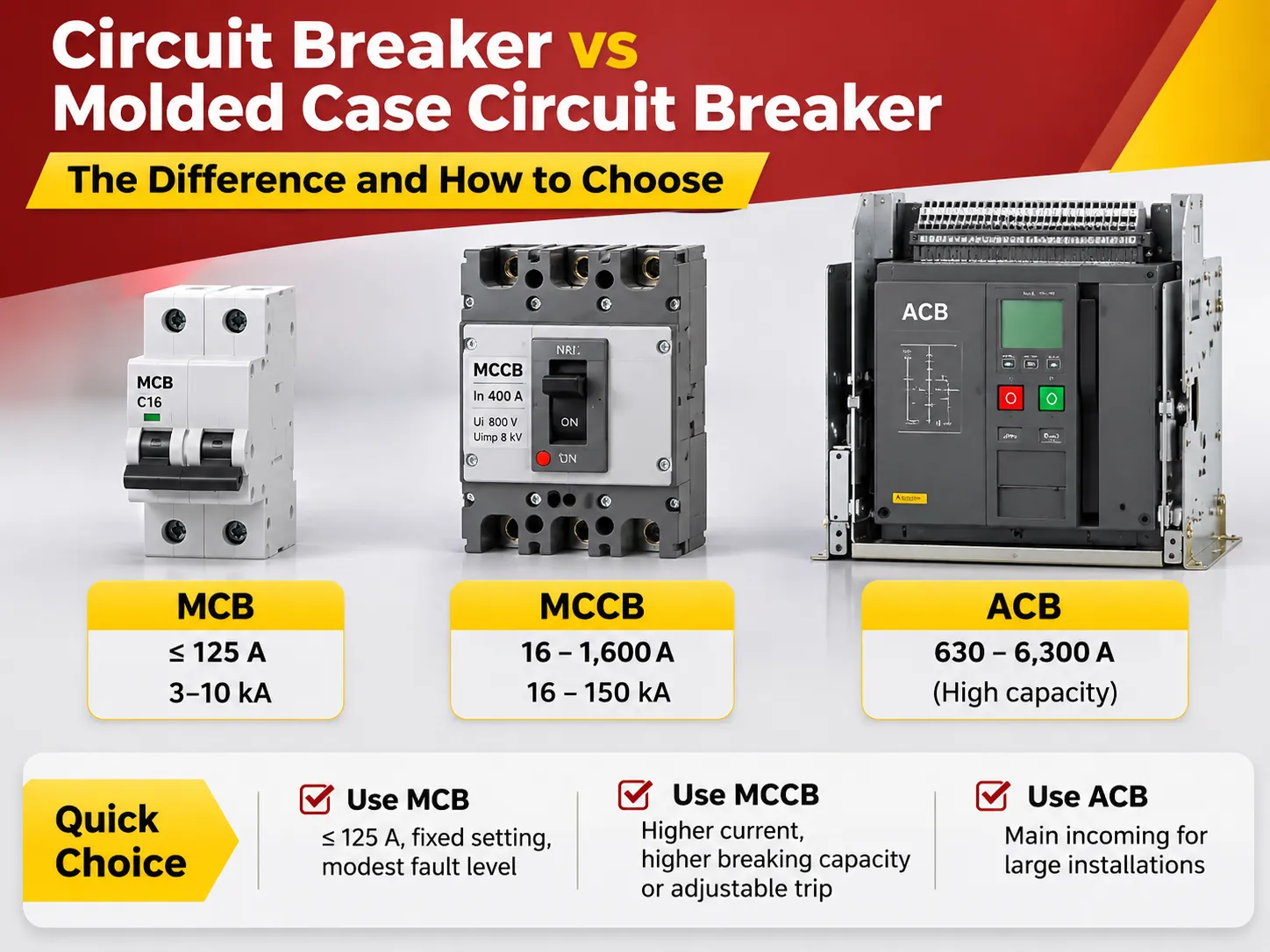
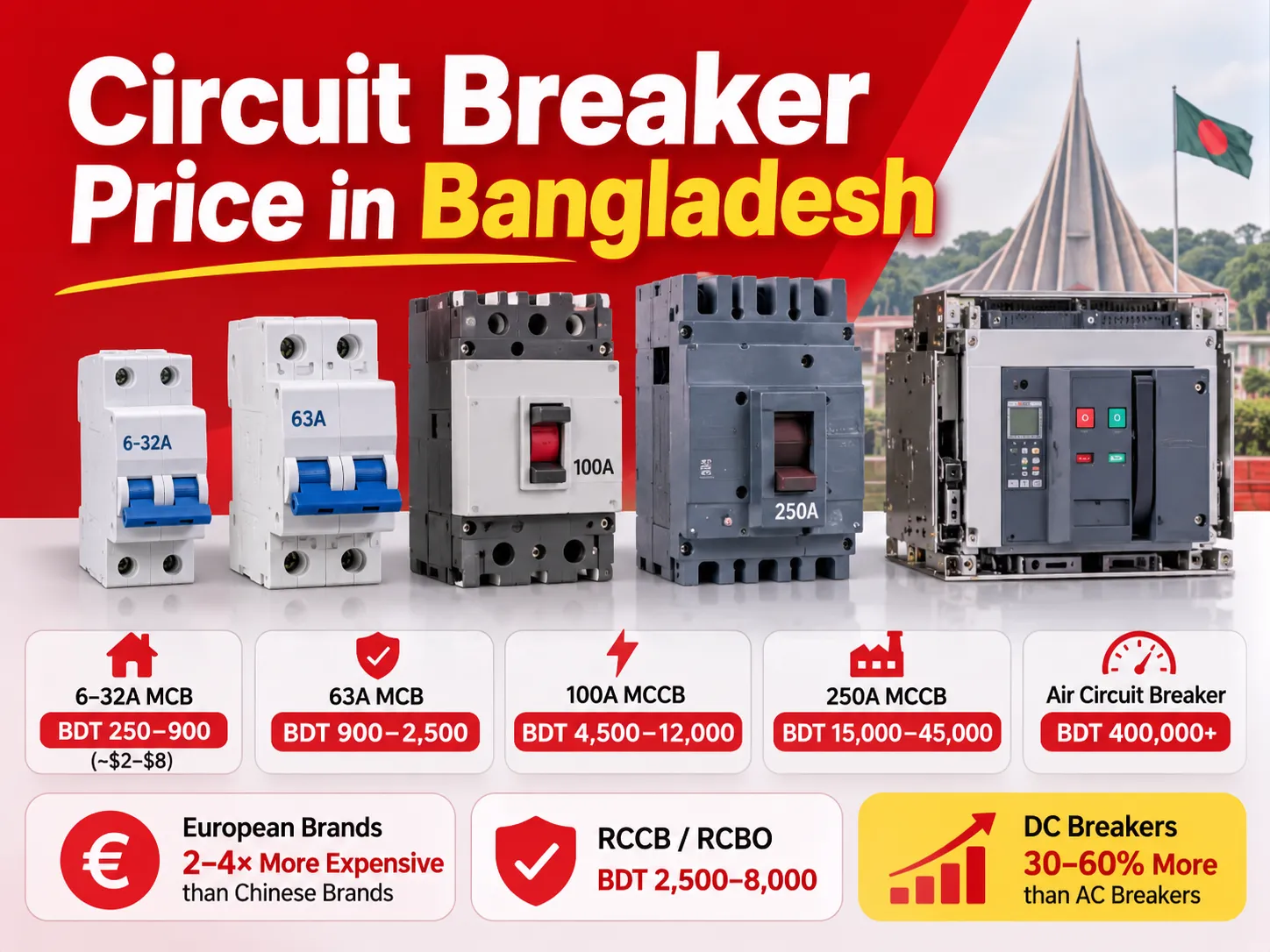
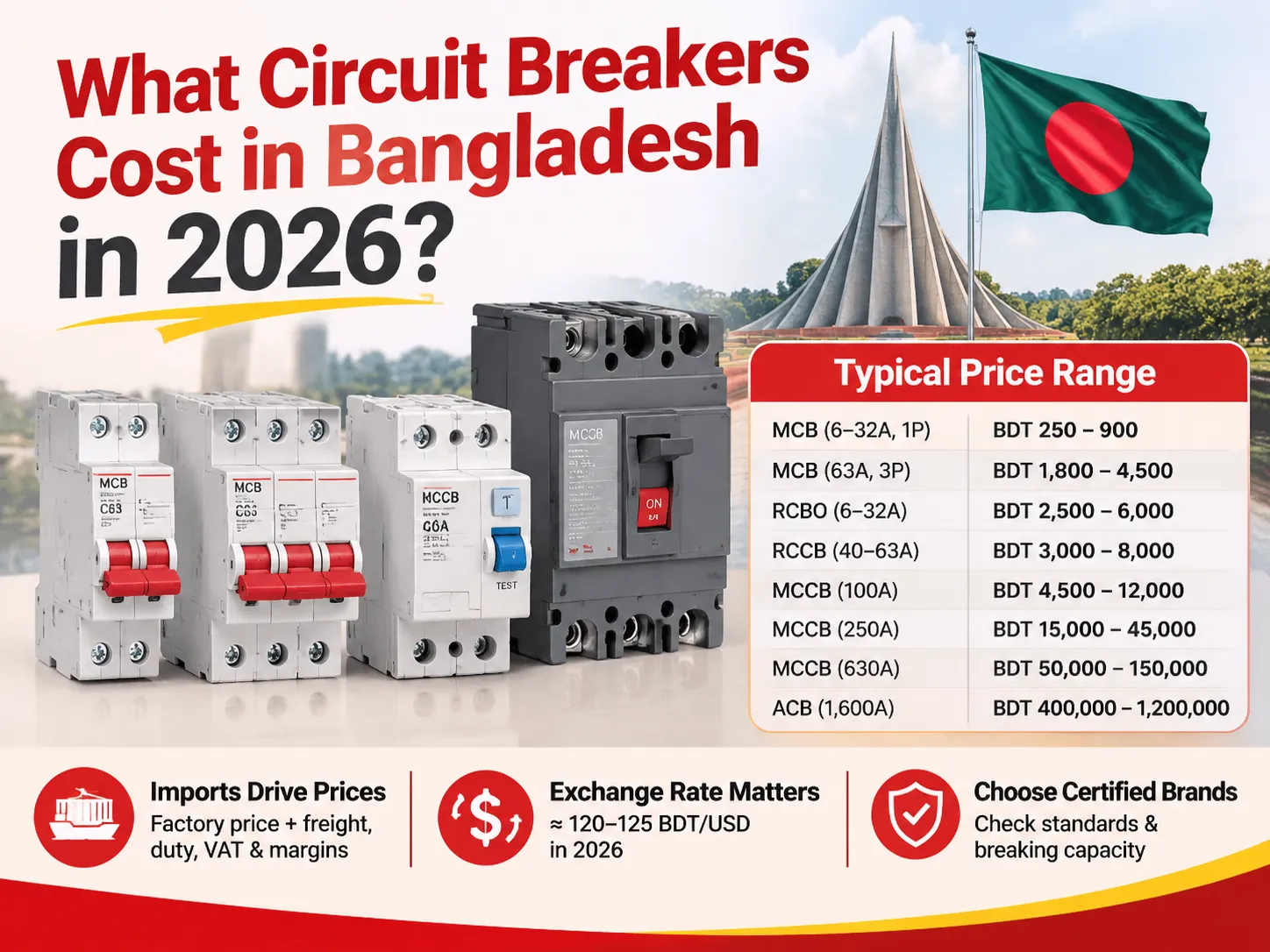
En résumé, un disjoncteur miniature de 6 à 32 A coûte environ 250-900 Taka à Dhaka ; un MCB 63 A se vend environ 900-2 500 Taka ; un disjoncteur moulé 100 A peut être trouvé pour 4 500-12 000 Taka ; 15 000-45 000 Taka pour un MCCB 250 A ; et 400 000 Taka et plus pour un disjoncteur d'air. Les DDR et les DDRC se situent entre 2 500 et 8 000 Taka. Le coût des produits européens de marque est généralement deux à quatre fois supérieur à celui des produits chinois comparables, car la prime correspond à un service local et à un certificat vérifiable plutôt qu'à un mécanisme supérieur. Les disjoncteurs DC coûtent généralement 30-60 % de plus que les disjoncteurs AC de même intensité nominale.
Les sections suivantes fournissent les coûts des disjoncteurs par type, intensité nominale, type de marque, type de courant, et le coût global, y compris les frais de conformité et de droits. La dernière section traite des points de défaillance des disjoncteurs bon marché et de la manière d'estimer les budgets de projet.
Le coût des disjoncteurs au Bangladesh en 2026
La plupart des disjoncteurs au Bangladesh sont importés. Leur coût comprend le prix fabricant plus le fret, les droits, la TVA, la marge de l'importateur et du détaillant. Par conséquent, un disjoncteur à Dhaka coûte généralement 40-60 % de plus que son prix FOB, et comparer les devis locaux aux offres Alibaba peut être trompeur.
Le taux de change BDT/USD joue un rôle aussi important que les tarifs. En 2026, le taux de change devrait être d'environ 120 à 125 BDT pour 1 USD et, par conséquent, un disjoncteur coté à 6 USD FOB coûtera environ 730 BDT avant tout droit, et le prix de vente au détail (entre 1 100 et 1 300 BDT) est raisonnable, non gonflé.
Il existe trois segments d'achat sur le marché électrique. Les secteurs résidentiel et commercial achètent des disjoncteurs miniatures dans les magasins d'électricité à Dhaka, Chittagong et Sylhet. Les projets industriels achètent des disjoncteurs moulés et des disjoncteurs d'air auprès de distributeurs autorisés selon un cahier des charges. Le secteur des services publics et le secteur gouvernemental achètent du matériel électrique via des appels d'offres compétitifs basés sur un cahier des charges comprenant des normes, des catégories de marques et des certifications de test.
Chaque ligne du tableau ci-dessous compare les prix des produits individuels du prix le plus bas d’un produit au prix le plus élevé du même type. Dans tous les cas, le ratio entre le produit au prix le plus bas et le produit au prix le plus élevé varie de deux à quatre fois. Les différences proviennent principalement du nom de la marque et de la certification plutôt que des capacités inhérentes des produits. Par exemple, le disjoncteur miniature (MCB) 32 A au prix le plus bas fabriqué par un fabricant réputé pourrait être capable d’interrompre 6 kA au maximum.
Par conséquent, chaque MCB 32 A fabriqué par un fabricant de qualité est capable d’une interruption de 6 kA, cependant la constance de la calibration, la qualité du placage, et la possibilité de valider la certification varient considérablement selon les fabricants. Par conséquent Les gammes de MCB qui publient à la fois leur tolérance de calibration et leurs classes de capacité de coupure sont plus faciles à comparer que les gammes de MCB qui ne publient que leurs intensités nominales.
Tarification par intensité ; au sein d’un type
Pour une famille de produits individuelle, l’augmentation du courant ne se traduit pas par une augmentation proportionnelle du prix pour le même produit. En connaissant les étapes de prix incrémentales au sein de chaque type de produit, vous pouvez budgétiser plus précisément votre achat.
| Étape d’intensité | Effet sur le prix | Raison |
|---|---|---|
| MCB 6 A à 32 A | Presque stable, 10-25 Taka | Boîtier identique, mécanisme identique, calibration différente |
| MCB 32 A à 63 A | Double | Boîtier plus grand, contacts plus lourds, classe 10 kA |
| MCB 63 A à 125 A | Triple à nouveau | Cadre différent, principalement tripolaire uniquement |
| MCCB 100 A à 250 A | Trois fois | Taille du cadre, capacité de coupure, unité de déclenchement |
| MCCB 250 A à 630 A | Trois/quatre fois | Option de déclenchement électronique, connexions barres omnibus |
| Avantage de prix du disjoncteur 6 kA vs. disjoncteur 10 kA | +30-50% | Chambre d’arc plus lourde, contacts plus grands |
| Avantage de prix du déclenchement thermomagnétique vs. déclenchement électronique | Deux à trois fois | Transformateurs de courant, processeur, réglages |
Les implications pratiques sont telles qu’un tableau contenant de nombreux petits circuits est moins cher qu’un tableau contenant quelques grands circuits. Un exemple est le coût inférieur d’un tableau domestique 12 voies contenant des disjoncteurs miniatures comparé au coût d’un disjoncteur moulé 250 A. C’est une considération importante lors de la préparation et de la répartition du budget du projet. Un autre exemple est le disjoncteur moulé à l’extrémité supérieure de l’échelle, qui a la capacité de couvrir la plage de 16-250 A sur un seul cadre avec un déclenchement thermique magnétique réglable, permettant la création d’un sous-tableau avec un calendrier abordable par rapport à une liste de nombreux dispositifs individuels.
Pourquoi les disjoncteurs AC et DC sont-ils si différents en prix
Le coût d’un disjoncteur DC comparé à un disjoncteur AC est supérieur de 30-60 Taka en raison de l’arc.
Dans un circuit AC, il y a deux demi-cycles ou passages par zéro pour chaque cycle complet, moment où l'arc s'éteint naturellement ; par conséquent, il suffit que le disjoncteur empêche la réinflammation de l'arc. En revanche, un circuit DC ne présente aucun passage par zéro, donc un arc doit être éteint par des moyens externes consistant à allonger l'arc, refroidir l'arc et diviser l'arc sur plusieurs électrodes ; par conséquent, le chicaneur d'arc pour un circuit DC doit être plus grand, il doit y avoir plus d'électrodes, et des forces magnétiques plus puissantes doivent être utilisées pour séparer les arcs, le tout dans le même espace qu'un circuit AC.
Au Bangladesh, les applications solaires pour l'alimentation DC ont connu une croissance rapide, et l'augmentation du prix pour les applications solaires se reflète dans le prix des disjoncteurs DC. Par exemple, le prix d'un disjoncteur DC avec un courant nominal de 32 ampères utilisé dans un combiné de chaîne varie de 1200 à 3000 BDT, tandis que le disjoncteur équivalent, à courant alternatif, est tarifé entre 400 et 900 BDT ; ainsi, encore une fois, la différence de prix est due à la conception des disjoncteurs DC.
En ce qui concerne la sécurité, les disjoncteurs DC ne doivent pas être utilisés ou remplacés par des disjoncteurs AC car ils sont incapables d'éteindre les arcs et peuvent se fermer involontairement en cas de défaillance du disjoncteur AC. Malheureusement, le remplacement des disjoncteurs AC par des disjoncteurs DC est une pratique courante dans les petites installations solaires ; d'où la raison des marquages distincts trouvés sur les dispositifs DC.
Niveaux de marques et ce que le premium offre
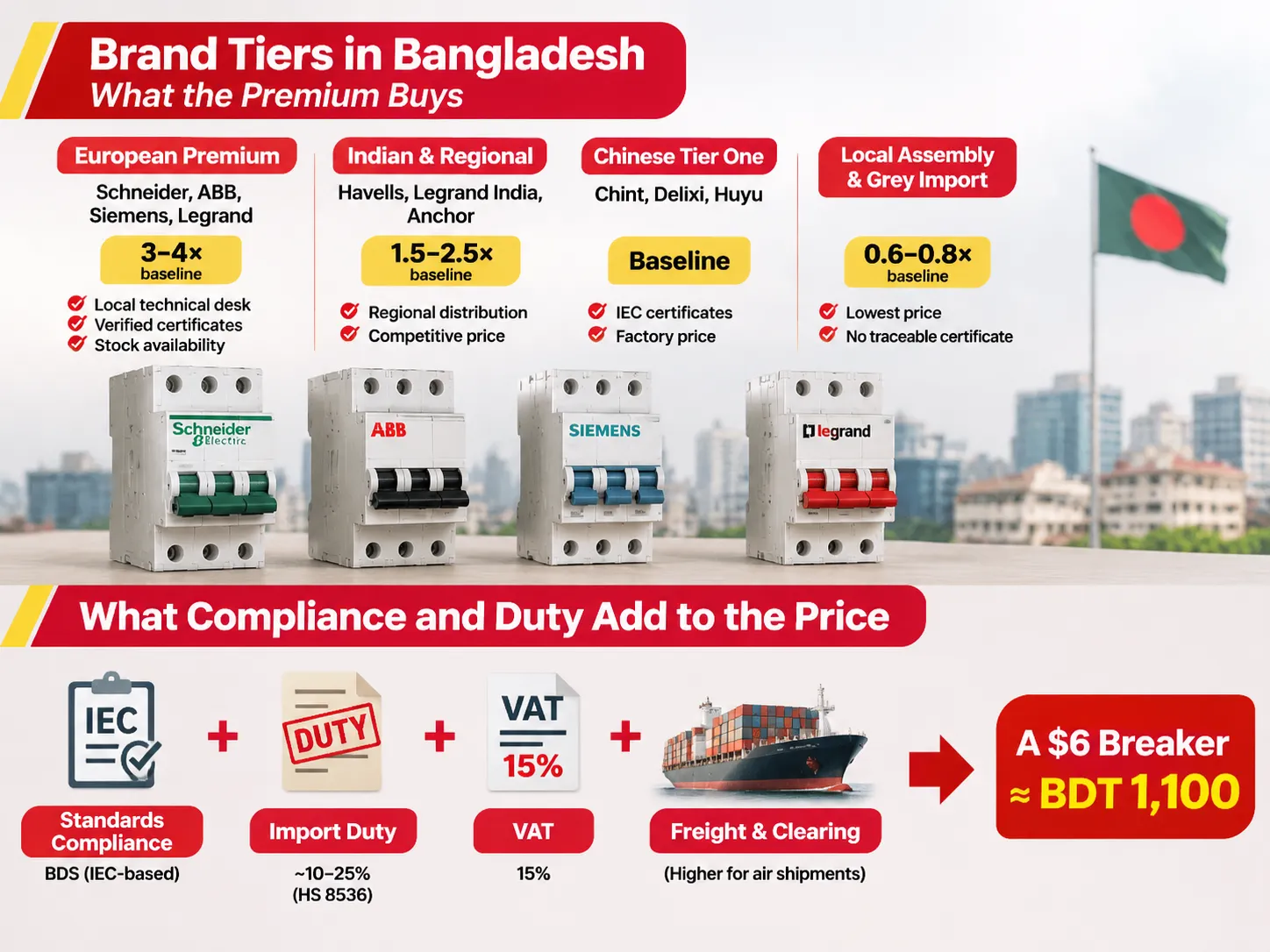
Les marques européennes premium offrent aux consommateurs bangladais trois avantages spécifiques : un support technique local, des certifications vérifiables via une base de données du fabricant, et un stock disponible immédiatement. Le support technique local est important pour la gestion des schémas de protection ; tandis que le certificat est exigé par les consultants pour la conformité aux réglementations locales ; et le stock est maintenu pour atténuer les problèmes causés par la défaillance des disjoncteurs, notamment dans les hôpitaux, où le délai de livraison attendu pour un disjoncteur de remplacement peut atteindre trois semaines.
Bien que les prix des marques chinoises de premier rang et des marques assemblées localement puissent être plus attractifs pour les résidents et les petites usines, le facteur le plus important lors du choix d'un dispositif est de savoir avec certitude qu'il existe une certification valide et traçable. Le dispositif doit également disposer d'un certificat d'étalonnage vérifiable because these devices have the highest potential for failure, which creates the need for fast replacement of breakers if the load ultimately exceeds 100 amps. At this point, the decision-making process regarding molded case breaker supply becomes increasingly complicated, due primarily to the number of devices purchased individually versus packaged together.
Between the factory and the retail shelf, there are three costs that account for most of the difference between an FOB price and the retail price in Dhaka.
What Compliance and Duty Add to the Price
The compliance with International Electrotechnical Commission (IEC) standards has been adopted for Bangladesh using Bangladesh Standards and Testing Institution (BSTI) equivalent(s). The BSTI certifies circuit breakers to allow them to be sold in Bangladesh; therefore, a circuit breaker needs to have been tested for compliance against the appropriate IEC standard in order to be deemed compliant, regardless of the label the manufacturer uses, and a test certificate serves as proof of compliance.
Import Duties on Circuit breakers fall under the Harmonized System (HS) classification of HS 8536. The import duty percentage rate applied to circuit breakers depends on their specific HS classification/subheading as well as whether or not the importer has an import concession and will range from approximately 10-25% of the Custom Invoice Value (CIF) amount; therefore, it is important to confirm the classification/subheading prior to shipping, rather than after shipping.
VAT is applied to an assessed value of 15% on the cost of the product at the time of Importation and again at the time of Sale; this figure explains the difference in the retail price for a circuit breaker that costs $6; therefore, a circuit breaker that costs $6 would sell at a retail shelf price of BDT 1,100 (rupees)/BDT 900 (rupees, respectively); VAT applies equally to all brands.
Freight & clearance represent the remaining part of the price difference between the FOB price and the Price on Shelf in Dhaka. While the cost per unit shipped in a full container of Miniature Circuit Breakers (MCB) is significantly less than that of a single Molded Case Circuit Breaker (MCCB) shipped via Air freight, the urgent Replacement of an MCCB from Bangladesh has a significantly higher shipping price than the same item included in a project shipment.
Where Inexpensive Products are Not as Effective
The main causes for the discrepancy between an electrical component that is effective for 20 years versus one that is only effective for three years come from four different areas that are typically not observable on the parts.
Calibration Drift. When a circuit breaker is new, it is calibrated to trip at approximately 1.6 times its rated capacity. However, after just a few years of being thermally cycled, a CB that originally was rated to trip at 1.6 has now calibrated itself to trip at 2.2 times its original rating, leaving the cable it protects without adequate protection. The calibration of each circuit breaker is determined by the bimetal strip and the adjusting screw. The calibration process is eliminated with inexpensive units so that manufacturers can take advantage of low-quality materials and manufacturing processes.
Contact Plating. Contact surfaces of circuit breakers can wear through due to heat generated at contact points due to inadequate contact surface area and, in many cases, inadequate shunt (to dissipate heat). Maintenance personnel typically discover overheating contact surfaces using infrared scans after the breaker has been running at an elevated temperature for one year.
Arc Chute Design. Arc chutes that are too short and contain too few plates will stop the current flow once during a fault condition; however, an inadequate design will not trip during the first short on the fault current, and the arc chute will fail again during the second iteration of the fault.
Terminal Torque. Circuit breakers that cannot be tightened properly due to striping the terminal threads at their rated torque will not operate safely when installed in a distribution board. Loose terminals are the most frequent cause of fires in the distribution board. The behaviour of multiple circuit breakers (MCBs) and moulded case circuit breakers (MCCBs) and why they are treated differently with respect to the ability of moulded case circuit breakers to withstand higher terminal loads are discussed.
At the point of assessment at the counter, only three of the four devices listed can actually be evaluated for acceptance of return and the certification of origin and possible batch marking of the unit should it fail. Therefore, when assessing a brand tier, it is not a quality decision but rather an evaluation of recourse available to buyers.
Building a Budget by Application
Using an application to create a project budget, we have provided an indicative estimate for devices needed based on typical applications:
| Application | Évaluation | Devices | Indicative budget |
|---|---|---|---|
| Two bedroom flat | 8 Circuits | 8-MCB 1-RCCB 1-Main switch | BDT 12,000-30,000 |
| Small Retail/Office | 12 Circuits | 12-MCB 2-RCBO 1-MCCB 100 A | BDT 25,000-60,000 |
| Small Factory | 200 A Service | 1-MCCB 250 A 6-MCB 100 A 12-MCB | BDT 120,000-280,000 |
| Rooftop Solar | 10 kW | DC isolators, DC breakers, AC breaker, SPD | BDT 35,000-80,000 |
| Industrial Main Incomer | 1600 A | 1-ACB metering & controls | BDT 500,000-1,300,000 |
The above costs are the costs for the device alone. To estimate a project budget for devices, we need to add between 60%-150% to the above costs for expenses related to boards, busbars, enclosures, wiring and labor depending upon whether the completed board was manufactured locally or imported as a complete assembly. As a result, it is common for project budgets that include only devices to be inaccurate by the time the board is energized.
Where HUYU products fit in the market
We manufacture miniature circuit breakers (MCB), moulded case circuit breakers (MCCB) from 1 A-1600 A as per the requirements of IEC 60898-1, IEC 60947-2 & UL 489 for regions that require UL rated MCBs and MCCBs. Our pricing is positioned in the Chinese tier-one group within Bangladesh, or approximately one third that of European brands and slightly less than one-fifth above the pricing of unbranded devices.
The succession of circuit breakers may vary widely based on local / national priorities and what the average cost of living or working costs are like. In some parts of Bangladesh you may be able to find MCB’s at a starting price of BDT 250. This is by no means a fair comparison as in most regions the prices can be found to have a maximum of five different price points between different brands or suppliers.
The minimum price point of an MCB would typically be around BDT 250 for miniaturised designs (with both 6 & 32 A ratings available) which could go as high as BDT 900 for larger 63 A models (type A). Most MCBs would be sold at around 40% to 50% less than the equivalent-value AC Breaker’s price.
Additional notes include:
Because of the size of Bangladesh and how long it has developed in relation to other Asian countries, you will not find all retail shops in every region providing the full range of products. As an example, in larger metropolitan areas, such as Dhaka you would expect to see more variety on offer as opposed to rural markets where most MCB brands may therefore only be supplied at specific times.
Three reasons for these price variations are as follows:
- Local product sourcing
- Volume of stock ordered
- Differences in business operations
It should also be remembered that circuit breakers in Bangladesh are more cost-effective compared to many European brands. The primary reason behind this is due to the developmental stage that Europe is at, regarding the price model of MCB breakers in comparison with Bangladesh. For instance, you can find AC circuit breakers from an average of BDT 400,000 or so (.which is equivalent to £100) while you will pay well over £1000-£2500 in Europe (depending on size, type, manufacturer).
A grey import device may not come with an authorised distributor’s warranty or technical support, however it will still function when purchased. Grey import devices may also be sold without the endorsement of a recognised brand, as many of them will come with a photocopy of the original certificate for authentication purposes – these devices often miss the step of proper calibration. Genuine versions may also exist, but usually deal with the initial product sourced from a batch older than what current production methods yield. Only the first two options above can yield significant savings for consumers, while both options leave consumers with all the risk associated with these types of products.
FAQ
Do I need to use a DC breaker on my solar array(s) in Bangladesh?
According to the National Electrical Code of Bangladesh (NEC), you must install a DC breaker on the DC side of your solar array. A DC breaker is designed for extinguishing DC arcs and therefore uses a longer arc chute than its AC equivalent to successfully extinguish an arc that does not have a zero-crossing, in addition to using additional plates and parts within the breaker. Therefore, an AC breaker rated to handle the same amount of current will not clear a DC fault reliably and may potentially fail in the closed position.
What kind of certification should a circuit breaker have in Bangladesh?
All circuit breakers on the market in Bangladesh should be tested and certified to the appropriate IEC standards. For miniature circuit breakers, the applicable standard is IEC 60898-1; while for moulded case circuit-breakers, the appropriate standard is IEC 60947-2. Your certificate for a circuit breaker should name the model and manufacturer exactly as it appears on the breaker itself. The Bureau of Standards and Technical Information has a number of local entities that certify products for local sale. When bidding on commercial projects, you should expect to have been asked to provide test report(s) and batch markings together with your circuit breaker certificates.
Références
- UL Solutions – Circuit Breaker Standards and Certification
- Schneider Electric – Circuit Design & Distribution Equipment
- Legrand – Circuit Breakers & Earth Leakage Devices
- Hitachi Energy – Low Voltage Circuit Protection and Switch Gear
- NEMA – Moulded Case Circuit Breaker Application Data
Conclusion
The cost of circuit breakers in Bangladesh is driven by type, rating, the supplier’s brand tier, along with any Applicable/Tariff duty and VAT stacks. For example, miniature breakers tend to cost comparatively low due to the small size of the device and the availability of common mechanisms associated with them; whereas a moulded case circuit breaker rated at 250A will cost nearly THIRTY times more due to the differences in the added complexity and expensively fabricated components associated to the product. The price is always going to be important, however, the more important question to answer is which supplier will give you a traceable certificate and accept this device back if it fails for any reason whatsoever.
In a market where grey imports and counterfeit devices are widespread and common, the only two things you have on your devices that cannot easily be copied or faked are the certificate P/N and Batch Mark, therefore, paying for those two items is certainly a good investment in your equipment and reputation.