
Crouse-Hinds devre kesicileri elektrik alanında garip bir niş işgal eder. Marka aktif kalmaya devam etmektedir — Eaton'ın bir alt bölümü olup aşırı ortamlar için endüstriyel çözümler içermektedir — ancak konutlarda ve hafif ticari tesislerde kullanılan eski devre kesici modellerine atıfta bulunur. Bu tür ekipmana sahip kişiler, orijinal modelin çok uzun zaman önce üretimden kalkması ve internette birçok yanlış önerinin bulunması nedeniyle zorluklar yaşamaktadır. Bu makale, Crouse-Hinds devre kesicisinin anlamı, UL testinden geçen modern eşdeğer modeller ve mevcut teklifin orijinal ekipman etiketi ile uyumluluğunun nasıl kontrol edileceği hakkında en kapsamlı bilgileri vermeyi amaçlamaktadır.
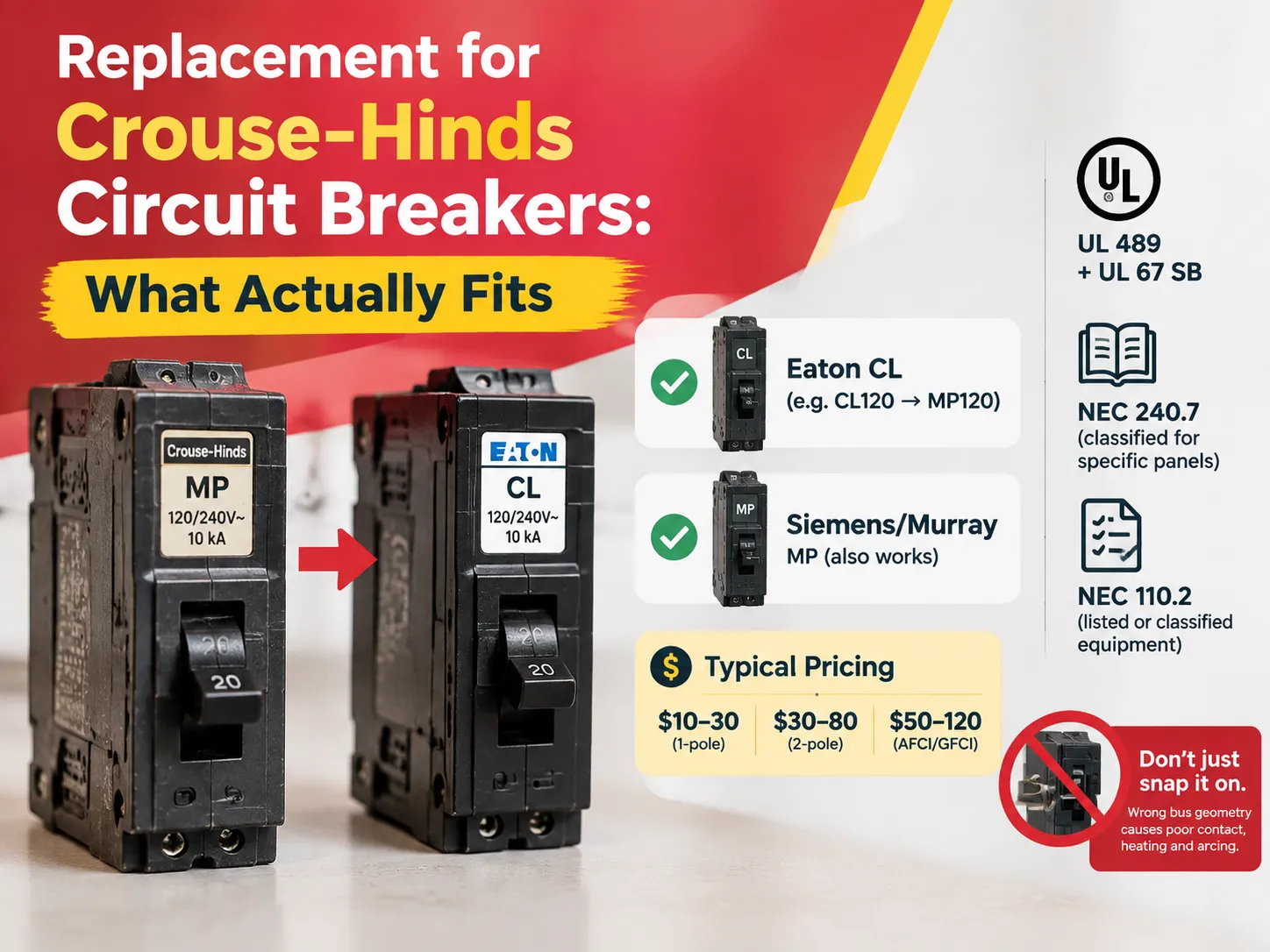
Kısa cevap: Konut tipi Crouse-Hinds devre kesicilerinin çoğunluğu bir inç tip MP konfigürasyonuna sahiptir ve önerilen yedekler Eaton CL serisindendir çünkü UL sertifikalıdırlar (örneğin, CL120 MP120'nin yerini alır ve CL220 MP220'nin yerini alır). Tip MP'yi üreten Murray markası sonunda Siemens ile birleştiğinden, Siemens/Murray MP kesicileri de aynı panellerde kullanıma uygundur. Yasal dayanaklar, fiziksel uyumluluk değil, UL 489'a göre UL sınıflandırması ve ilgili panel tipi için UL 67 SB listesine dayanmaktadır; Ulusal Elektrik Kodu Madde 240.7'de sınıflandırılmış devre kesicilerin yalnızca belirlenmiş panellerde kullanılabileceği belirtilirken, Madde 110.2 listelenmiş veya sınıflandırılmış ekipmanın kullanılma gerekliliğini şart koşar.
Crouse-Hinds Kesiciler Aslında Nedir
Yanlış anlama marka adıyla başlar. Crouse-Hinds artık Eaton'a ait bir markadır ve patlamaya dayanıklı kutular, HVAC aydınlatma armatürleri ve ilgili donanımlar dahil ürünler sunar; ancak, konut tipi yük kesicilerinin güncel bir tedarikçisi değildir. Bu, tüketicilerin Crouse-Hinds yedek kesiciler hakkında bilgi ararken muhtemelen 1965-1985 yılları arasına ait yük kesme panellerini görmeleri anlamına gelir.
Doğru cevabın neden sadece Crouse-Hinds olamayacağına dair net bir açıklama vardır. Tip MP kesiciyi üreten Murray ürün hattı, üretimi durdurulmadan önce birkaç kez el değiştirmiş ve teknolojisi Siemens'e ulaşmıştır. Ayrıca, Arrow-Hart ve Crouse-Hinds'in önceki operasyonları Cooper Industries tarafından devralınmış ve bu şirket 2012'de Eaton tarafından satın alınmıştır. Bu tarihin müteahhitler ve ev sahipleri için sonucu, kesici tasarımının sahiplik değişiklikleri boyunca hayatta kalmasıdır.
Bu nedenle, verilen gerçeklerden çıkarılacak olan, çözüm aranırken dikkate alınması gereken iki önemli nokta vardır. Birincisi, cevap ya Eaton CL serisi ya da Siemens/Murray MP kesici olmalıdır; bu, panelde önceden verilen bilgilere bağlıdır. İkincisi, bilgi araması forumdaki bir başlık yerine panelin dokümantasyonuna dayanmalıdır.
Listelenmiş vs Sınıflandırılmış: Her Şeyi Belirleyen Ayrım
Bu, tüm konunun en kritik kavramıdır ve çevrimiçi rehberlikte en çok karıştırılan noktadır.
UL Listesine sahip bir devre kesici, bu cihazın bağımsız bir ürün olarak test edildiği ve kabul edildiği anlamına gelir. UL Sınıflandırmasına sahip bir devre kesici ise, diğer üreticilerin belirli panellerinde kullanılırken test edildiği anlamına gelir. Eaton tarafından üretilen sınıflandırılmış seri, manyetik kesiciler için UL 489, yük merkezleri ve paneller için UL 67 SB, toprak arızası devre kesicileri için UL 943 ve ark arızası devre kesicileri için UL 1699 sertifikasyon süreçlerinden geçmiştir ve bu nedenle şirket, uyumlu olduğu 750’den fazla yük merkezi tipi olduğunu beyan etmektedir. Bu liste, General Electric, Thomas & Betts, ITE/Siemens, Murray, Crouse-Hinds ve Square D gibi şirketlerin isimlerini içermektedir.
Neden sadece uyumlu olmaktan daha önemlidir? Çünkü bir kesici bir bara takılabiliyor olsa bile, orada güvenli olmayabilir. Çeşitli üreticilerin busbar coğrafyası benzerdir, bu yüzden yabancı bir kesici takılabilir ancak temas ve basınç alanı yanlış olabilir, bu da direnç ısınması ve ark oluşumuna yol açar. NEC 110.2, ekipmanın yalnızca listelendiğinde iyi olduğunu belirtir; NEC 240.7 ise sınıflandırılmış kesicilerin sadece sınıflandırmaya göre belirli tip panellerde kullanılmasını zorunlu kılar. Bir denetçi, Crouse-Hinds panelinde listelenmemiş bir kesici görürse, kurulum başarısız olur, çalışıyor gibi görünse bile.
Bu ayrımın ticari bir sonucu vardır. Sınıflandırmalar belirli bir panel aralığı için verilir ve bu nedenle sınıflandırılmış ürün serisinde boşluklar vardır – örneğin, Eaton’ın CL serisi 50 Amperden yüksek veya başka belirli tip kesicileri içermez – sadece temel AFCI ve GFCI kesicileri üretilir. Bir panel 60 Amper veya daha yüksek derecelendirilmiş bir kesiciye ihtiyaç duyuyorsa veya konfigürasyonu benzersizse, cevap sınıflandırılmış bir kesicide değil, panelin değiştirilmesinde yatmalıdır. Bu ürünlerin arkasındaki sertifikasyon çerçevesi, paneli besleyen kesicileri yöneten aynı çerçevedir ve bu, rehberimizin konusu olan kesiciler için UL 489 sertifikasının anlamı.
Değiştirme Tablosu
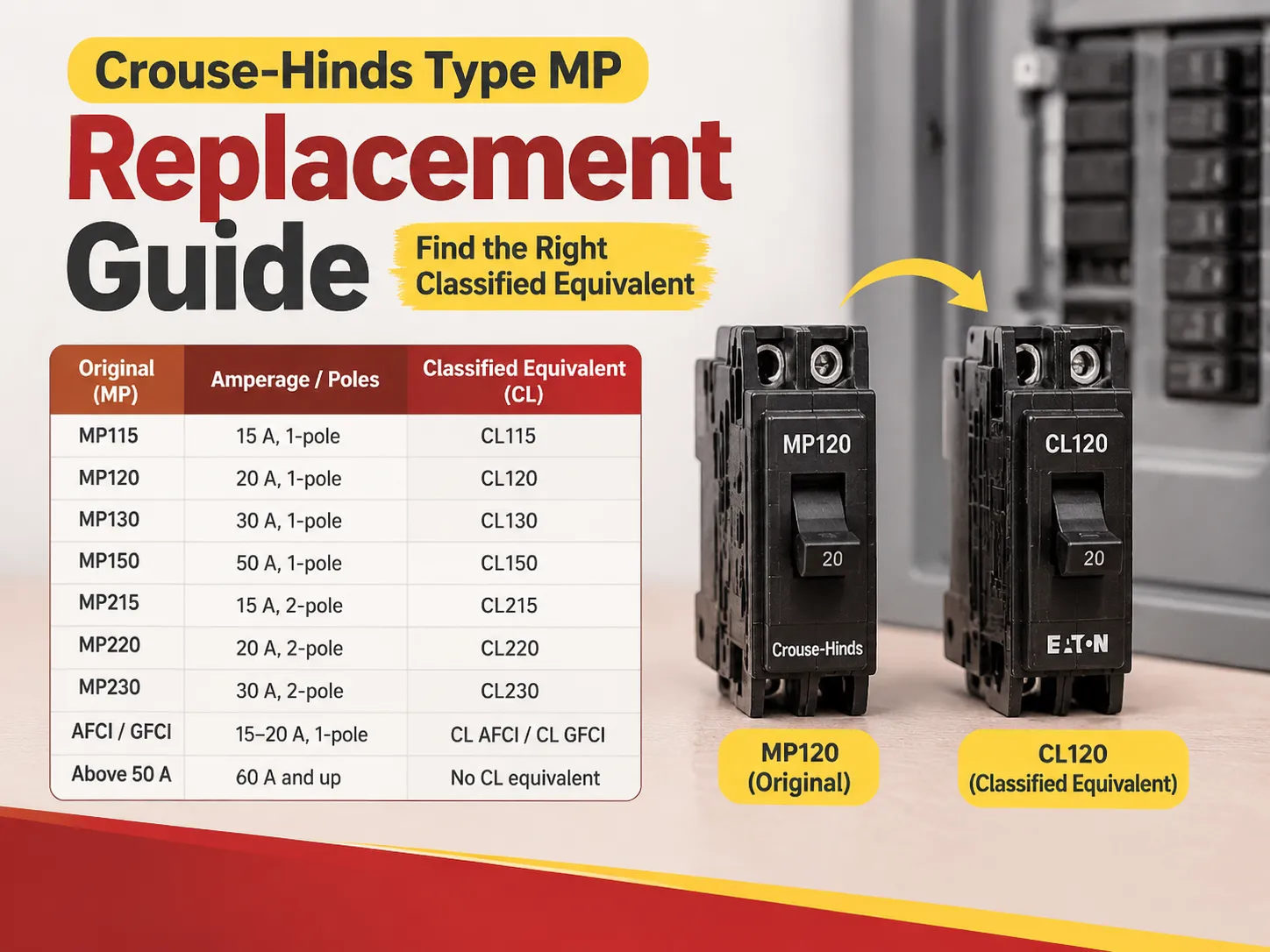
Crouse-Hinds MP devre kesicilerinin görselleri aşağıdaki tabloda bulunabilir ve eşdeğer modelleri de orada sunulmuştur. Değiştirilecek ürünün nominal voltajı, kutup sayısı ve atma kapasitesi orijinal ile en az eşit olmalıdır.
| Crouse-Hinds Tip MP (orijinal) | Amperaj / kutuplar | Eaton CL sınıflandırılmış eşdeğeri | Notlar |
|---|---|---|---|
| MP115 | 15 A, 1 kutup | CL115 | Standart dal devresi; 10 kAIC |
| MP120 | 20 A, 1 kutup | CL120 | Bu panellerde en yaygın yedek |
| MP130 | 30 A, 1 kutup | CL130 | Büyütmeden önce iletken boyutunu doğrulayın |
| MP150 | 50 A, 1 kutup | CL150 | Sınıflandırılmış aralığın üst sınırında |
| MP215 | 15 A, 2 kutuplu | CL215 | Ortak trip, 120/240 V |
| MP220 | 20 A, 2 kutuplu | CL220 | Ortak trip, 120/240 V |
| MP230 | 30 A, 2 kutuplu | CL230 | Kurutucular ve küçük alt paneller için tipik |
| AFCI / GFCI dal | 15-20 A, 1 kutuplu | CL AFCI ve CL GFCI tipleri | Mevcudiyet değişken; paneliniz için sınıflandırılmış listeyi kontrol edin |
| 50 A üzeri | 60 A ve üzeri | No CL equivalent | The honest answer is usually a panel replacement |
This table comes with two caveats. The first is that Eaton’s classified line is not the only acceptable way to connect power; since Siemens has acquired the Murray design that resulted in the Type MP, the current type of Siemens manufactured Murray circuit breakers is also considered appropriate for use with panels indicative of the MP label. In case Siemens MP is used instead for replacement, it would be the closest thing of getting the original product, but the important advantage is that in this case the panel label should clearly indicate the use of board. The second caveat is that “same amperage” does not equal to “same breaker.” A replacement GFCI or an AFCI type breaker means different wiring direction on the load side. There are some other limitations for using two-pole replacements of the multilayered branch circuit as well.
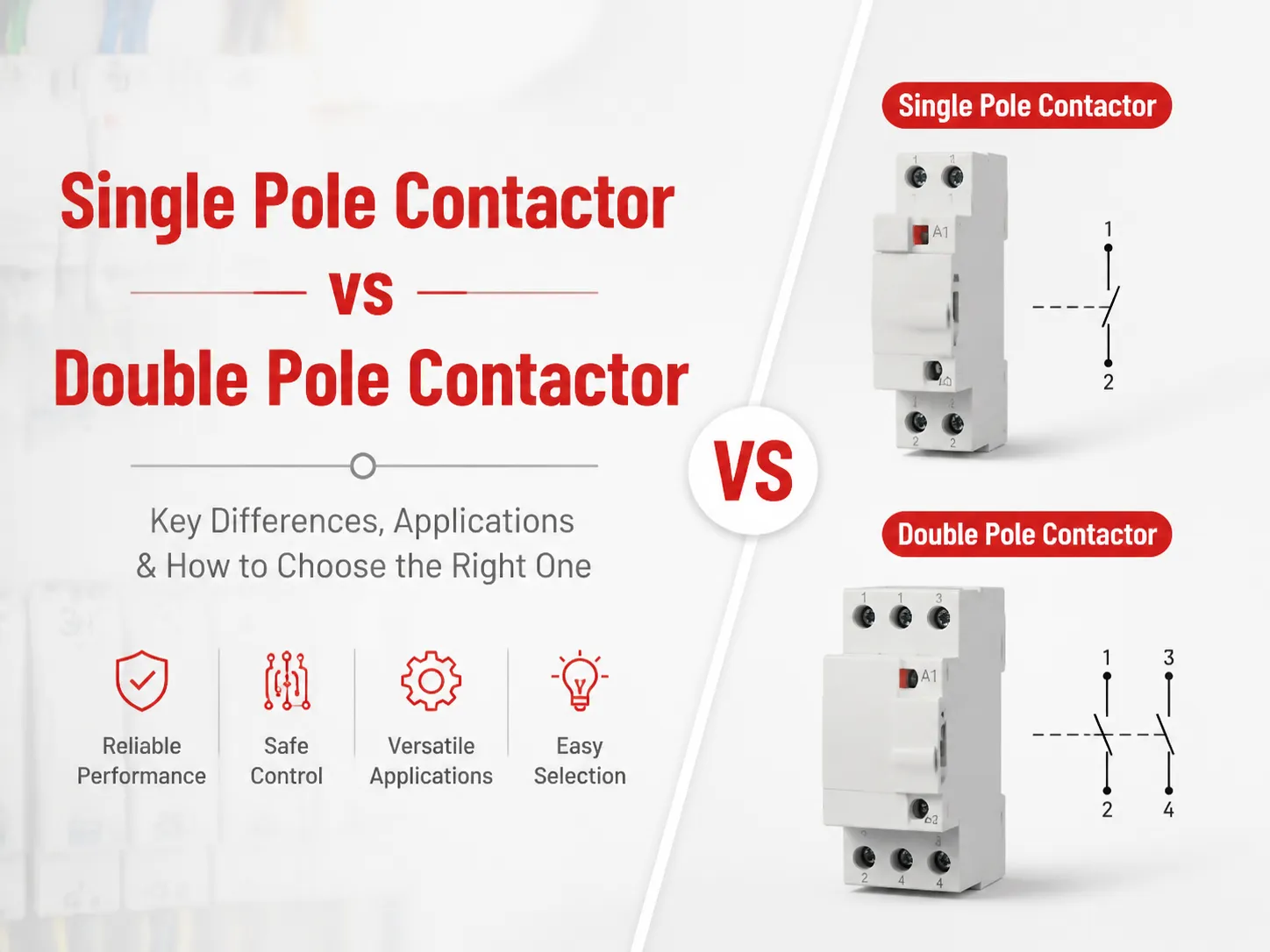
Pole count can be considered an issue since customers often improperly order circuit breakers. A single pole circuit breaker is designed simply for one leg of 120 volt circuit while two poles are used in 240 volt circuits and multiterminal branch circuits for enabling the simultaneous circuit shut down.The selection logic and the space implications are set out in our guide to single-pole versus double-pole breakers, and getting it wrong is the most common reason a replacement breaker has to be returned.
Where to Buy and What It Costs
Classified replacements are a general product, which is beneficial in terms of availability but doesn’t bode well for those searching for cheaper prices on less common items.
- The reliable first step in this case is an electrical distributor. They can cross-check the classified entry against the model of the panel and order the AFCI and GCFI variants that can’t be found in the major retailers.
- Home improvement stores have the usual CL types of the devices — usually 15 A, 20 A, or 30 A for the single-pole and 20 A, 30 A for the two-pole. This is easy and convenient, but the choice on the shelf tends to lack the unusual types.
- The online stores provide an alternative route for comparing the prices and looking up the catalogue where the exact model of the breaker is normally given.
- The approximate street prices for a classified replacement breaker are as follows. A single-pole 15 A or 20 A CL breaker goes for around $10-30. A two-pole 20 A or 30 A one costs approximately $30-80. The price for the AFCI and GFCI versions is generally around $50-120 due to the presence of the additional electronic equipment. If it exists in the classified category, the size of the ratings raises the price even higher.
By comparison, the cost of hiring an electrician to replace a breaker costs about $130-250, while the entire panel replacement costs a lot more.When the arithmetic starts to favour a new panel — and what that costs — is set out in our guide to elektrik paneli değişim maliyetimizin, which is worth reading before you commit to chasing one hard-to-find breaker.
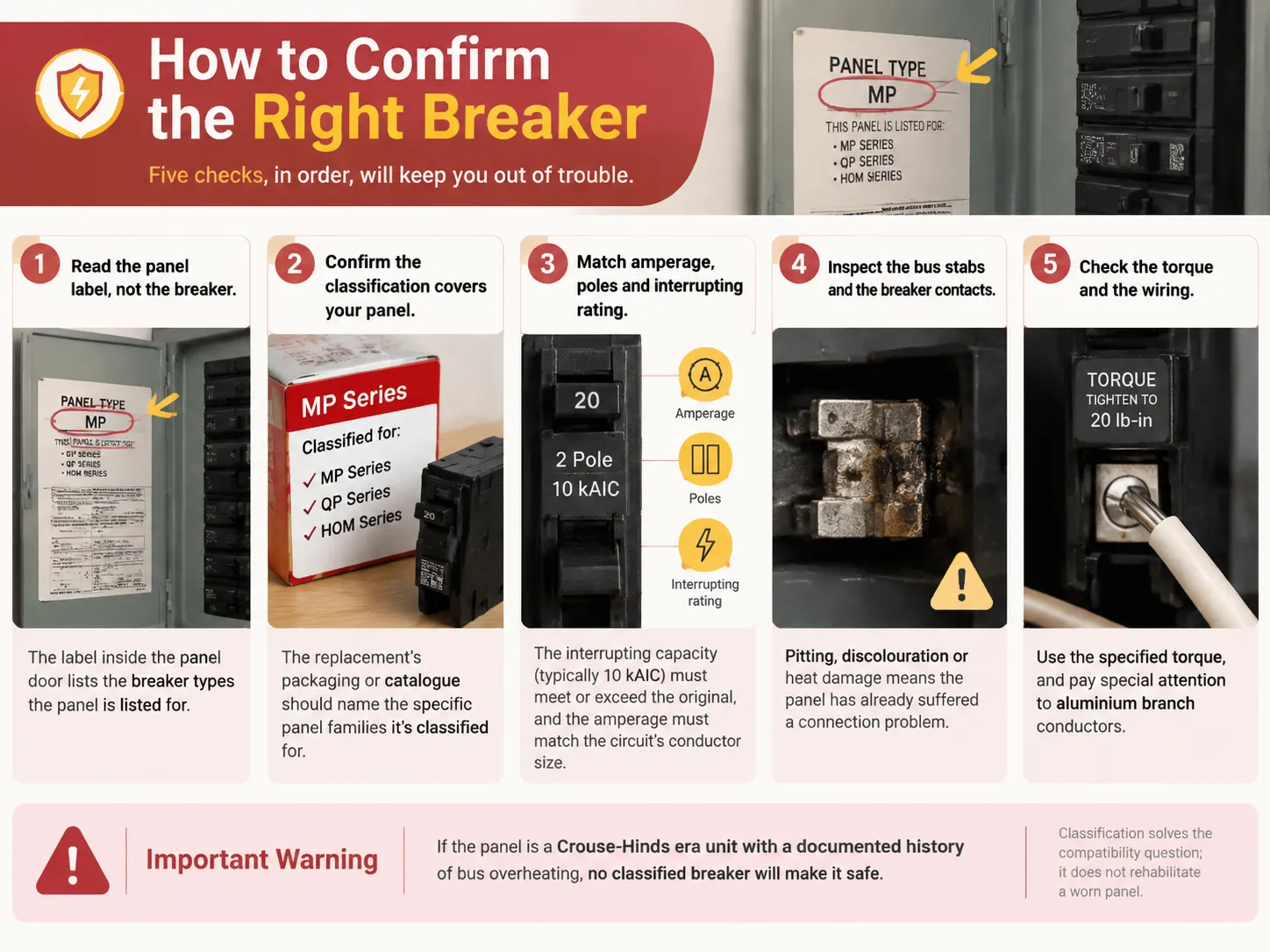
How to Confirm the Right Breaker
If you want to avoid problems, keep five essential checks in mind.
- Examine the label on the panel and not the breaker. You should look for its details. The label inside the panel shows you the types of breakers the panel is suitable for, and that is the information you are actually looking for. If it shows that this is a panel which allows for the use of MP series, then you can use the appropriate replacement, otherwise, it is better to seek expert opinions about the panel.
- Make sure that the classification applies to your panel. By examining a label or catalogue entry you should be able to see the panel families your replacement was made for, don’t believe anything saying “Compatible with most panels”.
- Check the similar specs with original one. Anyone should check the interrupting capacity of the circuit as it should not be lower than that of the original circuit.
- Bear in mind that it is crucial to make sure that bus stabs and breaker contacts are in good condition. If there are any signs of deformities at the stabs, and burnt contacts it means that the previous connection of the circuit failed.A breaker that has been running hot is worth diagnosing rather than simply swapping, using the checks in our guide to bir devre kesicinin bozuk olup olmadığını nasıl anlayacağınız.
- It is very important to check if torque indicators and wiring work properly. The breaker has every piece of information concerning terminal torque, and one of the reasons for nuisance tripping is loose terminations. You need to pay special attention to aluminum branches.
There is only one warning which should be highlighted in this case. The Crouse-Hinds panels have systems of connections which have already been overheated, and no classified breaker is able to protect the environment.
Where HUYU Fits
It is important to be honest about this matter to clarify the following: HUYU does NOT provide UL-approved substitutes for Crouse-Hinds Type MP panels, and a manufacturer that makes such claims is not being honest about its product. This kind of classification is assigned by UL for every type of panel and cannot be found in a catalogue of ordinary breakers.
What HUYU produces is the equipment for the second part of the market. If the project is about the installation of new equipment, not the repair of old panels – new subpanels, control boards for machines, OEM products, retrofitted distribution equipment – specifications will be different. HUYU produces an array of protection and distribution products having UL, KEMA, TUV, CE, and IEC certification, including an array of miniature circuit breakers starting from 1P up to 4P, and 63 A in B, C, and D curve. The HUM18-63N MCB range is representative of what a certified modern breaker line looks like when the buyer is specifying new rather than substituting old.
Following the recommendations in this regard is very simple. In the case one is operating a Crouse-Hinds panel, everyone has to purchase the panel-certified products. If one is preparing a new equipment specification, one must define the new certified product and mention that there are no lateral relations connected to the legacy. Getting these two things mixed up is what leads to having a sub-panel with devices from different manufacturers and questions from the inspector.
Repair the Panel or Replace It?
There is a point after which replacing breakers is no longer a good idea; and Crouse-Hinds’s systems reach that point before most. Panel replacement is merited under any of the following conditions: the panel label is unreadable or missing and no breakers can be proven classified for it; the bus is heat-damaged, pitted, or discolored; the required amp rating exceeds the rating allowed for the classified panel; the panel requires AFCI protection that cannot be found and the panel cannot be classified as such; the service ampacity is insufficient to accommodate modern demands; and you are already paying for an electrician to be present.
The determining factor in this case is usually the quantity of breakers that need to be replaced. Replacing a 1 20 A breaker in a working panel is small job. When replacing a number of breakers plus adding AFCI protection for a bedroom circuit finds the bus pitted, it is a complete panel project in disguise.
SSS
What breakers replace Crouse-Hinds?
The appropriate substitute for the one-inch Crouse-Hinds Type MP breaker is the Eaton CL series: CL120 replaces MP120, CL220 replaces MP220 and so on. Since Murray’s design for the Type MP passed on to Siemens, the current Siemens/Murray MP breakers can also be used when the MP series is called for in the panel label. The ease of utilization with these options relies upon the panel’s own listing: it has to describe either the original breaker type or a device cleared for use with it, not just one that fits the bus but is otherwise indeterminate.
Can I use a Siemens breaker in a Crouse-Hinds panel?
Yes, and the reason for this is that the Murray MP design has been taken over by Siemens. Though the Siemens breaker is a different type from the one involved, the Siemens/Murray MP breaker is still the successor of the original. Consult the panel label to determine if the MP designation is there and buy the MP family breaker.
Eaton devre kesicilerini Crouse-Hinds panelinde kullanabilir miyim?
Yes, as long as you opt for the classified line only and do not use the normal residential line of Eaton. The Eaton CL line is UL classified for Crouse-Hinds Type MP panels and hundreds of other load centers available in one- and two-pole breakers and backup models. The usual BR line does not qualify because it belongs to a completely different line. Such distinction can often go unnoticed when making an online order.
Can you provide a replacement chart for Crouse-Hinds circuit breakers?
The table is provided above to show some matching items: MP115 to CL115, MP120 to CL120, MP130 to CL130, MP150 to CL150, MP215 to CL215, MP220 to CL220, and MP230 to CL230, provided also as AFCI and GFCI models, and with subsequent capacity rating of over 50 A having no CL equivalent. Please consider any chart to be just a starting point of your search instead of granting permission to do so. The listing of the panel label should be treated as decisive as it shows which types of breakers are appropriate for that particular panel.
What if no classified breaker exists for my panel?
In that case, you should use only the original-type one if it is available. It is not acceptable to fit an unsuitable one that does not comply with the NEC codes. It must be clearly stated that no use of unlisted breakers is acceptable in any given instance.
Referanslar
- Eaton — Classified Circuit Breakers (UL Classified Replacement Breakers, Type CL and CHQ)
- NFPA — National Electrical Code, Articles 110.2 and 240.7
- UL Solutions — UL 489, UL 67 SB, UL 943 and UL 1699 Standards
- Siemens — Murray Type MP Circuit Breakers
Sonuç
When it comes to swapping out a Crouse-Hinds breaker, it’s really more about finding what class you need instead of seeking a particular model. The previous breakers are no longer available under that name. Not only is the circuit breaker already decades old, but also there aren’t really any acceptable replacements other than the original type MP design as stipulated by Siemens/Murray or the Eaton CL series approved by UL for the panels in question. Anything else is a risk, as it’s going to be a warranty nightmare. Step 1 is checking the label on the panel first, and then look for the amperage, poles, and interrupting rating. Many people check the classified listing names of their panels in the third step, and they should check the bus at last before making that purchase. In case the label has been lost, pitting has appeared on the bus, or the amp rating you need can’t be found within the classified range, it’s wiser not to waste money on a new breaker at this time.