
Tipik olarak, tesis yöneticileri elektrik yüklenicilerini herhangi bir pazarlama kampanyasına dayanarak seçmezler. Seçim yapmalarının farklı motivasyonları vardır – örneğin, acil olarak bir kiracıya yer hazırlamaları gerekebilir ve bu nedenle bir elektrik yüklenicisi seçme ihtiyacı hissedebilirler veya bir denetim başarısızlığı ya da tam dağıtım panosu gibi başka bir sorun nedeniyle bunu yapmak zorunda kalabilirler. Projeleri için elektrik yüklenicileri ararken, tesis yöneticilerinin kısa liste için sadece üç kaynağı vardır. Bu ya bir genel yüklenicinin tavsiyesi, bir distribütörün tavsiyesi ya da sabah erken saatlerde arayan bir kişi olabilir.
Şirketlerin ne sunduğu, hangi şirketlerin hangi seviyede hizmet verdiği, bu tür hizmetlerin 2026’da ne kadar tutacağı, nitelikli teklif verenlerin ucuz teklif verenlerden nasıl farklılaştığı, projenin Avrupa’da mı yoksa Kuzey Amerika’da mı gerçekleştirildiğine bağlı olarak neden cevabın değişebileceği.
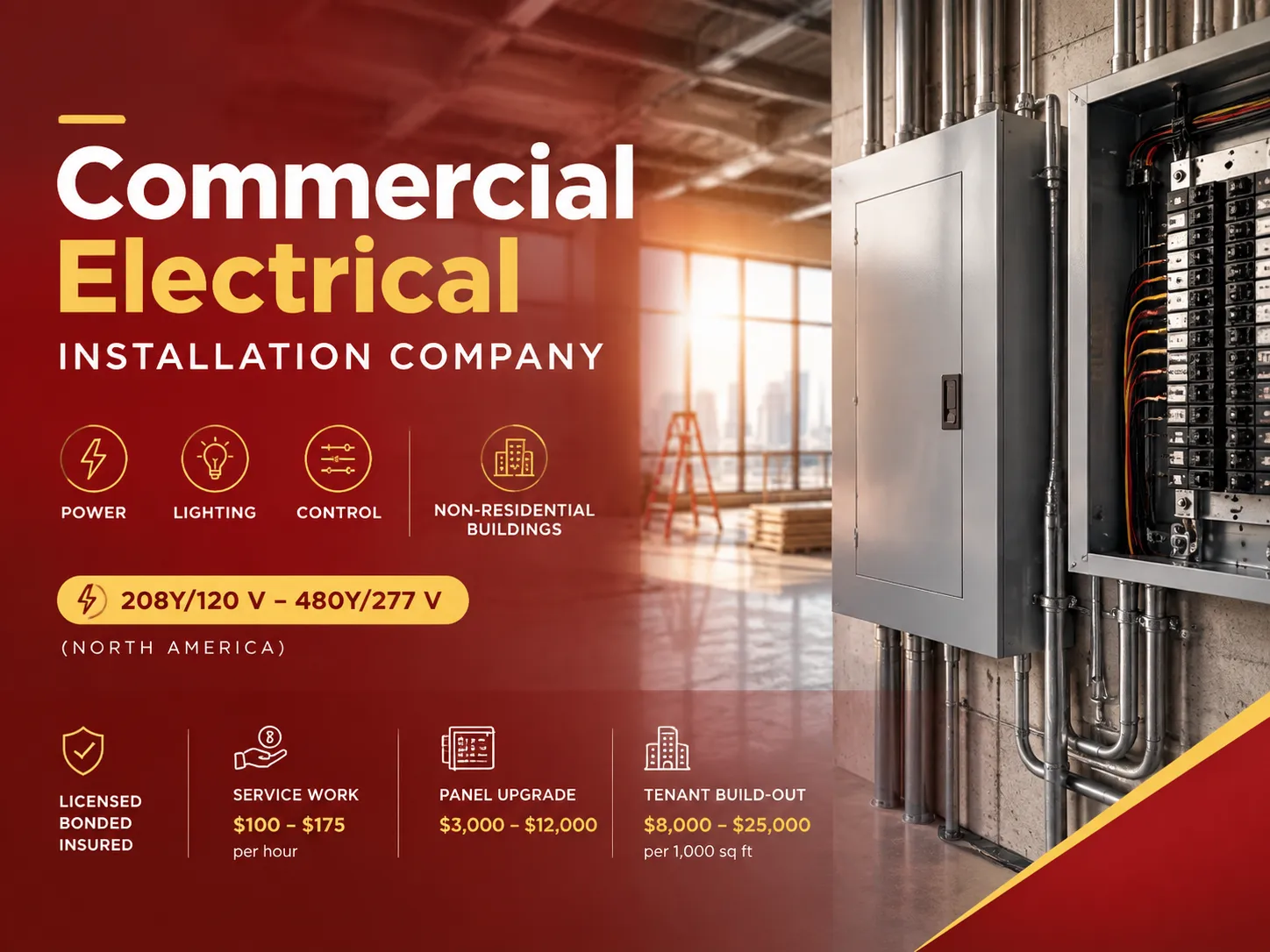
Kısa cevap: Bir elektrik yüklenicisi, ticari mülklerde elektrik sistemlerinin tasarımını, ekipman kurulumunu, testini ve devreye alımını gerçekleştiren bir işletmedir. Kuzey Amerika’da düşük voltaj sistemleri, nominal voltaj aralığı 208Y/120 V ile 480Y/277 V arasında çalışır, bu da şirketlerin eyalet gereksinimlerine göre lisans, teminat bonosu ve uygun sigorta kapsamı almaları gerektiği anlamına gelir. Sağlanan hizmetler saat başına 100-175 dolar arasında olabilir, ticari servis paneli yükseltmesi 3.000 ila 12.000 dolar arasında tutabilirken, kiracı yerleşimi bin metrekare başına 8.000 ila 25.000 dolar arasında değişebilir. Bununla birlikte, bazı durumlarda ulusal şirketler çok pahalı olabilir, çünkü yerel düzeyde güvenilir bir lisans sahibi büyük bir kuruluştan daha hızlı ve daha ucuz olabilir. Bu bağlamda HUYU, dağıtım sistemleri, yükleniciler ve kesiciler gibi düşük voltaj sistemlerinin montajı ile çalışmaktadır.
Ticari Elektrik Kurulum Şirketinin Gerçekte Yaptıkları
Kapsamı belirleyen metrekare değil, kullanım amacıdır. Örneğin, 40.000 metrekarelik bir tıbbi ofis ile aynı büyüklükte olan 40.000 metrekarelik bir dağıtım deposu, metrekare olarak eşit ancak gereksinimleri açısından çok farklıdır. İlki izole topraklı prizler, hastane sınıfı cihazlar, acil çıkış devreleri ve jeneratör transferi için bazı yöntemler gerektirir. İkincisi ise yüksek tavan aydınlatması, rıhtım seviyeleyici devreleri ve önemli bir motor yükü gerektirir.
Yüklenici her zaman servis girişi ve ana dağıtım, besleyiciler ve dal devreleri, güç ve aydınlatma, ısıtma ve soğutma, topraklama ve bağlama ile ani gerilim korumasından sorumludur. Tasarım ve inşa modeli kullanıldığında, aynı yüklenici ayrıca yük hesaplamalarını yapar, tek hat diyagramları oluşturur ve tasarım uyumluluğu için gereken kısa devre ve koordinasyon çalışmalarını geliştirir. Ancak, tasarım-teklif-inşa modellerinde bu işler mühendisler tarafından yapılır ve yüklenici sadece inşaat süreci ile ilgilenir.
Ticari ve konut binaları arasındaki fark, kullanılan sistem türünde olup işçilik kalitesiyle ilgili değildir. Ticari binalar 3 fazlı güç kullanır: ticari binalarda 208Y/120 V ve daha modern binalarda 480Y/277 V. Ayrıca, kablolama yöntemi kablo yerine bir kanal ve ayrı iletkenlerin kullanılmasını içerir. Son olarak, sistem NEC Madde 220’ye göre talep hesaplamalarına dayanarak tasarlanır ve boyutlandırılır. O dağıtım hattı içindeki cihazlar ve montajlar kendi standartlarını taşır — kalıplı-kasa kesiciler için UL 489, düşük voltaj güç devre kesicileri için UL 1066, pano için UL 891, anahtarlama donanımı için UL 1558 — ve tam setimiz kapsamındadır ticari elektrik hizmetleri rehberimizde.
En Büyük Ticari Elektrik Kurulum Şirketleri
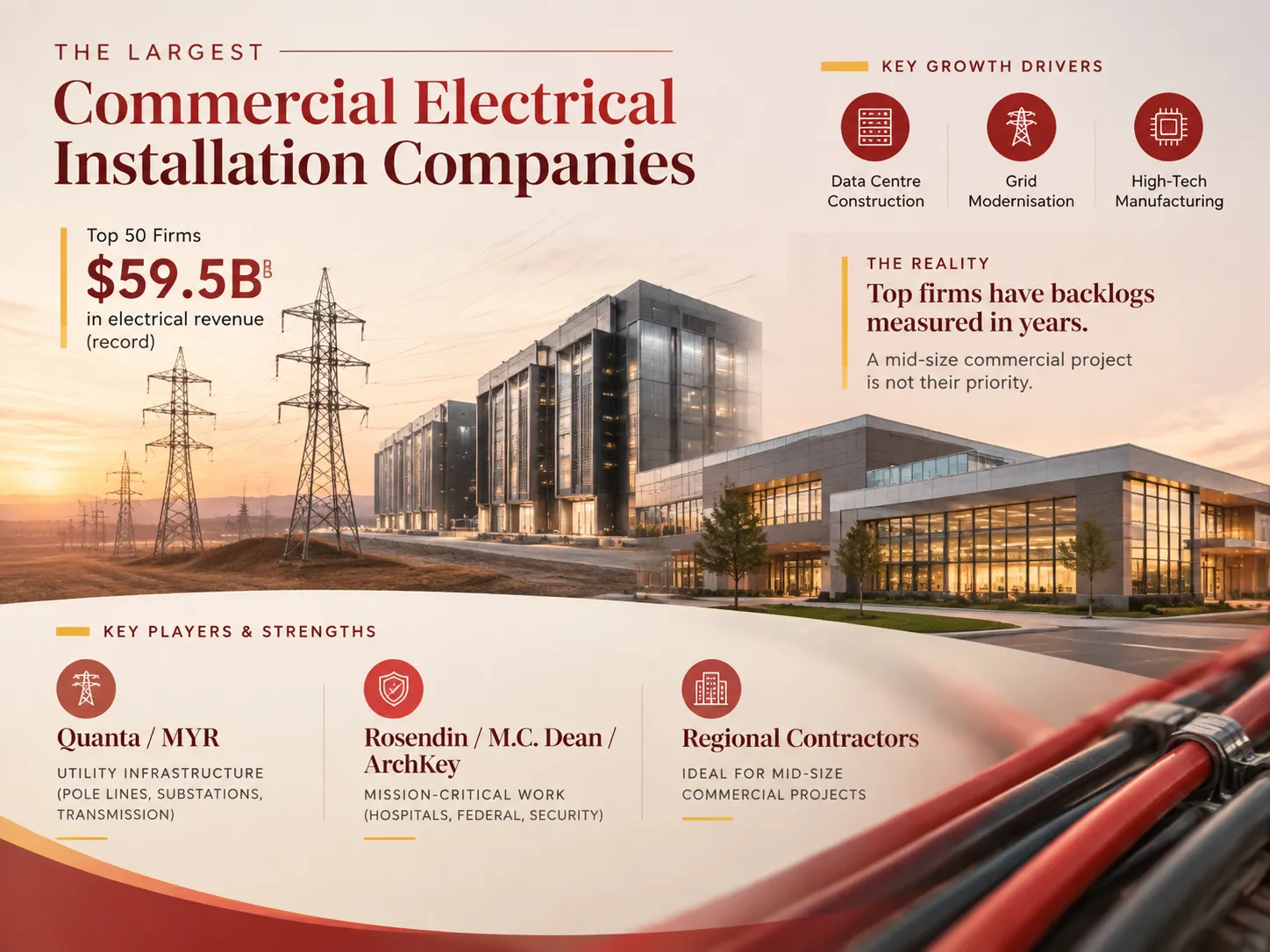
Gösterilen ölçek rakamları, EC&M’nin En İyi 50 elektrik yüklenicisi listesi ve ENR’nin En İyi 600 uzman yüklenicisi listesi esas alınarak gerçek yıllık hesap kazanımlarından alınmıştır. Son döngüde En İyi 50 yüklenicinin elde ettiği toplam gelir miktarı, esas olarak veri merkezleri, şebeke modernizasyonu ve yüksek teknoloji üretimi ile ilgili projeler tarafından yönlendirilen rekor yüksek bir miktar olan $59.5 milyar olmuştur. Bu yoğunlaşma müşteriler için özellikle önemlidir: en üst düzey yüklenicilerin aslında uzun iş yükü birikimleri vardır, bu da orta ölçekli ticari projeleri hiç önceliklendirmedikleri anlamına gelir.
| Şirket | Genel Merkez | 2025 elektrik geliri | En güçlü oldukları alanlar |
|---|---|---|---|
| Quanta Hizmetleri | Houston, TX | $13.5 milyar | İletim, dağıtım, büyük ölçekli yenilenebilir enerji |
| Rosendin Elektrik | San Jose, CA | $3.7 milyar | Veri merkezleri, yarı iletken, tasarım-yapım |
| EMCOR Grubu | Norwalk, CT | $3.6 milyar | Kurumsal, sağlık, ağ ve iletişim |
| MYR Grubu | Thornton, CO | $3.4 milyar | İletim ve dağıtım hatları artı ticari ve endüstriyel |
| Everus İnşaat Grubu | Bismarck, ND | $2.8 milyar | Kamu hizmetleri ve endüstriyel elektrik |
| IES Holdings | Houston, TX | $2.5 milyar | Endüstriyel hizmetler, altyapı |
| MMR Grubu | Baton Rouge, LA | $2.3 milyar | Enstrümantasyon ve kontrol, ağır sanayi |
| M.C. Dean | Tysons, VA | $1.9 milyar | Kritik görev, federal, güvenlik sistemleri |
| ArchKey Çözümleri | St. Louis, MO | $1.7 milyar | Teknoloji, sağlık, eğitim |
| Faith Technologies (FTI) | Menasha, WI | $1.4 milyar | Ön imalat, endüstriyel kontrol |
| E-J Elektrik Tesisatı | Long Island City, NY | $1.36 milyar | New York metro kurumsal ve ulaşım |
| Helix Elektrik | San Diego, CA | $957 m | Çok aileli, konaklama, güneş enerjisi |
Tabloyu ezberlemektense nasıl okunacağını anlamak daha önemlidir. Quanta ve MYR ağırlıklı olarak hizmetler sunmaktadır – direk hatları, trafo merkezleri ve iletim – bu, hastane tesisatından farklı bir iş alanıdır. Rosendin, M.C. Dean ve ArchKey, müşterinin duruş maliyetinin inşaat maliyetlerinden daha yüksek olduğu kritik görev ortamlarında faaliyet göstermektedir. Bir proje 60.000 sq ft ofis yenilemesi ve pano yükseltmesini içeriyorsa, üçü de rekabetçi olmaz ve rekabetçi olan yüklenici muhtemelen daha önce duymadığınız yerel bir firmadır. En büyük oyuncuların gelir yerine iş gücüne göre karşılaştırmalı sıralaması bizim ABD'deki en büyük elektrik yüklenicilerinin dökümünde.
Projenizin Aslında Hangi Tür Firma İhtiyacı Olduğu
Sektörde beş iyi bilinen iş modeli vardır ve her biri teklif verme biçimi açısından farklıdır. Bu seçimde en sık ve maliyetli hata yanlış türle çalışmaktır; bir türde başarılı olan bir firma başka bir türü yapma yapısal olarak yetersiz olabilir.
| Firma türü | Tipik sözleşme | Kazandıkları alanlar | Zorlandıkları alanlar |
|---|---|---|---|
| Ulusal EPC / hizmet sağlayıcı yüklenici | Trafo merkezleri, iletim, büyük ölçekli güneş enerjisi | Teminat kapasitesi, mühendislik derinliği, çok eyaletli ekipler | Küçük bina işleri; minimum proje büyüklüğü nedeniyle dışlanır |
| Bölgesel ticari yüklenici | Ofisler, okullar, perakende, sağlık hizmetleri, iç mekan düzenlemeleri | Yerel kod bilgisi, denetçi ilişkileri, rekabetçi fiyatlandırma | Sınırlı dahili mühendislik; dış mühendis gerekebilir |
| Servis ve bakım uzmanı | Zaman ve malzeme, bakım anlaşmaları | Müdahale süresi, yedek parça stoğu, tekrarlayan denetim işleri | Teklif işleri; küçük ekipler, büyük proje teminatı yok |
| Endüstriyel ve kontrol entegratörü | Motor kontrolü, PLC, VFD, proses gücü | Devreye alma, arıza giderme, üretim çalışma süresi | Mimari ve bitiş hassasiyeti gerektiren işler |
| Tasarım-yapım tek kaynak | Konseptten devreye almaya tam kapsam | Tek sorumluluk noktası, zaman çizelgesi sıkıştırması | Daha az fiyat şeffaflığı; tasarım değişiklikleri faturalandırılır |
Fabrika, sunucu odası veya tıbbi merkez gibi kesintisiz çalışan bir tesiste, en iyi çözümlerden biri inşaat işleri için bir yüklenici ve ekipman yönetimi için başka bir yüklenici tutmaktır. Her iki sağlayıcıyı aynı şirkete vermek genellikle her iki alanda da kötü performansa yol açar.

Gerçekten Anlamlı Olan Yetkinlikler
Kuzey Amerika’da yüklenici olarak çalışma lisansı alma süreci ulusal değil, eyalet, il veya yerel yönetim düzeyinde yürütülür. Bu, bir elektrik yüklenicisinin bir eyalet veya ilde belirli bir faaliyet için lisanslı olması, komşu bir yetki alanında otomatik olarak lisans gerekmeksizin çalışabileceği anlamına gelmez. Lisanslamaya ek olarak, aşağıdaki bilgilerin doğrulanması da önemlidir:
- İlgili yargı alanında elektrik müteahhitliği lisansı — örneğin California’da C-10 lisansı veya şirketler yerine bireyleri lisanslayan yargı alanlarında usta elektrikçi lisansı. Bu tür lisanslamanın, müteahhitin antetli kağıdında değil, ilgili lisanslama kurulunun web sitesinde doğrulanması gerektiğini unutmayın.
- NECA üyeliği — Ulusal Elektrik Müteahhitleri Derneği. Bu organizasyon, ilgili işçi ve standart kurumlarına üyeliğin bir göstergesidir, ancak söz konusu müteahhitin bir güvenlik sertifikası aldığı anlamına gelmez.
- JATC çıraklık programı ile bağlantı — Ortak Çıraklık ve Eğitim Komitesi, ilgili elektrikçilerin eğitiminden ve sektörde çalıştıkları saatlerin toplanmasından sorumludur. Bağımsız elektrik müteahhitlerinin de eşit derecede güvenilir olabilecek farklı çıraklık programları olabileceğini lütfen unutmayın.
- UL 508A listesi — Şirket kontrol panellerini kendisi yapıyorsa müteahhitin bu listeye sahip olması gerekir; aksi takdirde, paneller bu liste olmadan satılamaz.
- NABCEP sertifikası — Bu, ilgili birey güneş enerjisi ve enerji depolama sistemleri üzerinde çalışıyorsa geçerlidir.
- Müteahhit personelinin elektrik tesisatları ile çalışacak olanlarının NFPA 70E eğitim kursunu tamamladığını kanıtlayan kayıtlar. Güncel eğitim kayıtlarının size sağlandığından emin olun.
- ISO 9001, 14001 ve 45001 sertifikaları — Bu, müteahhit tarafından uygulanan kalite, çevresel ve iş sağlığı sistemleri ile ilgilidir.
- Sigorta ve sorumluluk sertifikaları — Bu, elektrik müteahhitinin iş fiyatı ile ilgili genel sorumluluk sigortası ve işçi tazminatı kapsamını ifade eder.
Güvenlikle ilgili olmayan başka bir nitelik ise maliyet kontrolüdür: bu, yargı alanınızın uyguladığı kod döngüsünün belgelenmesidir. Güncel deneyimi son iki kod baskısına kadar olan bir firma, ne yapacağını ve nasıl yapacağını yeniden öğrenmek zorunda kalacak ve bu da bütçenize daha yüksek maliyet getirecektir. Notlarımız ticari bina elektrik tesisatı için direnç sınırları bu gereksinimlerin ne kadar hızlı değiştiğini göstermektedir.
2026’da Ticari Elektrik Tesisatı Maliyetleri
2026 rapor edilen fiyat anketlerinde, bir çırak $45 ile $85 arasında, bir kalfa $75 ile $165 arasında ve bir usta veya endüstriyel uzman piyasa trendlerine göre $100 ile $225 arasında ücretlendirilir. Bir müşterinin müteahhite ödediği toplam tutar, ücretler, çalışan faydaları, sigorta ve diğer giderlerden oluşacaktır. Ticari projelerde, aynı tesiste yapılan konut işlerine kıyasla faturalandırma, daha fazla sigorta, dokümantasyon çabaları ve ödeme süresi nedeniyle ’ye kadar daha yüksek olabilir. Orta Batı ve Kuzeydoğu eyaletlerinde sendikalı iş gücüne sahip şirketler, rakiplerine göre ila daha fazla faturalandırma eğilimindedir.
| İş kalemi | Tipik 2026 aralığı | Notlar |
|---|---|---|
| Faturalandırılan kalfa saati | $100–$175 | Most contractors bill at firm rate, not individual wage |
| Minimum service call | 2–4 hours billed | Often plus a $75–$195 dispatch fee |
| After-hours or weekend emergency | 1.5–2.0× rate | Storm and restoration work quoted on site |
| Commercial service panel upgrade, 200–400 A | $3,000–$12,000 | Rises to $12,000–$28,000 at 600–800 A |
| Three-phase power installation | $5,000–$20,000+ | Utility coordination time is a variable cost |
| New circuit installation | $300–$1,200 per circuit | Conduit and ceiling access drive the spread |
| LED lighting retrofit, per 1,000 sq ft | $1,500–$6,000 | Per-fixture: $85–$285 installed |
| Tenant electrical build-out, per 1,000 sq ft | $8,000–$25,000 | Includes materials, labour, permits, inspection |
| Commercial EV charger, Level 2 | $2,500–$7,500 per port | DC fast charging: $45,000–$120,000 |
| Standby generator, 100–500 kW installed | $55,000–$180,000 | Transfer switch and fuel storage additional |
| Permits and inspection fees | $300–$2,000 | Multi-point inspections add rounds |
| Load study and panel inspection | $500–$1,500 | Cheapest line on the list; most often skipped |
There are three factors accounting for differences between two quotations for a project of the same nature. First is the age of the building and status of the wiring: obsolete feeder sizes, aluminium branch circuits and hidden junction boxes all relate to labour costs. The second is whether the work can be done live or requires a shutdown: a shutdown is a cost for the client as much as for the contractor. The third factor is access: the height of the ceiling, whether it is finished or whether any lift required will be of greater significance than the equipment.Panel and service pricing specifically is detailed in our cost breakdown for electrical panel replacement.
How to Vet a Bidder Before the Contract Is Signed
The sequence to verify that minimizes the number of financial transactions.
- Check the license number with the issuing authority by looking it up on its official records. Compare the license number of the company, its type, and expiration date with those on the license certificate. A valid license that does not have the necessary coverage is worse than not having a license at all, as it will be discovered during the inspection.
- Get a copy of the insurance policy directly from the insurers. The certificates must state the name of the contractor as the recipient. Ask explicitly if the workers’ compensation insures everyone who will spend time on the job, including subcontractors.
- Figure out who is supposed to run the project. The “face” in the sales meeting will not be the one who is in charge. So ask them for the foreman’s name and license class, and how many projects the foreman is currently managing.
- Ask for a detailed breakdown; not just a total sum. The quote must contain all the items such as raw materials, labors, permits, temporary power, etc. For instance, you will get nothing from a quote like “15000 for electric works.”
- Ask for written exclusions. The exclusions usually include drywall repair after wiring completion, painting, coordination work with the utility company, building permits, and the temporary power cost during the construction. Each one of those is going to appear in the change orders later.
- Get at least three quotes and compare them. You will usually find that quotes may vary significantly – on an average they may differ by 30-50%. A quote on the low end of the scale deserves explanation rather than being taken for granted.
- Require necessary test results as a deliverable. Accepting the final outcome without getting results of insulation resistance, earth continuity, polarity, and loop impedance tests creates problems with the installation.
- Check the progress of two reference projects of the same size. Ask the last client two questions: was the final invoice within the 10% of the total sum; and were the inspections passed?
Choosing by Region: United States, United Kingdom and the EU
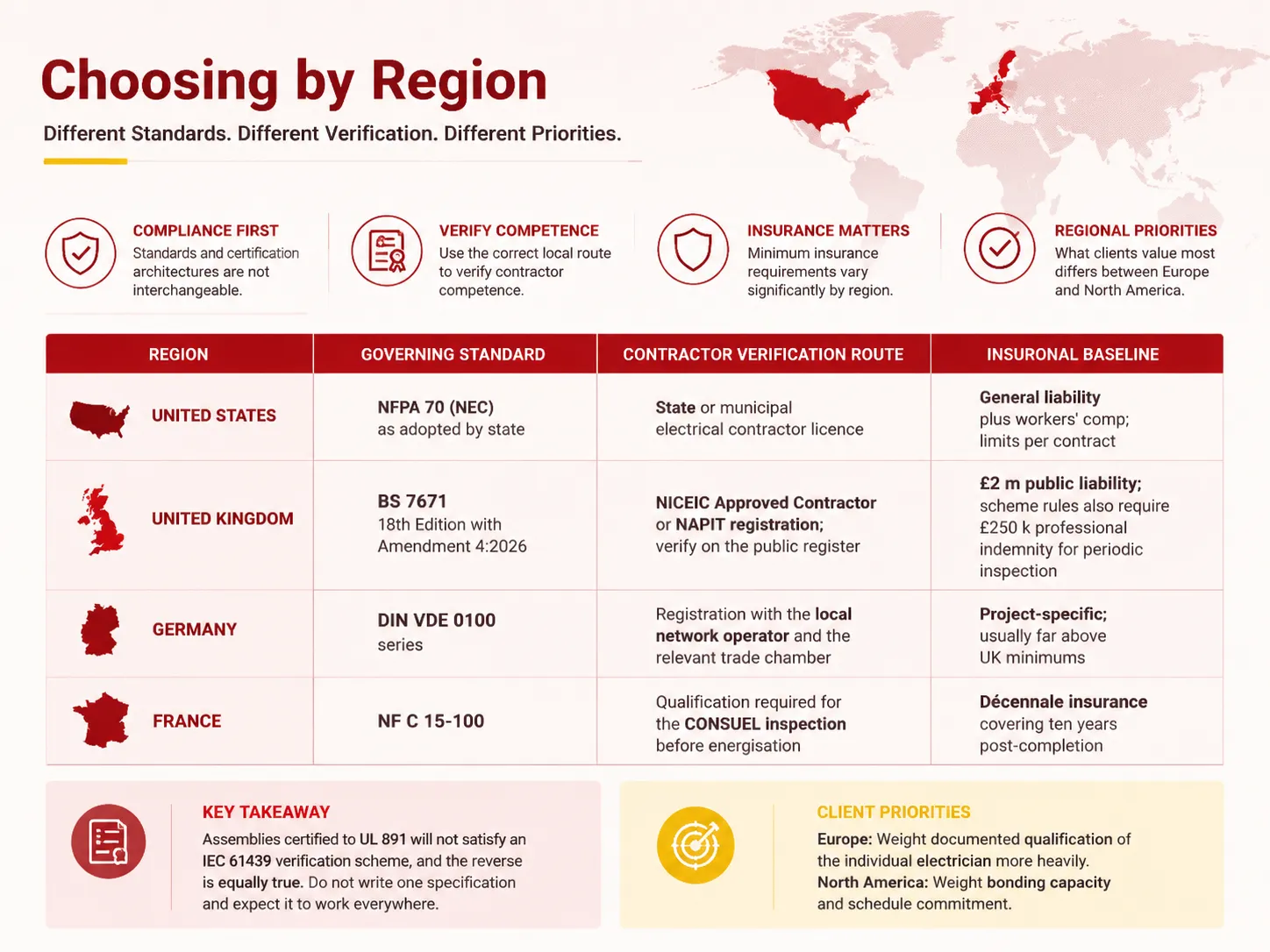
The differences in selection criteria are greater than most consumers believe since the compliance structure is not the same. North America follows the National Electrical Code (NFPA 70), which is adopted state by state with local amendments, and is certified to UL standards, while Europe follows IEC 60364 via its national wiring regulations and certifies equipment using IEC 61439 series which is different than UL 891 and UL 1558 in construction principles.
| Bölge | Geçerli standart | Contractor verification route | Insurance baseline |
|---|---|---|---|
| Amerika Birleşik Devletleri | NFPA 70 (NEC) as adopted by state | State or municipal electrical contractor licence | General liability plus workers’ comp; limits per contract |
| Birleşik Krallık | BS 7671, 18th Edition with Amendment 4:2026 | NICEIC Approved Contractor or NAPIT registration; verify on the public register | £2 m public liability; scheme rules also require £250 k professional indemnity for periodic inspection |
| Almanya | DIN VDE 0100 series | Registration with the local network operator and the relevant trade chamber | Project-specific; usually far above UK minimums |
| Fransa | NF C 15-100 | Qualification required for the CONSUEL inspection before energisation | Décennale insurance covering ten years post-completion |
Two important outcomes can be noted. Firstly, in the UK the most important filter that leads to registration is the registered competent-person scheme: the NICEIC registers and certifies nearly 33,000 businesses, conducts audits of some works by each company on an annual basis and obliges them to have the most recent version of the wiring regulations in possession. Consequently, public sector clients insist on the fact that only competent-person scheme registered firms can appear on tender lists. Secondly, in France it is impossible to energize any installation until it is inspected by CONSUEL, meaning that the contractor is certified by a third party before the client receives the service, which control does not exist in most regions of the USA.
When purchasing something that might be subjected to various national regulations, take care not to write one common specification. In the USA assemblies which were verified in accordance with UL 891 certification can be considered compliant with IEC 61439 regulations, and vice versa.
Red Flags and Contract Terms Worth Pushing Back On
Very low bids, those that appear more than 30% below the second lowest bid, are a clearly sign of a problem and invariably indicate one of four issues: use of unlicensed contractors, a lapse in the insurance certificate, the fact that permit fees were not included in the estimate, or avoidance of issues to come later due to incorrect substitution of materials after contract award. All four issues impact the owner eventually, with issues related to the latter usually occurring during failure investigation.
In addition to what has been mentioned above, we should also pay attention to contracting firms that would either not do the permitting under their name, answer scope questions without documents but verbally, or require a deposit of sums that are more than the cost of materials ordered. From a purely contractual standpoint, three items deserve scrutiny in the contract. The retainage clause states that part of the payment is held until the project is in compliance with the standards; the change-order clauses determine the payments in advance of the actual work; the completion and testing clause specifies the documents submitted by the contractor as proof of compliance so that the owner can get these documents in the end.
SSS
How much does an electrician charge for commercial work?
In 2026, it is expected that commercial work in the U.S. cost around $100–$175 an hour for a licensed journeyman, while master electricians and industrial specialists charge $145–225 in areas with high costs. The majority of commercial contractors charge at a fixed rate which covers all the overhead and costs of insurance rather than simply billing for the person’s pay. Normally there will be a minimum charge of 2–4 hours for a service call and an application of 1.5–2.0 multiplier with a trip charge in case of after-hours call the client receives. Pricing for the projects is considered separately where the service of 200–400 A increases the expenses from $3,000 to $12,000, and for a tenant build-out the prices vary between $8,000 and $25,000 for 1,000 square feet.
Why is Romex not allowed in commercial buildings?
Though non-metallic sheathed cable is not completely forbidden, the list of permitted uses is limited. NEC Article 334 describes the requirements for the use of non-metallic sheathed cable. It is outlined in Section 334.10 that it may be used in one- and two-family dwellings, in addition to other types of buildings of Type III, IV and V constructions — that means wood-framed buildings and heavy-timber buildings, but must be used behind some fire-resistant barrier or inside the areas that are unlikely to be damaged. Section 334.12 bans the use of the cable in Type I and Type II construction due to the fact that this included buildings are made of steel and concrete and includes commercial buildings, such as theatres, motion picture studios, garages and battery rooms, including the places that are located above dropped ceilings in non-residential buildings. Additionally, there may not be the possibility to use the non-metallic cable in constructed concrete or in wet locations. The protection is referred to as justification — a non-metallic coat neither provides mechanical protections nor has any fire protection features in comparison to MC cable or conduit. In most cases, when making the buildings of commercial purposes, this cable is neglected due to the type of construction of it.
Is there a difference between commercial and residential electricians?
Certainly, it is structural in nature rather than cosmetic. The work of the residential electricians is nearly all within the basic single-phase 120/240 V systems with the usage of sheath cables and the dimensions of circuits calculated from the standard dwelling load calculation. On the other hand, the commercial electricians operate with the three-phase systems such as 208Y/120 V and 480Y/277 V systems using conduit and individual conductors and determining their services based on the commercial demand. They should also have experience with motor operations, electric generators, transformer systems, etc. The industrial electricians represent the last specialization that is aimed at machines and conversion of electric energy into another type of work. Many middle-sized companies have all three kinds of work but it is worth being sure of the crew you get because the company might have license but the crew on the site might not have any necessary skills.
What are the three types of electrical installation?
These installations are divided into residential, commercial and industrial categories, and they vary in terms of voltage category, type of wiring and type of potential risks. Residential installations include homes and other dwellings such as homes using low-voltage single-phase AC systems with voltages of 120 or 240-volt, armoured cables, distribution boards and systems to charge electric cars. Commercial installations cover operating buildings from offices to hotels, hospitals and schools with three-phase voltage range from 208 volts to 480 volts, trunks for wiring and systems supplying electric energy for CCTV, ventilation and air conditioning. Industrial installations include plants and other heavy industry sites where large amount electrical power used for running heavy machinery results in losses in a case of a power outage.
Referanslar
- NFPA — NFPA 70 National Electrical Code
- NFPA — 70E Standard for Electrical Safety in the Workplace
- UL Solutions — Product safety standards and listings
- Ulusal Elektrik Müteahhitleri Birliği (NECA)
- EC&M Magazine — Top 50 Electrical Contractors ranking
- ENR — Top 600 Specialty Contractors
- ABD Çalışma İstatistikleri Bürosu — Elektrikçiler Meslek Görünümü
- NICEIC — Approved Contractor scheme requirements
- IET — BS 7671 Requirements for Electrical Installations
- UK Health and Safety Executive — Electrical safety guidance
Sonuç
The ideal commercial electrical installation contractor is one with the proper license for the task, equipped with a competent team trained in the technology used in the facility, and ready to provide the documents necessary to confirm their credentials on the register, not just in a brochure. Size makes a poor indicator of suitability; the top revenue companies are engaged in building transmission lines and data centers, not performing your service upgrade.
Three things must be followed in any project. First, check credentials with the proper authorities before making the first payment rather than after. Second, demand that you receive all “as built” documentation, designs of the panels, and testing results before transferring last payment rather than as an afterthought. Finally, make sure three bidders provide you with the detailed scope of work since differences between the bids reveal the risk associated with a project better than any single price does. If you follow all the above, electrical work will become no more than what it is supposed to be in a project.