

Không quan trọng bạn đang định kích thước mạch, chẩn đoán bộ ngắt mạch bị nhảy, chọn pin hay mua máy phát điện, câu hỏi luôn quay lại với ampe – dòng điện thực sự cần là bao nhiêu? Có thể nghe có vẻ đơn giản nhưng khi nói về dòng điện, bạn thực sự cần ba cách để xác định nó: bạn có thể đọc, tính toán hoặc đo lường.
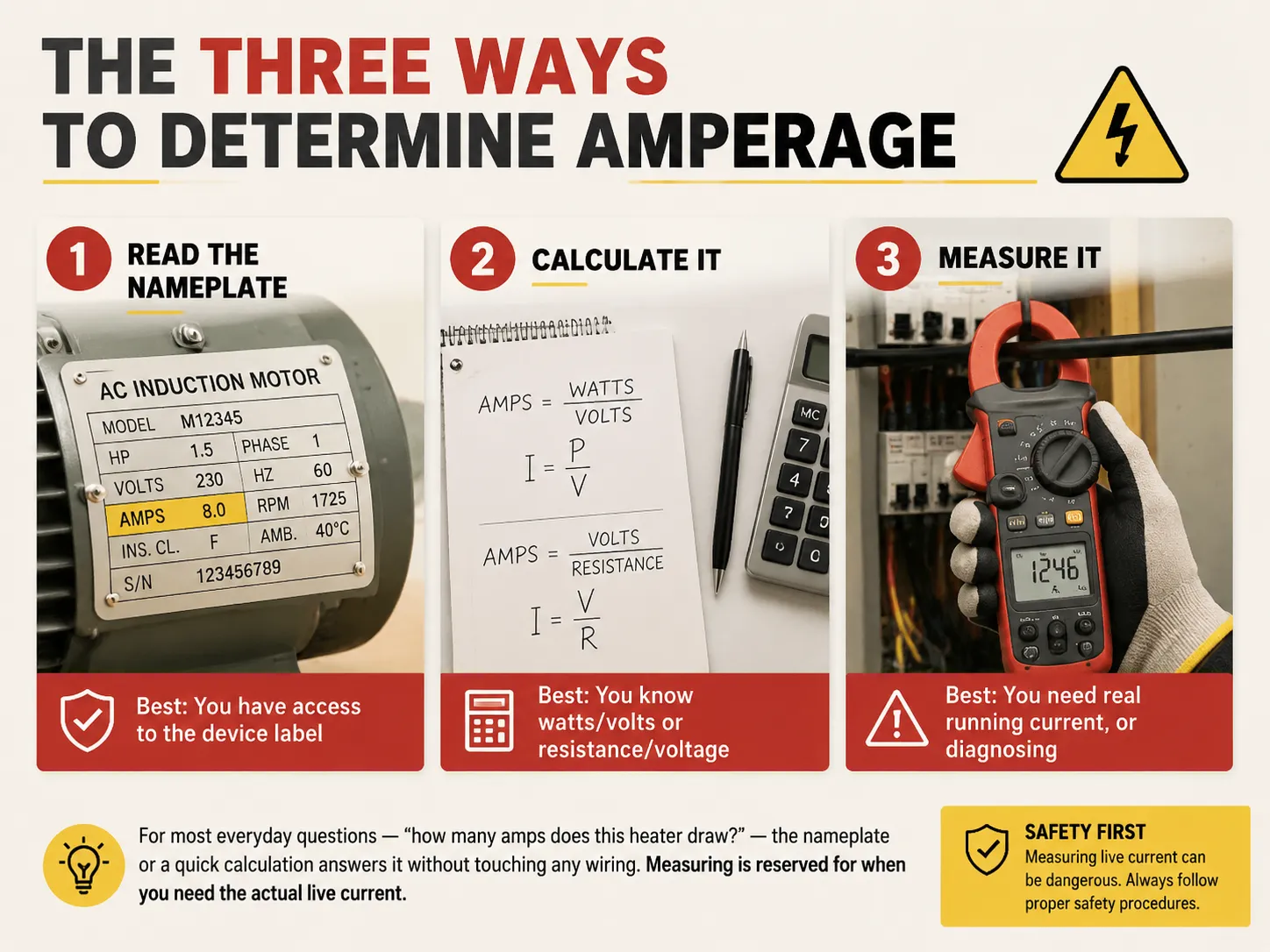
Tóm tắt: Bạn có thể xác định dòng điện theo nhiều cách: (1) bằng cách kiểm tra bảng tên – hầu hết thiết bị đều cho biết ampe của chúng; (2) bằng cách tính toán – nếu biết tải, có thể áp dụng công thức I = P ÷ V hoặc định luật Ohm I = V ÷ R; (3) bằng cách đo – bạn có thể sử dụng ampe kế kẹp dây hoặc ngắt mạch và dùng đồng hồ vạn năng để đo dòng điện nối tiếp.
Ba Cách Xác Định Dòng Điện
Có ba phương pháp thực sự để biết dòng điện của bất kỳ tải hoặc mạch nào, và biết các phương pháp này giúp tiết kiệm thời gian và loại bỏ rủi ro.
| Phương pháp | Tốt nhất khi | Độ chính xác | Rủi ro |
|---|---|---|---|
| Đọc bảng tên | Bạn có thể truy cập nhãn thiết bị | Tốt (giá trị định mức) | Không có |
| Tính toán | Bạn biết công suất/điện áp hoặc điện trở/điện áp | Tốt (phụ thuộc vào dữ liệu đầu vào) | Không có |
| Đo lường | Bạn cần dòng điện thực tế đang chạy hoặc chẩn đoán | Xuất sắc (đọc thực tế) | Nguy hiểm điện – phải tuân thủ quy tắc an toàn |
Trong hầu hết các trường hợp, ví dụ như “thiết bị sưởi này sử dụng bao nhiêu ampe”, bảng tên hoặc tính toán nhanh sẽ cung cấp câu trả lời mà không cần chạm vào dây. Việc đo chỉ nên thực hiện khi bạn cần biết lỗi thực sự; chỉ có ampe kế kẹp hoặc đồng hồ vạn năng nối tiếp mới cung cấp được thông tin đó.
Phương pháp 1: Đọc Bảng Tên
Nhãn là cách nhanh nhất và an toàn nhất để biết dòng điện. Mỗi thiết bị, dụng cụ, động cơ và bộ sạc đều có bảng tên hiển thị thông số điện:
- Ampe định mức: một số bảng tên ghi ampe theo định dạng “Amps: X A” và “Current: X A”.
- Công suất và Điện áp: một số nhãn cho biết công suất (hoặc kW) và điện áp; sử dụng công thức dưới đây để chuyển đổi.
- Kết hợp định mức: thiết bị HVAC chỉ ra FLA (dòng điện tải đầy đủ), RLA (dòng điện tải định mức) và MCA (dòng điện mạch tối thiểu) — FLA là dòng điện chạy và MCA là kích thước dây liên quan đến dòng điện.
- Động cơ: cố gắng tìm giá trị FLA ở điện áp yêu cầu (dòng điện động cơ thay đổi ở 120V và 240V).
Ví dụ, một máy sưởi không gian được đánh dấu “1,500W, 120V” có thể tính như sau: Amps = 1,500 ÷ 120 = 12.5A. Đây là lý do tại sao máy sưởi có hướng dẫn “Không sử dụng trên mạch 15A cùng với các tải khác” — 12.5A gần với dòng điện tối đa cho phép của 80% là 12A.
Phương pháp 2: Tính Toán (Các Công Thức)
Nếu bạn được cung cấp công suất, số kilowatt hoặc điện trở trên bảng tên, có hai công thức cơ bản để tính dòng điện:
Áp dụng công thức công suất có thể sử dụng trong hầu hết các tình huống.
Amps = Watts ÷ Volts (I=P÷V)
- Một máy sưởi có công suất 1500W và điện áp 120V có dòng điện 12.5 ampe.
- Một lò nướng 3000W với điện áp 240V có dòng điện 12.5 ampe (cùng công suất nhưng dòng điện bằng một nửa).
- Một máy phát điện 5kW với điện áp 240V có dòng điện trong trường hợp này là 5.000 ÷ 240 ≈ 20,8A.
Định luật Ohm áp dụng khi biết điện trở.
- Amps = Volts ÷ Ohms (I=V÷R)
- Ví dụ trong mạch 12V với tải 4 ohm, cần tính: 12 ÷ 4 = 3 A.
Ứng dụng tính toán ba pha trong chế độ công nghiệp.
- Amps = Watts ÷ (Volts × 1.732 × Hệ số công suất)
- Ví dụ, động cơ 10kW tiêu thụ điện ba pha 400V, Hệ số công suất 0,85 → 10.000 ÷ (400 × 1.732 × 0.85) ≈ 17A. (Để có con số gần đúng, vui lòng bỏ qua hệ số công suất và tính trong khoảng 15%)
Phương pháp 3: Đo trực tiếp (Công cụ & Các bước)
Nếu bạn cần dòng tải thực tế cho động cơ đang tải, mạch duy trì điểm ngắt hoặc để kiểm tra xả pin, thì bạn thực hiện đo dòng điện. Hai phương tiện:
| Công cụ | Cách hoạt động | Tốt Nhất Cho | Giá |
|---|---|---|---|
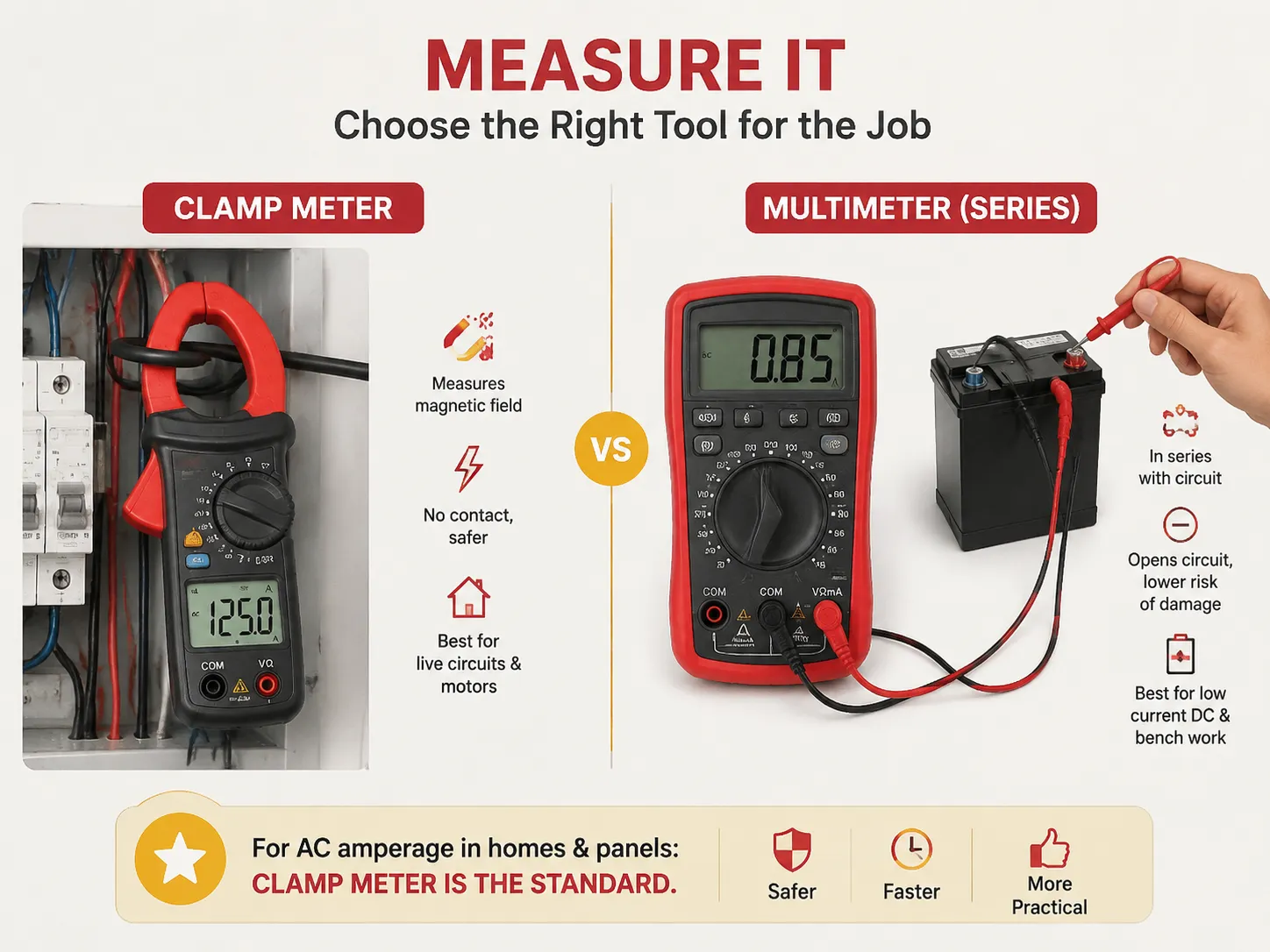
| Đồng hồ kẹp (ammeter) | Kẹp hàm quanh một dây dẫn; đo trường từ — không cần tiếp xúc | Mạch đang hoạt động, động cơ, dòng điện toàn thiết bị | $30-$150 |
| Đồng hồ đa năng (mạch nối tiếp) | Mở mạch và cho dòng điện đi qua đồng hồ | Dòng điện DC thấp (pin, cảm biến), công việc trên bàn | $20-$100 |
Đồng hồ kẹp là thiết bị ưu tiên cho dòng điện AC vì nó đo dòng điện mà không làm gián đoạn mạch hoặc tiếp xúc với các thành phần đang có điện. Do đó, nó an toàn hơn và thân thiện với người dùng hơn đồng hồ đa năng cơ bản khi đọc dòng điện trong nhà và bảng điện.
Sử dụng đồng hồ kẹp đúng cách
Dưới đây là hướng dẫn từng bước về cách sử dụng đồng hồ ampe kẹp:
- To start with, whether measuring with AC Amps (A~) or DC Amps should be determined.
- Next, if the meter has a zero button, it needs to be zeroed.
- When measuring the current, only one conductor should be clamped at a time.
- After taking care of that, we need to take a reading on the display.
- In order to take an accurate reading, the jaws of the clamp must be firmly held and in a perpendicular position.
- Finally, remember that although a specific motor nameplate indicates its FLA rating, under an actual load, the current may be more than what the nameplate said.
Using a Multimeter in Series
When working with DC circuits (batteries, solar panels, sensors) and low current AC on the test bench, you will likely use a multimeter in series.
- First turn off the power to the circuit and disconnect one wire so you can open it up.
- Next connect the wires: black to COM and red to the A (amps) socket and set the dial.
- Connect the multimeter in series with the load, so that the circuit flows through the multimeter: supply → multimeter → load.
- Start to measure on a high current I range (like 10A) first then when the reading is low go for lower currents. But do not start with a low current otherwise you would blow the fuse!
- Then turn the power and take the reading.
Never connect a multimeter set for the amps across a power source as that would result in a dead short!
Safety Rules When Measuring Current
- Clamp meters are safe when working around energized wires; series multimeters are not. To measure house/panel AC, you should use a clamp meter only—you won’t even come in contact with the wires.
- Never use a clamp meter on a cable with multiple wires, because you’ll get a false reading (close to zero) and this won’t give you any useful insight.
- Remember: breaking the panel rule is dangerous; even touching the breaker panel means live work; if you are not trained for this, stop doing it right away.
- Before starting to check your meter, ensure that it is rated according to CAT III in the case of a distribution circuit and CAT IV for a service entrance.
- For series measurements, switch off the power first, connect your meter, and then switch on again.
- If you have doubts, calculate or check the nameplate information, because in most cases, the amperage measurement does not come down to live measurements.
Interpreting Amperage: Watts, Voltage & the 80% Rule
Here’s what to do with the amperage:
- Watts = Amps × Volts — power calculation for energy and costs.
- Amp rating vs. breaker rating – loads must not exceed the circuit rating, for example, a 15A circuit breaker limiting total load of 1,800W
- 80% rule for loads working continuously for over three hours – the load is limited to 80% of circuit rating. For example, if you use a 15A circuitry, your max power consumption is equal to 1,440W. If you use a 20A circuitry, the power consumed should not be higher than 1,920W.
- Motor inrush – motors draw up to 5-8 times more than the running current when they are started.
- Voltage and amperage interplay – with 1,500W heater amp draw depending on voltage, if the heater is plugged into 120V, it takes 12.5A, while plugged into 240V, the amps drop down to 6.25.
Amps vs Volts vs Watts: What’s the Difference?
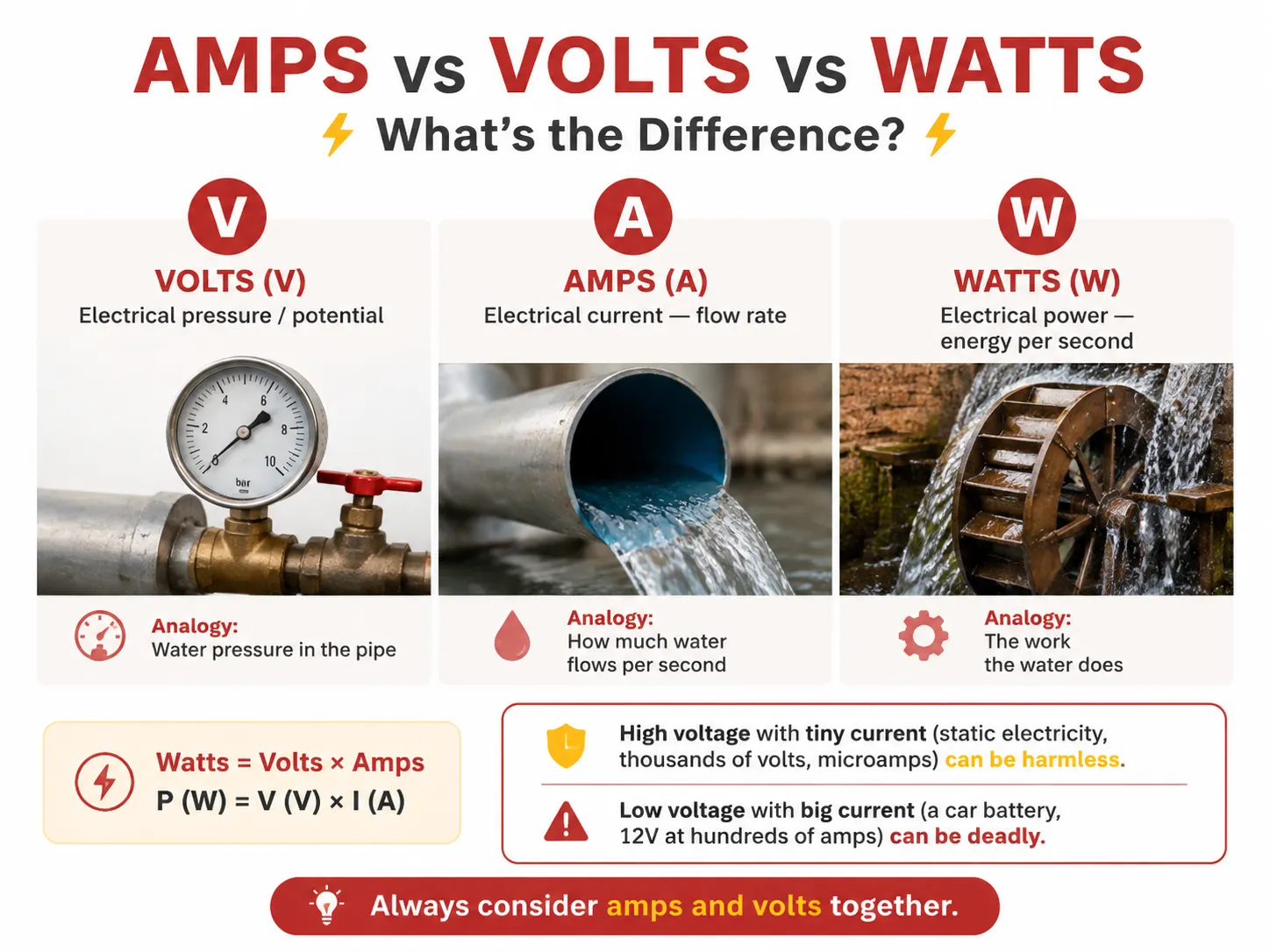
The three units describe three different things, and confusing them causes real mistakes:
| Đơn vị | Measures | Analogy |
|---|---|---|
| Volts (V) | Electrical pressure / potential | Water pressure in the pipe |
| Amps (A) | Electrical current — flow rate | How much water flows per second |
| Watts (W) | Electrical power — energy per second | The work the water does |
Volts force, amps navigate and wattage is the power factor, meaning Watts = Volts × Amps. If a voltage is high and the current is low (as with static electricity, thousands of volts and microamps) it can be harmless. However, if a voltage is low and the current is high (for example, a car battery of 12 volts operating on hundreds of amps) it can be lethal. Always take into account the fact that amps and volts must go together.
How to Tell if Your House Is 100A or 200A
Simple steps require no equipment:
- To read the main breaker, locate the visible breaker in the panel. It bears a number such as “100” or “200” which indicates its capacity.
- To read the meter base, there might be a reading on the meter socket or a utility tag.
- Look at the interior label which usually indicates the size of the main breaker and that of the electrical bus.
- Call the electricity provider and request information about the size of your service.
Importance of the information: a 100A service would prevent you from adding any gadgets that use a lot of energy such as electric vehicles, heaters, and ovens; a 200A service is a modern standard.If breakers trip regularly when you add load, and the main is 100A, an upgrade may be the real fix — and if a breaker is misbehaving, knowing how to tell if a breaker is bad separates a worn device from a genuinely overloaded circuit. For sizing and cost details, our guide to what a 15-amp circuit can carry và breaker replacement cost numbers help with the practical math.
Câu hỏi thường gặp
What is 20 amps equal to?
20 amps at 120V translates to a power output of 2,400 watts (Watts = Amps × Volts). Then we have 4,800W at 240V. A 20A circuit breaker in a 120V circuit allows carrying a maximum power of 1,920W (according to the 80% rule) or even 2,400W in non-continuous operation. 20A is comparable to such appliances as any large microwave (consuming 1,000-1,200W at 120V) or an electric kettle since it is a standard kitchen circuit indicator.
How to tell if house is 100 or 200 amp?
One definitive way of determining the amount of electrical service you have is to simply open the electrical panel and check the number imprinted on your main breaker (the large switch located at the top of the panel). This number is either 100, 120, or, at times, 150 or 225. The main breaker rating indicates the electrical service size. You can also check the label on the meter base as well as the label on the inside of the electrical panel for an estimate of the amount of service provided. Electricity supplied from the utility is typically 100A in older homes and 200A in any new construction.
How do I figure out the amperage?
There are three options for figuring out how many amps your device needs to operate: (1) check the name plate because most devices will list amp usage; (2) use the formula Amps = Watts ÷ Volts (using Ohm’s law, I = V ÷ R); or (3) measure the amperage with a meter. The last option either entails clamping an ammeter around one of the wires carrying current in the circuit, or hooking up a multimeter in series with a device that uses relatively little power. In most cases, the nameplate or a calculation is all that is necessary here and it is safe because there is no danger.
Is 5 amps the same as 5 volts?
No — they measure different things. Amps measure current (electricity in transit), volts measure electric pressure (voltage difference). Five amps is measurement of current; five volts provides measurement of pressure. Also power they deliver together in Watts is calculated using: , Watts = Volts * Amps: 5V * 5A = 25W. 5V source can provide current from microamps to many amps depending on the load; amps and volts can never be equal.
Tài liệu tham khảo
- NFPA 70 (NEC) — Circuit Sizing and the 80% Continuous Load Rule
- OSHA — Electrical Safety and Current Measurement Guidance
- Fluke — How to Measure Current with a Clamp Meter
- U.S. Department of Energy — Power and Energy Calculations
- IEC 61010 — Safety Requirements for Electrical Measurement Equipment
- IEC — SI Units: Ampere, Volt, and Watt Definitions
Kết luận
Finding the amperage relies on three steps that you need to know in advance: the nameplate can be read (the fastest and safest way), you can calculate amperage according to the formula A= (W/V) (or using the Ohm’s law), and you can measure amperage with the help of either a clamp meter (for a live circuit, it is important to follow all safety precautions), or a multimeter (for a direct current circuit) while keeping the 80% safety limit. One thing to remember is that amps and volts are two different things (in a 20A circuit you will get 2,400W from the 120V circuit).Understanding amperage — and how it relates to the protection devices behind it, from the basics of MCBs vs MCCBs việc tiêu chuẩn bộ ngắt UL 489 — is the foundation of safe electrical work.