
No importa si está dimensionando un circuito, diagnosticando un interruptor que está disparando, eligiendo su batería o realizando una compra de generador, la pregunta siempre vuelve a los amperios: ¿cuánta corriente necesita realmente? Puede parecer que es una sola cosa, pero cuando se habla de amperaje, lo que realmente necesita son tres formas de averiguarlo: puede leerlo, calcularlo o medirlo.
Resumen: Puede determinar el amperaje de varias maneras: (1) revisando la placa de características – la mayoría de los aparatos indican sus amperios; (2) calculándolo – si se conoce la carga, se puede aplicar la fórmula I = P ÷ V o la ley de Ohm I = V ÷ R; (3) tomando la medición – puede usar un amperímetro para abrazar el cable o abrir el circuito y usar el multímetro para hacer la medición en serie.
Las Tres Formas de Determinar el Amperaje
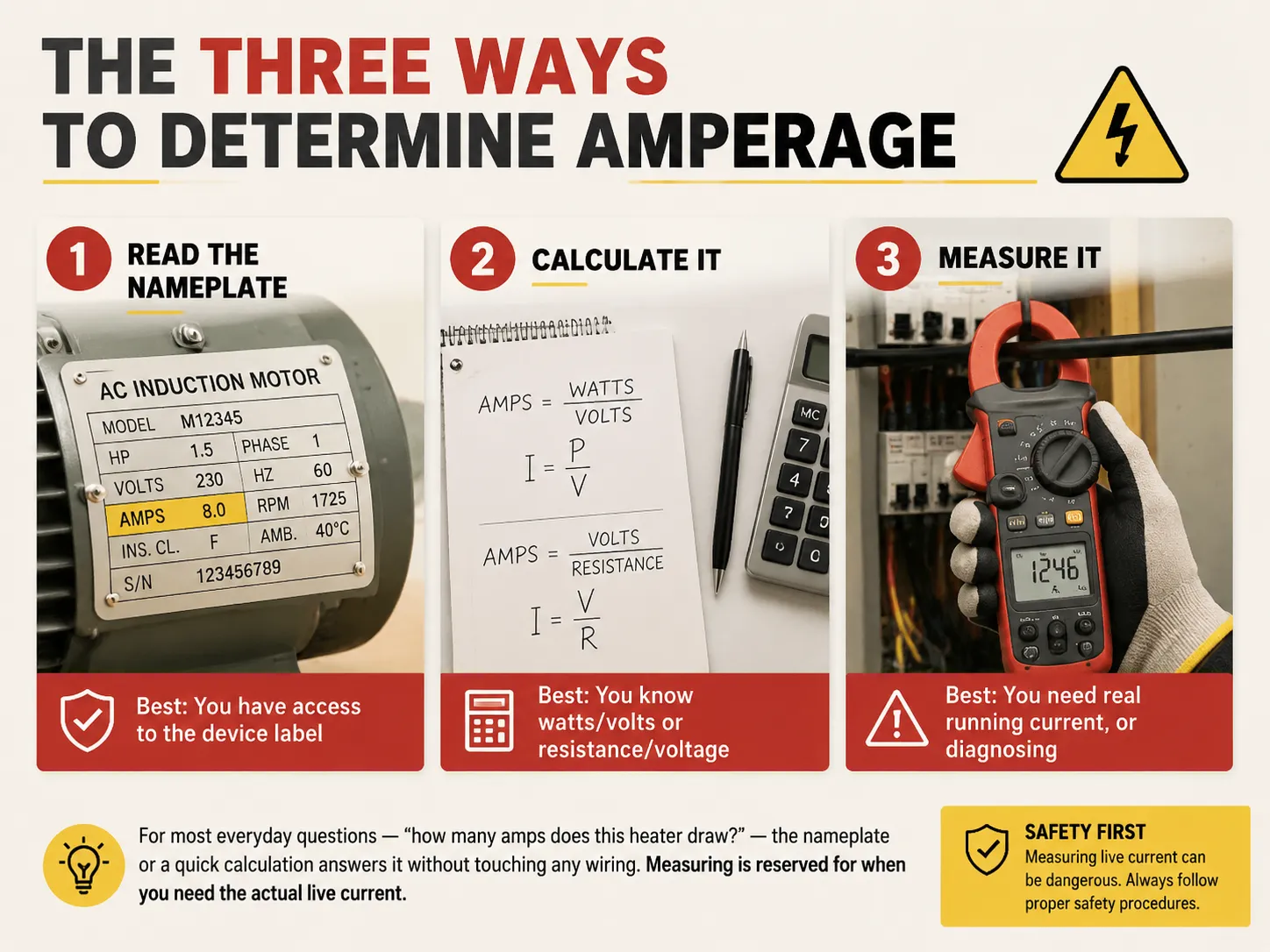
Existen tres métodos genuinos para conocer el amperaje de cualquier carga o circuito, y conocer los métodos ahorra tiempo y elimina riesgos.
| Método | Mejor Cuando | Precisión | Riesgo |
|---|---|---|---|
| Leer la placa de características | Tiene acceso a la etiqueta del dispositivo | Buena (valores nominales) | Ninguno |
| Calcularlo | Conoce vatios/voltios o resistencia/voltaje | Buena (depende de las entradas) | Ninguno |
| Medirlo | Necesita la corriente real en funcionamiento o está diagnosticando | Excelente (lectura real) | Riesgo eléctrico — debe seguir las normas de seguridad |
En la mayoría de los casos, por ejemplo, “¿cuántos amperios usa este calentador?”, la placa de características o un cálculo rápido proporcionarán una respuesta sin tocar cables. La medición solo debe hacerse cuando necesita conocer el error real; solo un medidor de pinza o un multímetro en serie pueden proporcionarle dicha información.
Método 1: Leer la Placa de Características
La etiqueta es la forma más rápida y segura de conocer el amperaje. Cada dispositivo, herramienta, motor y cargador tiene una placa que muestra sus especificaciones eléctricas:
- Amperios nominales: algunas placas especifican amperios en formato “Amps: X A” y “Current: X A”.
- Vatios y Voltaje: algunas etiquetas indican valores en vatios (o kW) y voltios; use la fórmula a continuación para convertirlo.
- Combinación nominal: los dispositivos HVAC indican FLA (amperios a plena carga), RLA (amperios de carga nominal) y MCA (amperaje mínimo del circuito) — FLA es para la corriente de funcionamiento y MCA es para el tamaño del cable en cuanto a amperaje se refiere.
- Motores: intente encontrar la clasificación FLA al voltaje requerido (los amperios para el motor varían a 120V y 240V).
Por ejemplo, un calentador de espacio marcado como “1,500W, 120V” puede calcularse de la siguiente manera: Amperios = 1,500 ÷ 120 = 12.5A. Esta es la razón por la que los calentadores tienen instrucciones que dicen, “No usar en un circuito de 15A junto con otras cargas” — 12.5A está cerca del amperaje máximo permitido de 80% de 12A.
Método 2: Calcularlo (Las Fórmulas)
Si le han proporcionado vatios, kilovatios o resistencia en la placa de características, hay dos fórmulas básicas para calcular el amperaje:
Aplicación de la fórmula de potencia que puede usarse en la mayoría de las situaciones.
Amperios = Vatios ÷ Voltios (I=P÷V)
- Un calentador con una potencia de 1500W y un voltaje de 120V tiene como resultado 12.5 amperios.
- Un horno de 3000W con un voltaje de 240V tiene 12.5 amperios (mismo vataje pero la mitad de amperios)
- Un generador de 5kW con un voltaje de 240V tiene una amperaje que en este caso es 5,000 ÷ 240 ≈ 20.8A.
La ley de Ohm se aplica cuando se conoce la resistencia.
- Amperios = Voltios ÷ Ohmios (I=V÷R)
- Por ejemplo, en un circuito de 12V con una carga de 4 ohmios, se necesita calcular: 12 ÷ 4 = 3 A.
Aplicación de cálculos trifásicos en modo industrial.
- Amperios = Vatios ÷ (Voltios × 1.732 × Factor de Potencia)
- Por ejemplo, un motor de 10kW que consume energía trifásica de 400V, Factor de Potencia 0.85 → 10,000 ÷ (400 × 1.732 × 0.85) ≈ 17A. (Para una cifra aproximada, ignore el factor de potencia y calcule en el rango de 15%)
Método 3: Mídalo (Herramientas y Pasos)
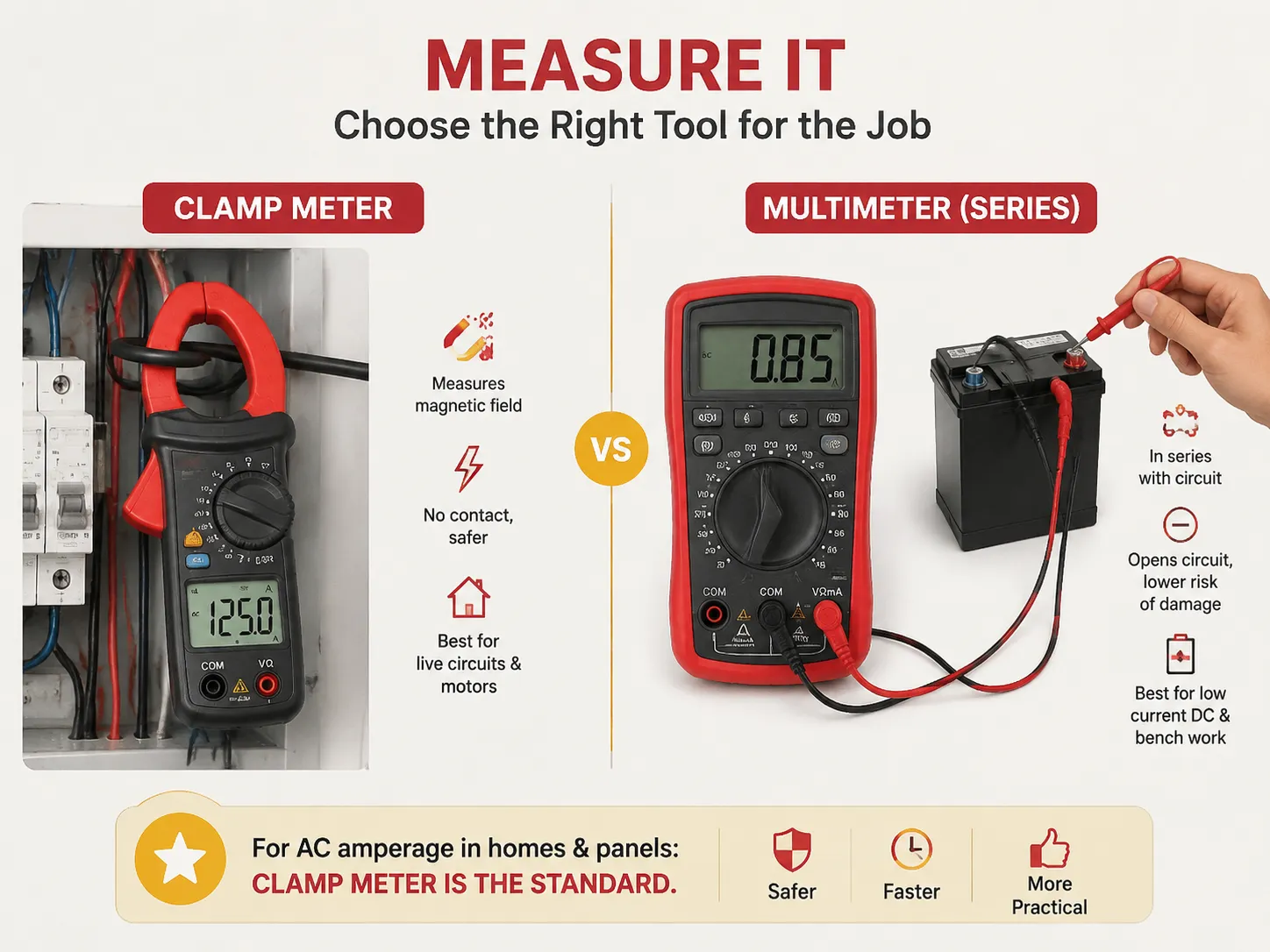
Si requiere la corriente de carga real para un motor cargado, un circuito que mantiene su punto de ruptura o para una prueba de descarga de batería, entonces realiza la medición de la corriente. Los dos medios:
| Herramienta | Cómo Funciona | Mejor Para | Precio |
|---|---|---|---|
| Pinza amperimétrica (amperímetro) | Las mordazas se cierran alrededor de un conductor; mide el campo magnético — no se necesita contacto | Circuitos en vivo, motores, corriente de dispositivo completo | $30-$150 |
| Multímetro (en serie) | Abre el circuito y pasa la corriente a través del medidor | Corriente continua de baja intensidad (baterías, sensores), trabajo de banco | $20-$100 |
La pinza amperimétrica es el instrumento preferido para amperaje de CA ya que mide la corriente sin interrumpir el circuito ni hacer contacto con componentes vivos. Por lo tanto, es mucho más seguro y fácil de usar que un multímetro básico para leer corrientes de casas y paneles.
Uso Correcto de una Pinza Amperimétrica
Aquí hay una guía paso a paso sobre cómo usar un amperímetro de pinza:
- Para empezar, se debe determinar si se mide con Amperios CA (A~) o Amperios CC.
- A continuación, si el medidor tiene un botón de cero, debe ser puesto a cero.
- Al medir la corriente, solo se debe sujetar un conductor a la vez con la pinza.
- Después de eso, necesitamos tomar una lectura en la pantalla.
- Para obtener una lectura precisa, las mordazas de la pinza deben sujetarse firmemente y en posición perpendicular.
- Finalmente, recuerde que aunque una placa de motor específica indique su clasificación FLA, bajo una carga real, la corriente puede ser mayor que la indicada en la placa.
Uso de un multímetro en serie
Al trabajar con circuitos CC (baterías, paneles solares, sensores) y corriente alterna de bajo amperaje en el banco de pruebas, probablemente usará un multímetro en serie.
- Primero apague la alimentación del circuito y desconecte un cable para poder abrirlo.
- Luego conecte los cables: negro a COM y rojo al conector A (amperios) y ajuste el dial.
- Conecte el multímetro en serie con la carga, de modo que el circuito fluya a través del multímetro: suministro → multímetro → carga.
- Comience midiendo en un rango de corriente alta I (como 10A) primero y luego, cuando la lectura sea baja, pase a corrientes más bajas. Pero no comience con una corriente baja, ¡de lo contrario quemará el fusible!
- Luego encienda la alimentación y tome la lectura.
Nunca conecte un multímetro configurado para amperios directamente a una fuente de alimentación, ¡ya que eso resultaría en un cortocircuito!
Reglas de seguridad al medir corriente
- Los medidores de pinza son seguros al trabajar alrededor de cables energizados; los multímetros en serie no lo son. Para medir CA en casas/paneles, debe usar solo un medidor de pinza; ni siquiera entrará en contacto con los cables.
- Nunca use un medidor de pinza en un cable con múltiples conductores, porque obtendrá una lectura falsa (cercana a cero) y esto no le dará ninguna información útil.
- Recuerde: romper la regla del panel es peligroso; incluso tocar el panel de interruptores significa trabajo en vivo; si no está capacitado para esto, deje de hacerlo inmediatamente.
- Antes de comenzar a verificar su medidor, asegúrese de que esté clasificado según CAT III en el caso de un circuito de distribución y CAT IV para una entrada de servicio.
- Para mediciones en serie, primero apague la alimentación, conecte su medidor y luego encienda nuevamente.
- Si tiene dudas, calcule o verifique la información de la placa de características, porque en la mayoría de los casos, la medición de amperaje no se reduce a mediciones en vivo.
Interpretación del amperaje: vatios, voltaje y la regla 80%
Esto es lo que debe hacer con el amperaje:
- Vatios = Amperios × Voltios — cálculo de potencia para energía y costos.
- Clasificación de amperios vs. clasificación del interruptor – las cargas no deben exceder la clasificación del circuito, por ejemplo, un interruptor de circuito de 15A que limita una carga total de 1,800W
- Regla 80% para cargas que funcionan continuamente por más de tres horas – la carga está limitada a 80% de la clasificación del circuito. Por ejemplo, si usa un circuito de 15A, su consumo máximo de potencia es igual a 1,440W. Si usa un circuito de 20A, la potencia consumida no debe ser mayor a 1,920W.
- Arranque del motor: los motores consumen de 5 a 8 veces más que la corriente de funcionamiento cuando se arrancan.
- Interacción entre voltaje y amperaje: con un consumo de amperios de 1,500W en un calentador dependiendo del voltaje, si el calentador está conectado a 120V, consume 12.5A, mientras que conectado a 240V, los amperios bajan a 6.25.
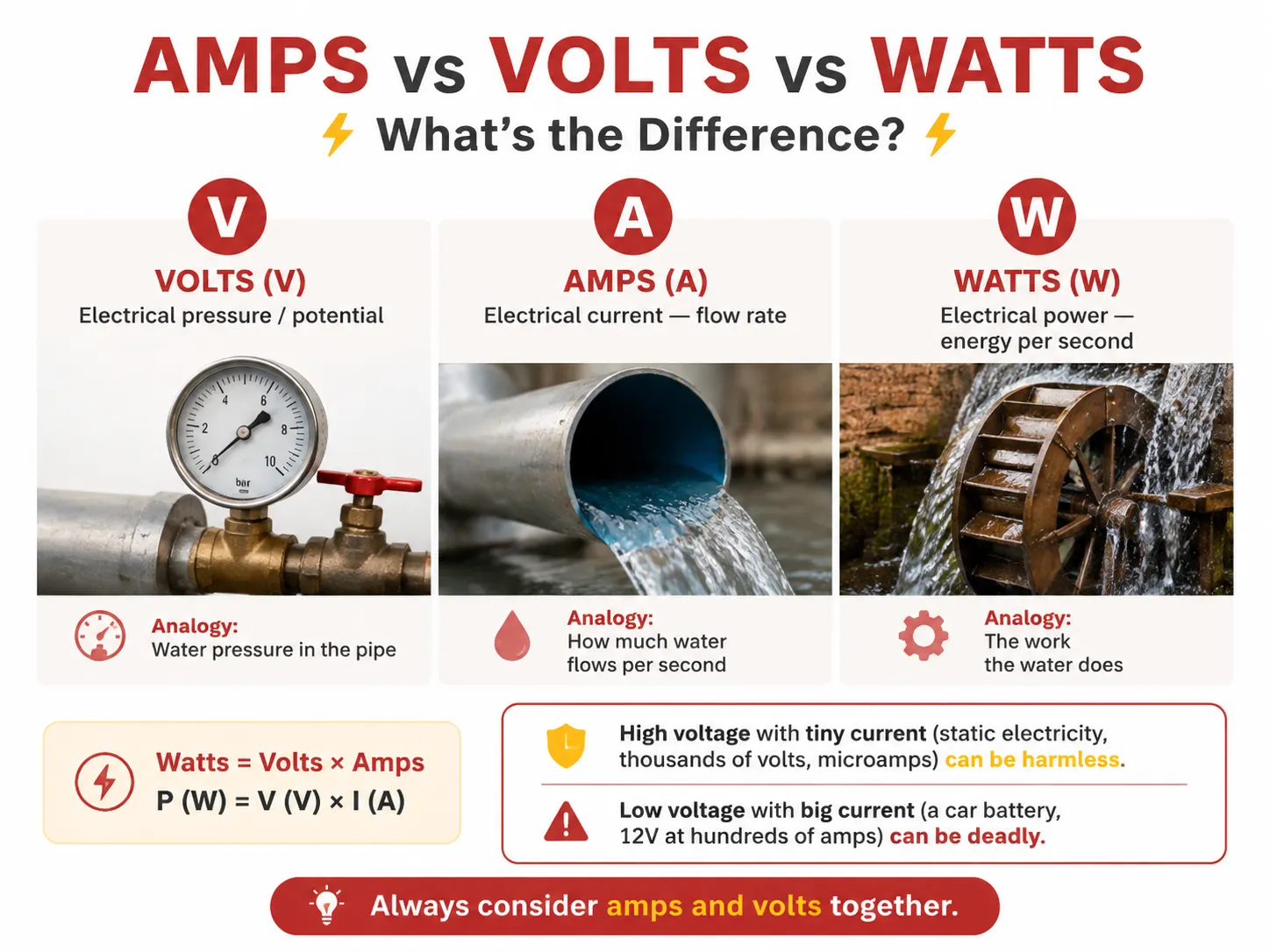
Amperios vs Voltios vs Vatios: ¿Cuál es la diferencia?
Las tres unidades describen tres cosas diferentes, y confundirlas causa errores reales:
| Unidad | Medidas | Analogía |
|---|---|---|
| Voltios (V) | Presión eléctrica / potencial | Presión del agua en la tubería |
| Amperios (A) | Corriente eléctrica — tasa de flujo | Cuánta agua fluye por segundo |
| Vatios (W) | Potencia eléctrica — energía por segundo | El trabajo que realiza el agua |
Los voltios son la fuerza, los amperios la navegación y los vatios el factor de potencia, lo que significa que Vatios = Voltios × Amperios. Si un voltaje es alto y la corriente baja (como con la electricidad estática, miles de voltios y microamperios) puede ser inofensivo. Sin embargo, si un voltaje es bajo y la corriente alta (por ejemplo, una batería de automóvil de 12 voltios que opera con cientos de amperios) puede ser letal. Siempre tenga en cuenta que amperios y voltios deben ir juntos.
Cómo saber si su casa es de 100A o 200A
Pasos simples que no requieren equipo:
- Para leer el interruptor principal, localice el interruptor visible en el panel. Lleva un número como “100” o “200” que indica su capacidad.
- Para leer la base del medidor, puede haber una lectura en el enchufe del medidor o una etiqueta del servicio público.
- Mire la etiqueta interior que usualmente indica el tamaño del interruptor principal y del bus eléctrico.
- Llame al proveedor de electricidad y solicite información sobre el tamaño de su servicio.
Importancia de la información: un servicio de 100A le impediría agregar dispositivos que consumen mucha energía como vehículos eléctricos, calentadores y hornos; un servicio de 200A es un estándar moderno. Si los interruptores se disparan regularmente cuando agrega carga, y el principal es de 100A, una actualización puede ser la solución real — y si un interruptor se comporta mal, saber cómo detectar si un interruptor está defectuoso separa un dispositivo desgastado de un circuito genuinamente sobrecargado. Para detalles de dimensionamiento y costos, nuestra guía sobre lo que puede soportar un circuito de 15 amperios y el costo de reemplazo del interruptor los números ayudan con las matemáticas prácticas.
Preguntas Frecuentes
¿A qué equivale 20 amperios?
20 amperios a 120V se traduce en una potencia de salida de 2,400 vatios (Vatios = Amperios × Voltios). Luego tenemos 4,800W a 240V. Un interruptor de circuito de 20A en un circuito de 120V permite transportar una potencia máxima de 1,920W (según la regla 80%) o incluso 2,400W en operación no continua. 20A es comparable a electrodomésticos como cualquier microondas grande (que consume 1,000-1,200W a 120V) o una tetera eléctrica, ya que es un indicador estándar de circuito de cocina.
¿Cómo saber si la casa tiene 100 o 200 amperios?
Una forma definitiva de determinar la cantidad de servicio eléctrico que tiene es simplemente abrir el panel eléctrico y verificar el número impreso en su interruptor principal (el interruptor grande ubicado en la parte superior del panel). Este número es 100, 120 o, en ocasiones, 150 o 225. La clasificación del interruptor principal indica el tamaño del servicio eléctrico. También puede verificar la etiqueta en la base del medidor así como la etiqueta en el interior del panel eléctrico para obtener una estimación de la cantidad de servicio proporcionado. La electricidad suministrada por la compañía eléctrica suele ser de 100A en casas antiguas y 200A en cualquier construcción nueva.
¿Cómo determino el amperaje?
Hay tres opciones para determinar cuántos amperios necesita su dispositivo para funcionar: (1) revisar la placa de características porque la mayoría de los dispositivos indican el consumo de amperios; (2) usar la fórmula Amperios = Vatios ÷ Voltios (usando la ley de Ohm, I = V ÷ R); o (3) medir el amperaje con un medidor. La última opción implica sujetar un amperímetro alrededor de uno de los cables que transportan corriente en el circuito, o conectar un multímetro en serie con un dispositivo que use relativamente poca potencia. En la mayoría de los casos, la placa de características o un cálculo es todo lo necesario aquí y es seguro porque no hay peligro.
¿5 amperios es lo mismo que 5 voltios?
No — miden cosas diferentes. Los amperios miden corriente (electricidad en tránsito), los voltios miden presión eléctrica (diferencia de voltaje). Cinco amperios es una medida de corriente; cinco voltios proporciona una medida de presión. Además, la potencia que entregan juntos en vatios se calcula usando: Vatios = Voltios * Amperios: 5V * 5A = 25W. Una fuente de 5V puede proporcionar corriente desde microamperios hasta muchos amperios dependiendo de la carga; amperios y voltios nunca pueden ser iguales.
Referencias
- NFPA 70 (NEC) — Dimensionamiento de Circuitos y la Regla de Carga Continua 80%
- OSHA — Seguridad Eléctrica y Guía de Medición de Corriente
- Fluke — Cómo Medir Corriente con un Amperímetro de Pinza
- Departamento de Energía de EE.UU. — Cálculos de Potencia y Energía
- IEC 61010 — Requisitos de Seguridad para Equipos de Medición Eléctrica
- IEC — Unidades SI: Definiciones de Amperio, Voltio y Vatio
Conclusión
Encontrar la amperaje se basa en tres pasos que necesita conocer de antemano: se puede leer la placa de características (la forma más rápida y segura), puede calcular la amperaje según la fórmula A= (W/V) (o usando la ley de Ohm), y puede medir la amperaje con la ayuda de un medidor de pinza (para un circuito en vivo, es importante seguir todas las precauciones de seguridad), o un multímetro (para un circuito de corriente continua) manteniendo el límite de seguridad 80%. Una cosa para recordar es que amperios y voltios son dos cosas diferentes (en un circuito de 20A obtendrá 2,400W del circuito de 120V). Entender la amperaje — y cómo se relaciona con los dispositivos de protección detrás de ella, desde lo básico de MCBs vs MCCBs de normas UL 489 para interruptores — es la base del trabajo eléctrico seguro.