

ไม่สำคัญว่าคุณจะกำหนดขนาดวงจร, วินิจฉัยเบรกเกอร์ที่ตัดวงจร, เลือกแบตเตอรี่ หรือซื้อเครื่องกำเนิดไฟฟ้า คำถามจะกลับมาที่แอมป์เสมอ – กระแสไฟฟ้าจริง ๆ ที่ต้องการมีเท่าไหร่? อาจดูเหมือนเป็นเรื่องเดียวแต่เมื่อพูดถึงแอมแปร์ สิ่งที่คุณต้องการจริง ๆ คือสามวิธีในการหาค่า: คุณสามารถอ่านมัน, คำนวณมัน หรือวัดมันได้.
สรุป: คุณสามารถหาค่าแอมแปร์ได้หลายวิธี: (1) โดยตรวจสอบแผ่นชื่อ – อุปกรณ์ส่วนใหญ่บอกค่าแอมแปร์; (2) โดยการคำนวณ – หากรู้ภาระ สูตร I = P ÷ V สามารถใช้ได้ หรือกฎของโอห์ม I = V ÷ R; (3) โดยการวัด – คุณสามารถใช้แอมมิเตอร์หนีบสายไฟ หรือแยกวงจรและใช้มัลติมิเตอร์วัดแบบอนุกรม.
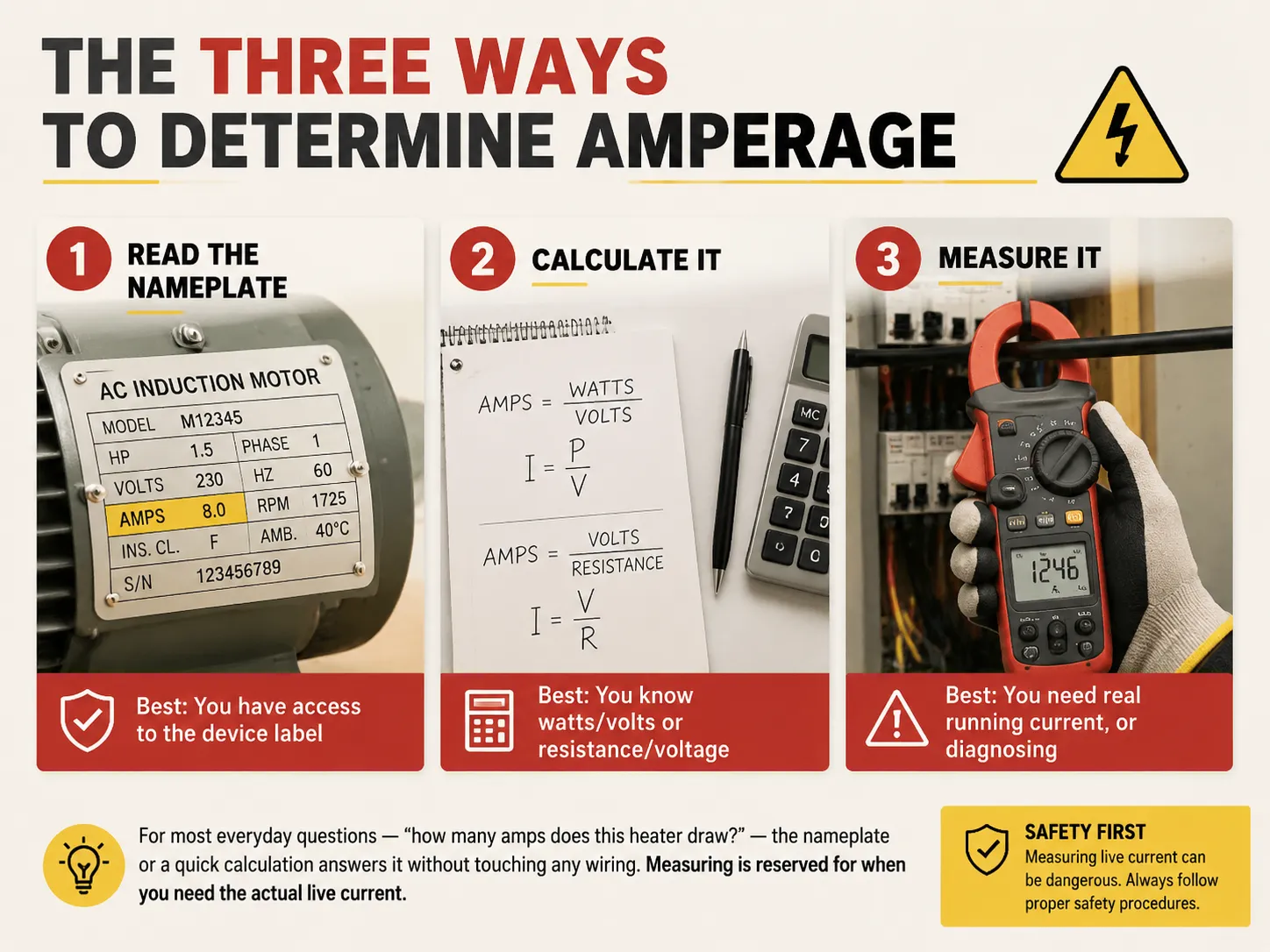
สามวิธีในการกำหนดค่าแอมแปร์
มีสามวิธีที่แท้จริงในการทราบค่าแอมแปร์ของภาระหรือวงจรใด ๆ และการรู้วิธีเหล่านี้ช่วยประหยัดเวลาและลดความเสี่ยง.
| วิธี | เหมาะสมที่สุดเมื่อ | ความแม่นยำ | ความเสี่ยง |
|---|---|---|---|
| อ่านแผ่นชื่อ | คุณสามารถเข้าถึงป้ายอุปกรณ์ได้ | ดี (ค่าที่ระบุ) | ไม่มี |
| คำนวณ | คุณรู้วัตต์/โวลต์ หรือ ความต้านทาน/แรงดันไฟฟ้า | ดี (ขึ้นอยู่กับข้อมูลนำเข้า) | ไม่มี |
| วัด | คุณต้องการกระแสไฟฟ้าจริงที่ใช้งาน หรือกำลังวินิจฉัย | ดีเยี่ยม (ค่าที่อ่านจริง) | อันตรายทางไฟฟ้า — ต้องปฏิบัติตามกฎความปลอดภัย |
ในกรณีส่วนใหญ่ เช่น “เครื่องทำความร้อนนี้ใช้กระแสกี่แอมป์” แผ่นชื่อหรือการคำนวณอย่างรวดเร็วจะให้คำตอบโดยไม่ต้องสัมผัสสายไฟ การวัดควรทำเฉพาะเมื่อคุณต้องการทราบข้อผิดพลาดจริง ๆ เท่านั้น; มีเพียงแอมมิเตอร์หนีบหรือมัลติมิเตอร์แบบอนุกรมเท่านั้นที่ให้ข้อมูลดังกล่าวได้.
วิธีที่ 1: อ่านแผ่นชื่อ
ป้ายชื่อเป็นวิธีที่รวดเร็วและปลอดภัยที่สุดในการหาค่าแอมแปร์ อุปกรณ์ เครื่องมือ มอเตอร์ และเครื่องชาร์จทุกชิ้นมีแผ่นชื่อที่แสดงข้อมูลทางไฟฟ้า:
- แอมแปร์ที่ระบุ: บางแผ่นชื่อระบุแอมแปร์ในรูปแบบ “Amps: X A” และ “Current: X A”.
- วัตต์และโวลต์: บางป้ายให้ค่ากำลังไฟเป็นวัตต์ (หรือกิโลวัตต์) และแรงดันไฟฟ้า; ใช้สูตรด้านล่างเพื่อแปลงค่า.
- การระบุค่ารวม: อุปกรณ์ HVAC ระบุ FLA (full-load amps), RLA (rated load amps) และ MCA (minimum circuit ampacity) — FLA คือกระแสไฟฟ้าที่ใช้งานจริง และ MCA คือขนาดสายไฟที่เหมาะสมตามแอมแปร์.
- มอเตอร์: พยายามหาค่า FLA ที่แรงดันไฟฟ้าที่ต้องการ (แอมแปร์ของมอเตอร์จะแตกต่างกันที่ 120V และ 240V).
ตัวอย่างเช่น เครื่องทำความร้อนที่ระบุว่า “1,500W, 120V” สามารถคำนวณได้ดังนี้: แอมแปร์ = 1,500 ÷ 120 = 12.5A นี่คือเหตุผลที่เครื่องทำความร้อนมีคำแนะนำว่า “ห้ามใช้กับวงจร 15A พร้อมกับภาระอื่น” — 12.5A ใกล้เคียงกับแอมแปร์สูงสุดที่อนุญาตของ 80% ที่ 12A.
วิธีที่ 2: คำนวณ (สูตร)
หากคุณได้รับข้อมูลวัตต์, กิโลวัตต์ หรือความต้านทานจากแผ่นชื่อ มีสองสูตรพื้นฐานในการคำนวณแอมแปร์:
การใช้สูตรกำลังไฟฟ้าที่ใช้ได้ในสถานการณ์ส่วนใหญ่.
แอมแปร์ = วัตต์ ÷ โวลต์ (I=P÷V)
- เครื่องทำความร้อนที่มีกำลังไฟ 1500W และแรงดันไฟฟ้า 120V จะมีค่าแอมแปร์ 12.5.
- เตาอบ 3000W ที่แรงดันไฟฟ้า 240V จะมีค่าแอมแปร์ 12.5 (กำลังไฟเท่ากันแต่แอมแปร์ครึ่งหนึ่ง)
- เครื่องกำเนิดไฟฟ้า 5kW ที่มีแรงดันไฟฟ้า 240V มีค่ากระแสไฟฟ้าในกรณีนี้คือ 5,000 ÷ 240 ≈ 20.8A.
กฎของโอห์มใช้ได้เมื่อทราบค่าความต้านทาน.
- แอมป์ = โวลต์ ÷ โอห์ม (I=V÷R)
- ตัวอย่างเช่น ในวงจร 12V ที่มีโหลด 4 โอห์ม ต้องคำนวณ: 12 ÷ 4 = 3 A.
การประยุกต์ใช้การคำนวณสามเฟสในโหมดอุตสาหกรรม.
- แอมป์ = วัตต์ ÷ (โวลต์ × 1.732 × ตัวประกอบกำลัง)
- ตัวอย่าง มอเตอร์ 10kW ใช้พลังงานสามเฟส 400V ตัวประกอบกำลัง 0.85 → 10,000 ÷ (400 × 1.732 × 0.85) ≈ 17A (สำหรับค่าประมาณ ให้ละเลยตัวประกอบกำลังและคำนวณในช่วง 15%)
วิธีที่ 3: การวัด (เครื่องมือและขั้นตอน)
หากคุณต้องการกระแสโหลดจริงสำหรับมอเตอร์ที่มีโหลด วงจรที่รักษาจุดตัด หรือสำหรับการทดสอบการคายประจุแบตเตอรี่ ให้ทำการวัดกระแสไฟฟ้า โดยมีสองวิธีดังนี้:
| เครื่องมือ | วิธีการทำงาน | เหมาะสำหรับ | ราคา |
|---|---|---|---|
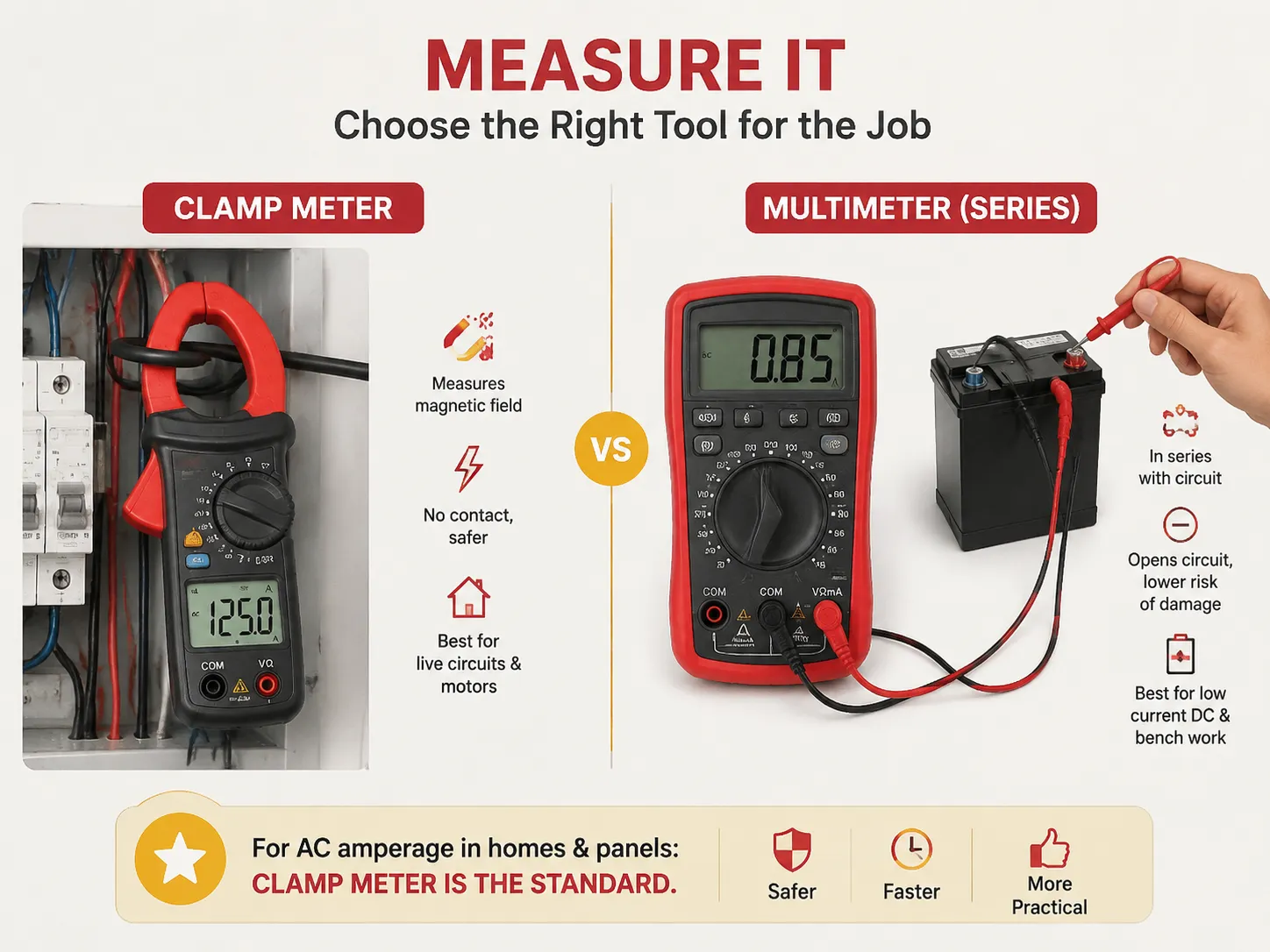
| แคลมป์มิเตอร์ (แอมมิเตอร์) | ขากรรไกรหนีบรอบตัวนำหนึ่งเส้น; วัดสนามแม่เหล็ก — ไม่ต้องสัมผัสโดยตรง | วงจรที่มีไฟฟ้า มอเตอร์ กระแสไฟฟ้าทั้งอุปกรณ์ | $30-$150 |
| มัลติมิเตอร์ (แบบอนุกรม) | เปิดวงจรและปล่อยกระแสผ่านมิเตอร์ | กระแสตรงต่ำ (แบตเตอรี่ เซ็นเซอร์) งานบนโต๊ะ | $20-$100 |
แคลมป์มิเตอร์เป็นเครื่องมือที่เหมาะสมสำหรับการวัดกระแสไฟฟ้ากระแสสลับ เนื่องจากวัดกระแสโดยไม่ต้องตัดวงจรหรือสัมผัสกับส่วนประกอบที่มีไฟฟ้า จึงปลอดภัยและใช้งานง่ายกว่ามัลติมิเตอร์พื้นฐานในการอ่านกระแสไฟฟ้าภายในบ้านและแผงควบคุม.
การใช้แคลมป์มิเตอร์อย่างถูกต้อง
นี่คือคำแนะนำทีละขั้นตอนเกี่ยวกับวิธีการใช้แคลมป์มิเตอร์:
- To start with, whether measuring with AC Amps (A~) or DC Amps should be determined.
- Next, if the meter has a zero button, it needs to be zeroed.
- When measuring the current, only one conductor should be clamped at a time.
- After taking care of that, we need to take a reading on the display.
- In order to take an accurate reading, the jaws of the clamp must be firmly held and in a perpendicular position.
- Finally, remember that although a specific motor nameplate indicates its FLA rating, under an actual load, the current may be more than what the nameplate said.
Using a Multimeter in Series
When working with DC circuits (batteries, solar panels, sensors) and low current AC on the test bench, you will likely use a multimeter in series.
- First turn off the power to the circuit and disconnect one wire so you can open it up.
- Next connect the wires: black to COM and red to the A (amps) socket and set the dial.
- Connect the multimeter in series with the load, so that the circuit flows through the multimeter: supply → multimeter → load.
- Start to measure on a high current I range (like 10A) first then when the reading is low go for lower currents. But do not start with a low current otherwise you would blow the fuse!
- Then turn the power and take the reading.
Never connect a multimeter set for the amps across a power source as that would result in a dead short!
Safety Rules When Measuring Current
- Clamp meters are safe when working around energized wires; series multimeters are not. To measure house/panel AC, you should use a clamp meter only—you won’t even come in contact with the wires.
- Never use a clamp meter on a cable with multiple wires, because you’ll get a false reading (close to zero) and this won’t give you any useful insight.
- Remember: breaking the panel rule is dangerous; even touching the breaker panel means live work; if you are not trained for this, stop doing it right away.
- Before starting to check your meter, ensure that it is rated according to CAT III in the case of a distribution circuit and CAT IV for a service entrance.
- For series measurements, switch off the power first, connect your meter, and then switch on again.
- If you have doubts, calculate or check the nameplate information, because in most cases, the amperage measurement does not come down to live measurements.
Interpreting Amperage: Watts, Voltage & the 80% Rule
Here’s what to do with the amperage:
- Watts = Amps × Volts — power calculation for energy and costs.
- Amp rating vs. breaker rating – loads must not exceed the circuit rating, for example, a 15A circuit breaker limiting total load of 1,800W
- 80% rule for loads working continuously for over three hours – the load is limited to 80% of circuit rating. For example, if you use a 15A circuitry, your max power consumption is equal to 1,440W. If you use a 20A circuitry, the power consumed should not be higher than 1,920W.
- Motor inrush – motors draw up to 5-8 times more than the running current when they are started.
- Voltage and amperage interplay – with 1,500W heater amp draw depending on voltage, if the heater is plugged into 120V, it takes 12.5A, while plugged into 240V, the amps drop down to 6.25.
Amps vs Volts vs Watts: What’s the Difference?
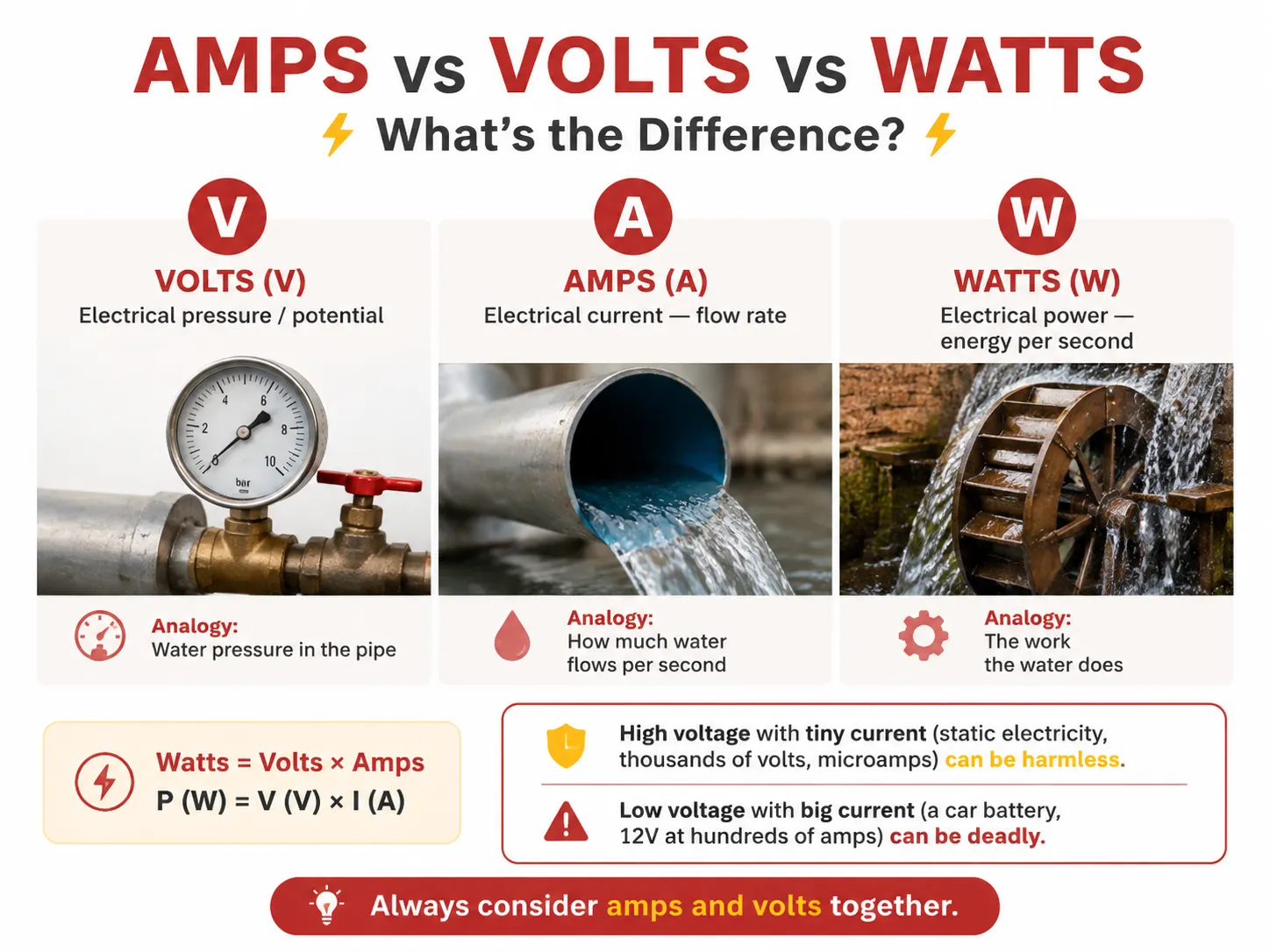
The three units describe three different things, and confusing them causes real mistakes:
| หน่วย | Measures | Analogy |
|---|---|---|
| Volts (V) | Electrical pressure / potential | Water pressure in the pipe |
| Amps (A) | Electrical current — flow rate | How much water flows per second |
| Watts (W) | Electrical power — energy per second | The work the water does |
Volts force, amps navigate and wattage is the power factor, meaning Watts = Volts × Amps. If a voltage is high and the current is low (as with static electricity, thousands of volts and microamps) it can be harmless. However, if a voltage is low and the current is high (for example, a car battery of 12 volts operating on hundreds of amps) it can be lethal. Always take into account the fact that amps and volts must go together.
How to Tell if Your House Is 100A or 200A
Simple steps require no equipment:
- To read the main breaker, locate the visible breaker in the panel. It bears a number such as “100” or “200” which indicates its capacity.
- To read the meter base, there might be a reading on the meter socket or a utility tag.
- Look at the interior label which usually indicates the size of the main breaker and that of the electrical bus.
- Call the electricity provider and request information about the size of your service.
Importance of the information: a 100A service would prevent you from adding any gadgets that use a lot of energy such as electric vehicles, heaters, and ovens; a 200A service is a modern standard.If breakers trip regularly when you add load, and the main is 100A, an upgrade may be the real fix — and if a breaker is misbehaving, knowing how to tell if a breaker is bad separates a worn device from a genuinely overloaded circuit. For sizing and cost details, our guide to what a 15-amp circuit can carry และ breaker replacement cost numbers help with the practical math.
คำถามที่พบบ่อย
What is 20 amps equal to?
20 amps at 120V translates to a power output of 2,400 watts (Watts = Amps × Volts). Then we have 4,800W at 240V. A 20A circuit breaker in a 120V circuit allows carrying a maximum power of 1,920W (according to the 80% rule) or even 2,400W in non-continuous operation. 20A is comparable to such appliances as any large microwave (consuming 1,000-1,200W at 120V) or an electric kettle since it is a standard kitchen circuit indicator.
How to tell if house is 100 or 200 amp?
One definitive way of determining the amount of electrical service you have is to simply open the electrical panel and check the number imprinted on your main breaker (the large switch located at the top of the panel). This number is either 100, 120, or, at times, 150 or 225. The main breaker rating indicates the electrical service size. You can also check the label on the meter base as well as the label on the inside of the electrical panel for an estimate of the amount of service provided. Electricity supplied from the utility is typically 100A in older homes and 200A in any new construction.
How do I figure out the amperage?
There are three options for figuring out how many amps your device needs to operate: (1) check the name plate because most devices will list amp usage; (2) use the formula Amps = Watts ÷ Volts (using Ohm’s law, I = V ÷ R); or (3) measure the amperage with a meter. The last option either entails clamping an ammeter around one of the wires carrying current in the circuit, or hooking up a multimeter in series with a device that uses relatively little power. In most cases, the nameplate or a calculation is all that is necessary here and it is safe because there is no danger.
Is 5 amps the same as 5 volts?
No — they measure different things. Amps measure current (electricity in transit), volts measure electric pressure (voltage difference). Five amps is measurement of current; five volts provides measurement of pressure. Also power they deliver together in Watts is calculated using: , Watts = Volts * Amps: 5V * 5A = 25W. 5V source can provide current from microamps to many amps depending on the load; amps and volts can never be equal.
อ้างอิง
- NFPA 70 (NEC) — Circuit Sizing and the 80% Continuous Load Rule
- OSHA — Electrical Safety and Current Measurement Guidance
- Fluke — How to Measure Current with a Clamp Meter
- U.S. Department of Energy — Power and Energy Calculations
- IEC 61010 — Safety Requirements for Electrical Measurement Equipment
- IEC — SI Units: Ampere, Volt, and Watt Definitions
สรุป
Finding the amperage relies on three steps that you need to know in advance: the nameplate can be read (the fastest and safest way), you can calculate amperage according to the formula A= (W/V) (or using the Ohm’s law), and you can measure amperage with the help of either a clamp meter (for a live circuit, it is important to follow all safety precautions), or a multimeter (for a direct current circuit) while keeping the 80% safety limit. One thing to remember is that amps and volts are two different things (in a 20A circuit you will get 2,400W from the 120V circuit).Understanding amperage — and how it relates to the protection devices behind it, from the basics of MCBs vs MCCBs การ มาตรฐานเบรกเกอร์ UL 489 — is the foundation of safe electrical work.