

Não importa se você está dimensionando um circuito, diagnosticando um disjuntor que está desarmando, escolhendo sua bateria ou fazendo a compra de um gerador, a questão sempre volta para os amperes – quanta corrente isso realmente precisa? Pode parecer uma coisa só, mas ao falar sobre amperagem, o que você realmente precisa são três maneiras de descobrir: você pode ler, calcular ou medir.
Resumo: Você pode descobrir a amperagem de várias maneiras: (1) verificando a placa de identificação – a maioria dos aparelhos informa seus amperes; (2) calculando – se a carga for conhecida, pode-se aplicar a fórmula I = P ÷ V ou a lei de Ohm I = V ÷ R; (3) fazendo a medição – você pode usar um amperímetro para prender no fio ou abrir o circuito e usar o multímetro para fazer a medição em série.
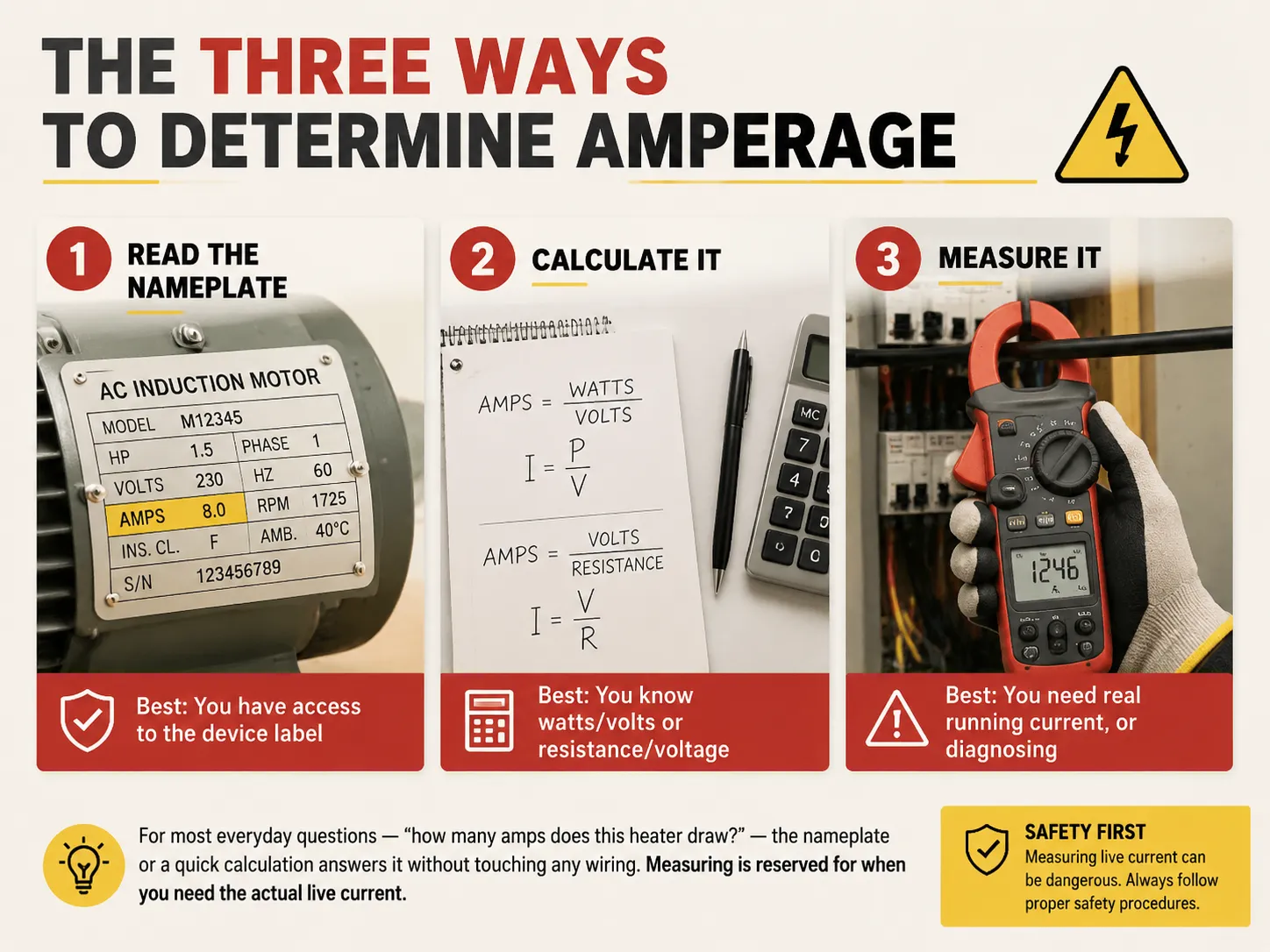
As Três Maneiras de Determinar a Amperagem
Existem três métodos genuínos para saber a amperagem de qualquer carga ou circuito, e conhecer os métodos economiza tempo e elimina riscos.
| Método | Melhor Quando | Precisão | Risco |
|---|---|---|---|
| Leia a placa de identificação | Você tem acesso à etiqueta do dispositivo | Boa (valores nominais) | Nenhum |
| Calcule | Você conhece watts/volts ou resistência/tensão | Boa (depende das entradas) | Nenhum |
| Meça | Você precisa da corrente real em funcionamento ou está diagnosticando | Excelente (leitura real) | Perigo elétrico — deve seguir as regras de segurança |
Na maioria dos casos, por exemplo, “quantos amperes este aquecedor usa”, a placa de identificação ou um cálculo rápido fornecerão uma resposta sem tocar no fio. A medição deve ser feita apenas quando você precisar saber o erro real; somente um alicate amperímetro ou um multímetro em série pode fornecer essa informação.
Método 1: Leia a Placa de Identificação
A etiqueta é a maneira mais rápida e segura de descobrir a amperagem. Todo dispositivo, ferramenta, motor e carregador possui uma placa que exibe suas especificações elétricas:
- Amperagem nominal: algumas placas especificam amperes no formato “Amps: X A” e “Current: X A”.
- Potência e Tensão: algumas etiquetas fornecem leituras em watts (ou kW) e volts; use a fórmula abaixo para converter.
- Combinação nominal: dispositivos HVAC indicam FLA (amperes de carga total), RLA (amperes de carga nominal) e MCA (ampacidade mínima do circuito) — FLA é para a corrente de funcionamento e MCA é para o tamanho do fio em relação à amperagem.
- Motores: tente descobrir a classificação FLA na tensão requerida (os amperes do motor variam em 120V e 240V).
Por exemplo, um aquecedor de ambiente marcado como “1.500W, 120V” pode ser calculado da seguinte forma: Amperes = 1.500 ÷ 120 = 12,5A. É por isso que os aquecedores têm instruções que dizem: “Não use no circuito de 15A junto com outras cargas” — 12,5A está próximo do máximo permitido de 80% de 12A.
Método 2: Calcule (As Fórmulas)
Se você recebeu a potência em watts, quilowatts ou resistência na placa, existem duas fórmulas básicas para calcular a amperagem:
Aplicação da fórmula de potência que pode ser usada na maioria das situações.
Amperes = Watts ÷ Volts (I=P÷V)
- Um aquecedor com potência de 1500W e tensão de 120V tem como resultado 12,5 amperes.
- Um forno de 3000W com tensão de 240V tem 12,5 amperes (mesma potência, mas metade dos amperes)
- Um gerador de 5kW com tensão de 240V tem uma amperagem que neste caso é 5.000 ÷ 240 ≈ 20,8A.
A lei de Ohm se aplica quando a resistência é conhecida.
- Amperes = Volts ÷ Ohms (I=V÷R)
- Por exemplo, em um circuito de 12V com uma carga de 4 ohms, é necessário calcular: 12 ÷ 4 = 3 A.
Aplicação de cálculos trifásicos em modo industrial.
- Amps = Watts ÷ (Volts × 1,732 × Fator de Potência)
- Por exemplo, motor de 10kW consumindo energia trifásica de 400V, Fator de Potência 0,85 → 10.000 ÷ (400 × 1,732 × 0,85) ≈ 17A. (Para um valor aproximado, por favor ignore o fator de potência e calcule na faixa de 15%)
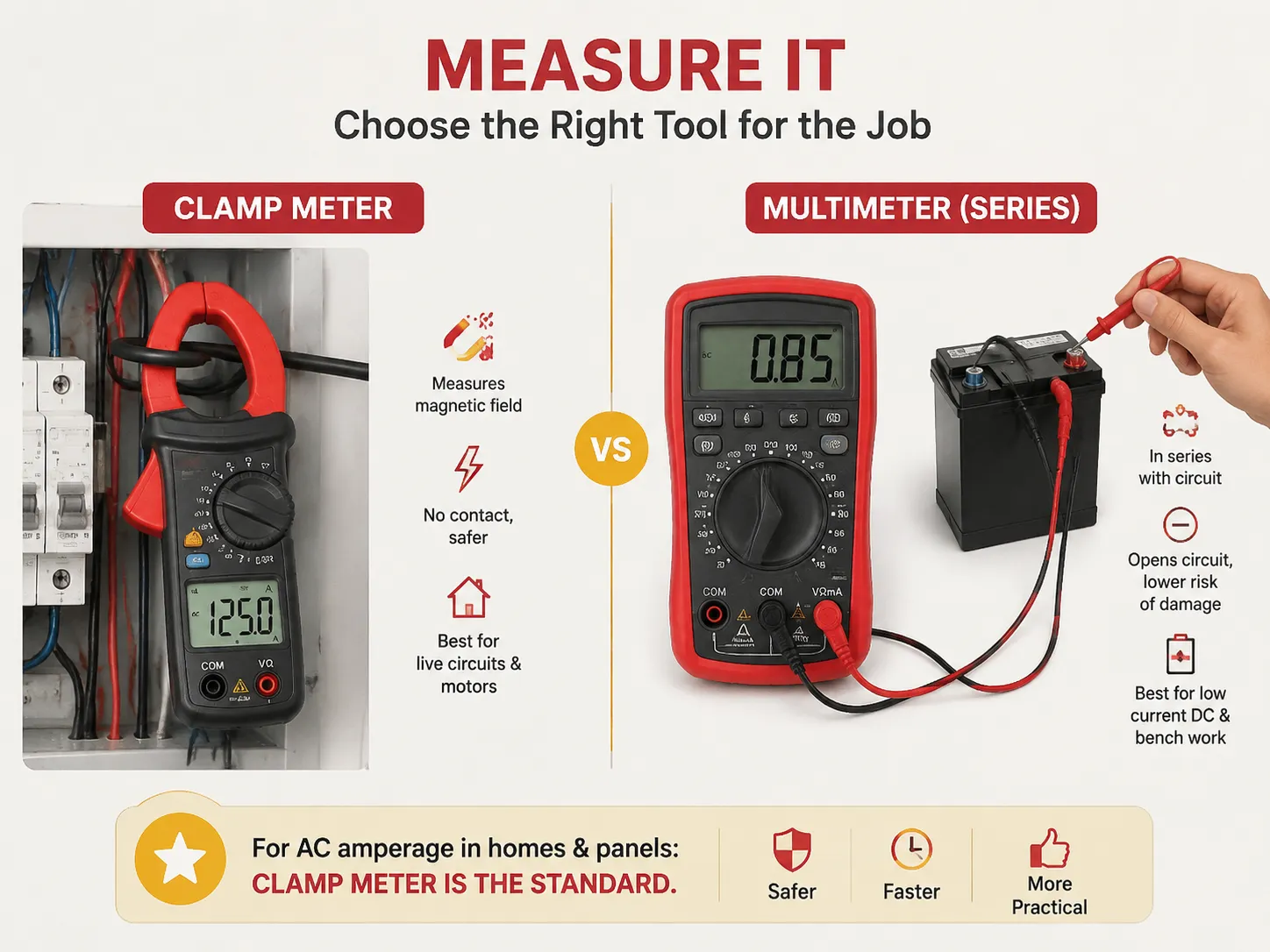
Método 3: Medir (Ferramentas e Passos)
Se você precisar da corrente real de carga para um motor carregado, um circuito que mantém seu ponto de ruptura ou para um teste de descarga de bateria, então você realiza a medição da corrente. Os dois meios:
| Ferramenta | Como Funciona | Melhor Para | Preço |
|---|---|---|---|
| Alicate amperímetro (amperímetro) | Mandíbulas prendem em torno de um condutor; mede o campo magnético — sem necessidade de contato | Circuitos vivos, motores, corrente de dispositivo completo | $30-$150 |
| Multímetro (em série) | Abre o circuito e passa a corrente pelo medidor | Corrente contínua de baixa intensidade (baterias, sensores), trabalho de bancada | $20-$100 |
O alicate amperímetro é o instrumento preferido para amperagem AC, pois mede a corrente sem interromper o circuito ou fazer contato com componentes energizados. Portanto, é muito mais seguro e fácil de usar do que um multímetro básico para leitura de correntes residenciais e de painéis.
Usando um Alicate Amperímetro Corretamente
Aqui está um guia passo a passo sobre como usar um amperímetro de alicate:
- To start with, whether measuring with AC Amps (A~) or DC Amps should be determined.
- Next, if the meter has a zero button, it needs to be zeroed.
- When measuring the current, only one conductor should be clamped at a time.
- After taking care of that, we need to take a reading on the display.
- In order to take an accurate reading, the jaws of the clamp must be firmly held and in a perpendicular position.
- Finally, remember that although a specific motor nameplate indicates its FLA rating, under an actual load, the current may be more than what the nameplate said.
Using a Multimeter in Series
When working with DC circuits (batteries, solar panels, sensors) and low current AC on the test bench, you will likely use a multimeter in series.
- First turn off the power to the circuit and disconnect one wire so you can open it up.
- Next connect the wires: black to COM and red to the A (amps) socket and set the dial.
- Connect the multimeter in series with the load, so that the circuit flows through the multimeter: supply → multimeter → load.
- Start to measure on a high current I range (like 10A) first then when the reading is low go for lower currents. But do not start with a low current otherwise you would blow the fuse!
- Then turn the power and take the reading.
Never connect a multimeter set for the amps across a power source as that would result in a dead short!
Safety Rules When Measuring Current
- Clamp meters are safe when working around energized wires; series multimeters are not. To measure house/panel AC, you should use a clamp meter only—you won’t even come in contact with the wires.
- Never use a clamp meter on a cable with multiple wires, because you’ll get a false reading (close to zero) and this won’t give you any useful insight.
- Remember: breaking the panel rule is dangerous; even touching the breaker panel means live work; if you are not trained for this, stop doing it right away.
- Before starting to check your meter, ensure that it is rated according to CAT III in the case of a distribution circuit and CAT IV for a service entrance.
- For series measurements, switch off the power first, connect your meter, and then switch on again.
- If you have doubts, calculate or check the nameplate information, because in most cases, the amperage measurement does not come down to live measurements.
Interpreting Amperage: Watts, Voltage & the 80% Rule
Here’s what to do with the amperage:
- Watts = Amps × Volts — power calculation for energy and costs.
- Amp rating vs. breaker rating – loads must not exceed the circuit rating, for example, a 15A circuit breaker limiting total load of 1,800W
- 80% rule for loads working continuously for over three hours – the load is limited to 80% of circuit rating. For example, if you use a 15A circuitry, your max power consumption is equal to 1,440W. If you use a 20A circuitry, the power consumed should not be higher than 1,920W.
- Motor inrush – motors draw up to 5-8 times more than the running current when they are started.
- Voltage and amperage interplay – with 1,500W heater amp draw depending on voltage, if the heater is plugged into 120V, it takes 12.5A, while plugged into 240V, the amps drop down to 6.25.
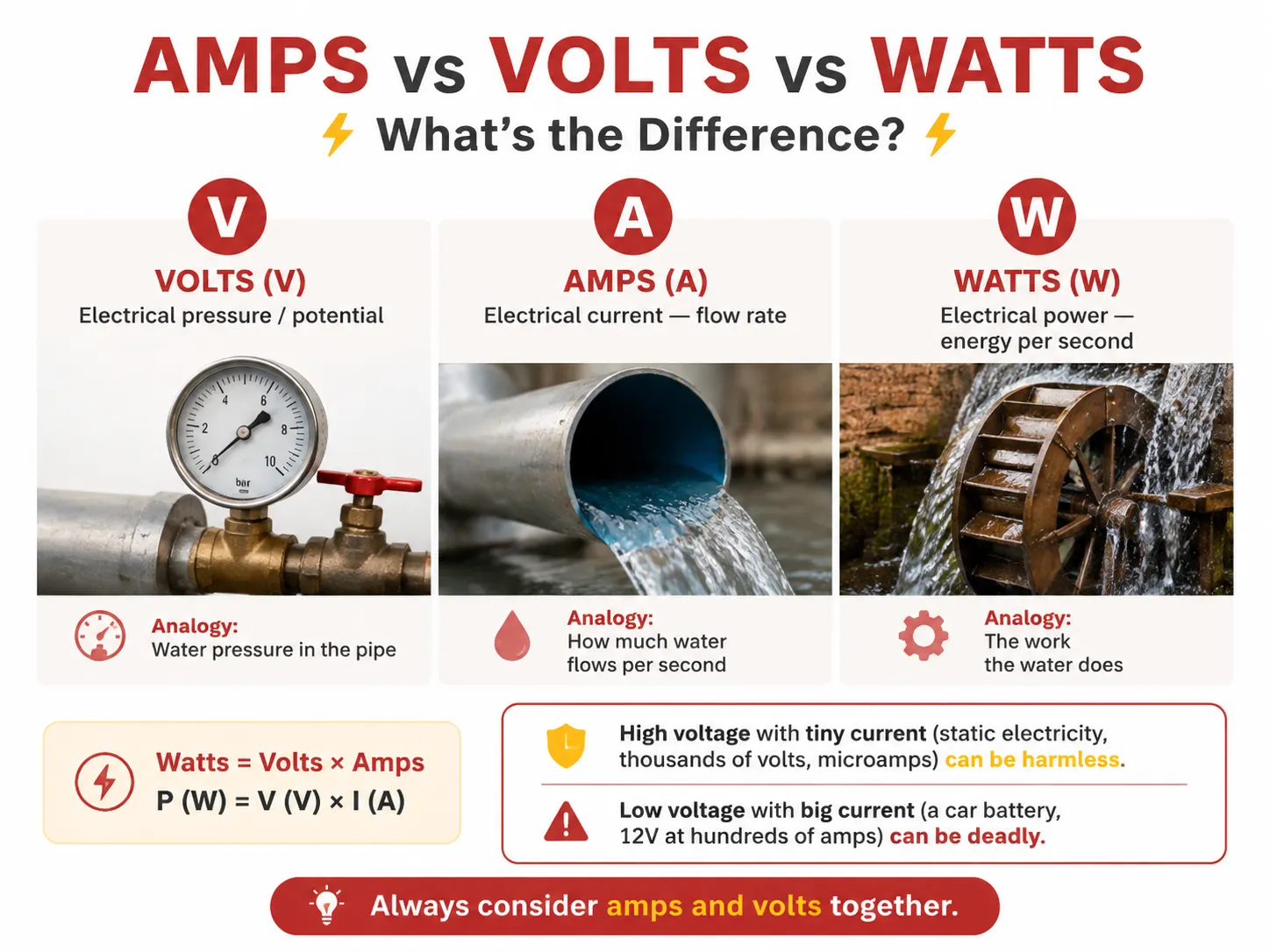
Amps vs Volts vs Watts: What’s the Difference?
The three units describe three different things, and confusing them causes real mistakes:
| Unidade | Measures | Analogy |
|---|---|---|
| Volts (V) | Electrical pressure / potential | Water pressure in the pipe |
| Amps (A) | Electrical current — flow rate | How much water flows per second |
| Watts (W) | Electrical power — energy per second | The work the water does |
Volts force, amps navigate and wattage is the power factor, meaning Watts = Volts × Amps. If a voltage is high and the current is low (as with static electricity, thousands of volts and microamps) it can be harmless. However, if a voltage is low and the current is high (for example, a car battery of 12 volts operating on hundreds of amps) it can be lethal. Always take into account the fact that amps and volts must go together.
How to Tell if Your House Is 100A or 200A
Simple steps require no equipment:
- To read the main breaker, locate the visible breaker in the panel. It bears a number such as “100” or “200” which indicates its capacity.
- To read the meter base, there might be a reading on the meter socket or a utility tag.
- Look at the interior label which usually indicates the size of the main breaker and that of the electrical bus.
- Call the electricity provider and request information about the size of your service.
Importance of the information: a 100A service would prevent you from adding any gadgets that use a lot of energy such as electric vehicles, heaters, and ovens; a 200A service is a modern standard.If breakers trip regularly when you add load, and the main is 100A, an upgrade may be the real fix — and if a breaker is misbehaving, knowing how to tell if a breaker is bad separates a worn device from a genuinely overloaded circuit. For sizing and cost details, our guide to what a 15-amp circuit can carry e o breaker replacement cost numbers help with the practical math.
Perguntas Frequentes
What is 20 amps equal to?
20 amps at 120V translates to a power output of 2,400 watts (Watts = Amps × Volts). Then we have 4,800W at 240V. A 20A circuit breaker in a 120V circuit allows carrying a maximum power of 1,920W (according to the 80% rule) or even 2,400W in non-continuous operation. 20A is comparable to such appliances as any large microwave (consuming 1,000-1,200W at 120V) or an electric kettle since it is a standard kitchen circuit indicator.
How to tell if house is 100 or 200 amp?
One definitive way of determining the amount of electrical service you have is to simply open the electrical panel and check the number imprinted on your main breaker (the large switch located at the top of the panel). This number is either 100, 120, or, at times, 150 or 225. The main breaker rating indicates the electrical service size. You can also check the label on the meter base as well as the label on the inside of the electrical panel for an estimate of the amount of service provided. Electricity supplied from the utility is typically 100A in older homes and 200A in any new construction.
How do I figure out the amperage?
There are three options for figuring out how many amps your device needs to operate: (1) check the name plate because most devices will list amp usage; (2) use the formula Amps = Watts ÷ Volts (using Ohm’s law, I = V ÷ R); or (3) measure the amperage with a meter. The last option either entails clamping an ammeter around one of the wires carrying current in the circuit, or hooking up a multimeter in series with a device that uses relatively little power. In most cases, the nameplate or a calculation is all that is necessary here and it is safe because there is no danger.
Is 5 amps the same as 5 volts?
No — they measure different things. Amps measure current (electricity in transit), volts measure electric pressure (voltage difference). Five amps is measurement of current; five volts provides measurement of pressure. Also power they deliver together in Watts is calculated using: , Watts = Volts * Amps: 5V * 5A = 25W. 5V source can provide current from microamps to many amps depending on the load; amps and volts can never be equal.
Referências
- NFPA 70 (NEC) — Circuit Sizing and the 80% Continuous Load Rule
- OSHA — Electrical Safety and Current Measurement Guidance
- Fluke — How to Measure Current with a Clamp Meter
- U.S. Department of Energy — Power and Energy Calculations
- IEC 61010 — Safety Requirements for Electrical Measurement Equipment
- IEC — SI Units: Ampere, Volt, and Watt Definitions
Conclusão
Finding the amperage relies on three steps that you need to know in advance: the nameplate can be read (the fastest and safest way), you can calculate amperage according to the formula A= (W/V) (or using the Ohm’s law), and you can measure amperage with the help of either a clamp meter (for a live circuit, it is important to follow all safety precautions), or a multimeter (for a direct current circuit) while keeping the 80% safety limit. One thing to remember is that amps and volts are two different things (in a 20A circuit you will get 2,400W from the 120V circuit).Understanding amperage — and how it relates to the protection devices behind it, from the basics of MCBs vs MCCBs as padrões de disjuntores UL 489 — is the foundation of safe electrical work.