
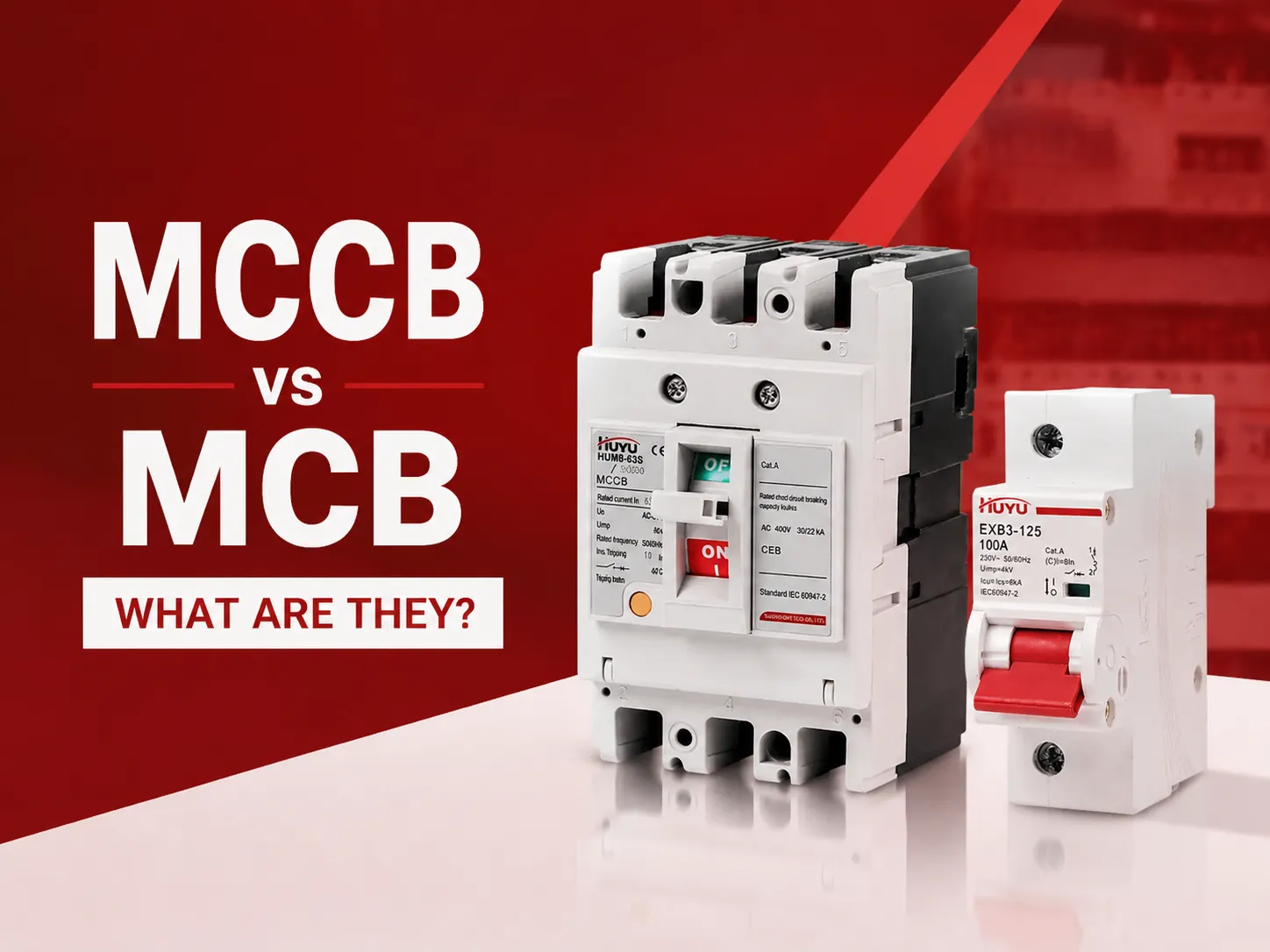
All electrical panels found in homes, offices, factories, and solar setups come with devices that protect against overcurrents. The most common are MCBs (Mini Circuit Breakers) and MCCBs (Molded Case Circuit Breakers). Both types of breakers appear the same from a distance. They both have toggle handles and trip out when too much current flows through them. Confusing MCBs with MCCBs can lead to an overall protection system that trips out on every inrush or does not clear a bolted fault; an example of this is a maintenance electrician’s experience of a 63A MCB protecting an MCCB in a motor feeder. The MCB trippped out on starting current three times a week until the MCB welded its contacts, and when the fault occurred, it wiped out half of the panel. It should be obvious that MCB’s and MCB’s perform different functions in an electrical system; those who specify, install, and maintain electrical circuit protection need to understand what differentiates these two devices.
What Is an MCB?
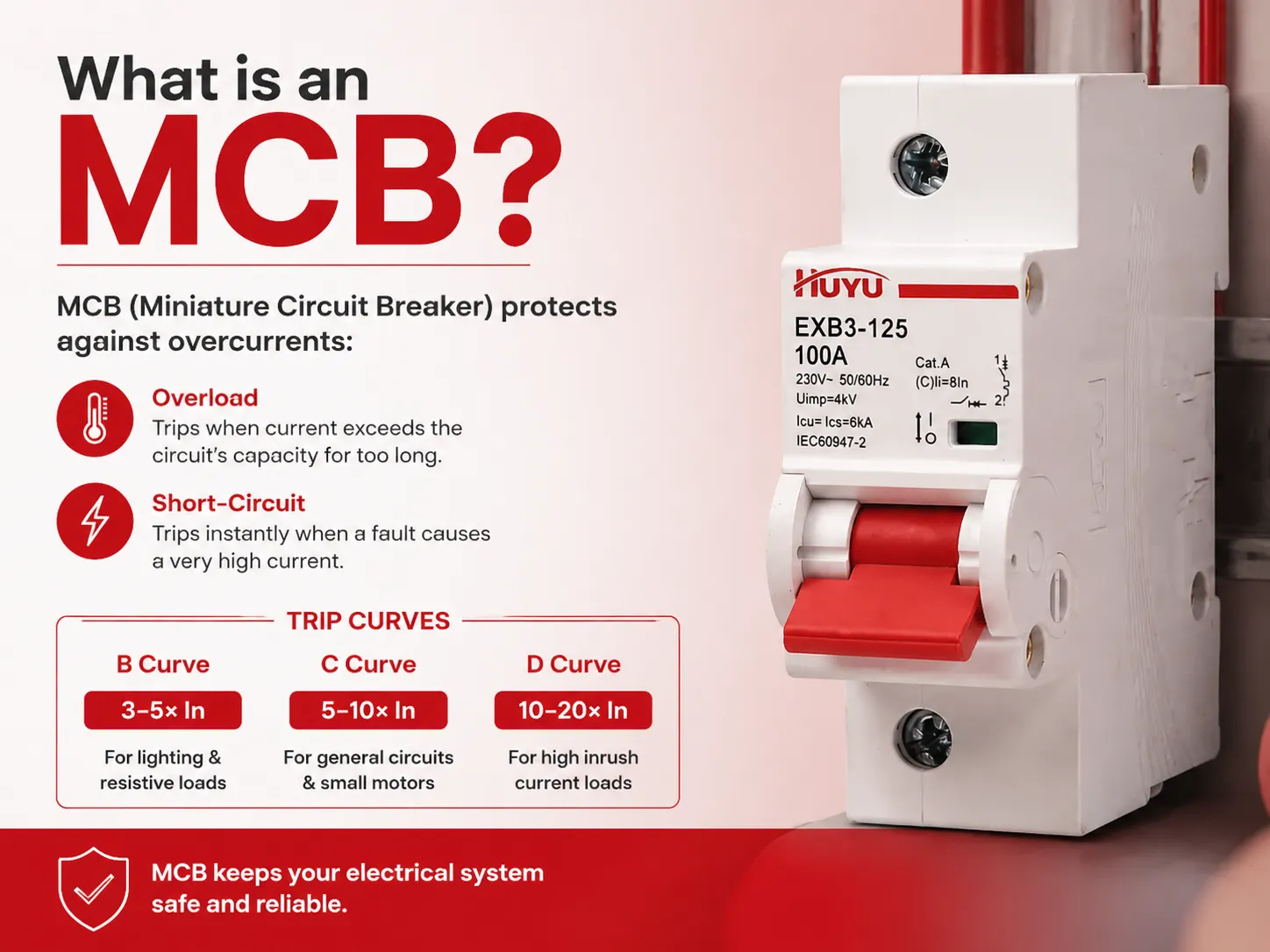
MCB stands for Miniature Circuit Breaker. The MCB is a small device that provides protection against overcurrents in low-voltage electrical installations, both residential and lightly commercial, as well as two forms of overcurrent (overload—where the current exceeds the circuit’s current-carrying capacity for an extended period of time, for example, when too many electrical devices are pumped from one circuit—and short-circuit; a condition when there is a short-circuit due to a failure or damage (to) electrical wiring)). The MCB will trip when the overload condition exists; when an overload trips, the MCB’s bimetallic element heats up/bends and therefore releases the breaker connection latch so that the circuit is disconnected from the other circuits. The MCB can also detect short-circuit conditions and trip the circuit when the element passes its ability (discharges current at a very high rate). The Bimetallic elements within the MCB’s tripping mechanism use both heat and magnetism to help the MCB trip, either of which can occur before the Bimetallic element can return to its original positioning (bent/bent-back).
MCBs for household applications are designed to meet relevant standards, such as IEC 60898. Standards specify three different trip curves available to manufacturers: B, C, and D. Each curve indicates how quickly the magnet will respond to an overcurrent condition relative to its rated current. For example, a B-curved MCB will trip at approximately 3-5 times its rated current. These trips were designed specifically for heating and lighting applications (i.e., resistive loads). A C-curved MCB will trip at approximately 5-10 times its rated current and is typically used in general branch circuits and smaller motor applications. Finally, a D-curved MCB will trip at approximately 10-20 times its rated current and was specifically designed to handle very high inrush current applications such as large transformers or X-ray machines.
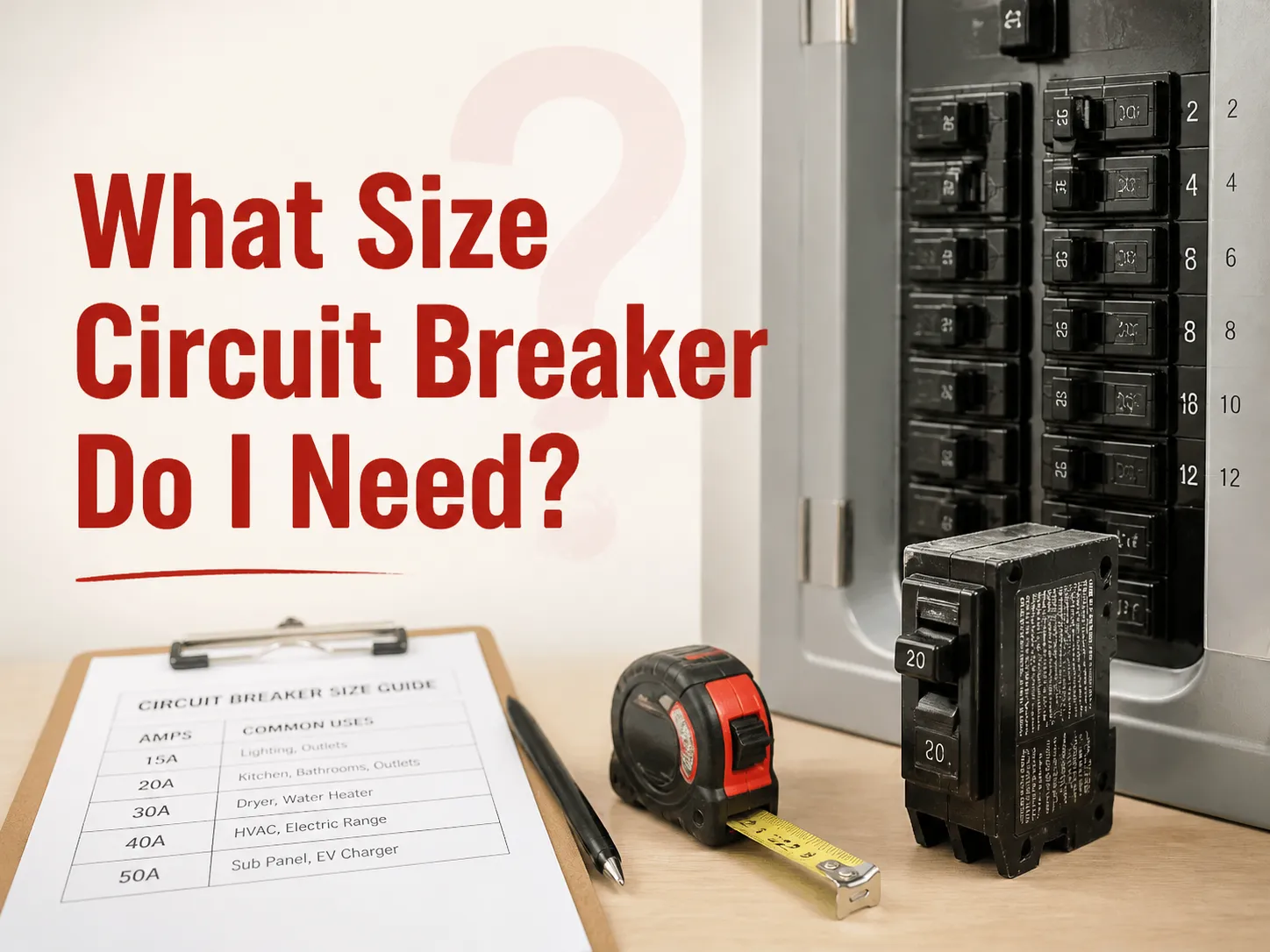
For help determining which curve and rating match a specific load, our article on what size circuit breaker you need walks through the NEC and IEC sizing methods.
What Is an MCCB?
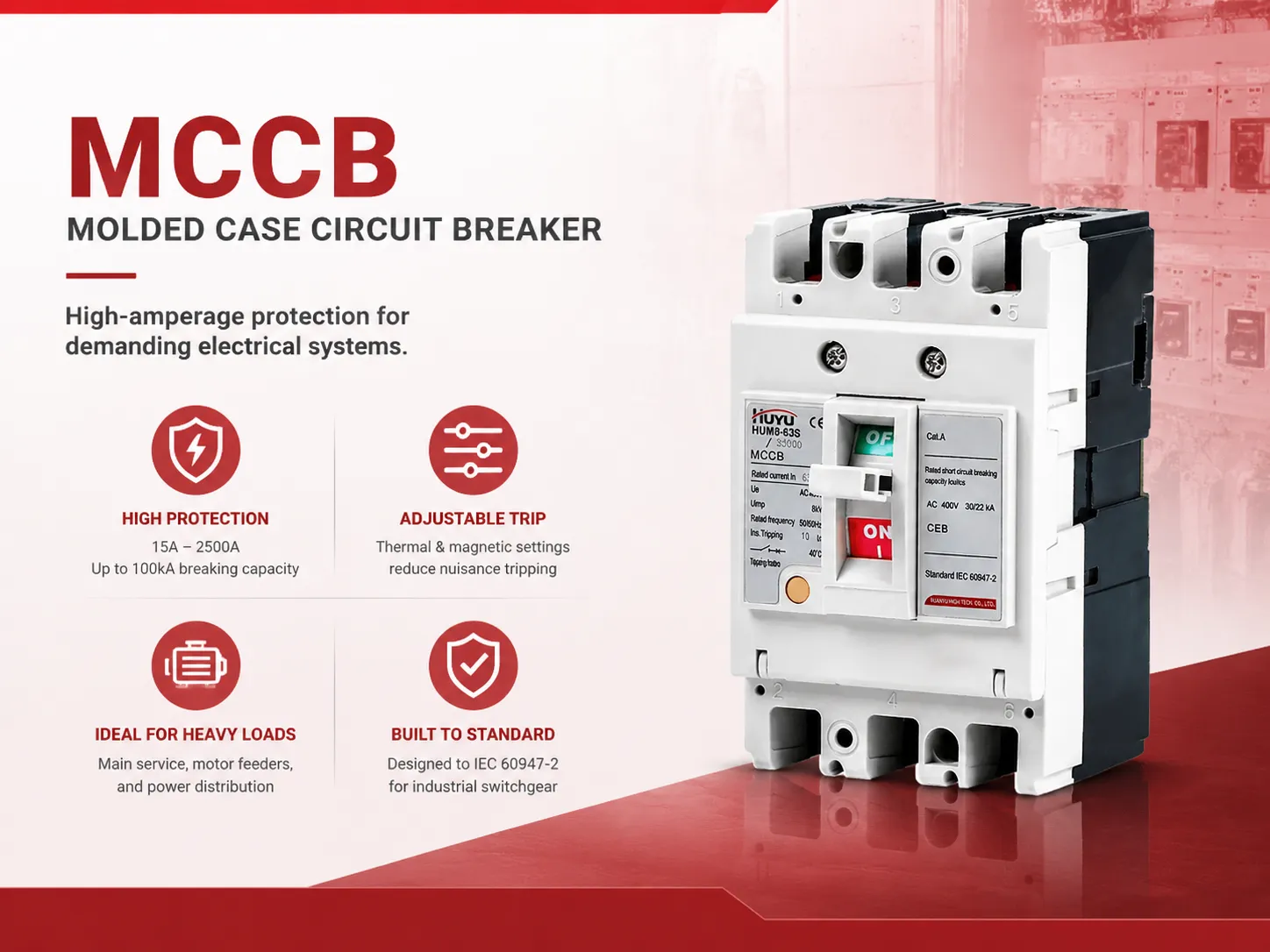
An MCCB is a circuit breaker with a molded case. It is designed for high-amperage circuits and/or applications requiring heavy-duty protection from electrical surges. An MCCB has both thermal and magnetic trip functions, similar to an MCB. However, the maximum current rating of an MCCB typically ranges from around 15A to 2,500A and can interrupt power at up to 100,000A or more in faults. Therefore, an MCCB is an ideal circuit breaker in locations such as main service entrance, feeder circuits for motors and other large electrical loads, and as a part of electrical distribution systems where there may be a lot of fault current present on the system.
MCCBs, as compared to MCBs, possess more than just a larger post. One key feature of an MCCB is the ability to adjust its settings. MCBs’ trip settings are set at the factory and cannot be changed; however, a majority of MCCBs allow for adjustments to the thermal and magnetic trip settings. With these adjustment options, the protection can be properly adjusted to suit the load. For example, if there is an inrush current associated with a motor, the magnetic pickup could be adjusted to be high enough not to cause nuisance tripping and yet still low enough to pick up an actual fault. Therefore, if it is critical to minimize nuisance tripping and coordinate with downstream breakers, it is necessary for an MCCB to have these adjustability features. MCCBs have been designed and manufactured in accordance to IEC 60947-2 for use as industrial switchgear. HUYU’s MCCB portfolio includes the HYM1 molded case circuit breaker, a range that provides the adjustable trip and higher interrupting capacity required for main feeders and industrial loads.
Some manufacturers also offer dedicated DC MCCBs for solar and battery storage applications. HUYU’s HUM9NEZ DC MCCB is a non‑polarity design rated up to 1200V DC, specifically intended for PV arrays and DC combiner boxes. This is a separate device from an AC MCCB; the arc‑extinction mechanism is engineered for the sustained DC arc, and it must not be used on an AC circuit.
MCCB vs. MCB: Key Differences at a Glance
| Characteristic | MCB (Miniature Circuit Breaker) | MCCB (Molded Case Circuit Breaker) |
|---|---|---|
| Rated current range | Typically 0.5A to 125A | Typically 15A to 2,500A |
| Interrupting capacity | 3 kA to 25 kA (typically 6–10 kA) | 10 kA to 100 kA or higher |
| Trip settings | Fixed; non‑adjustable | Often adjustable (thermal and magnetic) |
| Physical size | Compact; DIN rail mount; typically 1–4 poles per device | Larger; can be DIN rail or panel mount; 2, 3, or 4 poles |
| Common applications | Final circuits in homes and commercial buildings: lighting, sockets, small appliances | Main feeders, motor circuits, large equipment, industrial distribution, service entrances |
| Standards | IEC 60898, UL 1077 | IEC 60947‑2, UL 489 |
| Cost (approximate, per unit) | $5–$50 depending on rating and poles | $30–$500+ depending on rating, poles, and interrupting capacity |
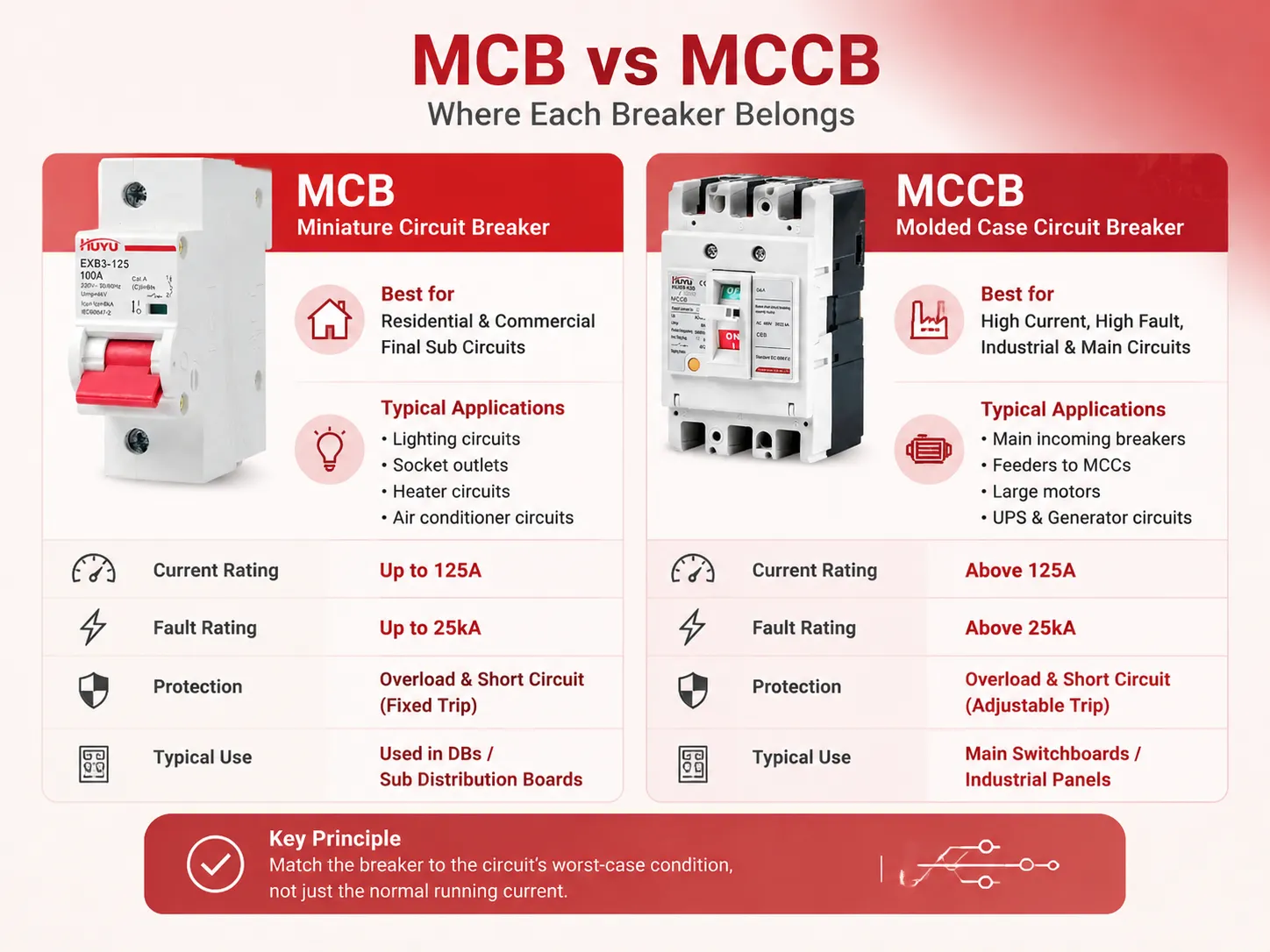
Where Each Breaker Belongs: Application Scenarios
The choice between a Miniature Circuit Breaker (MCB) or Molded Case Circuit Breaker (MCCB), isn’t purely based on personal preference. Rather, the choice will depend upon the requirements of the circuit.
- MCBs Two of the above listed items (lighting circuits, socket outlets circuit, Circuit for heater and circuit for Air conditioner) can be supplied Final Sub Circuits according to the current availability to those circuits from their upstream distribution and the rated ampacity of the MCB is well within their operating range. MCBs are used in residential C/Us and also within the D/Boards located in commercial office & retail environments .
- MCCBs The limits of the MCB have been exceeded as per manufacturer’s specifications; if the continuous load exceeds an MCB’s rating of 125A, then at least one MCCB (or two if more than one) will be required. Additionally, if the available fault current exceeds 25kA at the point of installation of an MCB, then also an additional MCCB will be required. Lastly, if the load on the circuit is a large motor with a starting current such that an MCB of a C-curve will cause it to trip (i.e., exceed the magnetic trip zone of an MCB (normally 2.5 to 3 x rated current)) when starting, then using an MCCB with adjustable magnetic pickup will provide protection against nuisance tripping while at the same time providing protection from faults. Additionally, MCCBs are generally used as the main incoming devices for industrial panelboards, as feeders to motor control centers and to provide protection from faults for large uninterruptible power supply (UPS) and generator circuits.
A motor can operate on an MCB instead of an MCCB as long as the current rating, fault rating and load profile of the motor are within the MCB’s capacity. For example, if you have a motor that draws 50A, requires an inrush current of 350A, and has a D-curved 50A rating – then this will be acceptable for your application. However, in the case of a 125A motor, the inrush current would exceed the capacity of the MCB. In general, the principle is to match the breaker to the circuit’s worst‑case condition, not to the normal running current alone. For help with the specific calculation, our guide on what size circuit breaker you need explains the process for both general and motor loads.
DC MCB vs. DC MCCB: A Separate Distinction
Both MCBs and MCCBs exist in DC‑rated versions for solar photovoltaic and battery storage applications. The distinction between a DC MCB and a DC MCCB follows the same current and fault‑level logic as the AC equivalents. A DC MCB, such as HUYU’s HUM18PV‑63 DC MCB, protects individual PV strings up to 63A. A DC MCCB, such as the HUM9NEZ DC MCCB, protects combiner outputs, battery bank feeders, and inverter DC inputs at higher currents and with higher interrupting capacity. The critical difference between AC and DC breakers — the arc‑extinction mechanism — applies equally to MCBs and MCCBs. A DC‑rated breaker must never be used on an AC circuit, and vice versa. Our article on DC MCB AC circuit compatibility explains the physics in detail.
What Are the Major Brands and Manufacturers?
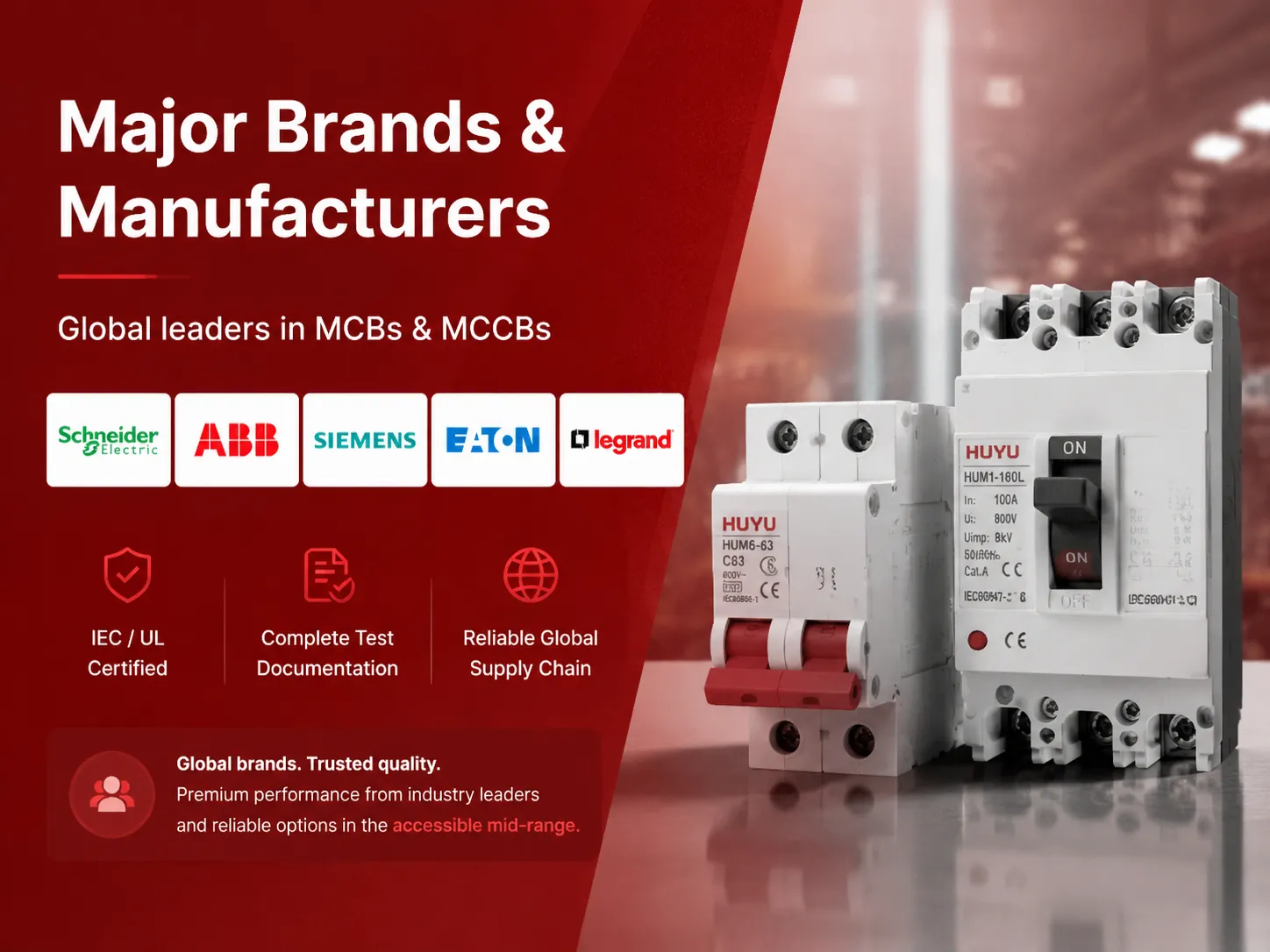
The global market for MCBs and MCCBs includes several large electrical groups that supply the majority of the world’s circuit protection. Schneider Electric (France) produces the Multi 9 and Acti 9 MCB ranges and the Compact NSX and Masterpact MCCB lines. ABB (Switzerland/Sweden) manufactures the S200 and SH200 MCB series and the Tmax and Emax MCCB families. Siemens (Germany) offers the Sentron MCB and 3VA and 3WL MCCB ranges. Eaton (Ireland/USA) produces the FAZ and PLS MCB lines and the NZM and Magnum MCCB portfolio. Legrand (France) supplies DX and TX3 MCBs for residential and commercial markets. These companies have deep product lines, extensive type‑test libraries, and global distribution networks. Their pricing reflects this position at the premium end of the market.
Alongside these global brands, a number of specialized and regional manufacturers — including HUYU — produce MCBs and MCCBs that meet the same IEC and UL standards, with competitive lead times, responsive customization, and a price point that sits in the accessible mid‑range. The key for any buyer is to verify that the breaker carries the required certification marks, that the manufacturer provides complete test documentation, and that the supply chain is reliable.
Frequently Asked Questions
What is the difference between MCCB vs MCB?
The main difference is Size. An MCB is a small, fixed breaker designed for final circuits up to approximately 125 amps with an interrupting capacity of 25 kA. An MCCB is a larger breaker that can be adjustable and is designed for current ratings of up to 2,500 amps and short circuit ratings of 100 kA. The MCBs provide protection to individual lighting and socket circuits while also protecting the main feeder motor circuits and industrial distribution circuits through an MCCB.
Can we use MCB instead of MCCB?
MCBs can only be used if the circuit’s current, available fault current and load characteristics are all within the MCB’s rating. If the circuit has a rating over 125 amps or a fault level greater than 25 kA, an MCCB is required. Using an MCB where an MCCB is required will result in nuisance tripping or not clearing the fault.
What is the difference between DC MCB and MCCB?
The same logic of distinguishing AC circuits from their respective fault levels and speed rating has also been applied to DC MCBs. A DC MCB provides individual protection to PV strings with lower rated currents while the DC MCCB provides combined protection to the combiner output circuit and feeder wire (battery) protection at higher rated currents and higher interrupting capability levels than that of the MCB. Both types of overcurrent protective devices (OCPDs) are required to have specific ratings for DC arc extinction.
What is MCCB used for?
An MCCB protects electrical mains, large motors, industrial distribution panels, service entrances, and any application with a continuous current rating of greater than approximately 125A or a fault current rating of greater than 25kA.
What are the 4 types of MCB?
MCBs are divided into four different types of trip curves. Class B has 3 to 5 times the rated current for resistive loads (heaters and fluorescent lamps). Class C has 5 to 10 times the rated current for general purpose socket circuits and small motors. Class D has 10 to 20 times the rated current for heavy load with high inrush (transformers and heavy motors) while class K has 8 to 12 times the rated current for inductive loads with moderate in-rush. There are also Classes A and Z that are used for extremely sensitive electronic protection.
How many amps is a MCCB?
The range of rating for an MCCB (molded case circuit breaker) varies by manufacturer and frame size; however, typical frame sizes (all of which have common short-circuit rating) range between 15A (amps) to greater than 2,500 A, depending on the model. The majority of MCCB models have a maximum current rating in 100A increments up to 1600A and can be rated higher for use in power distribution service.
References
- IEC 60898‑1 — Circuit‑breakers for overcurrent protection for household and similar installations — International Electrotechnical Commission.
- IEC 60947‑2 — Low‑voltage switchgear and controlgear — Part 2: Circuit‑breakers — International Electrotechnical Commission.
- Schneider Electric — Miniature Circuit Breakers and Molded Case Circuit Breakers — Product ranges and application guides.
- ABB — Miniature Circuit Breakers (MCBs) and Tmax MCCBs — Technical data and selection tools.
- Electrical Construction & Maintenance (EC&M) — Practical articles on circuit breaker selection and application.
Selecting between an MCB or an MCCB depends on what the protective device will be doing and where it will be used. An MCB is used to protect final circuits in homes and businesses, like lighting and appliances, with typical current flow and current fault levels. In situations where an MCB has been overloaded or has tripped (due to current flow exceeding its operating limits), an MCCB is used to provide larger, heavier duty loads, higher fault currents and adjustable protection needed for larger electrical loads, such as used in factories or large commercial buildings. Both devices serve different purposes and neither device can perform the function of the other. At HUYU, we provide complete electrical solutions by providing both MCBs and MCCBs for protection on all types of circuits (both AC and DC).