
يمكن بسهولة اعتبار أحد الأجزاء الرئيسية في التحكم بالمحرك هو القاطع AC. ولكن من الجدير بالذكر أن التكوين غير الصحيح للقاطع يمكن أن يكون أيضًا أحد المشاكل. على سبيل المثال، التيارات الأمبيرية التي يمكن رؤيتها على جانب القاطع توفر معلومات حول خصائصه من النوع المقاوم. ومع ذلك، إذا تم تحويل هذا الرقم لبدء تشغيل المحرك، فقد تظهر نقاط ساخنة في اللوحات. لذلك، يشرح هذا المقال ما هو القاطع AC، وما هو الملف الذي يمتلكه القاطع AC وما الذي يميزه عن القاطع DC، وما الفئة المستخدمة لتحديد الحمل وكيفية تنفيذ التوصيل الكهربائي، ونوع الصيانة المطلوبة وما سيكون سعره.
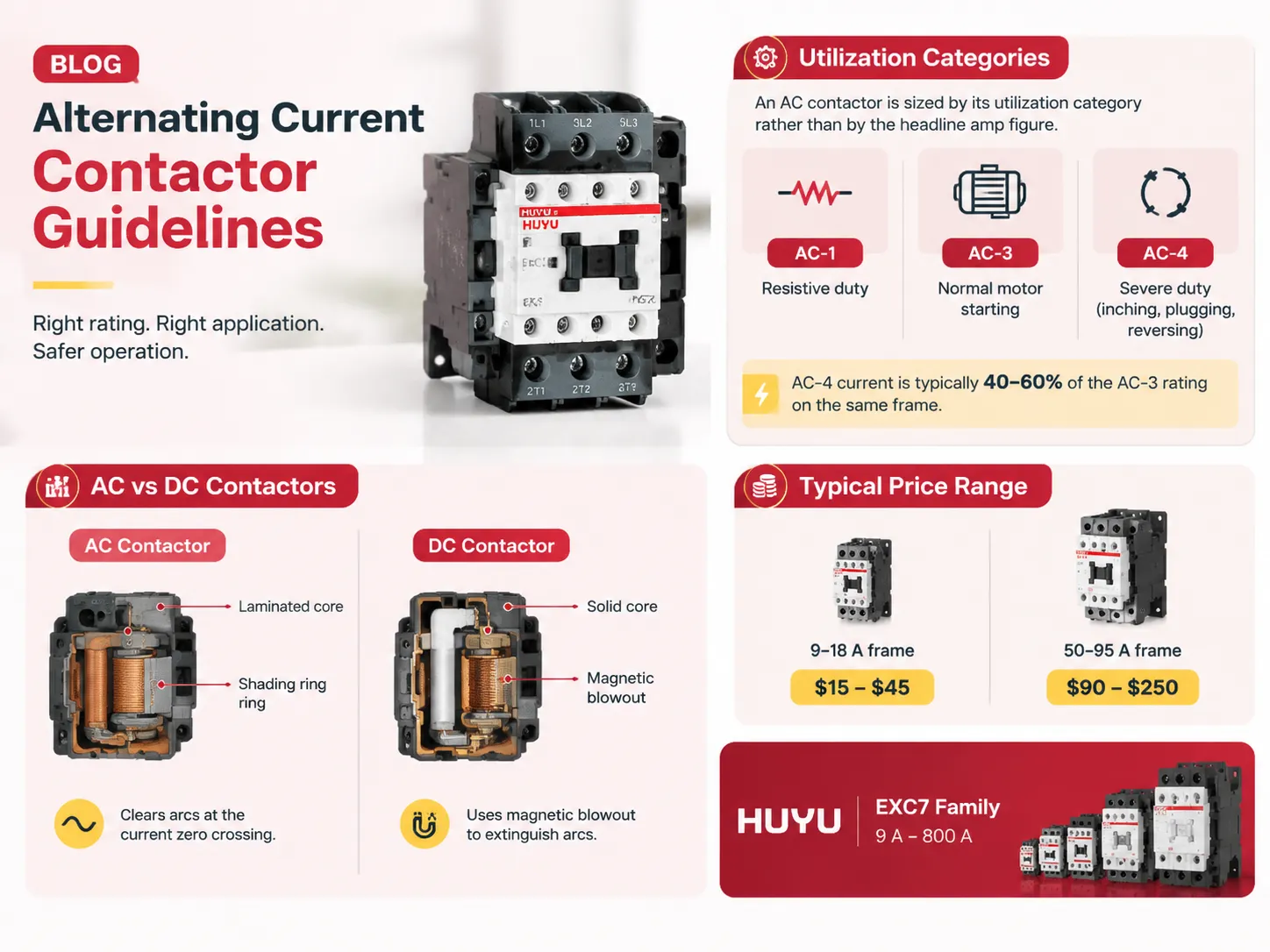
باختصار، يعمل القاطع AC كمفتاح للتحكم في أحمال التيار المتردد عن بُعد. تعتمد الخصائص الرئيسية على كيفية عمل القاطع، وليس على التيار، الذي هو مجرد أحد المواصفات. على سبيل المثال، يشير AC1 إلى الاستخدام في دورة عمل مقاومة، وAC3 يشير إلى الاستخدام لبدء تشغيل المحرك، وAC4 يشير إلى الاستخدام في تطبيقات شديدة القسوة (مثل العكس، التوصيل العكسي، التقدم التدريجي) حيث يكون التيار حوالي 40-60% أقل من AC3. القواطع AC وDC هي أنواع مختلفة من المفاتيح: تحتوي قواطع AC على قلب مكدس، وتكنولوجيا القطب المظلل تمكن القاطع AC من قطع التيار عند نقطة عبور الصفر، بينما لا تحتوي قواطع DC على قلب مكدس وتستخدم النفخ المغناطيسي. يتراوح سعر قواطع AC من 15 إلى 45 للأمبيرات من 9-18 أمبير ومن 90 إلى 250 للقواطع ذات تصنيفات 50-95 أمبير. تنتج شركة HUYU قواطع سلسلة EXC7 بتيارات تتراوح من 9 أمبير إلى 800 أمبير.
ما الذي يفعله الكونتاكتور AC فعليًا
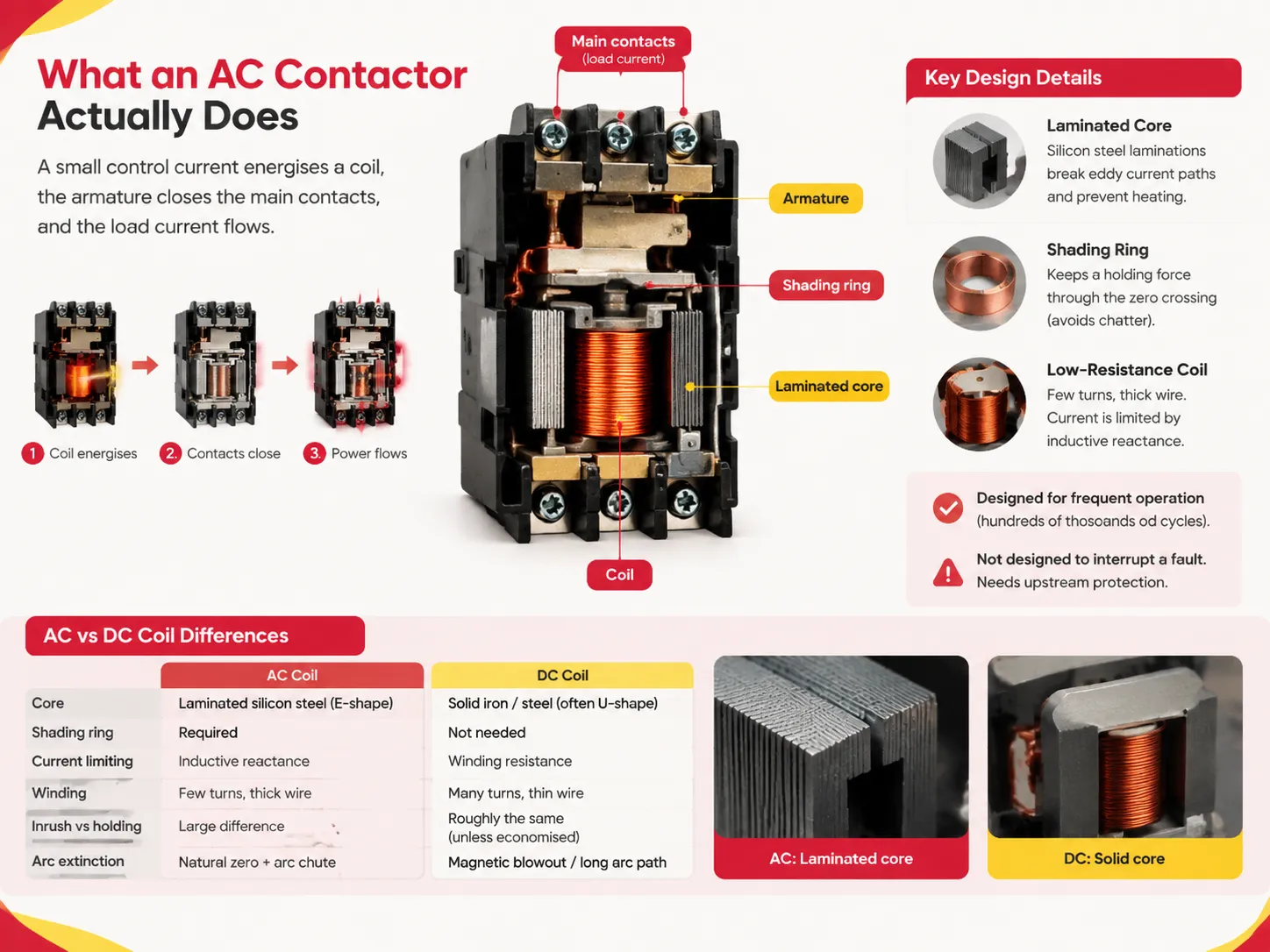
الكونتاكتور هو في الأساس مفتاح يعمل كهرومغناطيسيًا. عند تشغيل التحكم، يقوم تيار تحكم صغير بتنشيط ملف الكهرومغناطيس، مما يسحب الذراع، وبالتالي يغلق الاتصالات الرئيسية ويسمح بمرور التيار. يتم إزالة إشارة التحكم وتقوم الزنبركات بفتح الاتصالات مرة أخرى.
البساطة هي الهدف. هو مخصص للعمل بتردد عالٍ جدًا؛ حرفيًا مئات الآلاف من دورات التشغيل/الإيقاف طوال عمره، ومن هنا استخدامه الواسع في مفاتيح التشغيل بزر الضغط، وأنظمة التكييف، والمضخات، ولوحات الإضاءة العامة. لا يُقصد به أن يفصل عند تيار الخطأ بل يعتمد على مرحل علوي لهذه الوظيفة.
كيف يعمل الملف والنواة
يمكن تفسير عمل الكونتاكتور AC من خلال ثلاث خصائص تصميمية.
النواة المغلفة. أي مجال متردد يمر عبر أي موصل صلب يحفز تيارات دوامية جاهزة. إذا كانت النواة مصنوعة من الحديد الصلب، فإنها ستسخن. لذلك، يسمح تصميم الكونتاكتور AC بتكديس رقائق عازلة رقيقة من فولاذ السيليكون على شكل E لكسر مسار التيارات الدوامية. هذا هو الجواب على السؤال حول النواة المستخدمة في المرحلات والكونتاكتورات AC: فولاذ السيليكون المغلف وليس الحديد الصلب.
حلقة التظليل تمنع الارتجاج. عند تردد 50 هرتز، يعبر التيار خط الصفر 100 مرة في الثانية، بحيث عند كل عبور يختفي السحب المغناطيسي. إذا لم يتم اتخاذ أي إجراء، فإن الذراع ببساطة سيصدر طنينًا واهتزازًا وبالتالي يفقد اتصالاته. الحل هو حلقة تظليل نحاسية مثبتة على وجه القطب. تخلق حلقة التظليل تأخيرًا زمنيًا بالنسبة للتدفق في ذلك القسم المحدد مما يحافظ على قوة التثبيت طوال عبور الصفر. لذا عندما يبدأ الكونتاكتور في إصدار طنين عالٍ، فهذا يعني أن حلقة التظليل إما مكسورة أو مفقودة لأسباب أخرى.
الملف ذو مقاومة منخفضة وعدد لفات منخفض. يحد ملف التيار المتردد من التيار عن طريق المفاعلة الحثية بدلاً من المقاومة، وبالتالي يمكنه استخدام موصلات سميكة وعدد لفات منخفض نسبيًا. هذا أمر بالغ الأهمية عند محاولة استخدامه للعمل على التيار المستمر. علاوة على ذلك، يكون تيار التدفق الأولي للملفات أعلى بكثير من تيار التثبيت. وحدة EXC7 لديها استهلاك طاقة يتراوح بين 60-200 فولت أمبير حسب الإطار أثناء السحب و9-25 فولت أمبير أثناء التثبيت.
| الخاصية | ملف التيار المتردد | ملف التيار المستمر |
|---|---|---|
| القلب | فولاذ السيليكون المصفح (شكل E) | الحديد / الفولاذ الصلب (غالبًا شكل U) |
| حلقة التظليل | مطلوب | غير مطلوب |
| تحديد التيار | المفاعلة الحثية | مقاومة اللف |
| اللف | عدد لفات قليل، سلك سميك | عدد لفات كثير، سلك رفيع |
| تيار التدفق الأولي مقابل التثبيت | فرق كبير | تقريبًا نفس الشيء (ما لم يتم التوفير) |
| انطفاء القوس | صفر التيار الطبيعي + ممر القوس | تفجير مغناطيسي / مسار قوس طويل |
الأقطاب، الأمبيرات وأحجام الإطار
يتم تحديد الكونتاكتورات عبر ثلاثة أبعاد في آن واحد: عدد الأقطاب، تصنيف التيار وحجم الإطار. فهم نطاق حقيقي يجعل منطق التحديد ملموسًا.
عائلة EXC7 تعمل من إطارات قياسية مصنفة من 9 أمبير إلى 110 أمبير وإطارات تيار عالي مصنفة بين 120 أمبير و800 أمبير، جميعها بتكوين ثلاثي الأقطاب (3P). جهد العزل المصنف هو 690 فولت على الإطارات القياسية و1000 فولت على إطارات التيار العالي، مع جهد تشغيل 380/400 فولت أو 660/690 فولت. تغطية الطاقة تتراوح من 4 كيلوواط في الطرف الصغير إلى 450 كيلوواط على إطار 800 أمبير تحت واجب AC-4 عند 690 فولت.
لاحظ الاختلاف في قيم العمودين في الجدول أدناه. رقم AC-1 هو التيار الحراري الذي يمكن للاتصالات تحمله؛ بينما رقم AC-3 هو ما يمكن للجهاز فعليًا تبديله عند وجود محرك. للإطار الأصغر هذا 20 أمبير، بينما للإطار الكبير 9 أمبير. التحديد بناءً على الرقم الأول وتطبيقه على المحركات هو الخطأ الأكثر شيوعًا في بناء اللوحات.
| الإطار | AC-1 (إيث) | AC-3 عند 380/400 فولت | AC-4 عند 380/400 فولت | قدرة AC-3 |
|---|---|---|---|---|
| EXC7-09 | 20 أ | 9 أمبير | 5 أمبير | 4 كيلوواط |
| EXC7-18 | 32 أمبير | 18 أمبير | 7 أمبير | 5 كيلوواط |
| EXC7-32 | 50 أ | 32 أمبير | 12 أمبير | 15 كيلوواط |
| EXC7-50 | 80 أمبير | 50 أ | 24 أمبير | 22 كيلوواط |
| EXC7-95 | 125 أمبير | 95 أمبير | 44 أمبير | 45 كيلوواط |
| EXC7-225 (إطار تيار عالي) | 275 أمبير | 225 أمبير | — | 110 كيلوواط (AC-4) |
| EXC7-800 (إطار تيار عالي) | 900 أمبير | 800 أمبير | — | 450 كيلوواط (AC-4) |
إطارات التيار العالي ليست متكافئة حيث يوفر المصنع تصنيف تيار AC-3 مع تصنيف قدرة AC-4 بالكيلوواط، مما يتطلب من المستخدم اشتقاق عامل التخفيض من جداول اختيار الإطار ذات الصلة بدلاً من الحصول على مرجع واضح.
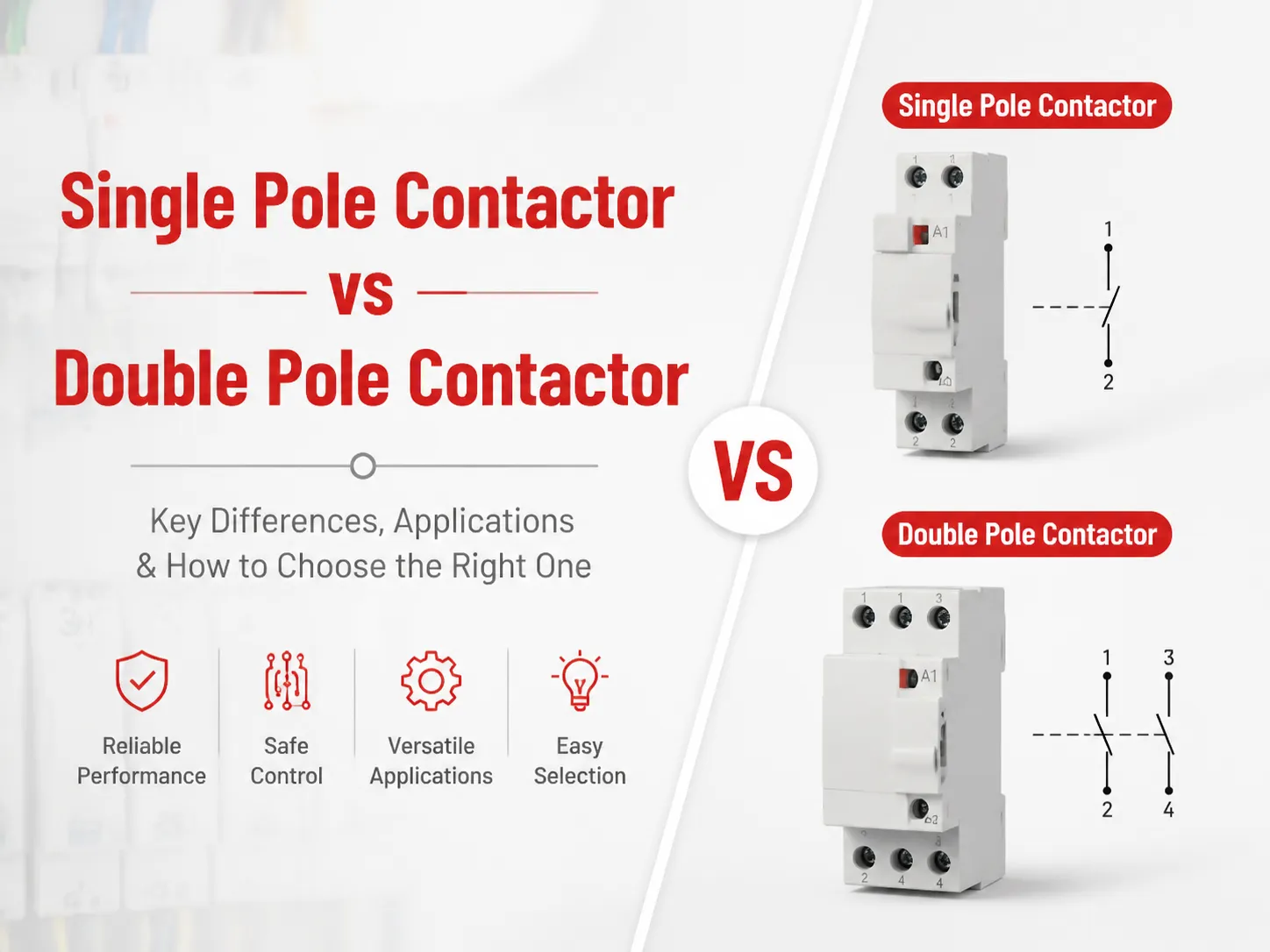
عامل آخر يجب أخذه في الاعتبار هو عدد الأقطاب. بالنسبة للمحركات ثلاثية الطور، الوحدات ذات الثلاثة أقطاب هي المعيار؛ توجد خيارات ذات قطب واحد وقطبين لكسر النيوترال، الأحمال أحادية الطور، أو دائرتين منفصلتين، ومن الضروري فهم أن الأجهزة ذات القطبين يجب توصيلها بشكل مختلف عن نظيراتها ذات القطب الواحد، على الرغم من أن كلاهما له نفس عدد الأقطاب.
بالإضافة إلى ذلك، يجب أخذ عائلة الإطار في الاعتبار عند البحث عن الملحقات. يمكن تركيب كتل التلامس المساعدة في الأعلى أو على الجانب، وتأتي مع تركيبات مختلفة من التلامسات المفتوحة عادة أو المغلقة عادة، تحتوي على رؤوس تأخير زمني هوائية، أغطية ضد الغبار، وحدات كبح الارتفاعات المفاجئة، وأقفال ميكانيكية لأزواج العكس.
فئات الاستخدام: حيث يحدث تحديد حجم المحرك فعليًا
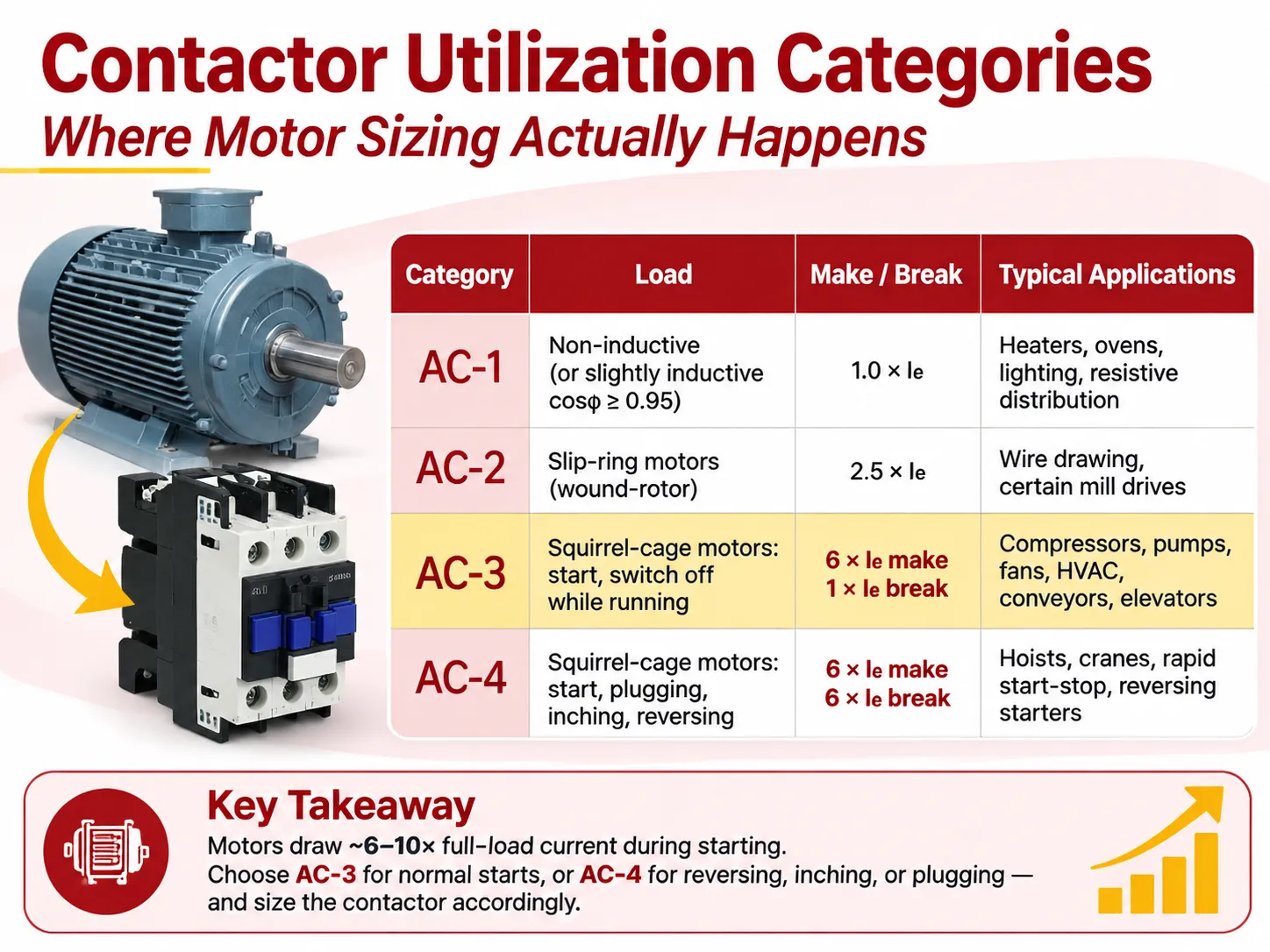
تصنيفات استخدام الكونتاكتور محددة في IEC 60947-4-1 من خلال دمج ظروف تشغيلها التي يجب أن تكون قد خضعت لاختبارات الموافقة النوعية. من بين البدائل المختلفة، هناك أربعة تُستخدم بشكل شائع في الممارسات، والاختلافات ليست شكلية فقط.
| الفئة | الحمل | التشغيل / الفصل | التطبيقات النموذجية |
|---|---|---|---|
| AC-1 | غير تحريضي أو تحريضي قليلاً (cosφ ≥ 0.95) | 0 × Ie | السخانات، الأفران، الإضاءة المتوهجة، التوزيع المقاوم |
| AC-2 | محركات الحلقات الانزلاقية (المحرك ذو الدوار الملفوف) | 5 × Ie | سحب الأسلاك، بعض محركات المطاحن القديمة |
| AC-3 | محركات القفص السنجابي: بدء التشغيل، الإيقاف أثناء التشغيل | 6 × Ie تشغيل، 1 × Ie فصل | الضواغط، المضخات، المراوح، HVAC، الناقلات، المصاعد، الخلاطات |
| AC-4 | محركات القفص السنجابي: بدء التشغيل، التوصيل العكسي، التشغيل التدريجي، العكس | 6 × Ie تشغيل، 6 × Ie فصل | الرافعات، الونشات، بدء وإيقاف سريع، بادئات عكسية |
التداعيات في الحياة الواقعية. يسحب المحرك ما يقارب ستة إلى عشرة أضعاف قيمته القصوى للتيار أثناء بدء التشغيل، ويجب على الكونتاكتور تحمل هذا الوضع. في حالة عمليات تشغيل المحرك البسيطة عندما يقوم فقط بتشغيل وإيقاف المحرك أثناء تشغيله، يكون ذلك AC-3؛ لذا يجب استخدام عمود AC-3. في حالة تطبيق خاص آخر عندما يعكس المحرك الاتجاهات عدة مرات أو يتم تشغيله تدريجياً، ينطبق AC-4 وفي الواقع، يجب ترقية حجم الجهاز لأن التيار أثناء AC-4 يكون ستة أضعاف التيار العادي، لذا عادةً ما يجب ترقية الجهاز لإطار واحد أو اثنين وأحيانًا وجود جهاز حماية أكبر أيضًا.
تنشر جداول EXC7 كلا العمودين مما يجعل من الممكن تحديد حجم الجهاز بشكل صحيح. على سبيل المثال، في حالة إطار 32 A AC-3 عند 400 V يكون التيار 32 A ولكن لـ AC-4 يكون فقط 12 A. التشغيل التدريجي 12 A على كونتاكتور 32 A مسموح به ولكن التشغيل التدريجي 25 A غير مسموح به.
الكونتاكتورات AC و DC غير قابلة للتبادل
هذا هو السؤال الأكثر تكرارًا، وهناك ثلاثة أسباب ميكانيكية تشرح الإجابة.
القوس الكهربائي. التيار المتردد يصل إلى الصفر مرتين في كل دورة وبعدها يفقد القوس طاقته. إذا كانت الفجوة بين نقاط التلامس وقناة القوس قد اكتسبت قوتها العازلة، فلن يشتعل القوس مرة أخرى. لذلك، يستخدم المحول القياسي فجوة صغيرة وقناة قوس من نوع الشبكة. التيار المستمر لا يصل إلى الصفر، وبالتالي يستمر القوس في عمله حتى يتم قطعه. الكونتاكتور DC مزود بملفات نفخ مغناطيسية، وموصلات القوس، وفجوات أكبر، وأحيانًا يكون محكم الإغلاق أو مفرغ الهواء. إذا تم تطبيق قوس DC على كونتاكتور AC، فسوف يتجاوز عمر الجهاز، مما يؤدي إلى تآكل كبير أو لحام نقاط التلامس.
الملف اللولبي. هذا هو النوع الأكثر شيوعًا من الأعطال. تتكون معاوقة الملف اللولبي للتيار المتردد بشكل رئيسي من المفاعلة الحثية، وهي دالة للتردد. إذا تم توصيل الملف بالتيار المستمر، يصبح التردد صفرًا، وتصبح المفاعلة صفرًا، وسيتصرف الملف كمقاوم ذو مقاومة منخفضة جدًا. ونتيجة لذلك، سيرتفع التيار إلى 5-10 أضعاف القيمة المقدرة، وسينفجر الملف في غضون ثوانٍ. العملية العكسية ليست ملحوظة جدًا، لكنها تعتبر عطلًا على أي حال: لا يمكن لملف التيار المستمر على التيار المتردد أن يعمل بشكل صحيح، لأنه يمتلك مقاومة أعلى.
القلب. القلب الصلب الذي يعمل تحت تيار مستمر ثابت سيحترق تحت التيار المتردد. بالإضافة إلى ذلك، فإن قلب التيار المتردد يهدر المادة المستخدمة للتيار المستمر. هذه هي الإجابة التي يخطئ المهندسون في فهمها: تستخدم القواطع الكهرومغناطيسية للتيار المتردد قلوبًا مصفحة، بينما تستخدم قواطع التيار المستمر قلوبًا صلبة.
بينما توجد ملفات لولبية عالمية للتيار المتردد/المستمر مصنوعة مع مقوم ومنظم، إلا أنها لا تزال تكلف أكثر وتعمل فقط ضمن نطاقات جهد معينة. إذا كانت الملصقة قد حددت جهدًا واحدًا فقط والنوع، فافترض أن ذلك صحيح. التزويد الخاطئ للملف اللولبي هو من أسرع الطرق لتدمير القاطع الكهرومغناطيسي.
عندما تحتاج إلى قاطع كهرومغناطيسي للتيار المستمر لتطبيقات تبديل DAV الفعلية مثل البطاريات، سلاسل التيار المستمر الشمسية، محطات شحن المركبات الكهربائية، أو محركات التيار المستمر. مشهد التصنيع لعائلة المنتجات هذه هو سلسلة توريد مختلفة، وهذه النظرة العامة على المصانع الرائدة لقواطع التيار المستمر هي نقطة انطلاق مفيدة للحصول على واحد.
هل القاطع الكهرومغناطيسي هو قاطع دائرة؟
لا، والخلط بينهما يسبب أخطاء تصميم حقيقية. تقوم ثلاثة أجهزة مختلفة بثلاث وظائف مختلفة.
| الجهاز | العمل | انقطاع زيادة التيار | تردد التشغيل |
|---|---|---|---|
| قاطع | التبديل عن بعد للحمل | لا شيء | عالي جدًا (مئات الآلاف من الدورات) |
| مرحل | Control-circuit switching and logic | لا شيء | High, but low current |
| قاطع الدائرة | Fault and overload interruption | نعم | Low (rare operation) |
| Thermal overload relay | Motor overload protection | Yes, via the contactor | Trips once, then resets |
| Motor circuit protector (MCP) | Short-circuit protection only | Magnetic only | Rare |
A contactor isn’t built to handle any short-circuit event, and its contacts will be damaged if it tries. A motor starter has all of the three devices working in synchronization: the contactor does the switching, the overload relay makes sure that there has been sustained overcurrent and opens the circuit of the contactor coil, the disruption of the current in the circuit happens upstream by the breaker or the fuse. That is why we need to know about the coordination Type 1 and Type 2 ratings since they tell us what will happen to the contactor when there is a short circuit with the Type 2 rating meaning that contact welding is not permitted.
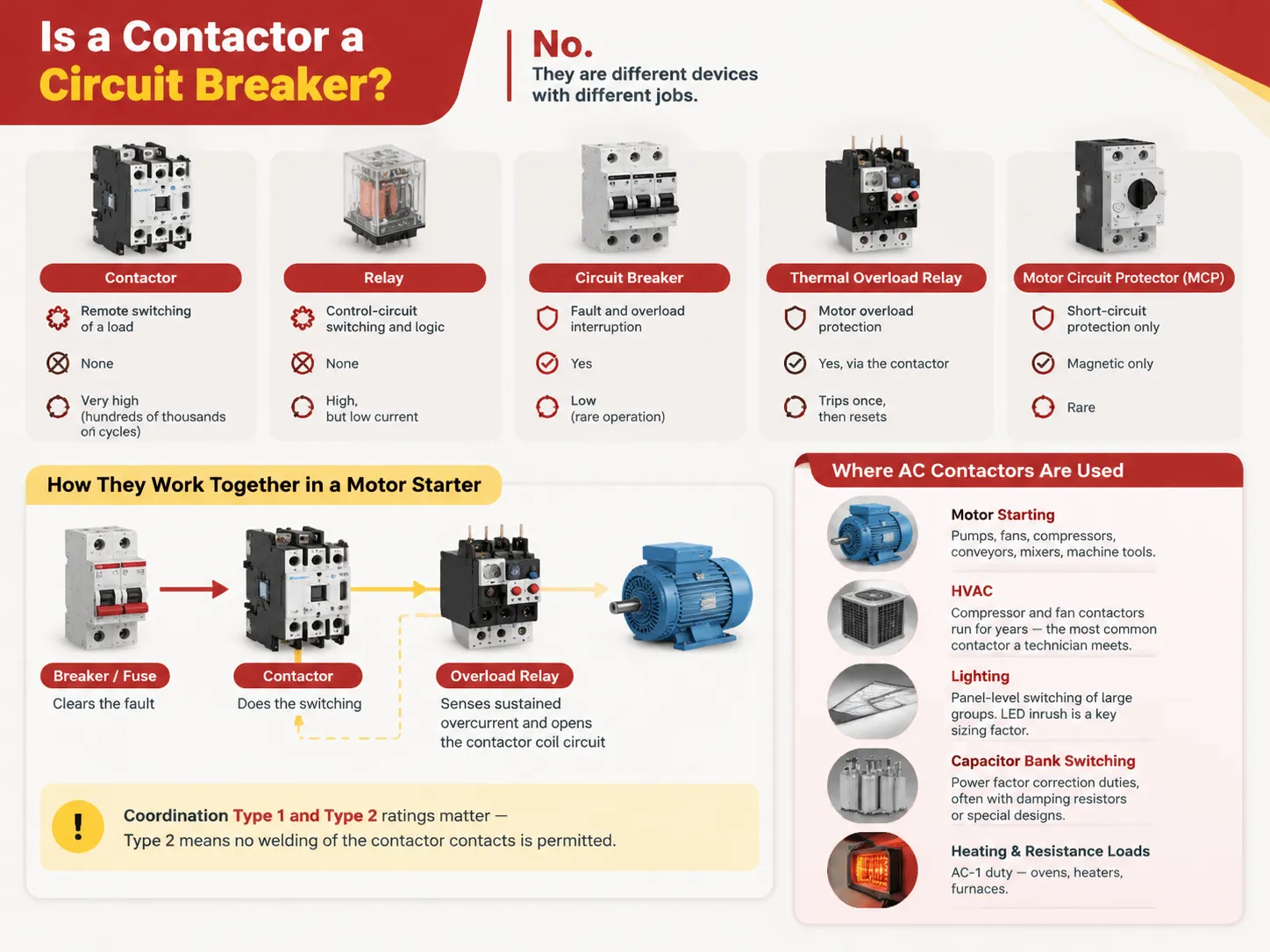
Where AC Contactors Are Used
Five categories of applications account for the majority of the industry.
- Starting of motors. This includes pumps, fans, compressors, conveyor belts, mixers, and machinery where a small motor is either operated directly or in a star-delta combination or via a soft start for larger motors as well.
- HVAC. The contactors employed in compressors and fans operate for many years and are the type of contactor most frequently seen by a technician. How this task affects the contactor after multiple starts and what failures the contactor experiences and which are caused by the refrigeration circuit must be treated separately, and the processes will be discussed in the current clarification of the operation of the contactor for HVAC equipment.
- Lighting. This is related to the control of lighting at the switchboard level where the total inrush is a proper design component due to the new LED lamp drivers.
- Switching capacitor banks. This is a function of power factor correction which involves large inrushes and utilizes damping resistors or special design contactors.
- Heating and resistive loads. This is an AC-1 function which ensures a long service life of the contactor: furnaces, heaters, stoves.
Contactors, Starters and Motor Circuits
The contactor in association with a thermal overload relay functions just like an electromagnetic starter. This combination is what is used in many three-phase motor installations.
- Direct-on-line (DOL). Only a single contactor. It has full voltage during starting. This method is simple and cheap but has its limits beyond which the electrical supply company does not approve the starting current.
- Reversing. It uses two contactors that have physical and electrical interlocks so that both can never be on at the same time. The interlock device is necessary because a control problem can cause both contactors to be closed together.
- Star-delta. This system uses three contactors and also utilizes the timer for reducing starting current while introducing some complications in the station.
- Soft Starter/VFD. This system is used at places where starting current or torque control is important, and in this case, the contactor acts as a bypass or isolation device rather being the main switching element in the circuit.
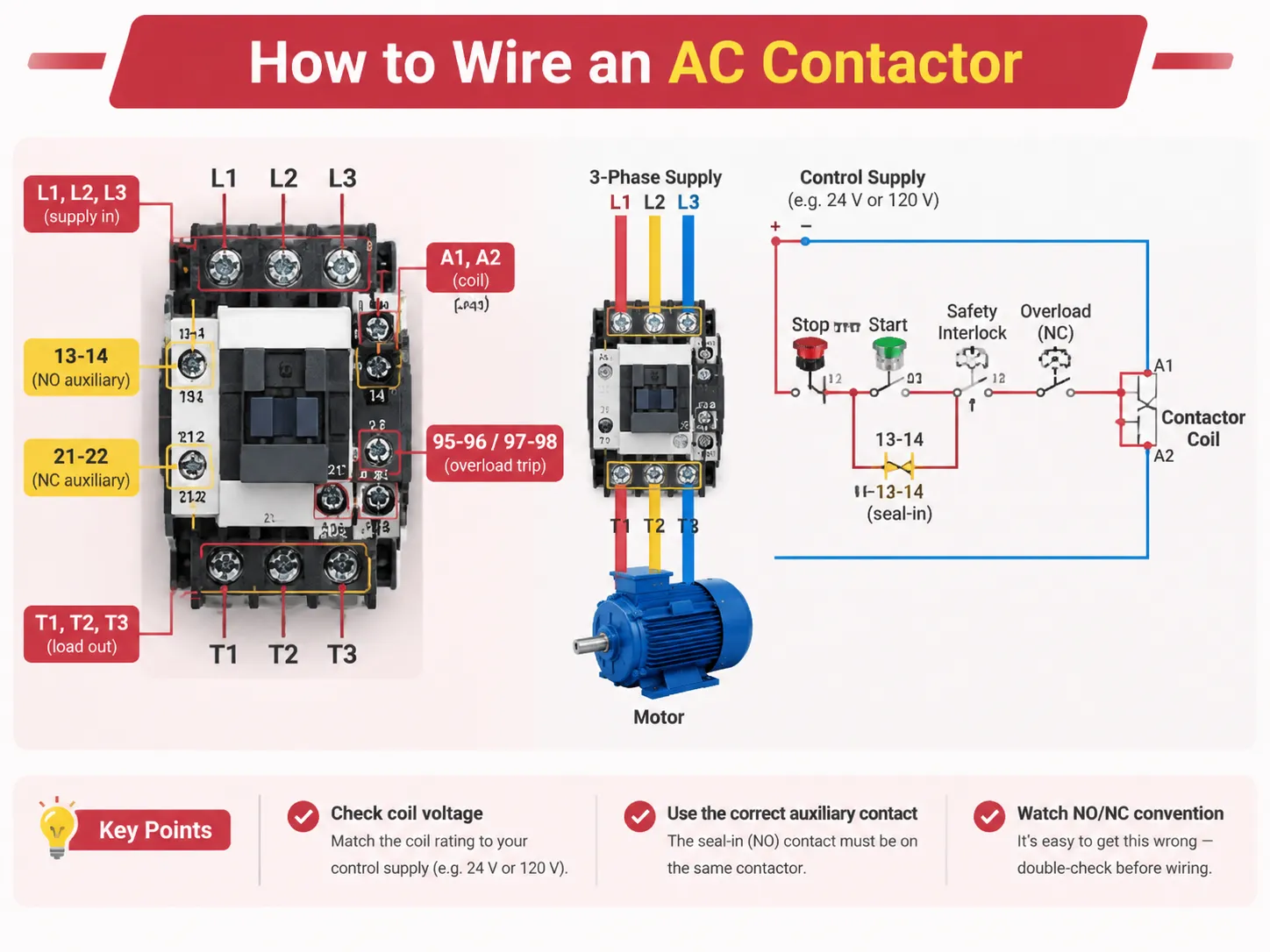
How to Wire an AC Contactor
The standard identification of each terminal should be memorised. If there is a mistake in the identification of any terminal, the contactor may falsely seem to operate but control something else.
| الطرف | المعنى |
|---|---|
| L1, L2, L3 | Line side of the main poles (supply in) |
| T1, T2, T3 | Load side of the main poles (motor out) |
| A1, A2 | Coil terminals |
| 13-14 | Normally open auxiliary contact |
| 21-22 | Normally closed auxiliary contact |
| 95-96 / 97-98 | Overload relay trip contact (NC / NO) |
The wiring corresponds to its purpose. L1 to L3 correspond to power supply wires, while T1 to T3 correspond to the motor wires. The control circuit is supplied through A1 and A2 of the start button, stop button, relevant safety interlocks and normally closed contact of overload relay.
A few practical notes. First of all, test the voltage before wiring up the coil as a coil rated for 120 V will not work when connected to 24 V supply. Secondly, make sure that the AUX contact used for seal-in is actually present on the contactor on which it is sealing rather than being part of a separate relay located in the vicinity. Getting the NO/NC convention wrong is common enough to be worth a deliberate check, and the distinction is explained clearly in this comparison of normally open versus normally closed contactor wiring.
Installing and Maintaining an AC Contactor
There are two main factors that influence installation: torque and environment. In the EXC7 family of products, terminals have capacities that vary from 1 to 4 mm² in the smallest frames to 50 to 240 mm² in the largest. The fastening torque ranges from 1.2 N·m to 14 N·m. Most of the field failures of contactors are due to terminals not receiving proper torque—they end up being loose, causing heating, which leads to the failure of the terminal block.
The presence of dust covers is well justified in factories, woodworking shops, or agricultural plants since abrasive or conductive dust would wear the contacts mechanically and electrically much faster than the accessory itself would cost. Surge suppression modules also help out; when you switch a coil, the inductive effect might end up damaging the output of a PLC if not properly suppressed. AC coils often use RC snubbers or varistors while DC coils use the flyback diode or transient voltage suppressor (TVS) though the latter has a downside: simple diodes slow release timing, making them less suitable for circuits where such timing checks are required for safety.
Maintenance is not a complex process: just isolate the circuit and perform the following operations. You need to check the state of wear of contacts and pitting; see if the screws in the terminal are tight; and check the mechanical functioning of the armature and the arc chutes. Then take the readings of the coil. The coil resistance between A1 and A2 should be about tens of ohms if the coil is healthy. If the contactor does not show any odd readings, there will be a low resistance in case of a short. The voltage drop across a closed pole while the load is switched on will be in millivolts but a reading of one volt or higher indicates that the contactor is in danger of overheating.
The most helpful thing a maintenance program can do is to monitor symptoms. Будучиaanut what type of fault occurs when a contactor starts to buzz, trip overload more frequently, or hold the circuit. Collecting those early signals and acting on them is the whole basis of condition-based maintenance, and the pattern of warning signs is set out in this overview of أعراض فشل الكونتاكتور.
Ultimately, it is important to express life in quantifiable terms. Electrical life is stated in terms of operational cycles and depends on duty: the same frame that supports about a hundred thousand AC-3 operations may only be capable of a fifth under AC-4. In general, mechanical life is greater than electrical life by a factor of ten. If a contactor is replaced more often than indicated by the duty cycle, then the mistake lies in sizing and not with the equipment.
What They Cost and How to Choose a Brand
Here are the prices from US and international distributors in 2026. The gap between a famous brand and a low-cost brand is real. It is visible in the kind of contact materials used to make them, not the plastic.
| عنصر | Typical price | ملاحظات |
|---|---|---|
| General-purpose relay, 10 A | $8–$15 | Control circuits only |
| Contactor, 9–18 A AC-3 | $15–$45 | Premium brands at the top of the band |
| Contactor, 25–40 A AC-3 | $40–$95 | Most common motor sizes |
| Contactor, 50–95 A AC-3 | $90–$250 | Frames get heavier; accessories extra |
| Contactor, 120–800 A | $250–$1,500+ | Frame size dominates the price |
| Thermal overload relay | $25–$120 | Matched to the contactor frame |
| Auxiliary contact block | $8–$25 | Per block |
| Surge suppression module | $10–$30 | RC or varistor for AC coils |
When it comes to choosing the right brand, it is no secret that major players such as Schneider, ABB, Siemens, Eaton, WEG and LS perform best when it comes to the type test results and the amount of documentation available to customers. They, however, require you to pay for it. Even though cheaper replicas of such products do exist, they are generally meant for heavier use; however, corners are being cut in the contact part, resulting in short life cycles of the devices themselves.
HUYU is in the second category, having an undeniable advantage of offering an extensive product line instead of a few types of equipment, which puts them at the bottom of the competition. The EXC7 AC contactor range covers 9 A to 800 A in one platform with the same accessory system — auxiliary blocks, delay heads, dust covers, suppressors and interlocks — and the high-current frames use a dual-coil control circuit that cuts holding power by more than 40%, which matters on a panel that runs continuously. What HUYU lacks is the decades of established customers and the native distributor network that a European brand can provide, and for a job in which the name of the brand is specified by some local utility or equipment manufacturer, this discrepancy is decisive.
الأسئلة الشائعة
What is an AC contactor used for?
The remote and continual ability to manipulate an alternating current load. This technology is mainly used for motor control, i.e., for starting or stopping three-phase motors of pumps, compressors, fans, conveyors, mixers, machine tools, and HVAC equipment. The remaining four applications include panel lighting switching, capacitor bank switching for power factor correction, resistance heating applications like ovens and furnaces, as well as general remote circuit switching when the operator has to control the load without having the manual switch that carries the full load.
هل يمكن أن يعمل AC بدون وحدة تحكم؟
Definitely. A contactor is one of many ways of switching an AC load, while smaller loads are usually switched through a manual switch, relay, solid-state relay, or some drive output. If using a contactor it means one is able to switch large currents with a small control signal and at a high rate, and also take care of arc management. If the load is small, seldom switched, or managed already by current controller, the contactor might be useless or limited to isolation functions only.
ما الفرق بين قاطع التيار المتردد (AC) وقاطع التيار المستمر (DC)؟
The three differences are: the core – an AC contactor has a laminated silicon steel core with a shading ring whereas a DC contactor has a solid core, since the magnetic flux doesn’t change; the coil – AC coils are characterized by a low-resistance coil of only a few turns and limited by inductive reactance, while DC coils have many turns and their high resistance eliminates the effect of reactance; the function of arc control mechanism – AC uses naturally occurring zeroes of DC has to involve magnetic blowout coils, since the arc does not get extinguished by itself.
What is AC1 and AC3 contactor?
The terms are the usage categories as described in IEC 60947-4-1. AC-1 is used for either non-inductive or slightly inductive loads such as heaters and resistance loads. For AC-1 class, the only requirement for the contactor is to carry and switch the current equal to its rating. AC-3 applies to induction motors, where six times the current rating is required at the start of the motor and at switch-off operation the contactor has the same rating.When selecting the appropriate column for your application, this is one case where a 32 A rating makes sense, where AC-1 gives a rating of 50A while AC-3 gives a rating of only 32A. Thus we should be using a 32 A rated motor, not the higher number indicated on the label.
Can AC contactor be used for DC?
The normal coil does not work perfectly on the first contact or reliably on of the electrics section. An AC coil operated by DC will lose the inductive resistance, as the current will become five to ten times higher than the rated current in a second. If an AC coil is substituted with a DC coil the main contacts still will fail, as the arc chamber is designed for the arc that crosses zero in each cycle, whereas the DC arc will not break up inside the chamber.
How do I know which frame size to buy?
Consult the AC-3 column for the full-load current of this motor at its working voltage and add some margin if inching or reversing is involved; in this case, check the AC-4 column instead. Check that the appropriate accessories exist for that frame. Do not size based on the AC-1 figure or the kW figure alone, since the kW figure is declared at different voltages, hence one frame size would carry more power at 400 V and less power at 690 V.
المراجع
- UL Standards & Engagement — UL 508, Industrial Control Equipment
- NFPA — NFPA 70, National Electrical Code (motor circuits, Article 430)
- NFPA — NFPA 70E, Standard for Electrical Safety in the Workplace
- International Electrotechnical Commission — IEC 60947-4-1, contactors and motor-starters
- WEG — IEC contactor sizing, utilization categories and coordination types
الخلاصة
Laminated core fitted with the shading coil that also works at low resistance using inductive reactance and arc chute working on zero-cross current basis. The understanding of these principles is essential; everything else is then easy.
The following points must be considered. First, the size should be chosen according to the application type and not based on the ampere rating so that in simple applications AC-3 is sufficient, whereas in some applications such as inverting AC-4 should be used, as this means achieving only half of the load required for the former; second, make sure that an AC coil is not being switched on from a DC supply, otherwise the coil would be burnt in a few seconds; and third, we need to understand that both terminal torque and arc chute and surge protection must be considered as maintenance items, not installation items.