
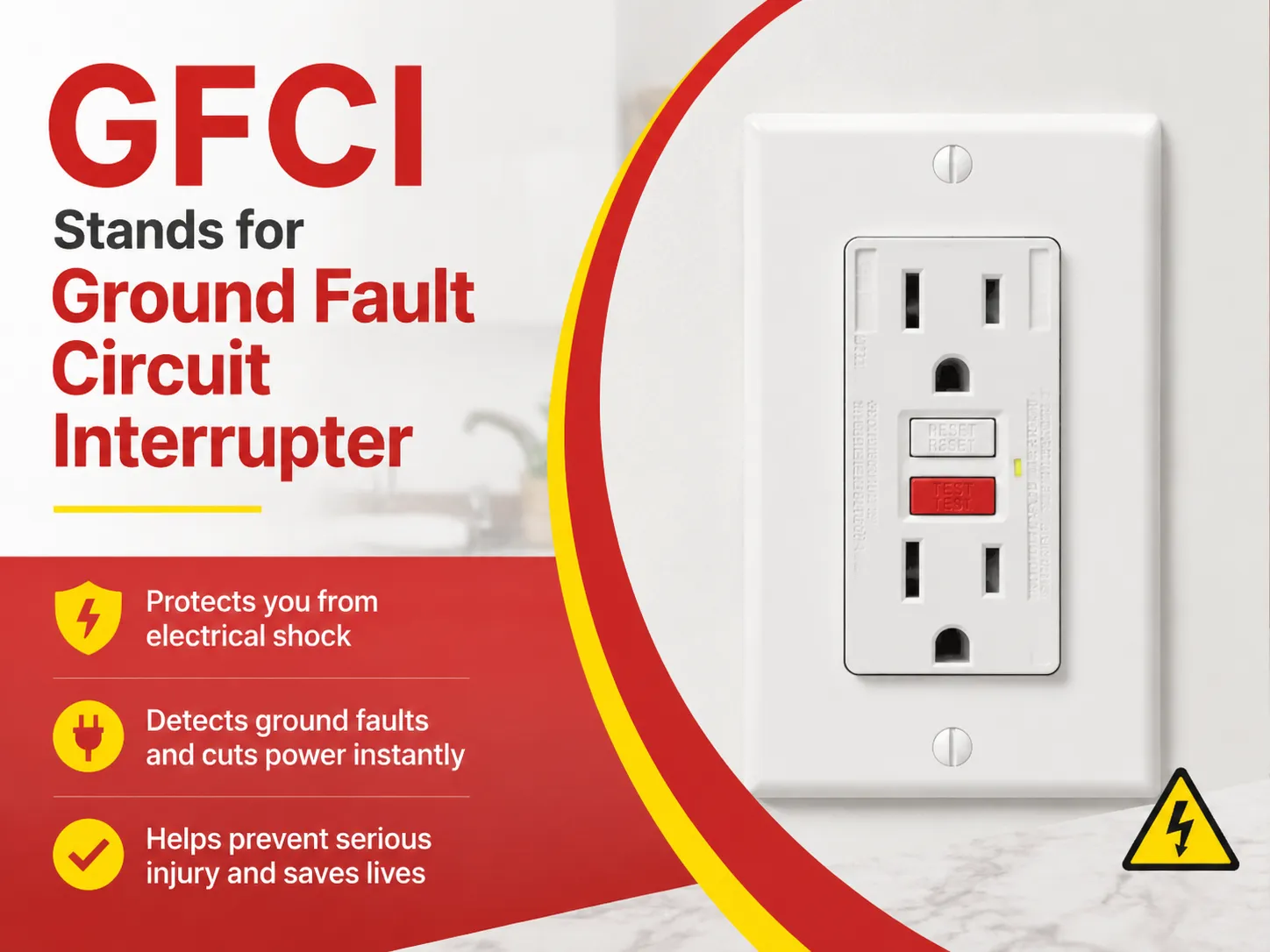
Anda mungkin sedang membaca lembar spesifikasi, mempersiapkan untuk tes listrik, atau sekadar mencoba memahami cara kerja stopkontak dapur Anda ketika Anda menemukan pernyataan bahwa “GFCI berarti gangguan sirkuit kesalahan tanah.” Itu mungkin terdengar benar, tetapi itu salah. Apa yang sebenarnya dimaksud dengan GFCI adalah ground fault circuit interrupter. Anda mungkin berpikir bahwa perbedaan antara kata “interrupter” dan “interference” hanya pada ejaan, tetapi ini bukan hanya soal ejaan; ini adalah perbedaan makna. Dalam artikel ini Anda akan menemukan penjelasan tentang apa itu GFCI, mengapa ground fault circuit interference salah, bagaimana GFCI bekerja, apa yang dapat menyebabkan perangkat trip, dan apa yang tidak boleh Anda colokkan ke GFCI.
Jawaban cepat: Istilah yang benar GFCI, yang merupakan singkatan dari Ground Fault Circuit Interrupter, sering disalahpahami sebagai nama lain seperti ground fault circuit interference dan grand fuse circuitry dalam terminologi listrik. Istilah ini merujuk pada perangkat yang memutus sirkuit listrik ketika mendeteksi kesalahan tanah. Menurut National Electrical Code dan kode UL, makna GFCI dapat dipahami dengan benar seperti ini.
Apa Arti Sebenarnya dari GFCI
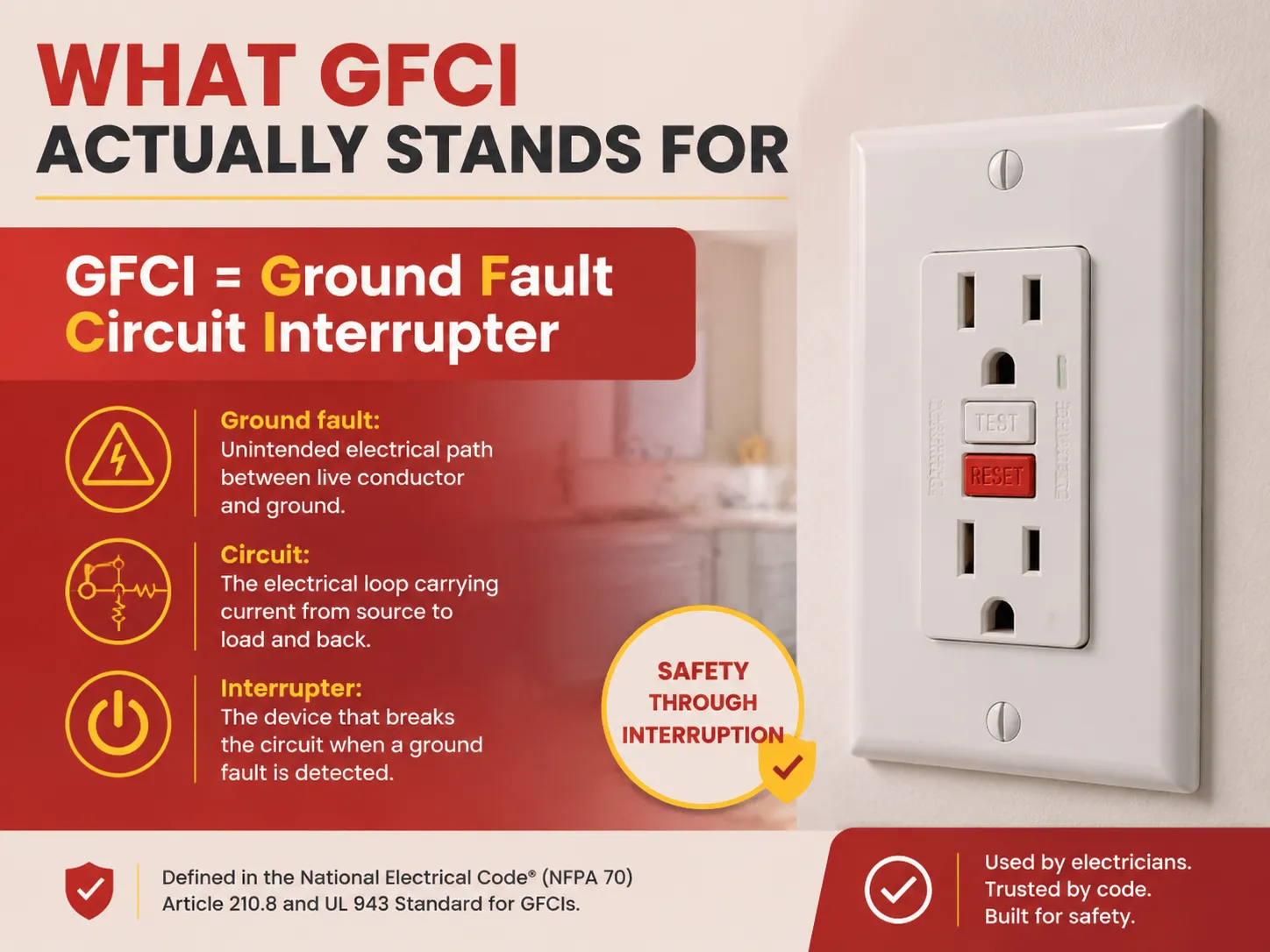
Akronim GFCI berarti: Ground Fault Circuit Interrupter.
Mari kita lihat definisi dari masing-masing kata:
- Kesalahan tanah: jalur listrik yang tidak disengaja antara kawat hidup dan tanah (misalnya, melalui seseorang, melalui air, melalui kawat yang putus atau melalui casing peralatan).
- Sirkuit: jalur listrik yang membuat arus mengalir dari N ke L dalam sebuah loop.
- Pemutus: unit yang memutus sirkuit jika terjadi kesalahan tanah.
Ini bukan hanya pendapat. Hal ini diatur dalam National Electrical Code (NFPA 70), di mana istilah “ground-fault circuit-interrupter” digunakan dalam Artikel 210.8 dan artikel terkait lainnya. Istilah ini juga digunakan dalam UL 943, yang merupakan standar keselamatan untuk GFCI. Selain itu, semua program pelatihan listrik, dokumentasi produsen (misalnya, Leviton, Eaton, Legrand), dan laporan inspeksi menggunakan istilah ’interrupter.“
Mengapa “Ground Fault Circuit Interference” Salah
Istilah “interference” mengimplikasikan gangguan, hambatan, atau interferensi pada sirkuit oleh perangkat, seperti gangguan elektromagnetik (EMI). Ini bukan yang dilakukan oleh GFCI. GFCI tidak mengganggu fungsi normal sirkuit karena perangkat ini diam dan tidak terlihat dalam sirkuit sambil membiarkan arus mengalir sebagaimana mestinya. Satu-satunya fungsi yang dimilikinya adalah menghentikan aliran arus segera setelah mendeteksi kesalahan tanah. Jadi, ini sama sekali bukan interferensi.
Tapi dari mana kebingungan itu berasal? Berikut beberapa penjelasan:
- Suara: kata “interrupter” dan “interference” dimulai dengan huruf yang sama dan terdengar agak mirip, yang menyebabkan kebingungan.
- Isi otomatis: pemeriksa ejaan dan AI kadang-kadang mengganti “interference” dengan kata tersebut karena kata itu lebih umum digunakan.
- Kebingungan dengan EMI: orang cenderung bingung antara “interference” dengan “electromagnetic interference” (EMI).
Kata yang tepat, diverifikasi sesuai dengan NEC dan UL, adalah interrupter, dan GFCI tidak dapat berarti “ground fault circuit interference.” Contoh kesalahan tersebut adalah GFCI ditulis sebagai berarti “ground fault circuit interference”.
Apa Itu GFCI dan Apa Fungsinya?
Perangkat pemutus sirkuit gangguan listrik adalah perangkat pencegahan yang bekerja cepat digunakan untuk melindungi individu dari bahaya kejutan listrik. Perangkat ini membandingkan arus di sumber yang mengalir di kabel garis panas dengan arus di kabel netral. Biasanya, arus ini sama. Namun, ketika sebagian aliran arus hilang melalui tanah seperti saat tangan basah menyentuh peralatan, menjatuhkan pengering rambut ke dalam air, atau memiliki kabel yang rusak. GFCI mendeteksi ketidakseimbangan arus dan menghentikan aliran listrik dalam waktu maksimal 1/40 detik.
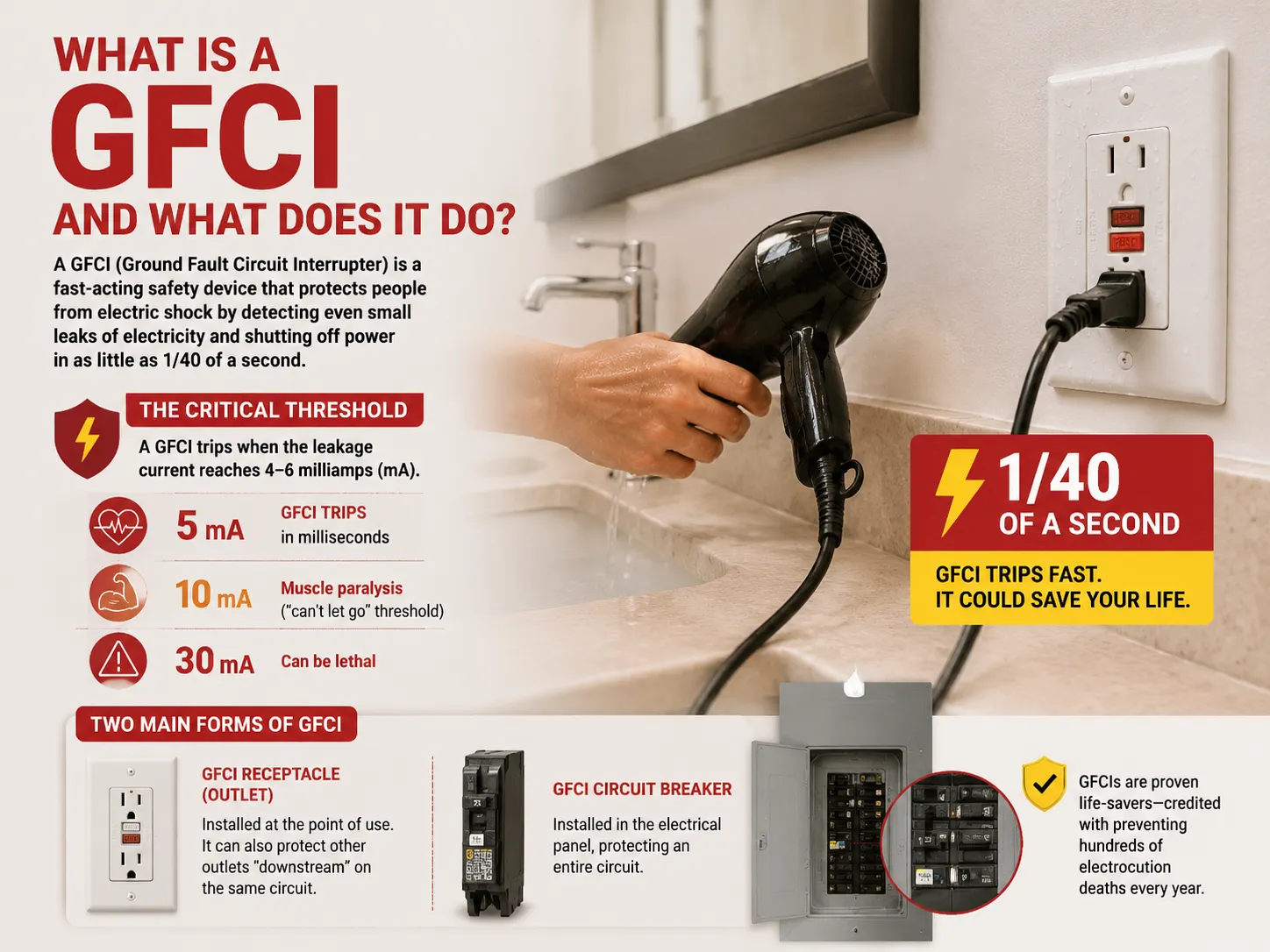
Tingkat kritis: GFCI akan aktif pada tanda 4 sampai 6 mA. Sebagai perbandingan, 10 mA dapat menyebabkan kelumpuhan otot (ambang “tidak bisa melepaskan”), sementara tingkat mematikan sekitar 30 mA. Dalam hitungan milidetik, GFCI aktif pada 5 mA dan menghentikan kejutan sebelum terlambat. Itulah sebabnya Komisi Keamanan Produk Konsumen sebagian besar memberikan kredit kepada GFCI karena menyelamatkan ratusan orang dari sengatan listrik. GFCI memiliki dua tipe utama:
- Stopkontak GFCI: stopkontak dengan tombol TEST dan RESET yang kita kenal dapat ditemukan di lokasi penggunaannya. Ini juga dapat berfungsi untuk melindungi stopkontak lain pada sirkuitnya.
- Pemutus sirkuit GFCI: terletak di panel listrik, melindungi seluruh sirkuit dari bahaya.
Artikel kami tentang pemutus sirkuit dan ground fault circuit interrupters menjelaskan bagaimana keduanya bekerja bersama.
Cara GFCI Mendeteksi Ground Fault
GFCI mengandung sebuah transformator kecil yang dikenal sebagai current transformer (CT) yang melingkari kedua kabel panas dan netral. Berikut cara kerjanya:
- Operasi normal: Arus mengalir melalui kabel panas dan kembali melalui kabel netral dengan jumlah arus yang sama. Medan magnet saling meniadakan, sehingga transformator tidak mendeteksi arus.
- Kesalahan tanah: Arus dialihkan melalui seseorang, air, atau kerusakan ke tanah alih-alih mengikuti jalur biasanya. Dengan demikian, kabel panas mendapatkan arus lebih banyak daripada kabel netral.
- Ketidakseimbangan: Transformator mendeteksi perbedaan dari 4–6 milliampere.
- Sinyal: Current transformer memicu solenoid yang secara mekanis membuka kontak dan memutuskan daya dari stopkontak.
- Reset: Pengguna perlu menekan tombol reset untuk mengaktifkan daya kembali karena GFCI menyimpan informasi tentang gangguan tersebut.
GFCI adalah jenis perlindungan yang benar-benar berbeda dari pemutus sirkuit karena mendeteksi kebocoran tanah dan bukan kelebihan beban.
Fakta dan Bukti: Standar & Kode
Berikut adalah bukti dokumenter yang menyelesaikan pertanyaan ini sekali dan untuk semua:
| Sumber | Apa yang Dikatakan |
|---|---|
| NFPA 70 (Kode Listrik Nasional) | Mendefinisikan dan mewajibkan “ground-fault circuit-interrupters” dalam Artikel 210.8 (unit hunian), Artikel 210.12 (arc-fault), dan Artikel 680 (kolam renang). Istilah resmi adalah “interrupter.” |
| Atur Ulang: | Standar keselamatan berjudul “Standard for Safety for Ground-Fault Circuit-Interrupters.” GFCI yang terdaftar UL diuji untuk trip pada 4–6 mA dalam waktu 25 ms. |
| NEC 210.8 | Memerlukan perlindungan GFCI untuk stopkontak kamar mandi, meja dapur, garasi, luar ruangan, ruang bawah tanah, ruang merangkak, area laundry, dan wet bar. |
| Literatur produsen | Leviton, Eaton, Legrand, Hubbell — setiap halaman produk dan manual instalasi produsen utama menggunakan istilah “ground fault circuit interrupter.” |
| Penggunaan kamus/industri | Glosarium industri listrik (IEEE, ESFI, OSHA) semuanya mendefinisikan GFCI sebagai “ground fault circuit interrupter.” |
Semua otoritas listrik yang sah menghindari istilah “interference.” Jika Anda diberikan kuis atau ujian lisensi berdasarkan akronim, jawaban yang harus Anda pilih selalu kata “interrupter.”
Tempat GFCI Diperlukan
Sesuai dengan NEC 210.8, area berikut dalam pengaturan residensial diwajibkan dipasang perlindungan Ground Fault Circuit Interrupter (GFCI):
- Kamar mandi harus memiliki perlindungan GFCI untuk semua stopkontak.
- Untuk meja dapur, semua stopkontak dalam jarak 6 kaki dari wastafel harus dilindungi dengan GFCI.
- Perlindungan GFCI harus disediakan di semua garasi atau ruang bawah tanah yang belum selesai.
- Semua stopkontak luar ruangan, termasuk yang digunakan di ruang merangkak dan bangunan yang belum selesai harus dipasang GFCI.
- Ruang laundry harus mematuhi persyaratan GFCI.
- Wet bar harus dilengkapi dengan perlindungan GFCI.
- Perlindungan GFCI juga diperlukan untuk rumah perahu, kolam renang, dan spa.
Namun, persyaratan GFCI yang luas juga berlaku di lingkungan komersial dan industri. Kode saat ini menjadi lebih ketat (2020 dan 2023) terkait peralatan yang sebelumnya tidak memerlukan fungsi GFCI.
Apa Penyebab GFCI Trip?
GFCI trip setiap kali mendeteksi arus bocor ke tanah. Penyebab paling umum:
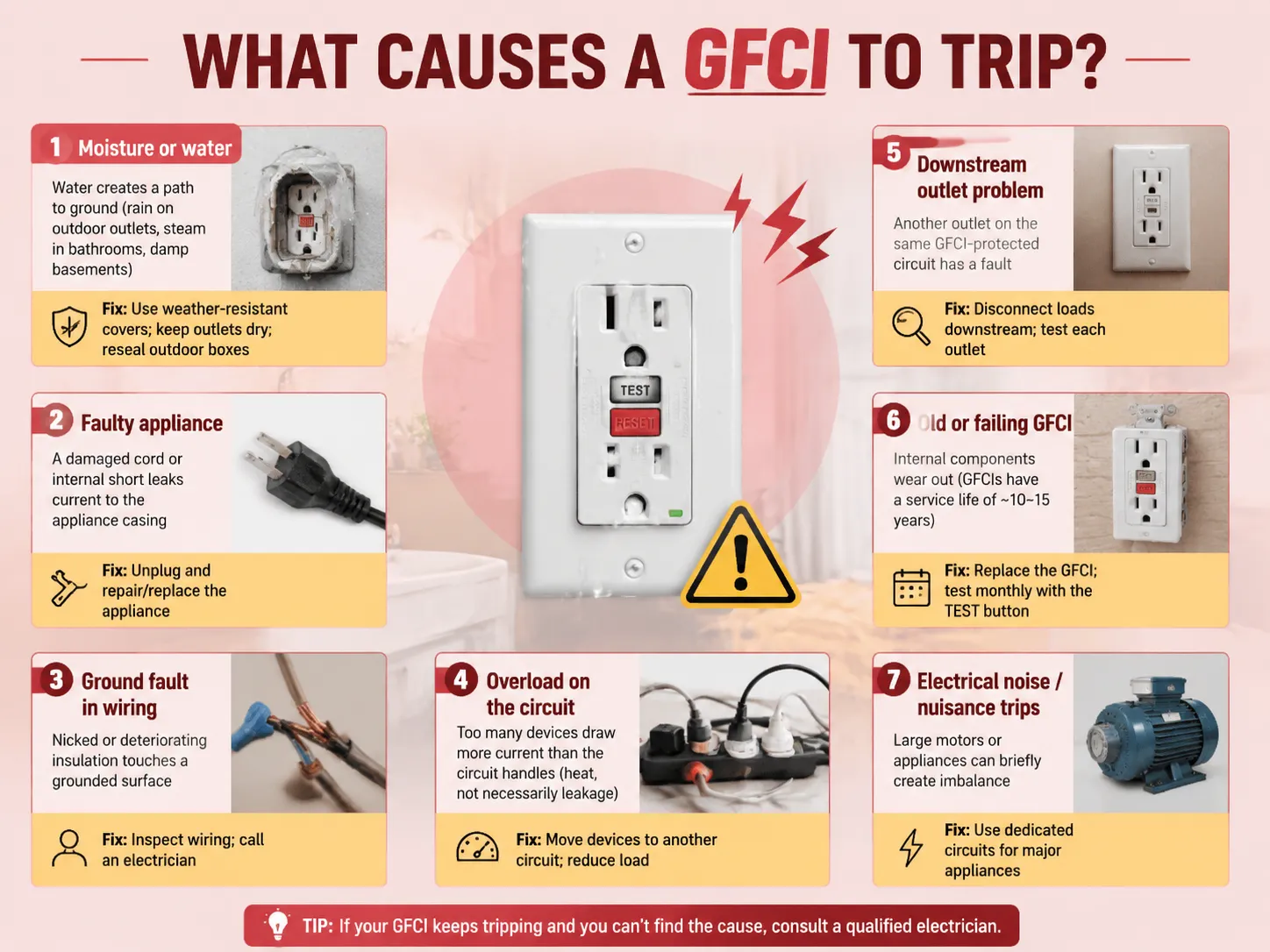
| Penyebab | Apa yang Terjadi | Perbaikan |
|---|---|---|
| Kelembaban atau air | Air menciptakan jalur ke tanah (hujan pada stopkontak luar ruangan, uap di kamar mandi, ruang bawah tanah lembap) | Gunakan penutup tahan cuaca; jaga stopkontak tetap kering; segel ulang kotak luar ruangan |
| Peralatan rusak | Kabel rusak atau hubung singkat internal menyebabkan arus bocor ke casing peralatan | Cabut dan perbaiki/ganti peralatan |
| Gangguan tanah pada kabel | Isolasi yang tergores atau memburuk menyentuh permukaan yang terhubung ke tanah | Periksa kabel; panggil teknisi listrik |
| Beban berlebih pada sirkuit | Terlalu banyak perangkat menarik arus lebih dari kapasitas sirkuit (panas, bukan kebocoran) | Pindahkan perangkat ke sirkuit lain; kurangi beban |
| Masalah stopkontak hilir | Stopkontak lain pada sirkuit yang dilindungi GFCI mengalami gangguan | Putuskan beban hilir; uji setiap stopkontak |
| GFCI lama atau rusak | Komponen internal aus (GFCI memiliki masa pakai sekitar 10–15 tahun) | Ganti GFCI; uji bulanan dengan tombol TEST |
| Gangguan listrik / trip gangguan | Motor besar atau peralatan dapat menyebabkan ketidakseimbangan sesaat | Gunakan sirkuit khusus untuk peralatan utama |
Untuk lebih lanjut tentang mendiagnosis trip berulang di tingkat pemutus sirkuit, lihat artikel kami tentang apa yang menyebabkan pemutus sirkuit trip dan apakah pemutus sirkuit yang sering trip berbahaya.
Apa yang Tidak Boleh Dicolokkan ke GFCI
Ini adalah detail penting yang perlu diperhatikan. Kode bangunan menyatakan kebutuhan keselamatan GFCI dalam beberapa kasus, tetapi ada beberapa perangkat yang tidak boleh dijalankan pada sirkuit yang dilengkapi dengan keselamatan GFCI karena pemutusan yang tidak terduga dapat menyebabkan kerusakan.
- Kulkas dan freezer: jika GFCI trip secara tidak terduga, kulkas akan mati tanpa Anda sadari dan situasi ini menyebabkan makanan menjadi rusak. Dalam banyak kasus, teknisi listrik biasanya menempatkan kulkas pada sirkuit khusus dan memastikan perlindungan GFCI hanya ada di tempat yang diwajibkan oleh kode, misalnya, jika terletak kurang dari 6 kaki dari wastafel.
- Pompa sumur: jika GFCI trip, pompa akan mati dan ruang bawah tanah akan banjir. Kode saat ini menyatakan bahwa sirkuit pompa sumur harus memiliki perlindungan GFCI sehingga disarankan untuk menggunakan pemutus GFCI dengan sensor alarm atau pompa sumur bertenaga baterai.
- Mesin penunjang hidup dan medis: perangkat ini harus tetap beroperasi dan memerlukan pasokan energi yang terjamin.
- Freezer dan freezer garasi: masalah yang sama seperti pada lemari es.
- Komputer/server (dalam beberapa kasus): pemutusan sirkuit yang tidak diinginkan dapat mengakibatkan hilangnya informasi penting sehingga sirkuit yang tidak terputus harus dipasang.
Hal utama di sini adalah mengikuti pedoman NEC adalah suatu keharusan jika perlindungan GFCI dinyatakan untuk kasus Anda karena beberapa peralatan memiliki sirkuit khusus terpisah dari yang lain dan dilengkapi dengan pemutus sirkuit GFCI dengan alarm untuk memberi tahu Anda tentang situasi pemutusan. Jika Anda tidak yakin apa persyaratan aktifnya, selalu lebih baik menghubungi teknisi listrik berlisensi.
GFCI vs. Pemutus Sirkuit: Apakah Sama?
Tidak — mereka melindungi terhadap bahaya yang berbeda:
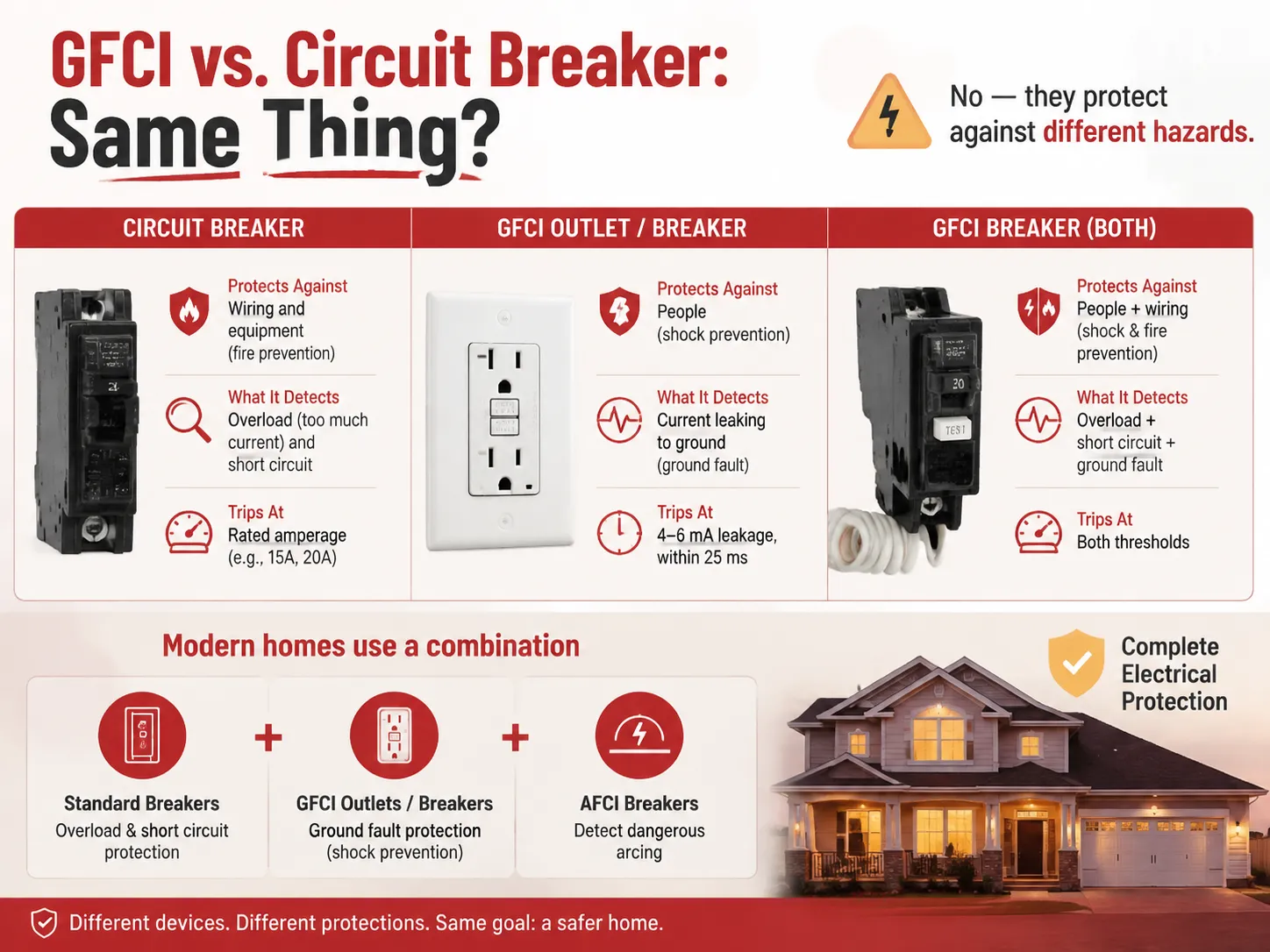
| Perangkat | Melindungi Terhadap | Apa yang Dideteksi | Memutus Pada |
|---|---|---|---|
| Pemutus sirkuit | Kabel dan peralatan (pencegahan kebakaran) | Beban lebih (arus terlalu besar) dan hubung singkat | Arus terukur (misalnya, 15A, 20A) |
| perlindungan ke kamar mandi, dapur, garasi, stopkontak luar ruangan, | Orang (pencegahan kejutan listrik) | Arus bocor ke tanah (kesalahan tanah) | Kebocoran 4–6 mA, dalam 25 ms |
| Pemutus GFCI (keduanya) | Orang + kabel | Beban lebih + hubung singkat + kesalahan tanah | Kedua ambang batas |
Rumah saat ini menggabungkan pemutus sirkuit standar untuk perlindungan beban sirkuit, outlet GFCI (Ground Fault Circuit Interrupter) atau pemutus GFCI untuk perlindungan kejutan arus, dan pemutus sirkuit altar untuk mendeteksi tingkat arus busur yang tidak aman. Jika Anda ingin memahami perangkat arus sisa terkait yang digunakan di bagian lain dunia, perbandingan kami tentang RCCB vs RCBO mencakup versi internasional dari konsep yang sama.
Pertanyaan yang Sering Diajukan
Apakah GFCI berarti ground fault circuit interrupter?
Memang — GFCI berarti ground fault circuit interrupter. Ini adalah versi yang benar yang diberikan oleh National Electrical Code (NFPA 70), UL 943 dan semua produsen terkemuka. GFCI memantau arus yang mengalir keluar melalui kabel panas terhadap pengembalian pada kabel netral terkait yang mana GFCI memutus sirkuit hampir dalam waktu 1/40 detik jika perbedaannya mencapai sekitar 4-6 miliampere (kesalahan tanah). Semua istilah lain seperti gangguan sirkuit kesalahan tanah adalah salah.
Apa yang tidak boleh dicolokkan ke GFCI?
Peralatan yang bisa berbahaya jika terjadi kehilangan daya adalah lemari es (kerusakan makanan), pompa sumur (banjir), peralatan medis dan penunjang hidup (risiko jiwa), dan komputer/server penting (risiko kehilangan data). Namun, kode masih mengharuskan GFCI hadir di banyak tempat ini. Dalam sebagian besar kasus, ini dapat dicapai melalui penggunaan sirkuit khusus, pemutus GFCI dengan alarm, atau cadangan baterai; perlindungan tidak boleh diabaikan. Konsultasikan dengan ahli untuk situasi Anda dan periksa kode lokal.
Apa arti GFCI untuk instalasi sirkuit yang baik grand fuse circuitry impulse ground fault circuit interrupter ground fault circuitry installation?
Jawaban yang benar adalah ground fault circuit interrupter. Semua alternatif lain salah; “grand fuse circuitry” salah mengartikan GFCI sebagai sekering; “impulse” tidak ada hubungannya dengan fungsi GFCI; dan “ground fault circuitry installation” menggambarkan instalasi umum bukan perangkatnya. Istilah yang sesuai dengan definisi yang diberikan dalam NEC dan UL hanya ground fault circuit interrupter — perangkat yang memutus sirkuit segera setelah mendeteksi ground fault.
Apa yang dapat menyebabkan ground fault circuit interrupter (GFCI) trip?
Ketika GFCI mengenali kebocoran arus listrik ke tanah (4–6 mA), ia akan trip. Berikut adalah alasan umum yang menyebabkan hal ini: adanya kelembaban atau air di area outlet (seperti hujan, uap, basement lembap); peralatan rusak yang memiliki kabel yang rusak atau korsleting di dalamnya; ground fault pada kabel (isolasi tergores); kelebihan beban sirkuit yang disebabkan oleh menghubungkan terlalu banyak perangkat; malfungsi pada outlet hilir yang berada di bawah perlindungan GFCI yang sama; GFCI yang rusak, tua, atau aus (masa pakai sekitar 10-15 tahun); dan gangguan yang dihasilkan oleh motor besar. Jika GFCI sering trip, perlu mencabut semua peralatan pada sirkuit tersebut. GFCI harus di-reset dan dicolokkan kembali satu per satu untuk mengidentifikasi sumber kegagalan, atau bantuan teknisi listrik profesional harus diminta.
Referensi
- NFPA 70 (Kode Listrik Nasional) — Kode otoritatif yang mendefinisikan “ground-fault circuit-interrupter” dan menentukan di mana perlindungan GFCI diperlukan (Artikel 210.8, Artikel 680).
- UL 943 — Standar Keamanan untuk Ground-Fault Circuit-Interrupters — Standar keselamatan UL yang mengesahkan GFCI, menentukan ambang trip 4–6 mA dan waktu trip 25 ms.
- Keselamatan Listrik OSHA — Panduan keselamatan tempat kerja AS tentang penggunaan GFCI dalam konstruksi dan industri umum, memperkuat terminologi yang benar dan aplikasi yang diperlukan.
- Yayasan Keselamatan Listrik Internasional (ESFI) — Organisasi nirlaba yang menyediakan edukasi konsumen tentang pengujian, instalasi GFCI, dan peran penyelamatan nyawa dari perlindungan ground fault.
- Keselamatan Listrik CPSC — Data Komisi Keamanan Produk Konsumen AS tentang pencegahan sengatan listrik oleh GFCI dan panduan keselamatan listrik rumah.
- U.S. Department of Energy — Mengoperasikan Outlet GFCI — Panduan praktis tentang cara kerja outlet GFCI, cara mengujinya setiap bulan, dan apa yang menyebabkan trip.
Kesimpulan
Jelas bahwa GFCI berarti Ground Fault Circuit Interrupter dan BUKAN “ground fault circuit interference.” Kata “interrupter” digunakan karena mendefinisikan tugas perangkat ini — memutus sirkuit sementara setelah mendeteksi ground fault. Kata “interference,” bagaimanapun, mendefinisikan sesuatu yang menyebabkan gangguan fungsi normal, yang merupakan kebalikan dari fungsi GFCI.
Berikut yang perlu diingat:
- Istilah yang benar adalah interrupter, yang telah secara resmi ditegaskan oleh NEC, UL 943, OSHA, dan semua produsen.
- GFCI membandingkan arus keluar dan masuk; ia trip pada 4-6 mA dalam hitungan milidetik.
- Ini melindungi seseorang tetapi bukan kabel karena sementara perlindungan sirkuit mencegah kelebihan beban, GFCI bekerja untuk mencegah kejutan listrik.
- Pastikan GFCI diuji setiap bulan dengan tombol TEST, dan diganti setiap 10-15 tahun.
- Hindari menghubungkan peralatan penunjang hidup dan penyimpanan makanan ke sirkuit GFCI di mana pemutusan dapat berbahaya — sebaliknya, pilih sirkuit tanpa GFCI atau yang memiliki sinyal alarm jika diizinkan oleh kode.
Lain kali Anda melihat “GFCI berarti gangguan sirkuit kesalahan tanah” di web, Anda akan tahu dengan pasti bahwa ini salah dan alasannya.