
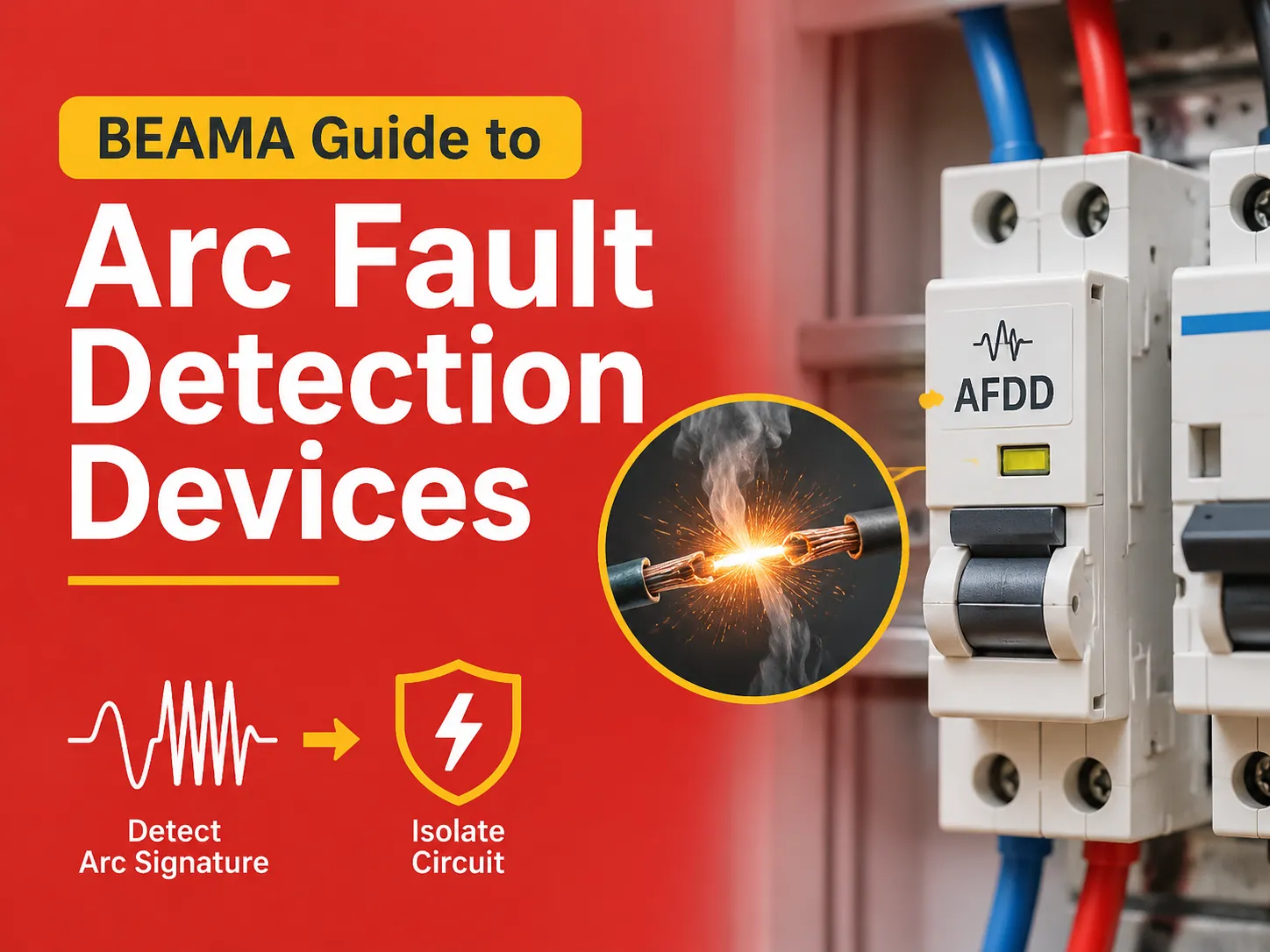
Fungsi dari perangkat deteksi gangguan busur (AFDD) adalah untuk menentukan apakah terdapat busur yang dihasilkan oleh sambungan terminal yang longgar, kabel yang dijepit, dan/atau paku yang menembus konduktor. Sebuah busur dapat berlangsung selama berbulan-bulan dengan arus yang terlalu rendah untuk mengoperasikan pemutus sirkuit atau tanpa kebocoran ke tanah dan indikasi pertama dari jenis gangguan ini biasanya adalah kebakaran.
Jawaban cepat: AFDD memantau bentuk gelombang arus dan tegangan untuk mendeteksi tanda tangan frekuensi tinggi dari sebuah busur dan secara otomatis memutus (memutuskan) sirkuit saat mendeteksi jenis gangguan ini. AFDD harus diproduksi dan diuji sesuai dengan Standar Internasional untuk perangkat deteksi gangguan busur (IEC 62606) dan dapat dibeli baik sebagai perangkat mandiri atau digabungkan dengan RCD dalam satu modul. Harga tipikal untuk AFDD berkisar antara £30 hingga £120 (tidak termasuk instalasi).
Bagian-bagian selanjutnya dari dokumen ini memberikan cakupan komprehensif dari panduan dan menjelaskan apa yang tercakup dalam panduan, apa yang dapat dideteksi AFDD yang tidak dapat dideteksi perangkat lain, bagaimana AFDD mendeteksi, di mana Peraturan Wiring mengharuskan AFDD, dalam bentuk apa perangkat tersedia, perbandingan dengan perangkat serupa lainnya, tanda yang harus diperiksa untuk kesesuaian, biaya, trip gangguan, cara memilih unit mandiri atau unit gabungan, dan di mana Anda dapat menemukan perangkat kami di daerah lokal Anda, serta daftar periksa untuk pengujian dan pemasangan AFDD.
Apa yang Dicakup Panduan BEAMA, dan Mengapa Panduan Ini Ada
Panduan BEAMA dikembangkan sebagai respons terhadap persyaratan dalam Amandemen 2 yang akan datang pada Standar Inggris 7671 bahwa AFDD harus dipasang pada sirkuit soket dengan rating 32 A atau kurang di dalam tempat tinggal berisiko tinggi; perbedaan antara AFDD, RCBO & RCCB dan AFCI di Amerika Utara tidak semudah yang banyak orang kira saat menilai katalog.
Panduan BEAMA dikembangkan oleh British Electrotechnical Manufacturers Association untuk mengatasi masalah yang terkait dengan pengenalan Peraturan Wiring yang direvisi dan AFDD baru, yang sedang dikirim oleh produsen dan dipasang oleh kontraktor. Di kedua sisi, diperlukan bahasa yang sama untuk memfasilitasi komunikasi. Panduan ini menjelaskan:
- Bagaimana AFDD bekerja dan apa fungsinya
- Bagaimana AFDD diuji
- Standar apa yang berlaku untuk AFDD
- Cara memilih dan memasang AFDD
EMF (Medan Elektromagnetik) adalah teknologi yang tidak intuitif; oleh karena itu, panduan dikembangkan bukan hanya lembar data atau katalog untuk AFDD. Misalnya, tujuan dari pemutus sirkuit adalah untuk melindungi terhadap kelebihan beban dan hubung singkat, yang mudah dipahami secara visual. Sebaliknya, AFDD melindungi terhadap mode kegagalan yang tidak memiliki tanda kerusakan yang terlihat sampai setelah kebakaran terjadi. Keputusan untuk memasang AFDD didasarkan pada penilaian risiko daripada perhitungan matematis sederhana.
Panduan ini juga memberikan alasan bisnis karena AFDD berharga beberapa kali lipat lebih mahal daripada miniature circuit breaker (MCB). Cara yang lebih mudah untuk menjelaskan penghindaran risiko yang terkait dengan AFDD dibandingkan dengan MCB adalah menggunakan dokumen yang diterbitkan oleh organisasi industri daripada brosur produsen saat meminta justifikasi pembelian AFDD.
Apa yang Dideteksi AFDD yang Tidak Bisa Dideteksi Perangkat Lain
Arc Fault Detection Device (AFDD) mendeteksi busur listrik dalam suatu rangkaian akibat kegagalan konduktor yang terhubung seri dengan beban listrik. Ketika konduktor gagal, busur yang terbentuk di antara ujung yang putus mempertahankan aliran arus melalui rangkaian, meskipun pada tingkat yang berkurang, dan dalam beberapa kasus, jumlah total arus yang mengalir melalui rangkaian tetap di bawah rating termal pemutus sirkuit secara tak terbatas. Sekrup terminal yang longgar, kabel ekstensi yang rusak, atau kabel yang terpotong saat instalasi dapat menghasilkan pola serupa.
Busur paralel terjadi ketika dua kabel membentuk busur yang berjalan dari line ke netral atau line ke ground dan menghasilkan arus yang cukup untuk memutus pemutus sirkuit. Versi yang paling berbahaya adalah resistansi tinggi antara kedua kabel; impedansi tinggi membatasi arus melalui kesalahan ke tingkat yang dapat ditoleransi oleh pemutus sirkuit, tetapi busur tetap berlanjut.
Residual current device tidak akan mendeteksi busur ini kecuali jika bocor ke ground; inilah sebabnya AFDD mengisi celah tersebut. Mereka mendeteksi busur itu sendiri dan bukan akibat dari busur (misalnya kebakaran), itulah mengapa perangkat ini dipasarkan sebagai perlindungan terhadap kebakaran listrik dan bukan sebagai perlindungan terhadap kelebihan beban atau sengatan listrik.
The → Yang pemutus busur detektor bekerja dengan prinsip yang sama dan, dijelaskan dari sisi instalasi, membedakan antara busur seri dan busur paralel.
Di Dalam Perangkat: Pendeteksian, Pemrosesan, dan Pemutusan
Perangkat secara terus-menerus mengambil sampel gelombang arus menggunakan transformator arus kecil atau shunt. Sebuah mikrokontroler mengidentifikasi fitur yang dapat mengenali busur termasuk konten frekuensi tinggi dari gelombang, peningkatan atau penurunan arus yang tajam, ‘jeda’ khas pada setiap setengah siklus, dan ketidakteraturan tanda tangan deteksi busur.
Mikrokontroler kemudian membandingkan fitur yang diekstrak dengan model busur saat ini yang didefinisikan pada 230 Volt dan 50 Hertz serta terhadap basis data pola yang tidak seharusnya menyebabkan pemutusan pada perangkat. Dalam kelompok kedua ini terdapat berbagai tantangan teknis yang disebabkan oleh noise frekuensi tinggi dari produk umum – dimmer, motor sikat, catu daya switching, dan bor – yang tidak menghasilkan busur listrik.
Sebagai hasil dari persyaratan tersebut, perangkat harus menggunakan solenoid yang membuka kontak relay setelah waktu trip yang ditentukan terpenuhi. Seperti halnya dengan noise frekuensi tinggi, waktu trip tidak bersifat instan karena perangkat sedang membedakan pola daripada mengukur tingkat tegangan atau arus. Waktu tambahan yang diberikan memungkinkan perangkat untuk mengabaikan kejadian sementara namun tetap mempertahankan kapasitas untuk mendeteksi kejadian busur listrik yang nyata.
Dijelaskan dalam standar IEC 62606 adalah jenis “gelombang uji” yang harus ditahan dan tidak ditahan oleh perangkat, dan secara khusus melarang perangkat untuk trip akibat arus inrush.
Di Mana Peraturan Wiring Mengharuskan AFDD
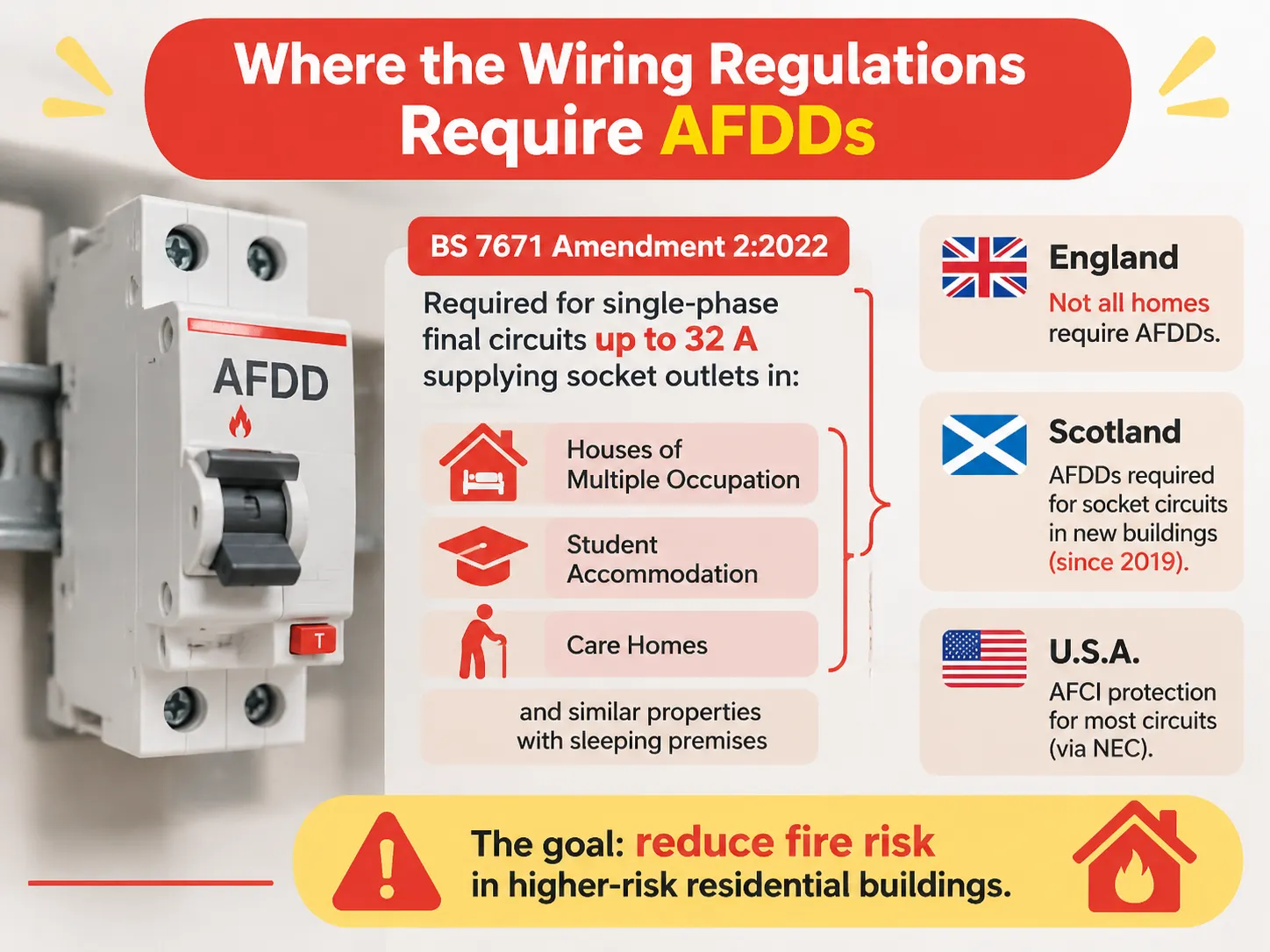
BS 7671 Amandemen 2:2022 mengharuskan semua sirkuit akhir fase tunggal dengan rating hingga 32 A yang memasok soket outlet yang terletak dalam properti residensial dengan risiko tinggi – rumah dengan banyak penghuni, akomodasi mahasiswa, panti jompo dan properti serupa yang memiliki ruang tidur – untuk dilengkapi dengan AFDD. Persyaratan ini dapat ditemukan dalam Regulasi 421.1.7 dan berlaku untuk semua instalasi baru dan perubahan, tetapi tidak untuk setiap instalasi yang sudah ada.
Ruang lingkup sengaja dibatasi dan tidak merujuk pada “semua tempat tinggal” seperti yang banyak orang kira. Tidak ada persyaratan di Inggris untuk setiap rumah dilengkapi dengan AFDD. Pada tahun 2019, standar bangunan Skotlandia mewajibkan penggunaan AFDD untuk sirkuit soket di bangunan baru. Oleh karena itu, spesifikasi untuk sirkuit soket di Glasgow dan Manchester akan berbeda.
Negara lain, Amerika Serikat, menggunakan pendekatan alternatif untuk menyediakan perlindungan busur listrik untuk hampir semua sirkuit cabang kecuali sejumlah kecil. Mereka menggunakan National Electrical Code dan standar AFCI mereka daripada IEC 62606 sebagai sarana untuk menyediakan perlindungan ini. Ada negara Eropa lain, seperti Jerman, yang juga memiliki persyaratan serupa untuk jenis hunian tertentu. Prinsip dasar untuk semua negara ini adalah bahwa persyaratan perlindungan busur listrik didasarkan pada tingkat risiko kebakaran yang terkait dengan struktur yang dapat dihuni.
Jenis dan Bentuk Fisik
Area pasar mencakup tiga jenis dan dengan demikian, saat memilih satu jenis biasanya akan didasarkan pada jumlah ruang panel yang akan ditempati daripada tingkat perlindungan yang akan diberikan.
| Format | Lebar | Apa yang dikandungnya | Tempat penggunaannya |
|---|---|---|---|
| AFDD Mandiri | 1 modul | Deteksi busur dengan mekanisme trip | Di hilir MCB atau RCBO yang sudah ada |
| AFDD + MCB | 2 modul | Deteksi busur dengan perlindungan arus | Sirkuit baru tanpa RCBO |
| AFDD + RCBO | 2 modul | Deteksi busur, perlindungan arus dan arus residual | Paling umum digunakan untuk sirkuit soket |
Format yang paling umum untuk spesifikasi adalah AFDD + RCBO karena kategori terakhir mencakup semua kebutuhan yang terkait dengan sirkuit soket. Selain itu, menggunakan satu perangkat untuk perlindungan arus dan arus residual menghemat terminal dan modul.
In our range of products the combined format is the AFDD7LE device in the 1P+N configuration that is used for all single-phase final circuits.
An AFDD is specifically designed for the detection of arcs in a circuit, which can cause fires. Its function is to provide additional safety protection and prevent loss of life and property.
AFDD, RCCB, RCBO and MCB: What Each One Detects
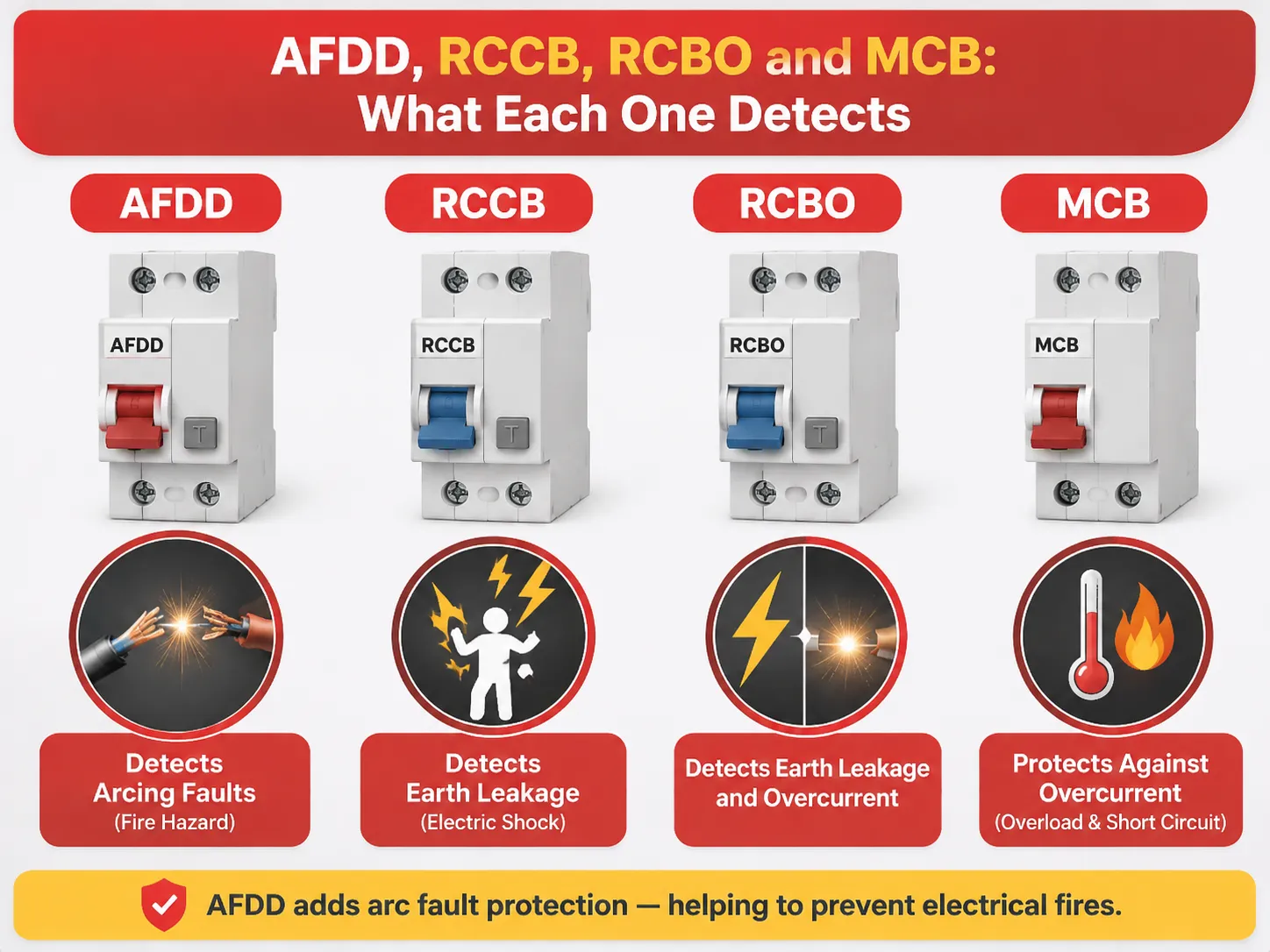
The significance of an AFDD, as compared to an RCCB, is that both devices provide the same protection against electrocution or electrical shock; however, the way in which they operate and the conditions prompting a trip vary. The difference between an AFDD and an RCCB is the “signature” of an arc. The current waveform of an arc is distinctive, therefore the AFDD is able to detect that signature. In situations where the cable insulation is damaged and an arc exists in the cable, it may not leak to earth, thus the RCCB will not detect such an event.
AFDD, RCCB and MCB are the three devices to compare. The purpose for which each of these devices was designed was to protect a circuit from overcurrent – that is to say, protect the conductors against overloads and short circuits.
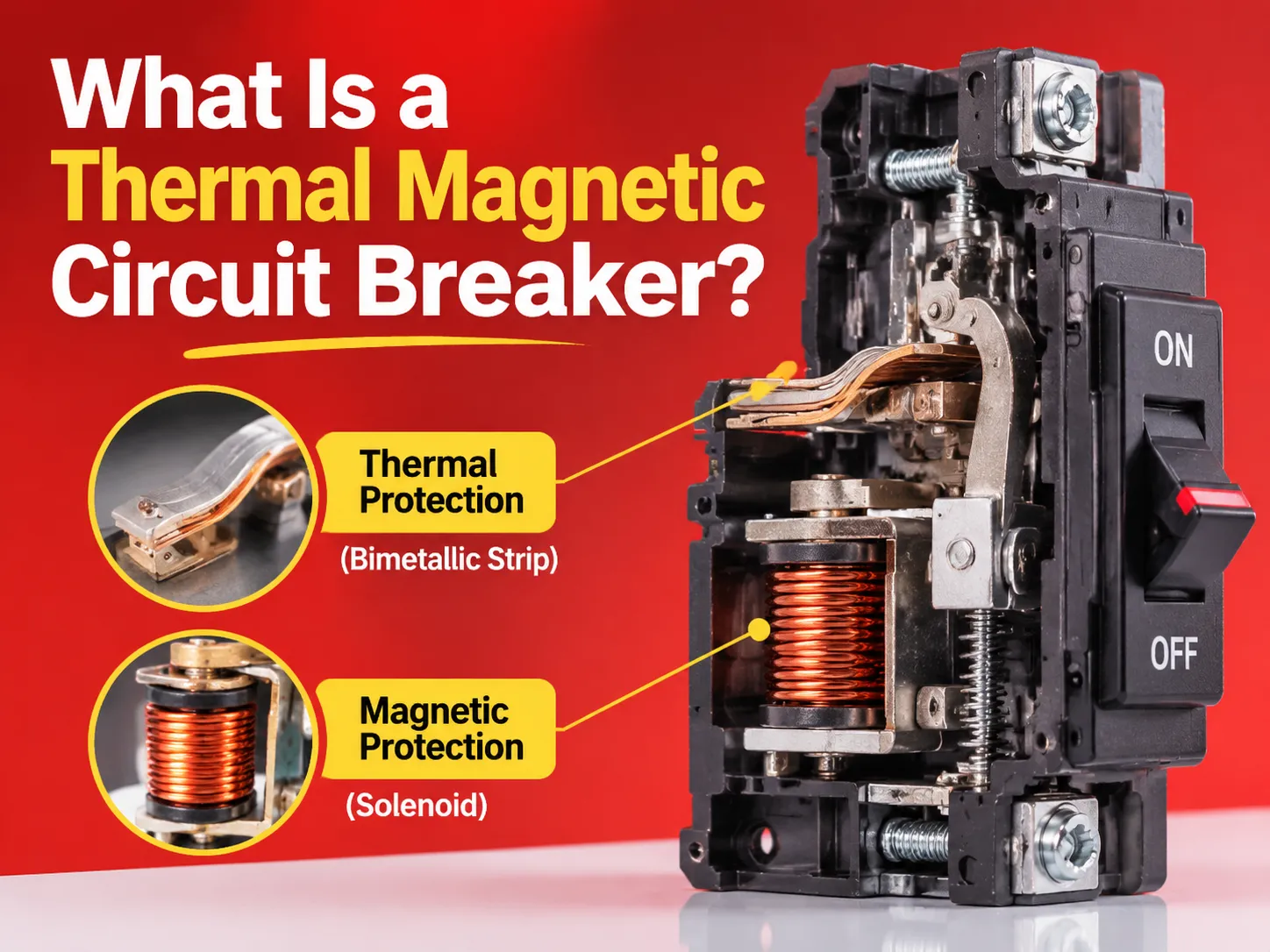
The MCB provides protection by tripping the circuit when the temperature of the conductor exceeds the temperature at which the insulation material becomes damaged. This is achieved by the MCB being equipped with a bimetallic strip that reacts to the heat generated by the overload to trip the device. The RCCB protects against electric shock and is connected to the earth with a residual current device (RCD). Once the RCCB detects that the current going out of the circuit differs from the current going back to the supply, it trips and disconnects the supply.
To recap,
- An AFDD is designed to provide additional protection to a circuit against potential fire hazards caused by arcing.
- An RCCB is designed to provide protection against electric shock by monitoring the difference in current between phases and earth connections.
- An MCB provides protection to conductors from overheating and short-circuiting.
AFDDs and RCBOs are two distinct types of devices, and therefore, the key difference between them is quite simple: there are no arc detection capabilities with an RCBO and an AFDD will only detect arcs if it is combined with an RCBO. You will find a further comparison between the two devices in an article regarding RCCBs versus RCBOs on the residual current side of things, and that article is especially relevant today as it highlights how many of the circuits that are used in homes today require both types of devices, so there is a debate on whether to purchase one device or two devices to fulfil the requirements.
Ratings and Markings to Check
Devices must meet six requirements to be deemed suitable. The standard, which is either IEC 62606 or the EN equivalent, should not be an endorsement, but rather, a specific number listed. The rated current for an AFDD will be typically between 6 A and 63 A; the rated voltage and frequency will typically be 230 V at 50 Hz (for the European market); and the rated conditional short circuit current is the fault current that will be applied to the device when using the type of upstream breaker specified.
If the AFDD is paired with an RCBO, it will typically detect a residual current of 30 mA for socket circuits. With an MCB, the AFDD will have more electronic components, and this means the terminal space will generally be less, which is important when using a 6 mm² cable.
The seventh requirement for an AFDD is not included on the device’s label. However, this information will appear on the certification document and will detail the testing done on the arc detection capability of the device. The test done to verify arc detection ability would be a type test to IEC 62606, not a routine test. A device that only has a routine test certificate and has not been proven to detect arcs cannot be relied upon to detect anything.
When considering the cost associated with AFDDs, it is commonly assumed that the installation will be more costly than the device itself, which leads to clients being surprised at the end of a quote.
What They Cost, and What the Installation Adds
An itemised breakdown of the costs associated with AFDDs is as follows:
| Item | Biaya tipikal | Catatan |
|---|---|---|
| AFDD Mandiri | £30 to £70 | Per module; will require an additional device to provide residual current protection |
| AFDD + MCB (2 modules) | £45 to £90 | The MCB does not provide residual current protection |
| AFDD + RCBO (2 modules) | £60 to £120 | The normal choice for circuits providing sockets |
| Board increase | £150 to £400 | Increasing board size or installing a new board |
| Tested and certified | £80 to £250 | A fixed price for each installation |
The issue with the costs associated with the board increase is that, when trying to install AFDDs protecting socket outlets from all ten circuits in a ten-way RCBO board, you will require the installation of a new board rather than the installation of ten additional devices; therefore, you will initially have a larger outlay than the device prices alone suggest.
The differential in price of devices when AFDDs are compared to RCBOs will be between £30 to £60 per board way for the next 20 years, allowing approximately a few £ a year for having AFDD protection against a deadly mode of failure, as described in the guide from BEAMA and the reason for the necessity for them.
What Is Nuisance Tripping, and What Causes It?
If an AFDD trips on a normal load, the AFDD has classified a waveform incorrectly, and there is a defined method of how this can occur; specifically, dimmers, when operated at a low wattage, produce a chopped waveform with a high frequency, which is similar to the waveform produced during an arc. Brush motors like the ones in power tools or vacuum cleaners typically generate continuous arcing from the brushes by design. Similar capabilities can be found within the output of poor filter quality on switching mode power supplies (SMPS).
While there are many possible explanations for nuisance tripping, older installations offer additional reasons. When the neutral for two circuits is shared, or if there was ever an intermittent ‘real’ arcing due to poor connection quality, or of damaged insulation in between the arcing cable, these types of faults exist and the device is justified in tripping, thus a nuisance trip must not be assumed as a fault with the device and must be explored further.
The diagnostic process employed will be the same as that used with an RCBO. To isolate your loads, you must first reset the device and connect them back one at a time. If a tripped device continues when a specific appliance is connected, then the appliance and/or its cord are at fault. If a tripped device continues without anything connected, then the wiring is at fault. If a tripped device continues only in wet weather conditions, then moisture penetration into the outdoor circuit must exist.
Choosing Between Standalone and Combined
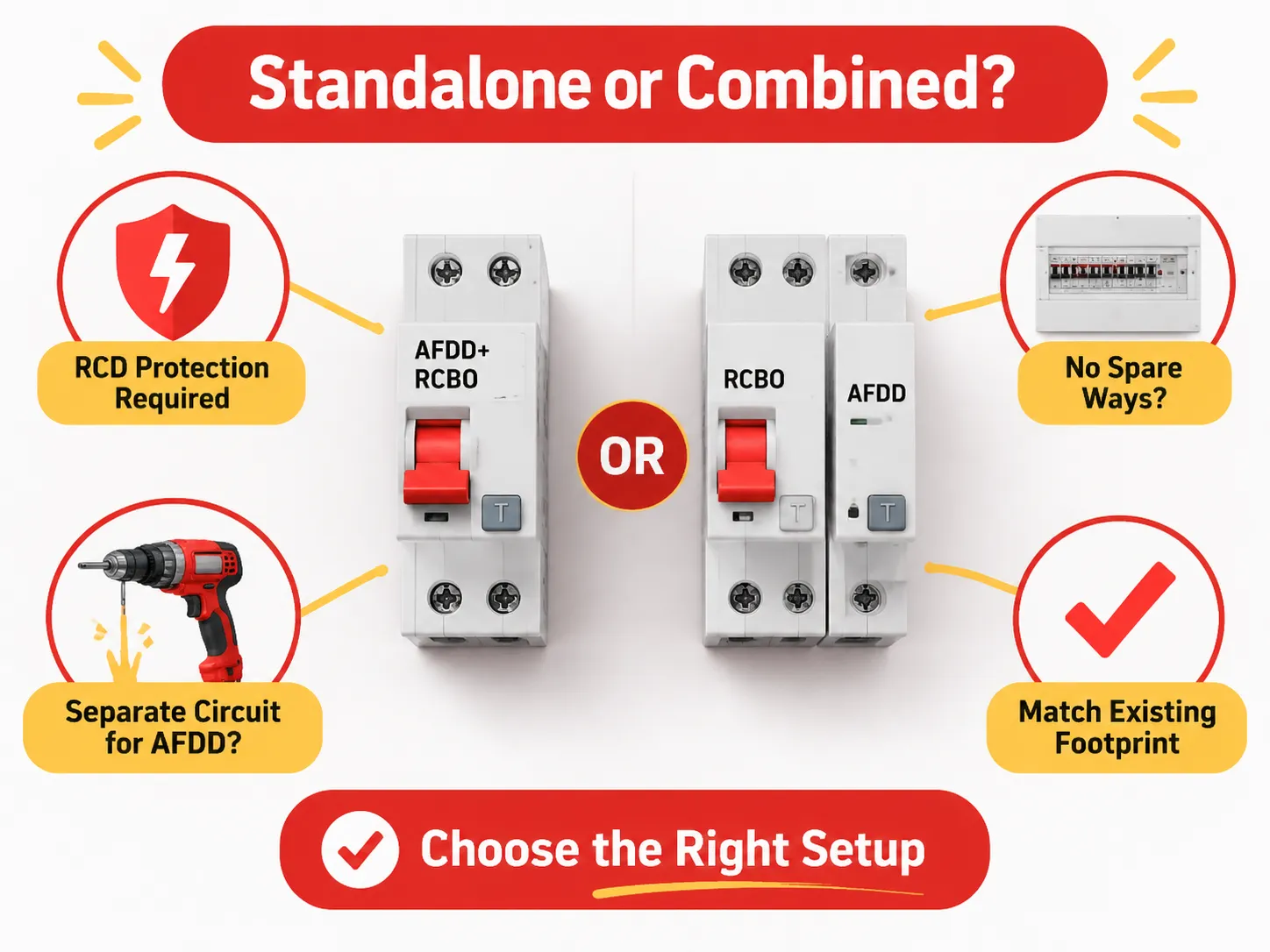
Four different variables will determine whether to choose between standalone devices versus combined devices:
- A socket outlet circuit must provide residual current protection, either combined with an AFDD within a single unit or separate.
- An existing circuit that already possesses an RCBO, and now also needs an AFDD, must therefore have a stand-alone AFDD added.
- In a board containing zero spare ways, a new installation of whatever configuration must take place – therefore providing the specification of the board would be paramount versus the device.
- Because of the spark-like sounds produced in some applications (e.g., a woodworking shop with tools built with brushes) the load circuit may have to have an AFDD on a different circuit than where the tools are plugged in.
As such, AFDD’s use of the RCBO format on most current boards provides a reference for the combined device. The footprint and terminal arrangement of each type of AFDD matches as such; therefore, any project that standardises on the same footprint can add the arc protection without the need to redesign the board.
Where HUYU Fits into this Picture
We manufacture the AFDD in the combined 1 phase + Neutral format, with the MCB and RCBO in the same footprint. The construction of the AFDD complies with IEC 62606 for the function of detection of arc and IEC 61009-1 for the function of overcurrent and residual. The combination is what actually will provide a socket circuit in a home.
For a specification, we can supply the type test report for arc detection, the residual current test data, and the conditional short-circuit rating with the upstream device used in the test. These three documents are what a certifying body or inspector will require and what a low-cost AFDD typically cannot provide.
In terms of mini circuit breaker, there are circuits throughout most buildings that do not require arc protection. The majority of circuits will not need an AFDD, and specifying an AFDD for every circuit means spending money where the potential risk does not warrant such an expense.
Checklist to Comply with Specifications
There are 5 items that are to be included when making a specification, to conform to IEC 62606. These include the formats of the device (combined or stand-alone), the rated current and residual current sensitivity if combined; the conditional short circuit rating (the upstream device that the combined device assumes is used); and type test evidence (evidence of testing) to be included with the order, not requested.
At the time of commissioning, 3 checks are required. These checks include the test button to verify the operation of the trip mechanism, however, not the operation of the arc detection mechanism; the residual current test (if a combined device) with an external tester, not the test button; and a load test with appliances that may be connected to the device, as it is better to discover if a dimmer switch or brushed motor will trip the device upon delivery rather than at 12:00 am.
The 4th check is documentation. A schedule is required for the installation to be maintainable. The schedule should indicate which devices are connected to which circuits and when the last test was performed. An AFDD is a safety device with a defined service life. A device that has never been tested is a device that cannot be vouched for.
Pertanyaan yang Sering Diajukan
What Are Arc Fault Detection Devices?
They are devices designed to detect high-frequency signatures from electrical arcs generating heat to ignite surrounding combustibles in the vicinity of an electrical circuit and automatically isolate the electrical circuit from its electrical supply prior to combustion. They are specified to the IEC 62606 standards; they are available as individual components or as part of an RCBO; and they provide protection for an arc or failure mode that cannot be detected by either the trip or residual current device.
What Methods Are Used to Detect Arc Faults?
Arc faults are detected by periodically sampling the current flowing in the circuit and examining the characteristics of the sampled waveform for certain defined features based upon high-frequency contents, sudden changes in current patterns, the stop time between cycles and whether the sampled waveform exhibits randomness in its pattern. A microcontroller compares these characteristics to those of a) the arc detection system and b) the associated load that is not supposed to cause a trip.
What Is an AFCI?
The AFCI (Arc Fault Circuit Interrupter) is the equivalent of an AFDD as defined in the North American UL 1699 standard. An AFCI performs the same function as an AFDD, but is tested to a different standard and rated to operate at 120 Volts in North American branch circuits. Therefore, AFCIs and AFDDs may not be replaced with one another or by a device that complies with one of the two standards.
Which Rooms Need AFCI Protection?
In England, the BS 7671 amendment 2 requires the installation of AFDD protection on socket circuits of 32 A or less at greater risk of electrical shock, which occur generally in HMOs, student accommodation and care homes but do not need to be installed in each room of every house. In Scotland, new houses must have an AFDD fitted as part of the electrical installation. In the United States of America, the National Electrical Code requires that most dwelling branch circuits must be protected by AFCIs.
Is an AFDD Used Instead of an RCBO?
No. AFDDs are designed to detect arcs in the circuit and an RCBO detects overloads, shortages and earth leakage of current. Typically, socket circuits will require both devices, which is why a combination of an AFDD and an RCBO in a single module is most commonly used. Standalone AFDDs are generally installed on the load side of an RCBO.
Why Does My AFDD Keep Tripping?
AFDD tripping can be caused by a load that creates arc-like sounds; e.g. a dimmer switch on a low setting; a vacuum cleaner; or a power drill; or from an actual fault, such as a loose connection or damaged cable. You can isolate all loads and reconnect them one by one to determine which appliance is causing the trip. If the trip occurs when nothing is connected, the problem may lie with the wiring.
Referensi
- Hager — AFDD Protection Devices and BS 7671 Guidance
- Siemens — AFDD Technology and Protective Devices
- Legrand — Arc Fault Protection in Residential Boards
- UL Solutions — Arc Fault and Residual Current Device Certification
- Electrical Engineering Portal — Arc Fault Detection and Protection Coordination
Kesimpulan
AFDDs are the only devices within a circuit board that detect the arc itself rather than the current produced by the arc. This is what enables AFDDs to detect a failing terminal connection that a circuit breaker would ignore, and which cannot be detected by an RCD. That is why the requirement was introduced into the regulations for buildings where persons sleep. The decision is based on the choice of format and proof. The combination of an AFDD and an RCBO can create a single module that protects a socket circuit, and the only proof that these detection devices work is the fulfillment of the type test to IEC 62606; everything else on the label is simply a rating, which is a much less rigorous process than testing for compliance with a standard.