
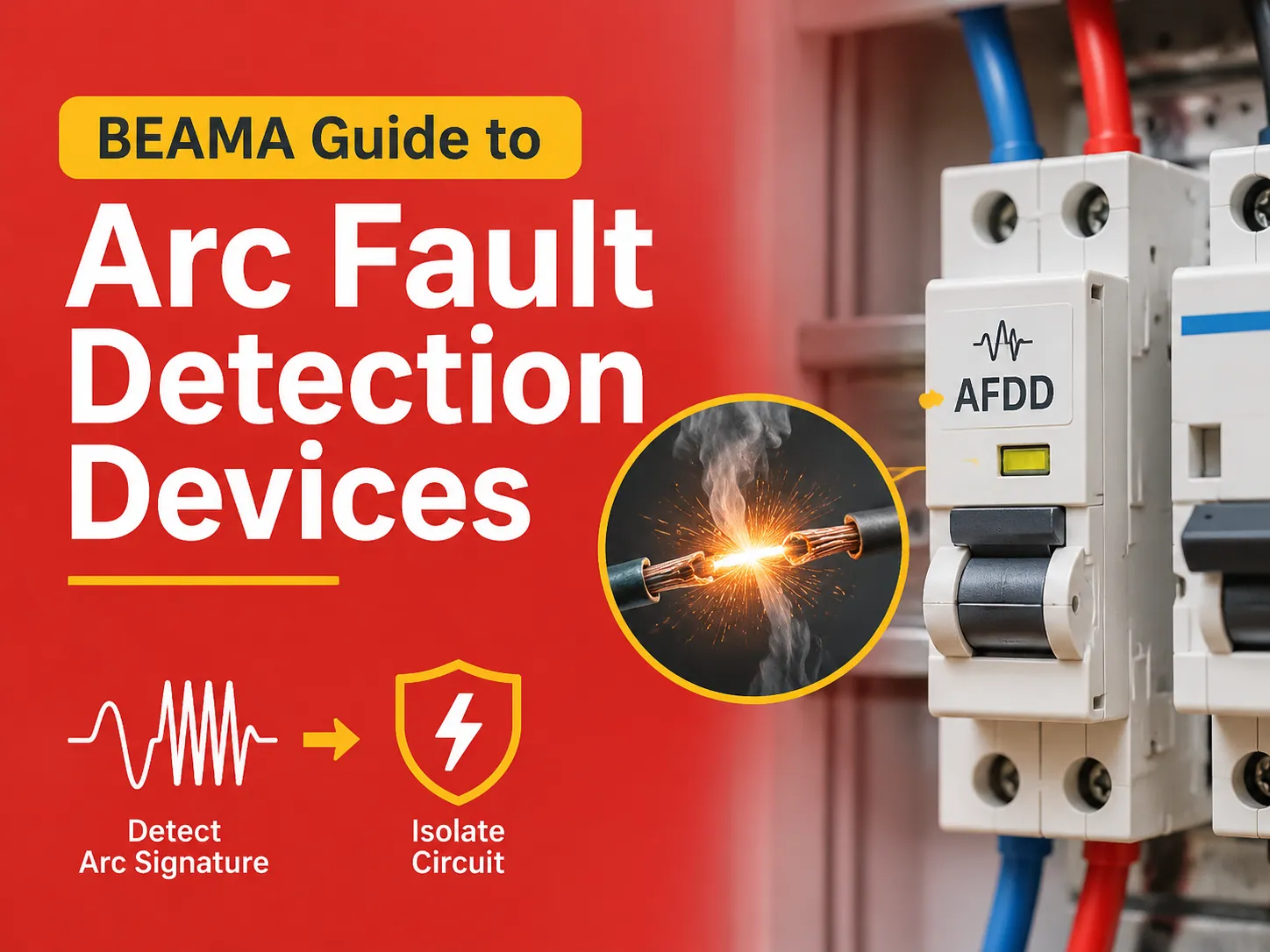
وظيفة جهاز كشف قوس كهربائي (AFDD) هي تحديد ما إذا كان هناك قوس ناتج عن اتصالات طرفية غير محكمة، أو كابلات مضغوطة، و/أو مسامير تخترق الموصلات. يمكن أن يستمر القوس لعدة أشهر عند تيار منخفض جداً بحيث لا يعمل قاطع الدائرة أو بدون تسرب إلى الأرض، وعادةً ما يكون أول مؤشر على هذا النوع من الأعطال هو الحريق.
إجابة سريعة: يراقب جهاز AFDD أشكال موجات التيار والجهد للكشف عن التوقيع عالي التردد للقوس ويقوم بعزل (فصل) الدائرة تلقائياً عند اكتشاف هذا النوع من الأعطال. يجب تصنيع واختبار أجهزة AFDD وفقاً للمعيار الدولي لأجهزة كشف القوس الكهربائي (IEC 62606) ويمكن شراؤها إما كجهاز مستقل أو مدمج مع RCD في وحدة واحدة. السعر النموذجي لجهاز AFDD يتراوح بين 30 إلى 120 جنيه إسترليني (باستثناء التركيب).
الأقسام المتبقية من هذا المستند تقدم تغطية شاملة للدليل وتشرح ما يغطيه الدليل، وما يمكن لجهاز AFDD اكتشافه والذي لا تستطيع الأجهزة الأخرى اكتشافه، وكيف يكتشف AFDD، وأين تتطلب لوائح الأسلاك تركيب أجهزة AFDD، وأشكال الأجهزة المتوفرة، ومقارنات مع أجهزة مشابهة أخرى، والعلامات التي يجب التحقق منها للامتثال، والتكاليف، والتنبيهات الكاذبة، وكيفية اختيار وحدة مستقلة أو وحدة مدمجة، وأين يمكن العثور على أجهزتنا في منطقتك المحلية، بالإضافة إلى قائمة مراجعة لتكليف وتركيب أجهزة AFDD.
ما يغطيه دليل BEAMA، ولماذا وُجد
تم تطوير دليل BEAMA استجابةً لمتطلبات التعديل الثاني القادم للمعيار البريطاني 7671 الذي ينص على تركيب أجهزة AFDD في دوائر المقابس المصنفة بـ 32 أمبير أو أقل داخل المباني السكنية عالية الخطورة؛ الفروق بين AFDD و RCBO و RCCB و AFCI في أمريكا الشمالية ليست سهلة التحديد كما يعتقد الكثيرون عند تقييم الكتالوجات.
تم تطوير دليل BEAMA بواسطة جمعية مصنعي الأجهزة الكهربائية البريطانية لمعالجة القضايا المرتبطة بإدخال لوائح الأسلاك المعدلة وأجهزة AFDD الجديدة، التي كانت تُشحن من قبل المصنعين وتُركب من قبل المقاولين. كان هناك حاجة إلى لغة مشتركة لتسهيل التواصل بين الطرفين. يشرح الدليل:
- كيف تعمل أجهزة AFDD وما تقوم به
- كيف يتم اختبار أجهزة AFDD
- ما هي المعايير المعمول بها لأجهزة AFDD
- كيفية اختيار وتركيب جهاز AFDD
المجال الكهرومغناطيسي (EMF) هو تقنية غير بديهية؛ لذلك تم تطوير دليل بدلاً من مجرد ورقة بيانات أو كتالوج لأجهزة AFDD. على سبيل المثال، الغرض من قاطع الدائرة هو الحماية من الأحمال الزائدة والدوائر القصيرة، وهو أمر سهل الفهم بصرياً. بالمقابل، يحمي جهاز AFDD من وضع فشل لا يظهر عليه أي علامة ضرر مرئية حتى بعد حدوث حريق. قرار تركيب جهاز AFDD يعتمد على تقييم المخاطر بدلاً من الحسابات الرياضية البسيطة.
يوفر الدليل أيضًا مبررًا تجاريًا لأن أجهزة كشف قوس الكهرباء (AFDDs) تكلف عدة أضعاف تكلفة قاطع الدائرة المصغر (MCB). طريقة أسهل لشرح تجنب المخاطر المرتبطة بأجهزة AFDD مقارنة بأجهزة MCB هي استخدام وثيقة منشورة من منظمة صناعية بدلاً من كتيب الشركة المصنعة عند طلب مبرر لشراء أجهزة AFDD.
ما الذي يكشفه جهاز AFDD ولا تكشفه الأجهزة الأخرى
يكشف جهاز كشف قوس الكهرباء (AFDD) عن القوس الكهربائي في الدائرة بسبب فشل موصل متصل على التوالي مع حمل كهربائي. عندما يفشل الموصل، تحافظ الأقواس التي تتكون بين الأطراف المكسورة على تدفق التيار عبر الدائرة، وإن كان بمستوى منخفض، وفي بعض الحالات، يبقى إجمالي التيار المتدفق عبر الدائرة أقل من التصنيف الحراري لقاطع الدائرة إلى أجل غير مسمى. يمكن أن ينتج نمط مشابه عن برغي طرفي مرتخي، أو سلك تمديد تالف، أو سلك مقطوع أثناء التركيب.
يحدث القوس الموازي عندما يشكل سلكان قوسًا يمتد من الخط إلى النيوترال أو من الخط إلى الأرض وينتج تيارًا كافيًا لتعطيل القاطع. النسخة الأكثر خطورة من هذا هي المقاومة العالية بين السلكين؛ حيث تحد المقاومة العالية من التيار المار عبر الأعطال إلى مستوى يمكن للقاطع تحمله، لكن القوس يستمر.
جهاز التيار المتبقي لن يكتشف هذه الأقواس إلا إذا تسربت إلى الأرض؛ ولهذا السبب تملأ أجهزة AFDD هذه الفجوة. فهي تكشف القوس نفسه وليس نتيجة القوس (أي الحريق), ، ولهذا السبب يتم تسويق هذه الأجهزة كحماية ضد الحرائق الكهربائية وليس كحماية ضد التحميل الزائد أو الصدمات الكهربائية.
ال قاطع كاشف القوس يعمل على نفس المبدأ، ومن منظور التركيب، يميز بين الأقواس المتسلسلة والأقواس المتوازية.
داخل الجهاز: الاستشعار، المعالجة، والتعطيل
يقوم الجهاز بأخذ عينات مستمرة لموجة التيار باستخدام محول تيار صغير أو مقاومة شنت. يحدد المتحكم الدقيق ميزات يمكنها التعرف على القوس بما في ذلك المحتوى عالي التردد للموجة، الزيادة أو النقصان الحاد في التيار، التوقف المميز في كل نصف دورة وعشوائية توقيع الكشف عن القوس.
ثم يقارن المتحكم الدقيق الميزات المستخرجة بنموذج القوس الحالي المحدد عند 230 فولت و50 هرتز وبقاعدة بيانات للأنماط التي لا يجب أن تسبب تعطيل الجهاز. ضمن المجموعة الثانية توجد مجموعة من التحديات التقنية التي تسببها الضوضاء عالية التردد الناتجة عن منتجات شائعة – مثل مخفتات الإضاءة، المحركات ذات الفرش، مزودات الطاقة التحويلية والمثاقب – والتي لا تنتج قوسًا كهربائيًا.
نتيجةً لهذا المتطلب، يجب أن يستخدم الجهاز ملفًا لولبيًا يفتح جهات الترحيل بعد استيفاء زمن الفصل المحدد. كما هو الحال مع الضوضاء عالية التردد، فإن زمن الفصل ليس فوريًا لأن الجهاز يميز نمطًا بدلاً من قياس مستوى الجهد أو التيار. الوقت الإضافي الممنوح يسمح للجهاز بتجاهل حدث عابر ولكنه لا يزال يحتفظ بالقدرة على اكتشاف حدث قوس كهربائي حقيقي.
موضح في المعيار IEC 62606 نوع “موجات الاختبار” التي يجب أن يتحملها الجهاز والتي لن يتحملها، ويحظر تحديدًا أن يتسبب الجهاز في الفصل بسبب تيار التدفق.
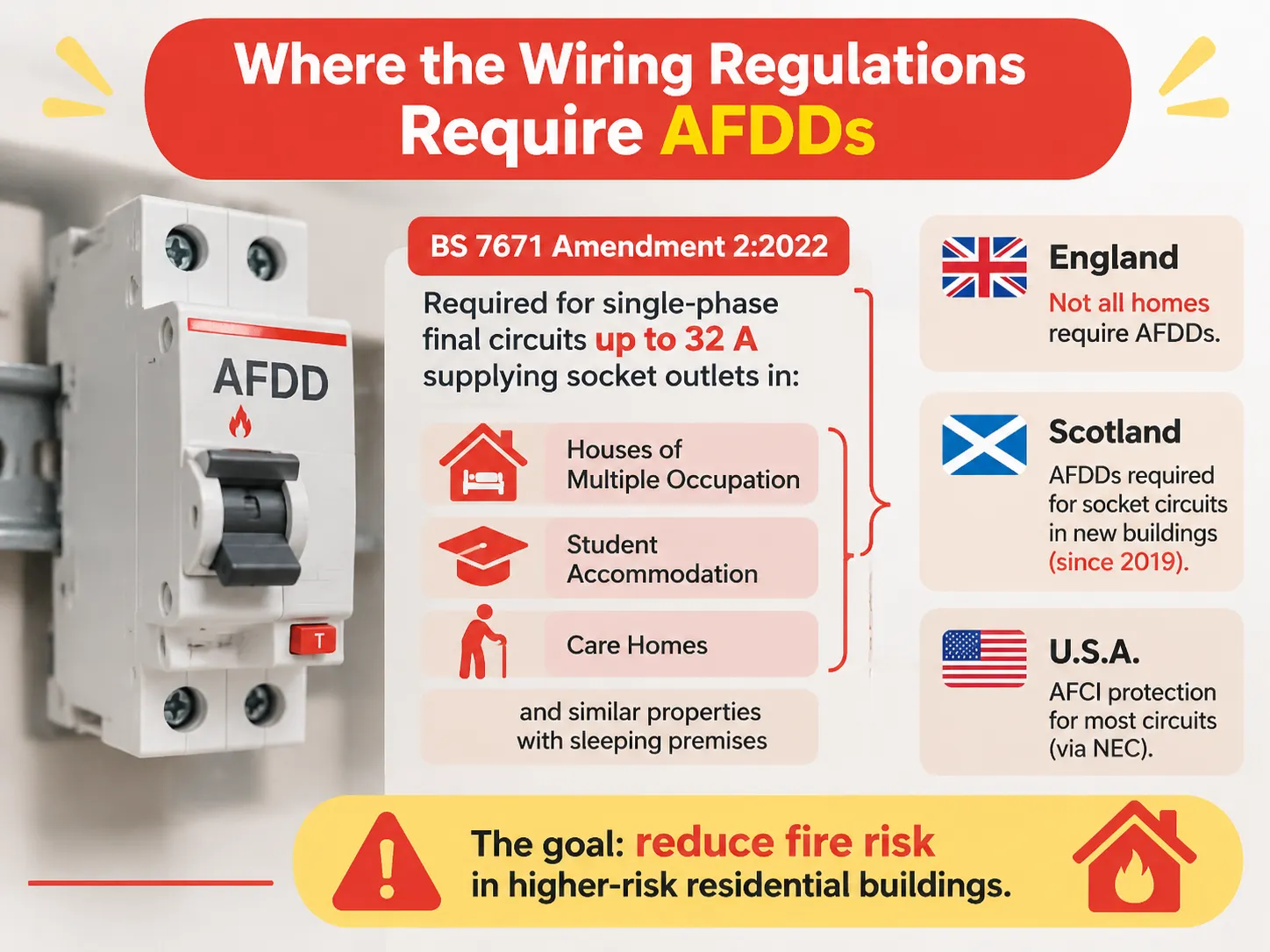
حيث تتطلب لوائح الأسلاك وجود أجهزة كشف قوس كهربائي (AFDDs)
يتطلب التعديل 2:2022 من BS 7671 أن تكون جميع الدوائر النهائية أحادية الطور المصنفة حتى 32 أمبير التي تغذي مآخذ التوصيل الموجودة داخل العقارات السكنية عالية المخاطر – منازل متعددة الإشغال، مساكن الطلاب، دور الرعاية والعقارات المماثلة التي تحتوي على أماكن نوم – مجهزة بأجهزة كشف القوس الكهربائي. يمكن العثور على هذا المطلب ضمن التنظيم 421.1.7 وينطبق على جميع التركيبات الجديدة والتعديلات، ولكنه لا ينطبق على كل تركيب قائم.
النطاق محدود عمدًا ولا يشير إلى “جميع المساكن” كما يعتقد الكثيرون. لا يوجد مطلب في إنجلترا لتزويد كل منزل بأجهزة كشف القوس الكهربائي. في عام 2019، فرضت معايير البناء في اسكتلندا استخدام أجهزة كشف القوس الكهربائي لدوائر المآخذ في المباني الجديدة. لذلك، ستختلف المواصفات لدوائر المآخذ في غلاسكو ومانشستر.
تستخدم دولة أخرى، الولايات المتحدة، نهجًا بديلاً لتوفير حماية من قوس كهربائي لجميع الدوائر الفرعية باستثناء عدد قليل منها. لقد استخدمت قانون الكهرباء الوطني ومعيار AFCI الخاص بها بدلاً من IEC 62606 كوسيلة لتوفير هذه الحماية. هناك دول أوروبية أخرى، مثل ألمانيا، لديها متطلبات مماثلة لأنواع معينة من الإشغال. المبدأ الأساسي لجميع هذه الدول هو أن متطلب الحماية من القوس الكهربائي يعتمد على درجة خطر الحريق المرتبطة بالهياكل الصالحة للسكن.
الأنواع والشكل
يغطي سوق الأجهزة ثلاثة أنواع، وعليه، عند اختيار نوع واحد، سيكون ذلك عادةً بناءً على مساحة اللوحة التي سيشغلها بدلاً من مستوى الحماية التي سيقدمها.
| الشكل | العرض | ما يحتويه | أماكن الاستخدام |
|---|---|---|---|
| جهاز كشف القوس الكهربائي المستقل | وحدة واحدة | كشف القوس مع آلية الفصل | بعد قاطع الدائرة المصغر (MCB) أو قاطع التيار المتبقي (RCBO) الموجود |
| جهاز كشف القوس الكهربائي + قاطع الدائرة المصغر (MCB) | وحدتان | كشف القوس مع حماية التيار | دوائر جديدة بدون RCBOs |
| جهاز كشف القوس الكهربائي + قاطع التيار المتبقي (RCBO) | وحدتان | كشف القوس، حماية التيار والتيار المتبقي | الأكثر استخدامًا لدوائر المآخذ |
الشكل الأكثر شيوعًا للمواصفات هو جهاز كشف القوس الكهربائي + قاطع التيار المتبقي (RCBO) حيث تغطي الفئة الأخيرة جميع الاحتياجات المرتبطة بدوائر المآخذ. بالإضافة إلى ذلك، استخدام جهاز واحد لكل من حماية التيار والتيار المتبقي يوفر طرفًا ووحدة.
In our range of products the combined format is the AFDD7LE device in the 1P+N configuration that is used for all single-phase final circuits.
An AFDD is specifically designed for the detection of arcs in a circuit, which can cause fires. Its function is to provide additional safety protection and prevent loss of life and property.
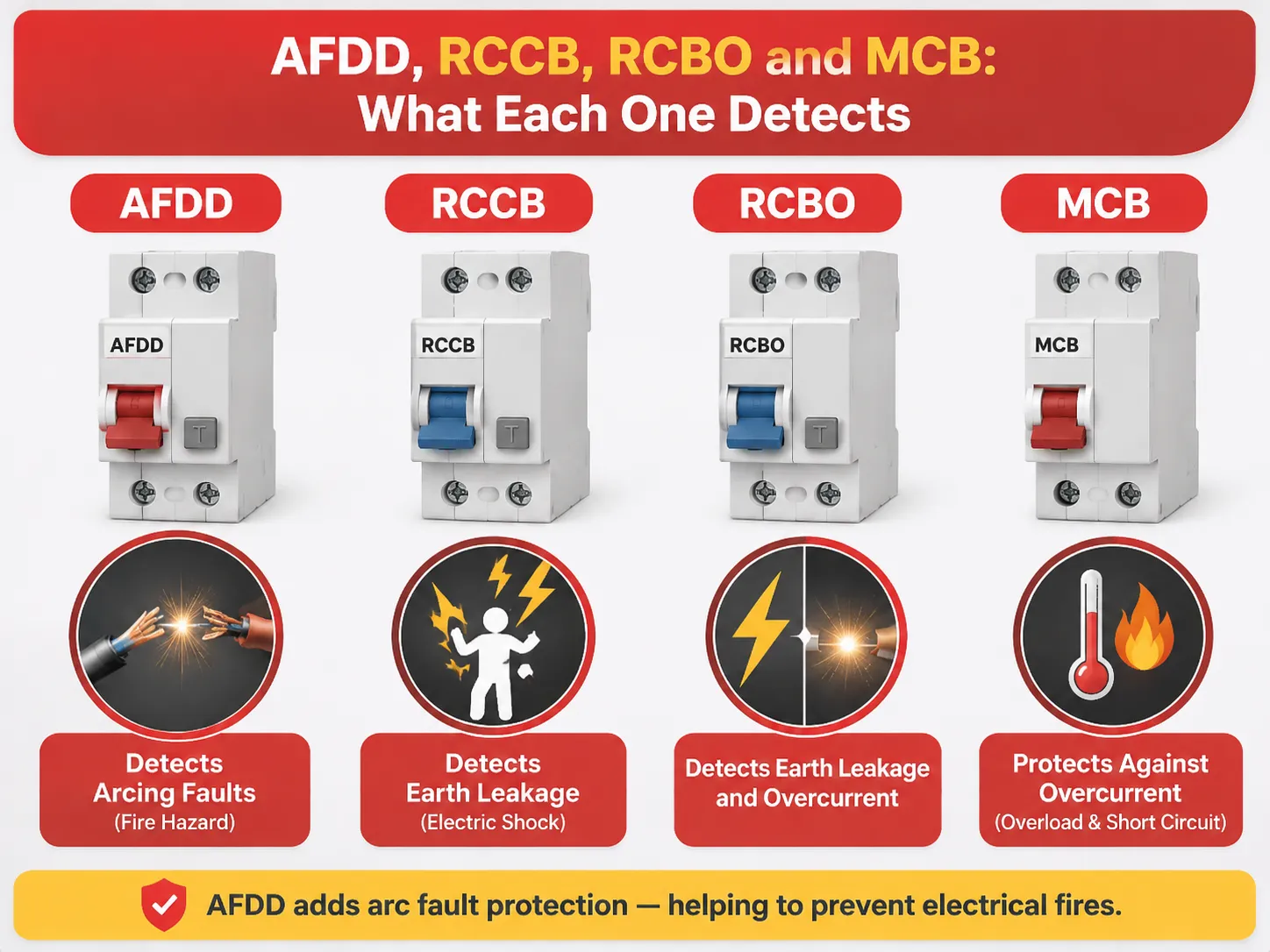
AFDD, RCCB, RCBO and MCB: What Each One Detects
The significance of an AFDD, as compared to an RCCB, is that both devices provide the same protection against electrocution or electrical shock; however, the way in which they operate and the conditions prompting a trip vary. The difference between an AFDD and an RCCB is the “signature” of an arc. The current waveform of an arc is distinctive, therefore the AFDD is able to detect that signature. In situations where the cable insulation is damaged and an arc exists in the cable, it may not leak to earth, thus the RCCB will not detect such an event.
AFDD, RCCB and MCB are the three devices to compare. The purpose for which each of these devices was designed was to protect a circuit from overcurrent – that is to say, protect the conductors against overloads and short circuits.
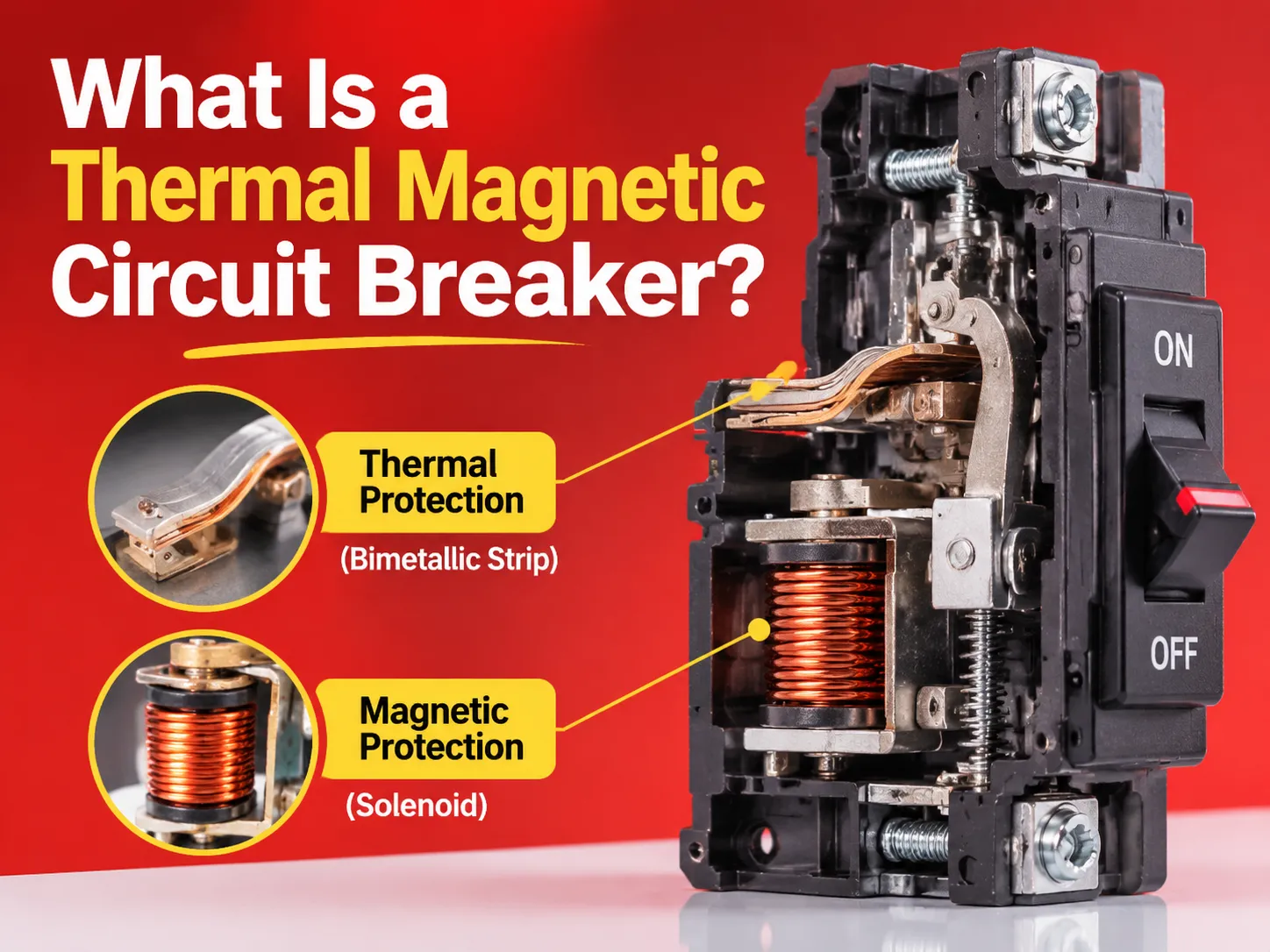
The MCB provides protection by tripping the circuit when the temperature of the conductor exceeds the temperature at which the insulation material becomes damaged. This is achieved by the MCB being equipped with a bimetallic strip that reacts to the heat generated by the overload to trip the device. The RCCB protects against electric shock and is connected to the earth with a residual current device (RCD). Once the RCCB detects that the current going out of the circuit differs from the current going back to the supply, it trips and disconnects the supply.
To recap,
- An AFDD is designed to provide additional protection to a circuit against potential fire hazards caused by arcing.
- An RCCB is designed to provide protection against electric shock by monitoring the difference in current between phases and earth connections.
- An MCB provides protection to conductors from overheating and short-circuiting.
AFDDs and RCBOs are two distinct types of devices, and therefore, the key difference between them is quite simple: there are no arc detection capabilities with an RCBO and an AFDD will only detect arcs if it is combined with an RCBO. You will find a further comparison between the two devices in an article regarding RCCBs versus RCBOs on the residual current side of things, and that article is especially relevant today as it highlights how many of the circuits that are used in homes today require both types of devices, so there is a debate on whether to purchase one device or two devices to fulfil the requirements.
Ratings and Markings to Check
Devices must meet six requirements to be deemed suitable. The standard, which is either IEC 62606 or the EN equivalent, should not be an endorsement, but rather, a specific number listed. The rated current for an AFDD will be typically between 6 A and 63 A; the rated voltage and frequency will typically be 230 V at 50 Hz (for the European market); and the rated conditional short circuit current is the fault current that will be applied to the device when using the type of upstream breaker specified.
If the AFDD is paired with an RCBO, it will typically detect a residual current of 30 mA for socket circuits. With an MCB, the AFDD will have more electronic components, and this means the terminal space will generally be less, which is important when using a 6 mm² cable.
The seventh requirement for an AFDD is not included on the device’s label. However, this information will appear on the certification document and will detail the testing done on the arc detection capability of the device. The test done to verify arc detection ability would be a type test to IEC 62606, not a routine test. A device that only has a routine test certificate and has not been proven to detect arcs cannot be relied upon to detect anything.
When considering the cost associated with AFDDs, it is commonly assumed that the installation will be more costly than the device itself, which leads to clients being surprised at the end of a quote.
What They Cost, and What the Installation Adds
An itemised breakdown of the costs associated with AFDDs is as follows:
| عنصر | التكلفة النموذجية | ملاحظة |
|---|---|---|
| جهاز كشف القوس الكهربائي المستقل | £30 to £70 | Per module; will require an additional device to provide residual current protection |
| AFDD + MCB (2 modules) | £45 to £90 | The MCB does not provide residual current protection |
| AFDD + RCBO (2 modules) | £60 to £120 | The normal choice for circuits providing sockets |
| Board increase | £150 to £400 | Increasing board size or installing a new board |
| Tested and certified | £80 to £250 | A fixed price for each installation |
The issue with the costs associated with the board increase is that, when trying to install AFDDs protecting socket outlets from all ten circuits in a ten-way RCBO board, you will require the installation of a new board rather than the installation of ten additional devices; therefore, you will initially have a larger outlay than the device prices alone suggest.
The differential in price of devices when AFDDs are compared to RCBOs will be between £30 to £60 per board way for the next 20 years, allowing approximately a few £ a year for having AFDD protection against a deadly mode of failure, as described in the guide from BEAMA and the reason for the necessity for them.
What Is Nuisance Tripping, and What Causes It?
If an AFDD trips on a normal load, the AFDD has classified a waveform incorrectly, and there is a defined method of how this can occur; specifically, dimmers, when operated at a low wattage, produce a chopped waveform with a high frequency, which is similar to the waveform produced during an arc. Brush motors like the ones in power tools or vacuum cleaners typically generate continuous arcing from the brushes by design. Similar capabilities can be found within the output of poor filter quality on switching mode power supplies (SMPS).
While there are many possible explanations for nuisance tripping, older installations offer additional reasons. When the neutral for two circuits is shared, or if there was ever an intermittent ‘real’ arcing due to poor connection quality, or of damaged insulation in between the arcing cable, these types of faults exist and the device is justified in tripping, thus a nuisance trip must not be assumed as a fault with the device and must be explored further.
The diagnostic process employed will be the same as that used with an RCBO. To isolate your loads, you must first reset the device and connect them back one at a time. If a tripped device continues when a specific appliance is connected, then the appliance and/or its cord are at fault. If a tripped device continues without anything connected, then the wiring is at fault. If a tripped device continues only in wet weather conditions, then moisture penetration into the outdoor circuit must exist.
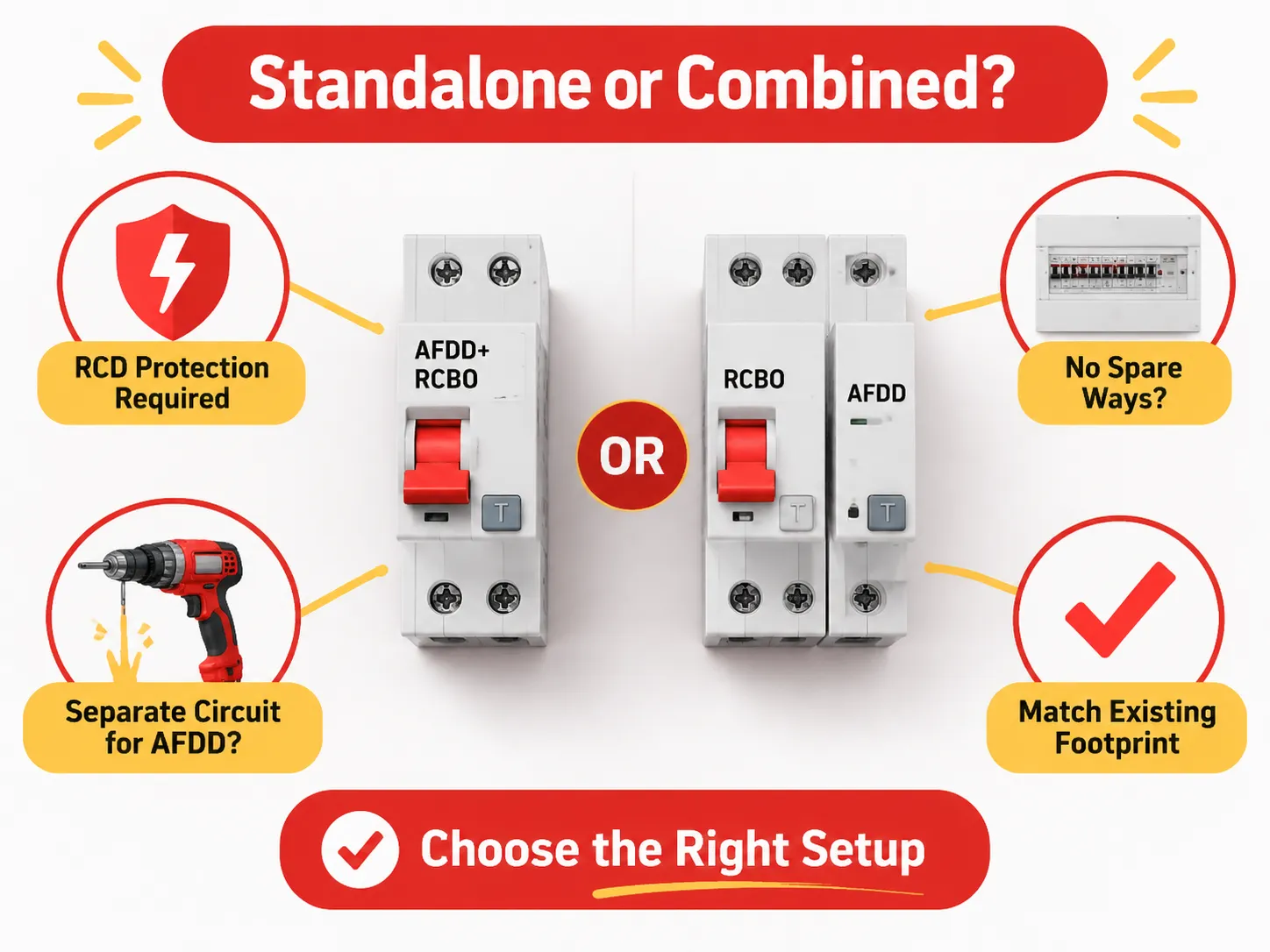
Choosing Between Standalone and Combined
Four different variables will determine whether to choose between standalone devices versus combined devices:
- A socket outlet circuit must provide residual current protection, either combined with an AFDD within a single unit or separate.
- An existing circuit that already possesses an RCBO, and now also needs an AFDD, must therefore have a stand-alone AFDD added.
- In a board containing zero spare ways, a new installation of whatever configuration must take place – therefore providing the specification of the board would be paramount versus the device.
- Because of the spark-like sounds produced in some applications (e.g., a woodworking shop with tools built with brushes) the load circuit may have to have an AFDD on a different circuit than where the tools are plugged in.
As such, AFDD’s use of the RCBO format on most current boards provides a reference for the combined device. The footprint and terminal arrangement of each type of AFDD matches as such; therefore, any project that standardises on the same footprint can add the arc protection without the need to redesign the board.
Where HUYU Fits into this Picture
We manufacture the AFDD in the combined 1 phase + Neutral format, with the MCB and RCBO in the same footprint. The construction of the AFDD complies with IEC 62606 for the function of detection of arc and IEC 61009-1 for the function of overcurrent and residual. The combination is what actually will provide a socket circuit in a home.
For a specification, we can supply the type test report for arc detection, the residual current test data, and the conditional short-circuit rating with the upstream device used in the test. These three documents are what a certifying body or inspector will require and what a low-cost AFDD typically cannot provide.
In terms of قواطع الدائرة الصغيرة, there are circuits throughout most buildings that do not require arc protection. The majority of circuits will not need an AFDD, and specifying an AFDD for every circuit means spending money where the potential risk does not warrant such an expense.
Checklist to Comply with Specifications
There are 5 items that are to be included when making a specification, to conform to IEC 62606. These include the formats of the device (combined or stand-alone), the rated current and residual current sensitivity if combined; the conditional short circuit rating (the upstream device that the combined device assumes is used); and type test evidence (evidence of testing) to be included with the order, not requested.
At the time of commissioning, 3 checks are required. These checks include the test button to verify the operation of the trip mechanism, however, not the operation of the arc detection mechanism; the residual current test (if a combined device) with an external tester, not the test button; and a load test with appliances that may be connected to the device, as it is better to discover if a dimmer switch or brushed motor will trip the device upon delivery rather than at 12:00 am.
The 4th check is documentation. A schedule is required for the installation to be maintainable. The schedule should indicate which devices are connected to which circuits and when the last test was performed. An AFDD is a safety device with a defined service life. A device that has never been tested is a device that cannot be vouched for.
الأسئلة الشائعة
What Are Arc Fault Detection Devices?
They are devices designed to detect high-frequency signatures from electrical arcs generating heat to ignite surrounding combustibles in the vicinity of an electrical circuit and automatically isolate the electrical circuit from its electrical supply prior to combustion. They are specified to the IEC 62606 standards; they are available as individual components or as part of an RCBO; and they provide protection for an arc or failure mode that cannot be detected by either the trip or residual current device.
What Methods Are Used to Detect Arc Faults?
Arc faults are detected by periodically sampling the current flowing in the circuit and examining the characteristics of the sampled waveform for certain defined features based upon high-frequency contents, sudden changes in current patterns, the stop time between cycles and whether the sampled waveform exhibits randomness in its pattern. A microcontroller compares these characteristics to those of a) the arc detection system and b) the associated load that is not supposed to cause a trip.
What Is an AFCI?
The AFCI (Arc Fault Circuit Interrupter) is the equivalent of an AFDD as defined in the North American UL 1699 standard. An AFCI performs the same function as an AFDD, but is tested to a different standard and rated to operate at 120 Volts in North American branch circuits. Therefore, AFCIs and AFDDs may not be replaced with one another or by a device that complies with one of the two standards.
Which Rooms Need AFCI Protection?
In England, the BS 7671 amendment 2 requires the installation of AFDD protection on socket circuits of 32 A or less at greater risk of electrical shock, which occur generally in HMOs, student accommodation and care homes but do not need to be installed in each room of every house. In Scotland, new houses must have an AFDD fitted as part of the electrical installation. In the United States of America, the National Electrical Code requires that most dwelling branch circuits must be protected by AFCIs.
Is an AFDD Used Instead of an RCBO?
No. AFDDs are designed to detect arcs in the circuit and an RCBO detects overloads, shortages and earth leakage of current. Typically, socket circuits will require both devices, which is why a combination of an AFDD and an RCBO in a single module is most commonly used. Standalone AFDDs are generally installed on the load side of an RCBO.
Why Does My AFDD Keep Tripping?
AFDD tripping can be caused by a load that creates arc-like sounds; e.g. a dimmer switch on a low setting; a vacuum cleaner; or a power drill; or from an actual fault, such as a loose connection or damaged cable. You can isolate all loads and reconnect them one by one to determine which appliance is causing the trip. If the trip occurs when nothing is connected, the problem may lie with the wiring.
المراجع
- Hager — AFDD Protection Devices and BS 7671 Guidance
- Siemens — AFDD Technology and Protective Devices
- Legrand — Arc Fault Protection in Residential Boards
- UL Solutions — Arc Fault and Residual Current Device Certification
- Electrical Engineering Portal — Arc Fault Detection and Protection Coordination
الخلاصة
AFDDs are the only devices within a circuit board that detect the arc itself rather than the current produced by the arc. This is what enables AFDDs to detect a failing terminal connection that a circuit breaker would ignore, and which cannot be detected by an RCD. That is why the requirement was introduced into the regulations for buildings where persons sleep. The decision is based on the choice of format and proof. The combination of an AFDD and an RCBO can create a single module that protects a socket circuit, and the only proof that these detection devices work is the fulfillment of the type test to IEC 62606; everything else on the label is simply a rating, which is a much less rigorous process than testing for compliance with a standard.