
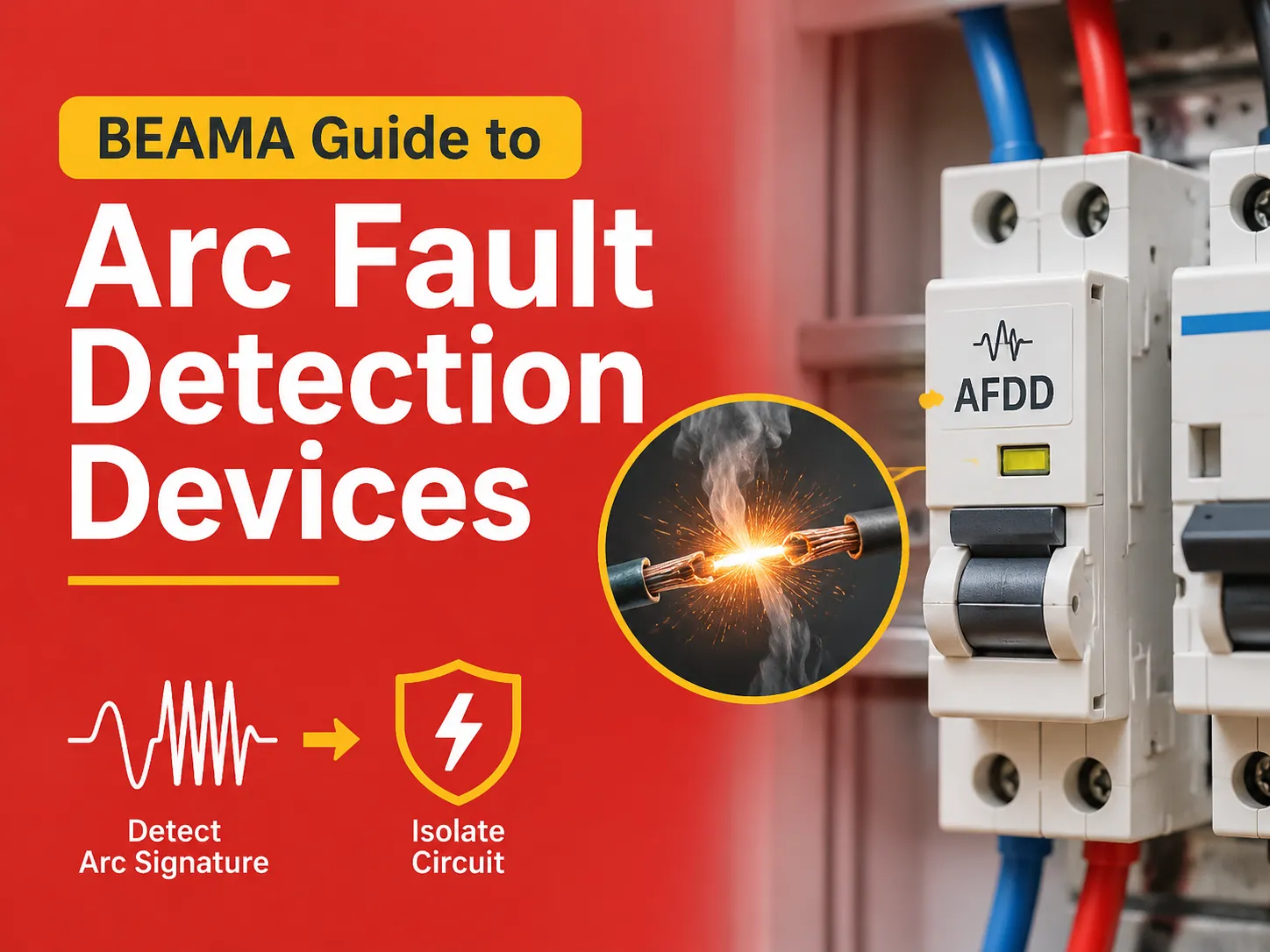
ฟังก์ชันของอุปกรณ์ตรวจจับความผิดปกติของประกายไฟ (AFDD) คือการตรวจสอบว่ามีประกายไฟเกิดจากการเชื่อมต่อเทอร์มินัลที่หลวม สายเคเบิลที่บีบอัด และ/หรือเล็บที่เจาะผ่านตัวนำหรือไม่ ประกายไฟสามารถเกิดขึ้นได้นานหลายเดือนที่กระแสไฟต่ำเกินกว่าจะทำให้เบรกเกอร์วงจรทำงานหรือไม่มีการรั่วไหลสู่ดิน และสัญญาณแรกของความผิดปกติประเภทนี้มักจะเป็นไฟไหม้.
คำตอบด่วน: AFDD ตรวจสอบรูปคลื่นของกระแสและแรงดันไฟฟ้าเพื่อตรวจจับลายเซ็นความถี่สูงของประกายไฟและแยกวงจร (ตัดการเชื่อมต่อ) โดยอัตโนมัติเมื่อพบความผิดปกติประเภทนี้ AFDD ต้องผลิตและทดสอบตามมาตรฐานสากลสำหรับอุปกรณ์ตรวจจับความผิดปกติของประกายไฟ (IEC 62606) และสามารถซื้อได้ทั้งในรูปแบบอุปกรณ์เดี่ยวหรือรวมกับ RCD ในโมดูลเดียว ราคาทั่วไปของ AFDD อยู่ระหว่าง £30 ถึง £120 (ไม่รวมค่าติดตั้ง).
ส่วนที่เหลือของเอกสารนี้ให้ความครอบคลุมอย่างครบถ้วนของคู่มือและอธิบายว่าคู่มือครอบคลุมอะไรบ้าง AFDD สามารถตรวจจับอะไรที่อุปกรณ์อื่นไม่สามารถทำได้ วิธีการตรวจจับของ AFDD ที่ไหนที่กฎระเบียบการเดินสายไฟกำหนดให้ใช้ AFDD รูปแบบของอุปกรณ์ที่มีอยู่ การเปรียบเทียบกับอุปกรณ์ที่คล้ายกัน เครื่องหมายที่ต้องตรวจสอบเพื่อความสอดคล้อง ค่าใช้จ่าย การตัดวงจรที่ไม่จำเป็น วิธีการเลือกใช้อุปกรณ์เดี่ยวหรือแบบรวม และสถานที่ที่คุณอาจพบอุปกรณ์ของเราในพื้นที่ของคุณ รวมถึงรายการตรวจสอบสำหรับการมอบหมายงานและการติดตั้ง AFDD.
สิ่งที่คู่มือ BEAMA ครอบคลุม และเหตุผลที่มีอยู่
คู่มือ BEAMA ถูกพัฒนาขึ้นเพื่อตอบสนองความต้องการภายใต้การแก้ไขครั้งที่ 2 ของมาตรฐานอังกฤษ 7671 ที่กำหนดให้ติดตั้ง AFDD ในวงจรซ็อกเก็ตที่มีการจัดอันดับ 32 A หรือต่ำกว่าในที่พักอาศัยที่มีความเสี่ยงสูง ความแตกต่างระหว่าง AFDD, RCBO & RCCB และ AFCI ในอเมริกาเหนือไม่ง่ายอย่างที่หลายคนเข้าใจเมื่อตรวจสอบแคตตาล็อก.
คู่มือ BEAMA ถูกพัฒนาโดยสมาคมผู้ผลิตอุปกรณ์ไฟฟ้าของอังกฤษเพื่อแก้ไขปัญหาที่เกี่ยวข้องกับการแนะนำกฎระเบียบการเดินสายไฟที่แก้ไขใหม่และ AFDD ใหม่ ซึ่งถูกจัดส่งโดยผู้ผลิตและติดตั้งโดยผู้รับเหมา ทั้งสองฝ่ายต้องการภาษากลางเพื่ออำนวยความสะดวกในการสื่อสาร คู่มืออธิบาย:
- วิธีการทำงานของ AFDD และสิ่งที่ทำ
- วิธีการทดสอบ AFDD
- มาตรฐานที่ใช้บังคับสำหรับ AFDD
- วิธีการเลือกและติดตั้ง AFDD
EMF (สนามแม่เหล็กไฟฟ้า) เป็นเทคโนโลยีที่ไม่สามารถเข้าใจได้โดยตรง ดังนั้นจึงมีการพัฒนาคู่มือแทนที่จะเป็นเพียงแผ่นข้อมูลหรือแคตตาล็อกสำหรับ AFDD ตัวอย่างเช่น วัตถุประสงค์ของเบรกเกอร์วงจรคือการป้องกันการโอเวอร์โหลดและวงจรลัดวงจร ซึ่งเข้าใจได้ง่ายด้วยสายตา ในทางตรงกันข้าม AFDD ป้องกันความล้มเหลวที่ไม่มีสัญญาณความเสียหายที่มองเห็นได้จนกว่าไฟจะเกิดขึ้น การตัดสินใจติดตั้ง AFDD ขึ้นอยู่กับการประเมินความเสี่ยงมากกว่าการคำนวณทางคณิตศาสตร์ง่ายๆ.
คู่มือยังให้เหตุผลทางธุรกิจเนื่องจาก AFDD มีราคาสูงกว่ามินิเอเจอร์เซอร์กิตเบรกเกอร์ (MCB) หลายเท่า วิธีที่ง่ายกว่าในการอธิบายการหลีกเลี่ยงความเสี่ยงที่เกี่ยวข้องกับ AFDD เมื่อเทียบกับ MCB คือการใช้เอกสารที่เผยแพร่จากองค์กรในอุตสาหกรรมแทนโบรชัวร์ของผู้ผลิตเมื่อขอเหตุผลในการซื้อ AFDD.
สิ่งที่ AFDD ตรวจจับได้ซึ่งอุปกรณ์อื่นไม่สามารถตรวจจับได้
อุปกรณ์ตรวจจับความผิดปกติของอาร์ค (AFDD) ตรวจจับการเกิดอาร์คในวงจรเนื่องจากความล้มเหลวของตัวนำที่ต่ออนุกรมกับโหลดไฟฟ้า เมื่อสายตัวนำล้มเหลว อาร์คที่เกิดขึ้นระหว่างปลายสายที่ขาดจะรักษาการไหลของกระแสผ่านวงจร แม้จะลดลงในระดับหนึ่ง และในบางกรณี ปริมาณกระแสทั้งหมดที่ไหลผ่านวงจรยังคงต่ำกว่าค่าการทนความร้อนของเซอร์กิตเบรกเกอร์อย่างไม่มีกำหนด สกรูเทอร์มินัลที่หลวม สายต่อที่เสียหาย หรือสายไฟที่ถูกตัดในระหว่างการติดตั้ง สามารถสร้างรูปแบบที่คล้ายกันได้.
อาร์คแบบขนานเกิดขึ้นเมื่อสายไฟสองเส้นสร้างอาร์คที่วิ่งจากสายไฟไปยังนิวทรัลหรือสายกราวด์และสร้างกระแสเพียงพอที่จะทำให้เบรกเกอร์ตัดวงจร เวอร์ชันที่อันตรายที่สุดคือความต้านทานสูงระหว่างสายไฟสองเส้น ความต้านทานสูงจำกัดกระแสผ่านความผิดพลาดให้อยู่ในระดับที่เบรกเกอร์สามารถทนได้ แต่การเกิดอาร์คยังคงดำเนินต่อไป.
อุปกรณ์ตรวจจับกระแสไฟตกค้างจะไม่เห็นอาร์คเหล่านี้เว้นแต่จะรั่วไหลไปยังกราวด์ นี่คือเหตุผลที่ AFDD เติมเต็มช่องว่างนี้. พวกมันตรวจจับอาร์คเอง ไม่ใช่ผลลัพธ์ของอาร์ค (เช่น ไฟไหม้), นั่นคือเหตุผลที่อุปกรณ์เหล่านี้ถูกทำตลาดในฐานะการป้องกันไฟฟ้าลัดวงจร ไม่ใช่การป้องกันการโอเวอร์โหลดหรือไฟฟ้าช็อต.
เดอะ เบรกเกอร์ตรวจจับอาร์ค ทำงานบนหลักการเดียวกันและอธิบายจากมุมมองการติดตั้ง โดยแยกแยะระหว่างอาร์คอนุกรมและอาร์คขนาน.
ภายในอุปกรณ์: การตรวจจับ การประมวลผล และการตัดวงจร
อุปกรณ์จะสุ่มตัวอย่างรูปคลื่นกระแสอย่างต่อเนื่องโดยใช้หม้อแปลงกระแสขนาดเล็กหรือชันท์ ไมโครคอนโทรลเลอร์จะระบุลักษณะที่สามารถบ่งชี้อาร์คได้ รวมถึงเนื้อหาความถี่สูงของรูปคลื่น การเพิ่มขึ้นหรือลดลงอย่างรวดเร็วของกระแส การหยุดชั่วคราวที่เป็นลักษณะเฉพาะในทุกครึ่งรอบ และความสุ่มของลายเซ็นการตรวจจับอาร์ค.
ไมโครคอนโทรลเลอร์จะเปรียบเทียบลักษณะที่สกัดออกมากับโมเดลอาร์คปัจจุบันที่กำหนดไว้ที่ 230 โวลต์และ 50 เฮิรตซ์ และกับฐานข้อมูลของรูปแบบที่ไม่ควรทำให้เกิดการตัดวงจรในอุปกรณ์ กลุ่มที่สองนี้ประกอบด้วยความท้าทายทางเทคนิคที่เกิดจากสัญญาณรบกวนความถี่สูงที่เกิดจากผลิตภัณฑ์ทั่วไป เช่น ดิมเมอร์ มอเตอร์แปรง แหล่งจ่ายไฟสวิตชิ่ง และสว่าน ซึ่งไม่ก่อให้เกิดอาร์คไฟฟ้า.
เนื่องจากข้อกำหนดนี้ อุปกรณ์ต้องใช้โซลินอยด์ซึ่งจะเปิดขั้วรีเลย์หลังจากเวลาทริปที่กำหนดครบถ้วนแล้ว เช่นเดียวกับเสียงรบกวนความถี่สูง เวลาทริปจะไม่เกิดขึ้นทันทีทันใดเนื่องจากอุปกรณ์กำลังแยกแยะรูปแบบมากกว่าการวัดระดับแรงดันหรือกระแสไฟฟ้า เวลาที่เพิ่มขึ้นนี้ช่วยให้อุปกรณ์สามารถละเลยเหตุการณ์ชั่วคราวได้ แต่ยังคงรักษาความสามารถในการตรวจจับเหตุการณ์ไฟฟ้าลัดวงจรจริงได้.
ระบุไว้ใน IEC 62606 มาตรฐานคือประเภทของ “รูปคลื่นทดสอบ” ที่อุปกรณ์ต้องทนทานและไม่ทนทาน และยังห้ามไม่ให้อุปกรณ์ทริปเนื่องจากกระแสไฟฟ้าเริ่มต้น.
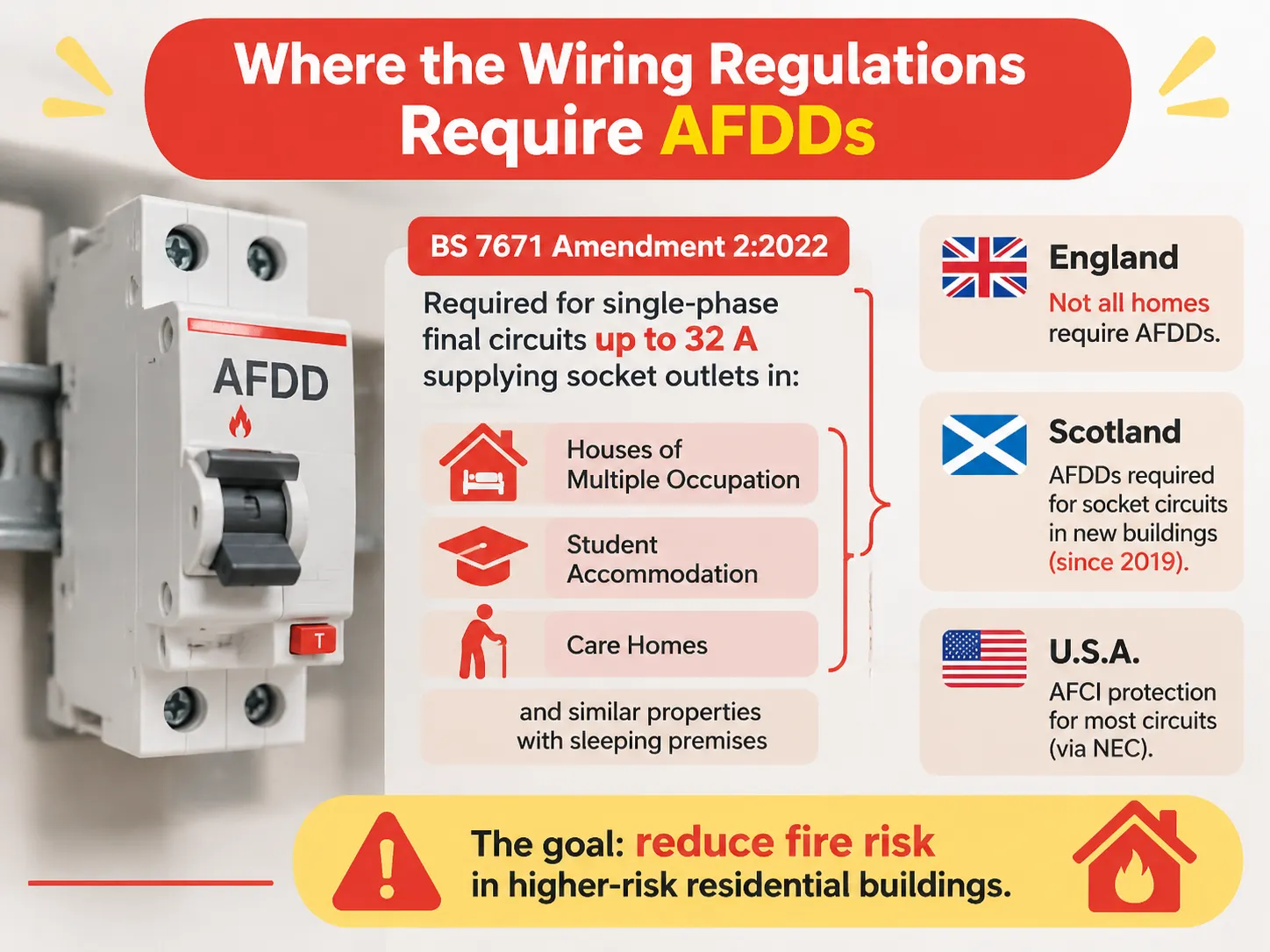
ที่ซึ่งข้อบังคับการเดินสายไฟฟ้ากำหนดให้ใช้ AFDD
BS 7671 Amendment 2:2022 กำหนดให้วงจรไฟฟ้าขั้นสุดท้ายแบบเฟสเดียวที่มีเรตติ้งสูงสุด 32 A ซึ่งจ่ายไฟให้กับเต้ารับที่ตั้งอยู่ภายใน อาคารที่อยู่อาศัยที่มีความเสี่ยงสูง – บ้านที่มีผู้อยู่อาศัยหลายคน ที่พักนักศึกษา บ้านพักคนชรา และอาคารที่มีห้องนอนลักษณะคล้ายกัน – ต้องติดตั้ง AFDD ข้อกำหนดนี้สามารถพบได้ใน Regulation 421.1.7 และใช้กับการติดตั้งใหม่และการเปลี่ยนแปลงเท่านั้น แต่ไม่ใช่กับการติดตั้งที่มีอยู่ทุกกรณี.
ขอบเขตถูกจำกัดอย่างจงใจและไม่ได้หมายถึง “ที่อยู่อาศัยทั้งหมด” ตามที่หลายคนเข้าใจ ไม่มีข้อกำหนดในอังกฤษที่ต้องติดตั้ง AFDD ในบ้านทุกหลัง ในปี 2019 มาตรฐานอาคารของสกอตแลนด์ได้กำหนดให้ใช้ AFDD สำหรับวงจรเต้ารับในอาคารใหม่ ดังนั้นข้อกำหนดสำหรับวงจรเต้ารับในกลาสโกว์และแมนเชสเตอร์จะแตกต่างกัน.
อีกประเทศหนึ่งคือสหรัฐอเมริกา ใช้วิธีการทางเลือกในการป้องกันไฟฟ้าลัดวงจรสำหรับวงจรสาขาส่วนใหญ่ ยกเว้นจำนวนเล็กน้อย โดยใช้ National Electrical Code และมาตรฐาน AFCI แทน IEC 62606 เพื่อให้การป้องกันนี้ มีประเทศยุโรปอื่น ๆ เช่น เยอรมนี ที่มีข้อกำหนดคล้ายกันสำหรับประเภทที่อยู่อาศัยบางประเภท หลักการพื้นฐานสำหรับประเทศเหล่านี้คือข้อกำหนดการป้องกันไฟฟ้าลัดวงจรขึ้นอยู่กับระดับความเสี่ยงไฟไหม้ที่เกี่ยวข้องกับโครงสร้างที่อยู่อาศัย.
ประเภทและรูปแบบ
ตลาดครอบคลุมสามประเภท ดังนั้นเมื่อเลือกประเภทหนึ่งโดยทั่วไปจะขึ้นอยู่กับพื้นที่แผงที่อุปกรณ์จะครอบครองมากกว่าระดับการป้องกันที่อุปกรณ์จะให้.
| รูปแบบ | ความกว้าง | สิ่งที่ประกอบด้วย | ใช้ที่ไหน |
|---|---|---|---|
| AFDD แบบอิสระ | 1 โมดูล | ตรวจจับไฟฟ้าลัดวงจรพร้อมกลไกทริป | ต่อท้าย MCB หรือ RCBO ที่มีอยู่ |
| AFDD + MCB | 2 โมดูล | ตรวจจับไฟฟ้าลัดวงจรพร้อมการป้องกันกระแสไฟฟ้า | วงจรใหม่ที่ไม่มี RCBO |
| AFDD + RCBO | 2 โมดูล | ตรวจจับไฟฟ้าลัดวงจร การป้องกันกระแสไฟฟ้า และกระแสไฟฟ้ารั่ว | ใช้บ่อยที่สุดสำหรับวงจรเต้ารับ |
รูปแบบที่ใช้บ่อยที่สุดสำหรับการกำหนดสเปคคือ AFDD + RCBO เนื่องจากประเภทสุดท้ายครอบคลุมความต้องการทั้งหมดที่เกี่ยวข้องกับวงจรเต้ารับ นอกจากนี้ การใช้หนึ่งอุปกรณ์สำหรับการป้องกันกระแสไฟฟ้าและกระแสไฟฟ้ารั่วช่วยประหยัดทั้งขั้วต่อและโมดูล.
ในกลุ่มผลิตภัณฑ์ของเรา รูปแบบผสมคือ AFDD7LE device in the 1P+N configuration that is used for all single-phase final circuits.
An AFDD is specifically designed for the detection of arcs in a circuit, which can cause fires. Its function is to provide additional safety protection and prevent loss of life and property.
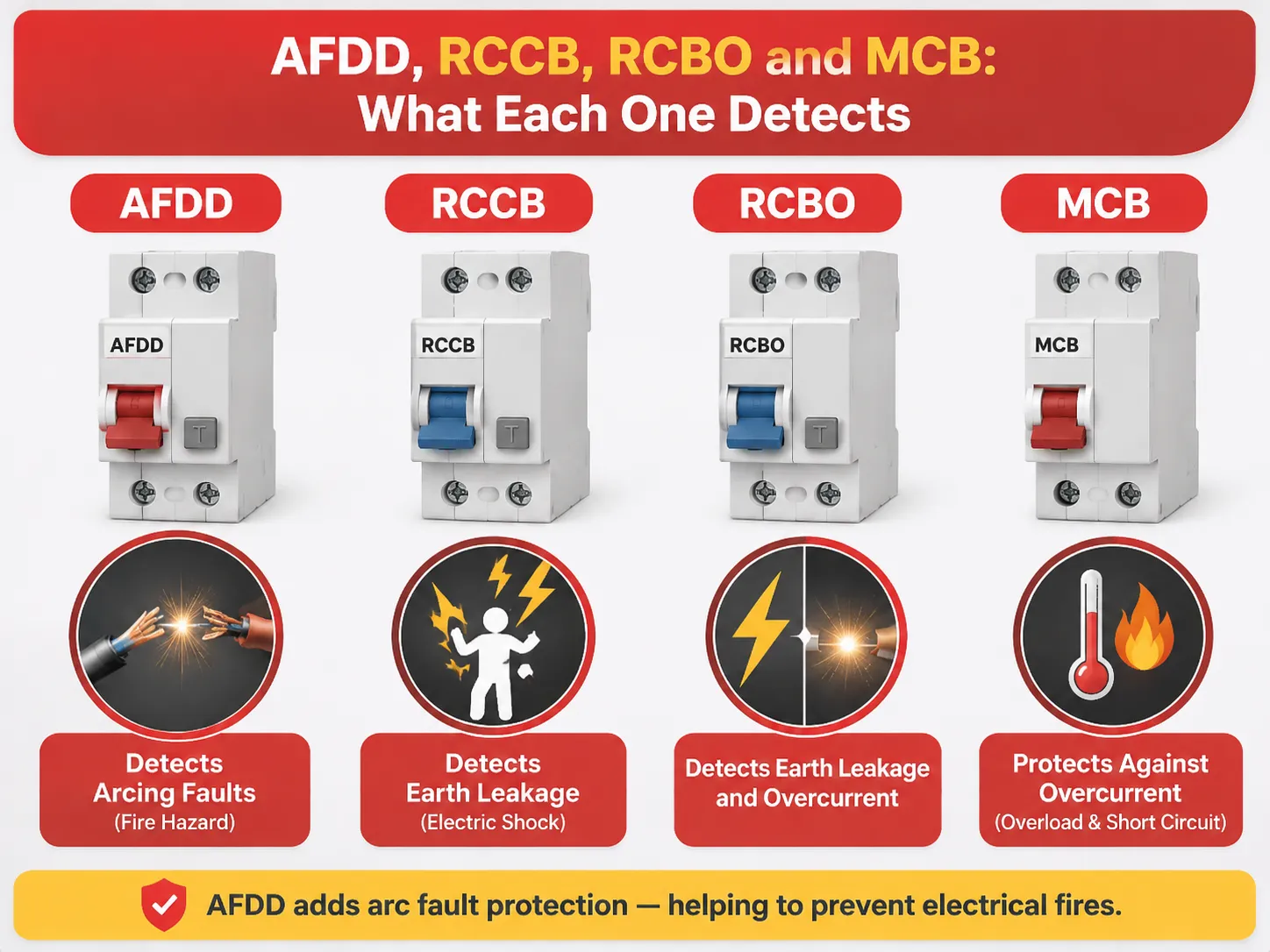
AFDD, RCCB, RCBO and MCB: What Each One Detects
The significance of an AFDD, as compared to an RCCB, is that both devices provide the same protection against electrocution or electrical shock; however, the way in which they operate and the conditions prompting a trip vary. The difference between an AFDD and an RCCB is the “signature” of an arc. The current waveform of an arc is distinctive, therefore the AFDD is able to detect that signature. In situations where the cable insulation is damaged and an arc exists in the cable, it may not leak to earth, thus the RCCB will not detect such an event.
AFDD, RCCB and MCB are the three devices to compare. The purpose for which each of these devices was designed was to protect a circuit from overcurrent – that is to say, protect the conductors against overloads and short circuits.
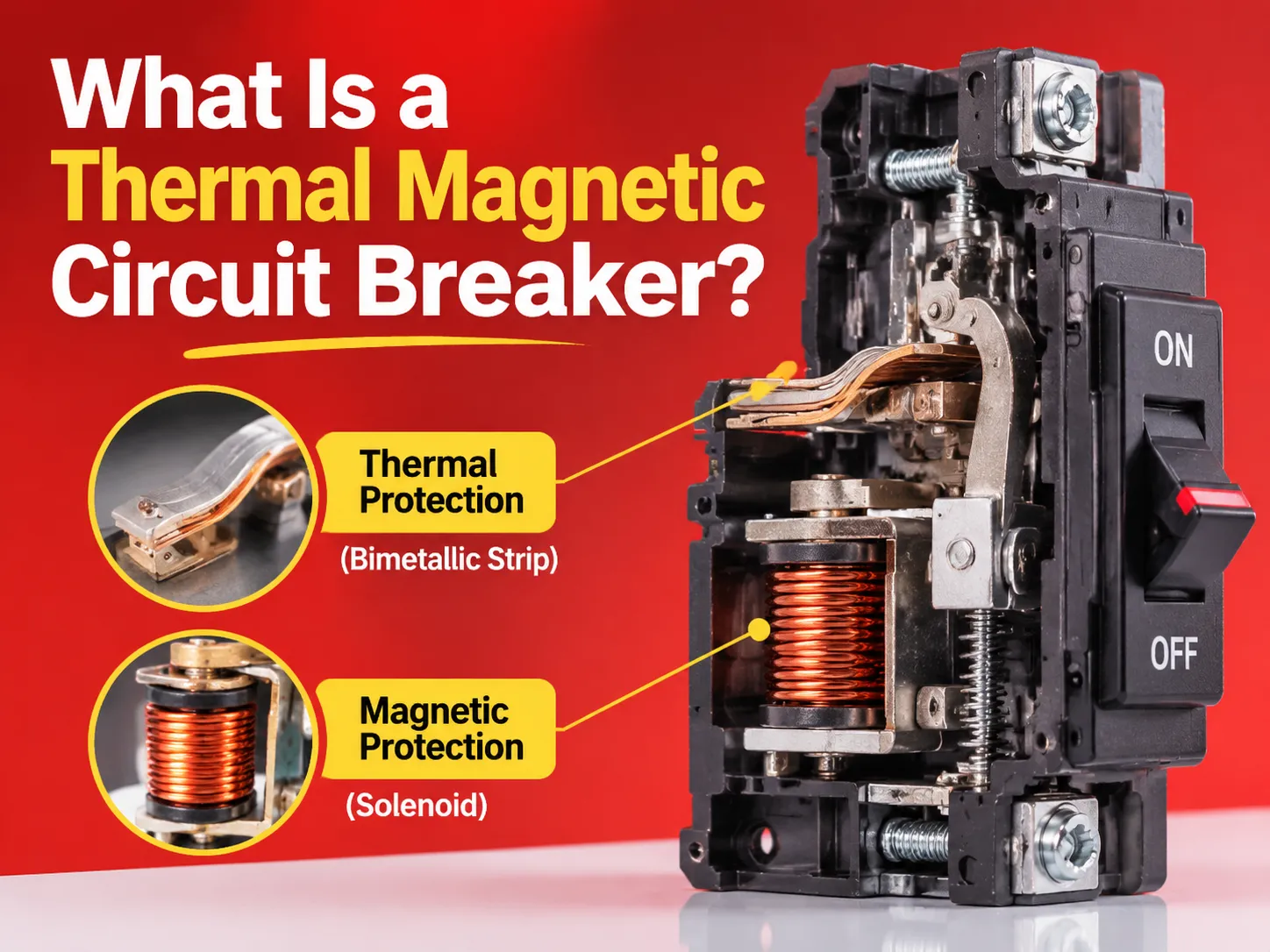
The MCB provides protection by tripping the circuit when the temperature of the conductor exceeds the temperature at which the insulation material becomes damaged. This is achieved by the MCB being equipped with a bimetallic strip that reacts to the heat generated by the overload to trip the device. The RCCB protects against electric shock and is connected to the earth with a residual current device (RCD). Once the RCCB detects that the current going out of the circuit differs from the current going back to the supply, it trips and disconnects the supply.
To recap,
- An AFDD is designed to provide additional protection to a circuit against potential fire hazards caused by arcing.
- An RCCB is designed to provide protection against electric shock by monitoring the difference in current between phases and earth connections.
- An MCB provides protection to conductors from overheating and short-circuiting.
AFDDs and RCBOs are two distinct types of devices, and therefore, the key difference between them is quite simple: there are no arc detection capabilities with an RCBO and an AFDD will only detect arcs if it is combined with an RCBO. You will find a further comparison between the two devices in an article regarding RCCBs versus RCBOs on the residual current side of things, and that article is especially relevant today as it highlights how many of the circuits that are used in homes today require both types of devices, so there is a debate on whether to purchase one device or two devices to fulfil the requirements.
Ratings and Markings to Check
Devices must meet six requirements to be deemed suitable. The standard, which is either IEC 62606 or the EN equivalent, should not be an endorsement, but rather, a specific number listed. The rated current for an AFDD will be typically between 6 A and 63 A; the rated voltage and frequency will typically be 230 V at 50 Hz (for the European market); and the rated conditional short circuit current is the fault current that will be applied to the device when using the type of upstream breaker specified.
If the AFDD is paired with an RCBO, it will typically detect a residual current of 30 mA for socket circuits. With an MCB, the AFDD will have more electronic components, and this means the terminal space will generally be less, which is important when using a 6 mm² cable.
The seventh requirement for an AFDD is not included on the device’s label. However, this information will appear on the certification document and will detail the testing done on the arc detection capability of the device. The test done to verify arc detection ability would be a type test to IEC 62606, not a routine test. A device that only has a routine test certificate and has not been proven to detect arcs cannot be relied upon to detect anything.
When considering the cost associated with AFDDs, it is commonly assumed that the installation will be more costly than the device itself, which leads to clients being surprised at the end of a quote.
What They Cost, and What the Installation Adds
An itemised breakdown of the costs associated with AFDDs is as follows:
| รายการ | ค่าใช้จ่ายทั่วไป | หมายเหตุ |
|---|---|---|
| AFDD แบบอิสระ | £30 to £70 | Per module; will require an additional device to provide residual current protection |
| AFDD + MCB (2 modules) | £45 to £90 | The MCB does not provide residual current protection |
| AFDD + RCBO (2 modules) | £60 to £120 | The normal choice for circuits providing sockets |
| Board increase | £150 to £400 | Increasing board size or installing a new board |
| Tested and certified | £80 to £250 | A fixed price for each installation |
The issue with the costs associated with the board increase is that, when trying to install AFDDs protecting socket outlets from all ten circuits in a ten-way RCBO board, you will require the installation of a new board rather than the installation of ten additional devices; therefore, you will initially have a larger outlay than the device prices alone suggest.
The differential in price of devices when AFDDs are compared to RCBOs will be between £30 to £60 per board way for the next 20 years, allowing approximately a few £ a year for having AFDD protection against a deadly mode of failure, as described in the guide from BEAMA and the reason for the necessity for them.
What Is Nuisance Tripping, and What Causes It?
If an AFDD trips on a normal load, the AFDD has classified a waveform incorrectly, and there is a defined method of how this can occur; specifically, dimmers, when operated at a low wattage, produce a chopped waveform with a high frequency, which is similar to the waveform produced during an arc. Brush motors like the ones in power tools or vacuum cleaners typically generate continuous arcing from the brushes by design. Similar capabilities can be found within the output of poor filter quality on switching mode power supplies (SMPS).
While there are many possible explanations for nuisance tripping, older installations offer additional reasons. When the neutral for two circuits is shared, or if there was ever an intermittent ‘real’ arcing due to poor connection quality, or of damaged insulation in between the arcing cable, these types of faults exist and the device is justified in tripping, thus a nuisance trip must not be assumed as a fault with the device and must be explored further.
The diagnostic process employed will be the same as that used with an RCBO. To isolate your loads, you must first reset the device and connect them back one at a time. If a tripped device continues when a specific appliance is connected, then the appliance and/or its cord are at fault. If a tripped device continues without anything connected, then the wiring is at fault. If a tripped device continues only in wet weather conditions, then moisture penetration into the outdoor circuit must exist.
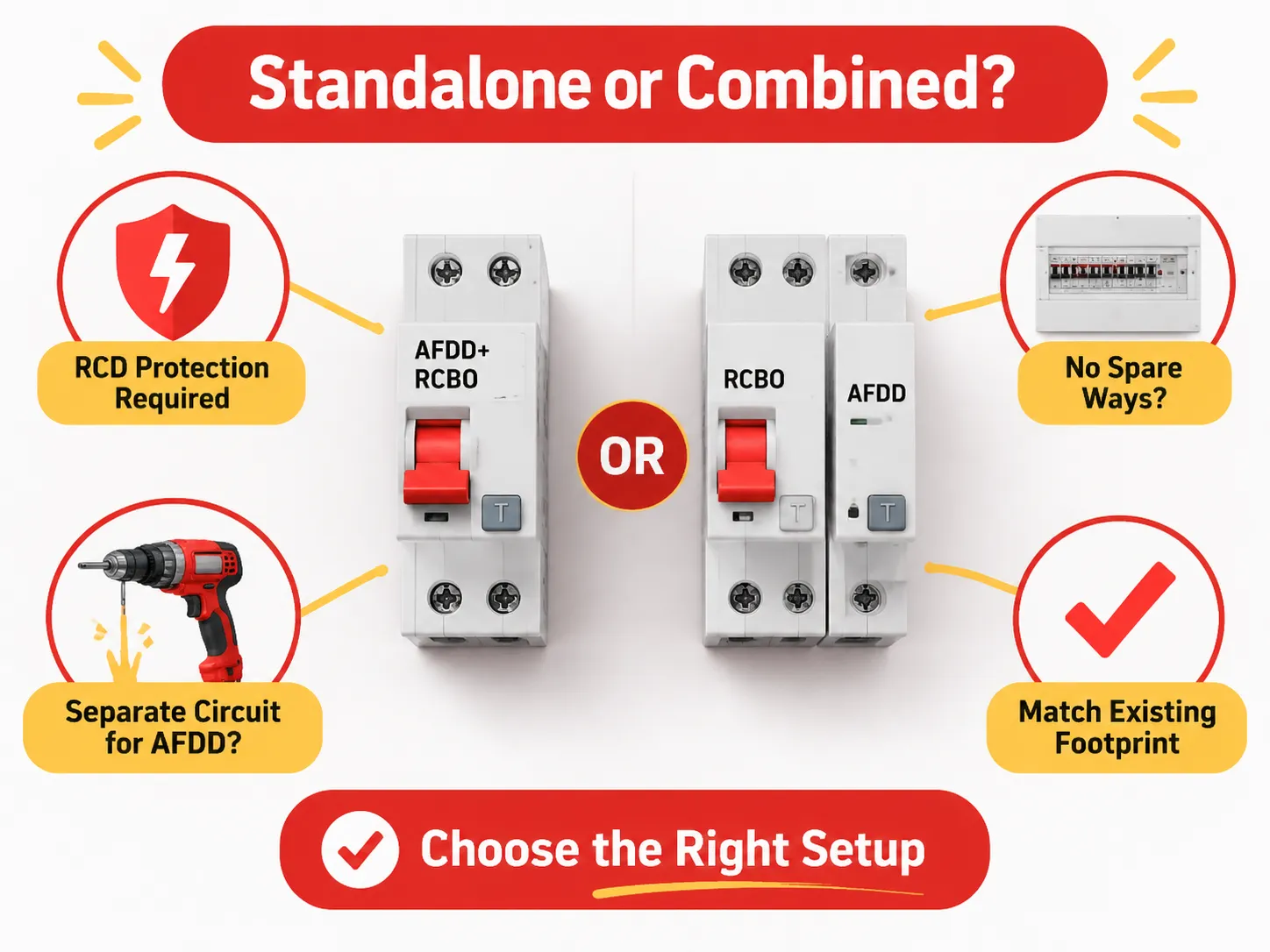
Choosing Between Standalone and Combined
Four different variables will determine whether to choose between standalone devices versus combined devices:
- A socket outlet circuit must provide residual current protection, either combined with an AFDD within a single unit or separate.
- An existing circuit that already possesses an RCBO, and now also needs an AFDD, must therefore have a stand-alone AFDD added.
- In a board containing zero spare ways, a new installation of whatever configuration must take place – therefore providing the specification of the board would be paramount versus the device.
- Because of the spark-like sounds produced in some applications (e.g., a woodworking shop with tools built with brushes) the load circuit may have to have an AFDD on a different circuit than where the tools are plugged in.
As such, AFDD’s use of the RCBO format on most current boards provides a reference for the combined device. The footprint and terminal arrangement of each type of AFDD matches as such; therefore, any project that standardises on the same footprint can add the arc protection without the need to redesign the board.
Where HUYU Fits into this Picture
We manufacture the AFDD in the combined 1 phase + Neutral format, with the MCB and RCBO in the same footprint. The construction of the AFDD complies with IEC 62606 for the function of detection of arc and IEC 61009-1 for the function of overcurrent and residual. The combination is what actually will provide a socket circuit in a home.
For a specification, we can supply the type test report for arc detection, the residual current test data, and the conditional short-circuit rating with the upstream device used in the test. These three documents are what a certifying body or inspector will require and what a low-cost AFDD typically cannot provide.
In terms of มินิ เซอร์กิต เบรกเกอร์, there are circuits throughout most buildings that do not require arc protection. The majority of circuits will not need an AFDD, and specifying an AFDD for every circuit means spending money where the potential risk does not warrant such an expense.
Checklist to Comply with Specifications
There are 5 items that are to be included when making a specification, to conform to IEC 62606. These include the formats of the device (combined or stand-alone), the rated current and residual current sensitivity if combined; the conditional short circuit rating (the upstream device that the combined device assumes is used); and type test evidence (evidence of testing) to be included with the order, not requested.
At the time of commissioning, 3 checks are required. These checks include the test button to verify the operation of the trip mechanism, however, not the operation of the arc detection mechanism; the residual current test (if a combined device) with an external tester, not the test button; and a load test with appliances that may be connected to the device, as it is better to discover if a dimmer switch or brushed motor will trip the device upon delivery rather than at 12:00 am.
The 4th check is documentation. A schedule is required for the installation to be maintainable. The schedule should indicate which devices are connected to which circuits and when the last test was performed. An AFDD is a safety device with a defined service life. A device that has never been tested is a device that cannot be vouched for.
คำถามที่พบบ่อย
What Are Arc Fault Detection Devices?
They are devices designed to detect high-frequency signatures from electrical arcs generating heat to ignite surrounding combustibles in the vicinity of an electrical circuit and automatically isolate the electrical circuit from its electrical supply prior to combustion. They are specified to the IEC 62606 standards; they are available as individual components or as part of an RCBO; and they provide protection for an arc or failure mode that cannot be detected by either the trip or residual current device.
What Methods Are Used to Detect Arc Faults?
Arc faults are detected by periodically sampling the current flowing in the circuit and examining the characteristics of the sampled waveform for certain defined features based upon high-frequency contents, sudden changes in current patterns, the stop time between cycles and whether the sampled waveform exhibits randomness in its pattern. A microcontroller compares these characteristics to those of a) the arc detection system and b) the associated load that is not supposed to cause a trip.
What Is an AFCI?
The AFCI (Arc Fault Circuit Interrupter) is the equivalent of an AFDD as defined in the North American UL 1699 standard. An AFCI performs the same function as an AFDD, but is tested to a different standard and rated to operate at 120 Volts in North American branch circuits. Therefore, AFCIs and AFDDs may not be replaced with one another or by a device that complies with one of the two standards.
Which Rooms Need AFCI Protection?
In England, the BS 7671 amendment 2 requires the installation of AFDD protection on socket circuits of 32 A or less at greater risk of electrical shock, which occur generally in HMOs, student accommodation and care homes but do not need to be installed in each room of every house. In Scotland, new houses must have an AFDD fitted as part of the electrical installation. In the United States of America, the National Electrical Code requires that most dwelling branch circuits must be protected by AFCIs.
Is an AFDD Used Instead of an RCBO?
No. AFDDs are designed to detect arcs in the circuit and an RCBO detects overloads, shortages and earth leakage of current. Typically, socket circuits will require both devices, which is why a combination of an AFDD and an RCBO in a single module is most commonly used. Standalone AFDDs are generally installed on the load side of an RCBO.
Why Does My AFDD Keep Tripping?
AFDD tripping can be caused by a load that creates arc-like sounds; e.g. a dimmer switch on a low setting; a vacuum cleaner; or a power drill; or from an actual fault, such as a loose connection or damaged cable. You can isolate all loads and reconnect them one by one to determine which appliance is causing the trip. If the trip occurs when nothing is connected, the problem may lie with the wiring.
อ้างอิง
- Hager — AFDD Protection Devices and BS 7671 Guidance
- Siemens — AFDD Technology and Protective Devices
- Legrand — Arc Fault Protection in Residential Boards
- UL Solutions — Arc Fault and Residual Current Device Certification
- Electrical Engineering Portal — Arc Fault Detection and Protection Coordination
สรุป
AFDDs are the only devices within a circuit board that detect the arc itself rather than the current produced by the arc. This is what enables AFDDs to detect a failing terminal connection that a circuit breaker would ignore, and which cannot be detected by an RCD. That is why the requirement was introduced into the regulations for buildings where persons sleep. The decision is based on the choice of format and proof. The combination of an AFDD and an RCBO can create a single module that protects a socket circuit, and the only proof that these detection devices work is the fulfillment of the type test to IEC 62606; everything else on the label is simply a rating, which is a much less rigorous process than testing for compliance with a standard.