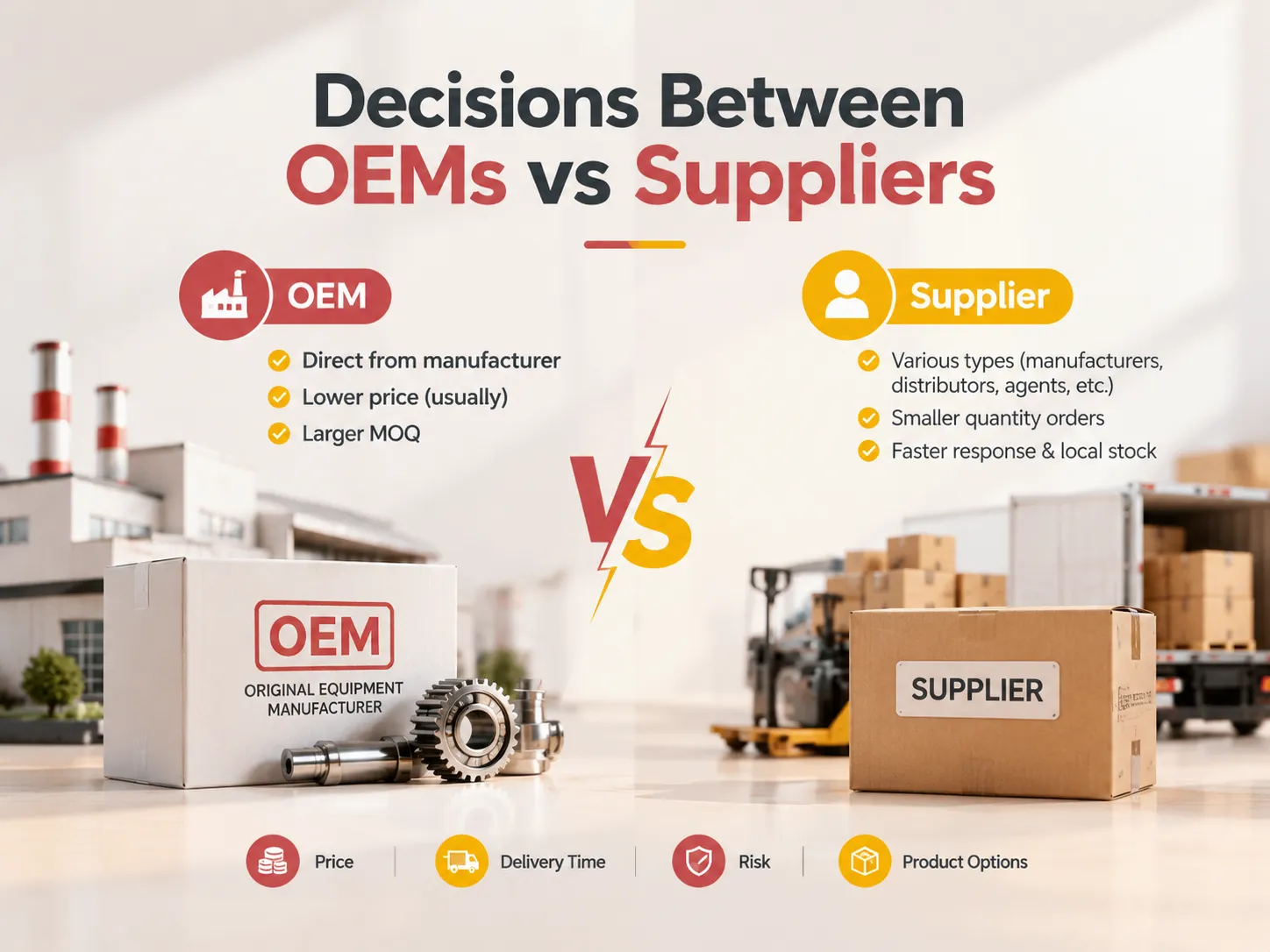
Eventualmente, toda pessoa que compra componentes em quantidade deve chegar a um ponto de decisão. Eles compram o componente diretamente do fabricante original do equipamento (OEM) ou os compram através de outra parte (fornecedor)? Esta parece ser uma questão simples relacionada à economia; no entanto, normalmente não é tão simples devido às convenções de nomenclatura que podem ser usadas ao lidar com OEMs e fornecedores. Existe potencial para má interpretação porque o nome OEM pode representar uma marca em uma embalagem de produto; no entanto, também pode se referir à instalação que fabrica o produto. Da mesma forma, o termo fornecedor também pode representar um fabricante, atacadista, corretor ou revendedor.
Esta entrada esclarece essa questão. Ela explorará os significados de OEM e fornecedor, sua origem, as implicações do uso de qualquer um dos termos em transações comerciais e como a escolha deve depender das circunstâncias do comprador, e não apenas dos números de vendas. Além disso, considerará qual fator contribui mais para o sucesso de todos os projetos, ou seja, quem tem autoridade para tomar decisões na unidade de compras que adquire o produto.
OEM significa a frase “original equipment manufacturer” (fabricante original do equipamento). Um OEM é uma empresa cujos produtos, especificações e marca(s) incluem peças de uma empresa específica, e comprar do OEM é um ato de obter o produto diretamente do seu fabricante, em vez de por meio de outra fonte (transações comerciais). Por outro lado, o termo fornecedor abrange todos os tipos de empresas ou pessoas que fornecem materiais, independentemente de serem empresas fabricantes ou empresas de distribuição que carregam uma variedade de marcas ou agentes comerciais ou de sourcing. Só porque você comprou do fabricante, não significa necessariamente que adquiriu a melhor qualidade. Você também deve levar em conta quem vai arcar com a possível perda do seu pedido. Normalmente, o preço que você paga ao comprar diretamente é menor; assim, a razão para ter um pedido mínimo de maior valor. Embora você possa receber o produto mais cedo, também terá prazos de entrega mais longos e arcará com a despesa logística de transportar seu pedido. Por outro lado, comprar via distribuidores pode permitir pedidos de menor quantidade, tempos de resposta mais rápidos e estoques localmente mantidos, mas ao mesmo tempo pode ter preços mais altos e oferecer menos opções de produtos e oportunidades de fornecedores.
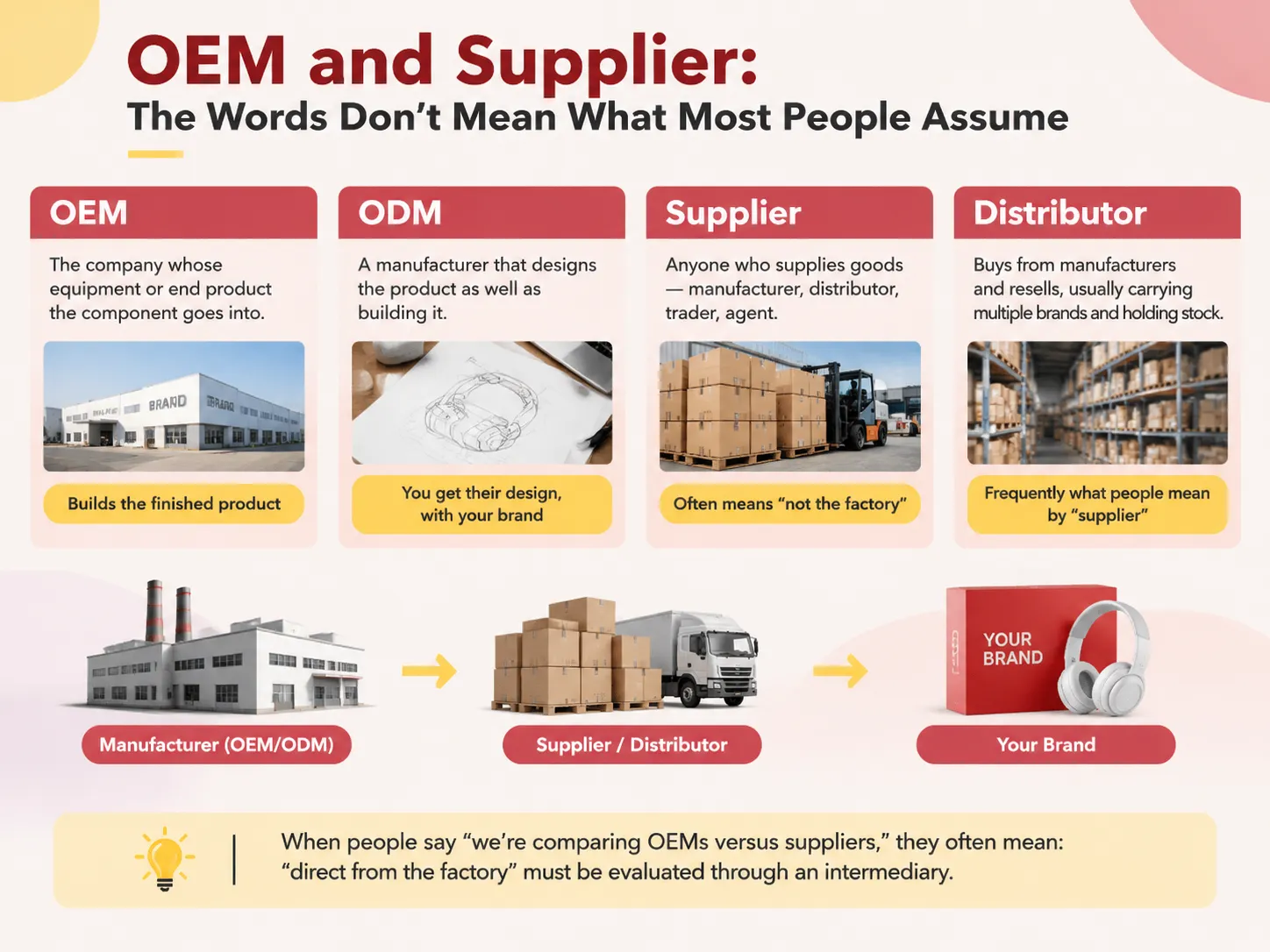
OEM e Fornecedor: As Palavras Não Significam o Que a Maioria das Pessoas Supõe
Vamos começar com as definições, porque todo o resto depende de entendê-las corretamente.
| Termo | Significado estrito | Como é usado na prática |
|---|---|---|
| OEM | Original Equipment Manufacturer — a empresa cujo equipamento ou produto final o componente integra, ou seja, a marca que vende o produto acabado | Frequentemente usado para significar “a fábrica que fabrica o produto”, particularmente na Ásia. “Comprar do OEM” geralmente significa comprar diretamente do fabricante |
| ODM | Original Design Manufacturer — um fabricante que projeta o produto além de construí-lo, que o comprador então marca com sua própria marca | A distinção em relação ao OEM é importante: com ODM você está comprando o design de outra pessoa com seu nome nele |
| Fornecedor | Qualquer pessoa que fornece bens — fabricante, distribuidor, comerciante, agente | Usado de forma vaga para significar “não a fábrica”, que é onde começa a confusão |
| Distribuidor | Um negócio que compra de fabricantes e revende, geralmente carregando múltiplas marcas e mantendo estoque | Frequentemente o que as pessoas querem dizer quando dizem “supplier” |
Quando mencionam “estamos comparando OEMs versus suppliers”, basicamente dizem: direto da fábrica deve ser avaliado através de um intermediário. Essa é a decisão que leva a um ato de desespero, e é basicamente sobre isso que o autor está falando.
Antes de entrarmos muito no assunto, outra complicação deve ser colocada na mesa. Existem dois usos opostos definidos para OEM suppliers. Por um lado, significa um fornecedor que vende para OEMs. Por outro, tende a implicar fornecedores que desempenham o impacto OEM — produzindo o produto esperado que carrega a marca de outra pessoa. Se você quiser a versão mais longa de como o modelo OEM realmente funciona comercialmente, a mecânica de contratação, propriedade de ferramentas e controle de marca estão explicadas nesta explicação de o que OEM significa e como funciona na prática, e vale a pena ler antes de entrar em uma negociação onde o outro lado está usando o termo de forma diferente da sua.
Quais Indústrias Usam Esses Termos, e Por Que Isso Muda o Significado
Essas expressões têm origens em diferentes indústrias, mas cada indústria as usa um pouco diferente uma da outra.
O setor automotivo é onde o termo “OEM” nasceu. Aqui essa expressão tem uma definição muito estrita. Agora OEM é visto como um fabricante de veículos — como Toyota, Volkswagen ou Ford. Fornecedores Tier 1 e Tier 2 são empresas que fornecem peças para eles, enquanto se uma empresa fabrica peças de acordo com um design OEM, ela é um fabricante contratado e não um OEM. No setor automotivo, peças OEM são entendidas como peças originais e autênticas feitas de acordo com as especificações da empresa que fabricou os veículos, em contraste com peças aftermarket feitas por outras empresas.
Em eletrônicos e bens de consumo, o significado de OEM mudou um pouco. Lá, é frequentemente usado como o nome de um fabricante contratado ou fábrica, enquanto ODM já projetou categorias inteiras de produtos. Normalmente, o logotipo na caixa não significa nada.
Em equipamentos elétricos, componentes industriais, produtos para construção, OEM está entre duas outras definições. O fabricante original do equipamento é uma fábrica real onde o design ocorre, a fábrica possui os certificados de tipo-teste e cumpre todas as normas internacionais. Existe mais uma camada abaixo dela, uma camada de distribuição após a qual há uma camada de montadores de painéis, integradores e empreiteiros.
Em tratamento de água, processamento de alimentos e certas outras indústrias, existe mais uma camada. É uma abordagem de distribuição multimarcas onde listas completas de materiais são construídas a partir de componentes de vários fabricantes. Essa abordagem é explicada em detalhes no estudo AXEON Supply, onde é afirmado que os distribuidores oferecem a conveniência de comprar várias marcas, mas cobram acréscimos de 15-40% em comparação com os preços do fabricante.
O que Realmente Muda na Transação
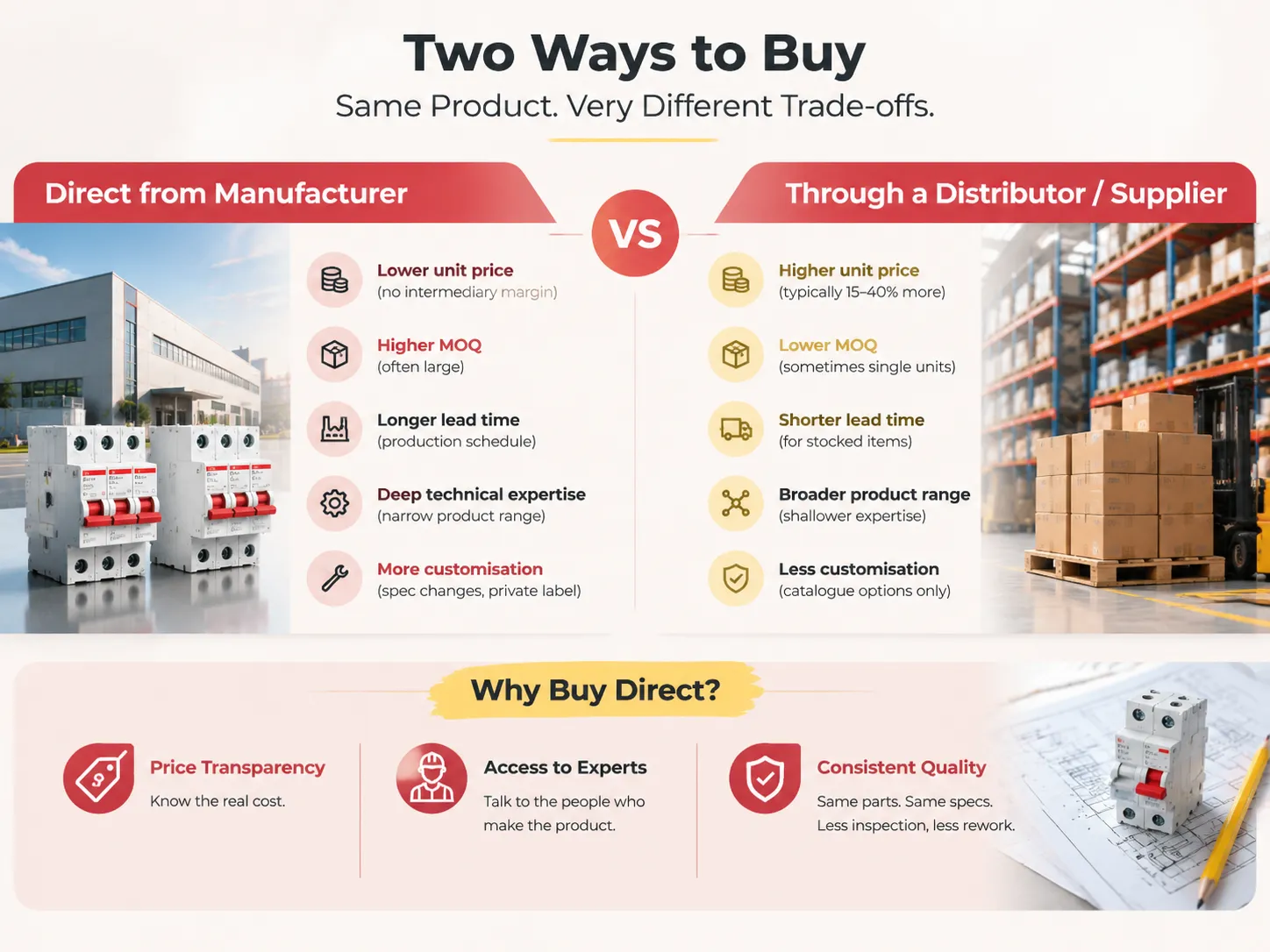
Retirando o vocabulário, a escolha se resume a seis diferenças práticas. Veja como elas se apresentam.
| Variável | Comprar diretamente de um fabricante | Comprar através de um distribuidor / fornecedor |
|---|---|---|
| Preço unitário | Mais baixo — sem margem intermediária | Mais alto — tipicamente 15–40% acima do preço do fabricante |
| Quantidade mínima de pedido | Frequentemente alta, às vezes muito alta | Baixa; às vezes unidades únicas |
| Prazo de entrega | Prazo de produção, medido em semanas | Mais curto para itens em estoque; mais longo para itens fora de estoque |
| Profundidade técnica | Profunda na sua própria linha de produtos, estreita entre categorias | Ampla, porém menos profunda, entre muitas marcas |
| Lista de materiais | Você a monta a partir de múltiplos relacionamentos com fabricantes | Fonte única pode cobrir várias linhas |
| Risk profile | You carry inventory and logistics risk | You carry price and availability risk |
| Customisation | Possible — spec changes, tooling, private label | Usually limited to catalogue options |
Establishing direct relationships with manufacturers allows you to gain three important advantages that can be difficult to acquire otherwise – price transparency, access to experts involved in the production process, and uniformity in the production specifications. The last advantage is particularly important: because the factory uses the same part and drawing it is possible to minimize quality inspection, and reduce rework.
Flexibility is the only thing you lose. In other words, factories are designed primarily to manufacture products rather than perform any resale activities. For a component like a miniature circuit breaker, where the product is standardised, type-tested and bought in volume, buying direct is usually the right structure — the technical questions are settled and what remains is price and availability, which is why a direct relationship with an MCB manufacturer tends to be the default for anyone buying in container quantities rather than boxes.
The reason distributors have existed is that the alternative is even more drastic. If you required eleven component types from six suppliers this month and four different ones next month, it would cost you more than the margin you are saving to manage six impersonal relationships across six factories. That is the crux of the validity of the distributor model, and it explains why industrial distribution has not yet been disintermediated despite claims to the contrary over decades.
How a Buyer Chooses: Start With Your Own Business Model
Most advice on “how to choose a supplier” gets it wrong by starting off with the supplier. That’s the wrong place to start. The first thing that you need to understand is your own business model because the model will determine what restrictions are hard and what are negotiable.
There are merely four key questions that you need to ask to resolve most of the cases.
- Does your name appear on the product? If you are selling under your own brand name, you are effectively the OEM. That dramatically alters the relations because now you will need the manufacturer that will produce according to your requirements and wait for you to brand it the way you want. If, on the contrary, you are acquiring a product that bears someone else’s brand name, you will just be a distributor with very different relationships with your suppliers.
- Do you need to modify product specifications? If the product you are buying matches your requirements, then you are mainly dealing with commercial issues. If you need another specification, then you should establish the manufacturing relations with the producer because the distributor will not be able to modify the product.
- What is your cash conversion cycle? You need to understand that making purchases directly requires larger quantities ordered ahead because all the expenses are met at once. If you can secure cash for future orders, then it is cheaper to acquire goods directly. If not, then you may rely on retailers.
- What is the level of risk with regard to different types of technologies? If the technical specifications are clear for you, take the risk and buy cheaper. If not, you will have to rely on the help of experts in manufacturing processes. Companies that run their own design, testing and manufacturing tend to be the ones who can answer a technical question with an answer rather than a datasheet, and in-house R&D and manufacturing capability is the thing to look for when that’s what you need.
The Private-Label Question
A common theme in nearly every OEM-supplier decision made happens to be about whether or not you want your brand on the product; which is why it deserves mentioning in its own section as it is often more critical than price.
Private label (or own-brand, white label, or OEM branding) is when a manufacturer produces an item that is branded with your brand name, packaging, part numbers and sometimes including your own documentation. This practice is very common in electrical parts, tools and wire accessories and even products sold in the industry, as well; this type of service acts as a clear indicator that the requisite relationship is manufacturing based, rather than simply distribution based, since distribution companies can’t put a brand on what they are not making.
Before agreeing to private label, however, you should first consider what it means to do so and how much it costs to use this option.
| Level of customisation | What changes | Typical implications |
|---|---|---|
| Own-brand packaging | Cartons, labels, inserts | Lowest barrier; often a minimum print run rather than a minimum product run |
| Own branding on product | Moulded or printed name, part numbers | Requires tooling changes — engraving, inserts or new moulds |
| Own specification | Rating, material, dimensions, features | Engineering work, new testing, potentially new certification |
| Own design | The product is yours; the factory builds it | You own the design and its IP; the factory becomes a contract manufacturer |
Here are three areas where people may get confused. First, certification stays with the product and not necessarily with the brand name. If your version of the product is different from the certified one, the certification is probably no longer valid and even new testing will be required. Second, who owns the tooling must also be established in writing before starting to work on product. Also, the MOQ refers to the item under private label, not just the product itself. Thus, having a product with a low MOQ but a packaging with a high one essentially means you have a high MOQ product.
If you end up not needing all four levels of certification, you should get this resolved too. The reason is that paying for certification which you do not require is one of the major reasons why even small companies get far worse deals in comparison with manufacturers.
How a Supplier Gets Onto an Approved Vendor List
Buyers are serious in their search for suppliers and in fact do not stop when they choose a supplier. They continue to look for and build their list of approved suppliers and buy from them afterwards. If you understand what the qualification process means, you will understand what you need to prepare for. This also makes the distinction between a manufacturer and a trading company that uses a manufacturer as its name.
The documents setting these criteria are the same for all industries. They include:
- Management system certificates. Certificates such as ISO 9001 with a scope statement must be checked as well. If a certificate covers trade and distribution, it cannot be compared with the one covering design and manufacture.
- Product certificates and type test reports. These certificates must be from recognized bodies, current and traceable to the actual product rather than similar products in its family.
- Factory audit/assessment. This could be either a third-party social audit or a process audit conducted by the customer. This is the stage that many trading companies cannot reach.
- Material and process documentation. Devices such as RoHS and REACH declarations, material certificates and certificates enabling batch traceability.
- Change notifications. This is the contractual obligation of customer to inform about changes in material, supplier or location as most field failures are caused by unannounced changes.
The certification kit is frequently the quickest method for sorting through various options because it is publicly available and can be verified rather than being self-reported. If you want to see what a documented compliance package looks like from a manufacturer rather than a reseller, the certificate and approval records published by a supplier are a fair test of that — a genuine manufacturer will have product certificates and approval documents that name its own legal entity and its own factory address, and a trading company usually won’t.
When the Chief Engineer Outranks Procurement
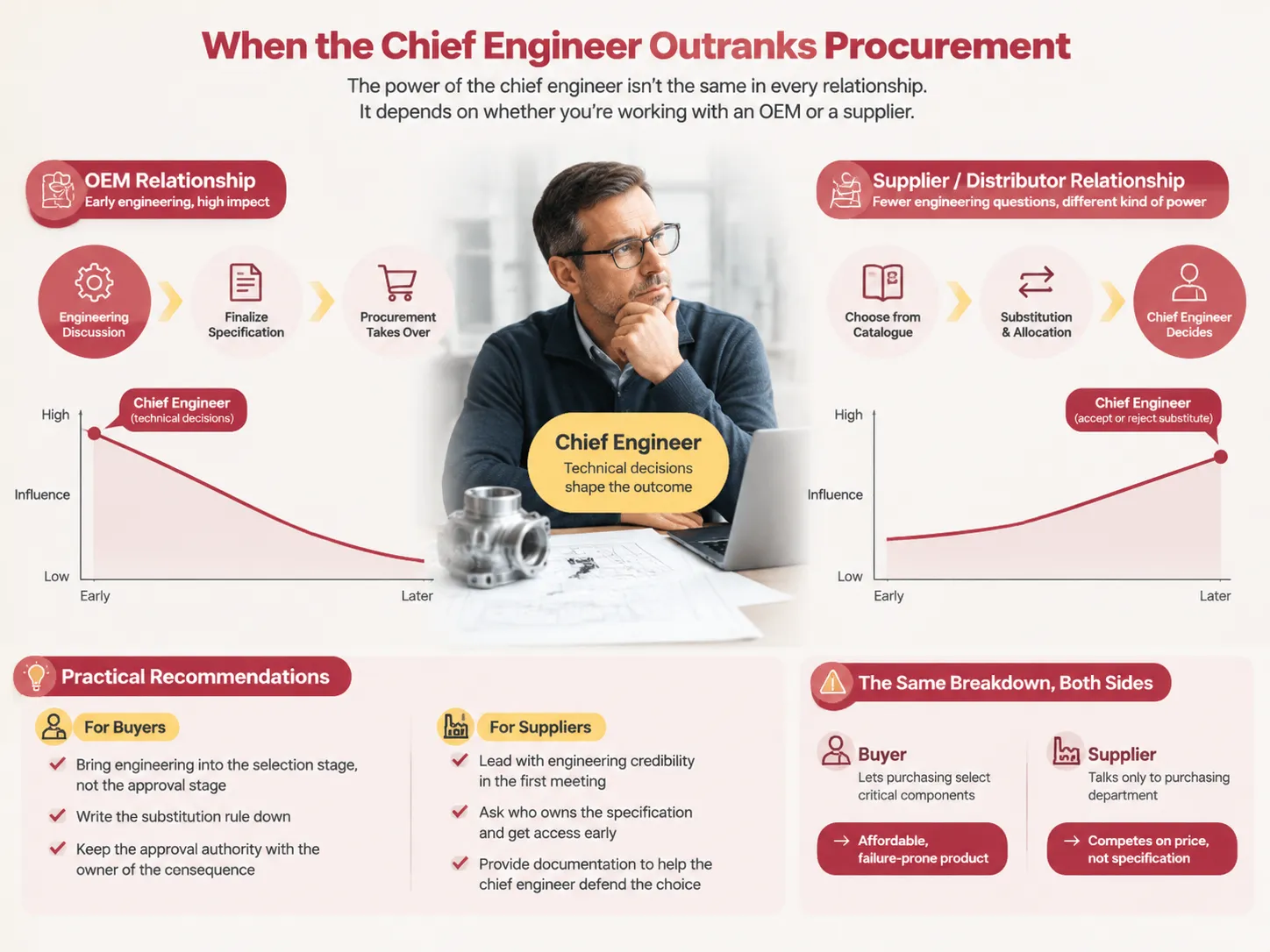
This paragraph explains something that can influence sourcing even more than pricing and it is usually not publicly documented: the power of the chief engineer differs among OEM and supplier relationships.
In the case of OEM relationships, an engineering discussion takes place early, and it has some substance; the engineers from the factory and from the customer agree on ratings, tolerances, materials, interface, and test criteria. At this time, the chief engineer experiences maximum impact because these matters belong to the technical field and cannot be evaluated by the procurement department. After the finalization of the specification and the release of the drawings, the power of the chief engineer drops exponentially since the matter becomes commercial, and all further questions become the domain of procurement. In other words, the power of the chief engineer is frontloaded in the case of OEM relationships. Make things work properly at the beginning or no chance to fix them during a product’s lifetime.
The situation is different with supplier or distributor relationships. There are fewer engineering-related questions because one can choose from a catalogue, so there are fewer decisions for engineers. However, the different type of power appears there — the authority to accept the substitute. When the item goes into allocation, when the brand stops being manufactured, or when the distributor offers an equivalent item, somebody has to make a decision about the unacceptableness of an equivalent solution. In practice, the task falls on the chief engineer’s shoulders; in reality it is a true decision that may have true consequences, as the part of a different engineering design may have a problem while remaining efficient on paper.
So practical recommendation is:
| If you’re the buyer | If you’re the supplier |
|---|---|
| Bring engineering into the selection stage, not the approval stage — by the time a part is approved, the leverage is gone | Lead with engineering credibility rather than price in the first meeting; it’s what opens the technical door |
| Write the substitution rule down: who can approve an alternative, and against what criteria | Ask who technically owns the specification, and get access to them early |
| Keep the approval authority with whoever owns the consequence of a failure | Provide documentation that lets a chief engineer defend the choice internally |
The breakdown type is identical on both sides. A purchaser who allows their purchasing department to select the critical components ends up with an affordable failure-prone product. A vendor who communicates solely with the purchasing department loses the opportunity to be specified and thus can only compete on a price-per-unit basis with vendors whose products have already been technically approved.
Second-Sourcing, and What It Costs You
There is one more question which haunts engineering and purchasing departments alike: should you second-source once you have made a choice?
There is good reason for doing it – one can fail if the parts you need are exclusively coming from a single source. The history of the industry offers numerous examples in this regard, including cases when an explosion at a factory or closure of a port resulted in trouble with a particular part for which there was no alternative. The process of finding a second supplier can help you with securing your procurement process and most procurement rules nowadays insist on having a backup producer for critical parts in place.
What seems to be less discussed is the cost of finding a second source. You have to carry out the same amount of work in terms of auditing and reporting as with the existing supplier all over again, not to mention that having two suppliers for a specific product reduces the volume purchased from each of them and makes them behave unfavorably from the price perspective. In addition to this, you are introducing variation into your processes which will lead to problems with both incoming quality checks and with failure analysis.
The good approach many experienced purchasing agents may advise is avoiding the practice of resorting to second sourcing in cases when it is not absolutely necessary. You may choose to second-source something that is expensive or hard to produce and you might have to pay for your peace of mind. In the cases of commodities you choose one supplier and have the capacity of switching suppliers fast enough.
One of the things that makes choosing the suppliers much easier is finding a manufacturer with an open technical department that utilizes reachable technology and is not reluctant to discuss substitutions. If the response of the prospective supplier to any technical questions is that they should check with the production, the second sourcing process becomes a real headache. That’s a good reason to look at how a manufacturer supports its supply relationships before you need the flexibility, rather than after.
Risks on Both Sides
Neither model is safe by default. Here’s the honest failure mode of each.
| Modelo | Characteristic failure | Warning sign |
|---|---|---|
| Direct from manufacturer | Over-committed inventory when demand shifts; long lead times turn a forecast error into a cash problem | You’re ordering to hit a price break rather than to meet demand |
| Direct from manufacturer | Unannounced process, material or sub-supplier changes | No written change-notification clause in the contract |
| Through a distributor | Paying 15–40% for convenience you don’t actually use | You’re still managing three distributors for one bill of materials |
| Through a distributor | Substitution creep — “equivalent” parts that aren’t | No documented approval process for alternatives |
| Either | Loss of technical support at the moment you need it most | You can’t reach an engineer, only an account manager |
If there is one point to be taken away from this part, it is the importance of the change-notification clause. The unauthorized substitution of materials and subcontractor suppliers is one of the leading causes of field failure in components that were qualified correctly, and covering it through a contractual clause is not expensive.
FAQ
What is the difference between OEM and supplier?
An OEM (original equipment manufacturer) is a participant in business, who manufactures parts or goods that are labeled by other manufacturer’s brands. The term supplier is larger, and can represent any entity that provides goods or services, such as a manufacturer, distributor or sourcing agent. The main difference is in risk assumption: while direct manufacturer provides lesser prices, more detailed support and greater control over specifications, this approach requires placing higher order quantities and exposes buyer to logistics risks, whereas partnership with distributors typically allows for lower quantities and faster deliveries along with 15-40% margins added.
What are the top 10 OEMs?
There is no definite reply since “top” varies according to the industry of interest. Considering the criteria of sales of global OEM companies, there appear to be clear winners such as Toyota and Volkswagen, in the next line are Samsung Electronics, Apple, General Motors, Ford, Mercedes-Benz Group, BMW Group, Honda Motor and Hyundai Motor Group. However, switch gears to specifically automotive production and the names of top companies appear to change. Include industrial electrical equipment production in the measurement and you will have names like ABB, Schneider Electric, Siemens and Honeywell as leading companies in the industry. Hence, it would be more meaningful to ask “Who are the top 10 OEMs” than “which industry of the given companies leads in various aspects?”.
What does “OEM supplier” mean?
The term is understood in two contradictory ways, hence the confusion. More often, OEM refers to a supplier of components to the final product manufacturers – that is, in this version the clientele are producers of finished goods. The term is used in the less common sense, when an OEM is a supplier that manufactures products under the name of the buyer rather than its own name. Once you spot the term in a contract or a supplier’s list, you need to think whether it applies in the first or in the second meaning, as the qualification and commercial terms differ for both meanings of the term.
Who are OEM suppliers?
OEM suppliers are firms that supply parts, assemblies, or services to producers of final products. They vary in scale, from Tier 1 suppliers who offer full systems to automotive plants, to contract manufacturers who produce branded products from client designs to component producers who manufacture things such as switches, fittings, or electronics that are incorporated into others’ products. The emphasis is not on the size or type of the product but on the direction of the relationship — as OEMs supply products to firms who take credit for them.
Referências
- AXEON Supply — OEMs vs Distributors: How AXEON Supply Simplifies Bulk Ordering & Fulfillment — distributor markups, MOQs and blanket order practice
- ISO 9001 Quality Management — the baseline management system standard for supplier qualification
- UL Solutions — product certification and type testing for electrical equipment
- International Electrotechnical Commission — international standards for electrical components
- International Energy Agency — global industrial and energy supply chain data
- Thomasnet — North American supplier and manufacturer directory
Conclusão
When it comes time for OEMs to choose their suppliers, they are often told that price will determine their decision, however this is clearly incorrect. The relevant factor is not the relative cost of the products, rather the amount of risk that they are comfortable taking on.
Direct Contact with Manufacturer: With regard to having specifications in place, brand name on the product, production documentation control, receiving the lowest sustainable unit cost and having engineers that can help you when the product specification sheet does not provide enough information – contacting the manufacturer is your best choice. You will also need to accept larger minimum order quantities, longer wait times, and an obligation for the inventory and logistics of your order.
Going through a Distributor: On the other hand, working with a distributor will give you the fastest time to delivery, greater product selection, ability to purchase small quantities, and if the cost of managing numerous factory relationships outweighs your expected savings, then it is clearly in your best interest to work with a distributor. However there will be trade-offs in terms of additional markup, lower quality of technical service, and the need to verify that the “equivalent” product that you purchase meets the original product’s specs, etc.
Two things will determine the outcome in this regard – first, prior to placing an order, make certain that the specifications are correct, because the technical influence of the supplier relationship will decline dramatically post order placement; and second, establish a process for approval of any substitutions and/or notification of any changes — these two items will result in greater savings than attempting to negotiate even a few percentage points off the unit cost of the product. Regardless of the option you pursue, it is important to have the correct qualification process in place in order to ensure that you have selected suppliers based upon verified documentation, actual factory evaluation and documented change control rather than just on the quoted unit price provided in your first email.