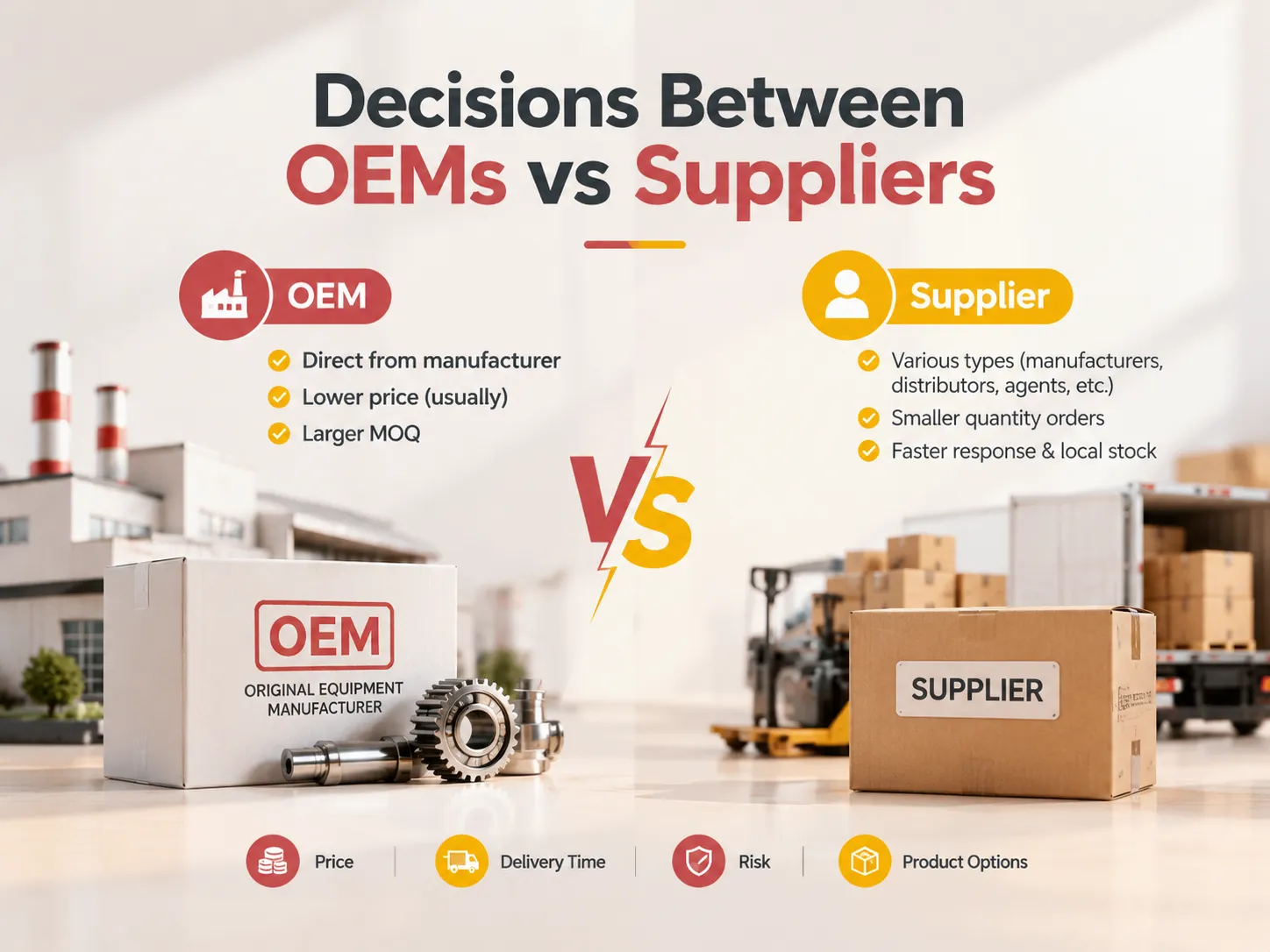
Cuối cùng, mỗi người mua linh kiện với số lượng lớn đều phải đến một điểm quyết định. Họ có mua linh kiện trực tiếp từ nhà sản xuất thiết bị gốc (OEM) hay mua qua một bên khác (nhà cung cấp)? Đây có vẻ là một câu hỏi đơn giản liên quan đến kinh tế; tuy nhiên, thường không đơn giản như vậy do các quy ước đặt tên có thể được sử dụng khi làm việc với OEM và nhà cung cấp. Có khả năng hiểu sai vì tên OEM có thể đại diện cho tên thương hiệu trên bao bì sản phẩm; tuy nhiên, nó cũng có thể chỉ cơ sở sản xuất sản phẩm. Tương tự, thuật ngữ nhà cung cấp cũng có thể đại diện cho nhà sản xuất, nhà bán buôn, môi giới hoặc người bán lại.
Bài viết này làm rõ vấn đề này. Nó sẽ khám phá ý nghĩa của OEM và nhà cung cấp, nguồn gốc của chúng, những hệ quả khi sử dụng từng thuật ngữ trong giao dịch kinh doanh, và cách lựa chọn nên dựa trên hoàn cảnh của người mua thay vì chỉ dựa vào số liệu bán hàng. Ngoài ra, nó sẽ xem xét yếu tố nào đóng góp nhiều nhất vào thành công của tất cả các dự án, đó là ai có quyền quyết định trong đơn vị mua hàng mua sản phẩm.
OEM là viết tắt của cụm từ “original equipment manufacturer” (nhà sản xuất thiết bị gốc). OEM là công ty có sản phẩm, thông số kỹ thuật và thương hiệu bao gồm các bộ phận của một công ty cụ thể, và việc mua từ OEM là hành động lấy sản phẩm trực tiếp từ nhà sản xuất thay vì qua nguồn khác (giao dịch thương mại). Ngược lại, thuật ngữ nhà cung cấp bao gồm tất cả các loại công ty hoặc cá nhân cung cấp vật liệu, bất kể họ là công ty sản xuất hay công ty phân phối mang nhiều thương hiệu hoặc đại lý thương mại hoặc nguồn cung ứng. Chỉ vì bạn mua từ nhà sản xuất không nhất thiết có nghĩa là bạn đã mua chất lượng tốt nhất. Bạn cũng phải tính đến ai sẽ chịu tổn thất tiềm năng trên đơn hàng của bạn. Thông thường, giá bạn trả khi mua trực tiếp sẽ thấp hơn; do đó có lý do cho việc đặt đơn hàng tối thiểu có giá trị lớn hơn. Mặc dù bạn có thể nhận sản phẩm sớm hơn, bạn cũng sẽ có thời gian giao hàng lâu hơn và chịu chi phí vận chuyển đơn hàng. Ngược lại, mua qua nhà phân phối có thể cho phép đặt hàng số lượng nhỏ hơn, thời gian phản hồi nhanh hơn và tồn kho tại địa phương, nhưng đồng thời có thể có giá cao hơn và cung cấp ít lựa chọn sản phẩm và cơ hội nhà cung cấp hơn.
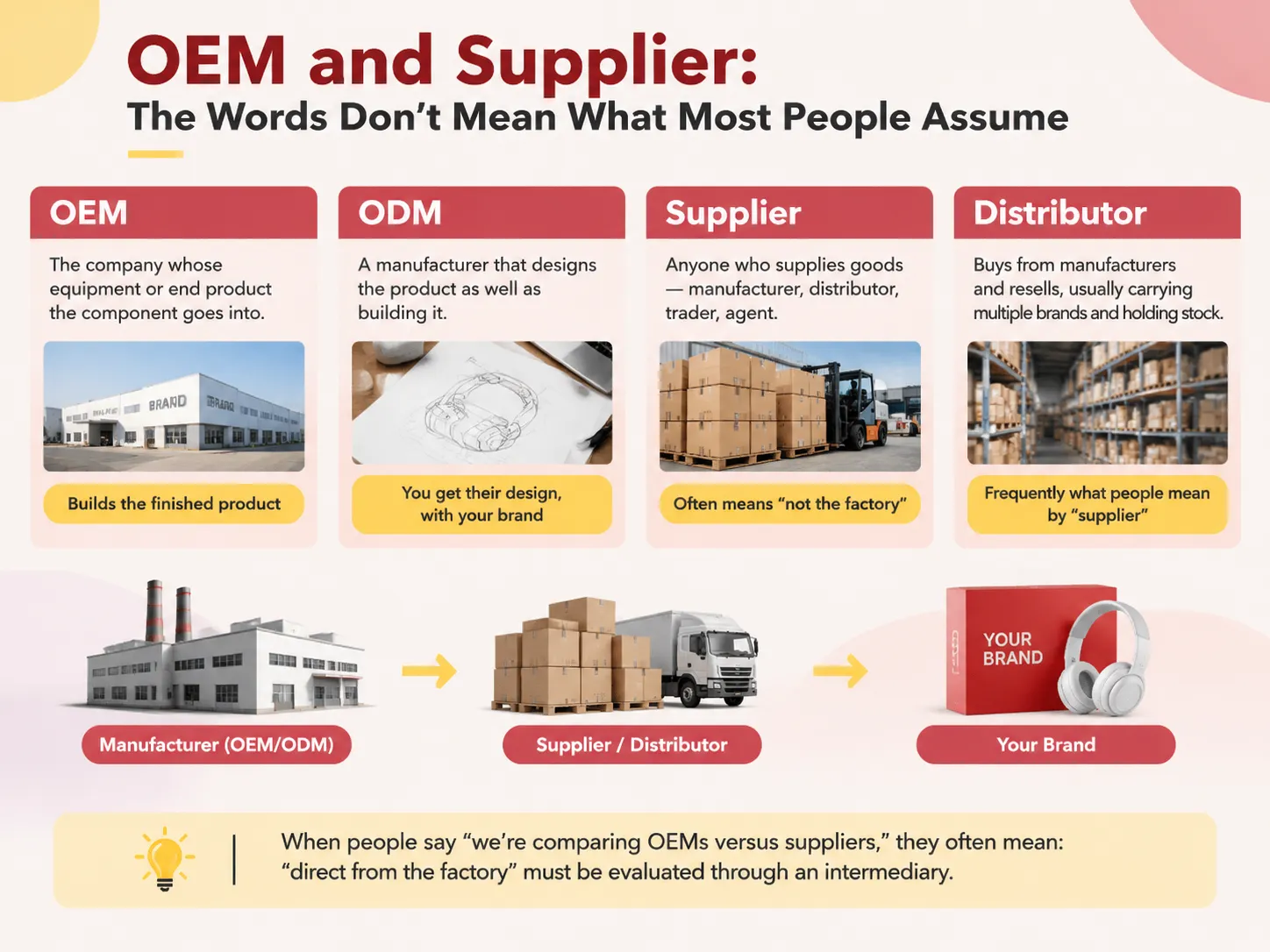
OEM và Nhà Cung Cấp: Những Từ Ngữ Không Có Nghĩa Như Phần Lớn Mọi Người Nghĩ
Hãy bắt đầu với định nghĩa, vì mọi thứ khác phụ thuộc vào việc hiểu đúng chúng.
| Thuật ngữ | Nghĩa chính xác | Cách sử dụng trong thực tế |
|---|---|---|
| OEM | Nhà sản xuất thiết bị gốc — công ty mà thiết bị hoặc sản phẩm cuối cùng mà linh kiện được lắp vào, tức là thương hiệu bán sản phẩm hoàn chỉnh | Thường được dùng để chỉ “nhà máy sản xuất sản phẩm,” đặc biệt ở châu Á. “Mua từ OEM” thường có nghĩa là mua trực tiếp từ nhà sản xuất. |
| ODM | Nhà sản xuất thiết kế gốc — một nhà sản xuất thiết kế sản phẩm cũng như xây dựng nó, sau đó người mua sẽ gắn thương hiệu của mình lên sản phẩm đó | Sự phân biệt với OEM rất quan trọng: với ODM, bạn đang mua thiết kế của người khác nhưng mang tên của bạn |
| Nhà cung cấp | Bất kỳ ai cung cấp hàng hóa — nhà sản xuất, nhà phân phối, thương nhân, đại lý | Được sử dụng một cách lỏng lẻo để chỉ “không phải nhà máy,” đó là nơi bắt đầu sự nhầm lẫn |
| Nhà phân phối | Một doanh nghiệp mua từ các nhà sản xuất và bán lại, thường mang nhiều thương hiệu và giữ hàng tồn kho | Thường là ý nghĩa mà mọi người muốn nói khi họ nói “nhà cung cấp” |
Khi họ đề cập “chúng tôi đang so sánh OEM với nhà cung cấp,” về cơ bản họ nói: mua trực tiếp từ nhà máy phải được đánh giá qua một bên trung gian. Đó là quyết định dẫn đến hành động tuyệt vọng, và đó chính là điều tác giả đang nói đến.
Trước khi đi sâu vào chi tiết, một phức tạp khác cần được đưa ra. Có hai cách định nghĩa trái ngược về nhà cung cấp OEM. Một mặt, nó có nghĩa là nhà cung cấp bán cho OEM. Mặt khác, nó thường ngụ ý các nhà cung cấp đóng vai trò OEM — sản xuất sản phẩm theo yêu cầu mang thương hiệu của người khác. Nếu bạn muốn phiên bản dài hơn về cách mô hình OEM hoạt động thương mại, cơ chế hợp đồng, quyền sở hữu công cụ và kiểm soát thương hiệu được trình bày trong giải thích này về ý nghĩa của OEM và cách nó hoạt động trong thực tế, và đáng để đọc trước khi bạn bước vào một cuộc đàm phán mà bên kia sử dụng thuật ngữ khác với bạn.
Các ngành công nghiệp nào sử dụng các thuật ngữ này, và tại sao nó thay đổi ý nghĩa
Những cụm từ này có nguồn gốc từ các ngành công nghiệp khác nhau, nhưng mỗi ngành sử dụng chúng hơi khác nhau.
Ngành công nghiệp ô tô là nơi thuật ngữ “OEM” ra đời. Ở đây cụm từ này có định nghĩa rất nghiêm ngặt. Hiện nay OEM được xem là nhà sản xuất xe — như Toyota, Volkswagen hoặc Ford. Các nhà cung cấp cấp 1 và cấp 2 là các công ty cung cấp linh kiện cho họ, trong khi nếu một công ty sản xuất linh kiện theo thiết kế của OEM, thì đó là nhà sản xuất hợp đồng chứ không phải OEM. Trong ngành ô tô, linh kiện OEM được hiểu là linh kiện chính hãng và nguyên bản được sản xuất theo thông số kỹ thuật của công ty sản xuất xe, trái ngược với linh kiện hậu mãi do các công ty khác sản xuất.
Trong lĩnh vực điện tử và hàng tiêu dùng, ý nghĩa của OEM đã thay đổi một chút. Ở đó, nó thường được sử dụng như tên của nhà sản xuất hợp đồng hoặc nhà máy trong khi ODM đã thiết kế toàn bộ các loại sản phẩm. Thông thường logo trên hộp không có ý nghĩa gì cả.
Trong thiết bị điện, linh kiện công nghiệp, sản phẩm xây dựng, OEM nằm giữa hai định nghĩa khác nhau. Nhà sản xuất thiết bị gốc là một nhà máy thực sự nơi thiết kế được thực hiện, nhà máy có chứng nhận thử nghiệm loại và tuân thủ tất cả các tiêu chuẩn quốc tế. Có một tầng nữa bên dưới, là tầng phân phối, sau đó là tầng các nhà xây dựng bảng điều khiển, tích hợp và nhà thầu.
Trong xử lý nước, chế biến thực phẩm và một số ngành khác, còn có một tầng nữa. Đây là một phương pháp phân phối đa thương hiệu, trong đó toàn bộ bảng kê vật liệu được xây dựng từ các thành phần của nhiều nhà sản xuất khác nhau. Phương pháp này được giải thích chi tiết trong nghiên cứu AXEON Supply, nơi nêu rõ rằng các nhà phân phối cung cấp sự tiện lợi khi mua nhiều thương hiệu nhưng tính phí tăng giá 15-40% so với giá của nhà sản xuất.
Những Thay Đổi Thực Sự Trong Giao Dịch
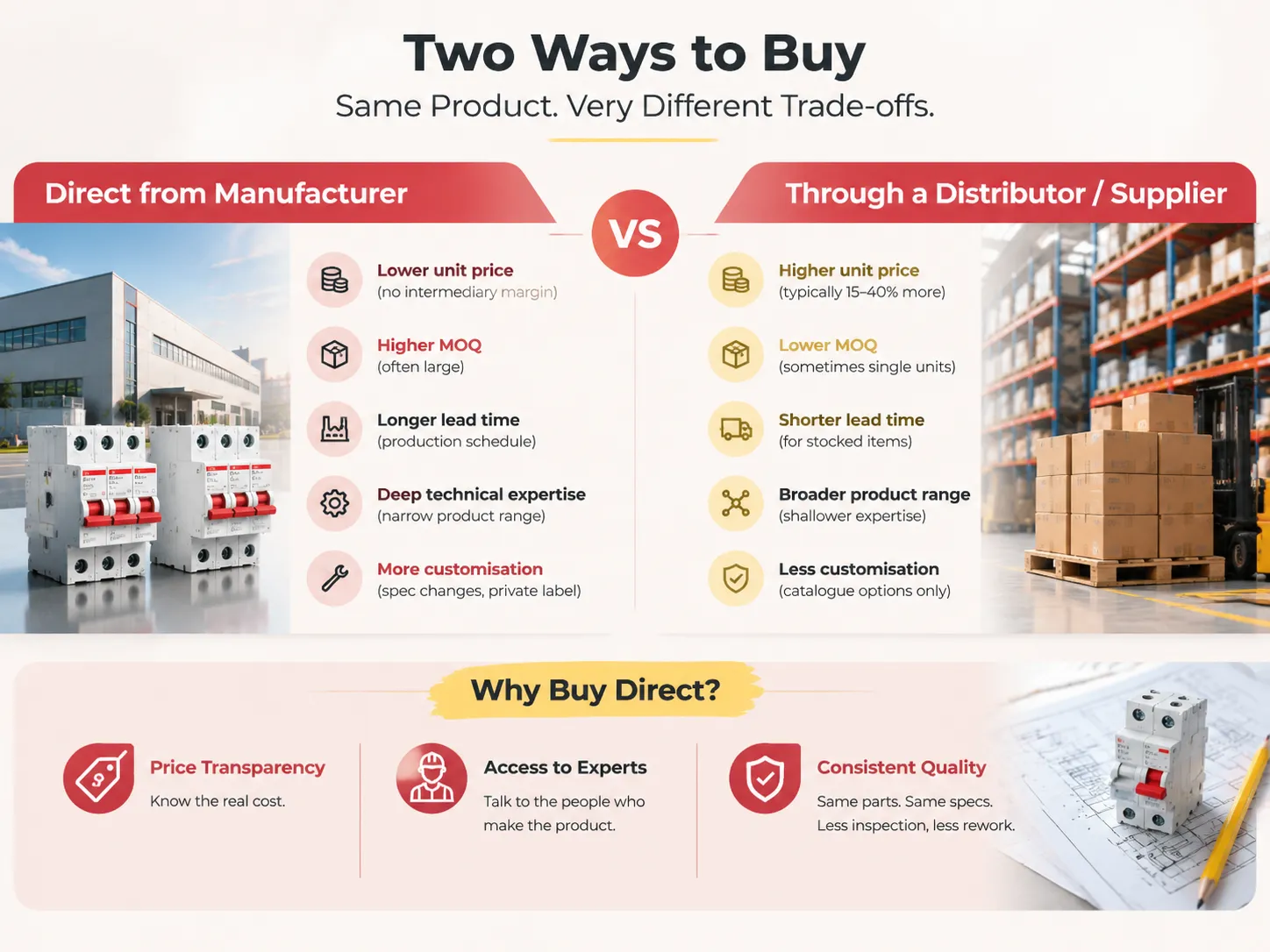
Loại bỏ thuật ngữ chuyên ngành và lựa chọn được thu gọn thành sáu điểm khác biệt thực tế. Dưới đây là cách chúng diễn ra.
| Biến số | Mua trực tiếp từ nhà sản xuất | Mua qua nhà phân phối / nhà cung cấp |
|---|---|---|
| Giá đơn vị | Thấp hơn — không có biên lợi nhuận trung gian | Cao hơn — thường là 15–40% trên giá nhà sản xuất |
| Số lượng đặt hàng tối thiểu | Thường cao, đôi khi rất cao | Thấp; đôi khi chỉ một đơn vị |
| Thời gian giao hàng | Thời gian sản xuất, tính bằng tuần | Ngắn hơn đối với hàng tồn kho; dài hơn đối với hàng không tồn kho |
| Độ sâu kỹ thuật | Sâu về phạm vi sản phẩm riêng của họ, hẹp trên các danh mục | Rộng nhưng nông hơn trên nhiều thương hiệu |
| Bảng kê vật liệu | Bạn lắp ráp nó từ nhiều mối quan hệ với nhà sản xuất | Một nguồn duy nhất có thể bao phủ nhiều dòng sản phẩm |
| Risk profile | You carry inventory and logistics risk | You carry price and availability risk |
| Customisation | Possible — spec changes, tooling, private label | Usually limited to catalogue options |
Establishing direct relationships with manufacturers allows you to gain three important advantages that can be difficult to acquire otherwise – price transparency, access to experts involved in the production process, and uniformity in the production specifications. The last advantage is particularly important: because the factory uses the same part and drawing it is possible to minimize quality inspection, and reduce rework.
Flexibility is the only thing you lose. In other words, factories are designed primarily to manufacture products rather than perform any resale activities. For a component like a miniature circuit breaker, where the product is standardised, type-tested and bought in volume, buying direct is usually the right structure — the technical questions are settled and what remains is price and availability, which is why a direct relationship with an MCB manufacturer tends to be the default for anyone buying in container quantities rather than boxes.
The reason distributors have existed is that the alternative is even more drastic. If you required eleven component types from six suppliers this month and four different ones next month, it would cost you more than the margin you are saving to manage six impersonal relationships across six factories. That is the crux of the validity of the distributor model, and it explains why industrial distribution has not yet been disintermediated despite claims to the contrary over decades.
How a Buyer Chooses: Start With Your Own Business Model
Most advice on “how to choose a supplier” gets it wrong by starting off with the supplier. That’s the wrong place to start. The first thing that you need to understand is your own business model because the model will determine what restrictions are hard and what are negotiable.
There are merely four key questions that you need to ask to resolve most of the cases.
- Does your name appear on the product? If you are selling under your own brand name, you are effectively the OEM. That dramatically alters the relations because now you will need the manufacturer that will produce according to your requirements and wait for you to brand it the way you want. If, on the contrary, you are acquiring a product that bears someone else’s brand name, you will just be a distributor with very different relationships with your suppliers.
- Do you need to modify product specifications? If the product you are buying matches your requirements, then you are mainly dealing with commercial issues. If you need another specification, then you should establish the manufacturing relations with the producer because the distributor will not be able to modify the product.
- What is your cash conversion cycle? You need to understand that making purchases directly requires larger quantities ordered ahead because all the expenses are met at once. If you can secure cash for future orders, then it is cheaper to acquire goods directly. If not, then you may rely on retailers.
- What is the level of risk with regard to different types of technologies? If the technical specifications are clear for you, take the risk and buy cheaper. If not, you will have to rely on the help of experts in manufacturing processes. Companies that run their own design, testing and manufacturing tend to be the ones who can answer a technical question with an answer rather than a datasheet, and in-house R&D and manufacturing capability is the thing to look for when that’s what you need.
The Private-Label Question
A common theme in nearly every OEM-supplier decision made happens to be about whether or not you want your brand on the product; which is why it deserves mentioning in its own section as it is often more critical than price.
Private label (or own-brand, white label, or OEM branding) is when a manufacturer produces an item that is branded with your brand name, packaging, part numbers and sometimes including your own documentation. This practice is very common in electrical parts, tools and wire accessories and even products sold in the industry, as well; this type of service acts as a clear indicator that the requisite relationship is manufacturing based, rather than simply distribution based, since distribution companies can’t put a brand on what they are not making.
Before agreeing to private label, however, you should first consider what it means to do so and how much it costs to use this option.
| Level of customisation | What changes | Typical implications |
|---|---|---|
| Own-brand packaging | Cartons, labels, inserts | Lowest barrier; often a minimum print run rather than a minimum product run |
| Own branding on product | Moulded or printed name, part numbers | Requires tooling changes — engraving, inserts or new moulds |
| Own specification | Rating, material, dimensions, features | Engineering work, new testing, potentially new certification |
| Own design | The product is yours; the factory builds it | You own the design and its IP; the factory becomes a contract manufacturer |
Here are three areas where people may get confused. First, certification stays with the product and not necessarily with the brand name. If your version of the product is different from the certified one, the certification is probably no longer valid and even new testing will be required. Second, who owns the tooling must also be established in writing before starting to work on product. Also, the MOQ refers to the item under private label, not just the product itself. Thus, having a product with a low MOQ but a packaging with a high one essentially means you have a high MOQ product.
If you end up not needing all four levels of certification, you should get this resolved too. The reason is that paying for certification which you do not require is one of the major reasons why even small companies get far worse deals in comparison with manufacturers.
How a Supplier Gets Onto an Approved Vendor List
Buyers are serious in their search for suppliers and in fact do not stop when they choose a supplier. They continue to look for and build their list of approved suppliers and buy from them afterwards. If you understand what the qualification process means, you will understand what you need to prepare for. This also makes the distinction between a manufacturer and a trading company that uses a manufacturer as its name.
The documents setting these criteria are the same for all industries. They include:
- Management system certificates. Certificates such as ISO 9001 with a scope statement must be checked as well. If a certificate covers trade and distribution, it cannot be compared with the one covering design and manufacture.
- Product certificates and type test reports. These certificates must be from recognized bodies, current and traceable to the actual product rather than similar products in its family.
- Factory audit/assessment. This could be either a third-party social audit or a process audit conducted by the customer. This is the stage that many trading companies cannot reach.
- Material and process documentation. Devices such as RoHS and REACH declarations, material certificates and certificates enabling batch traceability.
- Change notifications. This is the contractual obligation of customer to inform about changes in material, supplier or location as most field failures are caused by unannounced changes.
The certification kit is frequently the quickest method for sorting through various options because it is publicly available and can be verified rather than being self-reported. If you want to see what a documented compliance package looks like from a manufacturer rather than a reseller, the certificate and approval records published by a supplier are a fair test of that — a genuine manufacturer will have product certificates and approval documents that name its own legal entity and its own factory address, and a trading company usually won’t.
When the Chief Engineer Outranks Procurement
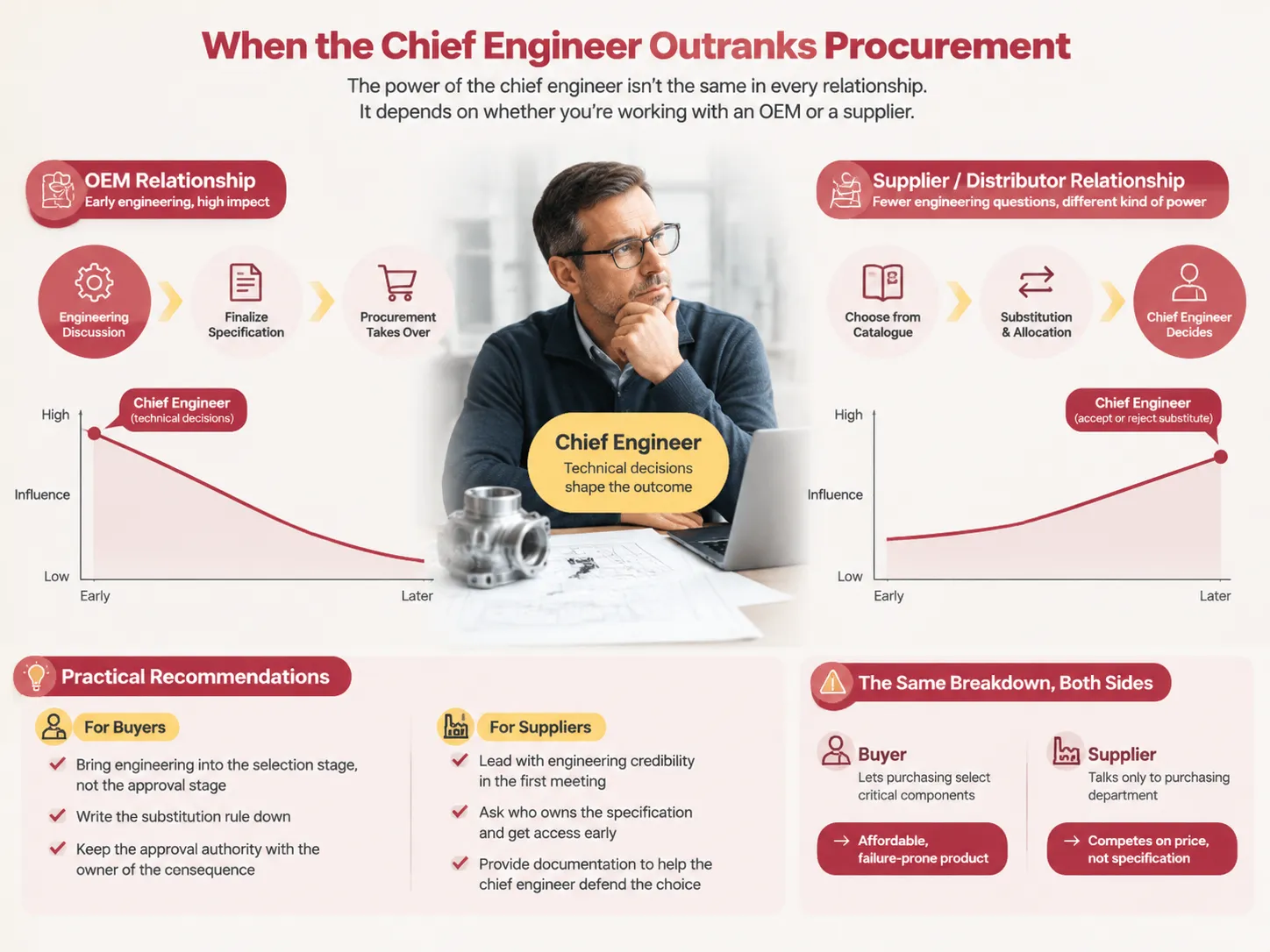
This paragraph explains something that can influence sourcing even more than pricing and it is usually not publicly documented: the power of the chief engineer differs among OEM and supplier relationships.
In the case of OEM relationships, an engineering discussion takes place early, and it has some substance; the engineers from the factory and from the customer agree on ratings, tolerances, materials, interface, and test criteria. At this time, the chief engineer experiences maximum impact because these matters belong to the technical field and cannot be evaluated by the procurement department. After the finalization of the specification and the release of the drawings, the power of the chief engineer drops exponentially since the matter becomes commercial, and all further questions become the domain of procurement. In other words, the power of the chief engineer is frontloaded in the case of OEM relationships. Make things work properly at the beginning or no chance to fix them during a product’s lifetime.
The situation is different with supplier or distributor relationships. There are fewer engineering-related questions because one can choose from a catalogue, so there are fewer decisions for engineers. However, the different type of power appears there — the authority to accept the substitute. When the item goes into allocation, when the brand stops being manufactured, or when the distributor offers an equivalent item, somebody has to make a decision about the unacceptableness of an equivalent solution. In practice, the task falls on the chief engineer’s shoulders; in reality it is a true decision that may have true consequences, as the part of a different engineering design may have a problem while remaining efficient on paper.
So practical recommendation is:
| If you’re the buyer | If you’re the supplier |
|---|---|
| Bring engineering into the selection stage, not the approval stage — by the time a part is approved, the leverage is gone | Lead with engineering credibility rather than price in the first meeting; it’s what opens the technical door |
| Write the substitution rule down: who can approve an alternative, and against what criteria | Ask who technically owns the specification, and get access to them early |
| Keep the approval authority with whoever owns the consequence of a failure | Provide documentation that lets a chief engineer defend the choice internally |
The breakdown type is identical on both sides. A purchaser who allows their purchasing department to select the critical components ends up with an affordable failure-prone product. A vendor who communicates solely with the purchasing department loses the opportunity to be specified and thus can only compete on a price-per-unit basis with vendors whose products have already been technically approved.
Second-Sourcing, and What It Costs You
There is one more question which haunts engineering and purchasing departments alike: should you second-source once you have made a choice?
There is good reason for doing it – one can fail if the parts you need are exclusively coming from a single source. The history of the industry offers numerous examples in this regard, including cases when an explosion at a factory or closure of a port resulted in trouble with a particular part for which there was no alternative. The process of finding a second supplier can help you with securing your procurement process and most procurement rules nowadays insist on having a backup producer for critical parts in place.
What seems to be less discussed is the cost of finding a second source. You have to carry out the same amount of work in terms of auditing and reporting as with the existing supplier all over again, not to mention that having two suppliers for a specific product reduces the volume purchased from each of them and makes them behave unfavorably from the price perspective. In addition to this, you are introducing variation into your processes which will lead to problems with both incoming quality checks and with failure analysis.
The good approach many experienced purchasing agents may advise is avoiding the practice of resorting to second sourcing in cases when it is not absolutely necessary. You may choose to second-source something that is expensive or hard to produce and you might have to pay for your peace of mind. In the cases of commodities you choose one supplier and have the capacity of switching suppliers fast enough.
One of the things that makes choosing the suppliers much easier is finding a manufacturer with an open technical department that utilizes reachable technology and is not reluctant to discuss substitutions. If the response of the prospective supplier to any technical questions is that they should check with the production, the second sourcing process becomes a real headache. That’s a good reason to look at how a manufacturer supports its supply relationships before you need the flexibility, rather than after.
Risks on Both Sides
Neither model is safe by default. Here’s the honest failure mode of each.
| Mô hình | Characteristic failure | Warning sign |
|---|---|---|
| Direct from manufacturer | Over-committed inventory when demand shifts; long lead times turn a forecast error into a cash problem | You’re ordering to hit a price break rather than to meet demand |
| Direct from manufacturer | Unannounced process, material or sub-supplier changes | No written change-notification clause in the contract |
| Through a distributor | Paying 15–40% for convenience you don’t actually use | You’re still managing three distributors for one bill of materials |
| Through a distributor | Substitution creep — “equivalent” parts that aren’t | No documented approval process for alternatives |
| Either | Loss of technical support at the moment you need it most | You can’t reach an engineer, only an account manager |
If there is one point to be taken away from this part, it is the importance of the change-notification clause. The unauthorized substitution of materials and subcontractor suppliers is one of the leading causes of field failure in components that were qualified correctly, and covering it through a contractual clause is not expensive.
Câu hỏi thường gặp
What is the difference between OEM and supplier?
An OEM (original equipment manufacturer) is a participant in business, who manufactures parts or goods that are labeled by other manufacturer’s brands. The term supplier is larger, and can represent any entity that provides goods or services, such as a manufacturer, distributor or sourcing agent. The main difference is in risk assumption: while direct manufacturer provides lesser prices, more detailed support and greater control over specifications, this approach requires placing higher order quantities and exposes buyer to logistics risks, whereas partnership with distributors typically allows for lower quantities and faster deliveries along with 15-40% margins added.
What are the top 10 OEMs?
There is no definite reply since “top” varies according to the industry of interest. Considering the criteria of sales of global OEM companies, there appear to be clear winners such as Toyota and Volkswagen, in the next line are Samsung Electronics, Apple, General Motors, Ford, Mercedes-Benz Group, BMW Group, Honda Motor and Hyundai Motor Group. However, switch gears to specifically automotive production and the names of top companies appear to change. Include industrial electrical equipment production in the measurement and you will have names like ABB, Schneider Electric, Siemens and Honeywell as leading companies in the industry. Hence, it would be more meaningful to ask “Who are the top 10 OEMs” than “which industry of the given companies leads in various aspects?”.
What does “OEM supplier” mean?
The term is understood in two contradictory ways, hence the confusion. More often, OEM refers to a supplier of components to the final product manufacturers – that is, in this version the clientele are producers of finished goods. The term is used in the less common sense, when an OEM is a supplier that manufactures products under the name of the buyer rather than its own name. Once you spot the term in a contract or a supplier’s list, you need to think whether it applies in the first or in the second meaning, as the qualification and commercial terms differ for both meanings of the term.
Who are OEM suppliers?
OEM suppliers are firms that supply parts, assemblies, or services to producers of final products. They vary in scale, from Tier 1 suppliers who offer full systems to automotive plants, to contract manufacturers who produce branded products from client designs to component producers who manufacture things such as switches, fittings, or electronics that are incorporated into others’ products. The emphasis is not on the size or type of the product but on the direction of the relationship — as OEMs supply products to firms who take credit for them.
Tài liệu tham khảo
- AXEON Supply — OEMs vs Distributors: How AXEON Supply Simplifies Bulk Ordering & Fulfillment — distributor markups, MOQs and blanket order practice
- ISO 9001 Quality Management — the baseline management system standard for supplier qualification
- UL Solutions — product certification and type testing for electrical equipment
- International Electrotechnical Commission — international standards for electrical components
- International Energy Agency — global industrial and energy supply chain data
- Thomasnet — North American supplier and manufacturer directory
Kết luận
When it comes time for OEMs to choose their suppliers, they are often told that price will determine their decision, however this is clearly incorrect. The relevant factor is not the relative cost of the products, rather the amount of risk that they are comfortable taking on.
Direct Contact with Manufacturer: With regard to having specifications in place, brand name on the product, production documentation control, receiving the lowest sustainable unit cost and having engineers that can help you when the product specification sheet does not provide enough information – contacting the manufacturer is your best choice. You will also need to accept larger minimum order quantities, longer wait times, and an obligation for the inventory and logistics of your order.
Going through a Distributor: On the other hand, working with a distributor will give you the fastest time to delivery, greater product selection, ability to purchase small quantities, and if the cost of managing numerous factory relationships outweighs your expected savings, then it is clearly in your best interest to work with a distributor. However there will be trade-offs in terms of additional markup, lower quality of technical service, and the need to verify that the “equivalent” product that you purchase meets the original product’s specs, etc.
Two things will determine the outcome in this regard – first, prior to placing an order, make certain that the specifications are correct, because the technical influence of the supplier relationship will decline dramatically post order placement; and second, establish a process for approval of any substitutions and/or notification of any changes — these two items will result in greater savings than attempting to negotiate even a few percentage points off the unit cost of the product. Regardless of the option you pursue, it is important to have the correct qualification process in place in order to ensure that you have selected suppliers based upon verified documentation, actual factory evaluation and documented change control rather than just on the quoted unit price provided in your first email.