
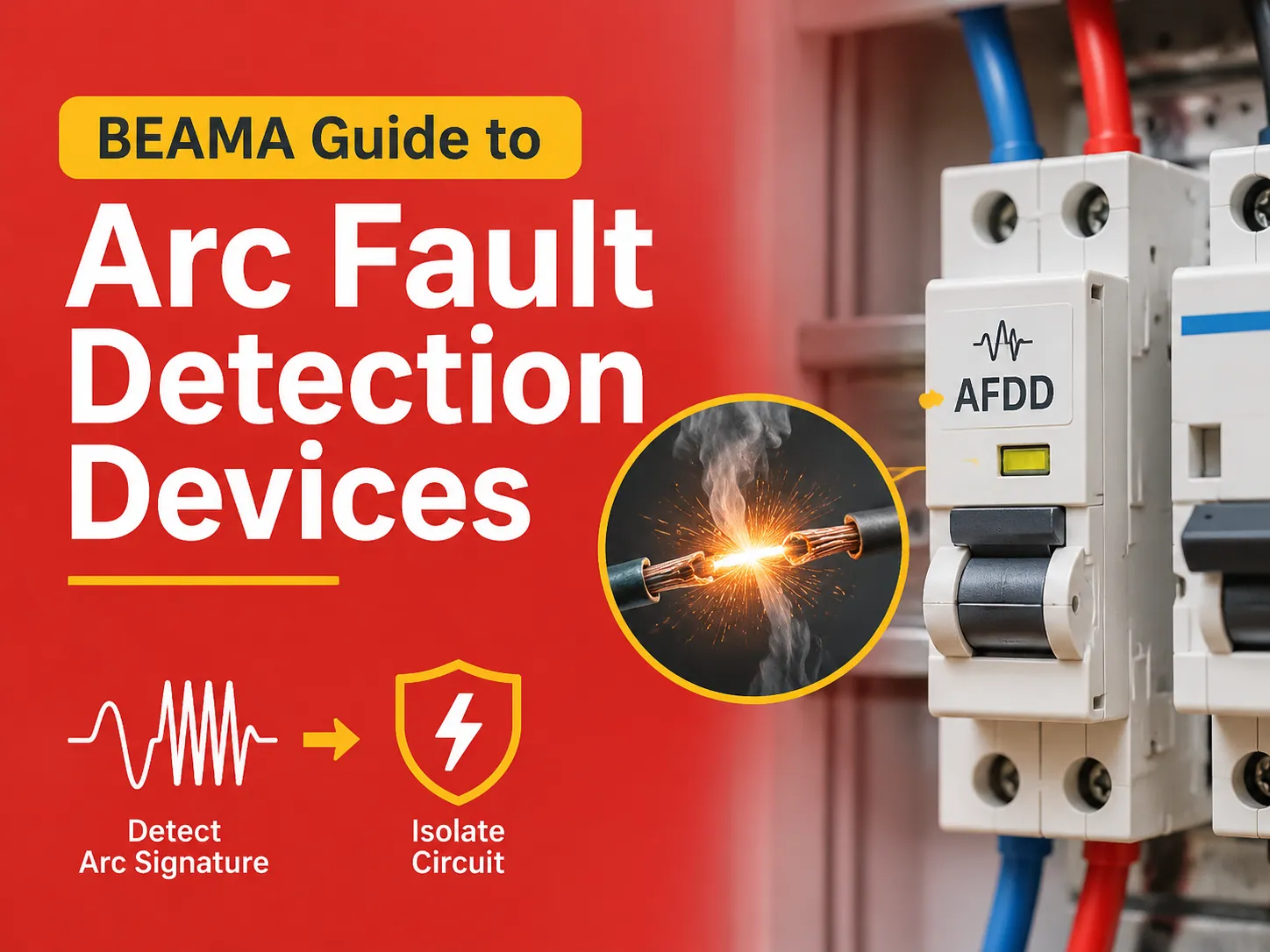
A função de um dispositivo de detecção de falha de arco (AFDD) é determinar se há um arco produzido por conexões de terminais soltas, cabos crimps e/ou pregos perfurando condutores. Um arco pode durar muitos meses com uma corrente baixa demais para operar um disjuntor ou sem uma fuga para terra, e a primeira indicação desse tipo de falha geralmente é um incêndio.
Resposta rápida: O AFDD monitora as formas de onda de corrente e tensão para detectar a assinatura de alta frequência de um arco e isola (desconecta) o circuito automaticamente quando detecta esse tipo de falha. Os AFDDs devem ser fabricados e testados de acordo com a Norma Internacional para dispositivos de detecção de falha de arco (IEC 62606) e podem ser adquiridos como dispositivo independente ou combinados com um RCD em um único módulo. O preço típico de um AFDD varia entre £30 a £120 (excluindo instalação).
As seções restantes deste documento fornecem uma cobertura abrangente do guia e explicam o que está coberto no guia, o que um AFDD pode detectar que outros dispositivos não detectam, como um AFDD detecta, onde os Regulamentos de Fiação exigem AFDDs, em que forma os dispositivos estão disponíveis, comparações com outros dispositivos similares, marcações para verificar conformidade, custos, disparos indevidos, como escolher uma unidade independente ou combinada, e onde você pode encontrar nossos dispositivos em sua área local, além de uma lista de verificação para comissionamento e instalação de AFDDs.
O que o Guia BEAMA Cobre e Por Que Ele Existe
O guia BEAMA foi desenvolvido em resposta à exigência da próxima Emenda 2 à Norma Britânica 7671 de que AFDDs devem ser instalados em circuitos de tomadas com classificação de 32 A ou menos em residências de alto risco; as diferenças entre AFDD, RCBO & RCCB e o AFCI na América do Norte não são tão fáceis de estabelecer quanto muitas pessoas presumem ao avaliar catálogos.
O guia BEAMA foi desenvolvido pela British Electrotechnical Manufacturers Association para abordar as questões associadas à introdução dos Regulamentos de Fiação revisados e dos novos AFDDs, que estavam sendo enviados pelos fabricantes e instalados pelos contratantes. Em ambos os lados, era necessária uma linguagem comum para facilitar a comunicação. O guia explica:
- Como os AFDDs funcionam e o que eles fazem
- Como os AFDDs são testados
- Quais são as normas aplicáveis para AFDDs
- Como selecionar e instalar um AFDD
O EMF (Campo Eletromagnético) é uma tecnologia não intuitiva; portanto, foi desenvolvido um guia em vez de apenas uma ficha técnica ou catálogo para AFDDs. Por exemplo, o propósito de um disjuntor é proteger contra sobrecargas e curtos-circuitos, o que é fácil de entender visualmente. Em contraste, o AFDD protege contra um modo de falha que não apresenta nenhum sinal visível de dano até que um incêndio tenha ocorrido. A decisão de instalar um AFDD é baseada em uma avaliação de risco e não em cálculos matemáticos simples.
O guia também fornece uma justificativa comercial porque os AFDDs custam várias vezes mais do que um disjuntor miniatura (MCB). Uma maneira mais fácil de explicar a evitação de risco associada aos AFDDs em comparação com os MCBs é usar um documento publicado por uma organização da indústria em vez de um folheto do fabricante ao solicitar a justificativa para a compra de AFDDs.
O que um AFDD Detecta Que Outros Dispositivos Não Podem
Um Dispositivo de Detecção de Falha de Arco (AFDD) detecta arcos em um circuito devido à falha de um condutor em série com uma carga elétrica. Quando um condutor falha, os arcos criados entre as extremidades quebradas mantêm o fluxo de corrente através do circuito, embora em um nível reduzido, e em algumas situações, a quantidade total de corrente que flui pelo circuito permanece abaixo da classificação térmica do disjuntor indefinidamente. Um parafuso terminal solto, um cabo de extensão danificado ou um fio cortado durante a instalação podem produzir um padrão semelhante.
Um arco paralelo ocorre quando dois fios formam um arco que vai de fase para neutro ou de fase para terra e produz corrente suficiente para disparar um disjuntor. A versão mais perigosa disso é a alta resistência entre os dois fios; a alta impedância limita a corrente através das falhas a um nível que um disjuntor pode tolerar, mas o arco continua.
Um dispositivo de corrente residual não detectará esses arcos a menos que vazem para a terra; é por isso que os AFDDs preenchem essa lacuna. Eles detectam o arco em si e não a consequência do arco (ou seja, incêndio), por isso esses dispositivos são comercializados como proteção contra incêndios elétricos e não como proteção contra sobrecargas ou choques elétricos.
O disjuntor detector de arco funciona com o mesmo princípio e, explicado do lado da instalação, distingue entre arcos em série e arcos paralelos.
Dentro do Dispositivo: Detecção, Processamento e Desarme
O dispositivo amostra continuamente a forma de onda da corrente usando um pequeno transformador de corrente ou um shunt. Um microcontrolador identifica características que podem indicar um arco, incluindo o conteúdo de alta frequência da forma de onda, um aumento ou diminuição abrupta da corrente, a ‘pausa’ característica em cada meio ciclo e a aleatoriedade da assinatura de detecção de arco.
O microcontrolador então compara as características extraídas com o modelo atual de arco definido em 230 Volts e 50 Hertz e contra um banco de dados de padrões que não devem causar disparo no dispositivo. Dentro do segundo grupo estão uma série de desafios técnicos apresentados por ruídos de alta frequência causados por produtos comuns – dimmers, motores com escovas, fontes chaveadas e furadeiras – que não produzem um arco elétrico.
Como resultado do requisito, o dispositivo deve empregar um solenóide que abre os contatos do relé após o tempo de disparo definido ser satisfeito. Assim como no ruído de alta frequência, o tempo de disparo não é instantâneo porque o dispositivo está discernindo um padrão em vez de medir um nível de tensão ou corrente. O tempo adicional fornecido permite que o dispositivo ignore um evento transitório, mas ainda assim mantém a capacidade de detectar um evento real de arco elétrico.
Delineado na norma IEC 62606 estão os tipos de “formas de onda de teste” que o dispositivo deve suportar e não suportará, e proíbe especificamente que o dispositivo dispare devido à corrente de irrupção.
Onde os Regulamentos de Fiação Exigem AFDDs
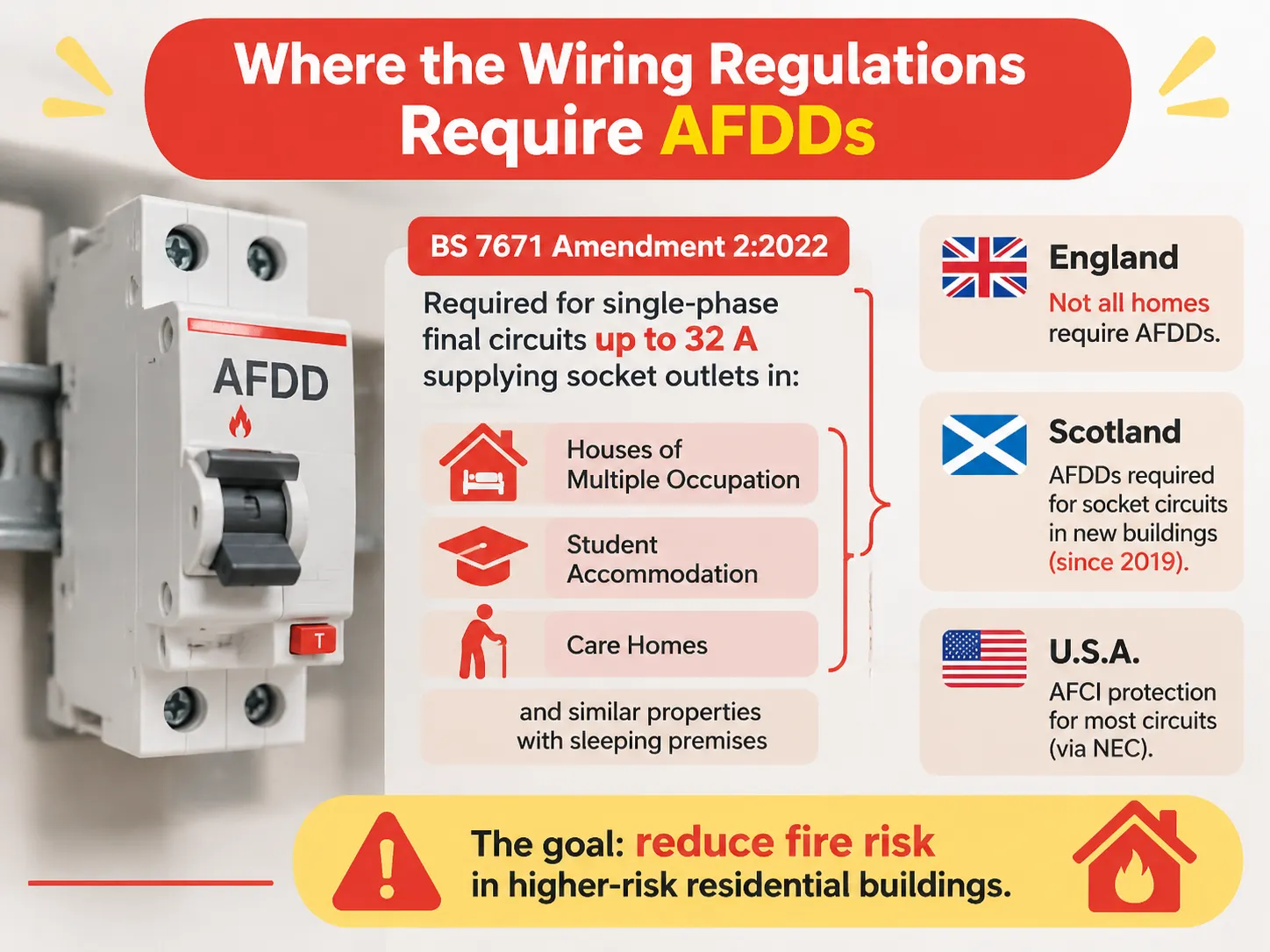
A Emenda 2:2022 da BS 7671 exige que todos os circuitos finais monofásicos com classificação de até 32 A que alimentam tomadas localizadas dentro de propriedades residenciais de maior risco – casas de ocupação múltipla, acomodações estudantis, lares de cuidados e propriedades similares que possuem dormitórios – sejam equipados com AFDD. Este requisito pode ser encontrado no Regulamento 421.1.7 e é aplicável a todas as novas instalações e alterações, mas não a todas as instalações existentes.
O escopo é propositalmente limitado e não se refere a “todas as habitações”, como muitas pessoas pensam. Não há exigência na Inglaterra para que todas as casas sejam providas de AFDDs. Em 2019, os padrões de construção da Escócia exigiram o uso de AFDDs para circuitos de tomadas em novos edifícios. Portanto, as especificações para circuitos de tomadas em Glasgow e Manchester serão diferentes.
Outro país, os Estados Unidos, utiliza uma abordagem alternativa para fornecer proteção contra falhas de arco para todos, exceto um pequeno número de circuitos ramais. Ele utiliza seu Código Elétrico Nacional e seu padrão AFCI em vez da IEC 62606 como meio de fornecer essa proteção. Existem outros países europeus, como a Alemanha, que também possuem requisitos semelhantes para certos tipos de ocupação. O princípio subjacente para todos esses países é que o requisito para proteção contra falhas de arco é baseado no grau de risco de incêndio associado a estruturas habitáveis.
Tipos e Formato
A área de mercado cobre três tipos e, como tal, ao escolher um tipo, normalmente será baseado na quantidade de espaço no painel que ocupará, em vez do nível de proteção que fornecerá.
| Formato | Largura | O que contém | Onde é utilizado |
|---|---|---|---|
| AFDD independente | 1 módulo | Detecção de arco com mecanismo de disparo | A jusante do MCB ou RCBO existente |
| AFDD + MCB | 2 módulos | Detecção de arco com proteção de corrente | Circuitos novos sem RCBOs |
| AFDD + RCBO | 2 módulos | Detecção de arco, proteção de corrente e corrente residual | Mais comumente usado para circuitos de tomadas |
O formato mais comum para especificação é AFDD + RCBO, pois a última categoria cobre todas as necessidades associadas a circuitos de tomadas. Além disso, usar um dispositivo para proteção tanto de corrente quanto de corrente residual economiza tanto um terminal quanto um módulo.
In our range of products the combined format is the AFDD7LE device in the 1P+N configuration that is used for all single-phase final circuits.
An AFDD is specifically designed for the detection of arcs in a circuit, which can cause fires. Its function is to provide additional safety protection and prevent loss of life and property.
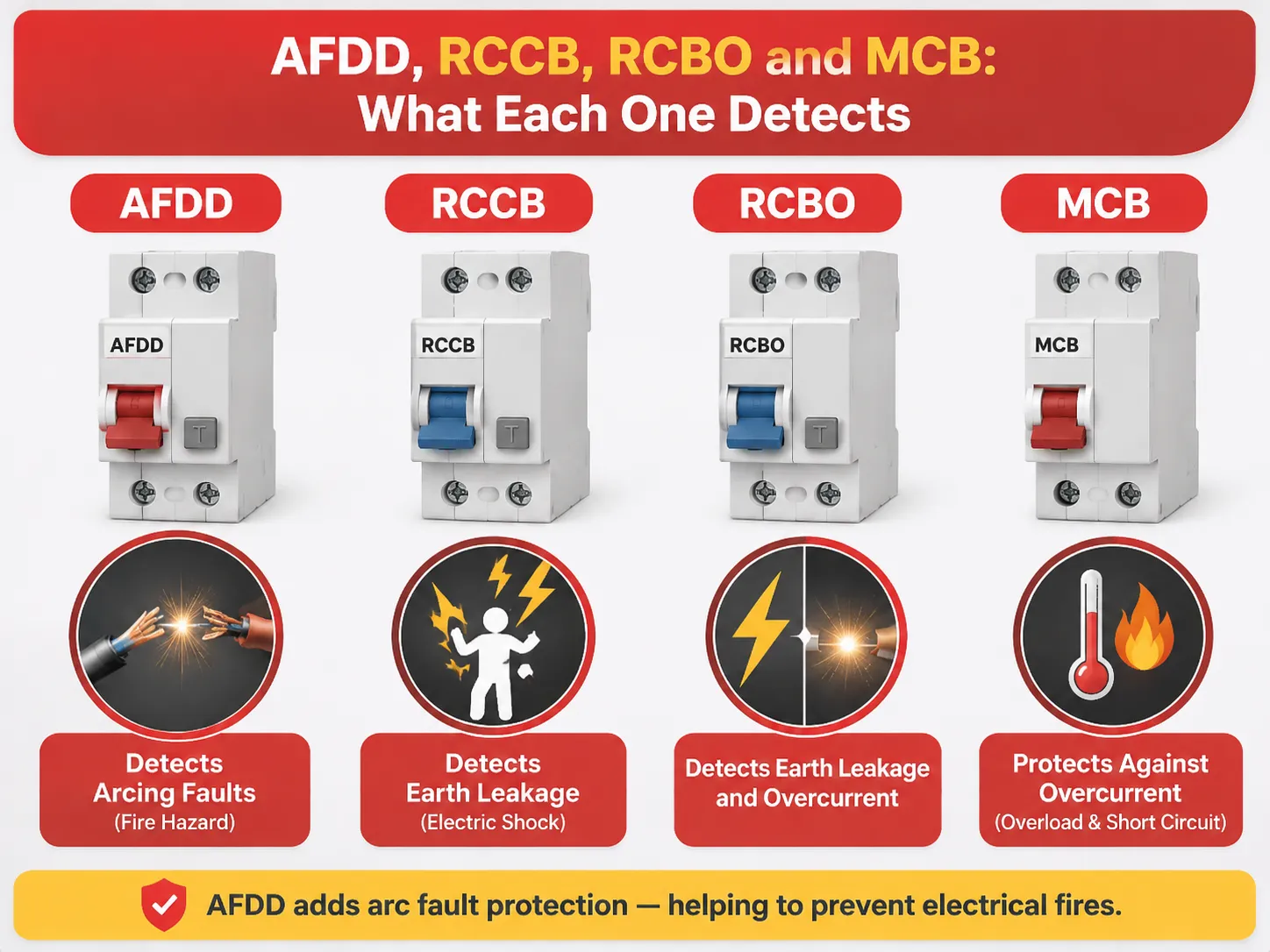
AFDD, RCCB, RCBO and MCB: What Each One Detects
The significance of an AFDD, as compared to an RCCB, is that both devices provide the same protection against electrocution or electrical shock; however, the way in which they operate and the conditions prompting a trip vary. The difference between an AFDD and an RCCB is the “signature” of an arc. The current waveform of an arc is distinctive, therefore the AFDD is able to detect that signature. In situations where the cable insulation is damaged and an arc exists in the cable, it may not leak to earth, thus the RCCB will not detect such an event.
AFDD, RCCB and MCB are the three devices to compare. The purpose for which each of these devices was designed was to protect a circuit from overcurrent – that is to say, protect the conductors against overloads and short circuits.
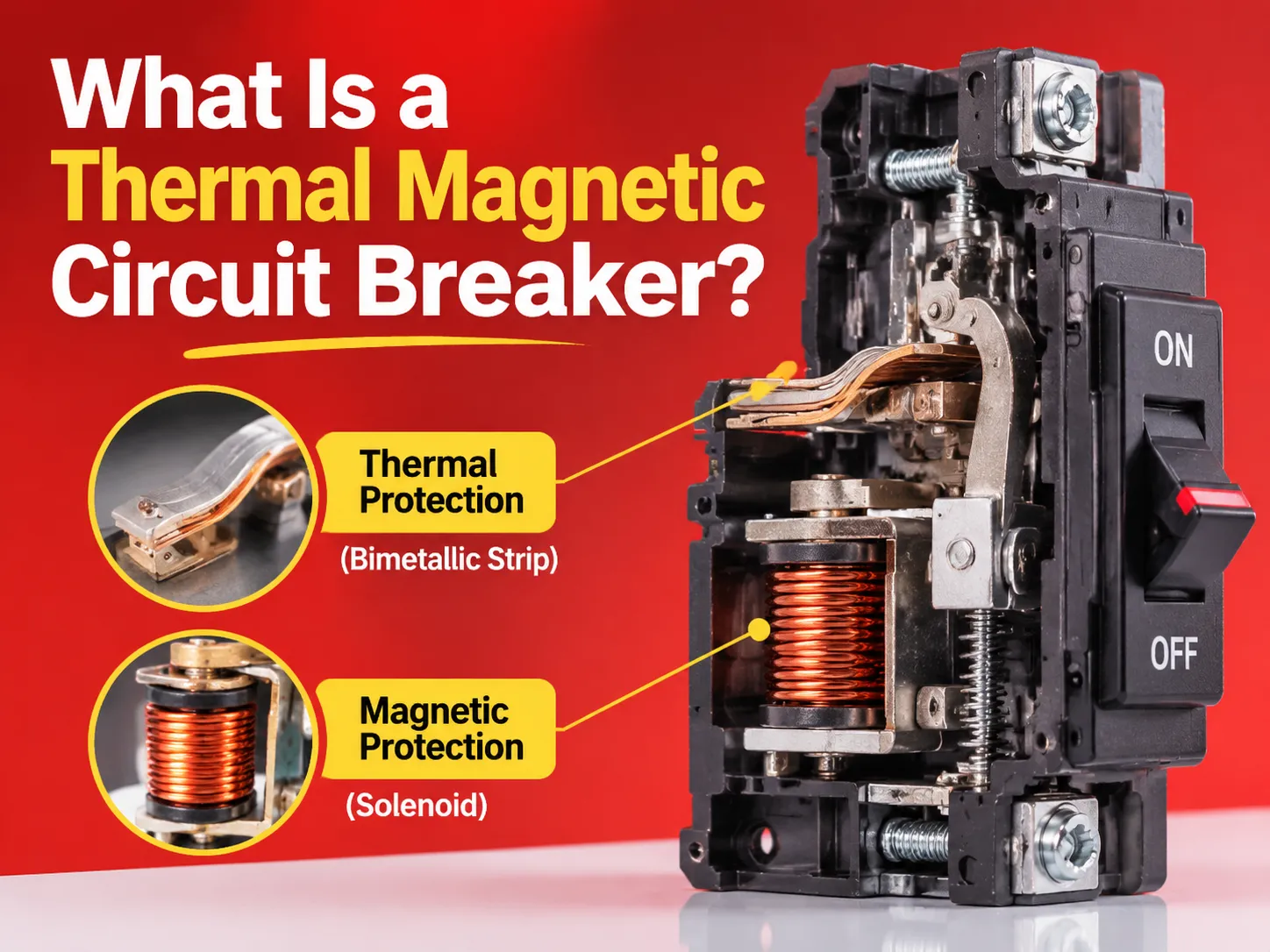
The MCB provides protection by tripping the circuit when the temperature of the conductor exceeds the temperature at which the insulation material becomes damaged. This is achieved by the MCB being equipped with a bimetallic strip that reacts to the heat generated by the overload to trip the device. The RCCB protects against electric shock and is connected to the earth with a residual current device (RCD). Once the RCCB detects that the current going out of the circuit differs from the current going back to the supply, it trips and disconnects the supply.
To recap,
- An AFDD is designed to provide additional protection to a circuit against potential fire hazards caused by arcing.
- An RCCB is designed to provide protection against electric shock by monitoring the difference in current between phases and earth connections.
- An MCB provides protection to conductors from overheating and short-circuiting.
AFDDs and RCBOs are two distinct types of devices, and therefore, the key difference between them is quite simple: there are no arc detection capabilities with an RCBO and an AFDD will only detect arcs if it is combined with an RCBO. You will find a further comparison between the two devices in an article regarding RCCBs versus RCBOs on the residual current side of things, and that article is especially relevant today as it highlights how many of the circuits that are used in homes today require both types of devices, so there is a debate on whether to purchase one device or two devices to fulfil the requirements.
Ratings and Markings to Check
Devices must meet six requirements to be deemed suitable. The standard, which is either IEC 62606 or the EN equivalent, should not be an endorsement, but rather, a specific number listed. The rated current for an AFDD will be typically between 6 A and 63 A; the rated voltage and frequency will typically be 230 V at 50 Hz (for the European market); and the rated conditional short circuit current is the fault current that will be applied to the device when using the type of upstream breaker specified.
If the AFDD is paired with an RCBO, it will typically detect a residual current of 30 mA for socket circuits. With an MCB, the AFDD will have more electronic components, and this means the terminal space will generally be less, which is important when using a 6 mm² cable.
The seventh requirement for an AFDD is not included on the device’s label. However, this information will appear on the certification document and will detail the testing done on the arc detection capability of the device. The test done to verify arc detection ability would be a type test to IEC 62606, not a routine test. A device that only has a routine test certificate and has not been proven to detect arcs cannot be relied upon to detect anything.
When considering the cost associated with AFDDs, it is commonly assumed that the installation will be more costly than the device itself, which leads to clients being surprised at the end of a quote.
What They Cost, and What the Installation Adds
An itemised breakdown of the costs associated with AFDDs is as follows:
| Item | Custo típico | Nota |
|---|---|---|
| AFDD independente | £30 to £70 | Per module; will require an additional device to provide residual current protection |
| AFDD + MCB (2 modules) | £45 to £90 | The MCB does not provide residual current protection |
| AFDD + RCBO (2 modules) | £60 to £120 | The normal choice for circuits providing sockets |
| Board increase | £150 to £400 | Increasing board size or installing a new board |
| Tested and certified | £80 to £250 | A fixed price for each installation |
The issue with the costs associated with the board increase is that, when trying to install AFDDs protecting socket outlets from all ten circuits in a ten-way RCBO board, you will require the installation of a new board rather than the installation of ten additional devices; therefore, you will initially have a larger outlay than the device prices alone suggest.
The differential in price of devices when AFDDs are compared to RCBOs will be between £30 to £60 per board way for the next 20 years, allowing approximately a few £ a year for having AFDD protection against a deadly mode of failure, as described in the guide from BEAMA and the reason for the necessity for them.
What Is Nuisance Tripping, and What Causes It?
If an AFDD trips on a normal load, the AFDD has classified a waveform incorrectly, and there is a defined method of how this can occur; specifically, dimmers, when operated at a low wattage, produce a chopped waveform with a high frequency, which is similar to the waveform produced during an arc. Brush motors like the ones in power tools or vacuum cleaners typically generate continuous arcing from the brushes by design. Similar capabilities can be found within the output of poor filter quality on switching mode power supplies (SMPS).
While there are many possible explanations for nuisance tripping, older installations offer additional reasons. When the neutral for two circuits is shared, or if there was ever an intermittent ‘real’ arcing due to poor connection quality, or of damaged insulation in between the arcing cable, these types of faults exist and the device is justified in tripping, thus a nuisance trip must not be assumed as a fault with the device and must be explored further.
The diagnostic process employed will be the same as that used with an RCBO. To isolate your loads, you must first reset the device and connect them back one at a time. If a tripped device continues when a specific appliance is connected, then the appliance and/or its cord are at fault. If a tripped device continues without anything connected, then the wiring is at fault. If a tripped device continues only in wet weather conditions, then moisture penetration into the outdoor circuit must exist.
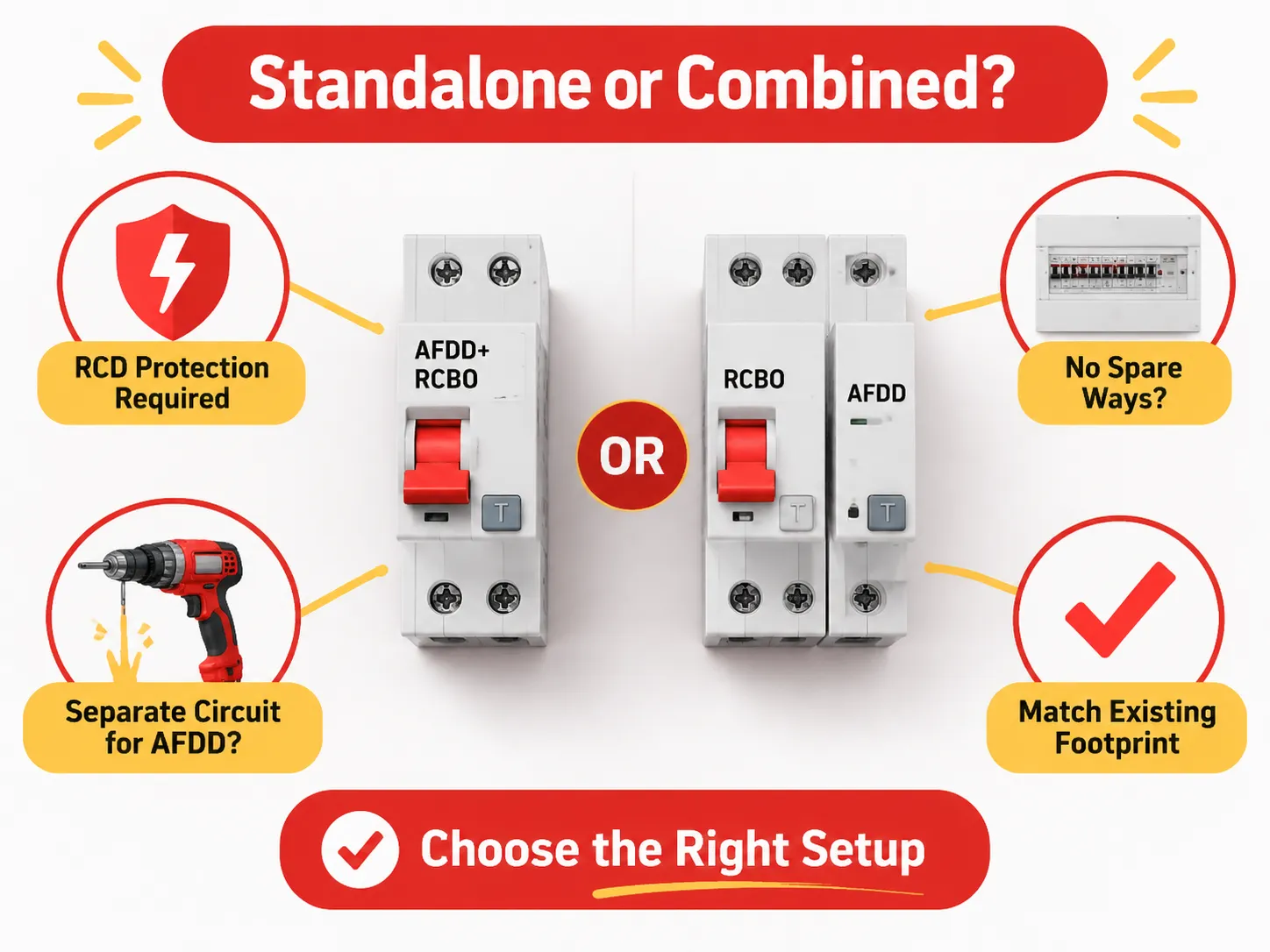
Choosing Between Standalone and Combined
Four different variables will determine whether to choose between standalone devices versus combined devices:
- A socket outlet circuit must provide residual current protection, either combined with an AFDD within a single unit or separate.
- An existing circuit that already possesses an RCBO, and now also needs an AFDD, must therefore have a stand-alone AFDD added.
- In a board containing zero spare ways, a new installation of whatever configuration must take place – therefore providing the specification of the board would be paramount versus the device.
- Because of the spark-like sounds produced in some applications (e.g., a woodworking shop with tools built with brushes) the load circuit may have to have an AFDD on a different circuit than where the tools are plugged in.
As such, AFDD’s use of the RCBO format on most current boards provides a reference for the combined device. The footprint and terminal arrangement of each type of AFDD matches as such; therefore, any project that standardises on the same footprint can add the arc protection without the need to redesign the board.
Where HUYU Fits into this Picture
We manufacture the AFDD in the combined 1 phase + Neutral format, with the MCB and RCBO in the same footprint. The construction of the AFDD complies with IEC 62606 for the function of detection of arc and IEC 61009-1 for the function of overcurrent and residual. The combination is what actually will provide a socket circuit in a home.
For a specification, we can supply the type test report for arc detection, the residual current test data, and the conditional short-circuit rating with the upstream device used in the test. These three documents are what a certifying body or inspector will require and what a low-cost AFDD typically cannot provide.
In terms of mini disjuntores, there are circuits throughout most buildings that do not require arc protection. The majority of circuits will not need an AFDD, and specifying an AFDD for every circuit means spending money where the potential risk does not warrant such an expense.
Checklist to Comply with Specifications
There are 5 items that are to be included when making a specification, to conform to IEC 62606. These include the formats of the device (combined or stand-alone), the rated current and residual current sensitivity if combined; the conditional short circuit rating (the upstream device that the combined device assumes is used); and type test evidence (evidence of testing) to be included with the order, not requested.
At the time of commissioning, 3 checks are required. These checks include the test button to verify the operation of the trip mechanism, however, not the operation of the arc detection mechanism; the residual current test (if a combined device) with an external tester, not the test button; and a load test with appliances that may be connected to the device, as it is better to discover if a dimmer switch or brushed motor will trip the device upon delivery rather than at 12:00 am.
The 4th check is documentation. A schedule is required for the installation to be maintainable. The schedule should indicate which devices are connected to which circuits and when the last test was performed. An AFDD is a safety device with a defined service life. A device that has never been tested is a device that cannot be vouched for.
Perguntas Frequentes
What Are Arc Fault Detection Devices?
They are devices designed to detect high-frequency signatures from electrical arcs generating heat to ignite surrounding combustibles in the vicinity of an electrical circuit and automatically isolate the electrical circuit from its electrical supply prior to combustion. They are specified to the IEC 62606 standards; they are available as individual components or as part of an RCBO; and they provide protection for an arc or failure mode that cannot be detected by either the trip or residual current device.
What Methods Are Used to Detect Arc Faults?
Arc faults are detected by periodically sampling the current flowing in the circuit and examining the characteristics of the sampled waveform for certain defined features based upon high-frequency contents, sudden changes in current patterns, the stop time between cycles and whether the sampled waveform exhibits randomness in its pattern. A microcontroller compares these characteristics to those of a) the arc detection system and b) the associated load that is not supposed to cause a trip.
What Is an AFCI?
The AFCI (Arc Fault Circuit Interrupter) is the equivalent of an AFDD as defined in the North American UL 1699 standard. An AFCI performs the same function as an AFDD, but is tested to a different standard and rated to operate at 120 Volts in North American branch circuits. Therefore, AFCIs and AFDDs may not be replaced with one another or by a device that complies with one of the two standards.
Which Rooms Need AFCI Protection?
In England, the BS 7671 amendment 2 requires the installation of AFDD protection on socket circuits of 32 A or less at greater risk of electrical shock, which occur generally in HMOs, student accommodation and care homes but do not need to be installed in each room of every house. In Scotland, new houses must have an AFDD fitted as part of the electrical installation. In the United States of America, the National Electrical Code requires that most dwelling branch circuits must be protected by AFCIs.
Is an AFDD Used Instead of an RCBO?
No. AFDDs are designed to detect arcs in the circuit and an RCBO detects overloads, shortages and earth leakage of current. Typically, socket circuits will require both devices, which is why a combination of an AFDD and an RCBO in a single module is most commonly used. Standalone AFDDs are generally installed on the load side of an RCBO.
Why Does My AFDD Keep Tripping?
AFDD tripping can be caused by a load that creates arc-like sounds; e.g. a dimmer switch on a low setting; a vacuum cleaner; or a power drill; or from an actual fault, such as a loose connection or damaged cable. You can isolate all loads and reconnect them one by one to determine which appliance is causing the trip. If the trip occurs when nothing is connected, the problem may lie with the wiring.
Referências
- Hager — AFDD Protection Devices and BS 7671 Guidance
- Siemens — AFDD Technology and Protective Devices
- Legrand — Arc Fault Protection in Residential Boards
- UL Solutions — Arc Fault and Residual Current Device Certification
- Electrical Engineering Portal — Arc Fault Detection and Protection Coordination
Conclusão
AFDDs are the only devices within a circuit board that detect the arc itself rather than the current produced by the arc. This is what enables AFDDs to detect a failing terminal connection that a circuit breaker would ignore, and which cannot be detected by an RCD. That is why the requirement was introduced into the regulations for buildings where persons sleep. The decision is based on the choice of format and proof. The combination of an AFDD and an RCBO can create a single module that protects a socket circuit, and the only proof that these detection devices work is the fulfillment of the type test to IEC 62606; everything else on the label is simply a rating, which is a much less rigorous process than testing for compliance with a standard.