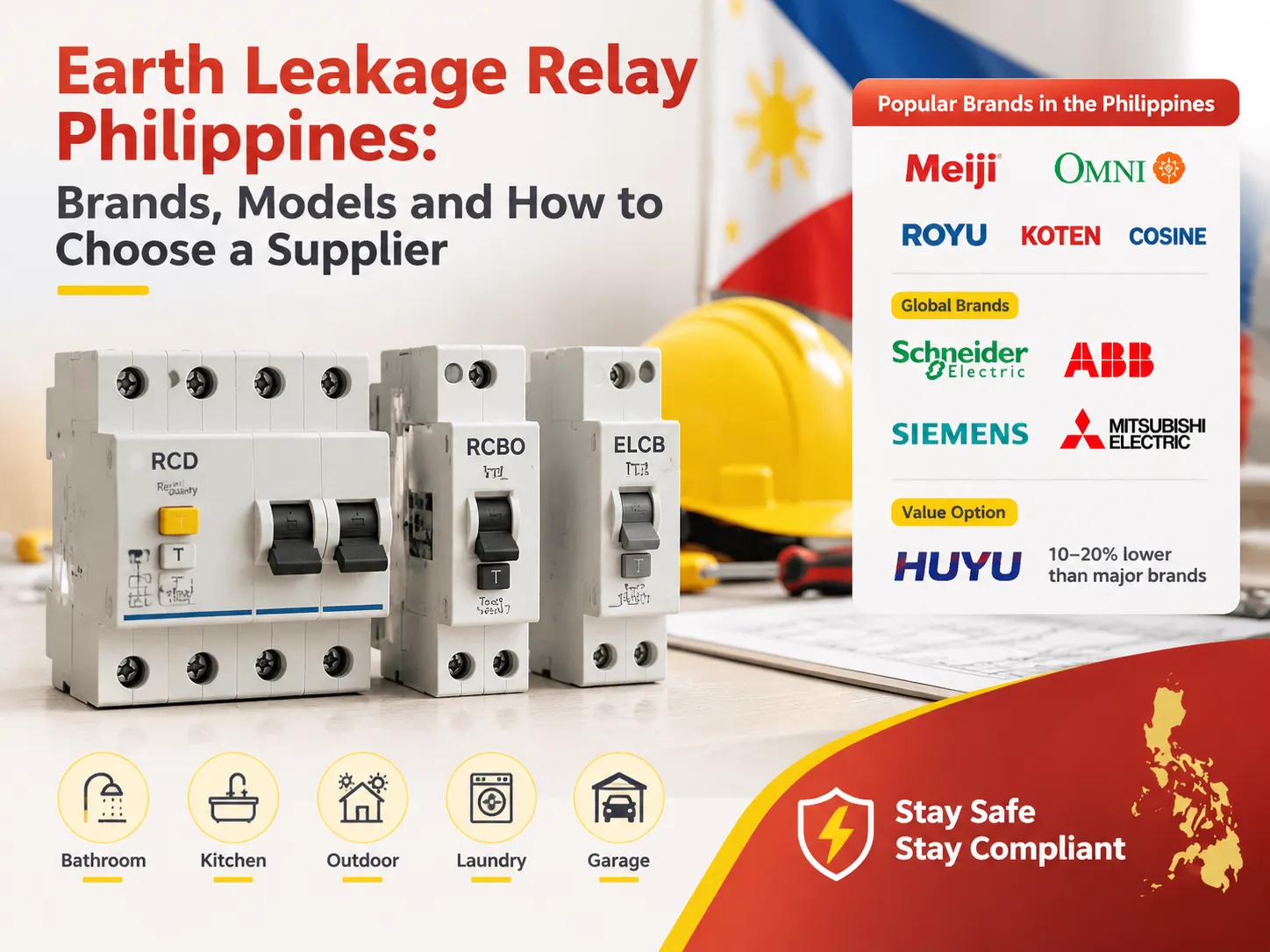
การซื้ออุปกรณ์ป้องกันไฟรั่วในฟิลิปปินส์แตกต่างจากการซื้อเบรกเกอร์วงจรเนื่องจากปัจจัยหลายประการ รวมถึงแรงดันไฟฟ้า 230 V ที่ความถี่ 60 Hz รหัสที่ใช้บังคับ (PEC แทน NEC) การมีเครื่องหมาย PS หรือสติ๊กเกอร์ ICC บนทุกอุปกรณ์ที่จำหน่ายในตลาดฟิลิปปินส์ และการตัดสินใจเลือกประเภทความไวเพื่อให้เป็นอุปกรณ์ป้องกันบุคคลหรือเพียงแค่อุปกรณ์ไฟฟ้า คู่มือนี้จะช่วยให้คุณเข้าใจความหมายของคำศัพท์ที่ใช้ ข้อกำหนดของ Philippine Electrical Code แบรนด์ที่มีในตลาดท้องถิ่น ราคา และวิธีการเลือกผู้จัดจำหน่ายโดยไม่ถูกโกง.
สรุป: รีเลย์ไฟรั่ว, RCD, RCCB และ ELCB หมายถึงอุปกรณ์ที่ตัดวงจรเมื่อมีกระแสไฟฟ้าไหลออกจากวงจรแทนที่จะไหลกลับผ่านสายกลาง ตาม PEC 2017 (บทความ 2.10.1.8) ครัวเรือนในฟิลิปปินส์ควรติดตั้งอุปกรณ์ป้องกัน GFCI Class A สำหรับห้องน้ำ ห้องครัว พื้นที่กลางแจ้ง ห้องซักผ้า และโรงรถ ที่ระดับ 4-6 mA และการป้องกันกระแสไฟฟ้ารั่ว 30 mA สำหรับวงจรเต้ารับไฟฟ้า RCD 30 mA ไม่ใช่ตัวแทนที่สมบูรณ์แบบของ GFCI 4-6 mA และ PEC กำหนดให้ต้องได้รับการอนุมัติจาก AHJ หากใช้ RCD หรือ RCBO แทนเต้ารับ คาดว่าจะใช้จ่าย ₱300 – ₱1500 สำหรับอุปกรณ์ 2 ขั้วในครัวเรือน ₱1500 – ₱4500 สำหรับ RCBO 30 A และ ₱2500 – ₱9000 สำหรับอุปกรณ์อุตสาหกรรม 4 ขั้ว Meiji, Omni, Royu, Koten และ Cosine เป็นที่นิยมในกลุ่มผู้ใช้ในประเทศ ขณะที่ Schneider, ABB, Siemens และ Mitsubishi Electric อยู่ในระดับสูงกว่า และ HUYU มีผลิตภัณฑ์เดียวกันแต่คิดราคาต่ำกว่า 10% – 20% เมื่อเทียบกับผู้เล่นระดับนานาชาติชั้นนำ.
รีเลย์ไฟรั่วคืออะไรจริงๆ
ก่อนอื่นเรามาพูดถึงคำศัพท์กันก่อน เพราะผู้ซื้อชาวฟิลิปปินส์ใช้คำหลายคำที่อาจหมายถึงอุปกรณ์สองหรือสามประเภทที่แตกต่างกัน.
รีเลย์ไฟรั่วเป็นคำทั่วไปที่หมายถึงอุปกรณ์ที่วัดผลรวมเวกเตอร์ของกระแสไฟฟ้าในตัวนำทั้งหมดโดยใช้หม้อแปลงกระแสแบบสมดุลแกน (CBCT) กระแสที่ไหลออกในสายเฟสควรเท่ากับผลรวมของกระแสในสายกลาง ดังนั้นหากมีกระแสไฟฟ้าหายไปไม่กี่มิลลิแอมป์ แสดงว่ากระแสไฟฟ้าได้รั่วไหลผ่านเส้นทางอื่น เช่น ผ่านคน น้ำ หรือโครงอุปกรณ์ที่ชำรุด.
มีอุปกรณ์หลายประเภทที่ใช้แนวคิดนี้และใช้ตัวย่อเดียวกัน.
| คำศัพท์ | ชื่อเต็ม | หน้าที่ของมัน | การตัดวงจรกระแสเกิน |
|---|---|---|---|
| ELR | รีเลย์ไฟรั่ว | ตรวจจับกระแสไฟฟ้ารั่วเท่านั้น มักเป็นรีเลย์แยกที่ควบคุมการตัดวงจรแบบชันท์ | ไม่มี |
| RCCB / RCD | เบรกเกอร์วงจรกระแสไฟฟ้ารั่ว | ตรวจจับกระแสไฟฟ้ารั่ว ติดตั้งบนราง DIN | ไม่มี |
| RCBO | เบรกเกอร์วงจรกระแสไฟฟ้ารั่วพร้อมการป้องกันกระแสเกิน | กระแสไฟฟ้ารั่วและกระแสเกินรวมในโมดูลเดียว | ใช่ |
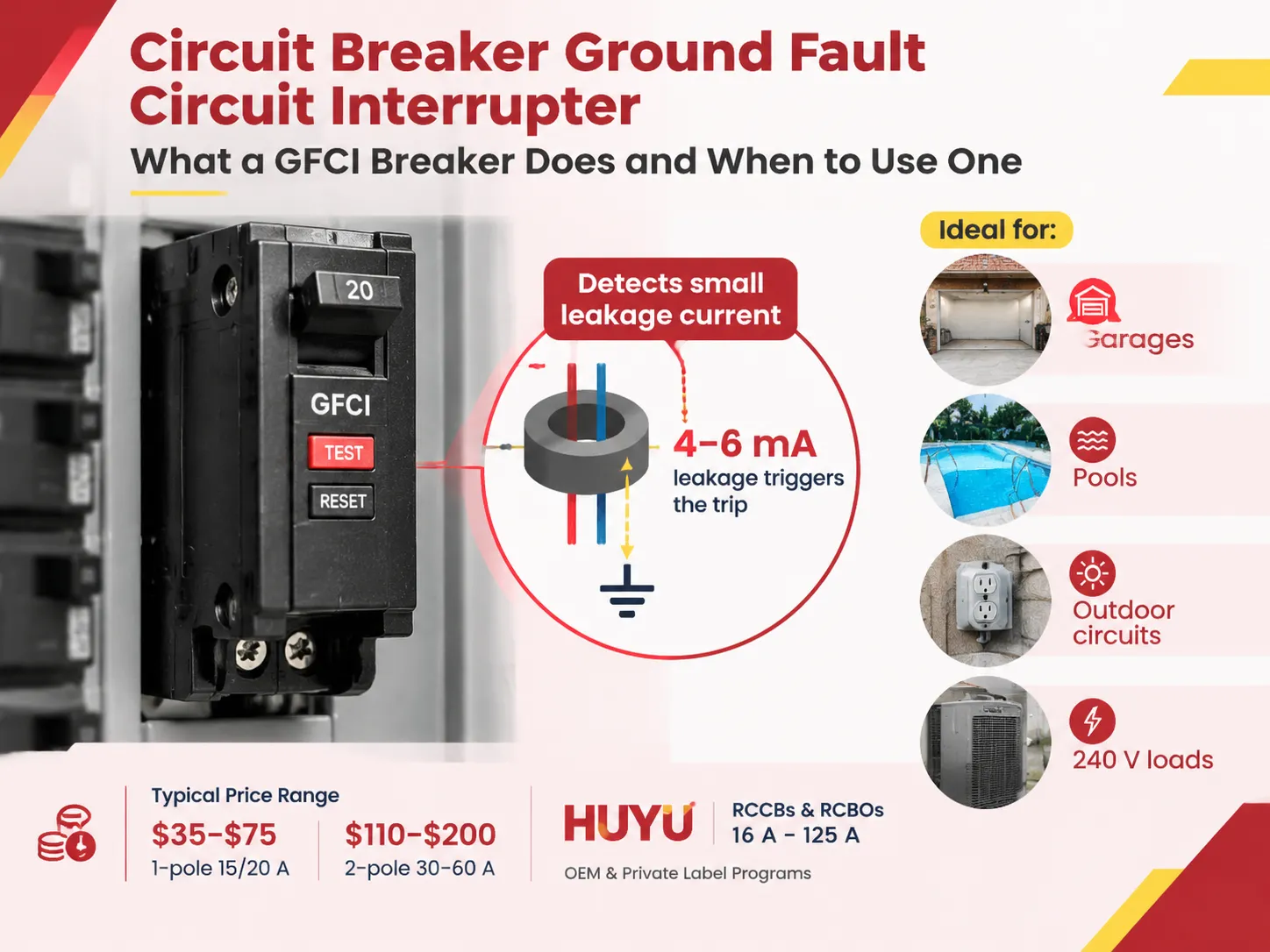
| GFCI | เบรกเกอร์ตัดวงจรไฟฟ้ารั่วลงดิน | ป้องกันบุคคลที่ 4–6 mA ตาม UL 943 | บางครั้ง |
| ELCB (แบบกระแสไฟฟ้าทำงาน) | เบรกเกอร์วงจรกระแสไฟฟ้ารั่ว | ชื่อเก่าสำหรับ RCD สมัยใหม่ | ไม่มี |
| ELCB (แบบแรงดันไฟฟ้าทำงาน) | เบรกเกอร์วงจรกระแสไฟฟ้ารั่ว | ตรวจจับแรงดันไฟฟ้าขึ้นบนโครงอุปกรณ์ | ไม่มี |
แถวสุดท้ายมีความสำคัญมากกว่าที่เห็น ELCB แบบแรงดันไฟฟ้าเป็นเทคโนโลยีเก่า การทำงานของพวกมันขึ้นอยู่กับเส้นทางดินที่สมบูรณ์แบบ ดังนั้นจึงอาจล้มเหลวโดยไม่แสดงอาการในสถานการณ์ที่ควรป้องกัน พวกมันไม่เป็นไปตามมาตรฐานปัจจุบันตาม PEC และผู้จัดจำหน่ายใดที่มีอุปกรณ์นี้เทียบเท่ากับ RCD ถือเป็นการเปิดเผยความน่าเชื่อถือของแคตตาล็อกของพวกเขา.
คำอธิบายเต็มรูปแบบของตัวย่อและวิธีการทำงานของขดลวดตรวจจับควรอ่านก่อนระบุสเปคใด ๆ และครอบคลุมในบทสรุปนี้ของ ความหมายของ ELR.
ข้อกำหนดของ Philippine Electrical Code
Philippine Electrical Code เป็นผลงานของ Institute of Integrated Electrical Engineers of the Philippines ร่วมกับ Board of Electrical Engineering และเป็นพื้นฐานทางกฎหมายของ Republic Act 7920 เวอร์ชันปัจจุบันของ PEC คือ PEC 2017 ซึ่งออกแบบตามแบบของ 2017 NE C.
มีบทความสองบทที่เกี่ยวข้องกับการป้องกันการรั่วไหลของกระแสไฟฟ้าสู่ดิน บทความแรกคือ Article 2.10.1.8 ซึ่งเกี่ยวข้องกับ ground-fault circuit interrupters ที่ปกป้องบุคคล และบทความที่สองคือ Article 2.30.7.6 ซึ่งเกี่ยวข้องกับการป้องกันการรั่วไหลของกระแสไฟฟ้าสู่ดินของเครื่องใช้ไฟฟ้า.
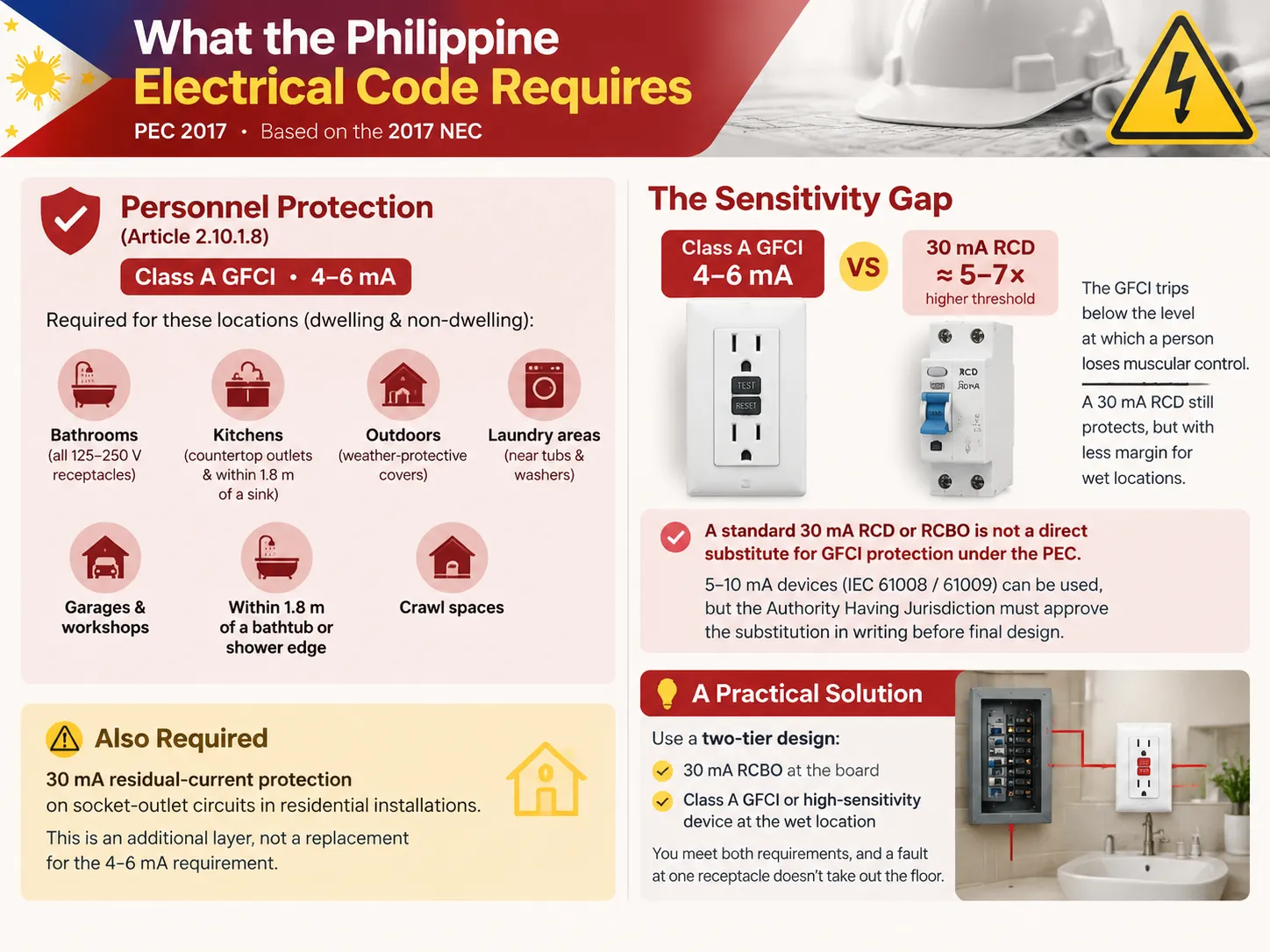
ข้อบังคับเกี่ยวกับการป้องกันส่วนบุคคลมีความเฉพาะเจาะจง เนื่องจากไม่ได้ทำงานเหมือน RCD 30 mA ที่ใช้กันทั่วไปในยุโรป ตาม PEC 2017 ที่อยู่อาศัยทั้งในและนอกบ้านควรมีระบบ ground-fault circuit interrupter Class A ที่มีความไวระหว่าง 4 mA ถึง 6 mA สำหรับอุปกรณ์ใด ๆ ในสถานที่ดังต่อไปนี้:
- ในห้องน้ำ ปลั๊กไฟ 125–250 V ทั้งหมดที่ใช้งาน
- ในห้องครัว ปลั๊กไฟบนเคาน์เตอร์และปลั๊กไฟใด ๆ ที่อยู่ห่างจากอ่างล้างมือไม่เกิน 1.8 เมตร
- ในพื้นที่นอกอาคารที่ปลั๊กไฟและปลั๊กเสียบภายนอกทั้งหมดตั้งอยู่ใต้ที่ครอบ
- ในพื้นที่ซักรีด ปลั๊กไฟทั้งหมดที่อยู่ใกล้อ่างซักผ้าและเครื่องซักผ้า
- ในโรงรถและเวิร์กช็อป
- ภายในระยะไม่เกิน 1.8 เมตรจากอ่างอาบน้ำและฝักบัว
นอกจากนี้ PEC ยังระบุมาตรการความปลอดภัยกระแสไฟฟ้ารั่ว 30 mA ในวงจรปลั๊กไฟในบ้าน นี่เป็นตัวเลือกเสริมและไม่ใช่การทดแทนข้อกำหนด 4-6 mA.
สิ่งที่ผู้ซื้อเข้าใจผิดคือความแตกต่างระหว่าง RCD 30 mA และ GFCI Class A ในแง่ของระดับความไว RCD 30 mA ทำงานที่กระแสประมาณห้าถึงเจ็ดเท่าที่สูงกว่าแต่มีวัตถุประสงค์เดียวกัน เพียงแต่ทำงานในรูปแบบที่แตกต่างกัน: GFCI ถูกปรับให้ตัดก่อนที่บุคคลจะสูญเสียความสามารถในการควบคุมกล้ามเนื้อ ขณะที่ RCD 30 mA มีระดับความปลอดภัยต่ำกว่าและยังสามารถให้การปกป้องบุคคลได้บางส่วนเมื่ออยู่ในโซนอันตรายจากน้ำ ในทำนองเดียวกัน PEC ถือว่าประเภทของอุปกรณ์นี้เป็นมาตรฐานและไม่ถือว่าอุปกรณ์ประเภทนี้เป็นตัวแทนเทียบเท่าของ GFCI อุปกรณ์ที่มีเรตติ้ง 5-10 mA และเป็นไปตามมาตรฐาน IEC 61008 หรือ IEC 61009 อาจสามารถทำงานได้เหมือนกันภายใต้เงื่อนไขที่เหมาะสม แต่รหัสกำหนดให้ต้องมีการตกลงล่วงหน้าเป็นลายลักษณ์อักษรจากหน่วยงานที่เกี่ยวข้องก่อนการออกแบบขั้นสุดท้ายจะเสร็จสมบูรณ์.
วิธีแก้ปัญหาง่ายๆ ที่ขจัดความจำเป็นของข้อพิพาททั้งหมดนี้คือการใช้ระบบสองขั้นตอน ด้วยวิธีนี้จะติดตั้ง RCD 30 mA ที่แผงควบคุมไฟฟ้า และ GFCI Class A หรืออุปกรณ์ที่มีความไวสูงทันทีที่บริเวณเปียก วิธีนี้ช่วยให้เป็นไปตามข้อกำหนดทั้งสองชุด และหากเกิดความผิดปกติที่จุดใดจุดหนึ่งจะไม่ส่งผลร้ายแรง.
ความไว ประเภท และตำแหน่งที่เหมาะสมของแต่ละอุปกรณ์
สองข้อกำหนดที่กำหนดว่าสิ่งใดอุปกรณ์สามารถทำได้จริงคือ ความไวในการตัดวงจรและการกำหนดประเภท.
| ความไว | สิ่งที่อุปกรณ์ปกป้อง | การใช้งานทั่วไปในฟิลิปปินส์ |
|---|---|---|
| 4–6 mA (GFCI Class A) | บุคคล | ห้องน้ำ ห้องครัว ปลั๊กไฟกลางแจ้ง ซักรีด |
| 10 มิลลิแอมป์ | บุคคล มีความปลอดภัยสูงขึ้น | การใช้งานพิเศษ สถานพยาบาล |
| 30 mA | บุคคล | The standard for socket-outlet circuits and final circuits |
| 100 mA | Equipment and fire | Sub-main protection where selectivity is needed |
| 300 mA | ไฟไหม้ | Main incomer, in addition to — never instead of — 30 mA downstream |
The Type designation indicates the fault current waves that are recognized by the equipment, and this is where many installations today fail. With solar inverters, variable frequency drives and EV chargers becoming the norm in buildings all over the Philippines, a Type AC device will only detect sinusoidal alternation residual current and cannot recognize the smooth DC component produced by these devices. Type A can detect both alternating and pulsating DC. Type B detects smooth DC as well. Type B is the right specification for any equipment comprising a rectifier, inverter or DC link, and this is not merely an upgrade with a fancy name.
Conditions in the Philippines That Change the Specification
Three local elements cause the design to deviate from the European standard.
230 V at 60 Hz. The electricity provided in the Philippines is usually 230 V single-phase at 60 Hz, with 3-phase 400 V being an option. Devices sold in these territories must work at the frequency of 60 Hz; devices that run only at the frequency of 50 Hz perform in an unpredictable manner, which makes the trip-time information unreliable.
Variety of earth arrangements. Electrical installations in the Philippines consist of different combinations of TT and TN-C-S systems depending on the power supply and the construction date. The type of earthing used defines whether an RCD by itself is sufficient or it has to be supplemented with an earth electrode that corresponds to the required standards and helps to calculate the fault-loop impedance. Mistaken assumptions about this are among the main reasons why newly installed RCDs sometimes fail to function as expected. The explanation of such systems is provided in the overview of TN-C-S and some other types of earthing systems.
Lightning. The average number of thunderstorm days in low-lying areas of the Philippines amounts to 25-50 a year, and those in mountainous regions experience even more. There are two direct consequences of thunderstorms for the placement of leaking-current devices. First of all, an earth electrode should be taken into account, and the minimum requirements state that it should be made of copper-plated steel and have 2.4 m and 15.87 mm (5/8 in) in diameter. Code compliance may indicate about 25 Ohms, although for reliable RCD operation, the value of 5 Ohms and over is favorable. Secondly, surge protection should be upstream of the leaking device.
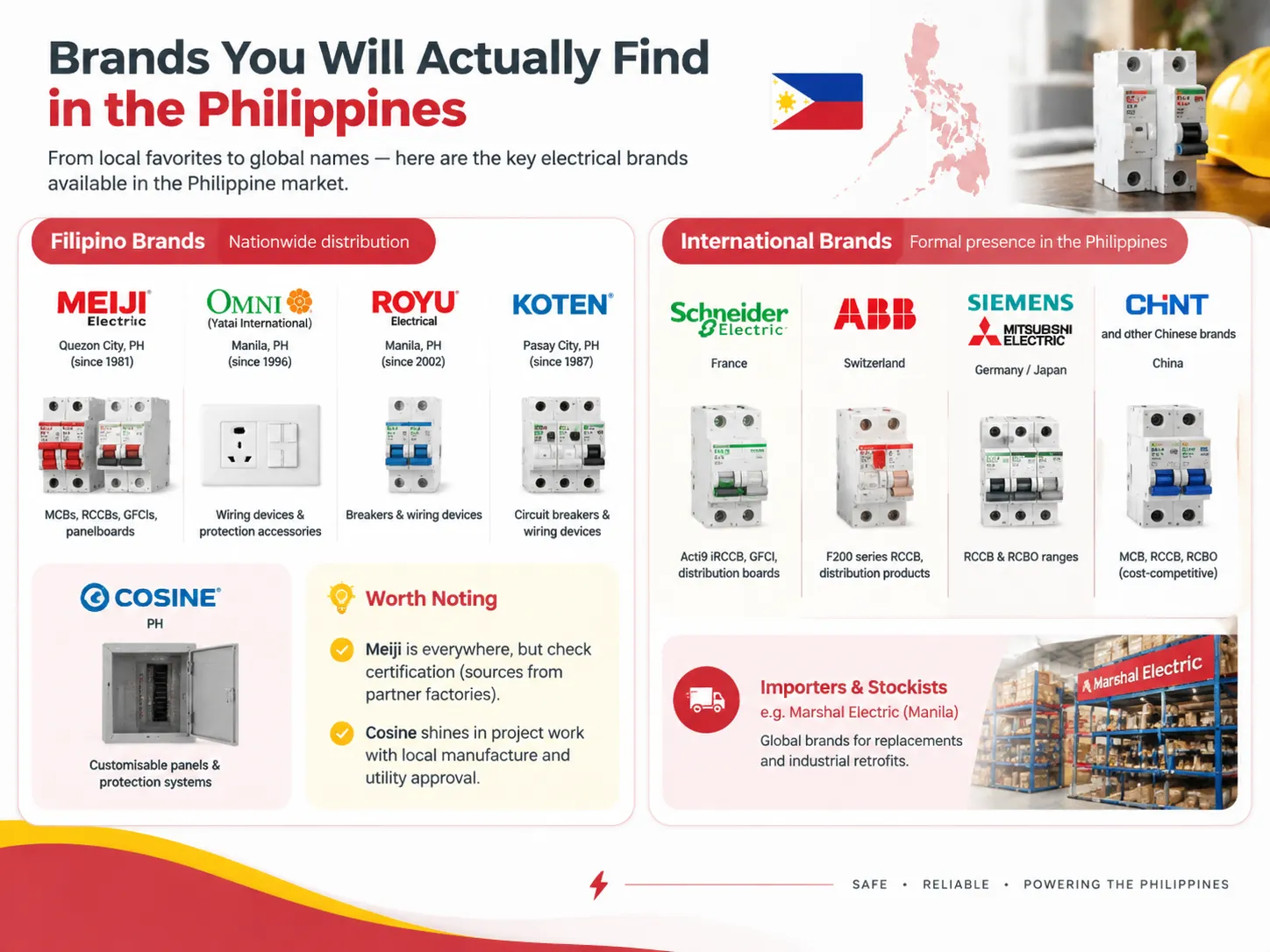
Brands You Will Actually Find in the Philippines
The local market is perfectly divided between Filipino brands with national distribution and those that are foreign but have a formal presence. Below figures show some street prices in 2026 for a domestic device of 2 poles that vary on the basis of ampere rating and sensitivity.
| แบรนด์ | Origin | What they supply | Typical price band | หมายเหตุ |
|---|---|---|---|---|
| Meiji Electric | Quezon City, PH — since 1981 | MCBs, RCCBs, GFCIs, panelboards, wiring devices | ₱400–₱2,500 | PEEP and DOE compliant; IEC-based designs; wide hardware-store stock |
| Omni (Yatai International) | Manila, PH — since 1996 | Wiring devices and protection accessories | ₱350–₱2,000 | PNS and ICC marked; the strongest nationwide distributor network |
| Royu Electrical | Manila, PH — since 2002 | Breakers (2-pole screw terminal, 220 V), wiring devices | ₱300–₱1,200 | Under the FELCO group; BPS certified; fire-retardant polycarbonate |
| Koten Enterprises | Pasay City, PH — since 1987 | Circuit breakers and standard wiring devices | ₱300–₱1,800 | Mass-housing and institutional favourite; parts always available |
| Cosine Industries | PH | Customisable panels and protection systems | Project-based | Locally made, strong utility approval, co-labelling available |
| ชไนเดอร์ อิเล็คทริค | ฝรั่งเศส | Acti9 iRCCB, AvatarOn GFCI, distribution boards | ₱700–₱4,500 | Widest specification presence on commercial projects |
| เอเอบี | สวิตเซอร์แลนด์ | F200 series RCCB, distribution products | ₱900–₱5,000 | Common on industrial and utility work |
| Siemens / Mitsubishi Electric | Germany / Japan | RCCB and RCBO ranges | ₱800–₱4,500 | Premium pricing; strong on OEM panels |
| Chint and other Chinese brands | China | MCB, RCCB, RCBO | ₱250–₱1,500 | Cost-competitive; certification varies enormously by product line |
There are two that require mentioning. Among the infamous brands in the Philippines, Meiji is the first choice for many domestic electricians. That’s because it’s available A-to-Z and with understandable labeling, which means that it has got the production from various factories rather than manufacturing everything on its own. Thus, the importance of checking certifications only increases. Cosine is the unique one for projects, given that it has the ability to produce things locally with the utility approval.
On the importers and the stockists level, there are companies like Marshal Electric in Manila that would have global brands for replacement and retrofitting. For the time being, being in need of a simple RCBO replacement, this layer is often faster than trying to get the replacement through the distributor order.
Common Models and What Each One Is For
Devices in this group do not have decorative design because they give you information on pole number, the type of current and other characteristics.
This means that encountering with a model such as 2P, 30mA, Type A, 6kA, you see a two-pole RCD with 30mA sensitivity that works with pulsating DC current and has a maximum short-circuit current of 6kA. Substitute 30 with 300, and a device turns into one that protects from fire and electric shock. Replace 2P with 4P, and the device protects you not only against electric shocks but also indicates if you have a three-phase circuit.
In case of a single-phase 230V domestic distribution board, you would typically encounter a 2-pole 30mA type A RCCB and a number of 16-32 A RCBOs. In commercial kitchens or wet areas of hospitals, you would be protected with devices with 10 mA GFCI. Any system with a drive or anything similarly requiring a type B device will make the specifications different.
HUYU’s residual-current range covers that spread in one family rather than piecemeal: a 16–125 A Type AC/Type A RCCB for the sub-main position, plus RCBOs from 6 A to 125 A, Type B and Type F variants for inverter and drive loads, and the MCB and AFDD lines that sit alongside them in the same board. The point of buying one family is that the accessories, busbars and enclosure widths are already matched.
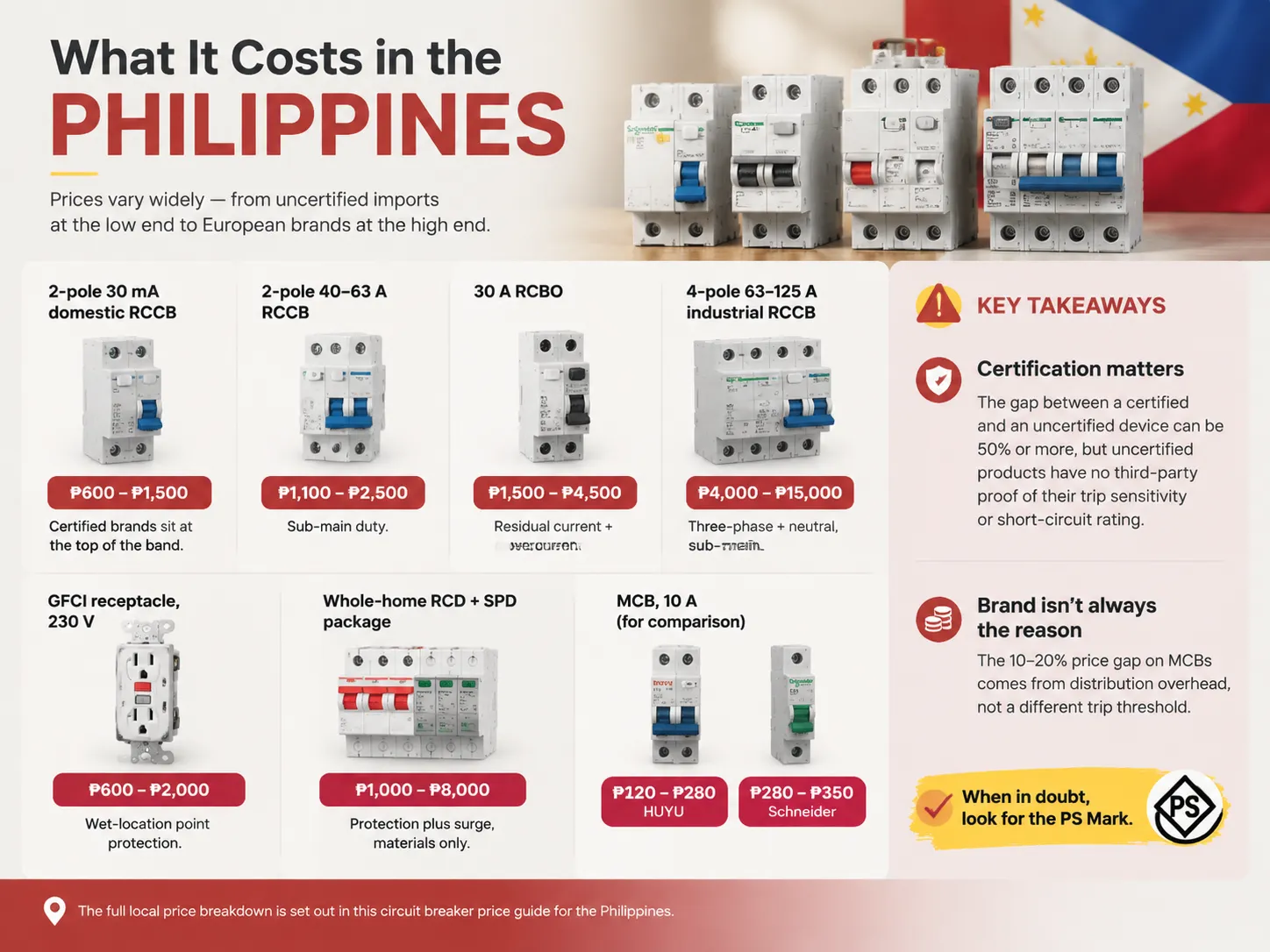
What It Costs in the Philippines
Philippine pricing is lumped because the cheaper side of the market is crowded by uncertified imports and the expensive one by European brands, leaving very limited possibilities in between. The bands below show 2026 street pricing, so regard the low end of any range with caution unless there is a visible PS Mark.
| อุปกรณ์ | Typical price (PHP) | หมายเหตุ |
|---|---|---|
| 2-pole 30 mA domestic RCCB | ₱600–₱1,500 | Certified brands sit at the top of the band |
| 2-pole 40–63 A RCCB | ₱1,100–₱2,500 | Sub-main duty |
| 30 A RCBO | ₱1,500–₱4,500 | Residual current plus overcurrent |
| 4-pole 63–125 A industrial RCCB | ₱4,000–₱15,000 | Three-phase plus neutral, sub-main |
| GFCI receptacle, 230 V | ₱600–₱2,000 | Wet-location point protection |
| Whole-home RCD + SPD package | ₱1,000–₱8,000 | Protection plus surge, materials only |
| MCB, 10 A, for comparison | ₱220–₱400 | HUYU ₱220–280; Schneider ₱280–350 |
There are two noteworthy patterns. The difference between an approved unit and one that is not may appear on paper to be more than fifty percent, however, the uncertified item has no verification that it will break at the values stated in its specifications or withstand short-circuit current of the same value. Therefore, the calculated difference is only a difference on paper. Similar situation can be observed in the table presented above, where HUYU offers its product at a price level of ₱220–280 while major European brands sell their devices for ₱280–400.The full local price breakdown is set out in this circuit breaker price guide for the Philippines.
How to Choose a Supplier
Philippine procurement depends on certifications more than on manufacturers, so figure out this checklist before worrying about price.
- PS Mark or ICC. Electrical equipment available in the Philippines is expected to be marked with the Philippine Standard Mark or an Import Commodity Clearance sticker. Without that, an appliance cannot be mentioned in a valid installation, no matter what kind of datasheet is provided.
- Specify standards. RCCB has to be certified according to IEC 61008, while RCBO has to provide IEC 61009. An offer saying “It conforms to IEC standards” is not definitive.
- Sensitive rating and Type. Make sure the offer indicates that it is 30 mA and appropriate Type A or B. If a drive, inverter or an adapter is included in the installation, Type B is obligatory.
- Breaking capacity. Ask what conditional short-circuit current a device is rated for and which protective device is used. The difference between a 10 kA unit and a 6 kA unit is not visible.
- 60Hz specification. Make sure the part complies with the specifications for 60Hz, not 50 Hz only.
- Warranty. It is better to ask for two-year warranty with some possibility of replacement rather than a one-year.
- Documentation. Make sure you obtain the test report and Declaration of Conformity each time the shipment arrives, not just once per inquiry.
This way a manufacturer like HUYU operates successfully. We are not well-known brand among Filipino customers, and if the specification mentions Schneider or ABB, it means that this specification involves these brands and not our company. In that case, we are able to compete based on performance specifications — 30 mA, Type A or B, PS Mark or ICC, IEC 61008/61009, two-year warranty according to the specifications strictly. The range and the OEM terms are set out on the RCCB manufacturing programme page.
คำถามที่พบบ่อย
Is an earth leakage relay the same as an RCD or RCCB?
So functionally the two devices are the same as they both sense the current flowing in the live conductors and trip on residual current. However the difference between them comes in terms of the form factor and their application. The earth leakage relay is usually a standalone equipment which is combined with a core balance current transformer and is responsible for the operation of the relay which is utilized when it is required to have a variable action of the device or to trip a large circuit breaker. RCCB is in fact a single DIN event component that performs the switch. In electrical works in the Philippines one will be faced with installation of RCCB or RCBO while earth leakage relays are used in industry and beyond.
Does the Philippine Electrical Code require an RCD in homes?
Yes, in two different ways. The requirement of PEC 2017 Article 2.10.1.8 is that Class A grounding fault circuit interrupters (GFCIs) should be applied when the current range is 4 to 6 mA in outlets located in bathrooms, kitchens near sinks, where water is used outdoors, in laundry areas, garages, and within 1.8 meters of a bathtub or shower. In addition to this, the code specifies that circuitry for socket-outlet circuits has a requirement of 30 mA for the residential output. Both of these requirements are applicable, and one may not replace the other because the thresholds of sensitivity are already different with these two requirements as well as the principles of protection.
Can a 30 mA RCD be used instead of a GFCI in the Philippines?
Rather than a straightforward substitute for the 4-6 mA requirement. It should be noted that PEC specifically mentions that the device with 30 mA rating does not comply with the GFCI regulation as 30 mA is about five to seven times more than the GFCI compliance level. Devices with 5-10 mA rating which are in accordance with IEC 61008 or IEC 61009 are compliant to requirements when the right type is utilized based on the load, but there is a limitation in the sense that prior written approval from AHAJ is necessary before the design completion. Thus, it will be more prudent to provide both: a 30 mA RCBO installed in the electrical panel and a Class A GFCI used in moist locations.
What Type should I specify — AC, A, B or F?
Type AC responds only to sinusoidal alternating residual current and is only used in simple resistive and lighting circuits. Type A adds pulsating DC to its sensing range and is the sensible minimum for modern installations with electronic equipment. Type B is required whenever the circuit contains any of the following: a variable frequency drive, a solar inverter, an EV charger, or any other equipment that can create smooth DC leakage because neither Type AC nor Type A will detect it. Type F is between types A and B when it comes to mixed frequencies from single-phase drives and some inverter loads. If there is any inverter on the load list, specify Type B and stop haggling.
Do I need surge protection as well as earth leakage protection?
Absolutely, and the two are not the same things, as an RCD reacts as regards to any residual current, but does not shield devices from voltage surge. Considering that there can 25-50 storm days every year in the Philippines flat regions, the usage of Type 1 SPD at the point of supplies with the use of Type 2 devices at the switches is common and advisable for anything what has sensitive loads. The distance between these two levels of SPD should be at least 10 m or they can be connected with the help of decoupling elements.
Why does a newly installed RCD trip for no apparent reason?
There are four reasons that can account for the majority of the instances. An included neutral conductor connecting ahead two circuits divides the return path and takes on the characteristics of a ground fault for the coil responsible for sensing the fault. A bootleg ground or neutral conductor that has inadvertently been grounded also produces the same results. Cable insulation that has absorbed moisture, typical for the older Philippine buildings, leads to the presence of a true leakage. Finally, a device that is installed incorrectly because of the type may trigger an alarm on the DC component of the load. In order to localize the source of the issue, disconnect the load first and then check the individual circuits.
อ้างอิง
- International Electrotechnical Commission — IEC 61008 and IEC 61009, residual current operated circuit-breakers
- UL Standards & Engagement — UL 943, Ground-Fault Circuit-Interrupters
- UL Solutions — testing and certification for residual current devices
- NFPA — NFPA 70, National Electrical Code (the basis of the PEC structure)
- ISO — ISO 9001 quality management, the framework behind IEC 61008/61009 certification
สรุป
When looking to purchase earth leakage protection in the Philippines, you will have to think about three different specifications as well as one certificate. The specifications include the sensitivity of the device (i.e. it should be 4–6 mA for personnel protection in compliance with PEC 2017, 30 mA for socket circuits and 300 mA for fire protection), number of poles and the Type of the device (AC means basic protection, A is the most common there is and B is suitable only when the inverter or the drive is used in the device). The certificate you need is either a PS Mark or ICC sticker — without the certificate, you cannot use the device in your installation even if the datasheet states otherwise.
As for the suppliers, you can choose from Meiji, Omni, Royu and Koten companies as they will provide you with fast replacement regardless of the device illness; Cosine company manufactures at local factories and has a range of strong utility approvals; Schneider, ABB, Siemens and Mitsubishi Electric are known for the presence of all specifications required for proper device functioning according to the consultants expectations. HUYU is competing on costs and OEM terms – our prices are 10–20% lower than those of the leading brands but since we are not a well-known brand we have to admit that.
Whichever option you choose to shop for, ask for the data you need (the standard number, declared sensitivity of the device, type of the device and its safety performance) in writing so that at least four points indicated in the quotation would not allow you to deal with most possible troubles.