
يختلف شراء أجهزة حماية تسرب التيار الأرضي في الفلبين عن شراء قواطع الدائرة بسبب عدة عوامل، بما في ذلك الجهد الكهربائي 230 فولت عند تردد 60 هرتز، والرمز المعمول به (PEC بدلاً من NEC)، والضرورة الإلزامية لوجود علامة PS أو ملصق ICC على كل جهاز يُباع في السوق الفلبينية، والقرار بشأن نوع الحساسية التي يجب استخدامها لجعل الجهاز إما يحمي الشخص أو فقط الجهاز الكهربائي. سيساعدك هذا الدليل على فهم معنى المصطلحات المستخدمة، ومتطلبات الكود الكهربائي الفلبيني، والعلامات التجارية المتوفرة في السوق المحلية، وأسعارها، وطرق اختيار المورد دون التعرض للاحتيال.
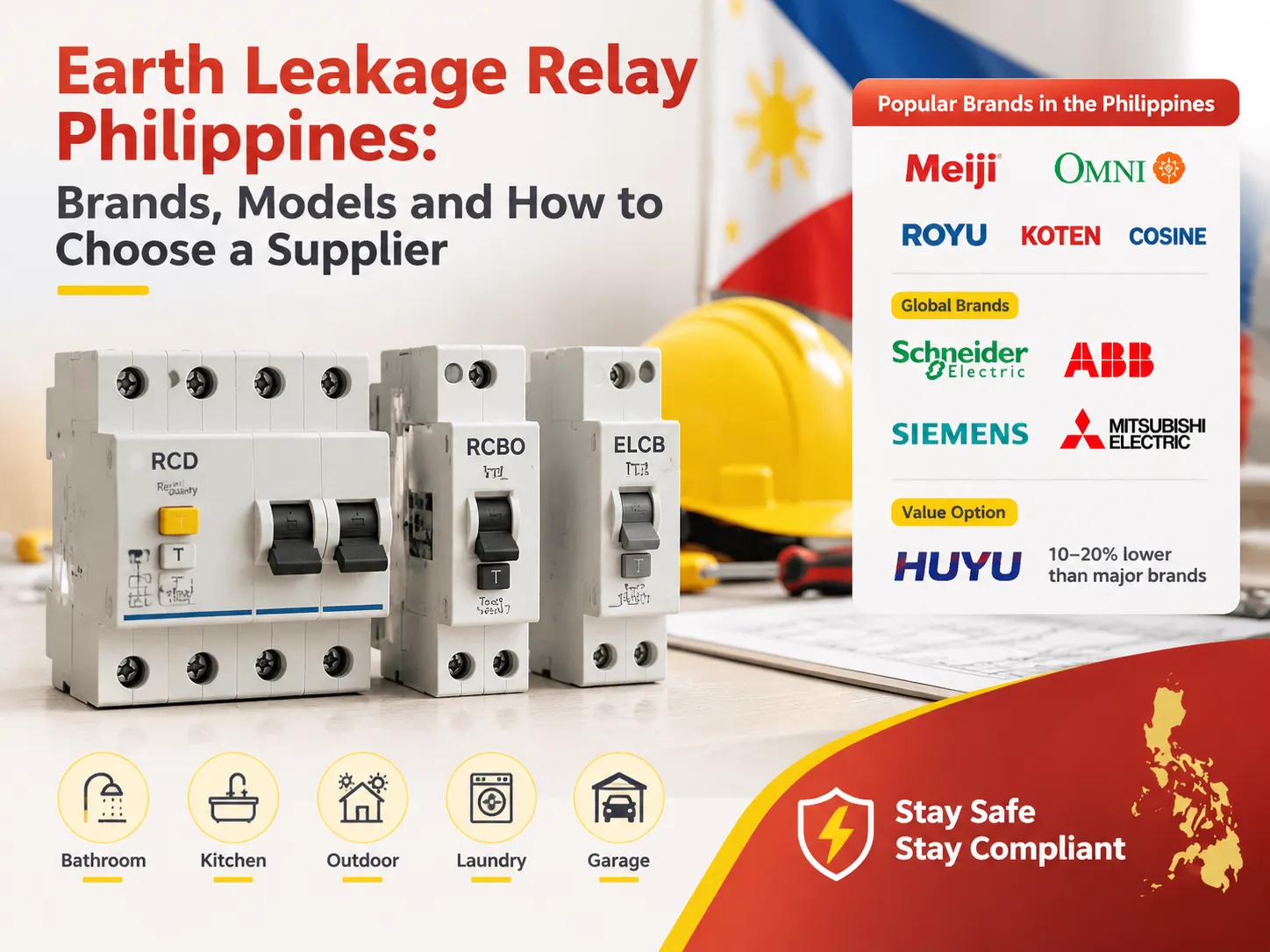
ملخص: تشير مرحلات تسرب التيار الأرضي، وأجهزة RCD، وRCCB، وELCB جميعها إلى أجهزة تفصل التيار عندما يتسرب التيار خارج الدائرة بدلاً من العودة عبر الموصل المحايد. وفقًا لـ PEC 2017 (المادة 2.10.1.8)، يجب توفير حماية GFCI من الفئة A للمنازل الفلبينية في الحمامات والمطابخ والمناطق الخارجية وغرف الغسيل والمرائب، بمستوى 4-6 مللي أمبير، وحماية تيار متبقي 30 مللي أمبير لدارات مآخذ التوصيل. جهاز RCD بتيار 30 مللي أمبير ليس بديلاً دقيقًا لجهاز GFCI بتيار 4-6 مللي أمبير ويتطلب PEC الحصول على موافقة AHJ في حال استخدام RCD أو RCBO بدلاً من المقبس. توقع إنفاق ₱300 – ₱1500 على جهاز منزلي ثنائي القطب، ₱1500 – ₱4500 على RCBO بتيار 30 أمبير، و₱2500 – ₱9000 على معدات صناعية رباعية القطب. تحظى Meiji وOmni وRoyu وKoten وCosine بشعبية بين المستخدمين المحليين بينما تحتل Schneider وABB وSiemens وMitsubishi Electric مرتبة أعلى منهم، وتوفر HUYU نفس المنتجات لكنها تفرض أسعارًا أقل على 10% – 20% مقارنة باللاعبين الدوليين الرائدين.
ما هو مرحل تسرب التيار الأرضي فعليًا
أولاً، دعونا نناقش المصطلحات لأن المشترين الفلبينيين يشيرون إلى عدة مصطلحات مختلفة تدل على احتمال وجود عنصرين أو ثلاثة مختلفة.
مرحل تسرب التيار الأرضي هو مصطلح عام يشير إلى جهاز يقيس مجموع المتجهات للتيارات في جميع الموصلات باستخدام محول تيار توازن النواة (CBCT). يجب أن تكون التيارات الخارجة في أسلاك الطور مساوية لمجموع التيارات في الموصلات المحايدة. وبالتالي، إذا فقدت بضعة مللي أمبير، فهذا يشير إلى أن التيار يتسرب عبر مسار آخر مثل شخص أو ماء أو إطار جهاز معطل.
هناك العديد من أنواع الأجهزة التي تعتمد على هذا المفهوم وتشارك نفس الاختصارات.
| المصطلح | الاسم الكامل | ما يقوم به | انقطاع زيادة التيار |
|---|---|---|---|
| ELR | مرحل تسرب التيار الأرضي | استشعار التيار المتبقي فقط، غالبًا مرحل منفصل يتحكم في فصل التيار | لا |
| قاطع التيار المتبقي / قاطع التيار المتبقي الأرضي | قاطع دائرة التيار المتبقي | استشعار التيار المتبقي، مركب على سكة DIN | لا |
| قاطع الدائرة ذو الحماية من التسرب الأرضي | قاطع التيار المتبقي مع حماية من التيار الزائد | التيار المتبقي بالإضافة إلى التيار الزائد في وحدة واحدة | نعم |
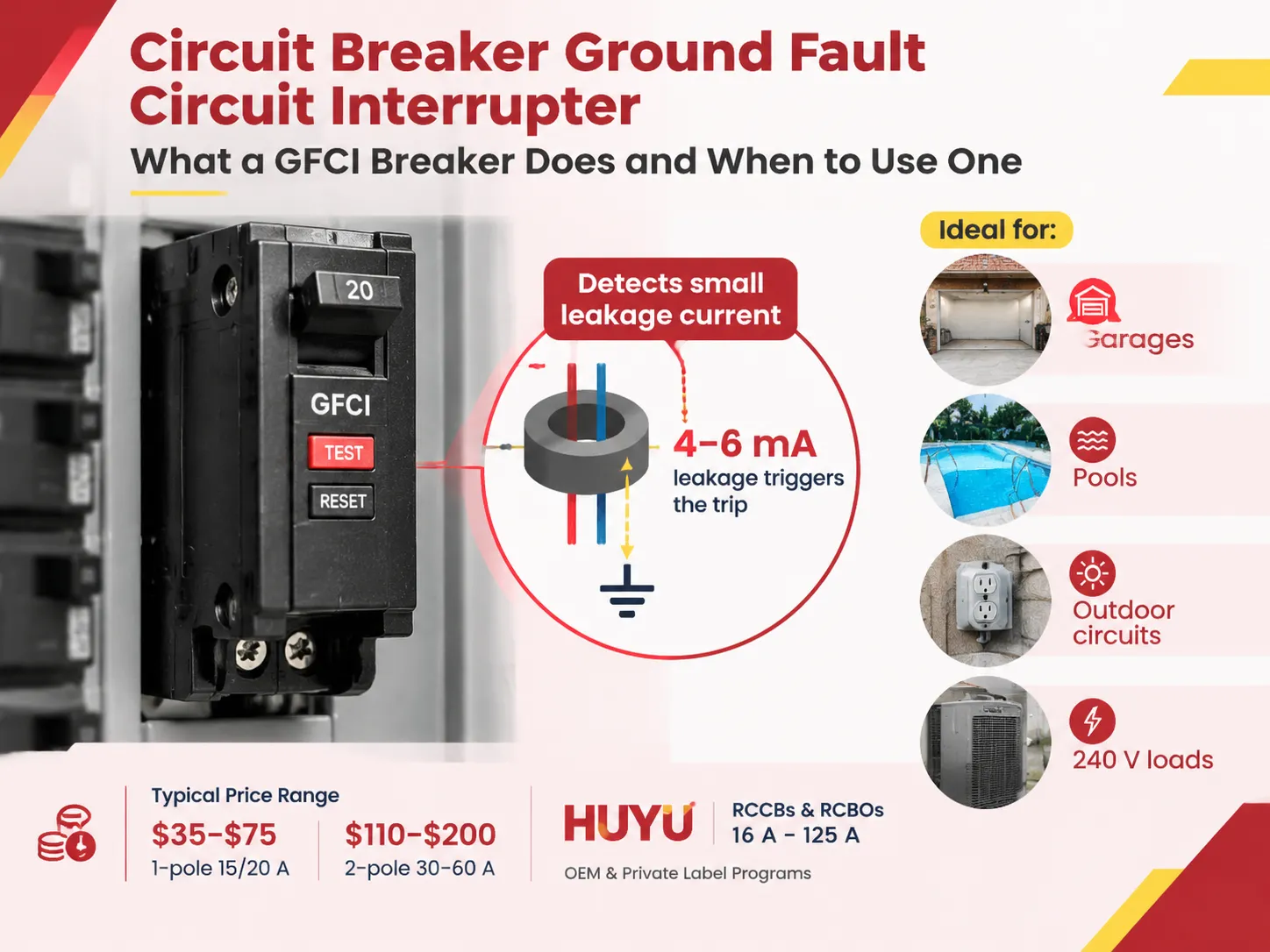
| GFCI | قاطع دائرة خطأ الأرض | حماية الأشخاص عند 4–6 مللي أمبير، وفقًا لـ UL 943 | أحيانًا |
| ELCB (تشغيل بالتيار) | قاطع دائرة تسرب التيار الأرضي | اسم قديم لجهاز RCD الحديث | لا |
| ELCB (تشغيل بالجهد) | قاطع دائرة تسرب التيار الأرضي | اكتشاف ارتفاع الجهد على هيكل الجهاز | لا |
الصف الأخير أكثر أهمية مما يبدو. أجهزة ELCB التي تعمل بالفولتية هي من التكنولوجيا القديمة. كان تشغيلها يعتمد على أن يكون مسار الأرض مثاليًا، ومن ثم يمكن أن تفشل بصمت في الظروف التي كان من المفترض أن تمنعها. إنها لا تتوافق مع المعايير الحالية وفقًا لـ PEC، وأي مورد يعتبرها مكافئة لـ RCD هو إشارة واضحة على مستوى ذكاء كتالوجه.
الشرح الكامل للاختصار وكيفية عمل ملف الاستشعار يستحق القراءة قبل تحديد أي شيء، وهو مغطى في هذا التحليل لـ ما الذي يرمز إليه ELR.
ما يتطلبه قانون الكهرباء الفلبيني
قانون الكهرباء الفلبيني هو نتاج معهد المهندسين الكهربائيين المتكاملين في الفلبين بالتعاون مع مجلس الهندسة الكهربائية والأساس القانوني لقانون الجمهورية 7920. النسخة الحالية من PEC هي PEC 2017، والتي تم تصميمها على غرار NE C لعام 2017.
هناك مقالتان تتعلقان بحماية الأعطال الأرضية. الأولى هي المادة 2.10.1.8 التي تتعلق بقواطع الدائرة الخاصة بالأعطال الأرضية التي تحمي الأشخاص، والثانية هي المادة 2.30.7.6 التي تتعلق بحماية الأعطال الأرضية للأجهزة.
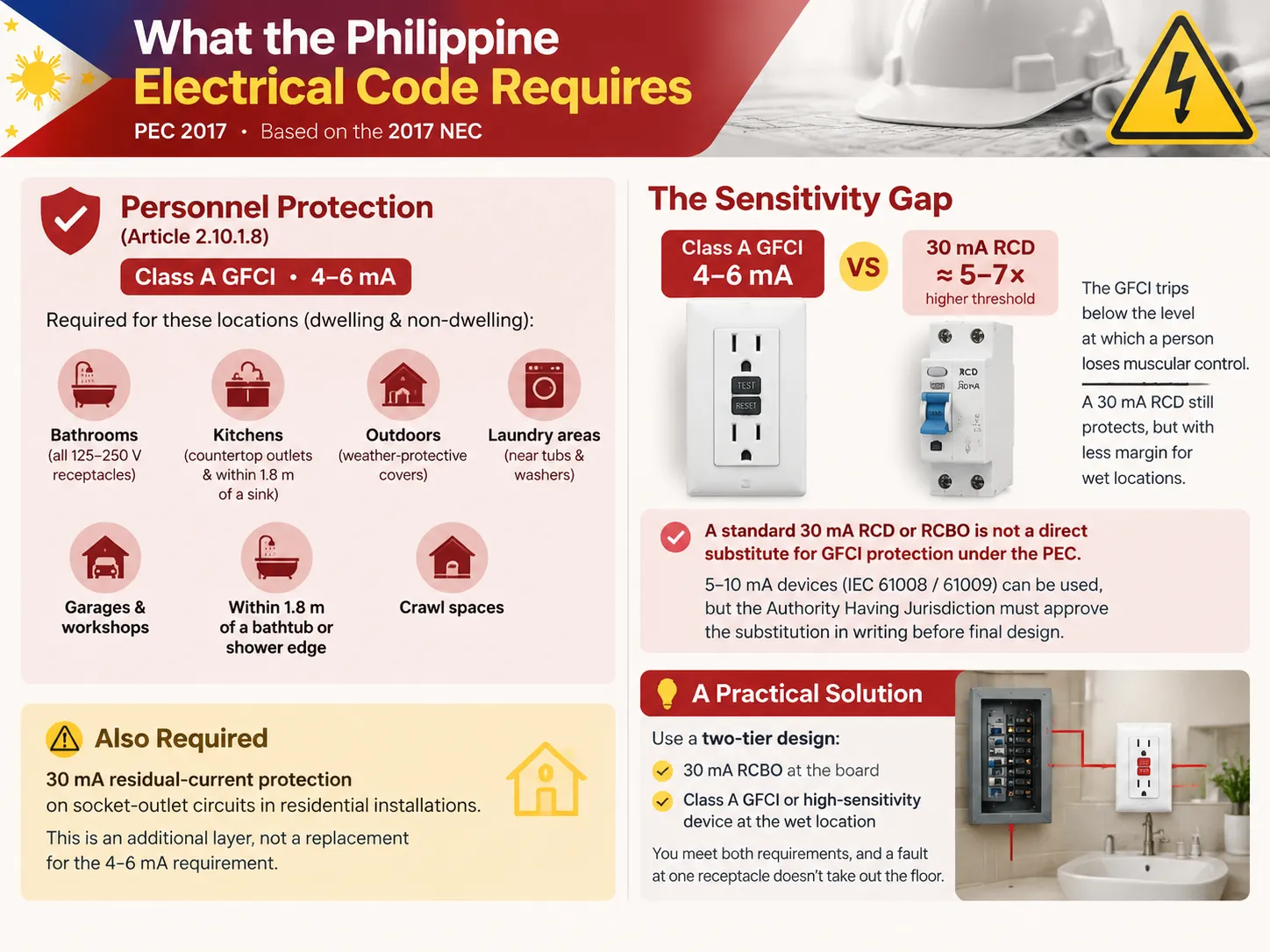
التنظيم المتعلق بالحماية الشخصية خاص، حيث إنه لا يعمل فعليًا مثل RCD بتيار 30 مللي أمبير الشائع في أوروبا. وفقًا لـ PEC 2017، يجب أن تحتوي كل من المساكن المنزلية وغير المنزلية على أنظمة قواطع دوائر الأعطال الأرضية من الفئة A بحساسية بين 4 مللي أمبير و6 مللي أمبير لأي جهاز في الأماكن التالية:
- في الحمامات، جميع المقابس التي تعمل بجهد 125–250 فولت المستخدمة
- في المطابخ، مقابس الأسطح وأي مقبس يقع على بعد أقل من 1.8 متر من الأحواض
- في المناطق الخارجية للمبنى حيث تقع جميع المقابس والمقابس الخارجية المشكوك فيها تحت الغطاء
- في مناطق الغسيل، جميع المقابس الواقعة بالقرب من أحواض الغسيل والغسالات
- في الكراجات وورش العمل
- على بعد أقل من 1.8 متر من الأحواض والدشات
بالإضافة إلى ذلك، ينص PEC على تدابير أمان التيار المتبقي بتيار 30 مللي أمبير في دوائر المقابس المنزلية. هذا خيار إضافي وليس بديلاً لمتطلبات 4-6 مللي أمبير.
ما يسيء المشترون فهمه هو الفرق بين RCDs بتيار 30 مللي أمبير و GFCIs من الفئة A من حيث مستويات الحساسية الخاصة بهم. يعمل RCD بتيار 30 مللي أمبير عند تيار أعلى بحوالي خمسة إلى سبعة أضعاف لكنه يخدم نفس الغرض، فقط بطرق مختلفة: يتم ضبط GFCI ليعمل قبل أن يفقد الشخص القدرة على التحكم في عضلاته بينما يحتوي RCD بتيار 30 مللي أمبير على هامش أمان أقل ولا يزال قادرًا على توفير بعض الحماية للشخص عندما يكون في منطقة خطر مائية. بنفس الطريقة، يعتبر PEC نوع الجهاز معيارياً ولا يعامل هذا النوع من الأجهزة كبديل مكافئ لـ GFCI. الأجهزة التي تحمل تصنيفات من 5-10 مللي أمبير والتي تتوافق مع معايير IEC 61008 أو IEC 61009 قد تكون قادرة على تحقيق نفس النتائج تحت ظروف مناسبة، لكن الكود يتطلب موافقة مسبقة على هذا الإجراء بشكل مكتوب من السلطات المختصة قبل الانتهاء من التصميم النهائي.
حل بسيط جدًا يلغي ضرورة كل هذه النزاعات هو استخدام نظام من مرحلتين. مع هذا النهج، يتم تركيب RCD بتيار 30 مللي أمبير في لوحة التحكم الكهربائية و GFCI من الفئة A أو جهاز فائق الحساسية مباشرة في المنطقة الرطبة. يساعد هذا النهج في تلبية كلا المجموعتين من المتطلبات، ولن يكون لأي خلل في أحد النقاط عواقب خطيرة.
الحساسية، النوع وأين ينتمي كل منها
يحدد مواصفان ما يمكن للجهاز فعله فعليًا: حساسية الفصل وتصنيف النوع.
| الحساسية | ما يحميه | الاستخدام النموذجي في الفلبين |
|---|---|---|
| 4–6 مللي أمبير (GFCI من الفئة A) | الأشخاص | الحمامات، المطابخ، المنافذ الخارجية، الغسيل |
| 10 مللي أمبير | الأشخاص، هامش أمان أعلى | التطبيقات الخاصة، المواقع الطبية |
| 30 مللي أمبير | الأشخاص | المعيار لدارات مآخذ التوصيل والدارات النهائية |
| 100 مللي أمبير | المعدات والحريق | الحماية الفرعية الرئيسية حيث تكون الانتقائية مطلوبة |
| 300 مللي أمبير | حريق | المدخل الرئيسي، بالإضافة إلى — وليس بدلاً من — 30 مللي أمبير في التيار الهابط |
يشير تصنيف النوع إلى موجات التيار الخاطئ التي يتعرف عليها الجهاز، وهنا تفشل العديد من التركيبات اليوم. مع تحول محولات الطاقة الشمسية، ومحركات التردد المتغير، وشواحن السيارات الكهربائية إلى القاعدة في المباني في جميع أنحاء الفلبين، فإن جهاز النوع AC سيكتشف فقط التيار المتبقي المتناوب الجيبي ولا يمكنه التعرف على المكون المستمر السلس الذي تنتجه هذه الأجهزة. النوع A يمكنه اكتشاف التيار المتناوب والمتقطع المستمر. النوع B يكتشف التيار المستمر السلس أيضًا. النوع B هو المواصفة الصحيحة لأي معدات تحتوي على مقوم، أو محول، أو وصلة تيار مستمر، وهذا ليس مجرد ترقية باسم فاخر.
الظروف في الفلبين التي تغير المواصفة
ثلاثة عناصر محلية تسبب انحراف التصميم عن المعيار الأوروبي.
230 فولت عند 60 هرتز. الكهرباء المقدمة في الفلبين عادةً 230 فولت أحادي الطور عند 60 هرتز، مع خيار 400 فولت ثلاثي الطور. يجب أن تعمل الأجهزة المباعة في هذه المناطق عند تردد 60 هرتز؛ الأجهزة التي تعمل فقط عند تردد 50 هرتز تؤدي أداءً غير متوقع، مما يجعل معلومات زمن الفصل غير موثوقة.
تنوع ترتيبات التأريض. تتكون التركيبات الكهربائية في الفلبين من مجموعات مختلفة من أنظمة TT وTN-C-S اعتمادًا على مصدر الطاقة وتاريخ البناء. نوع التأريض المستخدم يحدد ما إذا كان جهاز الحماية من التيار المتبقي (RCD) بمفرده كافيًا أو يجب تدعيمه بقضيب تأريض يتوافق مع المعايير المطلوبة ويساعد في حساب مقاومة حلقة الخطأ. الافتراضات الخاطئة حول هذا من الأسباب الرئيسية لفشل أجهزة RCD المثبتة حديثًا في العمل كما هو متوقع. يتم شرح هذه الأنظمة في نظرة عامة على TN-C-S وبعض أنواع أنظمة التأريض الأخرى.
البرق. يبلغ متوسط عدد أيام العواصف الرعدية في المناطق المنخفضة في الفلبين من 25 إلى 50 يومًا في السنة، وتزداد في المناطق الجبلية. هناك نتيجتان مباشرتان للعواصف الرعدية فيما يتعلق بوضع أجهزة التيار المتسرب. أولاً، يجب أخذ قضيب التأريض في الاعتبار، والمتطلبات الدنيا تنص على أنه يجب أن يكون مصنوعًا من فولاذ مطلي بالنحاس ويبلغ طوله 2.4 متر وقطره 15.87 ملم (5/8 بوصة). قد يشير الامتثال للكود إلى حوالي 25 أوم، على الرغم من أن قيمة 5 أوم أو أقل مفضلة لتشغيل موثوق لجهاز RCD. ثانيًا، يجب أن يكون الحماية من الارتفاعات الكهربائية قبل جهاز التيار المتسرب.
العلامات التجارية التي ستجدها فعليًا في الفلبين
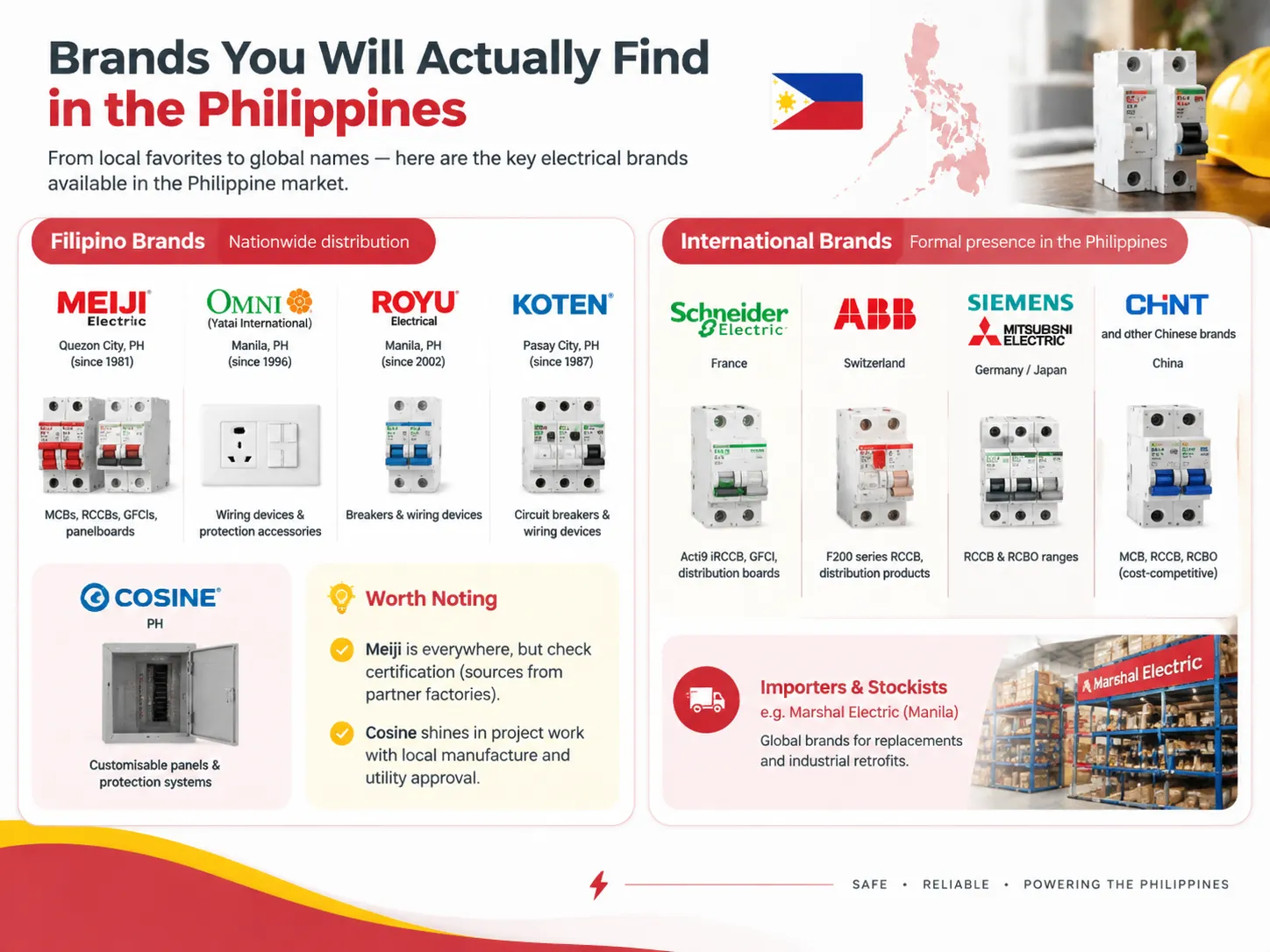
السوق المحلية مقسمة تمامًا بين العلامات التجارية الفلبينية ذات التوزيع الوطني وتلك الأجنبية التي لها حضور رسمي. الأرقام أدناه تظهر بعض الأسعار في الشارع لعام 2026 لجهاز محلي ذو قطبين تختلف بناءً على تصنيف الأمبير والحساسية.
| العلامة التجارية | الأصل | ما يوردونه | نطاق السعر النموذجي | ملاحظات |
|---|---|---|---|---|
| ميجي إلكتريك | مدينة كويزون، الفلبين — منذ 1981 | قواطع الدائرة الصغيرة (MCBs)، قواطع التيار المتبقي (RCCBs)، أجهزة الحماية من التيار الأرضي (GFCIs)، لوحات التوزيع، أجهزة التوصيل | ₱400–₱2,500 | متوافقة مع PEEP و DOE؛ تصاميم قائمة على IEC؛ مخزون واسع في متاجر الأجهزة |
| أومني (Yatai International) | مانيلا، الفلبين — منذ 1996 | أجهزة التوصيل وملحقات الحماية | ₱350–₱2,000 | معلمة PNS و ICC؛ أقوى شبكة موزعين على مستوى البلاد |
| روي إلكتريكال | مانيلا، الفلبين — منذ 2002 | قواطع (طرف لولبي ثنائي القطب، 220 فولت)، أجهزة التوصيل | ₱300–₱1,200 | تحت مجموعة FELCO؛ معتمدة من BPS؛ بولي كربونات مقاوم للحريق |
| كوتن إنتربرايزز | مدينة باسي، الفلبين — منذ 1987 | قواطع الدائرة وأجهزة التوصيل القياسية | ₱300–₱1,800 | مفضلة للإسكان الجماعي والمؤسسات؛ الأجزاء متوفرة دائماً |
| كوزاين إندستريز | الفلبين | لوحات وأنظمة حماية قابلة للتخصيص | بناءً على المشروع | صناعة محلية، موافقة قوية من المرافق، إمكانية التوسيم المشترك |
| شنايدر إلكتريك | فرنسا | Acti9 iRCCB، AvatarOn GFCI، لوحات التوزيع | ₱700–₱4,500 | أوسع تواجد للمواصفات في المشاريع التجارية |
| ABB | سويسرا | سلسلة F200 RCCB، منتجات التوزيع | ₱900–₱5,000 | شائعة في الأعمال الصناعية والمرافق |
| سيمنز / ميتسوبيشي إلكتريك | Germany / Japan | RCCB and RCBO ranges | ₱800–₱4,500 | Premium pricing; strong on OEM panels |
| Chint and other Chinese brands | China | MCB, RCCB, RCBO | ₱250–₱1,500 | Cost-competitive; certification varies enormously by product line |
There are two that require mentioning. Among the infamous brands in the Philippines, Meiji is the first choice for many domestic electricians. That’s because it’s available A-to-Z and with understandable labeling, which means that it has got the production from various factories rather than manufacturing everything on its own. Thus, the importance of checking certifications only increases. Cosine is the unique one for projects, given that it has the ability to produce things locally with the utility approval.
On the importers and the stockists level, there are companies like Marshal Electric in Manila that would have global brands for replacement and retrofitting. For the time being, being in need of a simple RCBO replacement, this layer is often faster than trying to get the replacement through the distributor order.
Common Models and What Each One Is For
Devices in this group do not have decorative design because they give you information on pole number, the type of current and other characteristics.
This means that encountering with a model such as 2P, 30mA, Type A, 6kA, you see a two-pole RCD with 30mA sensitivity that works with pulsating DC current and has a maximum short-circuit current of 6kA. Substitute 30 with 300, and a device turns into one that protects from fire and electric shock. Replace 2P with 4P, and the device protects you not only against electric shocks but also indicates if you have a three-phase circuit.
In case of a single-phase 230V domestic distribution board, you would typically encounter a 2-pole 30mA type A RCCB and a number of 16-32 A RCBOs. In commercial kitchens or wet areas of hospitals, you would be protected with devices with 10 mA GFCI. Any system with a drive or anything similarly requiring a type B device will make the specifications different.
HUYU’s residual-current range covers that spread in one family rather than piecemeal: a 16–125 A Type AC/Type A RCCB for the sub-main position, plus RCBOs from 6 A to 125 A, Type B and Type F variants for inverter and drive loads, and the MCB and AFDD lines that sit alongside them in the same board. The point of buying one family is that the accessories, busbars and enclosure widths are already matched.
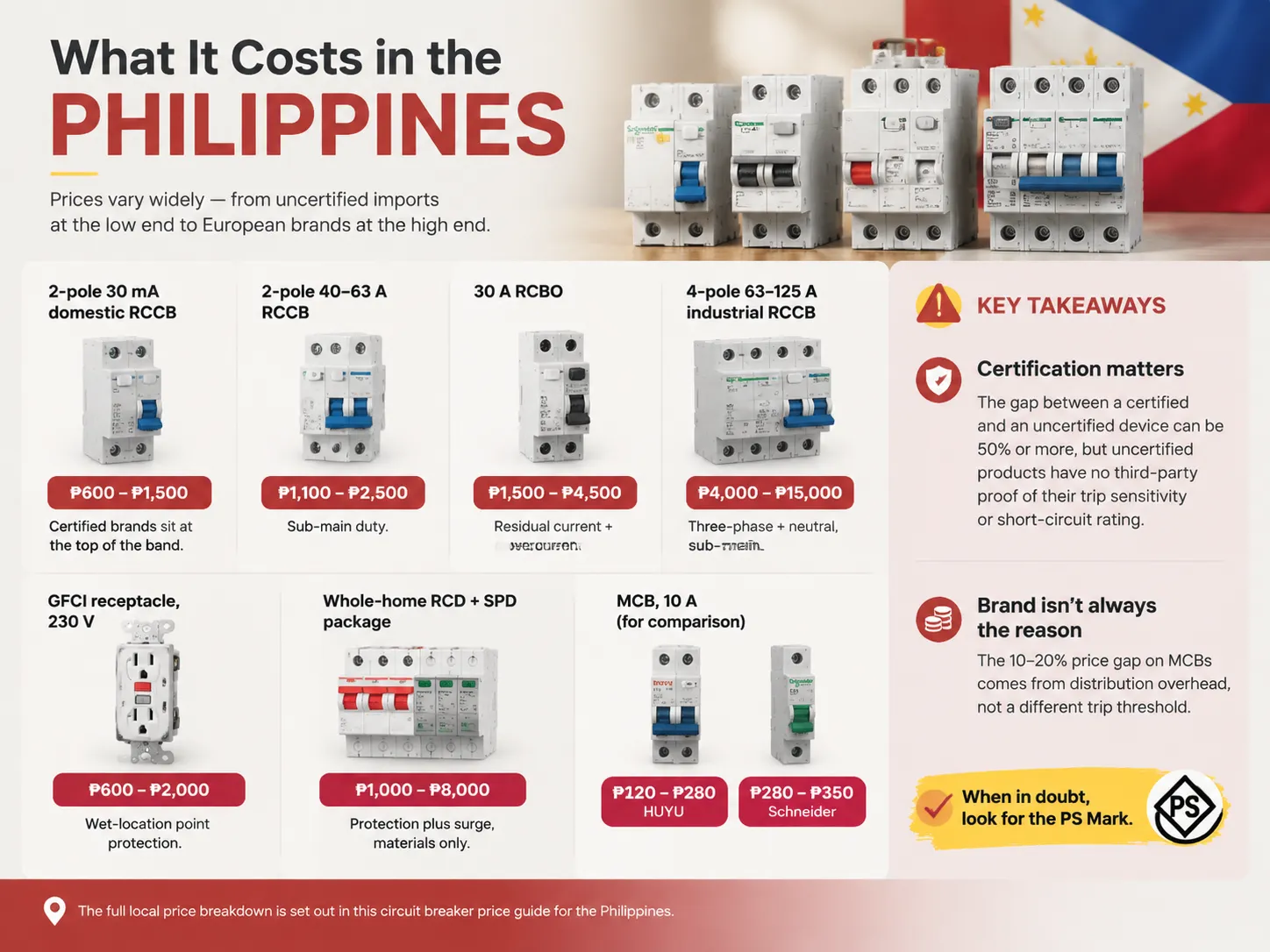
What It Costs in the Philippines
Philippine pricing is lumped because the cheaper side of the market is crowded by uncertified imports and the expensive one by European brands, leaving very limited possibilities in between. The bands below show 2026 street pricing, so regard the low end of any range with caution unless there is a visible PS Mark.
| الجهاز | Typical price (PHP) | ملاحظات |
|---|---|---|
| 2-pole 30 mA domestic RCCB | ₱600–₱1,500 | Certified brands sit at the top of the band |
| 2-pole 40–63 A RCCB | ₱1,100–₱2,500 | Sub-main duty |
| 30 A RCBO | ₱1,500–₱4,500 | Residual current plus overcurrent |
| 4-pole 63–125 A industrial RCCB | ₱4,000–₱15,000 | Three-phase plus neutral, sub-main |
| GFCI receptacle, 230 V | ₱600–₱2,000 | Wet-location point protection |
| Whole-home RCD + SPD package | ₱1,000–₱8,000 | Protection plus surge, materials only |
| MCB, 10 A, for comparison | ₱220–₱400 | HUYU ₱220–280; Schneider ₱280–350 |
There are two noteworthy patterns. The difference between an approved unit and one that is not may appear on paper to be more than fifty percent, however, the uncertified item has no verification that it will break at the values stated in its specifications or withstand short-circuit current of the same value. Therefore, the calculated difference is only a difference on paper. Similar situation can be observed in the table presented above, where HUYU offers its product at a price level of ₱220–280 while major European brands sell their devices for ₱280–400.The full local price breakdown is set out in this circuit breaker price guide for the Philippines.
How to Choose a Supplier
Philippine procurement depends on certifications more than on manufacturers, so figure out this checklist before worrying about price.
- PS Mark or ICC. Electrical equipment available in the Philippines is expected to be marked with the Philippine Standard Mark or an Import Commodity Clearance sticker. Without that, an appliance cannot be mentioned in a valid installation, no matter what kind of datasheet is provided.
- Specify standards. RCCB has to be certified according to IEC 61008, while RCBO has to provide IEC 61009. An offer saying “It conforms to IEC standards” is not definitive.
- Sensitive rating and Type. Make sure the offer indicates that it is 30 mA and appropriate Type A or B. If a drive, inverter or an adapter is included in the installation, Type B is obligatory.
- Breaking capacity. Ask what conditional short-circuit current a device is rated for and which protective device is used. The difference between a 10 kA unit and a 6 kA unit is not visible.
- 60Hz specification. Make sure the part complies with the specifications for 60Hz, not 50 Hz only.
- Warranty. It is better to ask for two-year warranty with some possibility of replacement rather than a one-year.
- Documentation. Make sure you obtain the test report and Declaration of Conformity each time the shipment arrives, not just once per inquiry.
This way a manufacturer like HUYU operates successfully. We are not well-known brand among Filipino customers, and if the specification mentions Schneider or ABB, it means that this specification involves these brands and not our company. In that case, we are able to compete based on performance specifications — 30 mA, Type A or B, PS Mark or ICC, IEC 61008/61009, two-year warranty according to the specifications strictly. The range and the OEM terms are set out on the RCCB manufacturing programme page.
الأسئلة الشائعة
Is an earth leakage relay the same as an RCD or RCCB?
So functionally the two devices are the same as they both sense the current flowing in the live conductors and trip on residual current. However the difference between them comes in terms of the form factor and their application. The earth leakage relay is usually a standalone equipment which is combined with a core balance current transformer and is responsible for the operation of the relay which is utilized when it is required to have a variable action of the device or to trip a large circuit breaker. RCCB is in fact a single DIN event component that performs the switch. In electrical works in the Philippines one will be faced with installation of RCCB or RCBO while earth leakage relays are used in industry and beyond.
Does the Philippine Electrical Code require an RCD in homes?
Yes, in two different ways. The requirement of PEC 2017 Article 2.10.1.8 is that Class A grounding fault circuit interrupters (GFCIs) should be applied when the current range is 4 to 6 mA in outlets located in bathrooms, kitchens near sinks, where water is used outdoors, in laundry areas, garages, and within 1.8 meters of a bathtub or shower. In addition to this, the code specifies that circuitry for socket-outlet circuits has a requirement of 30 mA for the residential output. Both of these requirements are applicable, and one may not replace the other because the thresholds of sensitivity are already different with these two requirements as well as the principles of protection.
Can a 30 mA RCD be used instead of a GFCI in the Philippines?
Rather than a straightforward substitute for the 4-6 mA requirement. It should be noted that PEC specifically mentions that the device with 30 mA rating does not comply with the GFCI regulation as 30 mA is about five to seven times more than the GFCI compliance level. Devices with 5-10 mA rating which are in accordance with IEC 61008 or IEC 61009 are compliant to requirements when the right type is utilized based on the load, but there is a limitation in the sense that prior written approval from AHAJ is necessary before the design completion. Thus, it will be more prudent to provide both: a 30 mA RCBO installed in the electrical panel and a Class A GFCI used in moist locations.
What Type should I specify — AC, A, B or F?
Type AC responds only to sinusoidal alternating residual current and is only used in simple resistive and lighting circuits. Type A adds pulsating DC to its sensing range and is the sensible minimum for modern installations with electronic equipment. Type B is required whenever the circuit contains any of the following: a variable frequency drive, a solar inverter, an EV charger, or any other equipment that can create smooth DC leakage because neither Type AC nor Type A will detect it. Type F is between types A and B when it comes to mixed frequencies from single-phase drives and some inverter loads. If there is any inverter on the load list, specify Type B and stop haggling.
Do I need surge protection as well as earth leakage protection?
Absolutely, and the two are not the same things, as an RCD reacts as regards to any residual current, but does not shield devices from voltage surge. Considering that there can 25-50 storm days every year in the Philippines flat regions, the usage of Type 1 SPD at the point of supplies with the use of Type 2 devices at the switches is common and advisable for anything what has sensitive loads. The distance between these two levels of SPD should be at least 10 m or they can be connected with the help of decoupling elements.
Why does a newly installed RCD trip for no apparent reason?
There are four reasons that can account for the majority of the instances. An included neutral conductor connecting ahead two circuits divides the return path and takes on the characteristics of a ground fault for the coil responsible for sensing the fault. A bootleg ground or neutral conductor that has inadvertently been grounded also produces the same results. Cable insulation that has absorbed moisture, typical for the older Philippine buildings, leads to the presence of a true leakage. Finally, a device that is installed incorrectly because of the type may trigger an alarm on the DC component of the load. In order to localize the source of the issue, disconnect the load first and then check the individual circuits.
المراجع
- International Electrotechnical Commission — IEC 61008 and IEC 61009, residual current operated circuit-breakers
- معايير ومشاركة UL — UL 943، قواطع الدائرة ذات الحماية من الأعطال الأرضية
- UL Solutions — testing and certification for residual current devices
- NFPA — NFPA 70, National Electrical Code (the basis of the PEC structure)
- ISO — ISO 9001 quality management, the framework behind IEC 61008/61009 certification
الخلاصة
When looking to purchase earth leakage protection in the Philippines, you will have to think about three different specifications as well as one certificate. The specifications include the sensitivity of the device (i.e. it should be 4–6 mA for personnel protection in compliance with PEC 2017, 30 mA for socket circuits and 300 mA for fire protection), number of poles and the Type of the device (AC means basic protection, A is the most common there is and B is suitable only when the inverter or the drive is used in the device). The certificate you need is either a PS Mark or ICC sticker — without the certificate, you cannot use the device in your installation even if the datasheet states otherwise.
As for the suppliers, you can choose from Meiji, Omni, Royu and Koten companies as they will provide you with fast replacement regardless of the device illness; Cosine company manufactures at local factories and has a range of strong utility approvals; Schneider, ABB, Siemens and Mitsubishi Electric are known for the presence of all specifications required for proper device functioning according to the consultants expectations. HUYU is competing on costs and OEM terms – our prices are 10–20% lower than those of the leading brands but since we are not a well-known brand we have to admit that.
Whichever option you choose to shop for, ask for the data you need (the standard number, declared sensitivity of the device, type of the device and its safety performance) in writing so that at least four points indicated in the quotation would not allow you to deal with most possible troubles.