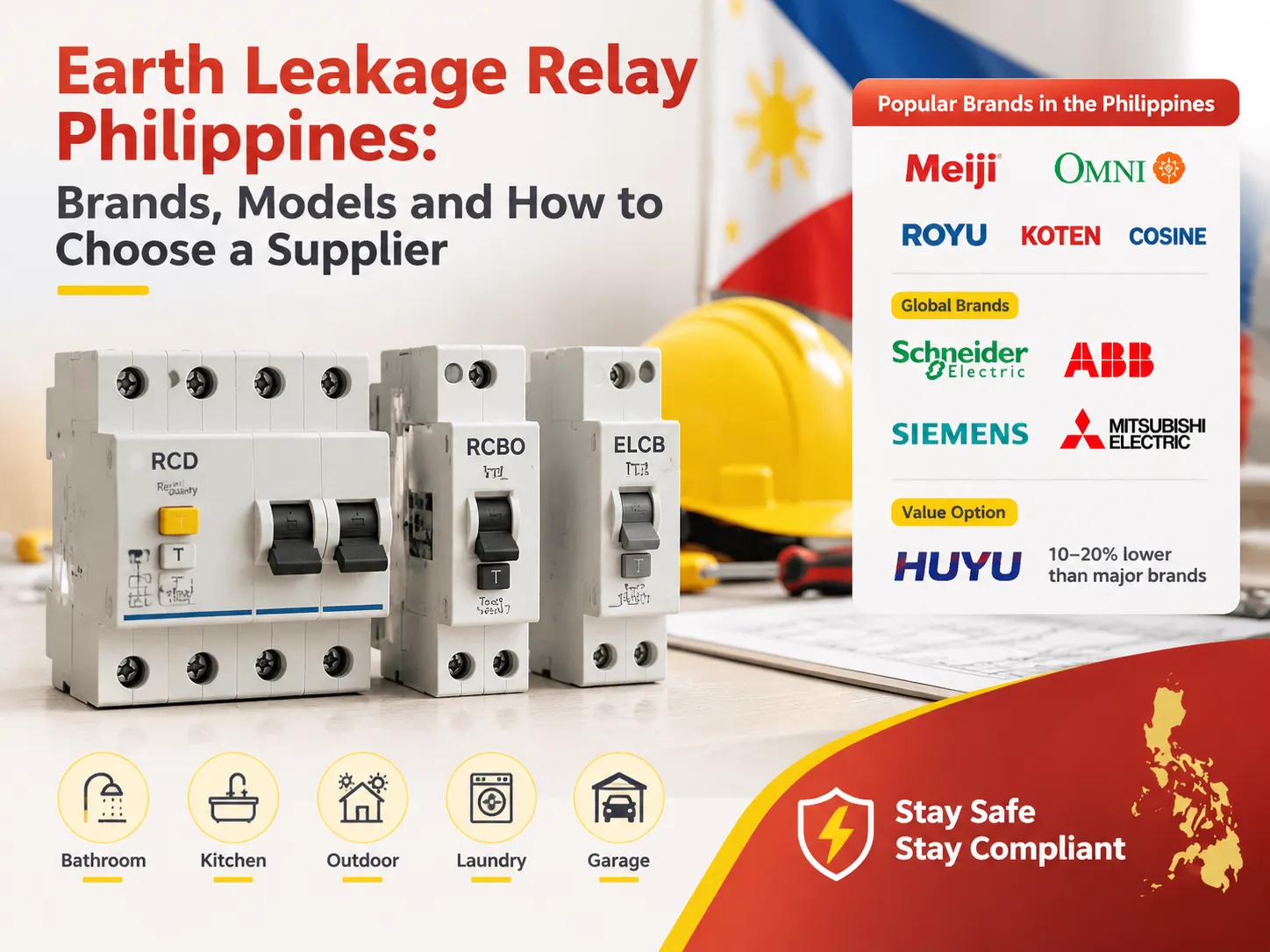
Pembelian perangkat proteksi kebocoran arus tanah di Filipina berbeda dengan pembelian pemutus sirkuit karena beberapa faktor, termasuk tegangan 230 V pada frekuensi 60 Hz, kode yang berlaku (PEC bukan NEC), keharusan adanya Tanda PS atau stiker ICC pada setiap perangkat yang dijual di pasar Filipina, dan keputusan jenis sensitivitas yang digunakan untuk menjadikannya perangkat yang melindungi orang atau hanya perangkat. Panduan ini akan membantu Anda memahami arti terminologi yang digunakan, persyaratan Kode Listrik Filipina, merek yang tersedia di pasar lokal, harga mereka, dan cara memilih pemasok tanpa mengalami penipuan.
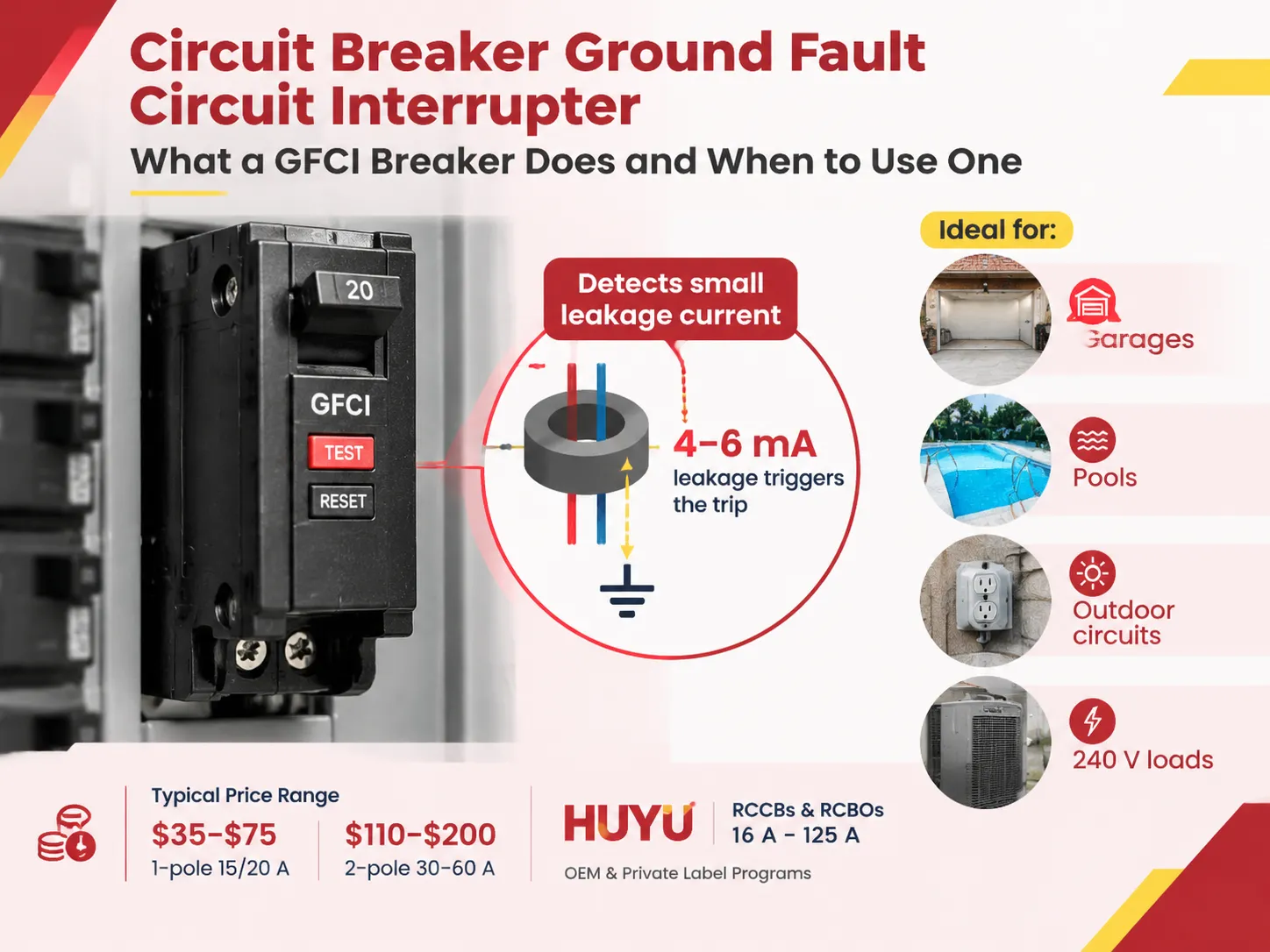
Ringkasan: Relay kebocoran arus tanah, RCD, RCCB, dan ELCB semuanya merujuk pada perangkat yang memutus arus saat arus mengalir keluar dari sirkuit alih-alih kembali melalui netral. Menurut PEC 2017 (Pasal 2.10.1.8), rumah tangga Filipina harus dilengkapi dengan proteksi GFCI Kelas A untuk kamar mandi, dapur, area luar ruangan, ruang cuci, dan garasi, pada tingkat 4-6 mA, serta proteksi arus sisa 30 mA untuk sirkuit soket outlet. RCD 30 mA bukan pengganti tepat untuk GFCI 4-6 mA dan PEC mengharuskan persetujuan AHJ diperoleh jika RCD atau RCBO digunakan sebagai pengganti receptacle. Harapkan pengeluaran ₱300 – ₱1500 untuk perangkat 2-pole rumah tangga, ₱1500 – ₱4500 untuk RCBO 30 A, dan ₱2500 – ₱9000 untuk peralatan tipe industri 4-pole. Meiji, Omni, Royu, Koten, dan Cosine populer di kalangan pengguna lokal sementara Schneider, ABB, Siemens, dan Mitsubishi Electric diposisikan lebih tinggi dari mereka, dan HUYU menyediakan produk yang sama tetapi mengenakan biaya 10% – 20% lebih rendah daripada pemain internasional terkemuka.
Apa Itu Relay Kebocoran Arus Tanah Sebenarnya
Pertama, mari kita bahas terminologi karena pembeli Filipina merujuk pada beberapa istilah berbeda yang mungkin menunjukkan dua atau tiga item berbeda.
Relay kebocoran arus tanah adalah istilah umum yang merujuk pada perangkat yang mengukur jumlah vektor arus di semua konduktor menggunakan transformator arus keseimbangan inti (CBCT). Arus yang keluar pada kabel fase harus sama dengan jumlah arus pada konduktor netral. Jadi, jika beberapa miliampere hilang, itu menunjukkan bahwa arus bocor melalui jalur lain seperti orang, air, atau rangka perangkat yang rusak.
Ada banyak jenis perangkat yang berdasarkan konsep ini dan menggunakan akronim yang sama.
| Istilah | Nama lengkap | Fungsinya | Trip arus lebih |
|---|---|---|---|
| ELR | Relay kebocoran arus tanah | Hanya mendeteksi arus sisa, sering berupa relay terpisah yang menggerakkan trip shunt | Tidak |
| RCCB / RCD | Pemutus sirkuit arus sisa | Deteksi arus sisa, dipasang di rel DIN | Tidak |
| RCBO | Pemutus arus sisa dengan proteksi lebih arus | Arus sisa plus proteksi lebih arus dalam satu modul | Ya |
| perlindungan ke kamar mandi, dapur, garasi, stopkontak luar ruangan, | Pemutus sirkuit gangguan tanah | Proteksi personel pada 4–6 mA, sesuai UL 943 | Kadang-kadang |
| ELCB (operasi arus) | Pemutus sirkuit kebocoran arus tanah | Nama lama untuk RCD modern | Tidak |
| ELCB (operasi tegangan) | Pemutus sirkuit kebocoran arus tanah | Mendeteksi kenaikan tegangan pada rangka perangkat | Tidak |
Baris terakhir lebih signifikan daripada yang terlihat. ELCB yang dioperasikan dengan tegangan adalah teknologi kuno. Operasinya bergantung pada jalur tanah yang sempurna, sehingga mereka bisa gagal tanpa suara dalam keadaan yang seharusnya mereka cegah. Mereka tidak sesuai dengan standar saat ini menurut PEC, dan setiap pemasok yang menganggapnya setara dengan RCD sedikit menunjukkan kurangnya kecerdasan dalam katalog mereka.
Penjelasan lengkap tentang akronim dan cara kerja kumparan sensor layak dibaca sebelum Anda menentukan spesifikasi apa pun, dan ini dibahas dalam rincian ini apa arti ELR.
Apa yang Diperlukan oleh Philippine Electrical Code
Philippine Electrical Code adalah produk dari Institute of Integrated Electrical Engineers of the Philippines bekerja sama dengan Board of Electrical Engineering dan dasar hukum dari Republic Act 7920. Versi PEC saat ini adalah PEC 2017, yang dimodelkan berdasarkan 2017 NE C.
Ada dua artikel yang berkaitan dengan perlindungan gangguan tanah. Yang pertama adalah Artikel 2.10.1.8 yang berkaitan dengan pemutus sirkuit gangguan tanah yang melindungi orang dan yang kedua adalah Artikel 2.30.7.6 yang berkaitan dengan perlindungan gangguan tanah pada peralatan.
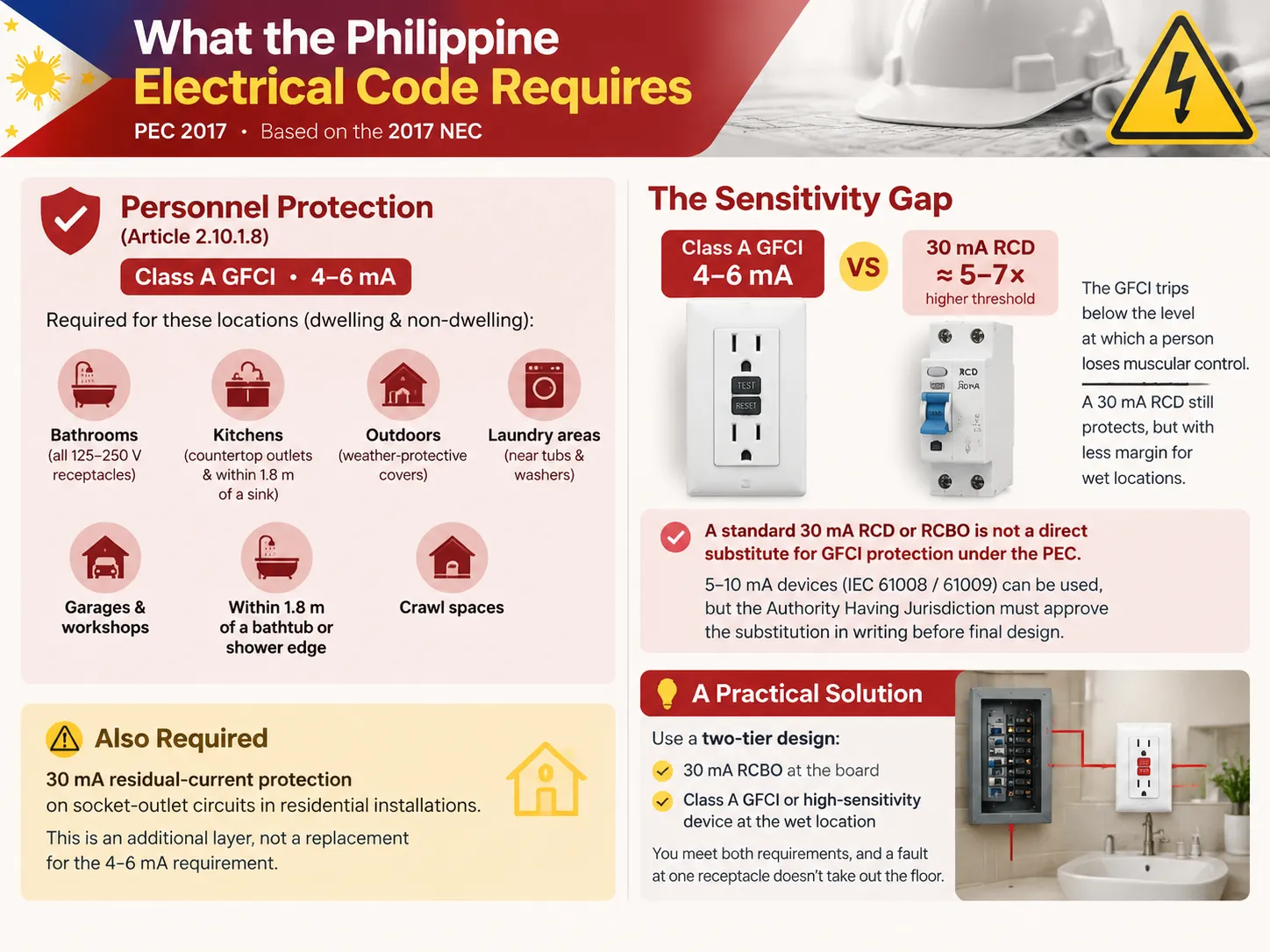
Regulasi mengenai perlindungan pribadi bersifat khusus, karena tidak berfungsi seperti RCD 30 mA yang umum di Eropa. Menurut PEC 2017, baik tempat tinggal rumah maupun non-rumah harus memiliki sistem pemutus sirkuit gangguan tanah Kelas A dengan sensitivitas antara 4 mA dan 6 mA untuk setiap perangkat di tempat berikut:
- di kamar mandi, semua soket 125–250 V yang digunakan
- di dapur, stopkontak meja dan soket apa pun yang berjarak kurang dari 1,8 m dari wastafel
- di area luar bangunan di mana semua soket dan steker luar ruangan yang diragukan berada di bawah penutup
- di area laundry, semua soket yang berlokasi dekat wastafel laundry dan mesin cuci
- di garasi dan bengkel
- dalam jarak kurang dari 1,8 m dari bak mandi dan shower
Selain itu, PEC menetapkan langkah keselamatan arus sisa 30 mA pada sirkuit soket rumah tangga. Ini adalah opsi tambahan dan bukan pengganti untuk persyaratan 4-6 mA.
Apa yang disalahpahami pembeli adalah perbedaan antara RCD 30 mA dan GFCI Kelas A dalam hal tingkat sensitivitasnya. RCD 30 mA beroperasi pada arus sekitar lima hingga tujuh kali lebih tinggi tetapi memiliki tujuan yang sama, hanya dengan cara yang berbeda: GFCI disesuaikan untuk memutus sebelum seseorang kehilangan kemampuan mengendalikan ototnya sementara RCD 30 mA memiliki batas keamanan yang lebih rendah dan masih dapat memberikan perlindungan kepada seseorang ketika berada di zona bahaya air. Dengan cara yang sama, PEC menganggap jenis perangkat ini sebagai standar dan tidak memperlakukan jenis perangkat ini sebagai pengganti setara untuk GFCI. Perangkat yang memiliki rating 5-10 mA dan yang memenuhi standar IEC 61008 atau IEC 61009 mungkin dapat mencapai hasil yang sama dalam kondisi yang tepat tetapi kode mengharuskan persetujuan tertulis sebelumnya dari otoritas yang berwenang sebelum desain akhir diselesaikan.
Satu solusi yang sangat sederhana yang menghilangkan kebutuhan semua perselisihan ini adalah penggunaan sistem dua tahap. Dengan pendekatan ini, seseorang memasang RCD 30 mA di panel kontrol listrik dan GFCI Kelas A atau perangkat super sensitif segera di area basah. Pendekatan seperti ini membantu memenuhi kedua set persyaratan, dan kerusakan pada salah satu titik tidak akan memiliki konsekuensi serius.
Sensitivitas, Tipe dan Tempat Masing-Masing
Dua spesifikasi menentukan apa yang sebenarnya dapat dilakukan oleh sebuah perangkat: sensitivitas trip dan penunjukan Tipe-nya.
| Sensitivitas | Apa yang dilindungi | Penggunaan tipikal di Filipina |
|---|---|---|
| 4–6 mA (GFCI Kelas A) | Orang | Kamar mandi, dapur, outlet luar ruangan, laundry |
| 10 mA | Orang, margin lebih tinggi | Aplikasi khusus, lokasi medis |
| 30 mA | Orang | The standard for socket-outlet circuits and final circuits |
| 100 mA | Equipment and fire | Sub-main protection where selectivity is needed |
| 300 mA | Kebakaran | Main incomer, in addition to — never instead of — 30 mA downstream |
The Type designation indicates the fault current waves that are recognized by the equipment, and this is where many installations today fail. With solar inverters, variable frequency drives and EV chargers becoming the norm in buildings all over the Philippines, a Type AC device will only detect sinusoidal alternation residual current and cannot recognize the smooth DC component produced by these devices. Type A can detect both alternating and pulsating DC. Type B detects smooth DC as well. Type B is the right specification for any equipment comprising a rectifier, inverter or DC link, and this is not merely an upgrade with a fancy name.
Conditions in the Philippines That Change the Specification
Three local elements cause the design to deviate from the European standard.
230 V at 60 Hz. The electricity provided in the Philippines is usually 230 V single-phase at 60 Hz, with 3-phase 400 V being an option. Devices sold in these territories must work at the frequency of 60 Hz; devices that run only at the frequency of 50 Hz perform in an unpredictable manner, which makes the trip-time information unreliable.
Variety of earth arrangements. Electrical installations in the Philippines consist of different combinations of TT and TN-C-S systems depending on the power supply and the construction date. The type of earthing used defines whether an RCD by itself is sufficient or it has to be supplemented with an earth electrode that corresponds to the required standards and helps to calculate the fault-loop impedance. Mistaken assumptions about this are among the main reasons why newly installed RCDs sometimes fail to function as expected. The explanation of such systems is provided in the overview of TN-C-S and some other types of earthing systems.
Lightning. The average number of thunderstorm days in low-lying areas of the Philippines amounts to 25-50 a year, and those in mountainous regions experience even more. There are two direct consequences of thunderstorms for the placement of leaking-current devices. First of all, an earth electrode should be taken into account, and the minimum requirements state that it should be made of copper-plated steel and have 2.4 m and 15.87 mm (5/8 in) in diameter. Code compliance may indicate about 25 Ohms, although for reliable RCD operation, the value of 5 Ohms and over is favorable. Secondly, surge protection should be upstream of the leaking device.
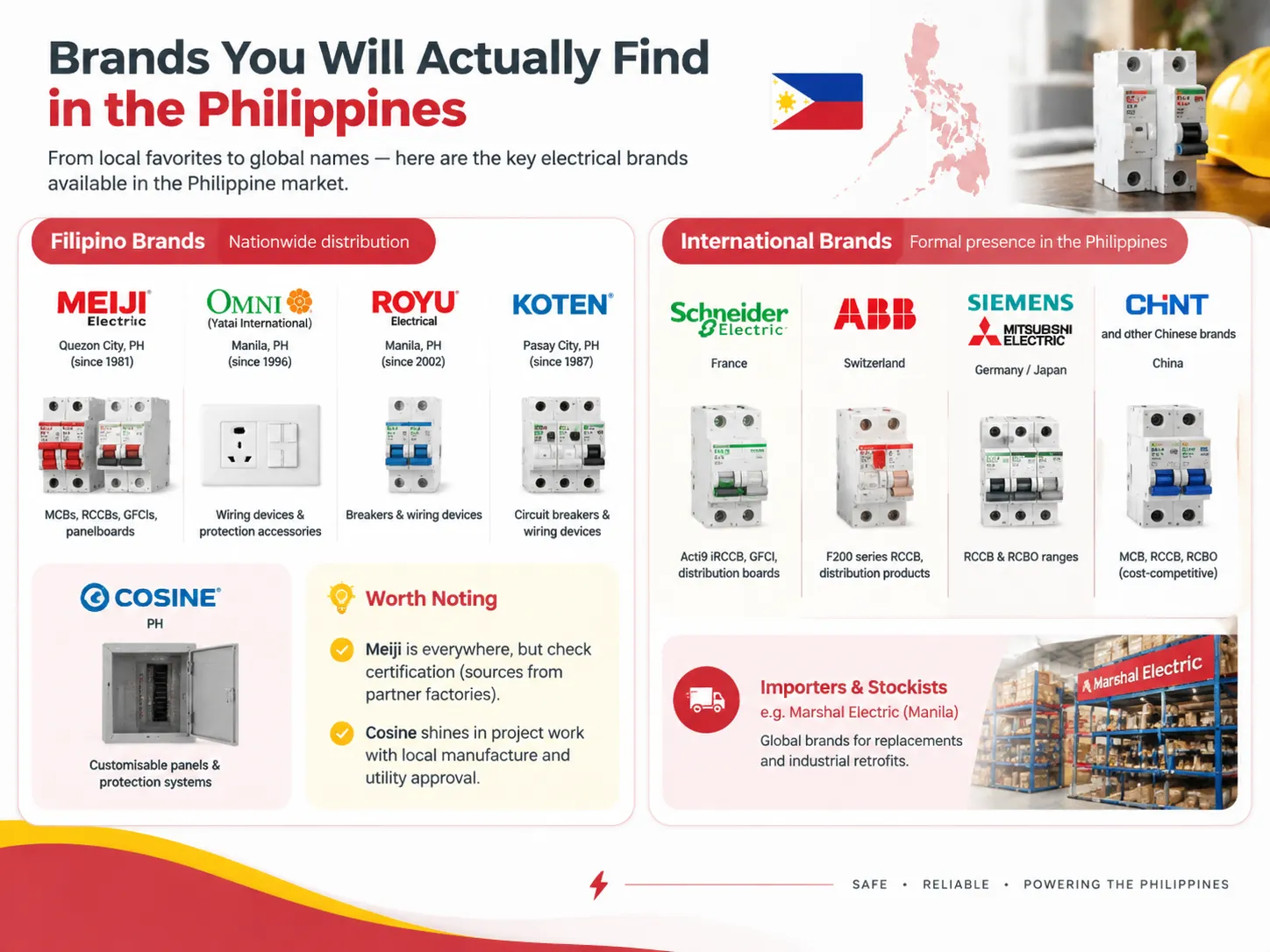
Brands You Will Actually Find in the Philippines
The local market is perfectly divided between Filipino brands with national distribution and those that are foreign but have a formal presence. Below figures show some street prices in 2026 for a domestic device of 2 poles that vary on the basis of ampere rating and sensitivity.
| Merek | Origin | What they supply | Typical price band | Catatan |
|---|---|---|---|---|
| Meiji Electric | Quezon City, PH — since 1981 | MCBs, RCCBs, GFCIs, panelboards, wiring devices | ₱400–₱2,500 | PEEP and DOE compliant; IEC-based designs; wide hardware-store stock |
| Omni (Yatai International) | Manila, PH — since 1996 | Wiring devices and protection accessories | ₱350–₱2,000 | PNS and ICC marked; the strongest nationwide distributor network |
| Royu Electrical | Manila, PH — since 2002 | Breakers (2-pole screw terminal, 220 V), wiring devices | ₱300–₱1,200 | Under the FELCO group; BPS certified; fire-retardant polycarbonate |
| Koten Enterprises | Pasay City, PH — since 1987 | Circuit breakers and standard wiring devices | ₱300–₱1,800 | Mass-housing and institutional favourite; parts always available |
| Cosine Industries | PH | Customisable panels and protection systems | Project-based | Locally made, strong utility approval, co-labelling available |
| Schneider Electric | Prancis | Acti9 iRCCB, AvatarOn GFCI, distribution boards | ₱700–₱4,500 | Widest specification presence on commercial projects |
| ABB | Swiss | F200 series RCCB, distribution products | ₱900–₱5,000 | Common on industrial and utility work |
| Siemens / Mitsubishi Electric | Germany / Japan | RCCB and RCBO ranges | ₱800–₱4,500 | Premium pricing; strong on OEM panels |
| Chint and other Chinese brands | China | MCB, RCCB, RCBO | ₱250–₱1,500 | Cost-competitive; certification varies enormously by product line |
There are two that require mentioning. Among the infamous brands in the Philippines, Meiji is the first choice for many domestic electricians. That’s because it’s available A-to-Z and with understandable labeling, which means that it has got the production from various factories rather than manufacturing everything on its own. Thus, the importance of checking certifications only increases. Cosine is the unique one for projects, given that it has the ability to produce things locally with the utility approval.
On the importers and the stockists level, there are companies like Marshal Electric in Manila that would have global brands for replacement and retrofitting. For the time being, being in need of a simple RCBO replacement, this layer is often faster than trying to get the replacement through the distributor order.
Common Models and What Each One Is For
Devices in this group do not have decorative design because they give you information on pole number, the type of current and other characteristics.
This means that encountering with a model such as 2P, 30mA, Type A, 6kA, you see a two-pole RCD with 30mA sensitivity that works with pulsating DC current and has a maximum short-circuit current of 6kA. Substitute 30 with 300, and a device turns into one that protects from fire and electric shock. Replace 2P with 4P, and the device protects you not only against electric shocks but also indicates if you have a three-phase circuit.
In case of a single-phase 230V domestic distribution board, you would typically encounter a 2-pole 30mA type A RCCB and a number of 16-32 A RCBOs. In commercial kitchens or wet areas of hospitals, you would be protected with devices with 10 mA GFCI. Any system with a drive or anything similarly requiring a type B device will make the specifications different.
HUYU’s residual-current range covers that spread in one family rather than piecemeal: a 16–125 A Type AC/Type A RCCB for the sub-main position, plus RCBOs from 6 A to 125 A, Type B and Type F variants for inverter and drive loads, and the MCB and AFDD lines that sit alongside them in the same board. The point of buying one family is that the accessories, busbars and enclosure widths are already matched.
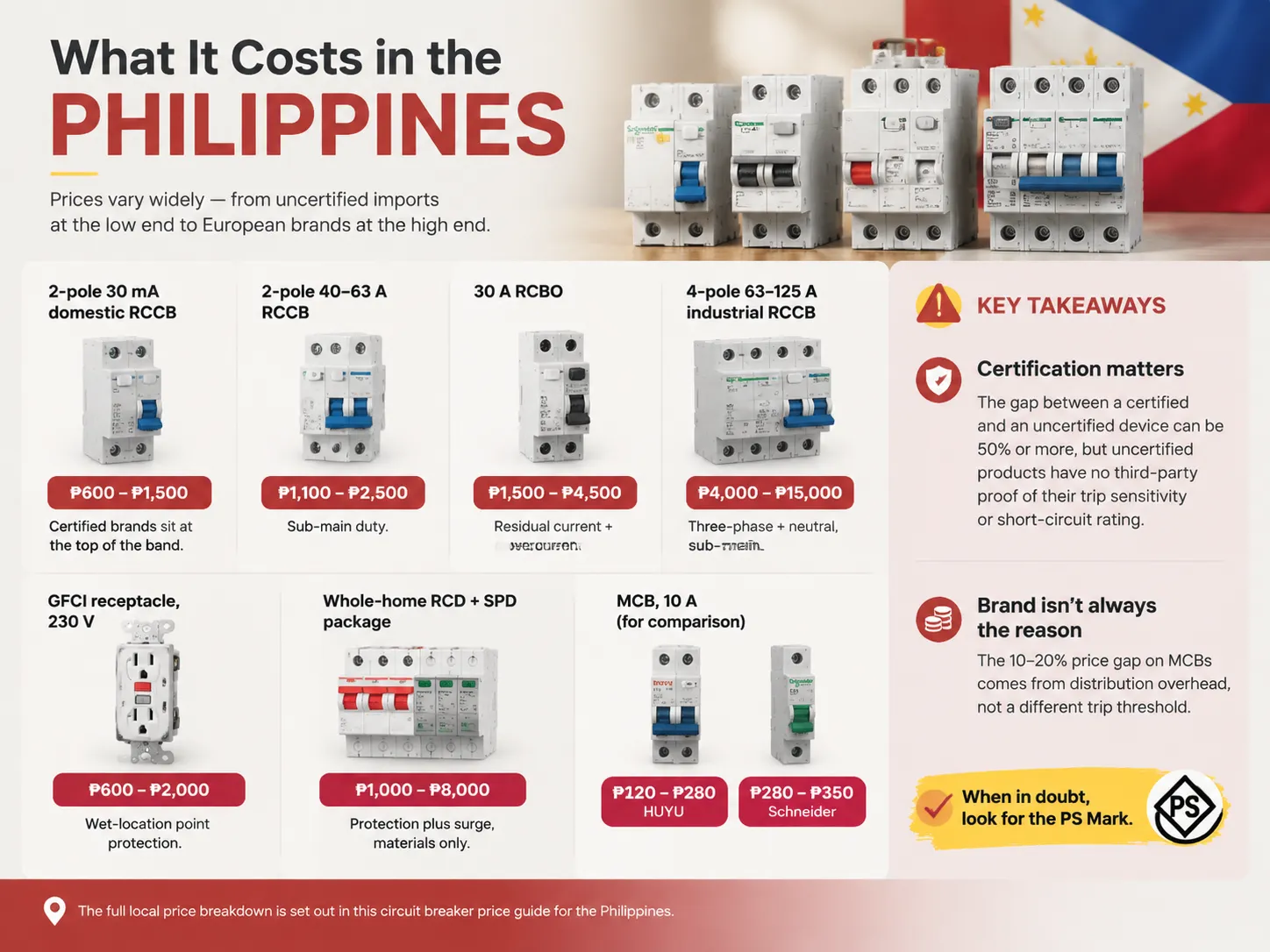
What It Costs in the Philippines
Philippine pricing is lumped because the cheaper side of the market is crowded by uncertified imports and the expensive one by European brands, leaving very limited possibilities in between. The bands below show 2026 street pricing, so regard the low end of any range with caution unless there is a visible PS Mark.
| Perangkat | Typical price (PHP) | Catatan |
|---|---|---|
| 2-pole 30 mA domestic RCCB | ₱600–₱1,500 | Certified brands sit at the top of the band |
| 2-pole 40–63 A RCCB | ₱1,100–₱2,500 | Sub-main duty |
| 30 A RCBO | ₱1,500–₱4,500 | Residual current plus overcurrent |
| 4-pole 63–125 A industrial RCCB | ₱4,000–₱15,000 | Three-phase plus neutral, sub-main |
| GFCI receptacle, 230 V | ₱600–₱2,000 | Wet-location point protection |
| Whole-home RCD + SPD package | ₱1,000–₱8,000 | Protection plus surge, materials only |
| MCB, 10 A, for comparison | ₱220–₱400 | HUYU ₱220–280; Schneider ₱280–350 |
There are two noteworthy patterns. The difference between an approved unit and one that is not may appear on paper to be more than fifty percent, however, the uncertified item has no verification that it will break at the values stated in its specifications or withstand short-circuit current of the same value. Therefore, the calculated difference is only a difference on paper. Similar situation can be observed in the table presented above, where HUYU offers its product at a price level of ₱220–280 while major European brands sell their devices for ₱280–400.The full local price breakdown is set out in this circuit breaker price guide for the Philippines.
How to Choose a Supplier
Philippine procurement depends on certifications more than on manufacturers, so figure out this checklist before worrying about price.
- PS Mark or ICC. Electrical equipment available in the Philippines is expected to be marked with the Philippine Standard Mark or an Import Commodity Clearance sticker. Without that, an appliance cannot be mentioned in a valid installation, no matter what kind of datasheet is provided.
- Specify standards. RCCB has to be certified according to IEC 61008, while RCBO has to provide IEC 61009. An offer saying “It conforms to IEC standards” is not definitive.
- Sensitive rating and Type. Make sure the offer indicates that it is 30 mA and appropriate Type A or B. If a drive, inverter or an adapter is included in the installation, Type B is obligatory.
- Breaking capacity. Ask what conditional short-circuit current a device is rated for and which protective device is used. The difference between a 10 kA unit and a 6 kA unit is not visible.
- 60Hz specification. Make sure the part complies with the specifications for 60Hz, not 50 Hz only.
- Warranty. It is better to ask for two-year warranty with some possibility of replacement rather than a one-year.
- Documentation. Make sure you obtain the test report and Declaration of Conformity each time the shipment arrives, not just once per inquiry.
This way a manufacturer like HUYU operates successfully. We are not well-known brand among Filipino customers, and if the specification mentions Schneider or ABB, it means that this specification involves these brands and not our company. In that case, we are able to compete based on performance specifications — 30 mA, Type A or B, PS Mark or ICC, IEC 61008/61009, two-year warranty according to the specifications strictly. The range and the OEM terms are set out on the RCCB manufacturing programme page.
FAQ
Is an earth leakage relay the same as an RCD or RCCB?
So functionally the two devices are the same as they both sense the current flowing in the live conductors and trip on residual current. However the difference between them comes in terms of the form factor and their application. The earth leakage relay is usually a standalone equipment which is combined with a core balance current transformer and is responsible for the operation of the relay which is utilized when it is required to have a variable action of the device or to trip a large circuit breaker. RCCB is in fact a single DIN event component that performs the switch. In electrical works in the Philippines one will be faced with installation of RCCB or RCBO while earth leakage relays are used in industry and beyond.
Does the Philippine Electrical Code require an RCD in homes?
Yes, in two different ways. The requirement of PEC 2017 Article 2.10.1.8 is that Class A grounding fault circuit interrupters (GFCIs) should be applied when the current range is 4 to 6 mA in outlets located in bathrooms, kitchens near sinks, where water is used outdoors, in laundry areas, garages, and within 1.8 meters of a bathtub or shower. In addition to this, the code specifies that circuitry for socket-outlet circuits has a requirement of 30 mA for the residential output. Both of these requirements are applicable, and one may not replace the other because the thresholds of sensitivity are already different with these two requirements as well as the principles of protection.
Can a 30 mA RCD be used instead of a GFCI in the Philippines?
Rather than a straightforward substitute for the 4-6 mA requirement. It should be noted that PEC specifically mentions that the device with 30 mA rating does not comply with the GFCI regulation as 30 mA is about five to seven times more than the GFCI compliance level. Devices with 5-10 mA rating which are in accordance with IEC 61008 or IEC 61009 are compliant to requirements when the right type is utilized based on the load, but there is a limitation in the sense that prior written approval from AHAJ is necessary before the design completion. Thus, it will be more prudent to provide both: a 30 mA RCBO installed in the electrical panel and a Class A GFCI used in moist locations.
What Type should I specify — AC, A, B or F?
Type AC responds only to sinusoidal alternating residual current and is only used in simple resistive and lighting circuits. Type A adds pulsating DC to its sensing range and is the sensible minimum for modern installations with electronic equipment. Type B is required whenever the circuit contains any of the following: a variable frequency drive, a solar inverter, an EV charger, or any other equipment that can create smooth DC leakage because neither Type AC nor Type A will detect it. Type F is between types A and B when it comes to mixed frequencies from single-phase drives and some inverter loads. If there is any inverter on the load list, specify Type B and stop haggling.
Do I need surge protection as well as earth leakage protection?
Absolutely, and the two are not the same things, as an RCD reacts as regards to any residual current, but does not shield devices from voltage surge. Considering that there can 25-50 storm days every year in the Philippines flat regions, the usage of Type 1 SPD at the point of supplies with the use of Type 2 devices at the switches is common and advisable for anything what has sensitive loads. The distance between these two levels of SPD should be at least 10 m or they can be connected with the help of decoupling elements.
Why does a newly installed RCD trip for no apparent reason?
There are four reasons that can account for the majority of the instances. An included neutral conductor connecting ahead two circuits divides the return path and takes on the characteristics of a ground fault for the coil responsible for sensing the fault. A bootleg ground or neutral conductor that has inadvertently been grounded also produces the same results. Cable insulation that has absorbed moisture, typical for the older Philippine buildings, leads to the presence of a true leakage. Finally, a device that is installed incorrectly because of the type may trigger an alarm on the DC component of the load. In order to localize the source of the issue, disconnect the load first and then check the individual circuits.
Referensi
- International Electrotechnical Commission — IEC 61008 and IEC 61009, residual current operated circuit-breakers
- UL Standards & Engagement — UL 943, Ground-Fault Circuit-Interrupters
- UL Solutions — testing and certification for residual current devices
- NFPA — NFPA 70, National Electrical Code (the basis of the PEC structure)
- ISO — ISO 9001 quality management, the framework behind IEC 61008/61009 certification
Kesimpulan
When looking to purchase earth leakage protection in the Philippines, you will have to think about three different specifications as well as one certificate. The specifications include the sensitivity of the device (i.e. it should be 4–6 mA for personnel protection in compliance with PEC 2017, 30 mA for socket circuits and 300 mA for fire protection), number of poles and the Type of the device (AC means basic protection, A is the most common there is and B is suitable only when the inverter or the drive is used in the device). The certificate you need is either a PS Mark or ICC sticker — without the certificate, you cannot use the device in your installation even if the datasheet states otherwise.
As for the suppliers, you can choose from Meiji, Omni, Royu and Koten companies as they will provide you with fast replacement regardless of the device illness; Cosine company manufactures at local factories and has a range of strong utility approvals; Schneider, ABB, Siemens and Mitsubishi Electric are known for the presence of all specifications required for proper device functioning according to the consultants expectations. HUYU is competing on costs and OEM terms – our prices are 10–20% lower than those of the leading brands but since we are not a well-known brand we have to admit that.
Whichever option you choose to shop for, ask for the data you need (the standard number, declared sensitivity of the device, type of the device and its safety performance) in writing so that at least four points indicated in the quotation would not allow you to deal with most possible troubles.