
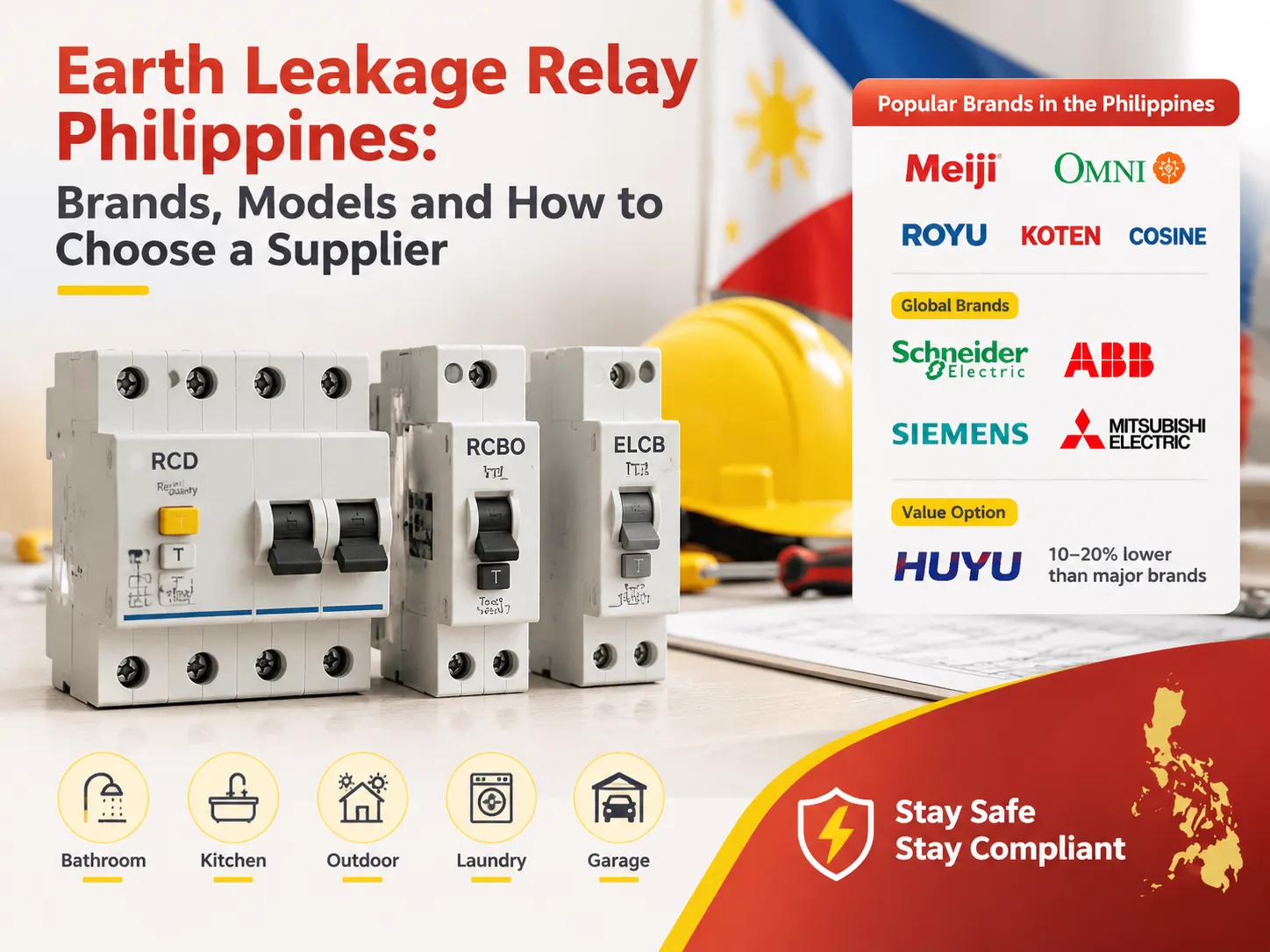
A compra de dispositivos de proteção contra fuga à terra nas Filipinas difere da compra de disjuntores devido a vários fatores, incluindo a tensão de 230 V na frequência de 60 Hz, o código aplicável (PEC em vez de NEC), a presença obrigatória de uma marca PS ou um adesivo ICC em cada dispositivo vendido no mercado filipino, e a decisão sobre qual tipo de sensibilidade usar para torná-lo um dispositivo que protege uma pessoa ou apenas um aparelho. Este guia ajudará você a entender o significado da terminologia usada, os requisitos do Código Elétrico Filipino, as marcas disponíveis no mercado local, seus preços e os meios de escolher o fornecedor sem encontrar fraudes.
Resumo: Relés de fuga à terra, RCDs, RCCBs e ELCBs referem-se a dispositivos que desarmam quando a corrente flui para fora do circuito em vez de retornar pelo neutro. De acordo com o PEC 2017 (Artigo 2.10.1.8), as residências filipinas devem ser equipadas com proteção GFCI Classe A para banheiros, cozinhas, áreas externas, lavanderias e garagens, no nível de 4-6 mA, e proteção contra corrente residual de 30 mA para circuitos de tomadas. Um RCD de 30 mA não é um substituto exato para um GFCI de 4-6 mA e o PEC exige que a aprovação da AHJ seja obtida caso um RCD ou RCBO seja usado em vez de uma tomada. Espere gastar ₱300 – ₱1500 em um dispositivo doméstico de 2 polos, ₱1500 – ₱4500 em um RCBO de 30 A, e ₱2500 – ₱9000 em um equipamento industrial de 4 polos. Meiji, Omni, Royu, Koten e Cosine são populares entre os usuários locais, enquanto Schneider, ABB, Siemens e Mitsubishi Electric estão posicionados acima deles, e a HUYU oferece os mesmos produtos, mas cobra menos em 10% – 20% do que os principais players internacionais.
O que é realmente um Relé de Fuga à Terra
Primeiro, vamos discutir a terminologia porque os compradores filipinos se referem a vários termos diferentes que provavelmente denotam dois ou três itens distintos.
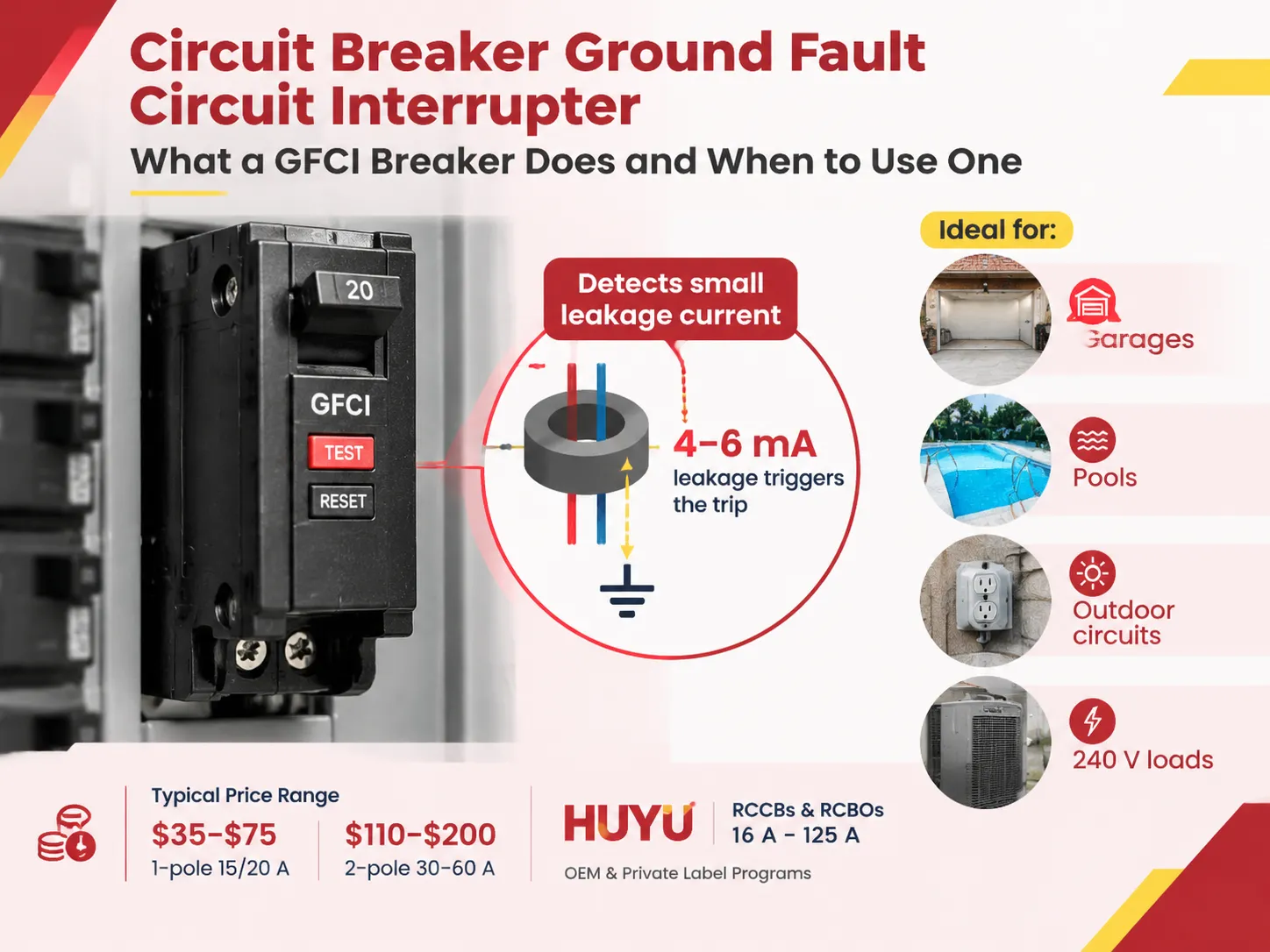
Um relé de fuga à terra é um termo geral que se refere a um dispositivo que mede a soma vetorial das correntes em todos os condutores usando um transformador de corrente de equilíbrio de núcleo (CBCT). As correntes que saem nos fios de fase devem ser iguais à soma das correntes nos condutores neutros. Assim, se alguns miliamperes estiverem faltando, isso indica que a corrente está vazando por outro caminho, como uma pessoa, água ou a estrutura de um aparelho com defeito.
Existem muitos tipos de dispositivos baseados neste conceito e que compartilham os mesmos acrônimos.
| Termo | Nome completo | O que ele faz | Disparo por sobrecorrente |
|---|---|---|---|
| ELR | Relé de fuga à terra | Detecção apenas de corrente residual, frequentemente um relé separado acionando um disparo por shunt | Não |
| RCCB / RCD | Disjuntor de corrente residual | Detecção de corrente residual, montado em trilho DIN | Não |
| RCBO | Disjuntor residual com sobrecorrente | Corrente residual mais sobrecorrente em um único módulo | Sim |
| proteção para banheiros, cozinhas, garagens, tomadas externas, | Interruptor de circuito por falha à terra | Proteção de pessoal em 4–6 mA, conforme UL 943 | Às vezes |
| ELCB (operado por corrente) | Disjuntor de circuito de fuga à terra | Nome antigo para um RCD moderno | Não |
| ELCB (operado por tensão) | Disjuntor de circuito de fuga à terra | Detecta um aumento de tensão no chassi de um aparelho | Não |
A última linha é mais significativa do que parece. ELCBs operados por tensão são de tecnologia antiquada. Seu funcionamento dependia do caminho de terra ser perfeito, portanto, podiam falhar silenciosamente na própria circunstância que deveriam prevenir. Eles não estão em conformidade com os padrões atuais segundo o PEC, e qualquer fornecedor que os apresente como equivalentes a um RCD demonstra certa falta de inteligência em seu catálogo.
A explicação completa do acrônimo e de como a bobina de detecção funciona vale a pena ser lida antes de especificar qualquer coisa, e está coberta nesta análise de o que ELR significa.
O que o Código Elétrico das Filipinas Exige
O Código Elétrico das Filipinas é um produto do Institute of Integrated Electrical Engineers of the Philippines em conjunto com o Board of Electrical Engineering e o fundamento legal da Republic Act 7920. A versão atual do PEC é a PEC 2017, que é modelada após o NE C 2017.
Existem dois artigos que tratam da proteção contra falhas à terra. O primeiro é o Artigo 2.10.1.8, que trata dos interruptores de circuito por falha à terra que protegem pessoas, e o segundo é o Artigo 2.30.7.6, que trata da proteção contra falhas à terra de aparelhos.
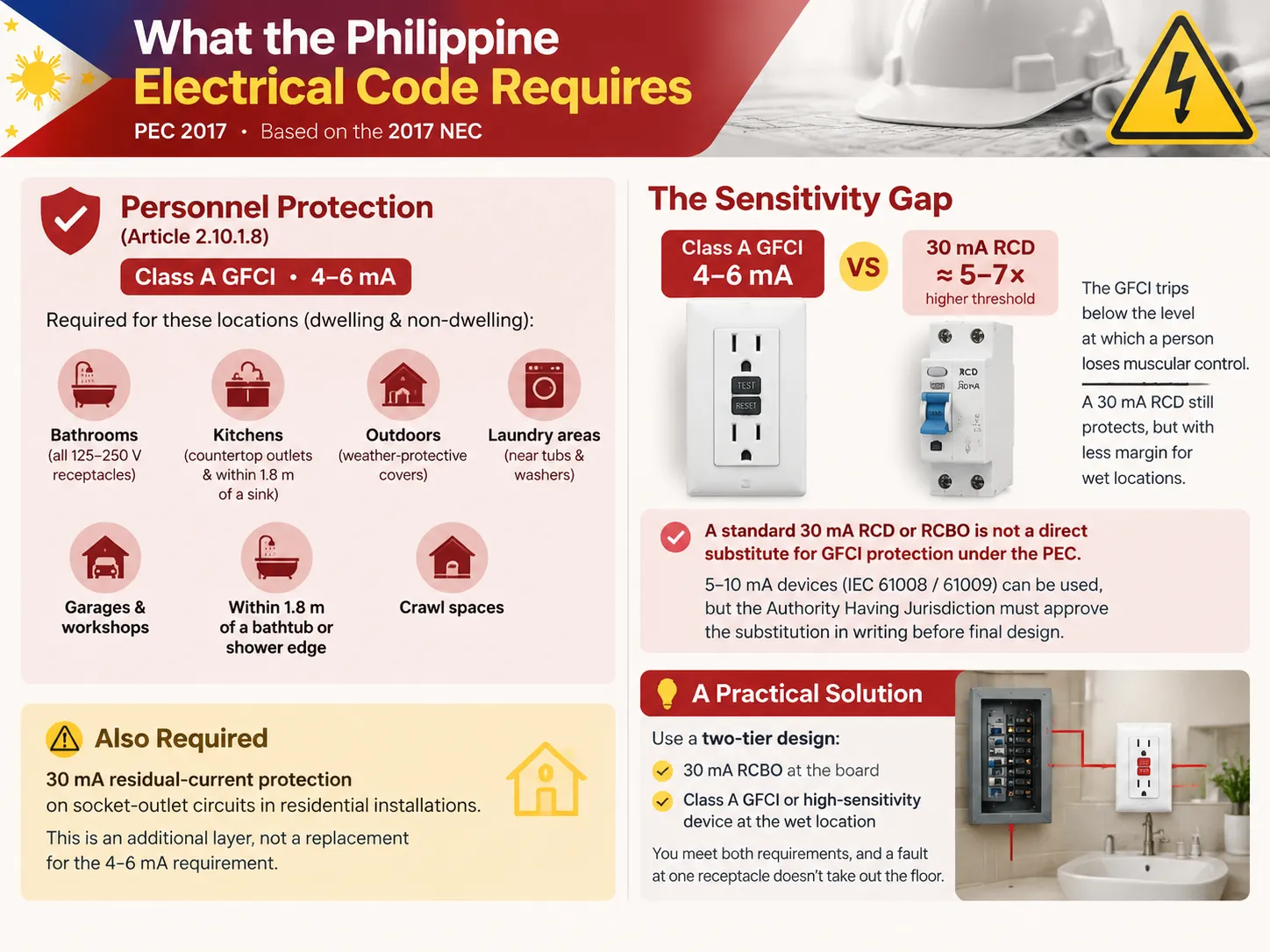
A regulamentação referente à proteção pessoal é particular, pois não funciona exatamente como o RCD de 30 mA comum na Europa. Segundo o PEC 2017, tanto residências quanto estabelecimentos não residenciais devem possuir sistemas de interruptores de circuito por falha à terra Classe A com sensibilidade entre 4 mA e 6 mA para qualquer aparelho nos seguintes locais:
- em banheiros, todas as tomadas de 125–250 V em uso
- em cozinhas, tomadas de bancada e qualquer tomada localizada a menos de 1,8 m de pias
- nas áreas externas do edifício onde todas as tomadas e plugues externos suspeitos estão localizados sob cobertura
- em áreas de lavanderia, todas as tomadas próximas a pias de lavanderia e máquinas de lavar
- em garagens e oficinas
- a menos de 1,8 m de banheiras e chuveiros
Além disso, o PEC estipula medidas de segurança de corrente residual de 30 mA em circuitos de tomadas residenciais. Esta é uma opção adicional e não substitui o requisito de 4-6 mA.
O que os compradores entendem mal é a diferença entre RCDs de 30 mA e GFCIs Classe A em termos de seus níveis de sensibilidade. O RCD de 30 mA opera com uma corrente aproximadamente cinco a sete vezes maior, mas serve ao mesmo propósito, apenas de maneiras diferentes: um GFCI é ajustado para desligar antes que a pessoa perca a capacidade de controlar seus músculos, enquanto um RCD de 30 mA tem um limite de segurança menor e ainda é capaz de fornecer alguma proteção à pessoa quando ela está em uma zona de risco de água. Da mesma forma, o PEC considera o tipo de dispositivo como padrão e não trata esse tipo de dispositivo como um substituto equivalente para o GFCI. Os dispositivos com classificações de 5-10 mA e que cumprem as normas IEC 61008 ou IEC 61009 podem ser capazes de alcançar os mesmos resultados sob condições adequadas, mas o código exige acordo prévio por escrito das autoridades competentes antes que o projeto final seja concluído.
Uma solução muito simples que elimina a necessidade de todas essas disputas é o uso de um sistema de dois estágios. Com essa abordagem, instala-se um RCD de 30 mA no painel de controle de eletricidade e um GFCI Classe A ou dispositivo super sensível imediatamente na área úmida. Essa abordagem ajuda a cumprir ambos os conjuntos de requisitos, e uma falha em um dos pontos não teria consequências graves.
Sensibilidade, Tipo e Onde Cada Um Pertence
Duas especificações decidem o que um dispositivo pode realmente fazer: sua sensibilidade de disparo e sua designação de Tipo.
| Sensibilidade | O que ele protege | Uso típico nas Filipinas |
|---|---|---|
| 4–6 mA (GFCI Classe A) | Pessoas | Banheiros, cozinhas, tomadas externas, lavanderia |
| 10 mA | Pessoas, margem maior | Aplicações especiais, locais médicos |
| 30 mA | Pessoas | O padrão para circuitos de tomadas e circuitos finais |
| 100 mA | Equipamento e incêndio | Proteção subprincipal onde a seletividade é necessária |
| 300 mA | Incêndio | Entrada principal, além de — nunca em vez de — 30 mA a jusante |
A designação do Tipo indica as ondas de corrente de falha que são reconhecidas pelo equipamento, e é aqui que muitas instalações hoje falham. Com inversores solares, acionamentos de frequência variável e carregadores de VE tornando-se a norma em edifícios em todo o Filipinas, um dispositivo Tipo AC detectará apenas corrente residual alternada senoidal e não pode reconhecer o componente DC suave produzido por esses dispositivos. O Tipo A pode detectar tanto corrente alternada quanto pulsante DC. O Tipo B detecta também DC suave. O Tipo B é a especificação correta para qualquer equipamento que compreenda um retificador, inversor ou link DC, e isso não é apenas uma atualização com um nome sofisticado.
Condições nas Filipinas que alteram a especificação
Três elementos locais fazem o projeto desviar do padrão europeu.
230 V a 60 Hz. A eletricidade fornecida nas Filipinas é geralmente 230 V monofásica a 60 Hz, com 400 V trifásico sendo uma opção. Os dispositivos vendidos nesses territórios devem funcionar na frequência de 60 Hz; dispositivos que operam apenas na frequência de 50 Hz apresentam desempenho imprevisível, o que torna a informação do tempo de disparo não confiável.
Variedade de arranjos de aterramento. As instalações elétricas nas Filipinas consistem em diferentes combinações dos sistemas TT e TN-C-S dependendo do fornecimento de energia e da data de construção. O tipo de aterramento utilizado define se um RCD sozinho é suficiente ou se deve ser complementado com um eletrodo de terra que corresponda aos padrões exigidos e ajude a calcular a impedância do circuito de falha. Suposições erradas sobre isso estão entre as principais razões pelas quais RCDs recém-instalados às vezes falham em funcionar como esperado. A explicação desses sistemas é fornecida na visão geral dos sistemas TN-C-S e alguns outros tipos de sistemas de aterramento.
Raios. O número médio de dias de tempestade em áreas baixas das Filipinas é de 25-50 por ano, e as regiões montanhosas experimentam ainda mais. Existem duas consequências diretas das tempestades para a colocação de dispositivos de corrente de fuga. Primeiro, um eletrodo de terra deve ser considerado, e os requisitos mínimos estabelecem que ele deve ser feito de aço cobreado e ter 2,4 m de comprimento e 15,87 mm (5/8 pol) de diâmetro. A conformidade com o código pode indicar cerca de 25 Ohms, embora para operação confiável do RCD, o valor de 5 Ohms ou menos seja favorável. Em segundo lugar, a proteção contra surtos deve estar a montante do dispositivo de fuga.
Marcas que você realmente encontrará nas Filipinas
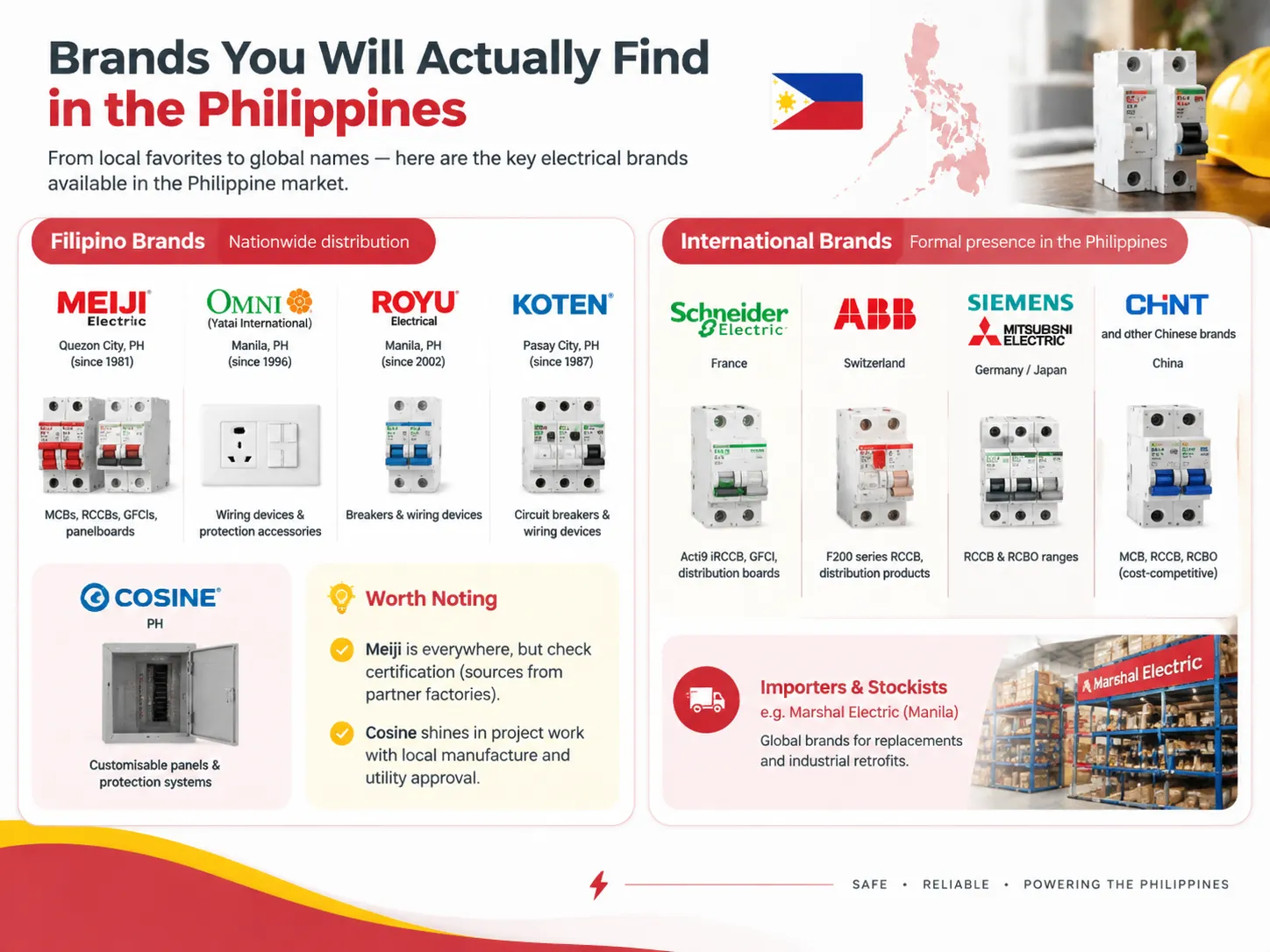
O mercado local está perfeitamente dividido entre marcas filipinas com distribuição nacional e aquelas que são estrangeiras, mas têm presença formal. As figuras abaixo mostram alguns preços de rua em 2026 para um dispositivo doméstico de 2 polos que variam com base na classificação de amperagem e sensibilidade.
| Marca | Origem | O que fornecem | Faixa típica de preço | Notas |
|---|---|---|---|---|
| Meiji Electric | Quezon City, PH — desde 1981 | MCBs, RCCBs, GFCIs, quadros de distribuição, dispositivos de fiação | ₱400–₱2,500 | Conforme PEEP e DOE; designs baseados em IEC; ampla disponibilidade em lojas de ferragens |
| Omni (Yatai International) | Manila, PH — desde 1996 | Dispositivos de fiação e acessórios de proteção | ₱350–₱2,000 | Marcado PNS e ICC; a rede de distribuidores mais forte do país |
| Royu Electrical | Manila, PH — desde 2002 | Disjuntores (terminal de parafuso bipolar, 220 V), dispositivos de fiação | ₱300–₱1,200 | Sob o grupo FELCO; certificado BPS; policarbonato retardante de fogo |
| Koten Enterprises | Pasay City, PH — desde 1987 | Disjuntores e dispositivos de fiação padrão | ₱300–₱1,800 | Preferido em habitação popular e instituições; peças sempre disponíveis |
| Cosine Industries | PH | Painéis personalizáveis e sistemas de proteção | Baseado em projetos | Produzido localmente, forte aprovação de concessionárias, co-rotulagem disponível |
| Schneider Electric | França | Acti9 iRCCB, AvatarOn GFCI, quadros de distribuição | ₱700–₱4,500 | Maior presença em especificações para projetos comerciais |
| ABB | Suíça | Série F200 RCCB, produtos de distribuição | ₱900–₱5,000 | Comum em trabalhos industriais e de concessionárias |
| Siemens / Mitsubishi Electric | Germany / Japan | RCCB and RCBO ranges | ₱800–₱4,500 | Premium pricing; strong on OEM panels |
| Chint and other Chinese brands | China | MCB, RCCB, RCBO | ₱250–₱1,500 | Cost-competitive; certification varies enormously by product line |
There are two that require mentioning. Among the infamous brands in the Philippines, Meiji is the first choice for many domestic electricians. That’s because it’s available A-to-Z and with understandable labeling, which means that it has got the production from various factories rather than manufacturing everything on its own. Thus, the importance of checking certifications only increases. Cosine is the unique one for projects, given that it has the ability to produce things locally with the utility approval.
On the importers and the stockists level, there are companies like Marshal Electric in Manila that would have global brands for replacement and retrofitting. For the time being, being in need of a simple RCBO replacement, this layer is often faster than trying to get the replacement through the distributor order.
Common Models and What Each One Is For
Devices in this group do not have decorative design because they give you information on pole number, the type of current and other characteristics.
This means that encountering with a model such as 2P, 30mA, Type A, 6kA, you see a two-pole RCD with 30mA sensitivity that works with pulsating DC current and has a maximum short-circuit current of 6kA. Substitute 30 with 300, and a device turns into one that protects from fire and electric shock. Replace 2P with 4P, and the device protects you not only against electric shocks but also indicates if you have a three-phase circuit.
In case of a single-phase 230V domestic distribution board, you would typically encounter a 2-pole 30mA type A RCCB and a number of 16-32 A RCBOs. In commercial kitchens or wet areas of hospitals, you would be protected with devices with 10 mA GFCI. Any system with a drive or anything similarly requiring a type B device will make the specifications different.
HUYU’s residual-current range covers that spread in one family rather than piecemeal: a 16–125 A Type AC/Type A RCCB for the sub-main position, plus RCBOs from 6 A to 125 A, Type B and Type F variants for inverter and drive loads, and the MCB and AFDD lines that sit alongside them in the same board. The point of buying one family is that the accessories, busbars and enclosure widths are already matched.
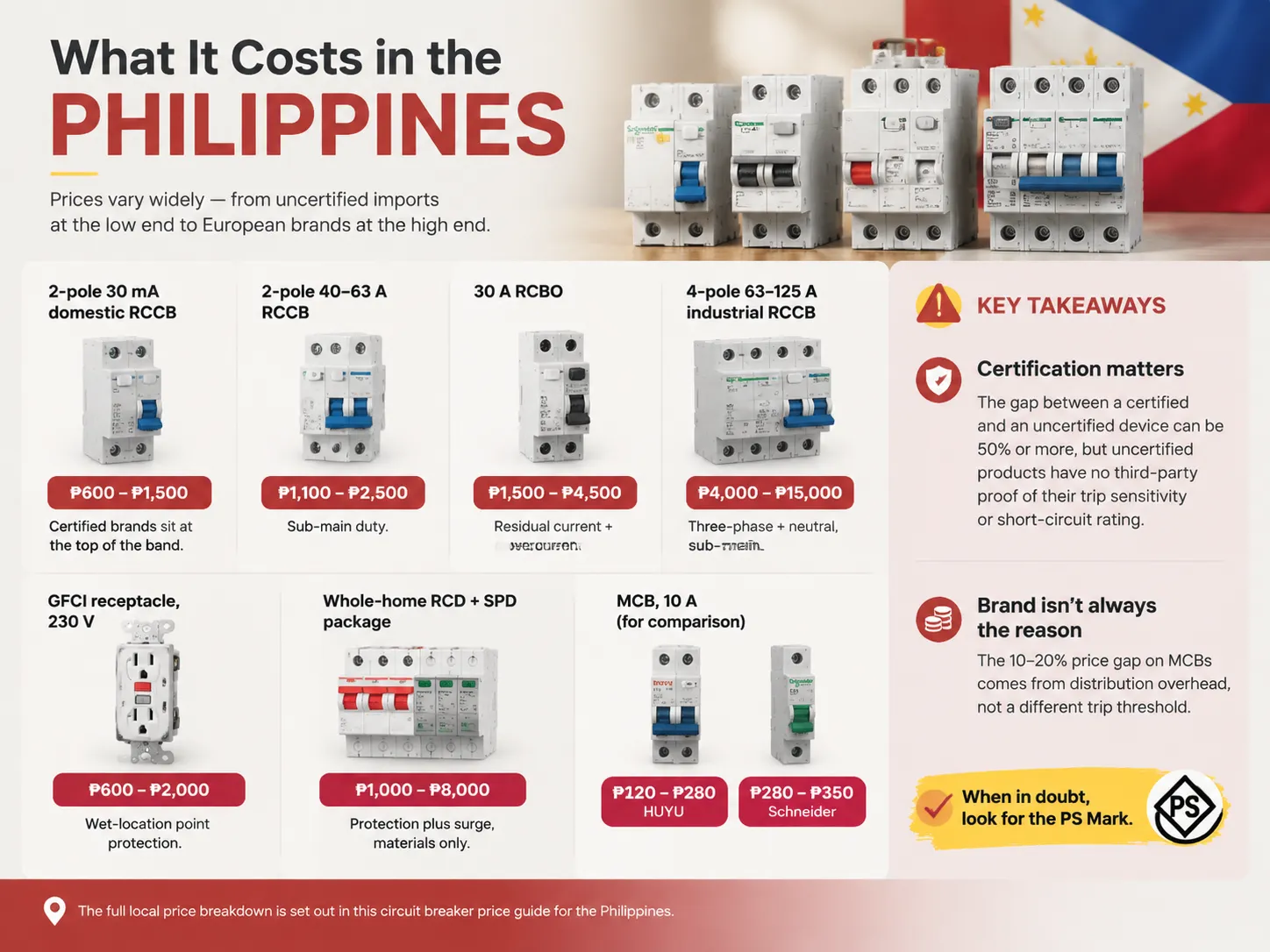
What It Costs in the Philippines
Philippine pricing is lumped because the cheaper side of the market is crowded by uncertified imports and the expensive one by European brands, leaving very limited possibilities in between. The bands below show 2026 street pricing, so regard the low end of any range with caution unless there is a visible PS Mark.
| Dispositivo | Typical price (PHP) | Notas |
|---|---|---|
| 2-pole 30 mA domestic RCCB | ₱600–₱1,500 | Certified brands sit at the top of the band |
| 2-pole 40–63 A RCCB | ₱1,100–₱2,500 | Sub-main duty |
| 30 A RCBO | ₱1,500–₱4,500 | Residual current plus overcurrent |
| 4-pole 63–125 A industrial RCCB | ₱4,000–₱15,000 | Three-phase plus neutral, sub-main |
| GFCI receptacle, 230 V | ₱600–₱2,000 | Wet-location point protection |
| Whole-home RCD + SPD package | ₱1,000–₱8,000 | Protection plus surge, materials only |
| MCB, 10 A, for comparison | ₱220–₱400 | HUYU ₱220–280; Schneider ₱280–350 |
There are two noteworthy patterns. The difference between an approved unit and one that is not may appear on paper to be more than fifty percent, however, the uncertified item has no verification that it will break at the values stated in its specifications or withstand short-circuit current of the same value. Therefore, the calculated difference is only a difference on paper. Similar situation can be observed in the table presented above, where HUYU offers its product at a price level of ₱220–280 while major European brands sell their devices for ₱280–400.The full local price breakdown is set out in this circuit breaker price guide for the Philippines.
How to Choose a Supplier
Philippine procurement depends on certifications more than on manufacturers, so figure out this checklist before worrying about price.
- PS Mark or ICC. Electrical equipment available in the Philippines is expected to be marked with the Philippine Standard Mark or an Import Commodity Clearance sticker. Without that, an appliance cannot be mentioned in a valid installation, no matter what kind of datasheet is provided.
- Specify standards. RCCB has to be certified according to IEC 61008, while RCBO has to provide IEC 61009. An offer saying “It conforms to IEC standards” is not definitive.
- Sensitive rating and Type. Make sure the offer indicates that it is 30 mA and appropriate Type A or B. If a drive, inverter or an adapter is included in the installation, Type B is obligatory.
- Breaking capacity. Ask what conditional short-circuit current a device is rated for and which protective device is used. The difference between a 10 kA unit and a 6 kA unit is not visible.
- 60Hz specification. Make sure the part complies with the specifications for 60Hz, not 50 Hz only.
- Warranty. It is better to ask for two-year warranty with some possibility of replacement rather than a one-year.
- Documentation. Make sure you obtain the test report and Declaration of Conformity each time the shipment arrives, not just once per inquiry.
This way a manufacturer like HUYU operates successfully. We are not well-known brand among Filipino customers, and if the specification mentions Schneider or ABB, it means that this specification involves these brands and not our company. In that case, we are able to compete based on performance specifications — 30 mA, Type A or B, PS Mark or ICC, IEC 61008/61009, two-year warranty according to the specifications strictly. The range and the OEM terms are set out on the RCCB manufacturing programme page.
FAQ
Is an earth leakage relay the same as an RCD or RCCB?
So functionally the two devices are the same as they both sense the current flowing in the live conductors and trip on residual current. However the difference between them comes in terms of the form factor and their application. The earth leakage relay is usually a standalone equipment which is combined with a core balance current transformer and is responsible for the operation of the relay which is utilized when it is required to have a variable action of the device or to trip a large circuit breaker. RCCB is in fact a single DIN event component that performs the switch. In electrical works in the Philippines one will be faced with installation of RCCB or RCBO while earth leakage relays are used in industry and beyond.
Does the Philippine Electrical Code require an RCD in homes?
Yes, in two different ways. The requirement of PEC 2017 Article 2.10.1.8 is that Class A grounding fault circuit interrupters (GFCIs) should be applied when the current range is 4 to 6 mA in outlets located in bathrooms, kitchens near sinks, where water is used outdoors, in laundry areas, garages, and within 1.8 meters of a bathtub or shower. In addition to this, the code specifies that circuitry for socket-outlet circuits has a requirement of 30 mA for the residential output. Both of these requirements are applicable, and one may not replace the other because the thresholds of sensitivity are already different with these two requirements as well as the principles of protection.
Can a 30 mA RCD be used instead of a GFCI in the Philippines?
Rather than a straightforward substitute for the 4-6 mA requirement. It should be noted that PEC specifically mentions that the device with 30 mA rating does not comply with the GFCI regulation as 30 mA is about five to seven times more than the GFCI compliance level. Devices with 5-10 mA rating which are in accordance with IEC 61008 or IEC 61009 are compliant to requirements when the right type is utilized based on the load, but there is a limitation in the sense that prior written approval from AHAJ is necessary before the design completion. Thus, it will be more prudent to provide both: a 30 mA RCBO installed in the electrical panel and a Class A GFCI used in moist locations.
What Type should I specify — AC, A, B or F?
Type AC responds only to sinusoidal alternating residual current and is only used in simple resistive and lighting circuits. Type A adds pulsating DC to its sensing range and is the sensible minimum for modern installations with electronic equipment. Type B is required whenever the circuit contains any of the following: a variable frequency drive, a solar inverter, an EV charger, or any other equipment that can create smooth DC leakage because neither Type AC nor Type A will detect it. Type F is between types A and B when it comes to mixed frequencies from single-phase drives and some inverter loads. If there is any inverter on the load list, specify Type B and stop haggling.
Do I need surge protection as well as earth leakage protection?
Absolutely, and the two are not the same things, as an RCD reacts as regards to any residual current, but does not shield devices from voltage surge. Considering that there can 25-50 storm days every year in the Philippines flat regions, the usage of Type 1 SPD at the point of supplies with the use of Type 2 devices at the switches is common and advisable for anything what has sensitive loads. The distance between these two levels of SPD should be at least 10 m or they can be connected with the help of decoupling elements.
Why does a newly installed RCD trip for no apparent reason?
There are four reasons that can account for the majority of the instances. An included neutral conductor connecting ahead two circuits divides the return path and takes on the characteristics of a ground fault for the coil responsible for sensing the fault. A bootleg ground or neutral conductor that has inadvertently been grounded also produces the same results. Cable insulation that has absorbed moisture, typical for the older Philippine buildings, leads to the presence of a true leakage. Finally, a device that is installed incorrectly because of the type may trigger an alarm on the DC component of the load. In order to localize the source of the issue, disconnect the load first and then check the individual circuits.
Referências
- International Electrotechnical Commission — IEC 61008 and IEC 61009, residual current operated circuit-breakers
- UL Standards & Engagement — UL 943, Ground-Fault Circuit-Interrupters
- UL Solutions — testing and certification for residual current devices
- NFPA — NFPA 70, National Electrical Code (the basis of the PEC structure)
- ISO — ISO 9001 quality management, the framework behind IEC 61008/61009 certification
Conclusão
When looking to purchase earth leakage protection in the Philippines, you will have to think about three different specifications as well as one certificate. The specifications include the sensitivity of the device (i.e. it should be 4–6 mA for personnel protection in compliance with PEC 2017, 30 mA for socket circuits and 300 mA for fire protection), number of poles and the Type of the device (AC means basic protection, A is the most common there is and B is suitable only when the inverter or the drive is used in the device). The certificate you need is either a PS Mark or ICC sticker — without the certificate, you cannot use the device in your installation even if the datasheet states otherwise.
As for the suppliers, you can choose from Meiji, Omni, Royu and Koten companies as they will provide you with fast replacement regardless of the device illness; Cosine company manufactures at local factories and has a range of strong utility approvals; Schneider, ABB, Siemens and Mitsubishi Electric are known for the presence of all specifications required for proper device functioning according to the consultants expectations. HUYU is competing on costs and OEM terms – our prices are 10–20% lower than those of the leading brands but since we are not a well-known brand we have to admit that.
Whichever option you choose to shop for, ask for the data you need (the standard number, declared sensitivity of the device, type of the device and its safety performance) in writing so that at least four points indicated in the quotation would not allow you to deal with most possible troubles.