
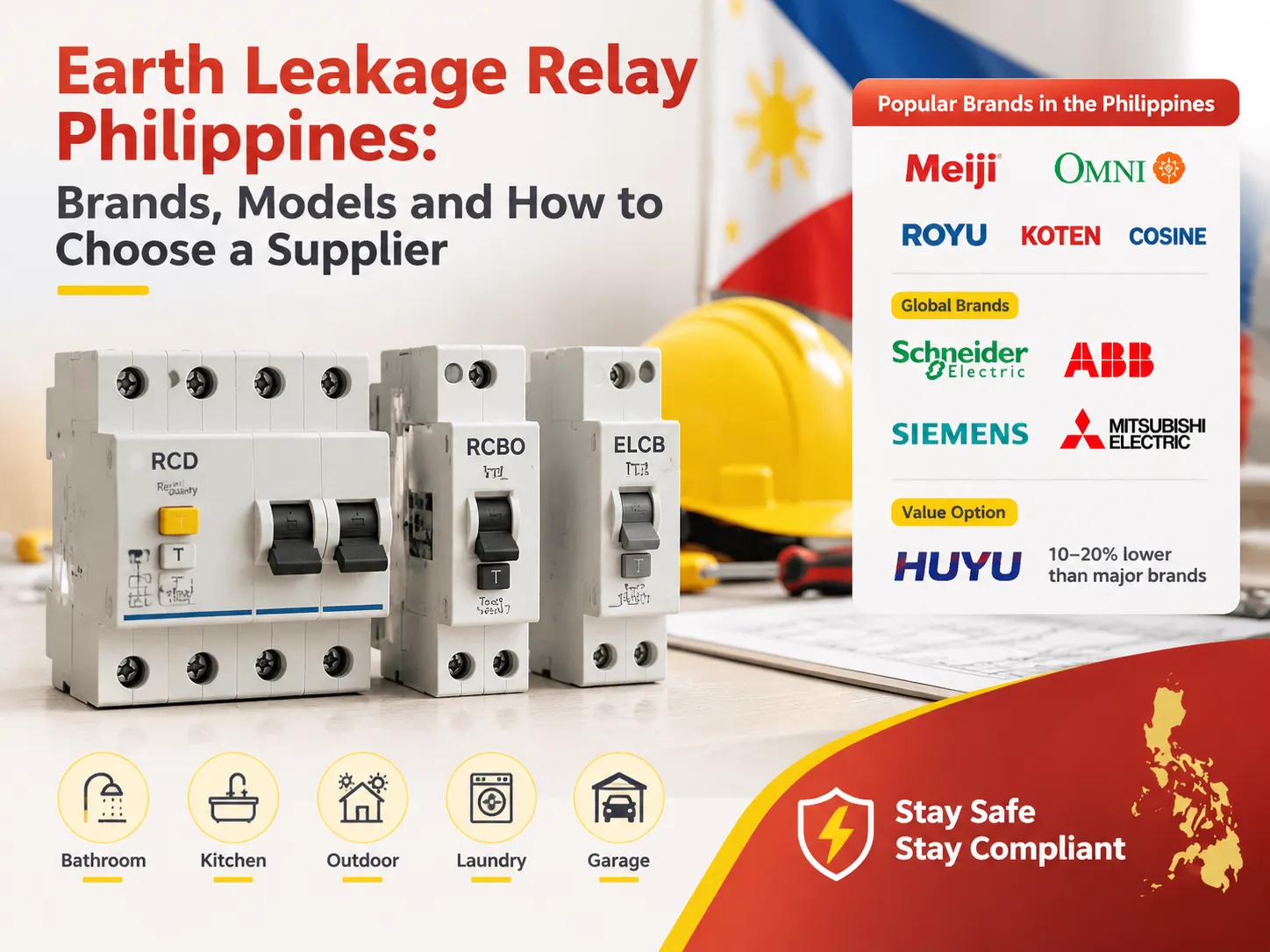
Filipinler'de toprak kaçak koruma cihazlarının satın alınması, 230 V gerilim ve 60 Hz frekans, uygulanabilir kod (NEC yerine PEC), Filipinler pazarında satılan her cihazda zorunlu PS Markası veya ICC etiketi bulunması ve cihazın kişiyi mi yoksa sadece bir cihazı mı koruyacağına karar verilmesi gibi çeşitli faktörler nedeniyle devre kesicilerin satın alınmasından farklıdır. Bu rehber, kullanılan terminolojinin anlamını, Filipin Elektrik Kodu gereksinimlerini, yerel pazarda bulunan markaları, fiyatlarını ve tedarikçiyi dolandırıcılıkla karşılaşmadan seçme yöntemlerini anlamanıza yardımcı olacaktır.
Özet: Toprak kaçak röleleri, RCD'ler, RCCB'ler ve ELCB'ler, akımın devreden çıkıp nötr üzerinden geri dönmediği durumlarda devreyi kesen cihazları ifade eder. PEC 2017'ye (Madde 2.10.1.8) göre, Filipinli hanelerde banyolar, mutfaklar, dış alanlar, çamaşır odaları ve garajlar için 4-6 mA seviyesinde Sınıf A GFCI koruması ve priz devreleri için 30 mA artık akım koruması sağlanmalıdır. 30 mA RCD, 4-6 mA GFCI'nin tam bir yerine geçmez ve PEC, bir priz yerine RCD veya RCBO kullanılması durumunda AHJ onayının alınmasını gerektirir. Bir ev tipi 2 kutuplu cihaz için ₱300 – ₱1500, 30 A RCBO için ₱1500 – ₱4500 ve 4 kutuplu endüstriyel tip ekipman için ₱2500 – ₱9000 harcama bekleyin. Meiji, Omni, Royu, Koten ve Cosine yerel kullanıcılar arasında popülerken, Schneider, ABB, Siemens ve Mitsubishi Electric bunların üzerinde konumlanmıştır ve HUYU aynı ürünleri sunarken lider uluslararası oyunculardan 10% – 20% daha az ücret almaktadır.
Toprak Kaçak Rölesi Aslında Nedir
Öncelikle, Filipinli alıcıların muhtemelen iki veya üç farklı öğeyi ifade eden birkaç farklı terime atıfta bulunduğu için terminolojiyi tartışalım.
Toprak kaçak rölesi, tüm iletkenlerdeki akımların vektörel toplamını çekirdek-dengeli akım trafosu (CBCT) kullanarak ölçen genel bir terimdir. Faz tellerinden çıkan akımlar, nötr iletkenlerdeki akımların toplamına eşit olmalıdır. Bu nedenle, birkaç miliamper eksikse, akımın bir kişi, su veya arızalı bir cihaz gövdesi gibi başka bir yoldan sızdığı anlamına gelir.
Bu konsepte dayanan ve aynı kısaltmaları paylaşan birçok cihaz türü vardır.
| Terim | Tam adı | Ne yapar | Aşırı akım açma |
|---|---|---|---|
| ELR | Toprak kaçak rölesi | Sadece artık akım algılama, genellikle bir şönt trip sürücüsü olan ayrı bir röle | Hayır |
| RCCB / RCD | Artık akım devre kesici | Artık akım algılama, DIN rayına monte | Hayır |
| RCBO | Aşırı akımlı artık akım kesici | Bir modülde artık akım ve aşırı akım | Evet |
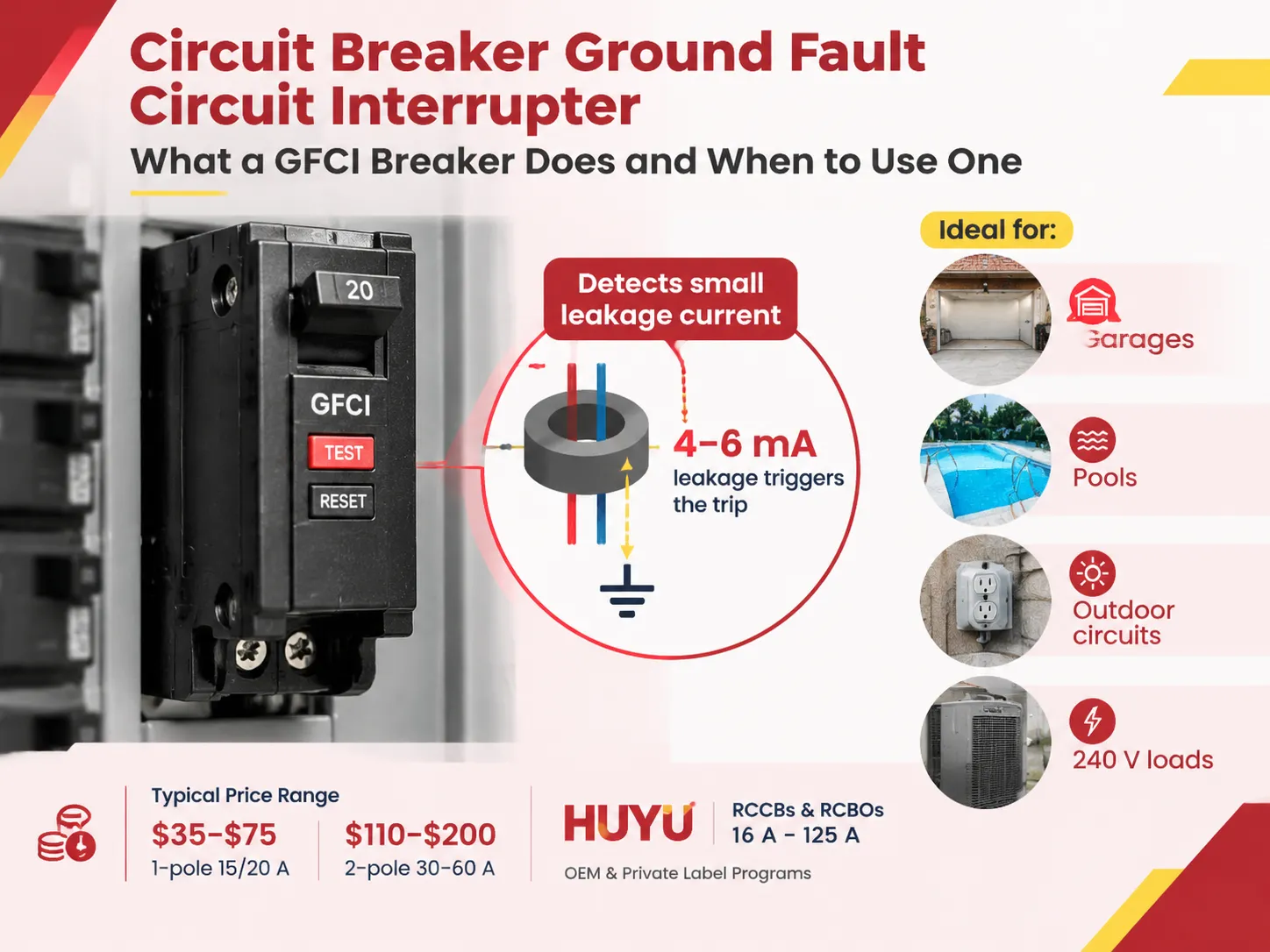
| koruma banyolara, mutfaklara, garajlara, dış prizlere, | Toprak hata devre kesici | UL 943'e göre 4–6 mA personel koruması | Bazen |
| ELCB (akım işletmeli) | Toprak kaçak devre kesici | Modern bir RCD için eski bir isim | Hayır |
| ELCB (gerilim işletmeli) | Toprak kaçak devre kesici | Bir cihaz şasisinde gerilim artışı algılandı | Hayır |
Son satır göründüğünden daha önemlidir. Gerilimle çalışan ELCB'ler eski teknolojiye sahiptir. Çalışmaları, toprak yolunun kusursuz olmasına dayanıyordu, bu nedenle önlemeleri gereken durumda sessizce arızalanabilirlerdi. PEC'ye göre mevcut standartlara uymazlar ve herhangi bir tedarikçinin birini RCD ile eşdeğer olarak göstermesi, kataloglarının zekâsı hakkında biraz ipucu verir.
Kısaltmanın tam açıklaması ve algılama bobininin nasıl çalıştığı, herhangi bir şey belirtmeden önce okunmaya değerdir ve bu ayrıntı şu çözümlemede ele alınmıştır ELR'nin ne anlama geldiği.
Filipin Elektrik Kodu'nun Gerektirdikleri
Filipin Elektrik Kodu, Filipinler Entegre Elektrik Mühendisleri Enstitüsü ile Elektrik Mühendisliği Kurulu iş birliğiyle oluşturulmuş ve Cumhuriyet Yasası 7920'nin yasal dayanağıdır. Mevcut PEC versiyonu PEC 2017 olup, 2017 NE C model alınarak hazırlanmıştır.
Toprak arızası korumasıyla ilgili iki madde vardır. Birincisi, insanları koruyan toprak arızası devre kesicileri ile ilgili olan Madde 2.10.1.8, ikincisi ise cihazların toprak arızası korumasıyla ilgili olan Madde 2.30.7.6'dır.
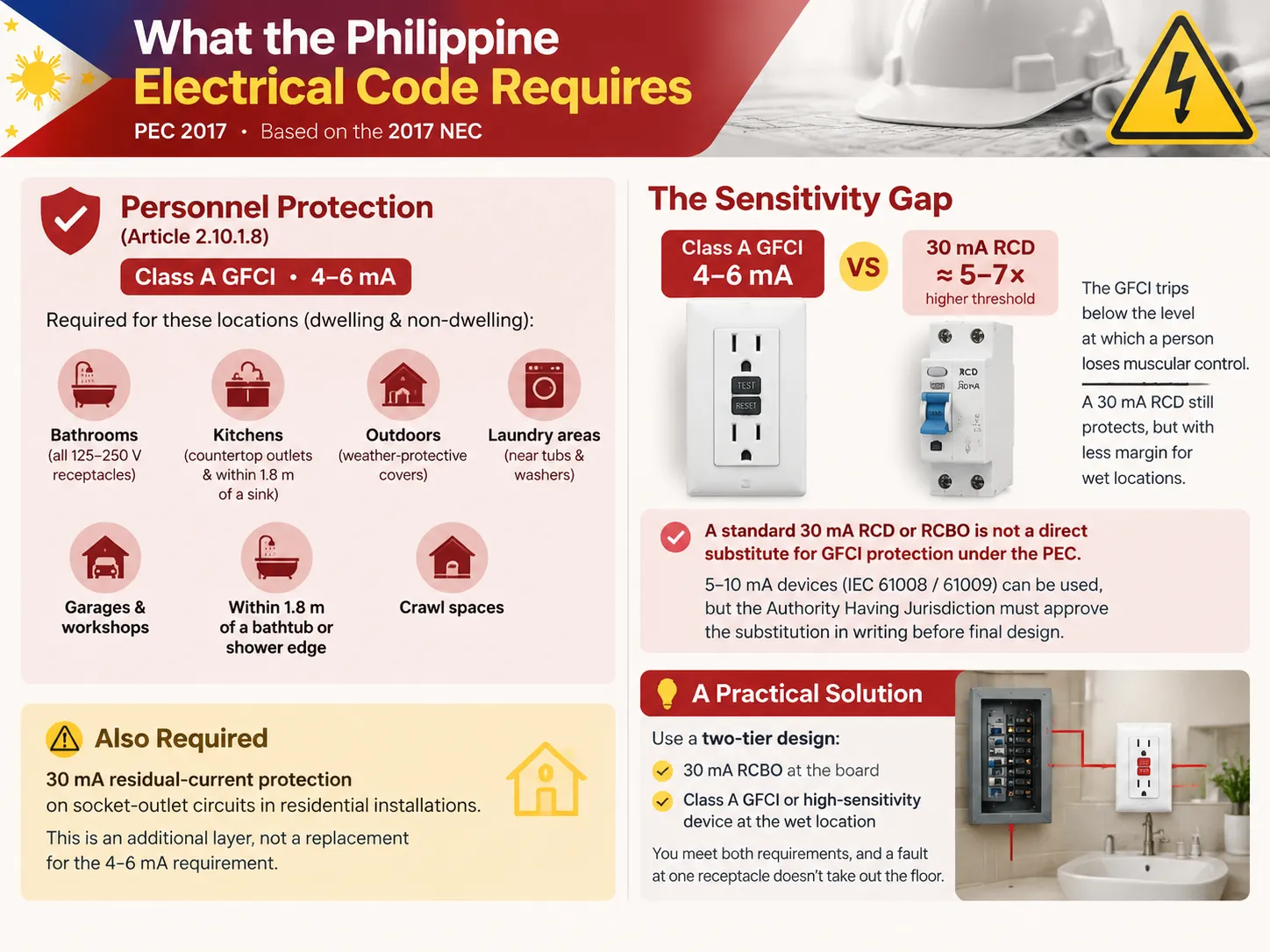
Kişisel koruma ile ilgili düzenleme özeldir, çünkü Avrupa'da yaygın olan 30 mA RCD gibi çalışmaz. PEC 2017'ye göre, hem ev hem de ev dışı yerleşimlerde, aşağıdaki tesislerdeki herhangi bir cihaz için 4 mA ile 6 mA arasında hassasiyete sahip Sınıf A toprak arızası devre kesici sistemleri bulunmalıdır:
- banyolarda, kullanılan tüm 125–250 V prizlerde
- mutfaklarda, tezgah prizlerinde ve lavabolara 1,8 m'den daha yakın herhangi bir prizde
- binanın dışındaki alanlarda, tüm şüpheli dış mekan prizleri ve fişleri kapak altında bulunmalıdır
- çamaşır alanlarında, çamaşır lavaboları ve çamaşır makinelerinin yakınındaki tüm prizlerde
- garajlarda ve atölyelerde
- küvet ve duşlardan 1,8 m'den daha az mesafede
Ayrıca, PEC ev priz devrelerinde 30 mA artık akım güvenlik önlemleri öngörür. Bu ek bir seçenektir ve 4-6 mA gerekliliğinin yerine geçmez.
Alıcıların yanlış anladığı nokta, 30 mA RCD'ler ile Sınıf A GFCI'lerin hassasiyet seviyeleri arasındaki farktır. 30 mA RCD, yaklaşık beş ila yedi kat daha yüksek akımda çalışır ancak aynı amaca hizmet eder, sadece farklı şekillerde: Bir GFCI, kişinin kas kontrolünü kaybetmeden önce devreyi kesmek üzere ayarlanmıştır, oysa 30 mA RCD daha az güvenlik payına sahiptir ve kişi su tehlikesi bölgesindeyken ona bir miktar koruma sağlamaya devam eder. Aynı şekilde PEC, cihaz tipini standart olarak kabul eder ve bu tip cihazı GFCI'nin eşdeğer bir ikamesi olarak değerlendirmez. 5-10 mA derecelendirmesine sahip ve IEC 61008 veya IEC 61009 standartlarına uygun cihazlar, uygun koşullar altında aynı sonuçları elde edebilir ancak kod, nihai tasarım tamamlanmadan önce ilgili yetkililerden yazılı olarak bu prosedür üzerinde önceden anlaşma yapılmasını gerektirir.
Tüm bu anlaşmazlıkların gerekliliğini ortadan kaldıran çok basit bir çözüm, iki aşamalı sistemin kullanılmasıdır. Bu yaklaşımda, elektrik kontrol panelinde 30 mA RCD ve hemen ıslak alanda Sınıf A GFCI veya süper hassas bir cihaz kurulur. Bu yaklaşım her iki gereksinim setinin de karşılanmasına yardımcı olur ve noktalardan birinde meydana gelen arıza ciddi sonuçlara yol açmaz.
Hassasiyet, Tip ve Her Birinin Yeri
Bir cihazın gerçekten ne yapabileceğini belirleyen iki özellik vardır: devre kesme hassasiyeti ve Tip tanımı.
| Hassasiyet | Ne korur | Filipinler'deki tipik kullanım |
|---|---|---|
| 4–6 mA (Sınıf A GFCI) | İnsanlar | Banyolar, mutfaklar, dış prizler, çamaşırhane |
| 10 mA | İnsanlar, daha yüksek marj | Özel uygulamalar, tıbbi alanlar |
| 30 mA | İnsanlar | Priz soket devreleri ve son devreler için standart |
| 100 mA | Ekipman ve yangın | Seçiciliğin gerektiği alt ana koruma |
| 300 mA | Yangın | Ana giriş, 30 mA aşağı akışın yerine değil, ek olarak |
Tip tanımı, ekipmanın tanıdığı arıza akımı dalgalarını belirtir ve bugün birçok tesisat burada başarısız olur. Filipinler genelinde binalarda güneş invertörleri, değişken frekans sürücüleri ve EV şarj cihazları norm haline gelirken, Tip AC cihaz sadece sinüzoidal alternatif artık akımı algılar ve bu cihazların ürettiği düzgün DC bileşenini tanıyamaz. Tip A hem alternatif hem de pulsasyonlu DC'yi algılayabilir. Tip B ise düzgün DC'yi de algılar. Tip B, doğrultucu, invertör veya DC bağlantısı içeren herhangi bir ekipman için doğru spesifikasyondur ve bu sadece şık bir isimle yapılan bir yükseltme değildir.
Filipinler’de Spesifikasyonu Değiştiren Koşullar
Üç yerel unsur tasarımın Avrupa standardından sapmasına neden olur.
230 V, 60 Hz. Filipinler’de sağlanan elektrik genellikle 230 V tek fazlı 60 Hz olup, 3 fazlı 400 V bir seçenektir. Bu bölgelerde satılan cihazlar 60 Hz frekansta çalışmalıdır; sadece 50 Hz frekansta çalışan cihazlar öngörülemez şekilde performans gösterir ve bu da kesme süresi bilgisini güvenilmez kılar.
Topraklama düzenlemelerinin çeşitliliği. Filipinler’deki elektrik tesisatları, güç kaynağı ve inşaat tarihine bağlı olarak TT ve TN-C-S sistemlerinin farklı kombinasyonlarından oluşur. Kullanılan topraklama türü, bir RCD’nin tek başına yeterli olup olmadığını veya gerekli standartlara uygun bir toprak elektrodu ile desteklenmesi gerektiğini belirler ve bu da arıza döngüsü empedansının hesaplanmasına yardımcı olur. Bu konuda yapılan yanlış varsayımlar, yeni kurulan RCD’lerin bazen beklenen şekilde çalışmamasının başlıca nedenlerindendir. Bu tür sistemlerin açıklaması TN-C-S ve diğer bazı topraklama sistemlerinin genel bakışında sunulmaktadır.
Yıldırım. Filipinler’in alçak bölgelerinde yıldırım fırtınası günlerinin ortalaması yılda 25-50 gün olup, dağlık bölgelerde bu sayı daha fazladır. Yıldırım fırtınalarının kaçak akım cihazlarının yerleşimi üzerinde iki doğrudan sonucu vardır. Öncelikle, bir toprak elektrodu dikkate alınmalıdır ve minimum gereksinimler, bunun bakır kaplı çelikten yapılmasını ve 2,4 m uzunluk ile 15,87 mm (5/8 inç) çapında olmasını belirtir. Kod uyumu yaklaşık 25 Ohm gösterebilir, ancak güvenilir RCD çalışması için 5 Ohm ve altı değer tercih edilir. İkinci olarak, aşırı gerilim koruması kaçak cihazın önünde olmalıdır.
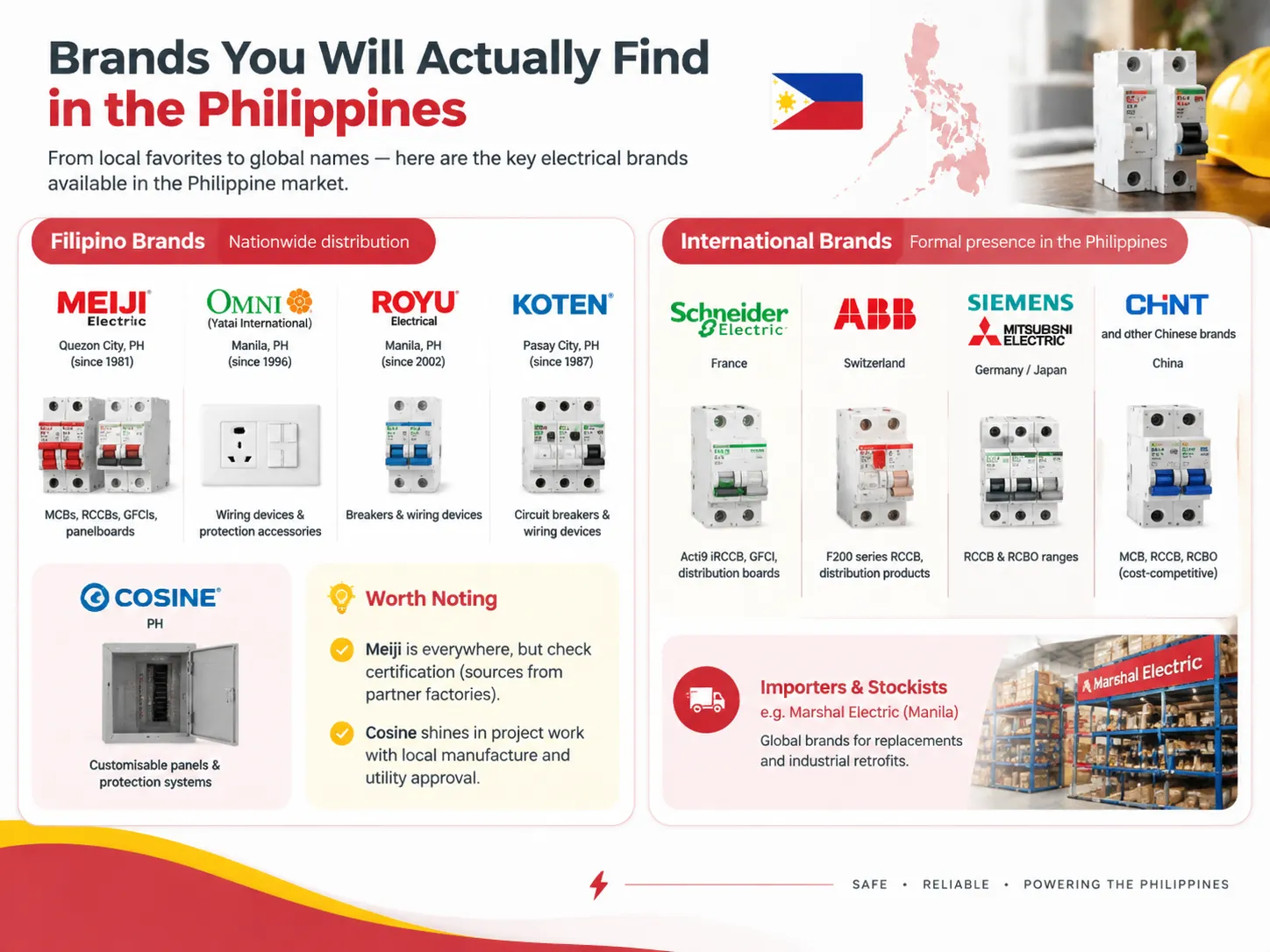
Filipinler’de Gerçekten Bulacağınız Markalar
Yerel pazar, ulusal dağıtımı olan Filipinli markalar ile resmi varlığı bulunan yabancı markalar arasında mükemmel şekilde bölünmüştür. Aşağıdaki rakamlar, ampere değeri ve hassasiyete göre değişen 2 kutuplu yerel bir cihaz için 2026 yılı sokak fiyatlarını göstermektedir.
| Marka | Menşei | Sağladıkları | Tipik fiyat aralığı | Notlar |
|---|---|---|---|---|
| Meiji Elektrik | Quezon City, PH — 1981’den beri | MCB’ler, RCCB’ler, GFCI’ler, pano tabloları, kablolama cihazları | ₱400–₱2,500 | PEEP ve DOE uyumlu; IEC tabanlı tasarımlar; geniş donanım mağazası stoğu |
| Omni (Yatai Uluslararası) | Manila, PH — 1996’dan beri | Kablolama cihazları ve koruma aksesuarları | ₱350–₱2,000 | PNS ve ICC işaretli; ülke çapında en güçlü dağıtıcı ağı |
| Royu Elektrik | Manila, PH — 2002’den beri | Kesiciler (2 kutuplu vida terminali, 220 V), kablolama cihazları | ₱300–₱1,200 | FELCO grubunun altında; BPS sertifikalı; alev geciktirici polikarbonat |
| Koten İşletmeleri | Pasay City, PH — 1987’den beri | Devre kesiciler ve standart kablolama cihazları | ₱300–₱1,800 | Toplu konut ve kurumsal tercih; parçalar her zaman mevcut |
| Cosine Endüstrileri | PH | Özelleştirilebilir paneller ve koruma sistemleri | Proje bazlı | Yerel üretim, güçlü kamu onayı, ortak etiketleme mevcut |
| 200 amperlik yük merkezleri ve sayaç-ana kombinasyonları, yeni konut inşaatı için standart ürünleri olarak üretmektedir; bu, 200 amperin modern bir tek aile evi için pratik minimum olduğunu yansıtmaktadır. | Fransa | Acti9 iRCCB, AvatarOn GFCI, dağıtım panoları | ₱700–₱4,500 | Ticari projelerde en geniş spesifikasyon varlığı |
| ABB | İsviçre | F200 serisi RCCB, dağıtım ürünleri | ₱900–₱5,000 | Endüstriyel ve kamu işleri için yaygın |
| Siemens / Mitsubishi Elektrik | Germany / Japan | RCCB and RCBO ranges | ₱800–₱4,500 | Premium pricing; strong on OEM panels |
| Chint and other Chinese brands | China | MCB, RCCB, RCBO | ₱250–₱1,500 | Cost-competitive; certification varies enormously by product line |
There are two that require mentioning. Among the infamous brands in the Philippines, Meiji is the first choice for many domestic electricians. That’s because it’s available A-to-Z and with understandable labeling, which means that it has got the production from various factories rather than manufacturing everything on its own. Thus, the importance of checking certifications only increases. Cosine is the unique one for projects, given that it has the ability to produce things locally with the utility approval.
On the importers and the stockists level, there are companies like Marshal Electric in Manila that would have global brands for replacement and retrofitting. For the time being, being in need of a simple RCBO replacement, this layer is often faster than trying to get the replacement through the distributor order.
Common Models and What Each One Is For
Devices in this group do not have decorative design because they give you information on pole number, the type of current and other characteristics.
This means that encountering with a model such as 2P, 30mA, Type A, 6kA, you see a two-pole RCD with 30mA sensitivity that works with pulsating DC current and has a maximum short-circuit current of 6kA. Substitute 30 with 300, and a device turns into one that protects from fire and electric shock. Replace 2P with 4P, and the device protects you not only against electric shocks but also indicates if you have a three-phase circuit.
In case of a single-phase 230V domestic distribution board, you would typically encounter a 2-pole 30mA type A RCCB and a number of 16-32 A RCBOs. In commercial kitchens or wet areas of hospitals, you would be protected with devices with 10 mA GFCI. Any system with a drive or anything similarly requiring a type B device will make the specifications different.
HUYU’s residual-current range covers that spread in one family rather than piecemeal: a 16–125 A Type AC/Type A RCCB for the sub-main position, plus RCBOs from 6 A to 125 A, Type B and Type F variants for inverter and drive loads, and the MCB and AFDD lines that sit alongside them in the same board. The point of buying one family is that the accessories, busbars and enclosure widths are already matched.
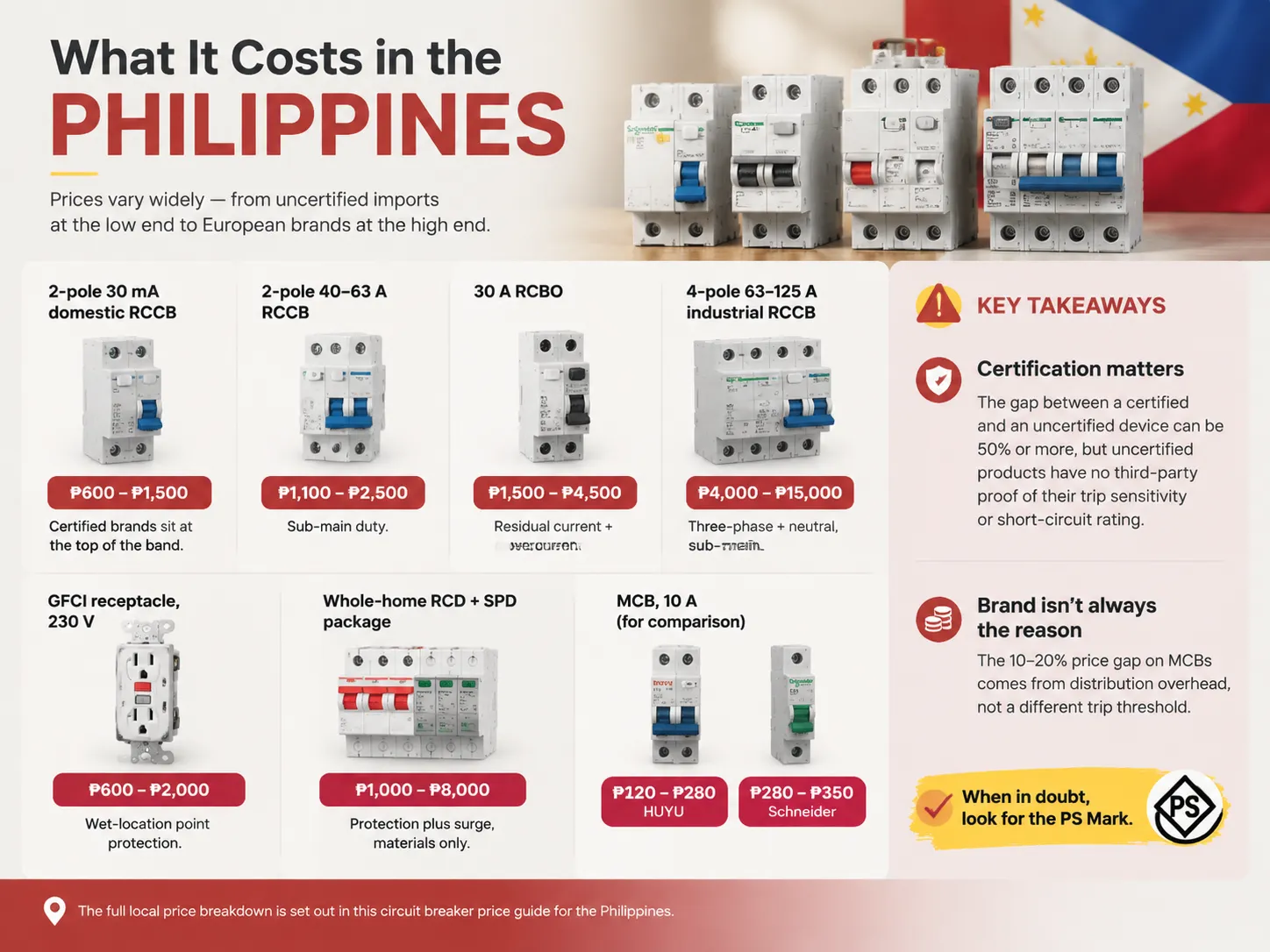
What It Costs in the Philippines
Philippine pricing is lumped because the cheaper side of the market is crowded by uncertified imports and the expensive one by European brands, leaving very limited possibilities in between. The bands below show 2026 street pricing, so regard the low end of any range with caution unless there is a visible PS Mark.
| Cihaz | Typical price (PHP) | Notlar |
|---|---|---|
| 2-pole 30 mA domestic RCCB | ₱600–₱1,500 | Certified brands sit at the top of the band |
| 2-pole 40–63 A RCCB | ₱1,100–₱2,500 | Sub-main duty |
| 30 A RCBO | ₱1,500–₱4,500 | Residual current plus overcurrent |
| 4-pole 63–125 A industrial RCCB | ₱4,000–₱15,000 | Three-phase plus neutral, sub-main |
| GFCI receptacle, 230 V | ₱600–₱2,000 | Wet-location point protection |
| Whole-home RCD + SPD package | ₱1,000–₱8,000 | Protection plus surge, materials only |
| MCB, 10 A, for comparison | ₱220–₱400 | HUYU ₱220–280; Schneider ₱280–350 |
There are two noteworthy patterns. The difference between an approved unit and one that is not may appear on paper to be more than fifty percent, however, the uncertified item has no verification that it will break at the values stated in its specifications or withstand short-circuit current of the same value. Therefore, the calculated difference is only a difference on paper. Similar situation can be observed in the table presented above, where HUYU offers its product at a price level of ₱220–280 while major European brands sell their devices for ₱280–400.The full local price breakdown is set out in this circuit breaker price guide for the Philippines.
How to Choose a Supplier
Philippine procurement depends on certifications more than on manufacturers, so figure out this checklist before worrying about price.
- PS Mark or ICC. Electrical equipment available in the Philippines is expected to be marked with the Philippine Standard Mark or an Import Commodity Clearance sticker. Without that, an appliance cannot be mentioned in a valid installation, no matter what kind of datasheet is provided.
- Specify standards. RCCB has to be certified according to IEC 61008, while RCBO has to provide IEC 61009. An offer saying “It conforms to IEC standards” is not definitive.
- Sensitive rating and Type. Make sure the offer indicates that it is 30 mA and appropriate Type A or B. If a drive, inverter or an adapter is included in the installation, Type B is obligatory.
- Breaking capacity. Ask what conditional short-circuit current a device is rated for and which protective device is used. The difference between a 10 kA unit and a 6 kA unit is not visible.
- 60Hz specification. Make sure the part complies with the specifications for 60Hz, not 50 Hz only.
- Warranty. It is better to ask for two-year warranty with some possibility of replacement rather than a one-year.
- Documentation. Make sure you obtain the test report and Declaration of Conformity each time the shipment arrives, not just once per inquiry.
This way a manufacturer like HUYU operates successfully. We are not well-known brand among Filipino customers, and if the specification mentions Schneider or ABB, it means that this specification involves these brands and not our company. In that case, we are able to compete based on performance specifications — 30 mA, Type A or B, PS Mark or ICC, IEC 61008/61009, two-year warranty according to the specifications strictly. The range and the OEM terms are set out on the RCCB manufacturing programme page.
SSS
Is an earth leakage relay the same as an RCD or RCCB?
So functionally the two devices are the same as they both sense the current flowing in the live conductors and trip on residual current. However the difference between them comes in terms of the form factor and their application. The earth leakage relay is usually a standalone equipment which is combined with a core balance current transformer and is responsible for the operation of the relay which is utilized when it is required to have a variable action of the device or to trip a large circuit breaker. RCCB is in fact a single DIN event component that performs the switch. In electrical works in the Philippines one will be faced with installation of RCCB or RCBO while earth leakage relays are used in industry and beyond.
Does the Philippine Electrical Code require an RCD in homes?
Yes, in two different ways. The requirement of PEC 2017 Article 2.10.1.8 is that Class A grounding fault circuit interrupters (GFCIs) should be applied when the current range is 4 to 6 mA in outlets located in bathrooms, kitchens near sinks, where water is used outdoors, in laundry areas, garages, and within 1.8 meters of a bathtub or shower. In addition to this, the code specifies that circuitry for socket-outlet circuits has a requirement of 30 mA for the residential output. Both of these requirements are applicable, and one may not replace the other because the thresholds of sensitivity are already different with these two requirements as well as the principles of protection.
Can a 30 mA RCD be used instead of a GFCI in the Philippines?
Rather than a straightforward substitute for the 4-6 mA requirement. It should be noted that PEC specifically mentions that the device with 30 mA rating does not comply with the GFCI regulation as 30 mA is about five to seven times more than the GFCI compliance level. Devices with 5-10 mA rating which are in accordance with IEC 61008 or IEC 61009 are compliant to requirements when the right type is utilized based on the load, but there is a limitation in the sense that prior written approval from AHAJ is necessary before the design completion. Thus, it will be more prudent to provide both: a 30 mA RCBO installed in the electrical panel and a Class A GFCI used in moist locations.
What Type should I specify — AC, A, B or F?
Type AC responds only to sinusoidal alternating residual current and is only used in simple resistive and lighting circuits. Type A adds pulsating DC to its sensing range and is the sensible minimum for modern installations with electronic equipment. Type B is required whenever the circuit contains any of the following: a variable frequency drive, a solar inverter, an EV charger, or any other equipment that can create smooth DC leakage because neither Type AC nor Type A will detect it. Type F is between types A and B when it comes to mixed frequencies from single-phase drives and some inverter loads. If there is any inverter on the load list, specify Type B and stop haggling.
Do I need surge protection as well as earth leakage protection?
Absolutely, and the two are not the same things, as an RCD reacts as regards to any residual current, but does not shield devices from voltage surge. Considering that there can 25-50 storm days every year in the Philippines flat regions, the usage of Type 1 SPD at the point of supplies with the use of Type 2 devices at the switches is common and advisable for anything what has sensitive loads. The distance between these two levels of SPD should be at least 10 m or they can be connected with the help of decoupling elements.
Why does a newly installed RCD trip for no apparent reason?
There are four reasons that can account for the majority of the instances. An included neutral conductor connecting ahead two circuits divides the return path and takes on the characteristics of a ground fault for the coil responsible for sensing the fault. A bootleg ground or neutral conductor that has inadvertently been grounded also produces the same results. Cable insulation that has absorbed moisture, typical for the older Philippine buildings, leads to the presence of a true leakage. Finally, a device that is installed incorrectly because of the type may trigger an alarm on the DC component of the load. In order to localize the source of the issue, disconnect the load first and then check the individual circuits.
Referanslar
- International Electrotechnical Commission — IEC 61008 and IEC 61009, residual current operated circuit-breakers
- UL Standartları ve Katılım — UL 943, Toprak Hatası Devre Kesicileri
- UL Solutions — testing and certification for residual current devices
- NFPA — NFPA 70, National Electrical Code (the basis of the PEC structure)
- ISO — ISO 9001 quality management, the framework behind IEC 61008/61009 certification
Sonuç
When looking to purchase earth leakage protection in the Philippines, you will have to think about three different specifications as well as one certificate. The specifications include the sensitivity of the device (i.e. it should be 4–6 mA for personnel protection in compliance with PEC 2017, 30 mA for socket circuits and 300 mA for fire protection), number of poles and the Type of the device (AC means basic protection, A is the most common there is and B is suitable only when the inverter or the drive is used in the device). The certificate you need is either a PS Mark or ICC sticker — without the certificate, you cannot use the device in your installation even if the datasheet states otherwise.
As for the suppliers, you can choose from Meiji, Omni, Royu and Koten companies as they will provide you with fast replacement regardless of the device illness; Cosine company manufactures at local factories and has a range of strong utility approvals; Schneider, ABB, Siemens and Mitsubishi Electric are known for the presence of all specifications required for proper device functioning according to the consultants expectations. HUYU is competing on costs and OEM terms – our prices are 10–20% lower than those of the leading brands but since we are not a well-known brand we have to admit that.
Whichever option you choose to shop for, ask for the data you need (the standard number, declared sensitivity of the device, type of the device and its safety performance) in writing so that at least four points indicated in the quotation would not allow you to deal with most possible troubles.