
ไม่ว่าคุณจะกำลังอัปเกรดบริการบ้านพักอาศัยเก่าจาก 60A เป็น 100A ติดตั้งสายฟีดเดอร์ไปยังโรงรถแยก หรือเดินสายไฟเวิร์กช็อปใหม่ คำถามแรกจะเหมือนกันเสมอ — สายไฟประเภทใด (ทองแดงหรืออลูมิเนียม) ที่ฉันต้องใช้สำหรับบริการ 100 แอมป์? คำตอบขึ้นอยู่กับรหัสสองแบบที่ใช้ เนื่องจากบริการบ้านพักอาศัยสามารถใช้ NEC 310.12 และจึงต้องการความสามารถในการรับกระแส 83% (ทองแดง 4 AWG หรืออลูมิเนียม 2 AWG) ขณะที่บริการเชิงพาณิชย์หมายความว่าคุณต้องใช้ทองแดง 3 AWG (เพื่อให้แน่ใจว่าความสามารถในการรับกระแสเต็มที่) หรืออลูมิเนียม 1 AWG หากทำถูกต้องคุณจะผ่านการตรวจสอบ; หากผิดพลาดคุณจะไม่ผ่านการตรวจสอบหรือสายไฟที่สำคัญที่สุดในไซต์ก่อสร้างของคุณจะร้อนเกินไป คู่มือด้านล่างนี้จะให้ขนาดสายไฟทั้งหมดที่คุณต้องการ รหัสที่เกี่ยวข้อง การคำนวณต่าง ๆ ที่เกี่ยวข้องกับสายทองแดงและอลูมิเนียม และรายละเอียดทั้งหมดเกี่ยวกับกระบวนการติดตั้ง.
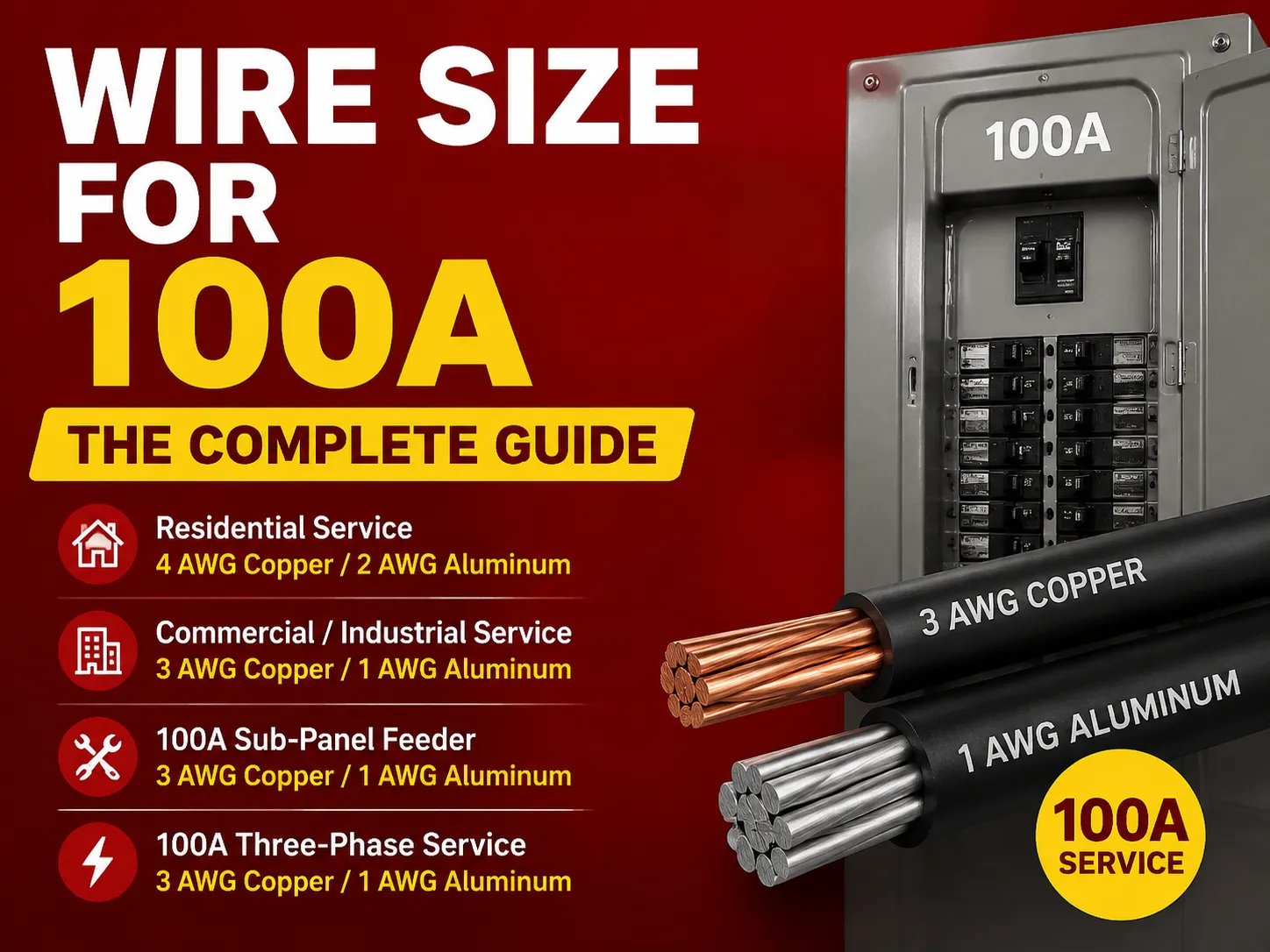
สรุป: ตาม NEC 310.12 (กฎ 83%) สำหรับบริการบ้านพักอาศัย 100A เฟสเดียว 120/240V ขนาดขั้นต่ำสำหรับทองแดงคือ 4 AWG และสำหรับอลูมิเนียมคือ 2 AWG สำหรับการใช้งานเชิงพาณิชย์ บริการสามเฟส หรือสายฟีดเดอร์ซับพาเนล 100A ข้อกำหนดของ NEC 310.16 ฉบับเต็มจะใช้สำหรับความสามารถในการรับกระแส: ขนาดขั้นต่ำสำหรับทองแดงคือ 3 AWG และสำหรับอลูมิเนียมคือ 1 AWG สายทองแดง 2 AWG (115A) ก็เหมาะสมสำหรับวงจร 100A หลายวงจรตาม NEC 240.4(B) สาย 6 AWG ไม่เป็นไปตามข้อกำหนดเนื่องจากต่ำกว่า (65A ที่ 75 °C) ปรับขนาดตามค่าคอลัมน์ 75 °C ปรับเป็นขนาดใหญ่ขึ้นสำหรับระยะทางที่ยาวกว่า ~100-150 ฟุต และตรวจสอบซ้ำกับผู้ตรวจสอบท้องถิ่นและหน่วยงานสาธารณูปโภคในโครงการของคุณ.
คำตอบโดยตรง: ขนาดสายไฟสำหรับบริการ 100A
นี่คือคำตอบทั้งหมดในตารางเดียว แถวที่คุณต้องการขึ้นอยู่กับประเภทของโครงสร้างและว่านี่คือทางเข้าบริการหรือสายฟีดเดอร์.
| สถานการณ์ | ทองแดง | อลูมิเนียม | พื้นฐานของรหัส |
|---|---|---|---|
| บริการบ้านพักอาศัย (เฟสเดียว 120/240V, บ้านส่วนใหญ่) | 4 AWG | 2 AWG | NEC 310.12 (กฎ 83%) |
| บริการเชิงพาณิชย์ / อุตสาหกรรม (เฟสเดียวหรือสามเฟส) | 3 AWG | 1 AWG | NEC 310.16 (ความจุเต็ม) |
| สายฟีดเดอร์ซับพาเนล 100A (โรงรถ, เวิร์กช็อป, ADU) | 3 AWG | 1 AWG | NEC 310.16 (ไม่มีข้อยกเว้นสำหรับที่อยู่อาศัย) |
| บริการสามเฟส 100A (ทุกประเภทการใช้งาน) | 3 AWG | 1 AWG | NEC 310.16 (ไม่มีข้อยกเว้นสำหรับที่อยู่อาศัย) |
นี่คือคำชี้แจงสามข้อที่ควรทราบ:
- สาย 6 AWG ไม่เหมาะสมสำหรับการรับโหลด 100A เนื่องจากทองแดง 6 AWG สามารถรับได้เพียง 65A ที่อุณหภูมิ 75 องศาเซลเซียส ดังนั้นควรเป็นส่วนหนึ่งของวงจร 50-60A.
- สายทองแดง 3 AWG เหมาะสำหรับรับกระแสไฟฟ้า 100A ที่อุณหภูมิ 75 องศาเซลเซียสอย่างแม่นยำ.
- สายทองแดง 2 AWG ก็ใช้งานได้เช่นกันเนื่องจากมีความสามารถ 115A ที่ 75 องศาเซลเซียส ดังนั้นตาม NEC 240.4(B) สามารถเดินสายไปยังวงจรที่ใช้เบรกเกอร์ 100A ได้.
NEC 310.12 และกฎ 83% (บริการที่อยู่อาศัย)
NEC 310.12 อนุญาตให้สายบริการและสายฟีดเดอร์ทั้งบ้านถูกกำหนดขนาดที่ 83% ของเรตติ้งบริการสำหรับบ้านพักอาศัยหนึ่งครอบครัว (หรือหน่วยที่อยู่อาศัยแยก) ที่ใช้ระบบเฟสเดียว 120/240V เหตุผลเบื้องหลังกฎนี้คือโหลดในบ้านมีความหลากหลาย แท้จริงแล้วเป็นไปไม่ได้ที่โหลดไฟฟ้าทั้งหมดจะทำงานพร้อมกัน ดังนั้น NEC จึงอนุญาตให้ใช้ขนาดสายไฟที่เล็กกว่าที่ระบุในตารางทั่วไปได้.
การคำนวณสำหรับ 100A เป็นดังนี้: 100 x 0.83 = 83A ความจุแอมป์ที่ต้องการ เพื่อเช็คความจุแอมป์ เราต้องหาค่าการจัดอันดับอุณหภูมิ ‒ ถ้าเรากำลังพูดถึง 75°C:
- 4 AWG ทองแดง (85A) → สามารถรองรับ 83A → เป็นขนาดทองแดงมาตรฐานสำหรับบริการที่อยู่อาศัย 100A.
- 2 AWG อะลูมิเนียม (90A) → สามารถรองรับ 83A → เป็นขนาดอะลูมิเนียมมาตรฐานสำหรับบริการที่อยู่อาศัย 100A.
นั่นคือเหตุผลที่คนพูดว่า “บริการ 100A เท่ากับ 4 AWG ทองแดง หรือ 2 AWG อะลูมิเนียม” – กฎระบุข้อเท็จจริงว่าเป็นขนาดเกจที่เล็กกว่าหนึ่งขนาดจากตารางทั่วไป อย่างไรก็ตาม ไม่ใช้กับ
- อาคารพาณิชย์ ร้านค้า สำนักงาน คลังสินค้า หรือโรงงาน.
- บริการสามเฟส.
- สายป้อนย่อยไปยังตู้ย่อย ‒ ใช้ความจุแอมป์เต็ม 310.16 แม้จะใช้ในบ้านหลังเดียวกัน.
NEC 310.16: ความจุแอมป์เต็มสำหรับพาณิชย์และตู้ย่อย
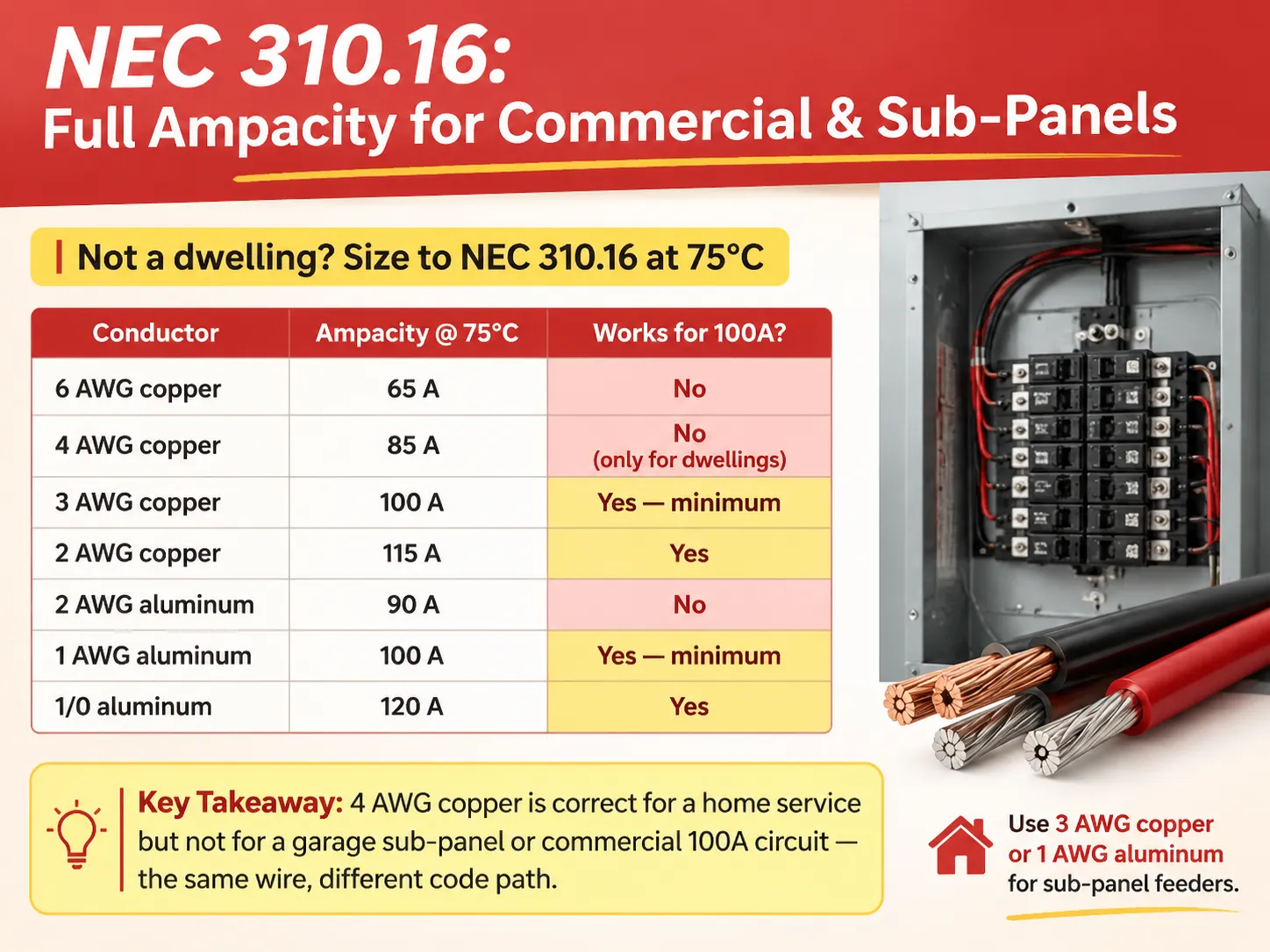
เมื่อข้อยกเว้นสำหรับที่อยู่อาศัยไม่ใช้ ให้กำหนดขนาดตาม NEC 310.16 ที่ 75°C (มาตรฐานสำหรับการต่ออุปกรณ์บริการ):
| ตัวนำ | ความจุแอมป์ @ 75°C | ใช้ได้กับ 100A หรือไม่? |
|---|---|---|
| 6 AWG ทองแดง | 65 แอมป์ | ไม่ (วงจร 50-60A) |
| 4 AWG ทองแดง | 85 แอมป์ | ไม่ภายใต้ 310.16 (ใช้ได้เฉพาะภายใต้ 310.12 สำหรับที่อยู่อาศัย) |
| 3 AWG ทองแดง | 100 แอมป์ | ใช่ — ขั้นต่ำ |
| 2 AWG ทองแดง | 115 แอมป์ | ใช่ (ตัวเลือกทั่วไปสำหรับพื้นที่สำรอง) |
| 2 AWG อะลูมิเนียม | 90 แอมป์ | ไม่ภายใต้ 310.16 (ใช้ได้เฉพาะภายใต้ 310.12) |
| 1 AWG อะลูมิเนียม | 100 แอมป์ | ใช่ — ขั้นต่ำ |
| 1/0 อะลูมิเนียม | 120 แอมป์ | ใช่ (มีส่วนเผื่อเพิ่มเติม) |
ผลลัพธ์หลัก: แม้ว่า 4 AWG ทองแดงจะยอมรับได้สำหรับบริการบ้าน แต่ไม่เหมาะสำหรับสายตู้ย่อยโรงรถหรือสายวงจร 100A พาณิชย์ — สายนี้สามารถอนุมัติได้แต่ไม่ผ่านวิธีมาตรฐานสายป้อนตู้ย่อย นี่คือจุดที่เกิดความสับสนส่วนใหญ่และนั่นคือเหตุผลที่มาตรฐานสำหรับสายทองแดงสายป้อนตู้ย่อยคือ 3 AWG ทองแดง หรือ 1 AWG อะลูมิเนียม.
ทองแดงกับอะลูมิเนียม: ความแตกต่างคืออะไร
ทั้งสองเป็นไปตามรหัส; การเลือกขึ้นอยู่กับเศรษฐศาสตร์และวินัยในการติดตั้ง:
| ปัจจัย | ทองแดง | อลูมิเนียม |
|---|---|---|
| ต้นทุนสัมพัทธ์ | เป็นฐาน (แพง) | ประมาณ 40-60% น้อยกว่าที่ขนาดนี้ |
| ขนาดที่ต้องการสำหรับ 100A (310.16) | 3 AWG | 1 AWG (ใหญ่กว่าสองขนาด) |
| น้ำหนัก | หนักกว่า | น้ำหนักประมาณ 1/3 — ดึงสายง่ายกว่า |
| การนำไฟฟ้า | สูงกว่า | ~61% ของทองแดง |
| Termination rules | มาตรฐาน | Anti-oxidant compound, AL-rated lugs, correct torque — mandatory |
| Corrosion | น้อยมาก | Oxidizes at terminations if untreated |
Aluminum is practically the most popular material used for both the 100A service entrance as well as for long feeders. Its installation is also common knowledge among certified electrical workers. There are three essentials that have to be used in all aluminum installations: an anti-oxidant joint connecting compound, terminals with AL/CU rating, and a torque wrench according to the manufacturer’s recommendations.
What Does “2-2-2-4” Wire Mean?
If you are picking a residential 100A feeder, the cable is noted to be “2-2-2-4” (this might appear as “2-2-2-4 SER” or “2-2-2-4 AL”). This notation breaks down the conductors in it: 2 conductors of 2 AWG are the 2 hot legs, and another 4 AWG is the neutral type of conductor along with one conductor of 4 AWG for grounding purpose.
- Two 2 AWG hots + 2 AWG neutral provide the 120/240 volt circuit.
- 4 AWG is the ground for the equipment.
- Since this is aluminium type of SER cable, it fulfills the standard 100A residential requirement of electrical installations per NEC 310.12 (2 AWG = 90A, more than enough voltage output of 83A).
To the question, “does 2-2-2-4 wire suffice for 100 amps?” the answer is “yes” for residential service and 100A feeder, where the 83% regulation would apply. However, it wouldn’t work for commercial services at 100A that would be needing 1 AWG cables for the hots.
Will 6 Gauge Wire Handle 100 Amps?
6 AWG copper wire is appropriate for 65A at 75°C (55A at 60°C) jobs which is not sufficient for a 100A service since this wire overheating can damage the insulation and create a serious fire risk. It is preferable to use this wire in low amperage circuits, up to 50-60A. For jobs with 100A or more workloads one has to use wire sizes of 3 AWG of copper or 1 AWG of aluminum.
Is #3 Copper Good for 100 Amps?
Indeed. 3 AWG copper is rated for 100A at 75°C; making it the exact minimum for a 100A general circuit, commercial service, or sub-panel feeder under NEC 310.16. Many electricians choose 2 AWG copper (115A) for ample room, derating, or long runs; which is indeed acceptable. For residential service only, 4 AWG copper is sufficient. In a nutshell, when asked is #3 copper good for 100 amps; this wire is indeed rated properly.
Run Length & Voltage Drop
Ampacity isn’t the only constraint — long runs lose voltage. Recommended maximums to stay within a 3% drop at 240V:
| ตัวนำ | ความยาววิ่งสูงสุดโดยประมาณทางเดียว (แรงดันตก 3%) |
|---|---|
| 3 AWG ทองแดง | ~147 ft |
| 2 AWG ทองแดง | ~185 ft |
| ทองแดง 1 AWG | ~234 ft |
| 1 AWG อะลูมิเนียม | ~142 ft |
| 1/0 อะลูมิเนียม | ~178 ft |
| 4 AWG copper (310.12 dwelling) | ~116 ft |
| 2 AWG aluminum (310.12 dwelling) | ~112 ft |
General information: ampacity is good for lengths up to around 100 ft, consider going one size up from 100-150 ft, and for lengths of around 150 ft and beyond, ampacity will need at least one size up (for example, from 3 AWG copper to 2 AWG or from 1 AWG aluminum to 1/0). In general, long runs in rural areas usually need more than one size increase.
Neutral & Grounding Conductor Sizing
A full installation of 100A must include neutral and grounding conductors as follows:
- Neutral: Correctly determined as per the calculated unbalanced loading (NEC Table 220), it is equivalent to the circuit hots for a 100A service in most cases, whereas one size lower in case allowed by the calculations.
- Grounding electrode conductor (GEC) – sized as per NEC table 250.66 – GEC is usually 8AWG copper minimum for 4AWG copper or 2 AWG aluminum service conductors; check the table for your proper wire size.
- Equipment ground (subs): sized as per NEC table 250.122 – typically 8 AWG copper or 6 AWG aluminum for 100A feeder.
- Grounding electrodes: for a building service grounded by two rods at decent distance from one another (NEC table 250.52).
It is one of the most common manageable mistakes in the service work to confuse tables 250.66 (GEC) and 250.122 (equipment ground) – pick the correct table for the right wire.
Sub-Panel Specifics: Detached Garage & Workshop
Running 100A to a detached garage, workshop, or ADU has additional codes and regulations to consider:
- A 4-wire feeder must be installed; this includes two hots going from the main panel, one neutral, and an equipment ground (NEC 250.32). Remember that the installation of a 3-wire feeder in a detached building is not acceptable.
- The neutral must be isolated. You must ensure that the neutral bar in the sub-panel is separately placed from the ground bar. The main panel provides the bonding of these two.
- Grounding is necessary for the new structure. The detached building should have its own grounding system (typical grounding rods in place to be used).
- The cable type will typically be 1 AWG SER aluminum or 3 AWG copper in the conduit for the 100A feeder; this has to adhere to 310.16.
- Make load calculations – it’s essential to perform load calculations before purchasing the wiring. An ADU with electric heats and an EV charging unit may require 125A and not 100A.
Common Mistakes on 100A Installations
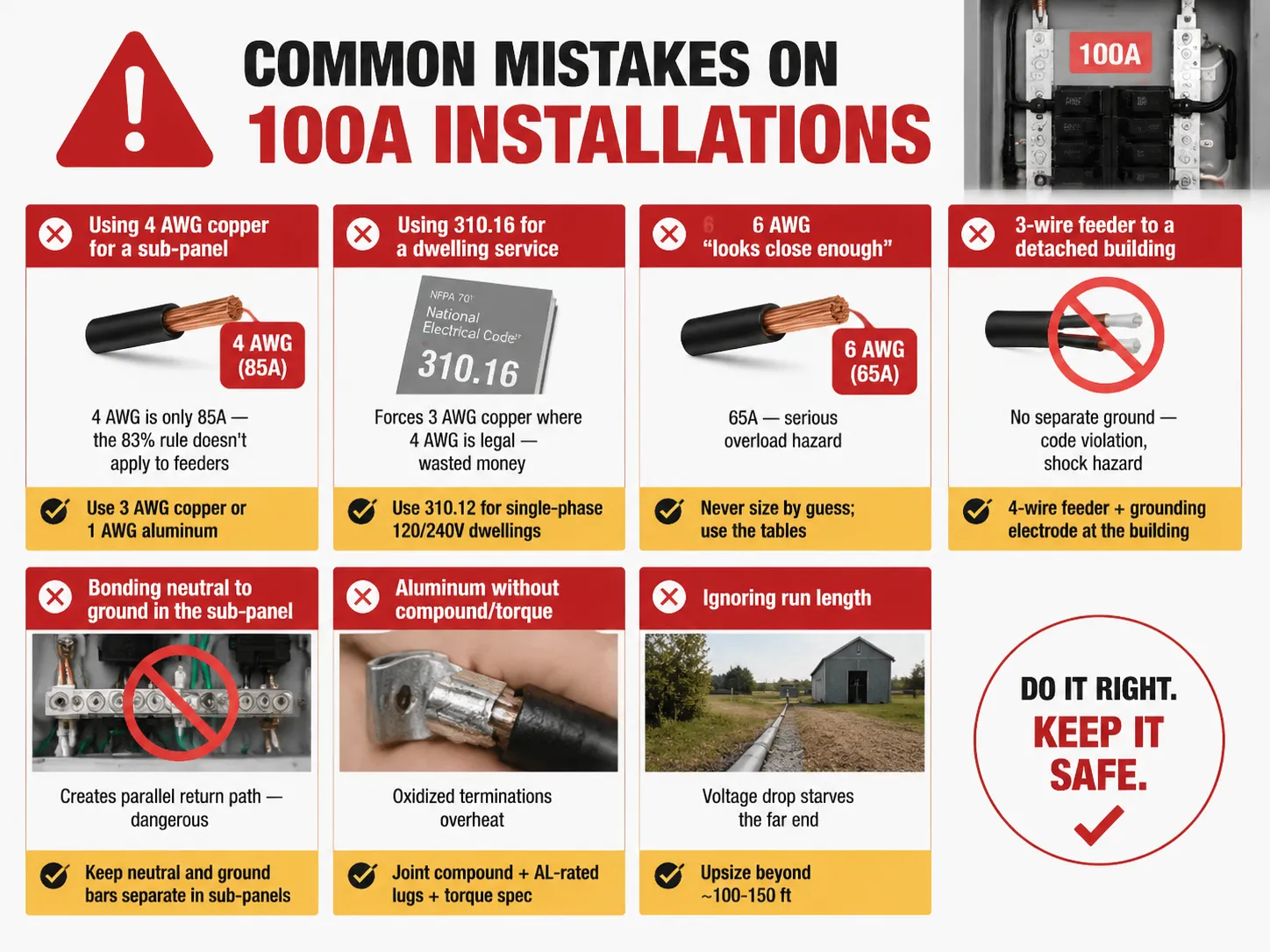
| ความผิดพลาด | เหตุผลที่ผิด | วิธีแก้ไขที่ถูกต้อง |
|---|---|---|
| Using 4 AWG copper for a sub-panel | 4 AWG is only 85A — the 83% rule doesn’t apply to feeders | 3 AWG copper or 1 AWG aluminum for 100A feeders |
| ใช้ 310.16 สำหรับบริการที่อยู่อาศัย | Forces 3 AWG copper where 4 AWG is legal — wasted money | ใช้ 310.12 สำหรับที่อยู่อาศัยเฟสเดียว 120/240V |
| 6 AWG “looks close enough” | 65A — serious overload hazard | Never size by guess; use the tables |
| 3-wire feeder to a detached building | No separate ground — code violation, shock hazard | 4-wire feeder + grounding electrode at the building |
| Bonding neutral to ground in the sub-panel | Creates parallel return path — dangerous | Keep neutral and ground bars separate in sub-panels |
| Aluminum without compound/torque | Oxidized terminations overheat | Joint compound + AL-rated lugs + torque spec |
| ไม่สนใจความยาวสาย | Voltage drop starves the far end | Upsize beyond ~100-150 ft |
การพิจารณาค่าใช้จ่ายและใบอนุญาต
Upgrade to a 100A service or installation of a new electrical feeder has the following costs:
- Materials include: panel – $60-$200, 100A main breaker – $30-$80, 2-2-2-4 aluminum SER – $1.50-$3 per foot, 3 AWG copper – $3-$6 per foot, meter base and hardware – $50-$150.
- Jobs will run at $800-$2,500 for a service upgrade and $500-$1,500 for a sub-panel feeder, based on run distance and access through walls.
- The permit and inspection normally cost $50-$300 and are required. Inspectors check wire and grounding size and bonding to be finished.
- Utility coordination is needed as the utility will own the meter and service connection.
When the project also involves panelboard and breakers, matching certified protection devices — and understanding the breaker types involved, from the basics of MCBs and MCCBs การ มาตรฐานเบรกเกอร์ UL 489 — keeps the whole install compliant end to end. And once the 100A main is in, every branch circuit behind it follows the same sizing discipline — the limits explained for a 15-amp circuit’s wattage apply at every level of the panel.
มาตรฐานสากล: หมายเหตุสั้น ๆ
Outside of North America, the determination of 100A wiring is done differently as most of the world implements methods consistent with IEC/BS 7671 standards (current and correction factor method) instead of using a simplified service table.
- In the UK (BS 7671), cable sizes are determined based on the installation method. For instance, a 100A single-phase connection usually requires a copper wire of between 25 and 50mm² depending on how long the cable is.
- In Europe (IEC 60364), the straightforward method is used.
- In Australia (AS/NZS 3000), method-based calculations are used for insulation and often result in use of 25 to 35mm² wires.
- In Canada (CE Code), a similar argument to that put forth by the NEC is used; installations may be based on 83%-like formulas.
The NEC procedure is based on rules pertaining specifically to the US and/or Canada installations; hence, if the location of the job is different from those two places it would be wise to hire an engineer or electrician to carry out the calculations.
คำถามที่พบบ่อย
What size wire do we need for a 100 amp service?
According to NEC 310.12 for residential systems with 100A service (single phase), it is allowed to use 4 AWG copper or 2 AWG aluminum conductors. Whereas in commercial systems with three-phase or 100A sub-panel system, the full ampacity from the NEC 310.16 has to be applied, which means a minimum of 3 AWG copper or 1 AWG aluminum conductors. In terms of size for the GEC, 8 AWG copper conductor must be used as per 250.66 along with upsizing for distances of more than 100-150 feet.
Is #3 copper good for 100 amps?
Indeed – 3 AWG copper is rated precisely as 100A at 75°C, it is exactly the minimum required for 100A regular circuit, commercial service or sub-panel feeding based on NEC 310.16. However, a large number of electricians use 2 AWG copper (115A) instead to provide more headroom due to derating. For household services only, 4 AWG copper is considered okay.
Is 2-2-2-4 wire good for 100 amps?
Indeed, when it comes to residential applications, “2-2-2-4” SER cable (2 AWG hot wires, 2 AWG neutral wire, and 4 AWG ground wire) is considered as the standard aluminum type for 100A residential service as stated in NEC 310.12 (it should be noted that 2 AWG aluminum wire is rated at 90A, which is more than enough for the 83A needed). But when it comes to commercial applications, 1 AWG aluminum wire or 3 AWG copper wire needed for 100A commercial service is required.
Will 6 gauge wire handle 100 amps?
No. 6 AWG copper wire has a rating of just 65 amperes at a temperature of 75°C (55 amperes at 60°C), which is not suitable for 100 amperes. The wire will get hot, allowing for very high risks of fire. 6 AWG copper is appropriate for circuits carrying 50-60 amperes (for example with ranges, ovens, or small sub-panels). For 100A use either 3 AWG copper or 1 AWG aluminum wire (in general) or 4 AWG copper or 2 AWG aluminum wire (for dwelling services).
อ้างอิง
- NFPA 70 — National Electrical Code (NEC): Articles 230, 240, 250, 310
- Mike Holt — NEC 310.12 83% Rule and Conductor Sizing
- OSHA 1910.303 — ข้อกำหนดไฟฟ้าทั่วไป
- EC&M Magazine — Service and Feeder Sizing Articles
- IEC 60364 — การติดตั้งไฟฟ้าแรงดันต่ำ (ระดับสากล)
- NEMA — Conductor and Wiring Standards
สรุป
The process of determining appropriate wire sizes for a service rated at 100 A depends on how you answer the question: does the 83% dwelling rule apply? According to NEC 310.12, in the case of residential applications, the standard wire sizing practice requires the use of 4 AWG copper wire or 2 AWG aluminum wire. In the case of commercial installations, systems equipped with three-phase motors, and hundred-amp sub-panels, the applicable wire sizes that comply with the code requirements concerning their ampacity correspond either with 3 AWG copper wire or with 1 AWG aluminum wire; therefore, in practice, 2 AWG copper wire is often used. When the panel and breakers are part of the job, understanding the protection devices — like recognizing a failing breaker and the practical pricing in breaker replacement cost — keeps the whole project safe, legal, and on budget.