
Независимо от того, обновляете ли вы старую жилую электросеть с 60А до 100А, устанавливаете линию питания к отдельному гаражу или прокладываете проводку в новой мастерской, первый вопрос всегда один — какой тип проводки (медь или алюминий) необходим для обслуживания 100 ампер? Ответ зависит от двух различных кодексов, которые применимы, поскольку жилая сеть может использовать NEC 310.12 и, следовательно, требовать 83% ампераж (4 AWG медь или 2 AWG алюминий), в то время как коммерческая сеть означает, что вам требуется либо 3 AWG медь (для обеспечения полного ампеража), либо 1 AWG алюминий. Сделайте правильно — и вы пройдете проверку; ошибетесь — и либо не пройдете проверку, либо перегреете самый критичный провод на вашем строительном объекте. Следующее руководство предоставит вам все размеры проводов, которые вам нужны, коды, лежащие в их основе, различные расчеты с медными и алюминиевыми проводами, а также подробности всего процесса установки.
Кратко: Согласно NEC 310.12 (правило 83%), для жилой однофазной сети 100А 120/240В минимальный размер для меди — 4 AWG, для алюминия — 2 AWG. Для коммерческого использования, трехфазных сетей или линий питания подпанелей на 100А применяются требования полного NEC 310.16 по амперажу: минимальный размер для меди — 3 AWG, для алюминия — 1 AWG. 2 AWG медь (115А) также может быть подходящим для многих цепей на 100А согласно NEC 240.4(B). 6 AWG не соответствует требованиям, так как его ампераж составляет 65А при 75 °C. Подбирайте размер по значениям в колонке 75 °C, увеличивайте размер для расстояний более ~100-150 футов и обязательно перепроверяйте с местным инспектором и коммунальными службами вашего проекта.
Прямой ответ: размер провода для обслуживания 100А
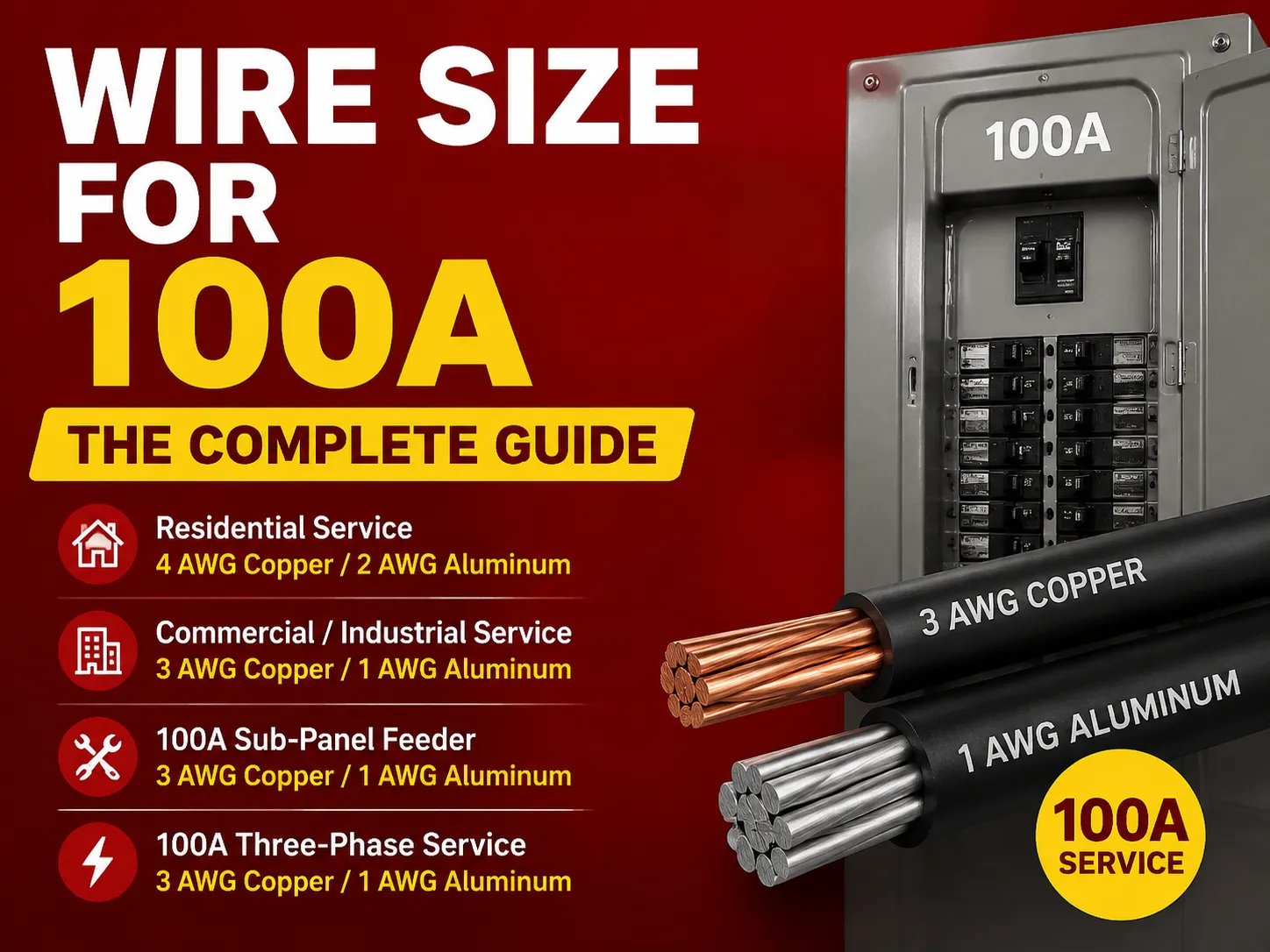
Вот полный ответ в одной таблице. Какую строку выбрать, зависит от типа конструкции и того, является ли это вводом в здание или линией питания.
| Сценарий | Медь | Алюминий | Основание кода |
|---|---|---|---|
| Жилая электросеть (однофазное 120/240В, большинство домов) | 4 AWG | 2 AWG | NEC 310.12 (правило 83%) |
| Коммерческая / промышленная электросеть (однофазное или трехфазное) | 3 AWG | 1 AWG | NEC 310.16 (полная амперажность) |
| Линия питания подпанели на 100А (гараж, мастерская, ADU) | 3 AWG | 1 AWG | NEC 310.16 (без исключения для жилых помещений) |
| Трехфазная сеть на 100А (любое назначение) | 3 AWG | 1 AWG | NEC 310.16 (без исключения для жилых помещений) |
Вот три уточнения, которые следует отметить:
- 6 AWG не подходит для нагрузки 100А, поскольку медь с 6 AWG может нести только 65А при температуре 75 градусов Цельсия. Следовательно, он должен использоваться в цепях на 50-60А.
- Медный провод 3 AWG подходит для нагрузки ровно 100А при 75 градусах Цельсия.
- Медный провод 2 AWG также подходит, так как его емкость составляет 115А при 75 градусах, поэтому согласно NEC 240.4(B) он может использоваться в цепях с автоматом на 100А.
NEC 310.12 и правило 83% (жилые сервисы)
NEC 310.12 разрешает размер проводников для обслуживания и питания всего дома устанавливать на уровне 83% от номинала обслуживания для однофамильного дома (или отдельного жилого блока), питаемого однофазной системой 120/240В. Основание этого правила — диверсификация нагрузок в доме. Действительно, невозможно, чтобы все электрические нагрузки работали одновременно. Поэтому NEC допускает использование проводников меньшего размера, чем указано в общих таблицах.
Расчет для 100A выглядит следующим образом: 100 x 0.83 = 83A требуемой ампacity. Чтобы проверить ампacity, нужно определить температурный рейтинг ‒ если речь идет о 75°C:
- 4 AWG медь (85A) → может выдержать 83A → это стандартный размер меди для жилых сервисов 100A.
- 2 AWG алюминий (90A) → может выдержать 83A → это стандартный размер алюминия для жилых сервисов 100A.
Вот почему говорят “100A сервис равен 4 AWG меди или 2 AWG алюминия” – правило указывает, что это на один калибр меньше, чем в общих таблицах. Однако оно не применяется к
- Коммерческим, розничным, офисным, складским или производственным зданиям.
- Трехфазным сервисам.
- Фидерам к субпанелям ‒ они используют полную ампacity по 310.16, даже если используются в том же жилом доме.
NEC 310.16: Полная ампacity для коммерческих и субпанелей
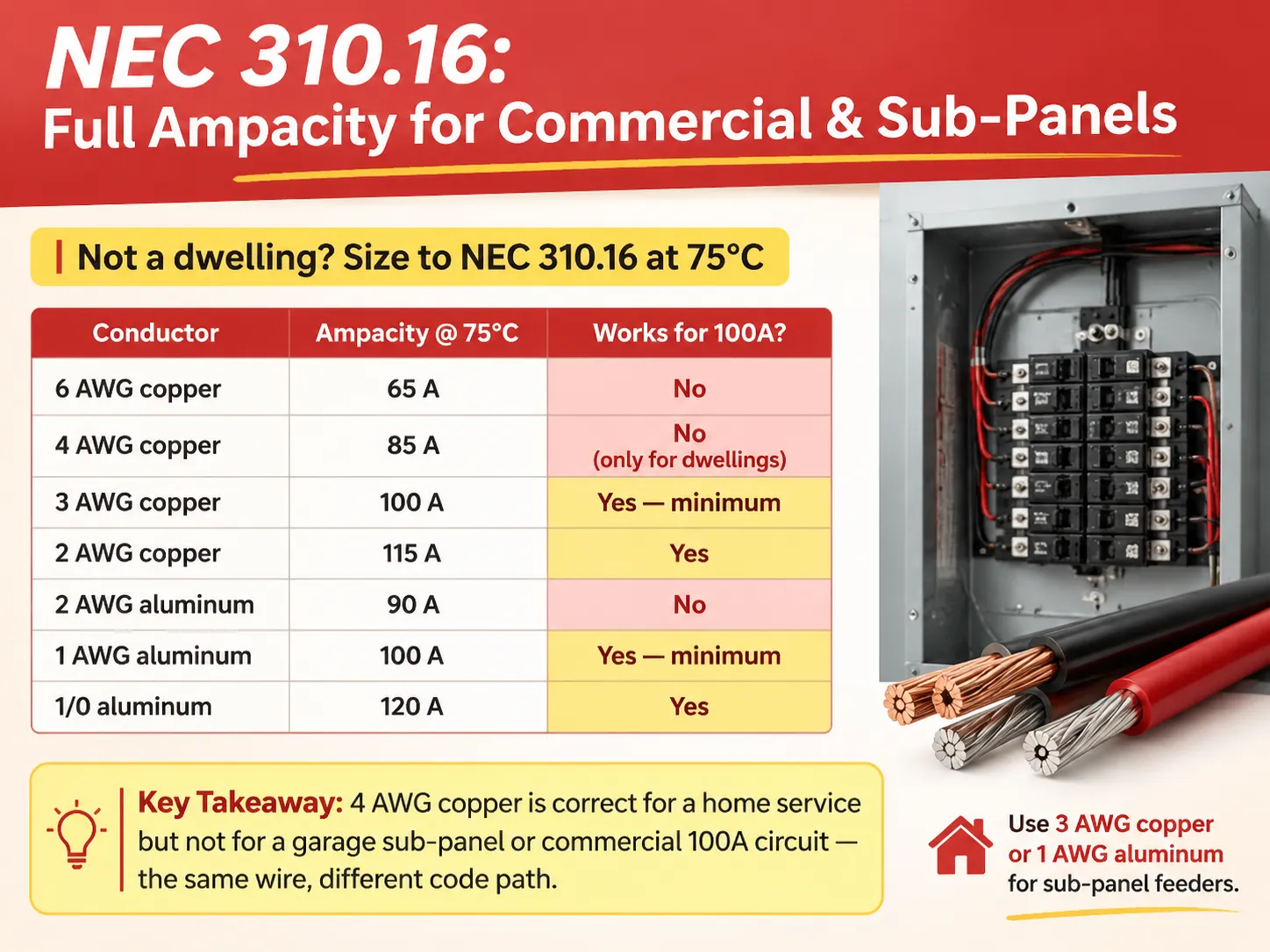
Когда исключение для жилых домов не применяется, размер выбирается по NEC 310.16 при 75°C (стандарт для подключений сервисного оборудования):
| Проводник | Ампераж при 75°C | Подходит для 100A? |
|---|---|---|
| 6 AWG медь | 65 A | Нет (цепь 50-60A) |
| 4 AWG медь | 85 A | Нет по 310.16 (только по 310.12 для жилых домов) |
| 3 AWG медь | 100 A | Да — минимум |
| 2 AWG медь | 115 A | Да (распространенный выбор для запаса по току) |
| 2 AWG алюминий | 90 А | Нет по 310.16 (только по 310.12) |
| 1 AWG алюминий | 100 A | Да — минимум |
| 1/0 алюминий | 120 А | Да (с дополнительным запасом) |
Основной вывод: хотя 4 AWG медь приемлема для домашнего сервиса, она не подходит для субпанели гаража или коммерческой цепи 100A — этот провод может быть одобрен, но не по стандартному методу для фидера субпанели. Отсюда возникает большая часть путаницы, и именно поэтому стандарт для медной проводки фидера субпанели — 3 AWG медь или 1 AWG алюминий.
Медь против алюминия: в чем разница
Оба соответствуют нормам; выбор зависит от экономики и дисциплины монтажа:
| Фактор | Медь | Алюминий |
|---|---|---|
| Относительная стоимость | Базовая (дорогая) | Примерно на 40-60% меньше при этом размере |
| Размер, необходимый для 100A (310.16) | 3 AWG | 1 AWG (на два размера больше) |
| Вес | Тяжелее | Примерно в 3 раза легче — проще тянуть |
| Проводимость | Выше | ~61% от меди |
| Termination rules | Стандарт | Anti-oxidant compound, AL-rated lugs, correct torque — mandatory |
| Corrosion | Минимальные | Oxidizes at terminations if untreated |
Aluminum is practically the most popular material used for both the 100A service entrance as well as for long feeders. Its installation is also common knowledge among certified electrical workers. There are three essentials that have to be used in all aluminum installations: an anti-oxidant joint connecting compound, terminals with AL/CU rating, and a torque wrench according to the manufacturer’s recommendations.
What Does “2-2-2-4” Wire Mean?
If you are picking a residential 100A feeder, the cable is noted to be “2-2-2-4” (this might appear as “2-2-2-4 SER” or “2-2-2-4 AL”). This notation breaks down the conductors in it: 2 conductors of 2 AWG are the 2 hot legs, and another 4 AWG is the neutral type of conductor along with one conductor of 4 AWG for grounding purpose.
- Two 2 AWG hots + 2 AWG neutral provide the 120/240 volt circuit.
- 4 AWG is the ground for the equipment.
- Since this is aluminium type of SER cable, it fulfills the standard 100A residential requirement of electrical installations per NEC 310.12 (2 AWG = 90A, more than enough voltage output of 83A).
To the question, “does 2-2-2-4 wire suffice for 100 amps?” the answer is “yes” for residential service and 100A feeder, where the 83% regulation would apply. However, it wouldn’t work for commercial services at 100A that would be needing 1 AWG cables for the hots.
Will 6 Gauge Wire Handle 100 Amps?
6 AWG copper wire is appropriate for 65A at 75°C (55A at 60°C) jobs which is not sufficient for a 100A service since this wire overheating can damage the insulation and create a serious fire risk. It is preferable to use this wire in low amperage circuits, up to 50-60A. For jobs with 100A or more workloads one has to use wire sizes of 3 AWG of copper or 1 AWG of aluminum.
Is #3 Copper Good for 100 Amps?
Indeed. 3 AWG copper is rated for 100A at 75°C; making it the exact minimum for a 100A general circuit, commercial service, or sub-panel feeder under NEC 310.16. Many electricians choose 2 AWG copper (115A) for ample room, derating, or long runs; which is indeed acceptable. For residential service only, 4 AWG copper is sufficient. In a nutshell, when asked is #3 copper good for 100 amps; this wire is indeed rated properly.
Run Length & Voltage Drop
Ampacity isn’t the only constraint — long runs lose voltage. Recommended maximums to stay within a 3% drop at 240V:
| Проводник | Приблизительно максимальная односторонняя длина трассы (3% падение) |
|---|---|
| 3 AWG медь | ~147 ft |
| 2 AWG медь | ~185 ft |
| 1 AWG медь | ~234 ft |
| 1 AWG алюминий | ~142 ft |
| 1/0 алюминий | ~178 ft |
| 4 AWG copper (310.12 dwelling) | ~116 ft |
| 2 AWG aluminum (310.12 dwelling) | ~112 ft |
General information: ampacity is good for lengths up to around 100 ft, consider going one size up from 100-150 ft, and for lengths of around 150 ft and beyond, ampacity will need at least one size up (for example, from 3 AWG copper to 2 AWG or from 1 AWG aluminum to 1/0). In general, long runs in rural areas usually need more than one size increase.
Neutral & Grounding Conductor Sizing
A full installation of 100A must include neutral and grounding conductors as follows:
- Neutral: Correctly determined as per the calculated unbalanced loading (NEC Table 220), it is equivalent to the circuit hots for a 100A service in most cases, whereas one size lower in case allowed by the calculations.
- Grounding electrode conductor (GEC) – sized as per NEC table 250.66 – GEC is usually 8AWG copper minimum for 4AWG copper or 2 AWG aluminum service conductors; check the table for your proper wire size.
- Equipment ground (subs): sized as per NEC table 250.122 – typically 8 AWG copper or 6 AWG aluminum for 100A feeder.
- Grounding electrodes: for a building service grounded by two rods at decent distance from one another (NEC table 250.52).
It is one of the most common manageable mistakes in the service work to confuse tables 250.66 (GEC) and 250.122 (equipment ground) – pick the correct table for the right wire.
Sub-Panel Specifics: Detached Garage & Workshop
Running 100A to a detached garage, workshop, or ADU has additional codes and regulations to consider:
- A 4-wire feeder must be installed; this includes two hots going from the main panel, one neutral, and an equipment ground (NEC 250.32). Remember that the installation of a 3-wire feeder in a detached building is not acceptable.
- The neutral must be isolated. You must ensure that the neutral bar in the sub-panel is separately placed from the ground bar. The main panel provides the bonding of these two.
- Grounding is necessary for the new structure. The detached building should have its own grounding system (typical grounding rods in place to be used).
- The cable type will typically be 1 AWG SER aluminum or 3 AWG copper in the conduit for the 100A feeder; this has to adhere to 310.16.
- Make load calculations – it’s essential to perform load calculations before purchasing the wiring. An ADU with electric heats and an EV charging unit may require 125A and not 100A.
Common Mistakes on 100A Installations
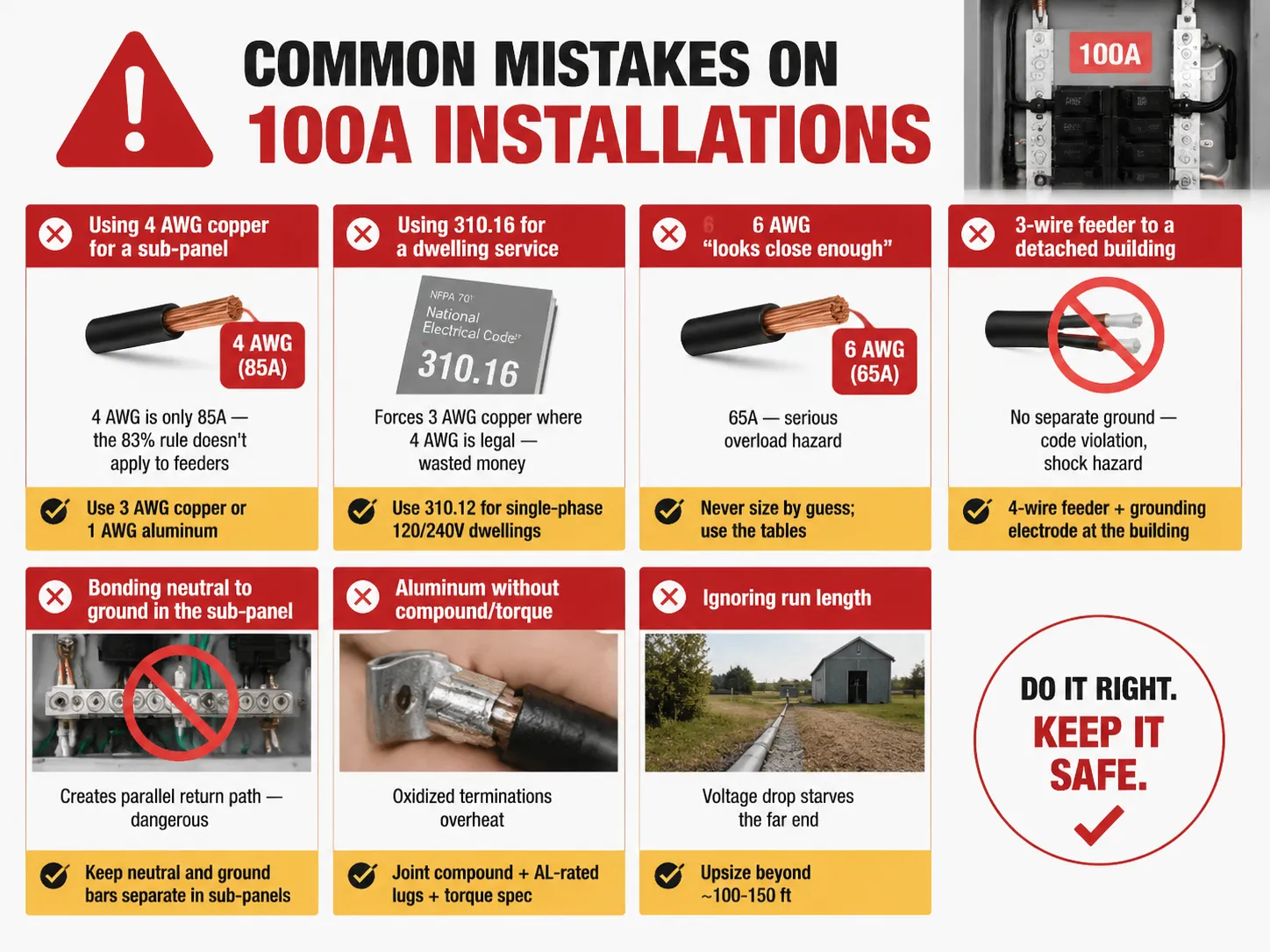
| Ошибка | Почему это неправильно | Правильный подход |
|---|---|---|
| Using 4 AWG copper for a sub-panel | 4 AWG is only 85A — the 83% rule doesn’t apply to feeders | 3 AWG copper or 1 AWG aluminum for 100A feeders |
| Использование 310.16 для жилого сервиса | Forces 3 AWG copper where 4 AWG is legal — wasted money | Используйте 310.12 для однофазных жилых домов 120/240В |
| 6 AWG “looks close enough” | 65A — serious overload hazard | Never size by guess; use the tables |
| 3-wire feeder to a detached building | No separate ground — code violation, shock hazard | 4-wire feeder + grounding electrode at the building |
| Bonding neutral to ground in the sub-panel | Creates parallel return path — dangerous | Keep neutral and ground bars separate in sub-panels |
| Aluminum without compound/torque | Oxidized terminations overheat | Joint compound + AL-rated lugs + torque spec |
| Игнорирование длины трассы | Voltage drop starves the far end | Upsize beyond ~100-150 ft |
Стоимость и вопросы разрешений
Upgrade to a 100A service or installation of a new electrical feeder has the following costs:
- Materials include: panel – $60-$200, 100A main breaker – $30-$80, 2-2-2-4 aluminum SER – $1.50-$3 per foot, 3 AWG copper – $3-$6 per foot, meter base and hardware – $50-$150.
- Jobs will run at $800-$2,500 for a service upgrade and $500-$1,500 for a sub-panel feeder, based on run distance and access through walls.
- The permit and inspection normally cost $50-$300 and are required. Inspectors check wire and grounding size and bonding to be finished.
- Utility coordination is needed as the utility will own the meter and service connection.
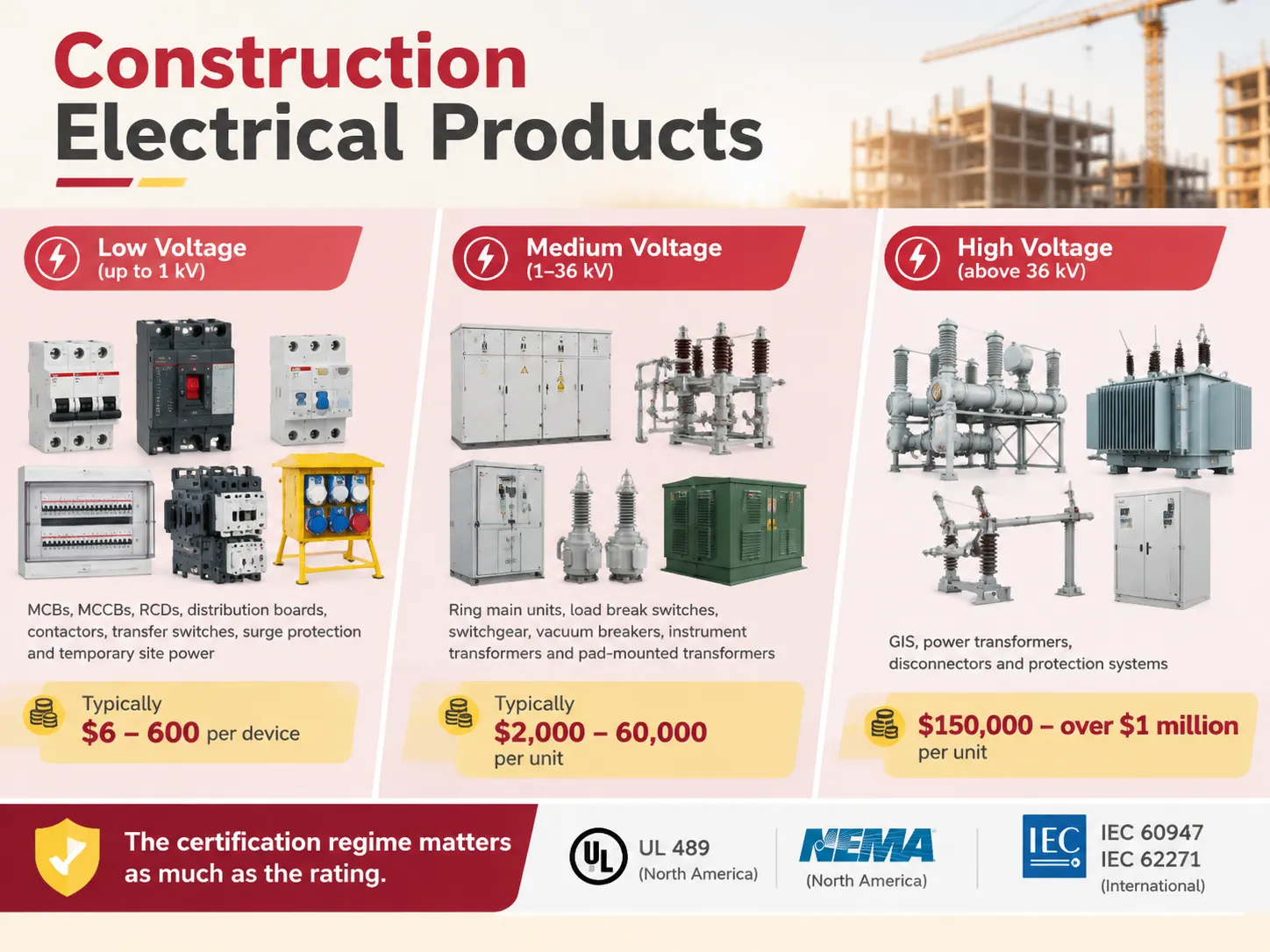
When the project also involves panelboard and breakers, matching certified protection devices — and understanding the breaker types involved, from the basics of MCBs and MCCBs о стандартам выключателей UL 489 — keeps the whole install compliant end to end. And once the 100A main is in, every branch circuit behind it follows the same sizing discipline — the limits explained for a 15-amp circuit’s wattage apply at every level of the panel.
Международные стандарты: краткое замечание
Outside of North America, the determination of 100A wiring is done differently as most of the world implements methods consistent with IEC/BS 7671 standards (current and correction factor method) instead of using a simplified service table.
- In the UK (BS 7671), cable sizes are determined based on the installation method. For instance, a 100A single-phase connection usually requires a copper wire of between 25 and 50mm² depending on how long the cable is.
- In Europe (IEC 60364), the straightforward method is used.
- In Australia (AS/NZS 3000), method-based calculations are used for insulation and often result in use of 25 to 35mm² wires.
- In Canada (CE Code), a similar argument to that put forth by the NEC is used; installations may be based on 83%-like formulas.
The NEC procedure is based on rules pertaining specifically to the US and/or Canada installations; hence, if the location of the job is different from those two places it would be wise to hire an engineer or electrician to carry out the calculations.
Часто задаваемые вопросы
What size wire do we need for a 100 amp service?
According to NEC 310.12 for residential systems with 100A service (single phase), it is allowed to use 4 AWG copper or 2 AWG aluminum conductors. Whereas in commercial systems with three-phase or 100A sub-panel system, the full ampacity from the NEC 310.16 has to be applied, which means a minimum of 3 AWG copper or 1 AWG aluminum conductors. In terms of size for the GEC, 8 AWG copper conductor must be used as per 250.66 along with upsizing for distances of more than 100-150 feet.
Is #3 copper good for 100 amps?
Indeed – 3 AWG copper is rated precisely as 100A at 75°C, it is exactly the minimum required for 100A regular circuit, commercial service or sub-panel feeding based on NEC 310.16. However, a large number of electricians use 2 AWG copper (115A) instead to provide more headroom due to derating. For household services only, 4 AWG copper is considered okay.
Is 2-2-2-4 wire good for 100 amps?
Indeed, when it comes to residential applications, “2-2-2-4” SER cable (2 AWG hot wires, 2 AWG neutral wire, and 4 AWG ground wire) is considered as the standard aluminum type for 100A residential service as stated in NEC 310.12 (it should be noted that 2 AWG aluminum wire is rated at 90A, which is more than enough for the 83A needed). But when it comes to commercial applications, 1 AWG aluminum wire or 3 AWG copper wire needed for 100A commercial service is required.
Will 6 gauge wire handle 100 amps?
No. 6 AWG copper wire has a rating of just 65 amperes at a temperature of 75°C (55 amperes at 60°C), which is not suitable for 100 amperes. The wire will get hot, allowing for very high risks of fire. 6 AWG copper is appropriate for circuits carrying 50-60 amperes (for example with ranges, ovens, or small sub-panels). For 100A use either 3 AWG copper or 1 AWG aluminum wire (in general) or 4 AWG copper or 2 AWG aluminum wire (for dwelling services).
Ссылки
- NFPA 70 — National Electrical Code (NEC): Articles 230, 240, 250, 310
- Mike Holt — NEC 310.12 83% Rule and Conductor Sizing
- OSHA 1910.303 — Общие электрические требования
- EC&M Magazine — Service and Feeder Sizing Articles
- IEC 60364 — Низковольтные электрические установки (международный стандарт)
- NEMA — Conductor and Wiring Standards
Заключение
The process of determining appropriate wire sizes for a service rated at 100 A depends on how you answer the question: does the 83% dwelling rule apply? According to NEC 310.12, in the case of residential applications, the standard wire sizing practice requires the use of 4 AWG copper wire or 2 AWG aluminum wire. In the case of commercial installations, systems equipped with three-phase motors, and hundred-amp sub-panels, the applicable wire sizes that comply with the code requirements concerning their ampacity correspond either with 3 AWG copper wire or with 1 AWG aluminum wire; therefore, in practice, 2 AWG copper wire is often used. When the panel and breakers are part of the job, understanding the protection devices — like recognizing a failing breaker and the practical pricing in breaker replacement cost — keeps the whole project safe, legal, and on budget.