
Ya sea que esté actualizando el servicio de su antigua vivienda residencial de 60A a 100A, instalando una línea alimentadora a un garaje independiente o cableando un nuevo taller, la primera pregunta siempre es la misma: ¿qué tipo de cableado (cobre o aluminio) necesito para un servicio de 100 amperios? La respuesta depende de dos códigos diferentes que aplican, ya que un servicio residencial puede usar NEC 310.12 y por lo tanto requerir ampacidad 83% (cobre 4 AWG o aluminio 2 AWG), mientras que un servicio comercial significa que requiere cobre 3 AWG (para asegurar la ampacidad completa) o aluminio 1 AWG. Hágalo bien y pasará la inspección; hágalo mal y fallará la inspección o sobrecalentará el cable más crítico en su sitio de construcción. La siguiente guía le proporcionará todos los tamaños de cable que necesita, los códigos que los respaldan, varios cálculos que involucran cable de cobre y aluminio, y detalles sobre el proceso de instalación.
En resumen: Según NEC 310.12 (la regla 83%), para un servicio residencial monofásico 100A 120/240V, el mínimo para cobre es 4 AWG y para aluminio es 2 AWG. Para uso comercial, servicios trifásicos o alimentadores de subpanel de 100A, aplican los requisitos completos de NEC 310.16 para ampacidad: el mínimo para cobre es 3 AWG y para aluminio es 1 AWG. El cobre 2 AWG (115A) también puede ser adecuado para muchos circuitos de 100A según NEC 240.4(B). El 6 AWG no cumple con los requisitos ya que es insuficiente (65A a 75 °C). Ajuste el tamaño a los valores en la columna de 75 °C, aumente el tamaño para distancias mayores a ~100-150 pies y verifique con un inspector local y las compañías de servicios locales en su proyecto.
La respuesta directa: Tamaño del cable para servicio de 100A
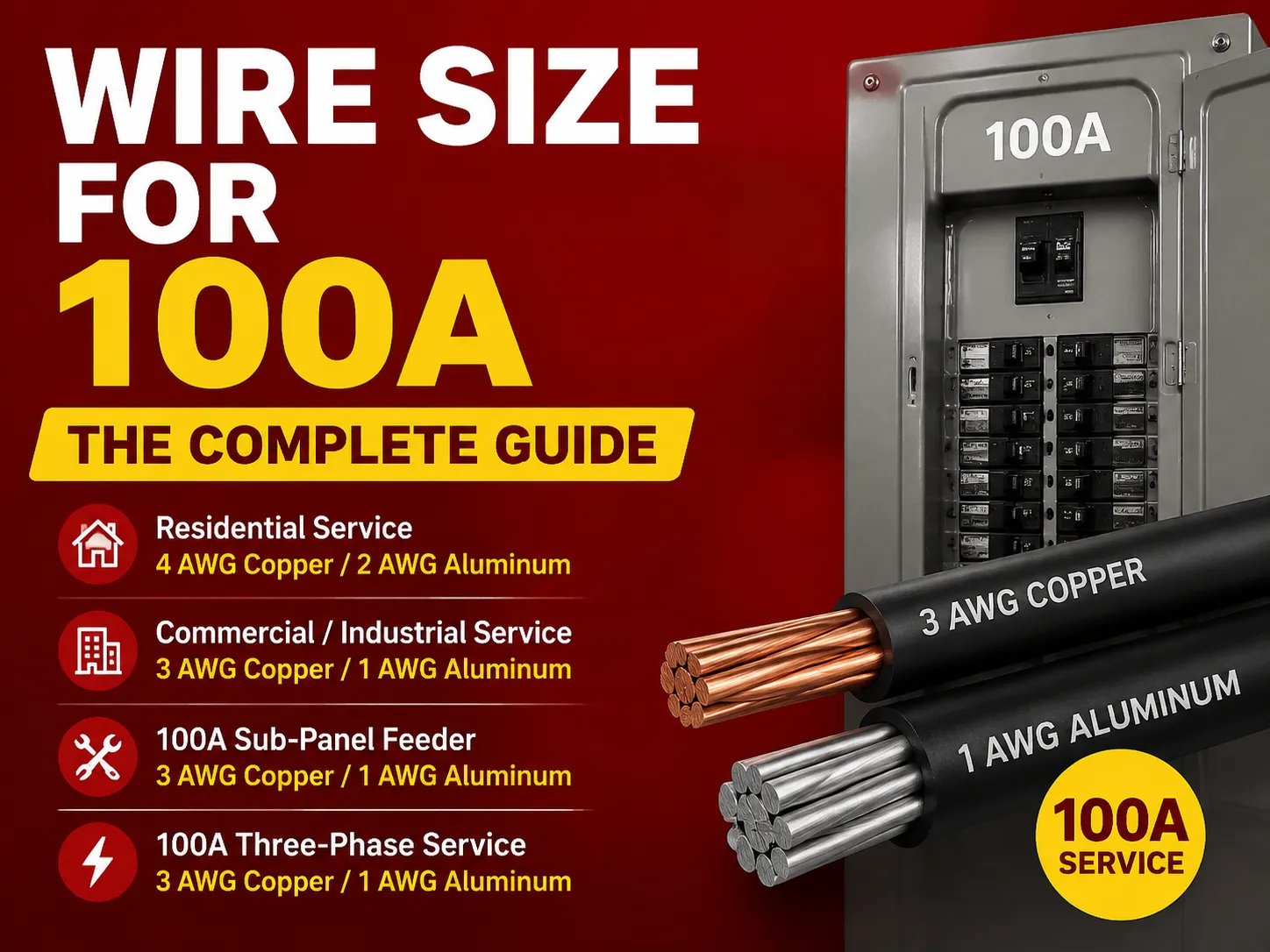
Aquí está la respuesta completa en una sola tabla. La fila que necesita depende del tipo de estructura y si es la entrada de servicio o alimentador.
| Escenario | Cobre | Aluminio | Base del código |
|---|---|---|---|
| Servicio de vivienda residencial (monofásico 120/240V, la mayoría de las casas) | 4 AWG | 2 AWG | NEC 310.12 (regla 83%) |
| Servicio comercial / industrial (monofásico o trifásico) | 3 AWG | 1 AWG | NEC 310.16 (capacidad total) |
| Alimentador de subpanel de 100A (garaje, taller, ADU) | 3 AWG | 1 AWG | NEC 310.16 (sin excepción para viviendas) |
| Servicio trifásico de 100A (cualquier ocupación) | 3 AWG | 1 AWG | NEC 310.16 (sin excepción para viviendas) |
Aquí hay tres aclaraciones a tener en cuenta:
- El 6 AWG no es adecuado para transportar una carga de 100A porque el cobre con 6 AWG solo puede transportar 65A a una temperatura de 75 grados Celsius. Por lo tanto, debe formar parte de un circuito de 50-60A.
- El cable de cobre 3 AWG es útil para transportar exactamente 100A a 75 grados Celsius.
- El cobre 2 AWG también funciona ya que tiene una capacidad de 115A a 75 grados, por lo que según NEC 240.4(B) puede ser cableado a un circuito que emplee un interruptor de 100A.
NEC 310.12 y la regla 83% (Servicios para viviendas)
NEC 310.12 permite que los conductores de servicio y alimentadores de toda la casa se dimensionen en 83% de la clasificación del servicio para una vivienda unifamiliar (o una unidad de vivienda individual) alimentada por un sistema monofásico 120/240V. La razón detrás de esta regla es el hecho de que las cargas en un hogar son diversificadas. De hecho, es imposible que todas las cargas eléctricas funcionen juntas. Por lo tanto, NEC permite usar tamaños de conductor más pequeños que los especificados en las tablas generales.
El cálculo para 100A es el siguiente: 100 x 0.83 = 83A de ampacidad requerida. Para verificar la ampacidad, necesitamos encontrar la clasificación de temperatura ‒ si estamos hablando de 75°C:
- Cobre 4 AWG (85A) → puede manejar 83A → es un tamaño estándar de cobre para servicios residenciales de 100A.
- Aluminio 2 AWG (90A) → puede manejar 83A → es un tamaño estándar de aluminio para servicios residenciales de 100A.
Esa es la razón por la que la gente dice “servicio de 100A equivale a cobre 4 AWG o aluminio 2 AWG” – la regla establece el hecho de que es un tamaño de calibre menor que el de las tablas generales. Sin embargo, no se aplica a
- Edificios comerciales, minoristas, oficinas, almacenes o de manufactura.
- Servicios trifásicos.
- Alimentadores a subpaneles ‒ utilizan la ampacidad completa según 310.16 incluso si se usan en la misma vivienda.
NEC 310.16: Ampacidad completa para comerciales y subpaneles
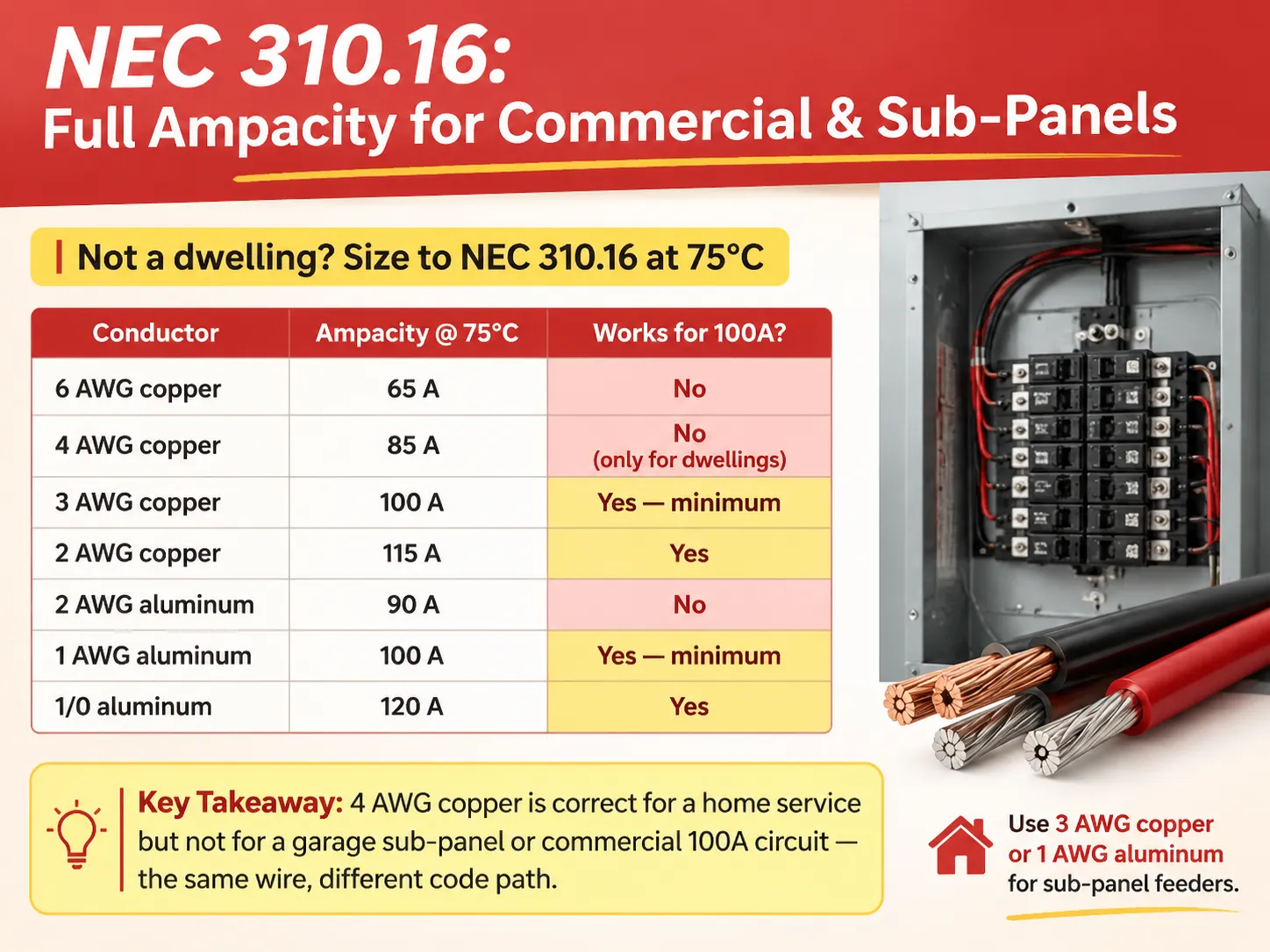
Cuando la excepción para viviendas no aplica, dimensionar según NEC 310.16 a 75°C (el estándar para terminaciones de equipo de servicio):
| Conductor | Capacidad de corriente @ 75°C | ¿Funciona para 100A? |
|---|---|---|
| Cobre 6 AWG | 65 A | No (circuito de 50-60A) |
| Cobre 4 AWG | 85 A | No bajo 310.16 (solo bajo 310.12 para viviendas) |
| Cobre 3 AWG | 100 A | Sí — mínimo |
| Cobre 2 AWG | 115 A | Sí (elección común para margen de seguridad) |
| Aluminio 2 AWG | 90 A | No bajo 310.16 (solo bajo 310.12) |
| Aluminio 1 AWG | 100 A | Sí — mínimo |
| Aluminio 1/0 | 120 A | Sí (margen extra) |
Resultado principal: Aunque el cobre 4 AWG es aceptable para servicio residencial, no funciona para un subpanel de garaje o cableado de circuito comercial de 100A — este cable puede ser aprobado pero no mediante el método estándar para alimentadores de subpanel. Aquí es donde surge la mayor confusión y por eso el estándar para cableado de alimentadores de subpanel es cobre 3 AWG o aluminio 1 AWG.
Cobre vs Aluminio: ¿Qué es diferente?
Ambos cumplen con el código; la elección depende de la economía más la disciplina de instalación:
| Factor | Cobre | Aluminio |
|---|---|---|
| Costo relativo | Base (costoso) | Aproximadamente 40-60% menos en este tamaño |
| Tamaño necesario para 100A (310.16) | 3 AWG | 1 AWG (dos tamaños más grande) |
| Peso | Más pesado | Aproximadamente 1/3 del peso — más fácil de jalar |
| Conductividad | Mayor | ~61% de la del cobre |
| Reglas de terminación | Estándar | Compuesto antioxidante, terminales con clasificación AL, torque correcto — obligatorio |
| Corrosión | Mínimas | Se oxida en las terminaciones si no se trata |
El aluminio es prácticamente el material más popular utilizado tanto para la entrada de servicio de 100A como para alimentadores largos. Su instalación también es conocimiento común entre los trabajadores eléctricos certificados. Hay tres elementos esenciales que deben usarse en todas las instalaciones de aluminio: un compuesto de unión antioxidante, terminales con clasificación AL/CU y una llave de torque según las recomendaciones del fabricante.
¿Qué significa el cable “2-2-2-4”?
Si está seleccionando un alimentador residencial de 100A, el cable se indica como “2-2-2-4” (esto podría aparecer como “2-2-2-4 SER” o “2-2-2-4 AL”). Esta notación desglosa los conductores en él: 2 conductores de 2 AWG son las 2 fases activas, y otro conductor de 4 AWG es el tipo neutro junto con un conductor de 4 AWG para el propósito de puesta a tierra.
- Dos conductores activos de 2 AWG + neutro de 2 AWG proporcionan el circuito de 120/240 voltios.
- 4 AWG es la tierra para el equipo.
- Dado que este es un cable tipo SER de aluminio, cumple con el requisito estándar residencial de 100A para instalaciones eléctricas según NEC 310.12 (2 AWG = 90A, más que suficiente salida de voltaje de 83A).
A la pregunta, “¿el cable 2-2-2-4 es suficiente para 100 amperios?” la respuesta es “sí” para servicio residencial y alimentador de 100A, donde aplicaría la regulación 83%. Sin embargo, no funcionaría para servicios comerciales a 100A que necesitarían cables de 1 AWG para las fases activas.
¿Puede un cable calibre 6 manejar 100 amperios?
El cable de cobre 6 AWG es apropiado para trabajos de 65A a 75°C (55A a 60°C), lo cual no es suficiente para un servicio de 100A ya que el sobrecalentamiento de este cable puede dañar el aislamiento y crear un riesgo serio de incendio. Es preferible usar este cable en circuitos de baja amperaje, hasta 50-60A. Para trabajos con cargas de 100A o más, se debe usar tamaños de cable de 3 AWG de cobre o 1 AWG de aluminio.
¿Es el cobre #3 bueno para 100 amperios?
De hecho. El cobre 3 AWG está clasificado para 100A a 75°C; siendo el mínimo exacto para un circuito general de 100A, servicio comercial o alimentador de subpanel bajo NEC 310.16. Muchos electricistas eligen cobre 2 AWG (115A) para mayor margen, reducción de capacidad o recorridos largos; lo cual es aceptable. Para servicio residencial solamente, cobre 4 AWG es suficiente. En resumen, cuando se pregunta si el cobre #3 es bueno para 100 amperios; este cable está correctamente clasificado.
Longitud de recorrido y caída de voltaje
La capacidad de corriente no es la única restricción — los recorridos largos pierden voltaje. Máximos recomendados para mantenerse dentro de una caída 3% a 240V:
| Conductor | Recorrido máximo aproximado en un solo sentido (caída 3%) |
|---|---|
| Cobre 3 AWG | ~147 pies |
| Cobre 2 AWG | ~185 pies |
| Cobre 1 AWG | ~234 pies |
| Aluminio 1 AWG | ~142 pies |
| Aluminio 1/0 | ~178 pies |
| Cobre 4 AWG (310.12 vivienda) | ~116 pies |
| Aluminio 2 AWG (310.12 vivienda) | ~112 pies |
Información general: la capacidad de corriente es adecuada para longitudes de hasta alrededor de 100 pies, considere aumentar un tamaño para longitudes de 100-150 pies, y para longitudes de alrededor de 150 pies y más, la capacidad de corriente necesitará al menos un tamaño mayor (por ejemplo, de cobre 3 AWG a 2 AWG o de aluminio 1 AWG a 1/0). En general, los recorridos largos en áreas rurales usualmente requieren más de un aumento de tamaño.
Dimensionamiento de conductores neutro y de puesta a tierra
Una instalación completa de 100A debe incluir conductores neutro y de puesta a tierra como sigue:
- Neutro: Determinado correctamente según la carga desequilibrada calculada (Tabla 220 del NEC), es equivalente a los conductores activos del circuito para un servicio de 100A en la mayoría de los casos, mientras que puede ser un tamaño menor si lo permiten los cálculos.
- Conductor de electrodo de puesta a tierra (GEC) – dimensionado según la tabla 250.66 del NEC – el GEC suele ser mínimo de cobre 8 AWG para conductores de servicio de cobre 4 AWG o aluminio 2 AWG; consulte la tabla para el tamaño adecuado del conductor.
- Puesta a tierra del equipo (subs): dimensionada según la tabla 250.122 del NEC – típicamente cobre 8 AWG o aluminio 6 AWG para alimentador de 100A.
- Electrodos de puesta a tierra: para un servicio de edificio conectado a tierra mediante dos varillas a una distancia adecuada entre sí (tabla 250.52 del NEC).
Es uno de los errores más comunes y manejables en el trabajo de servicio confundir las tablas 250.66 (GEC) y 250.122 (puesta a tierra del equipo) – seleccione la tabla correcta para el conductor adecuado.
Especificaciones para subpaneles: Garaje y taller independientes
La instalación de 100A a un garaje independiente, taller o ADU tiene códigos y regulaciones adicionales a considerar:
- Debe instalarse un alimentador de 4 conductores; esto incluye dos conductores activos desde el panel principal, un neutro y una puesta a tierra del equipo (NEC 250.32). Recuerde que la instalación de un alimentador de 3 conductores en un edificio independiente no es aceptable.
- El neutro debe estar aislado. Debe asegurarse de que la barra de neutro en el subpanel esté separada de la barra de tierra. El panel principal proporciona la conexión entre ambas.
- La puesta a tierra es necesaria para la nueva estructura. El edificio independiente debe tener su propio sistema de puesta a tierra (varillas de puesta a tierra típicas instaladas para su uso).
- El tipo de cable será típicamente aluminio SER 1 AWG o cobre 3 AWG en conducto para el alimentador de 100A; esto debe cumplir con la norma 310.16.
- Realice cálculos de carga – es esencial realizar cálculos de carga antes de comprar el cableado. Un ADU con calefacción eléctrica y una unidad de carga para vehículo eléctrico puede requerir 125A y no 100A.
Errores comunes en instalaciones de 100A
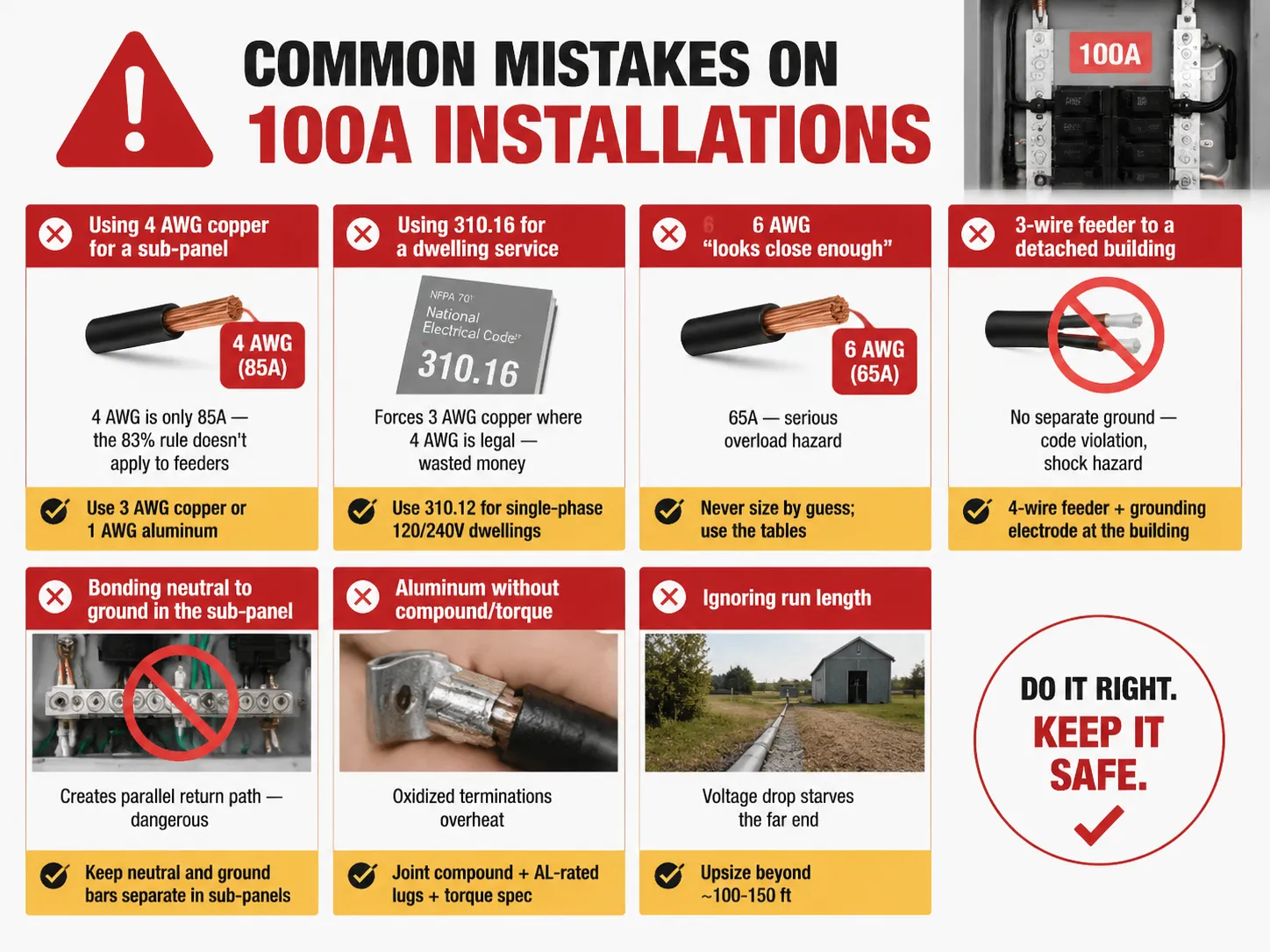
| Error | Por qué está mal | Enfoque correcto |
|---|---|---|
| Usar cobre 4 AWG para un subpanel | 4 AWG es solo 85A — la regla 83% no se aplica a alimentadores | Cobre 3 AWG o aluminio 1 AWG para alimentadores de 100A |
| Usar 310.16 para un servicio residencial | Obliga a usar cobre 3 AWG donde 4 AWG es legal — dinero desperdiciado | Use 310.12 para viviendas monofásicas 120/240V |
| 6 AWG “parece suficientemente cercano” | 65A — riesgo serio de sobrecarga | Nunca dimensione por suposición; use las tablas |
| Alimentador de 3 conductores a un edificio independiente | Sin tierra separada — violación del código, riesgo de choque eléctrico | Alimentador de 4 conductores + electrodo de puesta a tierra en el edificio |
| Unión del neutro a tierra en el subpanel | Crea un camino de retorno paralelo — peligroso | Mantener barras de neutro y tierra separadas en subpaneles |
| Aluminio sin compuesto/par de apriete | Terminaciones oxidadas se sobrecalientan | Compuesto para juntas + terminales calificadas para AL + especificación de torque |
| Ignorar la longitud de la carrera | Caída de voltaje priva al extremo lejano | Aumentar tamaño más allá de ~100-150 pies |
Consideraciones de costo y permiso
La actualización a un servicio de 100A o la instalación de un nuevo alimentador eléctrico tiene los siguientes costos:
- Los materiales incluyen: panel – $60-$200, interruptor principal de 100A – $30-$80, SER de aluminio 2-2-2-4 – $1.50-$3 por pie, cobre AWG 3 – $3-$6 por pie, base de medidor y hardware – $50-$150.
- Los trabajos costarán entre $800-$2,500 para una actualización de servicio y $500-$1,500 para un alimentador de subpanel, según la distancia y el acceso a través de paredes.
- El permiso e inspección normalmente cuestan $50-$300 y son obligatorios. Los inspectores verifican el tamaño del cable y la puesta a tierra y que la unión esté terminada.
- Se requiere coordinación con la compañía eléctrica ya que esta será propietaria del medidor y la conexión del servicio.
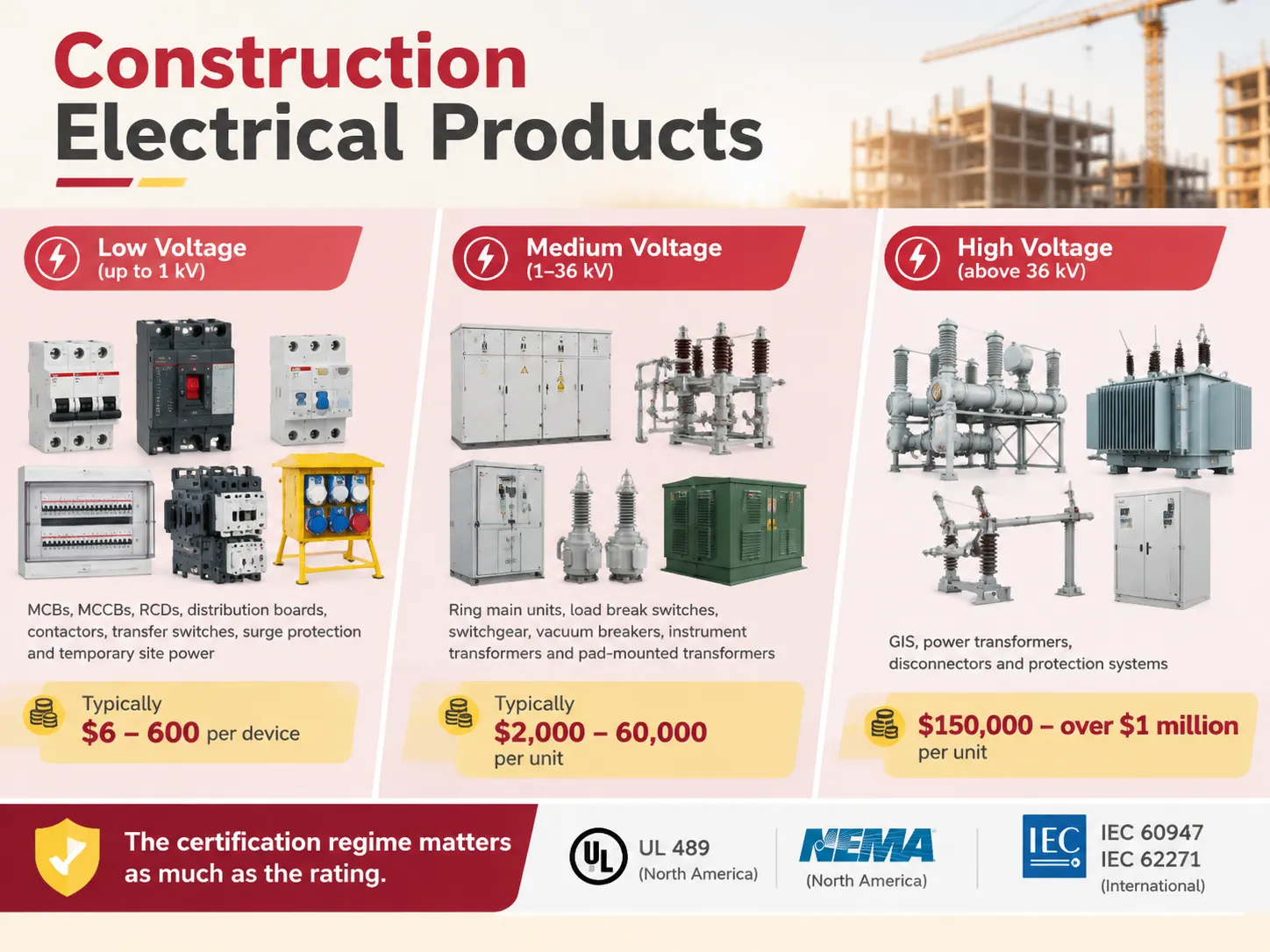
Cuando el proyecto también involucra tablero y interruptores, dispositivos de protección certificados coincidentes — y entender los tipos de interruptores involucrados, desde lo básico de MCBs y MCCBs de normas UL 489 para interruptores — mantiene toda la instalación conforme de principio a fin. Y una vez instalado el interruptor principal de 100A, cada circuito derivado detrás de él sigue la misma disciplina de dimensionamiento — los límites explicados para un circuito de 15 amperios en vatios se aplican en todos los niveles del panel.
Normas internacionales: una nota rápida
Fuera de Norteamérica, la determinación del cableado para 100A se realiza de manera diferente ya que la mayoría del mundo implementa métodos consistentes con las normas IEC/BS 7671 (método de corriente y factor de corrección) en lugar de usar una tabla simplificada de servicio.
- En el Reino Unido (BS 7671), los tamaños de cable se determinan según el método de instalación. Por ejemplo, una conexión monofásica de 100A generalmente requiere un cable de cobre entre 25 y 50mm² dependiendo de la longitud del cable.
- En Europa (IEC 60364), se utiliza el método directo.
- En Australia (AS/NZS 3000), se usan cálculos basados en el método para el aislamiento y a menudo resultan en el uso de cables de 25 a 35mm².
- En Canadá (CE Code), se usa un argumento similar al planteado por el NEC; las instalaciones pueden basarse en fórmulas similares a 83%.
El procedimiento del NEC se basa en reglas específicas para instalaciones en EE. UU. y/o Canadá; por lo tanto, si el lugar del trabajo es diferente a esos dos, sería prudente contratar a un ingeniero o electricista para realizar los cálculos.
Preguntas Frecuentes
¿Qué tamaño de cable necesitamos para un servicio de 100 amperios?
Según NEC 310.12 para sistemas residenciales con servicio de 100A (monofásico), se permite usar conductores de cobre 4 AWG o aluminio 2 AWG. Mientras que en sistemas comerciales con sistema trifásico o subpanel de 100A, se debe aplicar la ampacidad completa según NEC 310.16, lo que significa un mínimo de conductores de cobre 3 AWG o aluminio 1 AWG. En cuanto al tamaño para el GEC, debe usarse conductor de cobre 8 AWG según 250.66 junto con el aumento de tamaño para distancias mayores a 100-150 pies.
¿Es bueno el cobre #3 para 100 amperios?
De hecho, el cobre 3 AWG está clasificado precisamente para 100A a 75°C, es exactamente el mínimo requerido para un circuito regular de 100A, servicio comercial o alimentación de subpanel basado en NEC 310.16. Sin embargo, muchos electricistas usan cobre 2 AWG (115A) para proporcionar mayor margen debido a la reducción de capacidad. Para servicios domésticos solamente, se considera adecuado el cobre 4 AWG.
¿Es bueno el cable 2-2-2-4 para 100 amperios?
En efecto, para aplicaciones residenciales, el cable SER “2-2-2-4” (2 conductores calientes 2 AWG, conductor neutro 2 AWG y conductor de tierra 4 AWG) se considera el tipo estándar de aluminio para servicio residencial de 100A según NEC 310.12 (se debe notar que el conductor de aluminio 2 AWG está clasificado para 90A, lo cual es más que suficiente para los 83A requeridos). Pero para aplicaciones comerciales, se requiere conductor de aluminio 1 AWG o cobre 3 AWG para servicio comercial de 100A.
¿Soportará un cable calibre 6 100 amperios?
No. El cable de cobre 6 AWG tiene una clasificación de solo 65 amperios a 75°C (55 amperios a 60°C), lo que no es adecuado para 100 amperios. El cable se calentará, lo que permite riesgos muy altos de incendio. El cobre 6 AWG es apropiado para circuitos que llevan 50-60 amperios (por ejemplo, con estufas, hornos o subpaneles pequeños). Para 100A use ya sea cobre 3 AWG o aluminio 1 AWG (en general) o cobre 4 AWG o aluminio 2 AWG (para servicios residenciales).
Referencias
- NFPA 70 — Código Eléctrico Nacional (NEC): Artículos 230, 240, 250, 310
- Mike Holt — NEC 310.12 Regla 83% y Dimensionamiento de Conductores
- OSHA 1910.303 — Requisitos eléctricos generales
- EC&M Magazine — Artículos sobre Dimensionamiento de Servicio y Alimentadores
- IEC 60364 — Instalaciones eléctricas de baja tensión (Internacional)
- NEMA — Normas de Conductores y Cableado
Conclusión
El proceso para determinar los tamaños adecuados de cable para un servicio clasificado en 100 A depende de cómo responda a la pregunta: ¿aplica la regla 83% para viviendas? Según NEC 310.12, en aplicaciones residenciales, la práctica estándar de dimensionamiento de cables requiere el uso de cable de cobre 4 AWG o aluminio 2 AWG. En instalaciones comerciales, sistemas equipados con motores trifásicos y subpaneles de cien amperios, los tamaños de cable aplicables que cumplen con los requisitos del código respecto a su ampacidad corresponden ya sea con cable de cobre 3 AWG o aluminio 1 AWG; por lo tanto, en la práctica, se usa a menudo cable de cobre 2 AWG. Cuando el panel y los interruptores son parte del trabajo, entender los dispositivos de protección — como reconocer un interruptor defectuoso y la fijación práctica de precios en costo de reemplazo del interruptor — mantiene todo el proyecto seguro, legal y dentro del presupuesto.