
Que vous mettiez à niveau votre ancien service résidentiel de 60A à 100A, installiez une ligne d'alimentation vers un garage détaché, ou câbliez un nouvel atelier, la première question est toujours la même — quel type de câblage (cuivre ou aluminium) est nécessaire pour un service de 100 ampères ? La réponse repose sur deux codes différents qui s'appliquent, puisque un service résidentiel peut utiliser NEC 310.12 et donc nécessiter une ampacité 83% (cuivre 4 AWG ou aluminium 2 AWG), tandis qu'un service commercial signifie soit que vous avez besoin de cuivre 3 AWG (pour assurer l'ampacité complète) soit d'aluminium 1 AWG. Faites-le correctement et vous passez l'inspection ; faites-le mal et vous échouerez à l'inspection ou vous surchaufferez le fil le plus critique sur votre chantier. Le guide suivant vous fournira toutes les tailles de fils dont vous avez besoin, les codes qui les régissent, diverses calculs impliquant le cuivre et l'aluminium, ainsi que tous les détails sur le processus d'installation.
En résumé : Selon NEC 310.12 (la règle 83%), pour un service résidentiel monophasé 100A 120/240V, le minimum pour le cuivre est 4 AWG et pour l'aluminium 2 AWG. Pour un usage commercial, les services triphasés ou les alimentations de sous-panneaux 100A, les exigences complètes de NEC 310.16 s'appliquent pour l'ampacité : le minimum pour le cuivre est 3 AWG et pour l'aluminium 1 AWG. Le cuivre 2 AWG (115A) peut également convenir pour de nombreux circuits de 100A selon NEC 240.4(B). Le 6 AWG ne répond pas aux exigences car il est insuffisant (à 65A pour 75 °C). Ajustez la taille selon les valeurs de la colonne 75 °C, augmentez la taille pour toute distance supérieure à environ 100-150 pieds, et vérifiez auprès d'un inspecteur local ainsi que des services publics locaux pour votre projet.
La réponse directe : Taille du fil pour un service 100A
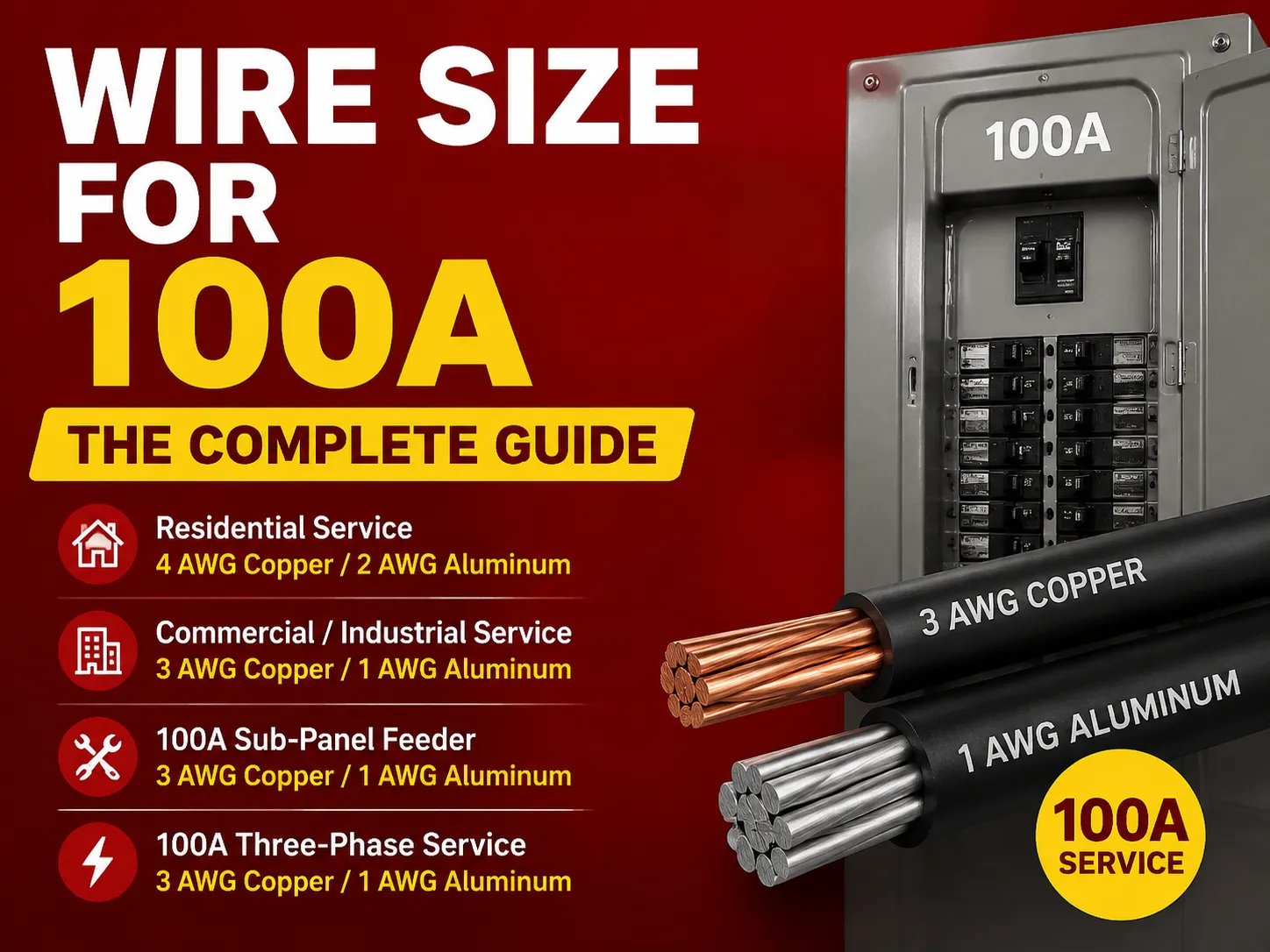
Voici la réponse complète dans un tableau unique. La ligne dont vous avez besoin dépend du type de structure et si c'est l'entrée de service ou l'alimentation.
| Scénario | Cuivre | Aluminium | Base du code |
|---|---|---|---|
| Service de logement résidentiel (monophasé 120/240V, la plupart des maisons) | 4 AWG | 2 AWG | NEC 310.12 (règle 83%) |
| Service commercial / industriel (monophasé ou triphasé) | 3 AWG | 1 AWG | NEC 310.16 (ampacité complète) |
| Alimentation de sous-panneau 100A (garage, atelier, ADU) | 3 AWG | 1 AWG | NEC 310.16 (pas d'exception pour logement) |
| Service triphasé 100A (toute occupation) | 3 AWG | 1 AWG | NEC 310.16 (pas d'exception pour logement) |
Voici trois clarifications à noter :
- Le 6 AWG n'est pas adapté pour supporter une charge de 100A car le cuivre 6 AWG ne peut supporter que 65A à une température de 75 degrés Celsius. Il devrait donc faire partie d'un circuit de 50-60A.
- Le fil cuivre 3 AWG est utile pour supporter exactement 100A à 75 degrés Celsius.
- Le cuivre 2 AWG fonctionne également puisqu'il a une capacité de 115A à 75 degrés, donc selon NEC 240.4(B) il peut être câblé sur un circuit utilisant un disjoncteur 100A.
NEC 310.12 & la règle 83% (Services de logement)
NEC 310.12 permet que les conducteurs de service et d'alimentation de toute la maison soient dimensionnés à 83% de la capacité nominale du service pour une habitation unifamiliale (ou une unité d'habitation individuelle) alimentée par un système monophasé 120/240V. La raison de cette règle est que les charges dans un foyer sont diversifiées. En effet, il est impossible que toutes les charges électriques fonctionnent simultanément. Par conséquent, NEC autorise l'utilisation de tailles de conducteurs plus petites que celles spécifiées dans les tableaux généraux.
Le calcul pour 100A est le suivant : 100 x 0,83 = 83A d’ampacité requise. Pour vérifier l’ampacité, nous devons trouver la température nominale ‒ si nous parlons de 75°C :
- 4 AWG cuivre (85A) → peut supporter 83A → c’est une taille standard de cuivre pour les services résidentiels de 100A.
- 2 AWG aluminium (90A) → peut supporter 83A → c’est une taille standard d’aluminium pour les services résidentiels de 100A.
C’est la raison pour laquelle on dit “ service 100A équivaut à 4 AWG cuivre ou 2 AWG aluminium ” – la règle indique qu’il s’agit d’une taille de calibre inférieure à celle des tableaux généraux. Cependant, cela ne s’applique pas à
- Bâtiments commerciaux, de détail, de bureaux, d’entrepôts ou de fabrication.
- Services triphasés.
- Alimenteurs vers sous-panneaux ‒ ils utilisent l’ampacité complète selon 310.16 même s’ils sont utilisés dans le même logement.
NEC 310.16 : Ampacité complète pour les panneaux commerciaux et sous-panneaux
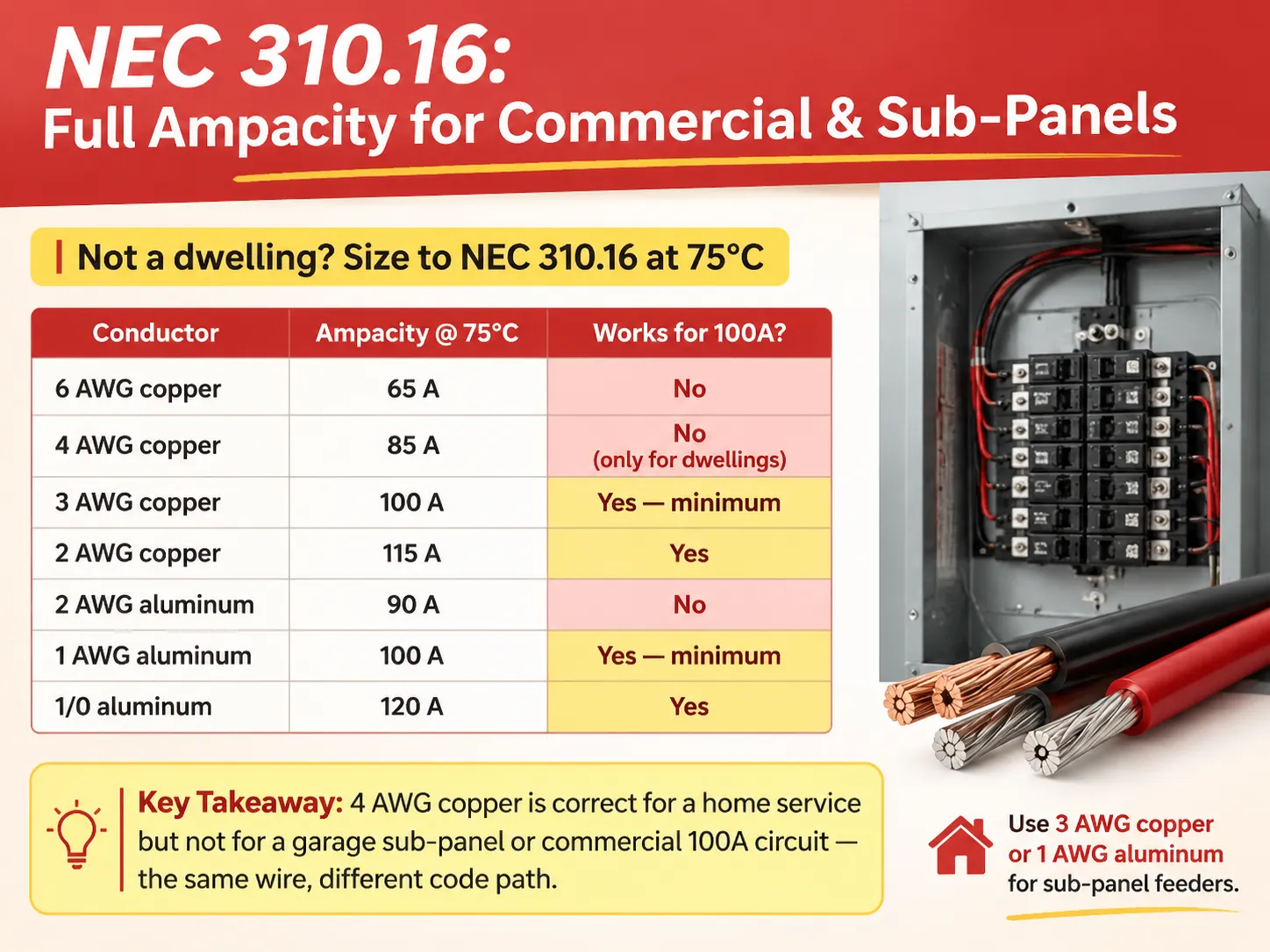
Lorsque l’exception pour le logement ne s’applique pas, dimensionnez selon NEC 310.16 à 75°C (la norme pour les terminaisons d’équipement de service) :
| Conducteur | Ampacité @ 75°C | Fonctionne pour 100A ? |
|---|---|---|
| 6 AWG cuivre | 65 A | Non (circuit 50-60A) |
| 4 AWG cuivre | 85 A | Non selon 310.16 (seulement selon 310.12 pour logements) |
| 3 AWG cuivre | 100 A | Oui — minimum |
| 2 AWG cuivre | 115 A | Oui (choix courant pour marge de sécurité) |
| 2 AWG aluminium | 90 A | Non selon 310.16 (seulement selon 310.12) |
| 1 AWG aluminium | 100 A | Oui — minimum |
| 1/0 aluminium | 120 A | Oui (marge supplémentaire) |
Résultat principal : Bien que le 4 AWG cuivre soit acceptable pour un service résidentiel, il ne convient pas pour un sous-panneau de garage ou un circuit commercial 100A — ce câble peut être approuvé mais pas via la méthode standard pour alimentateurs de sous-panneaux. C’est là que la plupart des confusions apparaissent et c’est pourquoi la norme pour le câblage cuivre des alimentateurs de sous-panneaux est 3 AWG cuivre ou 1 AWG aluminium.
Cuivre vs Aluminium : Quelles différences
Les deux sont conformes au code ; le choix dépend de l’économie et de la discipline d’installation :
| Facteur | Cuivre | Aluminium |
|---|---|---|
| Coût relatif | De base (cher) | Environ 40-60 % moins à cette taille |
| Taille nécessaire pour 100A (310.16) | 3 AWG | 1 AWG (deux tailles plus grand) |
| Poids | Plus lourd | Environ 1/3 du poids — plus facile à tirer |
| Conductivité | Plus élevé | ~61 % de celle du cuivre |
| Règles de terminaison | Norme | Composé anti-oxydant, cosses certifiées AL, couple de serrage correct — obligatoire |
| Corrosion | Minimes | Oxydation aux terminaisons si non traitée |
L'aluminium est pratiquement le matériau le plus utilisé à la fois pour l'entrée de service 100A et pour les longues alimentations. Son installation est également une connaissance courante parmi les électriciens certifiés. Trois éléments essentiels doivent être utilisés dans toutes les installations en aluminium : un composé de connexion anti-oxydant, des bornes avec certification AL/CU, et une clé dynamométrique selon les recommandations du fabricant.
Que signifie le câble “ 2-2-2-4 ” ?
Si vous choisissez un câble d'alimentation résidentiel 100A, le câble est noté “ 2-2-2-4 ” (cela peut apparaître sous la forme “ 2-2-2-4 SER ” ou “ 2-2-2-4 AL ”). Cette notation décompose les conducteurs : 2 conducteurs de 2 AWG sont les deux phases actives, un autre conducteur de 4 AWG est le neutre, ainsi qu’un conducteur de 4 AWG pour la mise à la terre.
- Deux conducteurs actifs de 2 AWG + un neutre de 2 AWG fournissent le circuit 120/240 volts.
- Le 4 AWG est la terre pour l’équipement.
- Puisqu’il s’agit d’un câble SER en aluminium, il répond à la norme résidentielle 100A des installations électriques selon NEC 310.12 (2 AWG = 90A, ce qui est largement suffisant avec une sortie de tension de 83A).
À la question “ le câble 2-2-2-4 suffit-il pour 100 ampères ? ”, la réponse est “ oui ” pour un service résidentiel et une alimentation 100A, où la réglementation 83% s’applique. Cependant, cela ne fonctionnerait pas pour des services commerciaux à 100A qui nécessiteraient des câbles 1 AWG pour les phases actives.
Un câble de calibre 6 supportera-t-il 100 ampères ?
Le câble cuivre 6 AWG est approprié pour 65A à 75°C (55A à 60°C), ce qui n’est pas suffisant pour un service 100A car la surchauffe de ce câble peut endommager l’isolation et créer un risque d’incendie sérieux. Il est préférable d’utiliser ce câble pour des circuits à faible intensité, jusqu’à 50-60A. Pour des charges de 100A ou plus, il faut utiliser des câbles de taille 3 AWG en cuivre ou 1 AWG en aluminium.
Le cuivre #3 est-il adapté pour 100 ampères ?
En effet. Le cuivre 3 AWG est classé pour 100A à 75°C ; ce qui en fait le minimum exact pour un circuit général 100A, un service commercial ou une alimentation de sous-panneau selon NEC 310.16. De nombreux électriciens choisissent le cuivre 2 AWG (115A) pour une marge de sécurité, une dégradation ou des longues distances ; ce qui est tout à fait acceptable. Pour un service résidentiel uniquement, le cuivre 4 AWG est suffisant. En résumé, lorsqu’on demande si le cuivre #3 est adapté pour 100 ampères, ce câble est effectivement correctement classé.
Longueur de course et chute de tension
L’ampacité n’est pas la seule contrainte — les longues distances entraînent une chute de tension. Les maximums recommandés pour rester dans une chute 3% à 240V :
| Conducteur | Course maximale approximative en aller simple (chute 3%) |
|---|---|
| 3 AWG cuivre | ~147 pieds |
| 2 AWG cuivre | ~185 pieds |
| Cuivre 1 AWG | ~234 pieds |
| 1 AWG aluminium | ~142 pieds |
| 1/0 aluminium | ~178 pieds |
| Cuivre 4 AWG (310.12 habitation) | ~116 pieds |
| Aluminium 2 AWG (310.12 habitation) | ~112 pieds |
Informations générales : l’ampacité est bonne pour des longueurs jusqu’à environ 100 ft, il est conseillé de passer à une taille supérieure entre 100 et 150 ft, et pour des longueurs d’environ 150 ft et plus, l’ampacité nécessitera au moins une taille supérieure (par exemple, de cuivre 3 AWG à 2 AWG ou d’aluminium 1 AWG à 1/0). En général, les longues distances en zones rurales nécessitent souvent plus d’une augmentation de taille.
Dimensionnement des conducteurs neutre et de mise à la terre
Une installation complète de 100A doit inclure des conducteurs neutres et de mise à la terre comme suit :
- Neutre : correctement déterminé selon la charge déséquilibrée calculée (tableau NEC 220), il est équivalent aux conducteurs actifs du circuit pour un service 100A dans la plupart des cas, tandis qu'une taille inférieure est permise si les calculs l'autorisent.
- Conducteur de l'électrode de mise à la terre (GEC) – dimensionné selon le tableau NEC 250.66 – le GEC est généralement en cuivre 8 AWG minimum pour des conducteurs de service en cuivre 4 AWG ou aluminium 2 AWG ; vérifiez le tableau pour la taille de fil appropriée.
- Mise à la terre de l'équipement (subs) : dimensionnée selon le tableau NEC 250.122 – typiquement cuivre 8 AWG ou aluminium 6 AWG pour un feeder 100A.
- Électrodes de mise à la terre : pour un service de bâtiment mis à la terre par deux tiges à une distance décente l'une de l'autre (tableau NEC 250.52).
C’est l’une des erreurs les plus courantes et gérables dans le travail de service de confondre les tableaux 250.66 (GEC) et 250.122 (mise à la terre de l’équipement) – choisissez le tableau correct pour le bon fil.
Spécificités du sous-panneau : garage détaché et atelier
Alimenter un garage détaché, un atelier ou une ADU en 100A implique des codes et règlements supplémentaires à considérer :
- Un feeder à 4 fils doit être installé ; cela inclut deux conducteurs actifs allant du panneau principal, un neutre et une mise à la terre de l’équipement (NEC 250.32). Rappelez-vous que l’installation d’un feeder à 3 fils dans un bâtiment détaché n’est pas acceptable.
- Le neutre doit être isolé. Vous devez vous assurer que la barre neutre dans le sous-panneau est séparée de la barre de terre. Le panneau principal assure la liaison entre ces deux.
- La mise à la terre est nécessaire pour la nouvelle structure. Le bâtiment détaché doit avoir son propre système de mise à la terre (tiges de mise à la terre typiques en place à utiliser).
- Le type de câble sera typiquement du SER aluminium 1 AWG ou cuivre 3 AWG dans le conduit pour le feeder 100A ; cela doit respecter la norme 310.16.
- Effectuez des calculs de charge – il est essentiel de réaliser des calculs de charge avant d’acheter le câblage. Une ADU avec chauffage électrique et une unité de recharge EV peut nécessiter 125A et non 100A.
Erreurs courantes sur les installations 100A
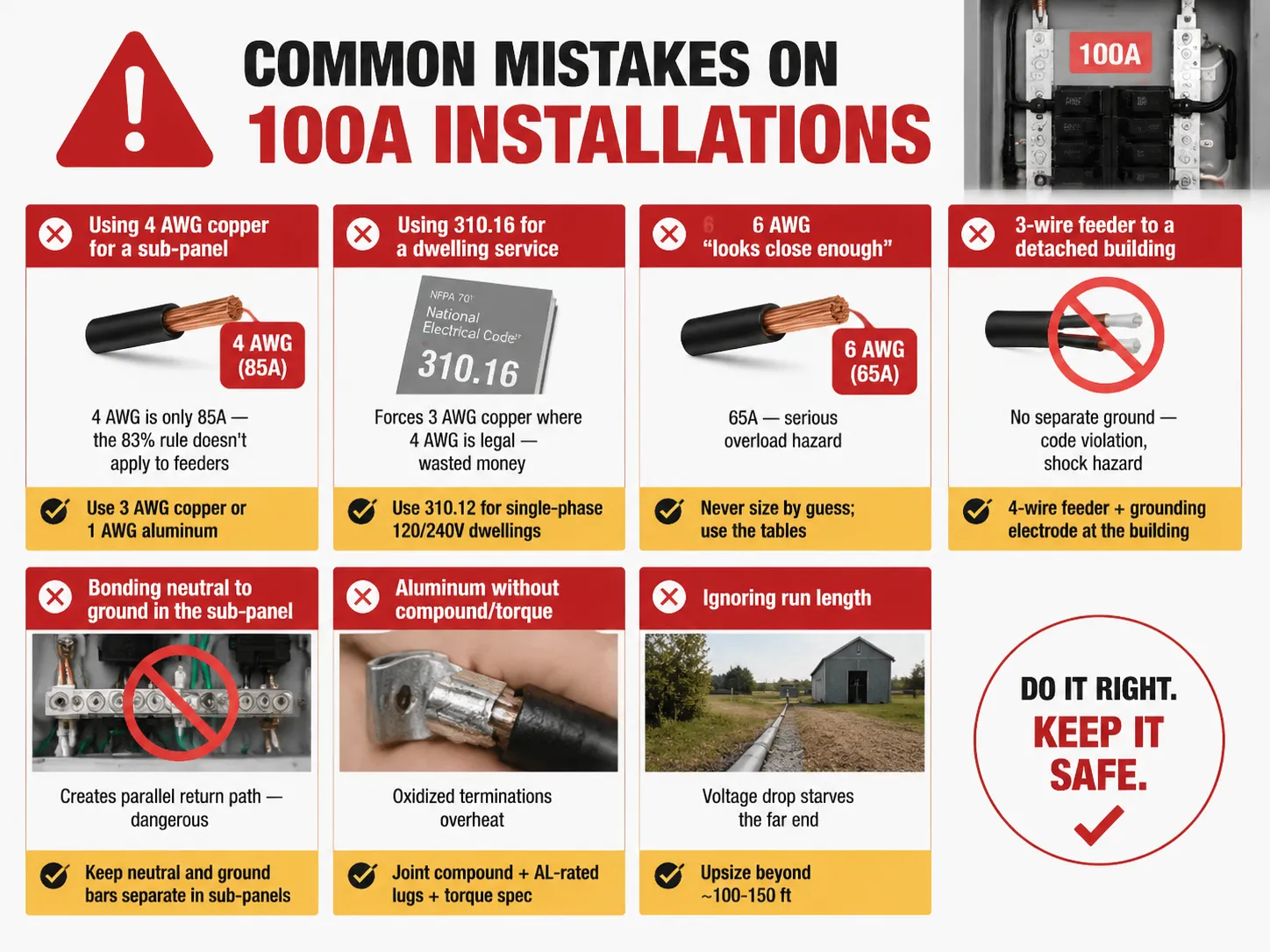
| Erreur | Pourquoi c’est incorrect | Approche correcte |
|---|---|---|
| Utilisation de cuivre 4 AWG pour un sous-panneau | 4 AWG ne supporte que 85A — la règle 83% ne s’applique pas aux feeders | Cuivre 3 AWG ou aluminium 1 AWG pour feeders 100A |
| Utilisation de 310.16 pour un service résidentiel | Imposer du cuivre 3 AWG alors que 4 AWG est légal — argent gaspillé | Utilisez 310.12 pour les habitations monophasées 120/240V |
| 6 AWG “ semble assez proche ” | 65A — risque sérieux de surcharge | Ne jamais dimensionner par approximation ; utilisez les tableaux |
| Feeder à 3 fils vers un bâtiment détaché | No separate ground — code violation, shock hazard | 4-wire feeder + grounding electrode at the building |
| Bonding neutral to ground in the sub-panel | Creates parallel return path — dangerous | Keep neutral and ground bars separate in sub-panels |
| Aluminum without compound/torque | Oxidized terminations overheat | Joint compound + AL-rated lugs + torque spec |
| Ignorer la longueur de course | Voltage drop starves the far end | Upsize beyond ~100-150 ft |
Considérations de coût et de permis
Upgrade to a 100A service or installation of a new electrical feeder has the following costs:
- Materials include: panel – $60-$200, 100A main breaker – $30-$80, 2-2-2-4 aluminum SER – $1.50-$3 per foot, 3 AWG copper – $3-$6 per foot, meter base and hardware – $50-$150.
- Jobs will run at $800-$2,500 for a service upgrade and $500-$1,500 for a sub-panel feeder, based on run distance and access through walls.
- The permit and inspection normally cost $50-$300 and are required. Inspectors check wire and grounding size and bonding to be finished.
- Utility coordination is needed as the utility will own the meter and service connection.
When the project also involves panelboard and breakers, matching certified protection devices — and understanding the breaker types involved, from the basics of MCBs and MCCBs de les normes UL 489 pour disjoncteurs — keeps the whole install compliant end to end. And once the 100A main is in, every branch circuit behind it follows the same sizing discipline — the limits explained for a 15-amp circuit’s wattage apply at every level of the panel.
Normes internationales : une brève note
Outside of North America, the determination of 100A wiring is done differently as most of the world implements methods consistent with IEC/BS 7671 standards (current and correction factor method) instead of using a simplified service table.
- In the UK (BS 7671), cable sizes are determined based on the installation method. For instance, a 100A single-phase connection usually requires a copper wire of between 25 and 50mm² depending on how long the cable is.
- In Europe (IEC 60364), the straightforward method is used.
- In Australia (AS/NZS 3000), method-based calculations are used for insulation and often result in use of 25 to 35mm² wires.
- In Canada (CE Code), a similar argument to that put forth by the NEC is used; installations may be based on 83%-like formulas.
The NEC procedure is based on rules pertaining specifically to the US and/or Canada installations; hence, if the location of the job is different from those two places it would be wise to hire an engineer or electrician to carry out the calculations.
Questions Fréquemment Posées
What size wire do we need for a 100 amp service?
According to NEC 310.12 for residential systems with 100A service (single phase), it is allowed to use 4 AWG copper or 2 AWG aluminum conductors. Whereas in commercial systems with three-phase or 100A sub-panel system, the full ampacity from the NEC 310.16 has to be applied, which means a minimum of 3 AWG copper or 1 AWG aluminum conductors. In terms of size for the GEC, 8 AWG copper conductor must be used as per 250.66 along with upsizing for distances of more than 100-150 feet.
Is #3 copper good for 100 amps?
Indeed – 3 AWG copper is rated precisely as 100A at 75°C, it is exactly the minimum required for 100A regular circuit, commercial service or sub-panel feeding based on NEC 310.16. However, a large number of electricians use 2 AWG copper (115A) instead to provide more headroom due to derating. For household services only, 4 AWG copper is considered okay.
Is 2-2-2-4 wire good for 100 amps?
Indeed, when it comes to residential applications, “2-2-2-4” SER cable (2 AWG hot wires, 2 AWG neutral wire, and 4 AWG ground wire) is considered as the standard aluminum type for 100A residential service as stated in NEC 310.12 (it should be noted that 2 AWG aluminum wire is rated at 90A, which is more than enough for the 83A needed). But when it comes to commercial applications, 1 AWG aluminum wire or 3 AWG copper wire needed for 100A commercial service is required.
Will 6 gauge wire handle 100 amps?
No. 6 AWG copper wire has a rating of just 65 amperes at a temperature of 75°C (55 amperes at 60°C), which is not suitable for 100 amperes. The wire will get hot, allowing for very high risks of fire. 6 AWG copper is appropriate for circuits carrying 50-60 amperes (for example with ranges, ovens, or small sub-panels). For 100A use either 3 AWG copper or 1 AWG aluminum wire (in general) or 4 AWG copper or 2 AWG aluminum wire (for dwelling services).
Références
- NFPA 70 — National Electrical Code (NEC): Articles 230, 240, 250, 310
- Mike Holt — NEC 310.12 83% Rule and Conductor Sizing
- OSHA 1910.303 — Exigences électriques générales
- EC&M Magazine — Service and Feeder Sizing Articles
- IEC 60364 — Installations électriques basse tension (International)
- NEMA — Conductor and Wiring Standards
Conclusion
The process of determining appropriate wire sizes for a service rated at 100 A depends on how you answer the question: does the 83% dwelling rule apply? According to NEC 310.12, in the case of residential applications, the standard wire sizing practice requires the use of 4 AWG copper wire or 2 AWG aluminum wire. In the case of commercial installations, systems equipped with three-phase motors, and hundred-amp sub-panels, the applicable wire sizes that comply with the code requirements concerning their ampacity correspond either with 3 AWG copper wire or with 1 AWG aluminum wire; therefore, in practice, 2 AWG copper wire is often used. When the panel and breakers are part of the job, understanding the protection devices — like recognizing a failing breaker and the practical pricing in breaker replacement cost — keeps the whole project safe, legal, and on budget.