
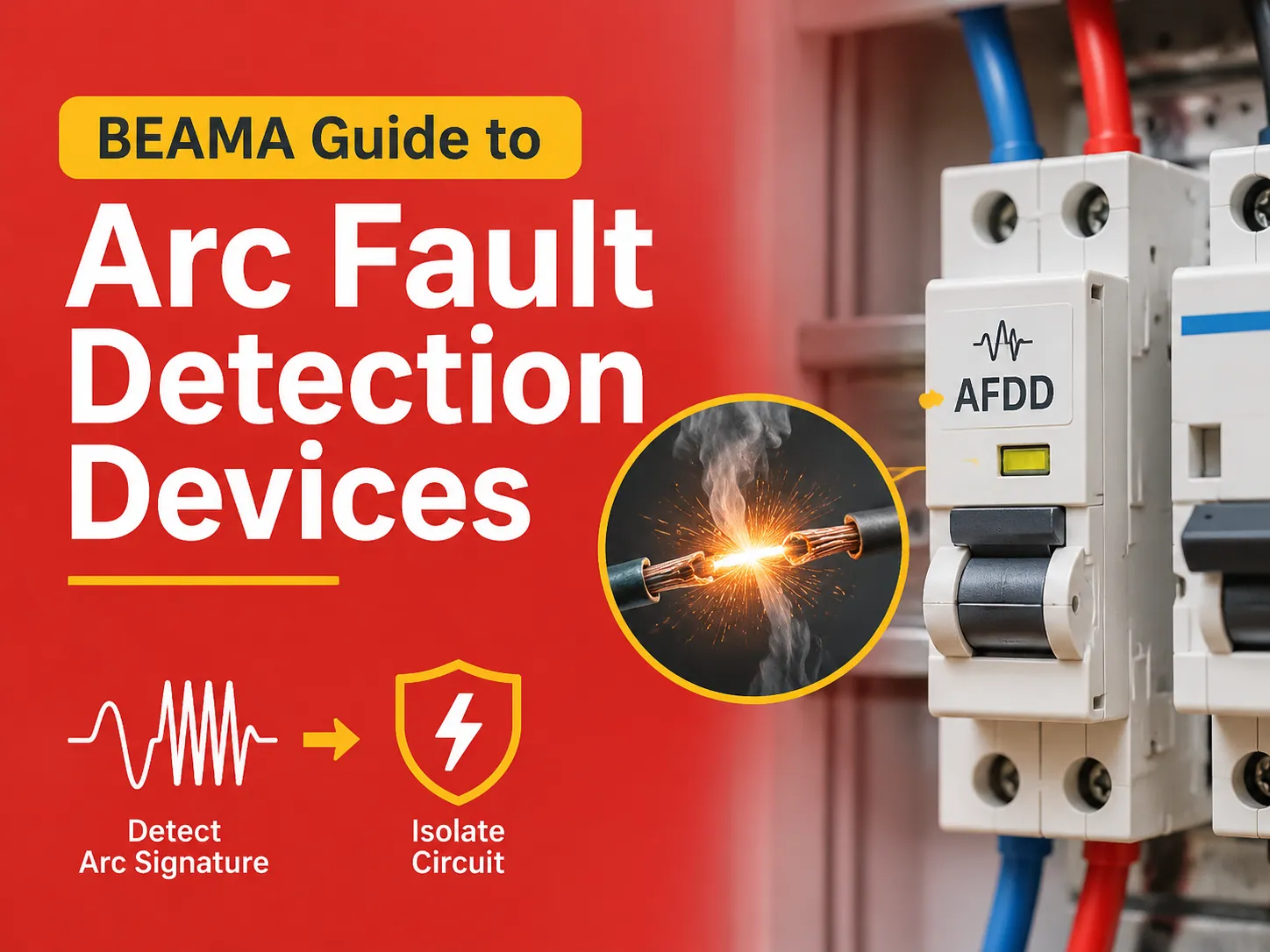
The function of an arc-fault detection device (AFDD) is to determine whether there is an arc produced by loose terminal connections, crimped cables and/or nails piercing through conductors. An arc can last for many months at a current too low to operate a circuit breaker or without a leakage to earth and the first indication of this type of fault is usually a fire.
Hızlı cevap: The AFDD monitors current and voltage waveforms to detect the high frequency signature of an arc and isolates (disconnects) the circuit automatically when it detects this type of fault. AFDDs shall be manufactured and tested according to the International Standard for arc fault detection devices (IEC 62606) and may be purchased either as a standalone device or combined with an RCD in one module. The typical price for an AFDD is between £30 to £120 (excluding installation).
The remaining sections of this document provide a comprehensive coverage of the guide and explain what is covered in the guide, what an AFDD can detect that other devices do not, how an AFDD detects, where Wiring Regulations require AFDDs, what form the devices are available in, comparisons of other similar devices, markings to check for conformity, costs, nuisance trips, how to choose either a stand-alone unit or a combined unit, and where you may find our devices in your local area, plus a checklist for commissioning and installing AFDDs.
What the BEAMA Guide Covers, and Why It Exists
The BEAMA guide was developed in response to the requirement under the forthcoming Amendment 2 to British Standard 7671 that AFDDs shall be fitted to socket circuits rated 32 A or less within high risk residential premises; the differences between AFDD, RCBO & RCCB and the AFCI in North America are not as easy to establish as many people presume they are when assessing catalogues.
The BEAMA guide was developed by the British Electrotechnical Manufacturers Association to address the issues associated with the introduction of the revised Wiring Regulations and the new AFDDs, which were being shipped by manufacturers and installed by contractors. On both sides, a common language was needed to facilitate communication. The guide explains:
- How AFDDs work and what they do
- How AFDDs are tested
- What are the applicable standards for AFDDs
- How to select and install an AFDD
The EMF (Electromagnetic Field) is a non-intuitive technology; therefore, a guide was developed rather than just a data sheet or catalog for AFDDs. For example, the purpose of a circuit breaker is to protect against overloads and short circuits, which is easy to understand visually.By contrast, the AFDD protects against a failure mode that doesn’t have any visible sign of damage until after a fire has occurred. The decision to install an AFDD is based on an assessment of risk rather than simple mathematical calculations.
The guide also provides a business rationale because AFDDs cost multiple times more than a miniature circuit breaker (MCB). An easier way to explain the risk avoidance associated with AFDDs versus MCBs is to use a published document from an industry organization as opposed to a manufacturer’s brochure when asking for justification for purchasing AFDDs.
What an AFDD Detects That Other Devices Cannot
An Arc Fault Detection Device (AFDD) detects arcing in a circuit due to the failure of a conductor in series with an electrical load. When a conductor fails, the arcs created between the broken ends maintain the flow of current through the circuit, albeit at a reduced level, and in some instances, the total amount of current flowing through the circuit remains below the thermal rating of the circuit breaker indefinitely. A loose terminal screw, a damaged extension cord or a cut wire during installation can all produce a similar pattern.
A parallel arc occurs when two wires form an arc that runs from line-to-neutral or line-to-ground and produces enough current to trip a breaker. The most dangerous version of this is high resistance between the two wires; the high impedance limits the current through the faults to a level a breaker can tolerate, but the arcing continues.
A residual current device will not see these arcs unless they leak to ground; this is why AFDDs fill the gap. They detect the arc itself and not the consequence of the arc (i.e. fire), that is why these devices are marketed as protection against electrical fires and not as protection against overloads or electric shocks.
The → The arc detector breaker works on the same principle and, explained from the installation side, distinguishes between series arcs and parallel arcs.
Inside the Device: Sensing, Processing and Tripping
The device continuously samples the current waveform using a small current transformer or a shunt. A micro-controller identifies features that can identify an arc including the high frequency content of the waveform, a sharp increase or decrease in current, characteristic ‘pause’ on every half cycle and the randomness of an arc detection signature.
The micro-controller then compares the extracted features to the current arc model defined at 230 Volts and 50 Hertz and against a database of patterns that should not cause tripping on the device. Within the second group lies a range of technical challenges presented by high frequency noise caused by common products – dimmers, brushed motors, switching power supplies and drills – which do not produce an electric arc.
As a result of the requirement, the device must employ a solenoid which opens the relay contacts after the defined trip time is satisfied. As with high-frequency noise, the trip time is not instantaneous because the device is discerning a pattern rather than measuring a level of voltage or current. The additional time provided allows the device to ignore a transient event but yet still allows it to retain the capacity to detect a real electric arc event.
Outlined in the IEC 62606 standard are the type of “test waveforms” the device must withstand and will not withstand, and it specifically prohibits the device from tripping due to the inrush current.
Where the Wiring Regulations Require AFDDs
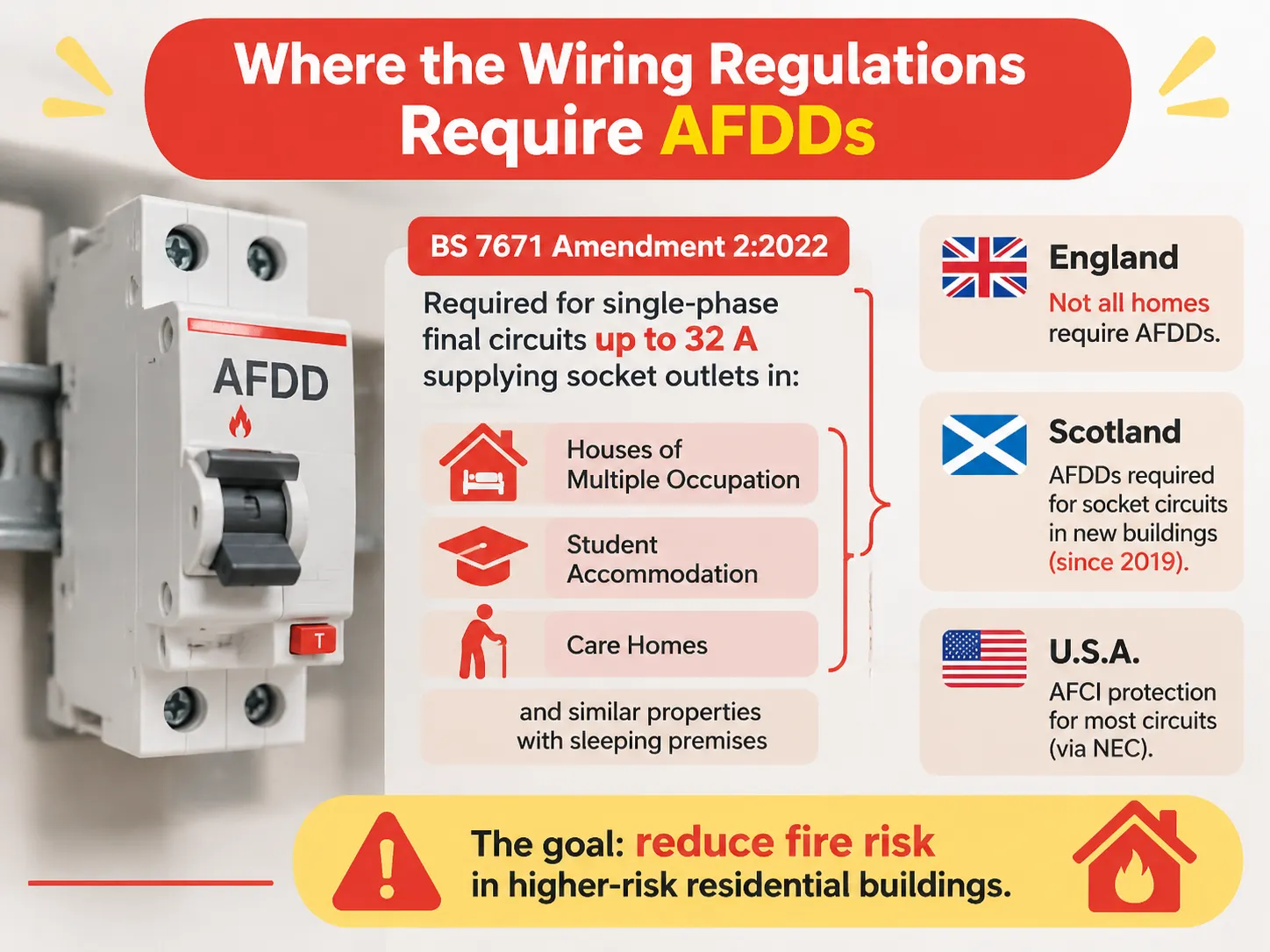
BS 7671 Amendment 2:2022 requires all single phase final circuits rated up to 32 A supplying socket outlets located within higher risk residential properties – houses of multiple occupation, student accommodation, care homes and similar properties having sleeping premises – to be equipped with AFDD. This requirement can be found within Regulation 421.1.7 and is applicable to all new installations and alterations, but not to every existing installation.
The scope is purposely limited and does not refer to “all dwellings” as many people think. There is no requirement in England for every house to be provided with AFDDs. In 2019, Scotland’s building standards mandated the use of AFDDs for socket circuits in new buildings. Therefore, the specifications for socket circuits in Glasgow and Manchester will differ.
Another country, the United States, uses an alternate approach to provide arc fault protection to all but a small number of branch circuits. It has used its National Electrical Code and its AFCI standard rather than IEC 62606 as a means of providing this protection. There are other European countries, such as Germany, which also have similar requirements for certain occupancy types. The underlying principle for all these countries is that the requirement for arc fault protection is based upon the degree of fire risk associated with habitable structures.
Types and Form Factor
The market area covers three types and as such, when choosing one type it will most typically be based on the amount of panel space that it will occupy rather than the level of protection that it will provide.
| Format | Genişlik | What it contains | Kullanıldığı yer |
|---|---|---|---|
| Standalone AFDD | 1 module | Arc detection with trip mechanism | Downstream of existing MCB or RCBO |
| AFDD + MCB | 2 modules | Arc detection with current protection | New circuits with no RCBOs |
| AFDD + RCBO | 2 modules | Arc detection, current protection and residual current | Most commonly used for socket circuits |
The most common format for specification is AFDD + RCBO as the last category covers all needs associated with socket circuits. In addition, using one device for both current and residual current protection saves both a terminal and a module.
In our range of products the combined format is the AFDD7LE device in the 1P+N configuration that is used for all single-phase final circuits.
An AFDD is specifically designed for the detection of arcs in a circuit, which can cause fires. Its function is to provide additional safety protection and prevent loss of life and property.
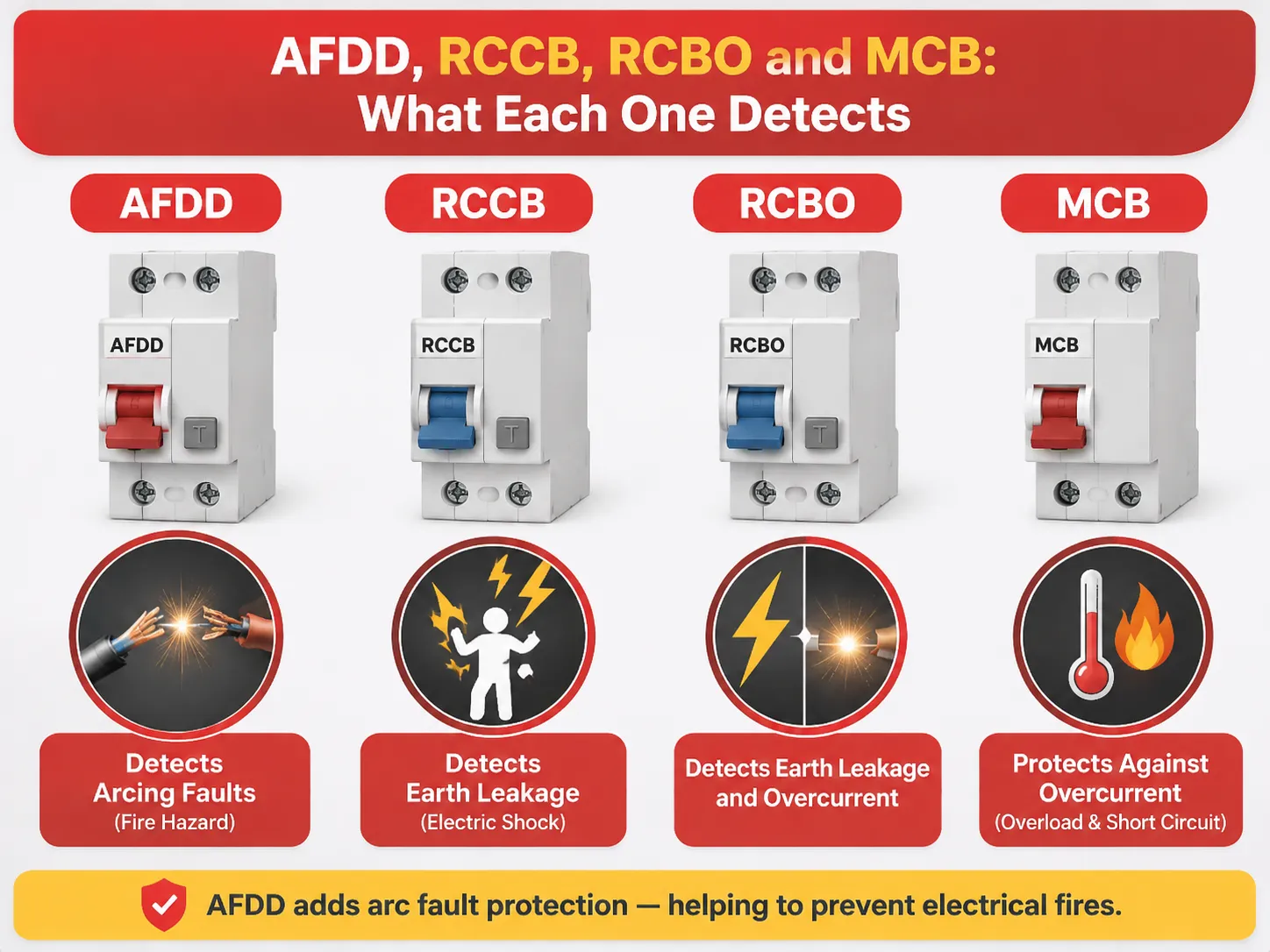
AFDD, RCCB, RCBO and MCB: What Each One Detects
The significance of an AFDD, as compared to an RCCB, is that both devices provide the same protection against electrocution or electrical shock; however, the way in which they operate and the conditions prompting a trip vary. The difference between an AFDD and an RCCB is the “signature” of an arc. The current waveform of an arc is distinctive, therefore the AFDD is able to detect that signature. In situations where the cable insulation is damaged and an arc exists in the cable, it may not leak to earth, thus the RCCB will not detect such an event.
AFDD, RCCB and MCB are the three devices to compare. The purpose for which each of these devices was designed was to protect a circuit from overcurrent – that is to say, protect the conductors against overloads and short circuits.
The MCB provides protection by tripping the circuit when the temperature of the conductor exceeds the temperature at which the insulation material becomes damaged. This is achieved by the MCB being equipped with a bimetallic strip that reacts to the heat generated by the overload to trip the device. The RCCB protects against electric shock and is connected to the earth with a residual current device (RCD). Once the RCCB detects that the current going out of the circuit differs from the current going back to the supply, it trips and disconnects the supply.
To recap,
- An AFDD is designed to provide additional protection to a circuit against potential fire hazards caused by arcing.
- An RCCB is designed to provide protection against electric shock by monitoring the difference in current between phases and earth connections.
- An MCB provides protection to conductors from overheating and short-circuiting.
AFDDs and RCBOs are two distinct types of devices, and therefore, the key difference between them is quite simple: there are no arc detection capabilities with an RCBO and an AFDD will only detect arcs if it is combined with an RCBO. You will find a further comparison between the two devices in an article regarding RCCBs versus RCBOs on the residual current side of things, and that article is especially relevant today as it highlights how many of the circuits that are used in homes today require both types of devices, so there is a debate on whether to purchase one device or two devices to fulfil the requirements.
Ratings and Markings to Check
Devices must meet six requirements to be deemed suitable. The standard, which is either IEC 62606 or the EN equivalent, should not be an endorsement, but rather, a specific number listed. The rated current for an AFDD will be typically between 6 A and 63 A; the rated voltage and frequency will typically be 230 V at 50 Hz (for the European market); and the rated conditional short circuit current is the fault current that will be applied to the device when using the type of upstream breaker specified.
If the AFDD is paired with an RCBO, it will typically detect a residual current of 30 mA for socket circuits. With an MCB, the AFDD will have more electronic components, and this means the terminal space will generally be less, which is important when using a 6 mm² cable.
The seventh requirement for an AFDD is not included on the device’s label. However, this information will appear on the certification document and will detail the testing done on the arc detection capability of the device. The test done to verify arc detection ability would be a type test to IEC 62606, not a routine test. A device that only has a routine test certificate and has not been proven to detect arcs cannot be relied upon to detect anything.
When considering the cost associated with AFDDs, it is commonly assumed that the installation will be more costly than the device itself, which leads to clients being surprised at the end of a quote.
What They Cost, and What the Installation Adds
An itemised breakdown of the costs associated with AFDDs is as follows:
| Madde | Tipik maliyet | Not |
|---|---|---|
| Standalone AFDD | £30 to £70 | Per module; will require an additional device to provide residual current protection |
| AFDD + MCB (2 modules) | £45 to £90 | The MCB does not provide residual current protection |
| AFDD + RCBO (2 modules) | £60 to £120 | The normal choice for circuits providing sockets |
| Board increase | £150 to £400 | Increasing board size or installing a new board |
| Tested and certified | £80 to £250 | A fixed price for each installation |
The issue with the costs associated with the board increase is that, when trying to install AFDDs protecting socket outlets from all ten circuits in a ten-way RCBO board, you will require the installation of a new board rather than the installation of ten additional devices; therefore, you will initially have a larger outlay than the device prices alone suggest.
The differential in price of devices when AFDDs are compared to RCBOs will be between £30 to £60 per board way for the next 20 years, allowing approximately a few £ a year for having AFDD protection against a deadly mode of failure, as described in the guide from BEAMA and the reason for the necessity for them.
What Is Nuisance Tripping, and What Causes It?
If an AFDD trips on a normal load, the AFDD has classified a waveform incorrectly, and there is a defined method of how this can occur; specifically, dimmers, when operated at a low wattage, produce a chopped waveform with a high frequency, which is similar to the waveform produced during an arc. Brush motors like the ones in power tools or vacuum cleaners typically generate continuous arcing from the brushes by design. Similar capabilities can be found within the output of poor filter quality on switching mode power supplies (SMPS).
While there are many possible explanations for nuisance tripping, older installations offer additional reasons. When the neutral for two circuits is shared, or if there was ever an intermittent ‘real’ arcing due to poor connection quality, or of damaged insulation in between the arcing cable, these types of faults exist and the device is justified in tripping, thus a nuisance trip must not be assumed as a fault with the device and must be explored further.
The diagnostic process employed will be the same as that used with an RCBO. To isolate your loads, you must first reset the device and connect them back one at a time. If a tripped device continues when a specific appliance is connected, then the appliance and/or its cord are at fault. If a tripped device continues without anything connected, then the wiring is at fault. If a tripped device continues only in wet weather conditions, then moisture penetration into the outdoor circuit must exist.
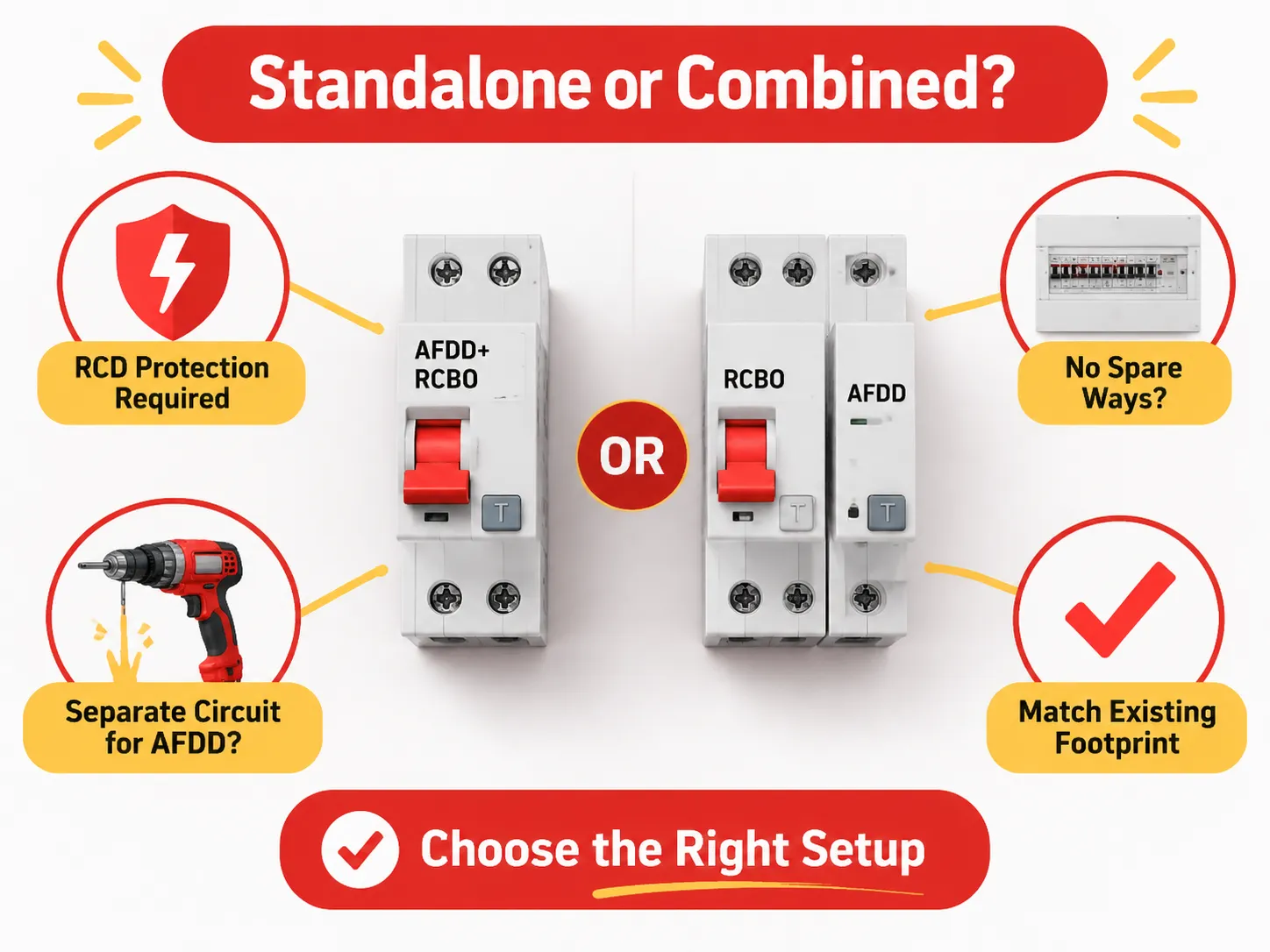
Choosing Between Standalone and Combined
Four different variables will determine whether to choose between standalone devices versus combined devices:
- A socket outlet circuit must provide residual current protection, either combined with an AFDD within a single unit or separate.
- An existing circuit that already possesses an RCBO, and now also needs an AFDD, must therefore have a stand-alone AFDD added.
- In a board containing zero spare ways, a new installation of whatever configuration must take place – therefore providing the specification of the board would be paramount versus the device.
- Because of the spark-like sounds produced in some applications (e.g., a woodworking shop with tools built with brushes) the load circuit may have to have an AFDD on a different circuit than where the tools are plugged in.
As such, AFDD’s use of the RCBO format on most current boards provides a reference for the combined device. The footprint and terminal arrangement of each type of AFDD matches as such; therefore, any project that standardises on the same footprint can add the arc protection without the need to redesign the board.
Where HUYU Fits into this Picture
We manufacture the AFDD in the combined 1 phase + Neutral format, with the MCB and RCBO in the same footprint. The construction of the AFDD complies with IEC 62606 for the function of detection of arc and IEC 61009-1 for the function of overcurrent and residual. The combination is what actually will provide a socket circuit in a home.
For a specification, we can supply the type test report for arc detection, the residual current test data, and the conditional short-circuit rating with the upstream device used in the test. These three documents are what a certifying body or inspector will require and what a low-cost AFDD typically cannot provide.
In terms of mini devre kesiciler, there are circuits throughout most buildings that do not require arc protection. The majority of circuits will not need an AFDD, and specifying an AFDD for every circuit means spending money where the potential risk does not warrant such an expense.
Checklist to Comply with Specifications
There are 5 items that are to be included when making a specification, to conform to IEC 62606. These include the formats of the device (combined or stand-alone), the rated current and residual current sensitivity if combined; the conditional short circuit rating (the upstream device that the combined device assumes is used); and type test evidence (evidence of testing) to be included with the order, not requested.
At the time of commissioning, 3 checks are required. These checks include the test button to verify the operation of the trip mechanism, however, not the operation of the arc detection mechanism; the residual current test (if a combined device) with an external tester, not the test button; and a load test with appliances that may be connected to the device, as it is better to discover if a dimmer switch or brushed motor will trip the device upon delivery rather than at 12:00 am.
The 4th check is documentation. A schedule is required for the installation to be maintainable. The schedule should indicate which devices are connected to which circuits and when the last test was performed. An AFDD is a safety device with a defined service life. A device that has never been tested is a device that cannot be vouched for.
Sıkça Sorulan Sorular
What Are Arc Fault Detection Devices?
They are devices designed to detect high-frequency signatures from electrical arcs generating heat to ignite surrounding combustibles in the vicinity of an electrical circuit and automatically isolate the electrical circuit from its electrical supply prior to combustion. They are specified to the IEC 62606 standards; they are available as individual components or as part of an RCBO; and they provide protection for an arc or failure mode that cannot be detected by either the trip or residual current device.
What Methods Are Used to Detect Arc Faults?
Arc faults are detected by periodically sampling the current flowing in the circuit and examining the characteristics of the sampled waveform for certain defined features based upon high-frequency contents, sudden changes in current patterns, the stop time between cycles and whether the sampled waveform exhibits randomness in its pattern. A microcontroller compares these characteristics to those of a) the arc detection system and b) the associated load that is not supposed to cause a trip.
What Is an AFCI?
The AFCI (Arc Fault Circuit Interrupter) is the equivalent of an AFDD as defined in the North American UL 1699 standard. An AFCI performs the same function as an AFDD, but is tested to a different standard and rated to operate at 120 Volts in North American branch circuits. Therefore, AFCIs and AFDDs may not be replaced with one another or by a device that complies with one of the two standards.
Which Rooms Need AFCI Protection?
In England, the BS 7671 amendment 2 requires the installation of AFDD protection on socket circuits of 32 A or less at greater risk of electrical shock, which occur generally in HMOs, student accommodation and care homes but do not need to be installed in each room of every house. In Scotland, new houses must have an AFDD fitted as part of the electrical installation. In the United States of America, the National Electrical Code requires that most dwelling branch circuits must be protected by AFCIs.
Is an AFDD Used Instead of an RCBO?
No. AFDDs are designed to detect arcs in the circuit and an RCBO detects overloads, shortages and earth leakage of current. Typically, socket circuits will require both devices, which is why a combination of an AFDD and an RCBO in a single module is most commonly used. Standalone AFDDs are generally installed on the load side of an RCBO.
Why Does My AFDD Keep Tripping?
AFDD tripping can be caused by a load that creates arc-like sounds; e.g. a dimmer switch on a low setting; a vacuum cleaner; or a power drill; or from an actual fault, such as a loose connection or damaged cable. You can isolate all loads and reconnect them one by one to determine which appliance is causing the trip. If the trip occurs when nothing is connected, the problem may lie with the wiring.
Referanslar
- Hager — AFDD Protection Devices and BS 7671 Guidance
- Siemens — AFDD Technology and Protective Devices
- Legrand — Arc Fault Protection in Residential Boards
- UL Solutions — Arc Fault and Residual Current Device Certification
- Electrical Engineering Portal — Arc Fault Detection and Protection Coordination
Sonuç
AFDDs are the only devices within a circuit board that detect the arc itself rather than the current produced by the arc. This is what enables AFDDs to detect a failing terminal connection that a circuit breaker would ignore, and which cannot be detected by an RCD. That is why the requirement was introduced into the regulations for buildings where persons sleep. The decision is based on the choice of format and proof. The combination of an AFDD and an RCBO can create a single module that protects a socket circuit, and the only proof that these detection devices work is the fulfillment of the type test to IEC 62606; everything else on the label is simply a rating, which is a much less rigorous process than testing for compliance with a standard.