
Cho dù bạn đang nâng cấp dịch vụ nhà ở cũ từ 60A lên 100A, lắp đặt đường cấp nguồn cho gara tách rời, hoặc đi dây cho một xưởng mới, câu hỏi đầu tiên luôn giống nhau — loại dây nào (đồng hay nhôm) tôi cần cho dịch vụ 100 amp? Câu trả lời dựa trên hai bộ quy chuẩn khác nhau áp dụng, vì dịch vụ nhà ở có thể sử dụng NEC 310.12 và do đó yêu cầu ampacity 83% (4 AWG đồng hoặc 2 AWG nhôm), trong khi dịch vụ thương mại có nghĩa là bạn cần 3 AWG đồng (để đảm bảo ampacity đầy đủ) hoặc 1 AWG nhôm. Làm đúng bạn sẽ vượt qua kiểm tra; làm sai bạn sẽ bị trượt kiểm tra hoặc làm quá nhiệt dây quan trọng nhất tại công trường xây dựng của bạn. Hướng dẫn sau sẽ cung cấp cho bạn tất cả các kích thước dây cần thiết, các quy chuẩn liên quan, các phép tính khác nhau liên quan đến dây đồng và nhôm, và chi tiết về quy trình lắp đặt.
Tóm lại: Theo NEC 310.12 (quy tắc 83%), đối với dịch vụ nhà ở 100A một pha 120/240V, kích thước tối thiểu cho đồng là 4 AWG và cho nhôm là 2 AWG. Đối với sử dụng thương mại, dịch vụ ba pha, hoặc feeder bảng phụ 100A, các yêu cầu của toàn bộ NEC 310.16 áp dụng cho ampacity: kích thước tối thiểu cho đồng là 3 AWG và cho nhôm là 1 AWG. 2 AWG đồng (115A) cũng có thể phù hợp cho nhiều mạch 100A theo NEC 240.4(B). 6 AWG không đáp ứng yêu cầu vì nó thấp hơn (65A ở 75 °C). Điều chỉnh kích thước theo giá trị trong cột 75 °C, tăng kích thước cho khoảng cách dài hơn ~100-150 ft, và kiểm tra lại với cả thanh tra địa phương và các tiện ích địa phương trong dự án của bạn.
Câu trả lời trực tiếp: Kích thước dây cho dịch vụ 100A
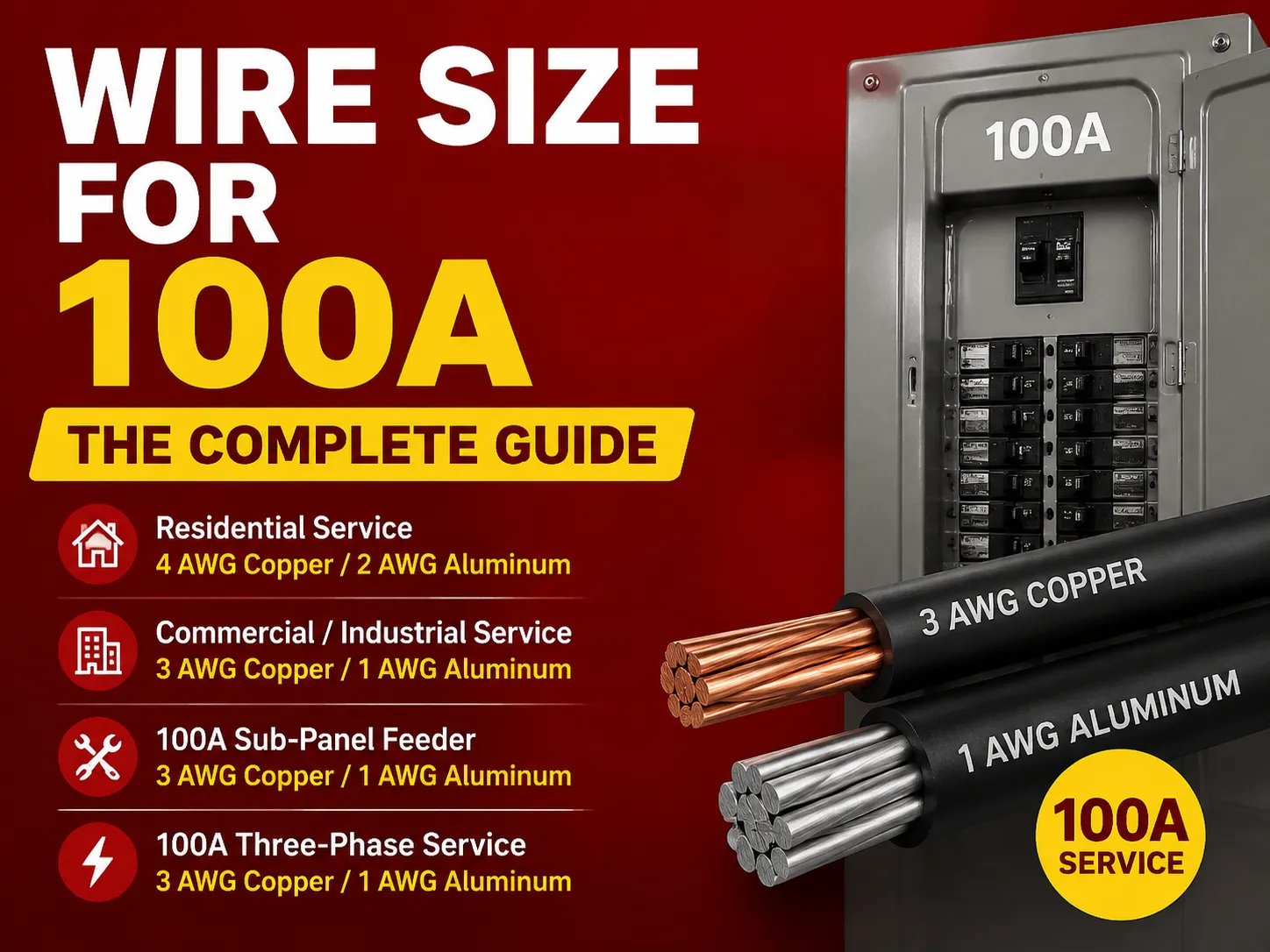
Đây là câu trả lời đầy đủ trong một bảng duy nhất. Hàng bạn cần phụ thuộc vào loại cấu trúc và đây là cửa dịch vụ hay feeder.
| Kịch bản | Đồng | Nhôm | Cơ sở mã |
|---|---|---|---|
| Dịch vụ nhà ở dân cư (đơn pha 120/240V, hầu hết các nhà) | 4 AWG | 2 AWG | NEC 310.12 (quy tắc 83%) |
| Dịch vụ thương mại / công nghiệp (đơn pha hoặc ba pha) | 3 AWG | 1 AWG | NEC 310.16 (đầy đủ công suất) |
| Feeder bảng phụ 100A (gara, xưởng, ADU) | 3 AWG | 1 AWG | NEC 310.16 (không ngoại lệ nhà ở) |
| Dịch vụ ba pha 100A (bất kỳ loại sử dụng nào) | 3 AWG | 1 AWG | NEC 310.16 (không ngoại lệ nhà ở) |
Dưới đây là ba điểm làm rõ cần lưu ý:
- 6 AWG không phù hợp để mang tải 100A vì đồng 6 AWG chỉ có thể mang 65A ở nhiệt độ 75 độ C. Do đó nó nên là một phần của mạch 50-60A.
- Dây đồng 3 AWG hữu ích để mang chính xác 100A ở 75 độ C.
- Dây đồng 2 AWG cũng phù hợp vì nó có công suất 115A ở 75 độ, nên theo NEC 240.4(B) có thể đi dây cho mạch sử dụng cầu dao 100A.
NEC 310.12 & Quy tắc 83% (Dịch vụ nhà ở)
NEC 310.12 cho phép dây dẫn dịch vụ và feeder toàn bộ nhà được định kích thước ở 83% của định mức dịch vụ cho nhà ở một gia đình (hoặc đơn vị nhà ở riêng biệt) được cấp nguồn bởi hệ thống một pha 120/240V. Lý do đằng sau quy tắc này là thực tế rằng tải trong một hộ gia đình là đa dạng. Thật vậy, không thể tất cả các tải điện hoạt động cùng lúc. Do đó, NEC cho phép sử dụng kích thước dây nhỏ hơn so với các bảng chung quy định.
Việc tính toán cho 100A như sau: 100 x 0.83 = 83A ampacity cần thiết. Để kiểm tra ampacity, chúng ta cần tìm xếp hạng nhiệt độ ‒ nếu chúng ta đang nói về 75°C:
- 4 AWG đồng (85A) → có thể chịu được 83A → đây là kích thước đồng tiêu chuẩn cho dịch vụ nhà ở 100A.
- 2 AWG nhôm (90A) → có thể chịu được 83A → đây là kích thước nhôm tiêu chuẩn cho dịch vụ nhà ở 100A.
Đó là lý do tại sao người ta nói “dịch vụ 100A tương đương 4 AWG đồng hoặc 2 AWG nhôm” – quy tắc này cho biết thực tế rằng nó nhỏ hơn một kích thước so với bảng chung. Tuy nhiên, nó không áp dụng cho
- Các tòa nhà thương mại, bán lẻ, văn phòng, kho hàng hoặc sản xuất.
- Dịch vụ ba pha.
- Dây dẫn cấp cho các bảng phụ ‒ chúng sử dụng ampacity đầy đủ theo 310.16 ngay cả khi sử dụng trong cùng một hộ gia đình.
NEC 310.16: Ampacity đầy đủ cho thương mại & bảng phụ
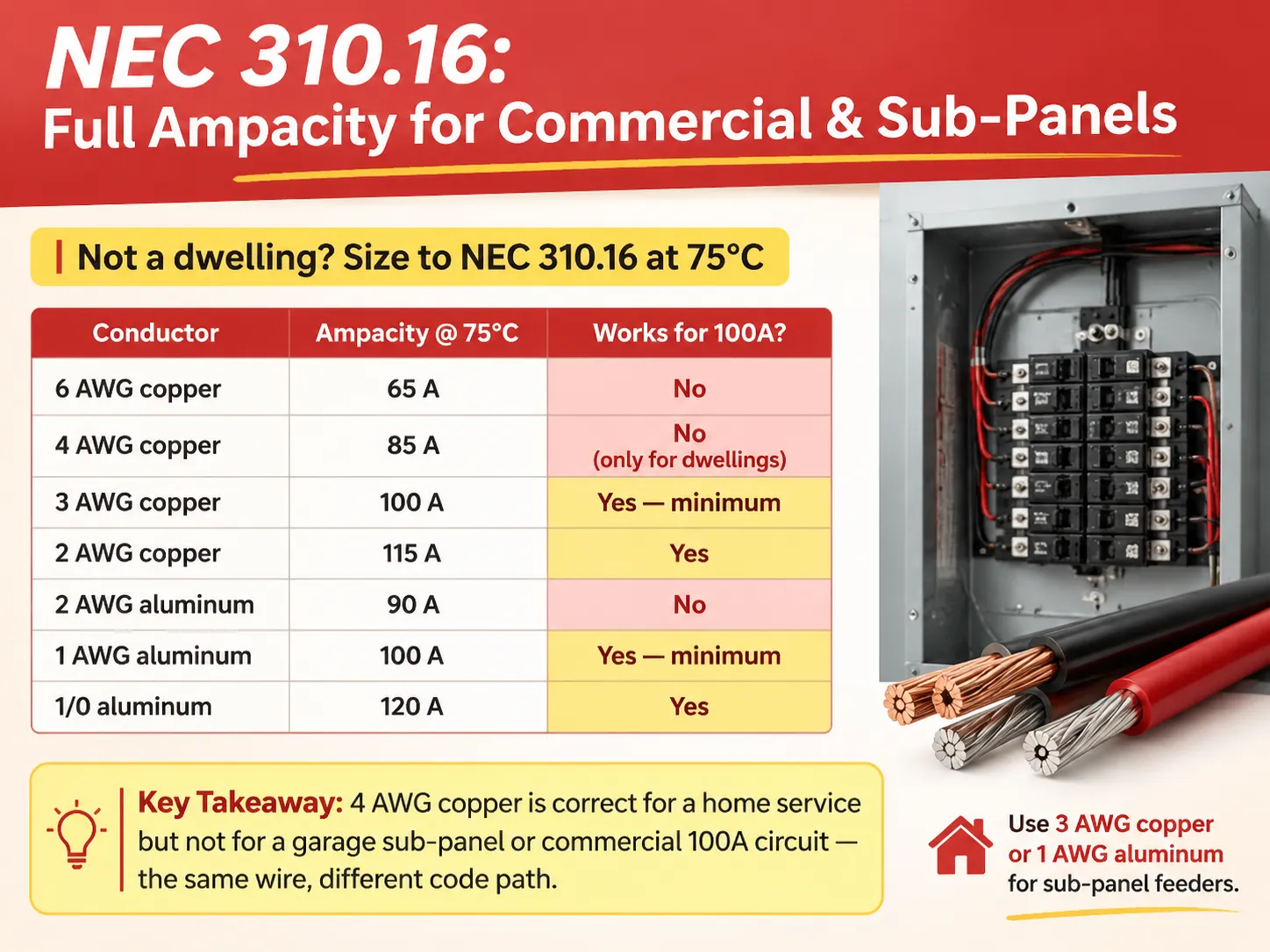
Khi ngoại lệ cho nhà ở không áp dụng, kích thước theo NEC 310.16 ở 75°C (tiêu chuẩn cho đầu nối thiết bị dịch vụ):
| Dây dẫn | Dòng điện định mức @ 75°C | Có phù hợp cho 100A không? |
|---|---|---|
| 6 AWG đồng | 65 A | Không (mạch 50-60A) |
| 4 AWG đồng | 85 A | Không theo 310.16 (chỉ theo 310.12 cho nhà ở) |
| 3 AWG đồng | 100 A | Có — tối thiểu |
| 2 AWG đồng | 115 A | Có (lựa chọn phổ biến để dự phòng) |
| 2 AWG nhôm | 90 A | Không theo 310.16 (chỉ theo 310.12) |
| 1 AWG nhôm | 100 A | Có — tối thiểu |
| 1/0 nhôm | 120 A | Có (dư margin) |
Kết quả chính: Mặc dù 4 AWG đồng được chấp nhận cho dịch vụ nhà ở, nó không phù hợp cho bảng phụ gara hoặc dây mạch 100A thương mại — dây này có thể được phê duyệt nhưng không theo phương pháp tiêu chuẩn cho dây dẫn bảng phụ. Đây là nguồn gốc của hầu hết sự nhầm lẫn và đó là lý do tiêu chuẩn cho dây dẫn bảng phụ bằng đồng là 3 AWG đồng hoặc 1 AWG nhôm.
Đồng vs Nhôm: Sự khác biệt là gì
Cả hai đều tuân thủ mã; lựa chọn dựa trên kinh tế và kỷ luật lắp đặt:
| Yếu tố | Đồng | Nhôm |
|---|---|---|
| Chi phí tương đối | Cơ bản (đắt) | Khoảng 40-60% nhẹ hơn ở kích thước này |
| Kích thước cần cho 100A (310.16) | 3 AWG | 1 AWG (lớn hơn hai kích thước) |
| Trọng lượng | Nặng hơn | Khoảng 1/3 trọng lượng — dễ kéo hơn |
| Độ dẫn điện | Cao hơn | ~61% của đồng |
| Termination rules | Tiêu chuẩn | Anti-oxidant compound, AL-rated lugs, correct torque — mandatory |
| Corrosion | Tối thiểu | Oxidizes at terminations if untreated |
Aluminum is practically the most popular material used for both the 100A service entrance as well as for long feeders. Its installation is also common knowledge among certified electrical workers. There are three essentials that have to be used in all aluminum installations: an anti-oxidant joint connecting compound, terminals with AL/CU rating, and a torque wrench according to the manufacturer’s recommendations.
What Does “2-2-2-4” Wire Mean?
If you are picking a residential 100A feeder, the cable is noted to be “2-2-2-4” (this might appear as “2-2-2-4 SER” or “2-2-2-4 AL”). This notation breaks down the conductors in it: 2 conductors of 2 AWG are the 2 hot legs, and another 4 AWG is the neutral type of conductor along with one conductor of 4 AWG for grounding purpose.
- Two 2 AWG hots + 2 AWG neutral provide the 120/240 volt circuit.
- 4 AWG is the ground for the equipment.
- Since this is aluminium type of SER cable, it fulfills the standard 100A residential requirement of electrical installations per NEC 310.12 (2 AWG = 90A, more than enough voltage output of 83A).
To the question, “does 2-2-2-4 wire suffice for 100 amps?” the answer is “yes” for residential service and 100A feeder, where the 83% regulation would apply. However, it wouldn’t work for commercial services at 100A that would be needing 1 AWG cables for the hots.
Will 6 Gauge Wire Handle 100 Amps?
6 AWG copper wire is appropriate for 65A at 75°C (55A at 60°C) jobs which is not sufficient for a 100A service since this wire overheating can damage the insulation and create a serious fire risk. It is preferable to use this wire in low amperage circuits, up to 50-60A. For jobs with 100A or more workloads one has to use wire sizes of 3 AWG of copper or 1 AWG of aluminum.
Is #3 Copper Good for 100 Amps?
Indeed. 3 AWG copper is rated for 100A at 75°C; making it the exact minimum for a 100A general circuit, commercial service, or sub-panel feeder under NEC 310.16. Many electricians choose 2 AWG copper (115A) for ample room, derating, or long runs; which is indeed acceptable. For residential service only, 4 AWG copper is sufficient. In a nutshell, when asked is #3 copper good for 100 amps; this wire is indeed rated properly.
Run Length & Voltage Drop
Ampacity isn’t the only constraint — long runs lose voltage. Recommended maximums to stay within a 3% drop at 240V:
| Dây dẫn | Chiều dài chạy tối đa một chiều xấp xỉ (sụt áp 3%) |
|---|---|
| 3 AWG đồng | ~147 ft |
| 2 AWG đồng | ~185 ft |
| Đồng 1 AWG | ~234 ft |
| 1 AWG nhôm | ~142 ft |
| 1/0 nhôm | ~178 ft |
| 4 AWG copper (310.12 dwelling) | ~116 ft |
| 2 AWG aluminum (310.12 dwelling) | ~112 ft |
General information: ampacity is good for lengths up to around 100 ft, consider going one size up from 100-150 ft, and for lengths of around 150 ft and beyond, ampacity will need at least one size up (for example, from 3 AWG copper to 2 AWG or from 1 AWG aluminum to 1/0). In general, long runs in rural areas usually need more than one size increase.
Neutral & Grounding Conductor Sizing
A full installation of 100A must include neutral and grounding conductors as follows:
- Neutral: Correctly determined as per the calculated unbalanced loading (NEC Table 220), it is equivalent to the circuit hots for a 100A service in most cases, whereas one size lower in case allowed by the calculations.
- Grounding electrode conductor (GEC) – sized as per NEC table 250.66 – GEC is usually 8AWG copper minimum for 4AWG copper or 2 AWG aluminum service conductors; check the table for your proper wire size.
- Equipment ground (subs): sized as per NEC table 250.122 – typically 8 AWG copper or 6 AWG aluminum for 100A feeder.
- Grounding electrodes: for a building service grounded by two rods at decent distance from one another (NEC table 250.52).
It is one of the most common manageable mistakes in the service work to confuse tables 250.66 (GEC) and 250.122 (equipment ground) – pick the correct table for the right wire.
Sub-Panel Specifics: Detached Garage & Workshop
Running 100A to a detached garage, workshop, or ADU has additional codes and regulations to consider:
- A 4-wire feeder must be installed; this includes two hots going from the main panel, one neutral, and an equipment ground (NEC 250.32). Remember that the installation of a 3-wire feeder in a detached building is not acceptable.
- The neutral must be isolated. You must ensure that the neutral bar in the sub-panel is separately placed from the ground bar. The main panel provides the bonding of these two.
- Grounding is necessary for the new structure. The detached building should have its own grounding system (typical grounding rods in place to be used).
- The cable type will typically be 1 AWG SER aluminum or 3 AWG copper in the conduit for the 100A feeder; this has to adhere to 310.16.
- Make load calculations – it’s essential to perform load calculations before purchasing the wiring. An ADU with electric heats and an EV charging unit may require 125A and not 100A.
Common Mistakes on 100A Installations
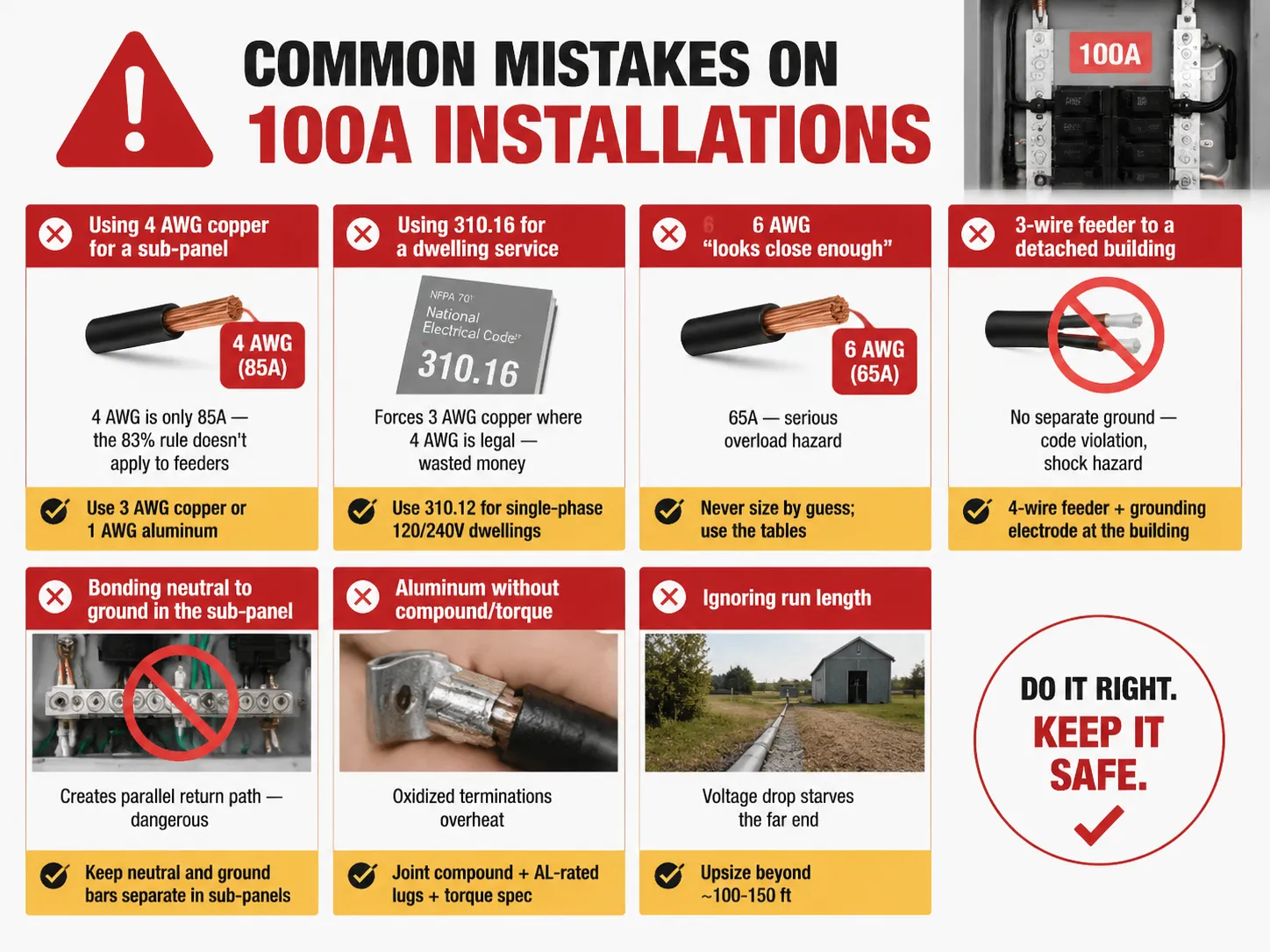
| Sai lầm | Tại sao sai | Cách tiếp cận đúng |
|---|---|---|
| Using 4 AWG copper for a sub-panel | 4 AWG is only 85A — the 83% rule doesn’t apply to feeders | 3 AWG copper or 1 AWG aluminum for 100A feeders |
| Sử dụng 310.16 cho dịch vụ nhà ở | Forces 3 AWG copper where 4 AWG is legal — wasted money | Sử dụng 310.12 cho nhà ở đơn pha 120/240V |
| 6 AWG “looks close enough” | 65A — serious overload hazard | Never size by guess; use the tables |
| 3-wire feeder to a detached building | No separate ground — code violation, shock hazard | 4-wire feeder + grounding electrode at the building |
| Bonding neutral to ground in the sub-panel | Creates parallel return path — dangerous | Keep neutral and ground bars separate in sub-panels |
| Aluminum without compound/torque | Oxidized terminations overheat | Joint compound + AL-rated lugs + torque spec |
| Bỏ qua chiều dài chạy dây | Voltage drop starves the far end | Upsize beyond ~100-150 ft |
Cân nhắc về chi phí & giấy phép
Upgrade to a 100A service or installation of a new electrical feeder has the following costs:
- Materials include: panel – $60-$200, 100A main breaker – $30-$80, 2-2-2-4 aluminum SER – $1.50-$3 per foot, 3 AWG copper – $3-$6 per foot, meter base and hardware – $50-$150.
- Jobs will run at $800-$2,500 for a service upgrade and $500-$1,500 for a sub-panel feeder, based on run distance and access through walls.
- The permit and inspection normally cost $50-$300 and are required. Inspectors check wire and grounding size and bonding to be finished.
- Utility coordination is needed as the utility will own the meter and service connection.
When the project also involves panelboard and breakers, matching certified protection devices — and understanding the breaker types involved, from the basics of MCBs and MCCBs việc tiêu chuẩn bộ ngắt UL 489 — keeps the whole install compliant end to end. And once the 100A main is in, every branch circuit behind it follows the same sizing discipline — the limits explained for a 15-amp circuit’s wattage apply at every level of the panel.
Tiêu chuẩn quốc tế: Một ghi chú nhanh
Outside of North America, the determination of 100A wiring is done differently as most of the world implements methods consistent with IEC/BS 7671 standards (current and correction factor method) instead of using a simplified service table.
- In the UK (BS 7671), cable sizes are determined based on the installation method. For instance, a 100A single-phase connection usually requires a copper wire of between 25 and 50mm² depending on how long the cable is.
- In Europe (IEC 60364), the straightforward method is used.
- In Australia (AS/NZS 3000), method-based calculations are used for insulation and often result in use of 25 to 35mm² wires.
- In Canada (CE Code), a similar argument to that put forth by the NEC is used; installations may be based on 83%-like formulas.
The NEC procedure is based on rules pertaining specifically to the US and/or Canada installations; hence, if the location of the job is different from those two places it would be wise to hire an engineer or electrician to carry out the calculations.
Câu hỏi thường gặp
What size wire do we need for a 100 amp service?
According to NEC 310.12 for residential systems with 100A service (single phase), it is allowed to use 4 AWG copper or 2 AWG aluminum conductors. Whereas in commercial systems with three-phase or 100A sub-panel system, the full ampacity from the NEC 310.16 has to be applied, which means a minimum of 3 AWG copper or 1 AWG aluminum conductors. In terms of size for the GEC, 8 AWG copper conductor must be used as per 250.66 along with upsizing for distances of more than 100-150 feet.
Is #3 copper good for 100 amps?
Indeed – 3 AWG copper is rated precisely as 100A at 75°C, it is exactly the minimum required for 100A regular circuit, commercial service or sub-panel feeding based on NEC 310.16. However, a large number of electricians use 2 AWG copper (115A) instead to provide more headroom due to derating. For household services only, 4 AWG copper is considered okay.
Is 2-2-2-4 wire good for 100 amps?
Indeed, when it comes to residential applications, “2-2-2-4” SER cable (2 AWG hot wires, 2 AWG neutral wire, and 4 AWG ground wire) is considered as the standard aluminum type for 100A residential service as stated in NEC 310.12 (it should be noted that 2 AWG aluminum wire is rated at 90A, which is more than enough for the 83A needed). But when it comes to commercial applications, 1 AWG aluminum wire or 3 AWG copper wire needed for 100A commercial service is required.
Will 6 gauge wire handle 100 amps?
No. 6 AWG copper wire has a rating of just 65 amperes at a temperature of 75°C (55 amperes at 60°C), which is not suitable for 100 amperes. The wire will get hot, allowing for very high risks of fire. 6 AWG copper is appropriate for circuits carrying 50-60 amperes (for example with ranges, ovens, or small sub-panels). For 100A use either 3 AWG copper or 1 AWG aluminum wire (in general) or 4 AWG copper or 2 AWG aluminum wire (for dwelling services).
Tài liệu tham khảo
- NFPA 70 — National Electrical Code (NEC): Articles 230, 240, 250, 310
- Mike Holt — NEC 310.12 83% Rule and Conductor Sizing
- OSHA 1910.303 — Yêu cầu điện tổng quát
- EC&M Magazine — Service and Feeder Sizing Articles
- IEC 60364 — Lắp đặt điện áp thấp (Quốc tế)
- NEMA — Conductor and Wiring Standards
Kết luận
The process of determining appropriate wire sizes for a service rated at 100 A depends on how you answer the question: does the 83% dwelling rule apply? According to NEC 310.12, in the case of residential applications, the standard wire sizing practice requires the use of 4 AWG copper wire or 2 AWG aluminum wire. In the case of commercial installations, systems equipped with three-phase motors, and hundred-amp sub-panels, the applicable wire sizes that comply with the code requirements concerning their ampacity correspond either with 3 AWG copper wire or with 1 AWG aluminum wire; therefore, in practice, 2 AWG copper wire is often used. When the panel and breakers are part of the job, understanding the protection devices — like recognizing a failing breaker and the practical pricing in breaker replacement cost — keeps the whole project safe, legal, and on budget.