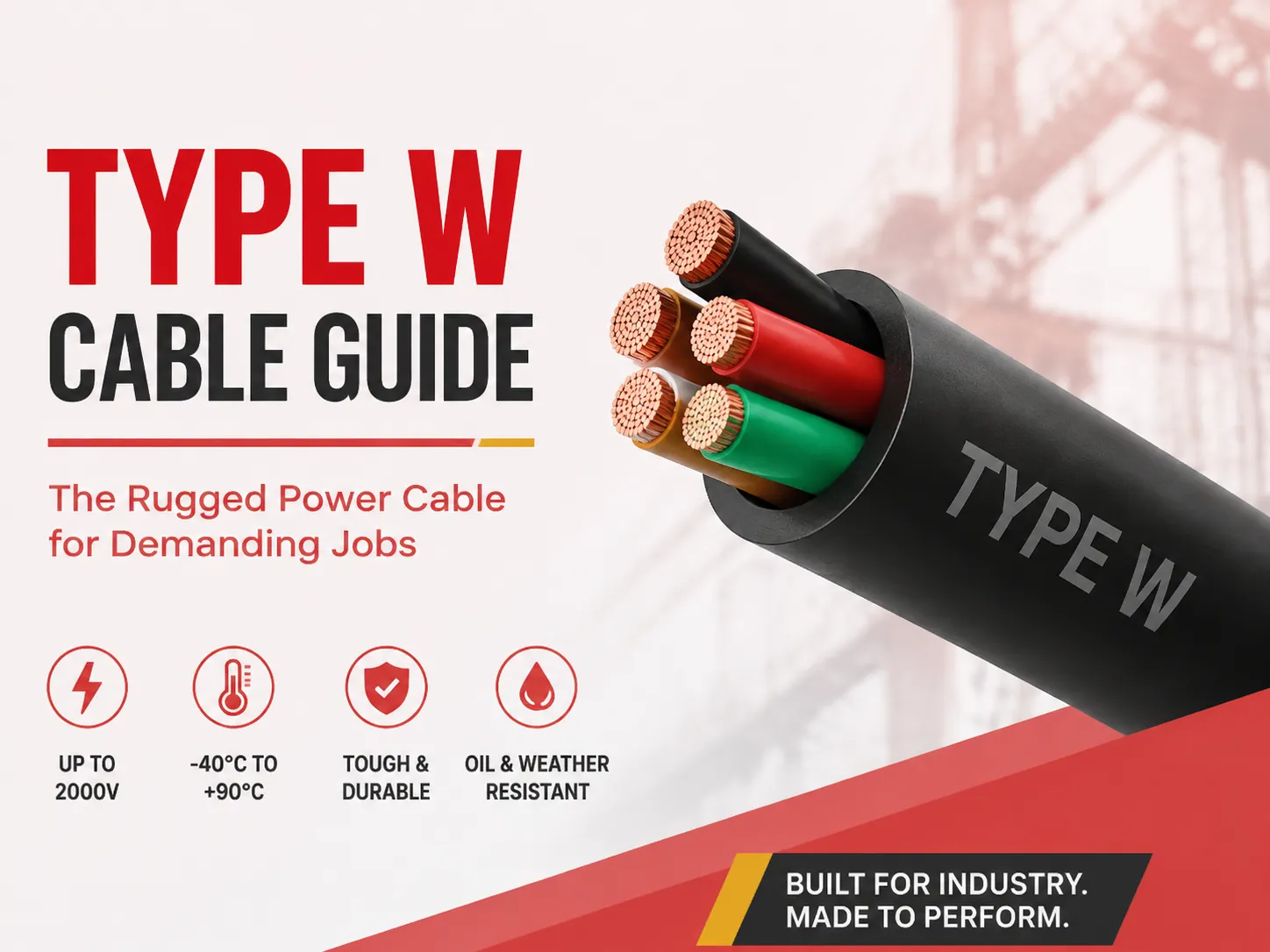
Nếu bạn đã từng chỉ định cáp cho một công trường xây dựng, một máy phát điện, một hoạt động khai thác mỏ hoặc một hệ thống phân phối điện di động, bạn có thể đã gặp thuật ngữ “Type W” và đối mặt với sự nhầm lẫn mà nó mang lại. “W” là viết tắt của gì? Nước? Thời tiết? Dây điện? Và sự khác biệt của nó với SOOW, cũng có chữ “W” trong đó là gì? Dưới đây là thông tin bạn cần biết: Type W đề cập đến phân loại UL của cáp điện di động chịu tải nặng với điện áp định mức lên đến 2000 volt, được làm bằng lớp cách điện EPDM dày và vỏ CPE cứng phù hợp với các điều kiện công nghiệp khắc nghiệt nhất. Bài viết thảo luận về ý nghĩa thực sự của Type W, các ứng dụng của nó, cách phân biệt nó với SOOW và các loại cáp di động khác cũng như cách chọn loại phù hợp.
Ghi chú ngắn: Type W liên quan đến phân loại UL của cáp điện di động phù hợp với điện áp cao lên đến 2000V (vì các dây dẫn đơn cũng đồng thời nhận được xếp hạng RHH/RHW cho 600V). Type W có lớp cách điện cao su EPDM nhiệt rắn và vỏ làm từ vật liệu CPE hoặc CSPE, nhiệt độ hoạt động từ -40°C đến +90°C, trong khi cấu trúc hoàn hảo để sử dụng trong môi trường khắc nghiệt như khai thác mỏ, công trường xây dựng, khoan giàn hoặc trong các máy bơm. Chữ ”W” chỉ ra đây là một loại cáp cụ thể không thể nhầm lẫn với ý nghĩa của ”W” trong SOOW, vì ở đây nó có nghĩa là dây cáp chống chịu thời tiết. Type W có nhiều ưu điểm hơn SOOW vì nó cung cấp điện áp định mức cao hơn, cách điện tốt hơn và độ bền cao hơn.
“Type W” có nghĩa là gì?
Được thiết lập bởi Underwriters Laboratory, phân loại Type W xác định một loại cáp đủ bền để chịu được các ứng dụng khắc nghiệt hơn. Nó còn được biết đến như một loại cáp điện di động, và là một trong những loại cáp chính được sử dụng để truyền tải điện trong các môi trường thương mại.
Các đặc tính định nghĩa của cáp Type W:
- Điện áp định mức: Type W được định mức cho điện áp cao lên đến 2000 volt AC hoặc DC (khi sử dụng nhiều dây dẫn) cao hơn đáng kể so với các dây cáp điện áp thấp tiêu chuẩn. Các dây dẫn riêng lẻ cũng đáp ứng xếp hạng kép RHH/RHW ở điện áp 600 volt.
- Cách điện: cao su EPDM (ethylene propylene diene monomer) nhiệt rắn cung cấp vật liệu cách điện bền và chịu nhiệt cao.
- Vỏ: vỏ CPE (chlorinated polyethylene) hoặc CSPE cung cấp khả năng bảo vệ đáng tin cậy chống lại các vật liệu ăn mòn và độ ẩm.
- Dải nhiệt độ: -40°С đến +90°С.
- Dây dẫn: từ 1 đến 5 dây dẫn (đen, trắng, đỏ, xanh lá, cam) phù hợp với độ linh hoạt cao; kích thước AWG từ 8 AWG đến 500 MCM khi sử dụng làm dây dẫn đơn và từ 8
- AWG đến 4/0 AWG khi sử dụng làm dây dẫn đa lõi.
Tóm lại, cáp Type W là loại được sử dụng khi cáp nối dài tiêu chuẩn hoặc thậm chí cáp SOOW không thể chịu được dòng điện và điện áp yêu cầu tại công trường, mỏ, v.v.
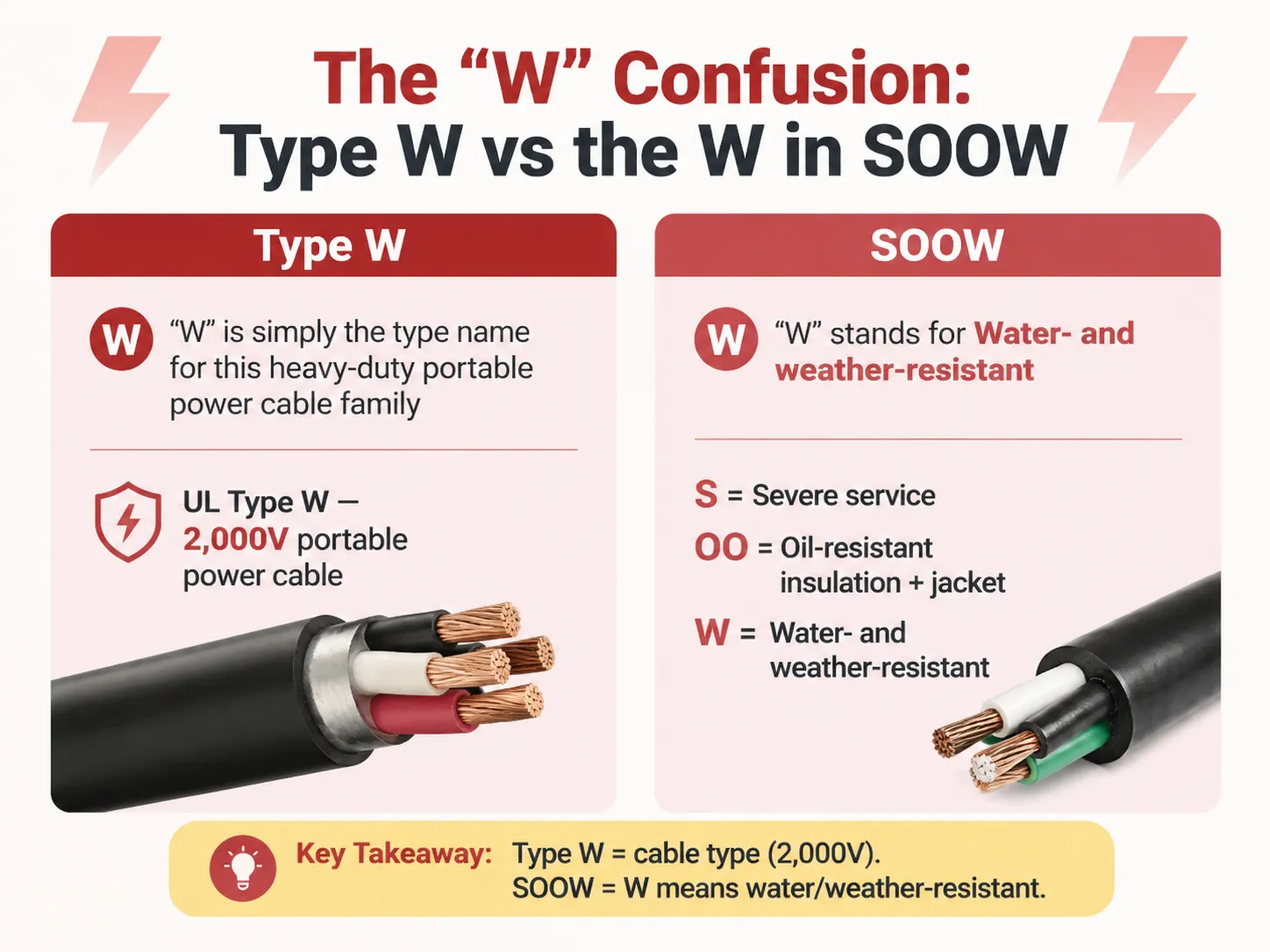
Sự nhầm lẫn về “W”: Type W so với chữ W trong SOOW
Chữ “W” xuất hiện trong hai loại ký hiệu cáp khác nhau và chúng đề cập đến hai ý nghĩa hoàn toàn khác biệt, tạo nên khu vực gây nhầm lẫn lớn nhất.
| Ký hiệu | Ý nghĩa của “W” | Ý nghĩa đầy đủ |
|---|---|---|
| Loại W (cáp nguồn di động) | “W” đơn giản là tên loại cho dòng cáp nguồn di động chịu tải nặng này | UL Type W — cáp nguồn di động 2.000V |
| SOOW (dây dịch vụ) | “W” đại diện cho Chống nước và thời tiết | S = Dịch vụ nghiêm ngặt, OO = cách điện + áo khoác chịu dầu, W = chống thời tiết/nước |
Do đó, mặc dù cả “Type W” và “SOOW” đều có chữ “W” trong tên, trong trường hợp trước, “W” là một phần trong tên cáp, giống như các loại “Type G” và “Type SC.” Ngược lại, trong “SOOW,” “W” đóng vai trò là tính từ chỉ rằng cáp có khả năng chống nước. Vì vậy, bất kỳ ai tìm kiếm “type w meaning” liên quan đến cáp hầu như luôn tìm kiếm cáp nguồn di động UL Type W thay vì khả năng chống nước.
Thông số kỹ thuật cáp Type W
Dưới đây là hình ảnh tổng thể của một cáp Type W điển hình:
| Tham số | Giá trị |
|---|---|
| Loại cáp | UL Type W (cáp nguồn di động) |
| Đánh giá điện áp | 000V AC/DC (đa lõi); lõi đơn được đánh giá kép RHH/RHW 600V |
| Cách điện | Cao su EPDM nhiệt rắn |
| Áo khoác | CPE hoặc CSPE |
| Dải nhiệt độ | -40°C đến +90°C |
| Số lượng lõi dẫn | 1-5 (đen, trắng, đỏ, xanh lá, cam) |
| Cấu trúc bện | Đồng bện dạng dây thừng (linh hoạt) |
| Kích thước lõi đơn | 8 AWG đến 500 MCM |
| Kích thước đa lõi | 8 AWG đến 4/0 AWG |
| Điện trở | Khả năng chống mài mòn, va đập, dầu, hóa chất và thời tiết xuất sắc |
| Phê duyệt | UL 1650, kiểm tra ngọn lửa MSHA, kiểm tra ngọn lửa UL, ICEA S-75-381 / NEMA WC-58, CSA, RoHS |
Các đặc điểm đáng chú ý ở đây là định mức 2.000V (khoảng 3,3 lần so với 600V SOOW), cùng với lớp áo dày và chắc chắn không gặp khó khăn với đá, phương tiện hoặc thời tiết xấu.
Cáp Loại W được sử dụng để làm gì?
Loại W được ưu tiên ở mọi nơi máy móc di động cần điện áp cao, dòng điện lớn và kết cấu chắc chắn:
- Khai thác mỏ — cung cấp năng lượng cho máy khoan, băng tải, bơm và thiết bị vận chuyển (được MSHA phê duyệt cho khai thác mỏ).
- Xây dựng — cung cấp điện tạm thời từ máy phát điện đến bảng điều khiển, máy hàn và máy móc nặng.
- Cho thuê máy phát điện — kết nối máy phát điện với hộp phân phối và thiết bị chuyển giao.
- Dầu khí và giàn khoan — cung cấp năng lượng cho bơm bùn, tời và thiết bị tại các công trường khoan.
- Vận tải biển — cung cấp điện bờ và các hoạt động hàng hải nặng.
- Giải trí — đảm bảo phân phối công suất cao từ các xe sản xuất.
- Công nghiệp — cung cấp điện tạm thời cho bảo trì, thời gian ngừng hoạt động và máy móc vận chuyển.
- Bơm và cần cẩu — động cơ sử dụng nhiều dòng điện trên khoảng cách dài.
Được đánh giá là RHH/RHW, Loại W có thể hoạt động như dây kết nối đa năng trong ống dẫn.
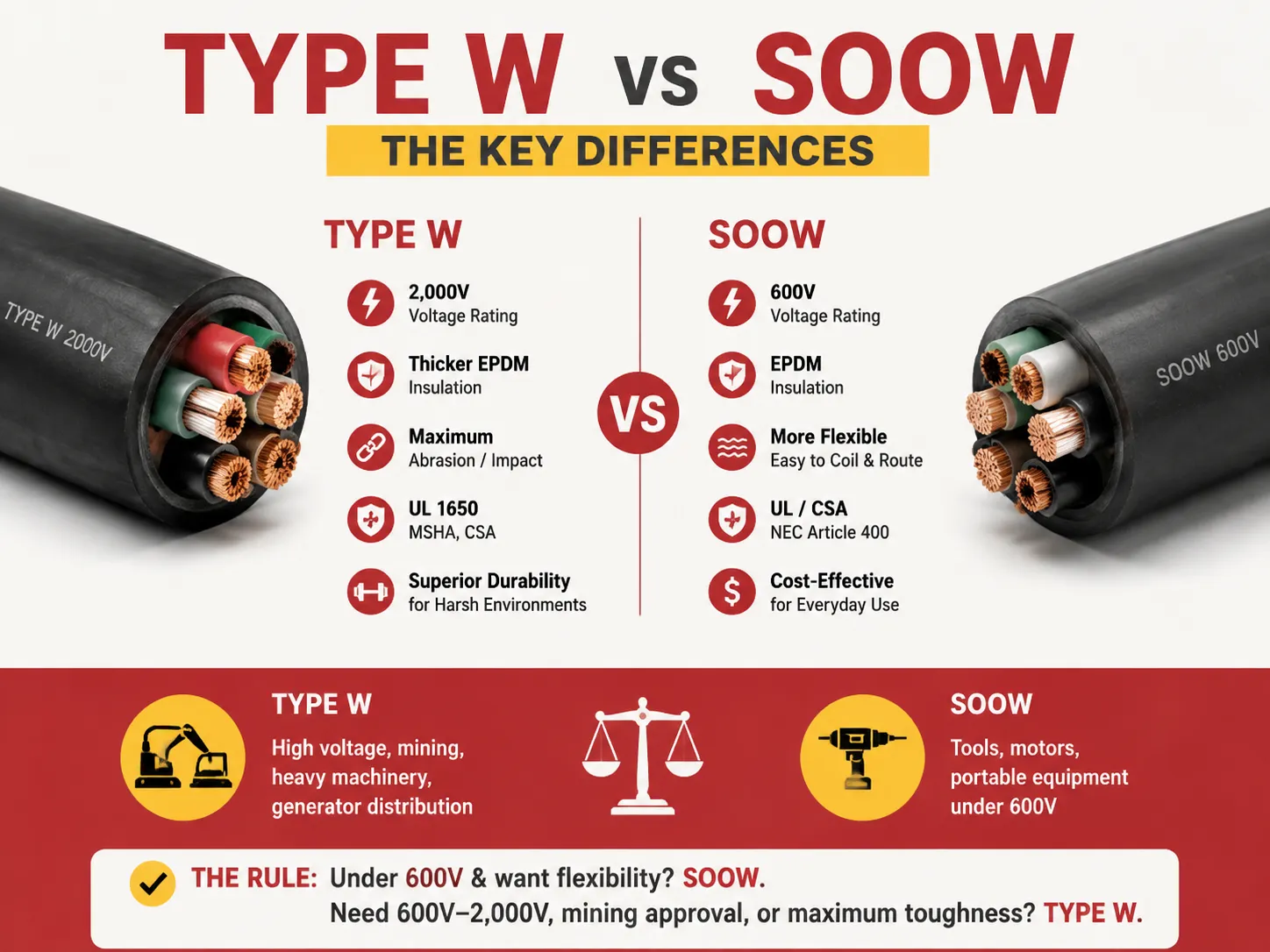
Loại W so với SOOW: Những khác biệt chính
| Tính Năng | Loại W | SOOW |
|---|---|---|
| Loại | Cáp nguồn di động | Dây dịch vụ |
| Đánh giá điện áp | 000V | 600V |
| Cách điện | EPDM dày hơn | EPDM (mỏng hơn) |
| Áo khoác | CPE/CSPE nặng — khả năng chống mài mòn/va đập tối đa | CPE — bền nhưng linh hoạt hơn |
| Độ linh hoạt | Cứng hơn, nặng hơn | Linh hoạt hơn, dễ cuộn và định tuyến |
| Độ bền | Vượt trội — chịu được phương tiện, đá, va đập | Tốt — phù hợp với hầu hết các công trường |
| Kích thước điển hình | 8 AWG đến 4/0 (đa lõi); lên đến 500 MCM đơn lõi | 18 đến 6 AWG điển hình |
| Phê duyệt chính | UL 1650, MSHA, CSA | UL/CSA, NEC Điều 400 |
| Chi Phí | Giá cao hơn mỗi foot (nhiều đồng + cách điện hơn) | Thấp hơn |
| Phù hợp nhất cho | Điện áp cao, khai thác mỏ, máy móc nặng, phân phối máy phát điện | Dụng cụ, động cơ, thiết bị di động dưới 600V |
Tóm lại: dưới 600V và cần linh hoạt? Chọn SOOW; cần 600V-2.000V, có thể chi trả cho việc chứng nhận phù hợp khai thác mỏ hoặc hoạt động ở sức căng tối đa? Chọn Loại W.
Loại W so với các cáp di động khác (SJOOW, SEOOW, STOW, Loại G)
Gia đình cáp di động có nhiều thành viên; đây là cách Loại W so sánh:
| Loại cáp | Ứng dụng chính | Đặc điểm chính | Sử Dụng Tốt Nhất |
|---|---|---|---|
| SJOOW | 300V | “Dây dịch vụ ”nhỏ” — mỏng, linh hoạt | Dụng cụ nhẹ, thiết bị nhỏ |
| SOOW | 600V | Dây dịch vụ chịu tải nặng, chống dầu + nước | Dụng cụ và thiết bị công nghiệp chung |
| SEOOW | 600V | Thermoplastic elastomer jacket | Freezing environments, extreme cold |
| STOW | 600V | Thermoplastic (PVC) jacket | Consumer-grade extension cords |
| Loại W | 000V | Heavy portable power cable, MSHA | Mining, high-voltage distribution, heavy equipment |
| Type G | 000V | Very similar to Type W; ground conductors included in the assembly | Portable power distribution with integrated ground |
Type W and Type G can almost be regarded as siblings as both of them are portable power cables rated at 2,000V, which means they can withstand and endure a lot of wear and tear. What separates Type W from Type G however is that Type G constructions typically come with grounding conductors as part of the package while Type W depends on the conductor arrangement that has been specified to achieve grounding. In most instances high voltage portable work can be achieved through the usage of either dressing; it is just important to check which dressing is most appropriate for the job at hand.
Approvals & Standards
Type W cable possesses numerous certifications that guarantee its success in many applications:
- UL 1650 — This is the portable power cable standard.
- UL Type W listing — Rated for 2,000V in any configuration.
- UL dual rated RHH/RHW — indicates that the single conductors are rated for 600V as general building wire.
- MSHA flame test — Approved for mining use (needed for underground applications).
- ICEA S-75-381 / NEMA WC-58 — They are recognized portable cables standards.
- CSA approval — The Canadian qualification.
- RoHS — This means that the restricted hazardous substances are not present.
If your project is connected to MSHA, you will need Type W cable — SOOW won’t make it through the inspection.
How to Choose: Type W or SOOW?
Proceed to ask the following questions in order:
- What is the required voltage for the equipment? For any voltage greater than 600V, Type W is the choice. For voltages equal to or below 600V, both options would suffice.
- How severe is the working environment? If mining is involved (severe pressure from rocks, equipment being dragged over cables, heavy crushing etc.), it is advisable to go with Type W since its jacket is thicker.
- Do you need permission from MSHA? If the application is taking place underground, choose Type W.
- How flexible should your cable be? If flexing around tight corners, twisting and turning is required, it is preferable to go for SOOW.
- Working under how much money? Type W has a higher price than SOOW, if less than 600V is needed, choose SOOW.
Safety & Usage Rules
- Examine before every use — look for any damage such as cuts, scrapes, compression areas, or exposed wires; Type W is durable, but it is not indestructible.
- Do not use as a permanent building wire within walls — it is a portable wire; for permanent electrical work, the wiring used is THHN/THWN with conduit.
- Do not direct bury unless the construction is designed to be buried — check the jacket markings and local requirements.
- Choose the correct ampacity according to the load — Type W wire can take 2,000V but this refers to the voltage capacity and not the ampacity.
- Prevent damage — use ramps or elevated ways where trucks and cars travel on the cable; avoid putting the cable in standing and stagnant water.
- Scrape off the oil and other chemicals immediately after the cable is overexposed to them — the coat of the cable can be oil-resistant, but it will hold longer without these chemicals.
Prices & Where to Buy
The reason behind the higher price of Type W in comparison to SOOW is that Type W uses more copper and heavier insulation material. Typical pricing estimates per foot for 2025-2026 (for multi-conductor copper wire) is as follows:
| Conductor Size | Typical Price per Foot |
|---|---|
| 8 AWG (3-4 conductors) | $4-$8 |
| 6 AWG | $6-$12 |
| 4 AWG | $8-$16 |
| 2 AWG | $12-$24 |
| 1 AWG | $15-$30 |
| 1/0 AWG | $18-$38 |
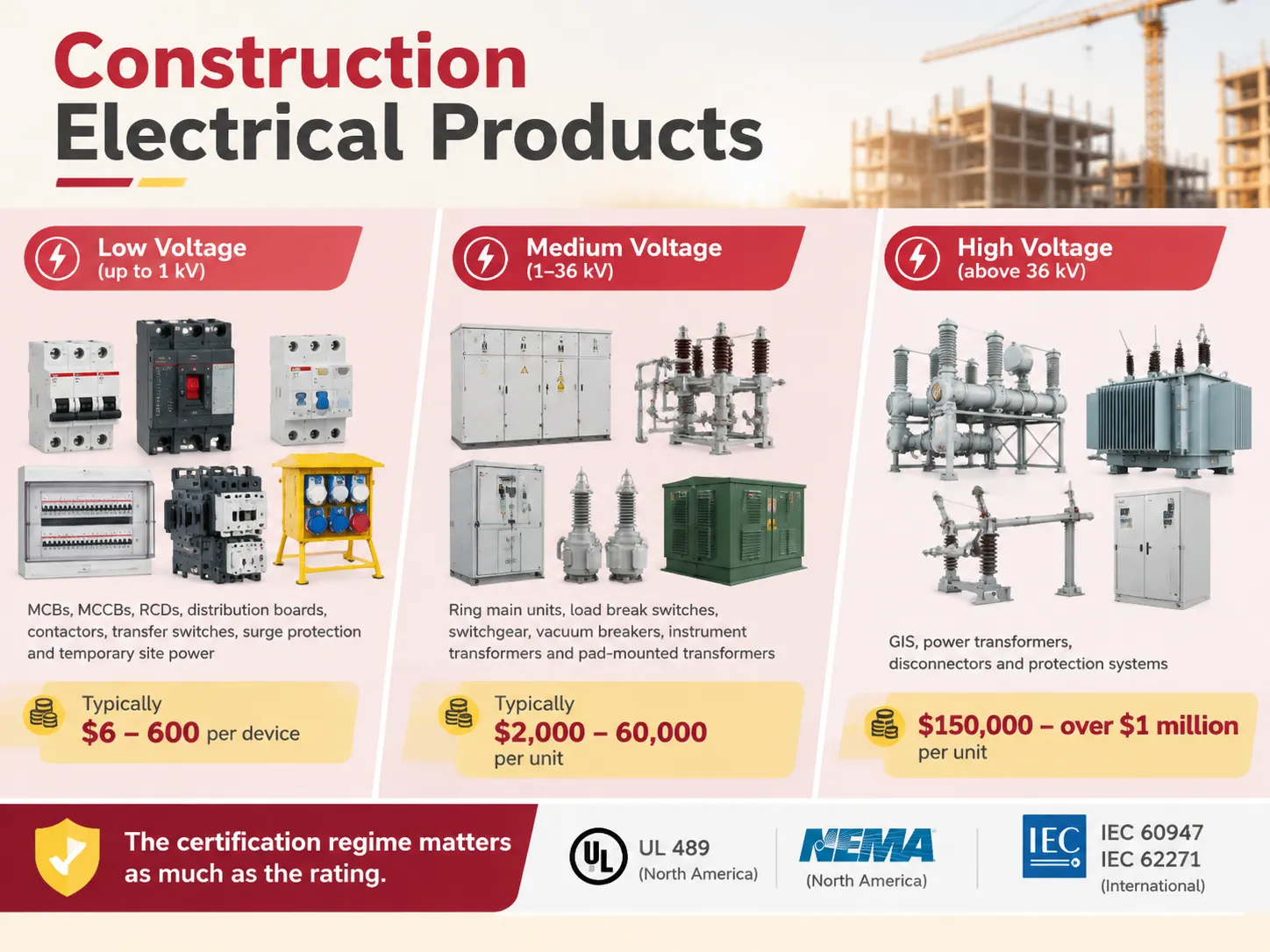
Different pricing applies depending on the wiring installation, based on the conductor number, insulation material, and supplier; however, the cost is lowered greatly when purchased in bulk from the wire distributor.For buyers building distribution systems around portable power — generators, transfer switches, and the protection gear behind them — pairing the right cable with the right MCB/MCCB protection and a certified bộ ngắt UL 489 keeps the whole power chain safe and code-compliant — and when a breaker eventually needs replacing, the costs in our breaker replacement guide help you budget the job.
Câu hỏi thường gặp
What is the main difference between Type W and SOOW cables?
The differences between them consist of their ratings and durability: Type W has a tough portable power cable rated for extreme use with voltages of up to 2,000V thanks to its thick layers of EPDM insulation and CPE jacket while SOOW is a more flexible and less costly cable rated for 600V use. Type W is also MSHA-approved for use in mines. Use SOOW at less than 600V if flexibility is required; choose Type W for any higher voltage or maximum durability.
Does SOOW cable need to be in conduit?
NO – SOOW is a service cord that makes it possible to operate without conduit’s help in a flexible application (NEC Article 400). Its use for permanent installation is not permitted, and it is not approved for underground installation. Permanent installation requires the use of building wires (THHN/THWN) and conduit, while SOOW can be employed for portable power supply tasks.
What voltage is SOOW rated for?
SOOW has a voltage rating of 600 volts (plus 300V versions referred as junior SJOOW). SOOW cable can be used for applications involving most power tools, motors as well as machinery. However, Type W cable is required for higher voltage systems as well as for mining operations requiring MSHA approval.
Can Type W cable be used as building wire?
Single conductor Type W is a dual rated cable with both RHH and RHW ratings up to 600 volts. For this reason, single conductor Type W can be used as industrial hook-up wire in conduit up to 600 volts. However, while multi-conductor Type W is meant to be used for temporary power, using this type for permanent installation is not recommended. Always check local codes in accordance to the specific use of the cable.
Tài liệu tham khảo
- Allied Wire & Cable — Type W Cable Specifications and Applications
- UL — UL 1650 Portable Power Cable Standard & Type W Listing
- MSHA — Mine Safety and Health Administration Cable Requirements
- NFPA 70 (NEC) — Article 400 Flexible Cords and Cables
- NEMA — NEMA WC-58 Portable and Power Feeder Cables
- AutomationDirect — Portable Cord and Type W Selection Guide
Kết luận
Type W is the UL designation used for the heavy-duty flexible power cable that is sought after in industrial environments when the task is major and the surroundings difficult: rated for 2000 volts, made of the EPDM rubber material and CPE plastic, able to work in the temperature range from -40 to +90 degrees Celsius, MSHA compliant for mining applications. The “W” refers to the type of the cable and not to the “water resistant” W in SOOW, which is a different cable type working on 600 volts with higher flexibility and lower cost. Use SOOW cable for general-purpose portable tools, and Type W for high voltage power distribution, mining, generators, and heavy machinery — and always combine this cable with approved safety equipment.