
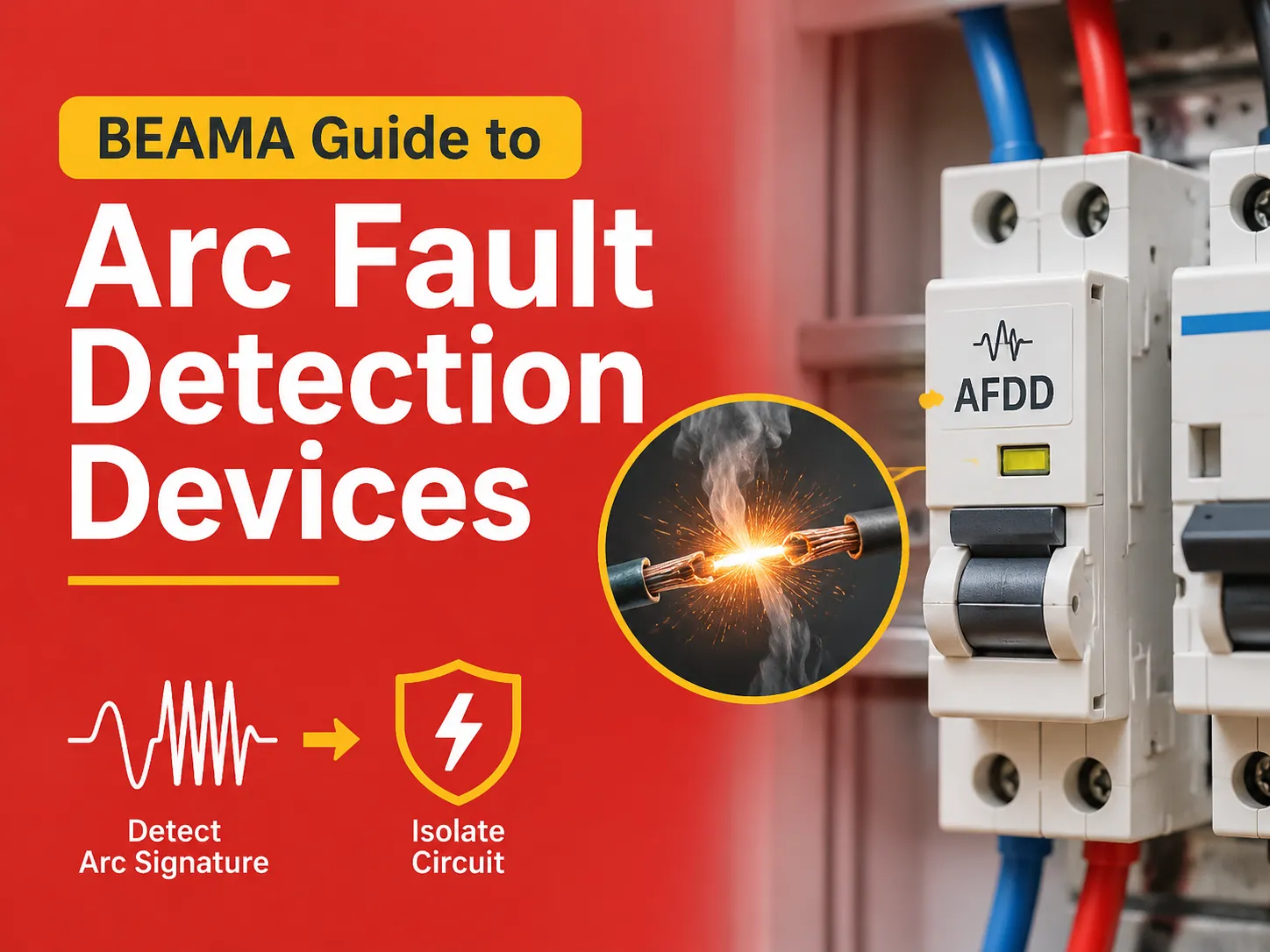
Chức năng của thiết bị phát hiện lỗi hồ quang (AFDD) là xác định xem có hồ quang được tạo ra bởi các kết nối đầu cọc lỏng lẻo, cáp ép và/hoặc đinh đâm xuyên qua dây dẫn hay không. Một hồ quang có thể kéo dài nhiều tháng với dòng điện quá thấp để kích hoạt bộ ngắt mạch hoặc không có rò rỉ xuống đất và dấu hiệu đầu tiên của loại lỗi này thường là cháy.
Trả lời nhanh: AFDD giám sát dạng sóng dòng điện và điện áp để phát hiện đặc trưng tần số cao của hồ quang và tự động cách ly (ngắt) mạch khi phát hiện loại lỗi này. AFDD phải được sản xuất và kiểm tra theo Tiêu chuẩn Quốc tế cho thiết bị phát hiện lỗi hồ quang (IEC 62606) và có thể được mua dưới dạng thiết bị độc lập hoặc kết hợp với RCD trong một mô-đun. Giá điển hình cho một AFDD dao động từ £30 đến £120 (chưa bao gồm lắp đặt).
Các phần còn lại của tài liệu này cung cấp phạm vi bao quát toàn diện của hướng dẫn và giải thích những gì được đề cập trong hướng dẫn, AFDD có thể phát hiện những gì mà các thiết bị khác không thể, cách AFDD phát hiện, nơi Quy định Điện yêu cầu AFDD, các dạng thiết bị có sẵn, so sánh với các thiết bị tương tự khác, các dấu hiệu để kiểm tra sự phù hợp, chi phí, các lần ngắt không mong muốn, cách chọn thiết bị độc lập hoặc thiết bị kết hợp, và nơi bạn có thể tìm thấy thiết bị của chúng tôi tại khu vực địa phương, cùng với danh sách kiểm tra cho việc vận hành và lắp đặt AFDD.
Hướng Dẫn BEAMA Bao Gồm Những Gì và Tại Sao Nó Tồn Tại
Hướng dẫn BEAMA được phát triển nhằm đáp ứng yêu cầu theo Sửa đổi 2 sắp tới của Tiêu chuẩn Anh 7671 rằng AFDD phải được lắp đặt cho các mạch ổ cắm có định mức 32 A hoặc thấp hơn trong các cơ sở nhà ở có nguy cơ cao; sự khác biệt giữa AFDD, RCBO & RCCB và AFCI ở Bắc Mỹ không dễ xác định như nhiều người tưởng khi đánh giá các danh mục sản phẩm.
Hướng dẫn BEAMA được phát triển bởi Hiệp hội Nhà sản xuất Thiết bị Điện Anh nhằm giải quyết các vấn đề liên quan đến việc giới thiệu Quy định Điện sửa đổi và các AFDD mới, vốn được các nhà sản xuất vận chuyển và các nhà thầu lắp đặt. Cả hai bên đều cần một ngôn ngữ chung để thuận tiện cho việc giao tiếp. Hướng dẫn giải thích:
- Cách hoạt động và chức năng của AFDD
- Cách kiểm tra AFDD
- Các tiêu chuẩn áp dụng cho AFDD
- Cách lựa chọn và lắp đặt AFDD
EMF (Trường Điện Từ) là một công nghệ không trực quan; do đó, một hướng dẫn được phát triển thay vì chỉ một bảng dữ liệu hoặc danh mục cho AFDD. Ví dụ, mục đích của bộ ngắt mạch là bảo vệ chống quá tải và ngắn mạch, điều này dễ hiểu bằng mắt thường. Ngược lại, AFDD bảo vệ chống lại một chế độ lỗi không có dấu hiệu hư hại nhìn thấy được cho đến khi xảy ra cháy. Quyết định lắp đặt AFDD dựa trên đánh giá rủi ro thay vì các phép tính toán học đơn giản.
Hướng dẫn cũng cung cấp một lý do kinh doanh vì AFDD có giá cao gấp nhiều lần so với cầu dao tự động loại nhỏ (MCB). Một cách dễ dàng hơn để giải thích việc tránh rủi ro liên quan đến AFDD so với MCB là sử dụng một tài liệu đã được công bố từ một tổ chức ngành thay vì một tờ rơi của nhà sản xuất khi yêu cầu lý do cho việc mua AFDD.
Những gì AFDD phát hiện mà các thiết bị khác không thể
Thiết bị phát hiện hồ quang (AFDD) phát hiện hồ quang trong mạch do sự cố của dây dẫn nối tiếp với tải điện. Khi dây dẫn bị hỏng, các hồ quang tạo ra giữa các đầu đứt duy trì dòng điện qua mạch, mặc dù ở mức giảm, và trong một số trường hợp, tổng lượng dòng điện chạy qua mạch vẫn dưới mức định mức nhiệt của cầu dao tự động vô thời hạn. Một vít đầu cọc lỏng, dây nối dài bị hỏng hoặc dây bị cắt trong quá trình lắp đặt đều có thể tạo ra mẫu tương tự.
Hồ quang song song xảy ra khi hai dây tạo thành hồ quang chạy từ dây pha đến dây trung tính hoặc dây nối đất và tạo ra dòng điện đủ để nhảy cầu dao. Phiên bản nguy hiểm nhất của điều này là điện trở cao giữa hai dây; trở kháng cao giới hạn dòng điện qua lỗi ở mức cầu dao có thể chịu được, nhưng hồ quang vẫn tiếp tục.
Thiết bị dòng rò sẽ không phát hiện các hồ quang này trừ khi chúng rò rỉ xuống đất; đây là lý do AFDD lấp đầy khoảng trống này. Chúng phát hiện chính hồ quang chứ không phải hậu quả của hồ quang (ví dụ: cháy nổ), đó là lý do các thiết bị này được tiếp thị như là bảo vệ chống cháy điện chứ không phải bảo vệ chống quá tải hoặc điện giật.
The → Cái cầu dao phát hiện hồ quang hoạt động theo nguyên lý tương tự và, được giải thích từ phía lắp đặt, phân biệt giữa hồ quang nối tiếp và hồ quang song song.
Bên trong thiết bị: Cảm biến, Xử lý và Nhảy cầu dao
Thiết bị liên tục lấy mẫu dạng sóng dòng điện bằng cách sử dụng một biến dòng nhỏ hoặc một điện trở shunt. Một vi điều khiển xác định các đặc điểm có thể nhận biết hồ quang bao gồm thành phần tần số cao của dạng sóng, sự tăng hoặc giảm đột ngột của dòng điện, đặc trưng ‘tạm dừng’ trên mỗi nửa chu kỳ và tính ngẫu nhiên của chữ ký phát hiện hồ quang.
Vi điều khiển sau đó so sánh các đặc điểm trích xuất với mô hình hồ quang hiện tại được định nghĩa ở 230 Volt và 50 Hertz và với cơ sở dữ liệu các mẫu không nên gây nhảy cầu dao trên thiết bị. Trong nhóm thứ hai này có một loạt các thách thức kỹ thuật do nhiễu tần số cao gây ra bởi các sản phẩm phổ biến – dimmer, động cơ chổi than, nguồn điện chuyển mạch và máy khoan – mà không tạo ra hồ quang điện.
Do yêu cầu này, thiết bị phải sử dụng một solenoid mở các tiếp điểm rơ le sau khi thời gian ngắt định trước được đáp ứng. Giống như nhiễu tần số cao, thời gian ngắt không phải là tức thời vì thiết bị đang phân biệt một mẫu thay vì đo mức điện áp hoặc dòng điện. Thời gian bổ sung này cho phép thiết bị bỏ qua sự kiện nhất thời nhưng vẫn giữ khả năng phát hiện sự kiện hồ quang điện thực sự.
Được nêu trong tiêu chuẩn IEC 62606 là loại “dạng sóng thử nghiệm” mà thiết bị phải chịu được và không chịu được, và nó cụ thể cấm thiết bị ngắt do dòng điện khởi động.
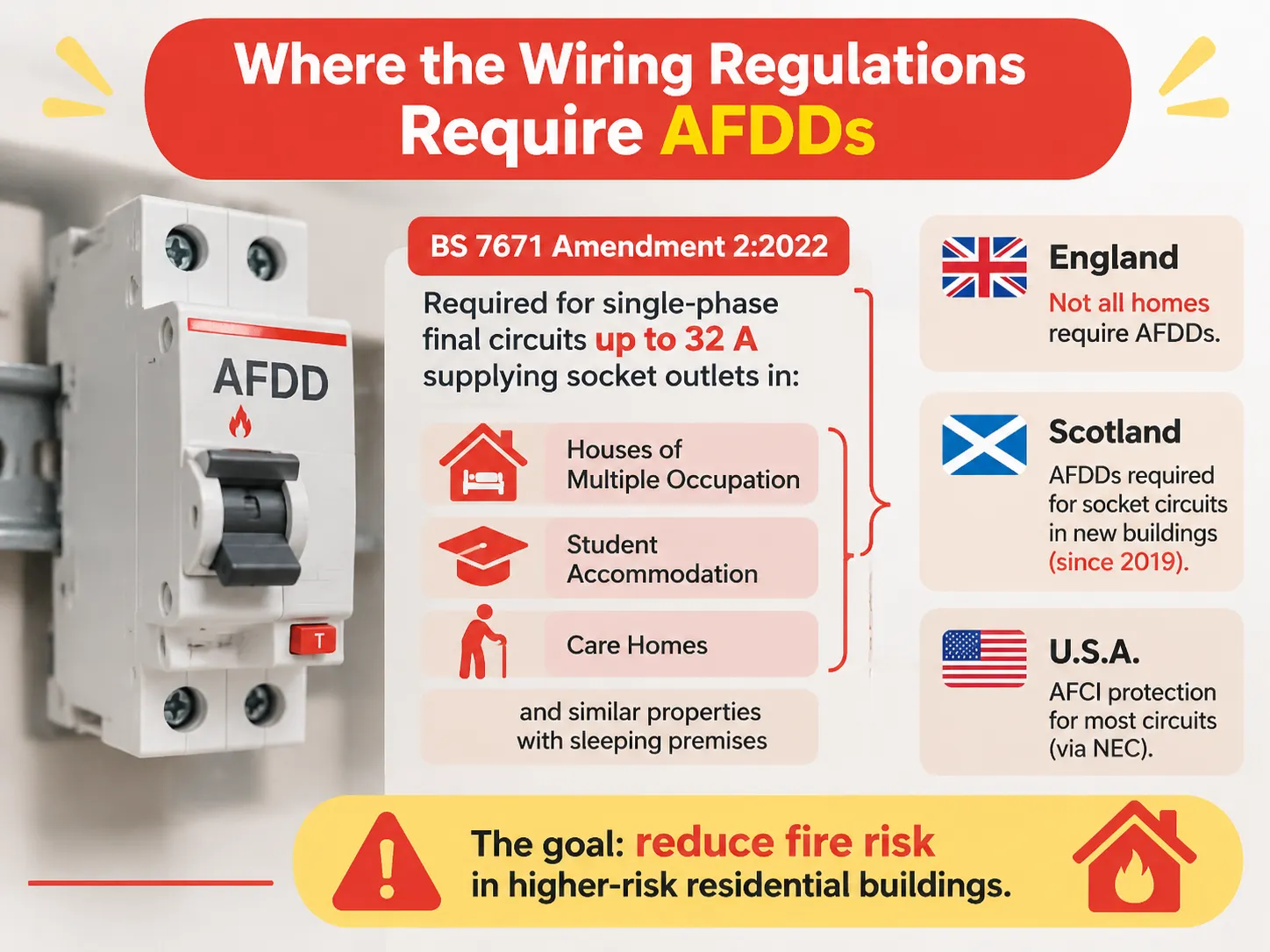
Nơi Quy định Điện Yêu cầu AFDD
BS 7671 Sửa đổi 2:2022 yêu cầu tất cả các mạch cuối pha đơn định mức lên đến 32 A cấp nguồn cho ổ cắm nằm trong các bất động sản dân cư có rủi ro cao hơn – nhà ở nhiều người thuê, ký túc xá sinh viên, nhà chăm sóc và các bất động sản tương tự có phòng ngủ – phải được trang bị AFDD. Yêu cầu này có thể được tìm thấy trong Quy định 421.1.7 và áp dụng cho tất cả các lắp đặt mới và sửa đổi, nhưng không áp dụng cho mọi lắp đặt hiện có.
Phạm vi được giới hạn có chủ ý và không đề cập đến “tất cả các nhà ở” như nhiều người nghĩ. Ở Anh không có yêu cầu mỗi ngôi nhà phải được trang bị AFDD. Năm 2019, tiêu chuẩn xây dựng của Scotland đã bắt buộc sử dụng AFDD cho các mạch ổ cắm trong các tòa nhà mới. Do đó, các thông số kỹ thuật cho các mạch ổ cắm ở Glasgow và Manchester sẽ khác nhau.
Một quốc gia khác, Hoa Kỳ, sử dụng phương pháp thay thế để cung cấp bảo vệ hồ quang cho hầu hết các mạch nhánh ngoại trừ một số ít. Họ đã sử dụng Bộ Quy chuẩn Điện Quốc gia và tiêu chuẩn AFCI thay vì IEC 62606 như một phương tiện cung cấp bảo vệ này. Có những quốc gia châu Âu khác, như Đức, cũng có yêu cầu tương tự cho một số loại cư trú nhất định. Nguyên tắc cơ bản cho tất cả các quốc gia này là yêu cầu bảo vệ hồ quang dựa trên mức độ rủi ro cháy liên quan đến các cấu trúc có thể ở được.
Các loại và Hình thức
Khu vực thị trường bao gồm ba loại và do đó, khi chọn một loại, thường sẽ dựa trên diện tích bảng điều khiển mà nó chiếm chỗ hơn là mức độ bảo vệ mà nó cung cấp.
| Định dạng | Chiều rộng | Những gì nó chứa | Nơi sử dụng |
|---|---|---|---|
| AFDD độc lập | 1 mô-đun | Phát hiện hồ quang với cơ chế ngắt | Phía hạ lưu của MCB hoặc RCBO hiện có |
| AFDD + MCB | 2 mô-đun | Phát hiện hồ quang với bảo vệ dòng điện | Mạch mới không có RCBO |
| AFDD + RCBO | 2 mô-đun | Phát hiện hồ quang, bảo vệ dòng điện và dòng rò | Thường được sử dụng nhất cho các mạch ổ cắm |
Định dạng phổ biến nhất cho thông số kỹ thuật là AFDD + RCBO vì loại cuối cùng bao phủ tất cả các nhu cầu liên quan đến mạch ổ cắm. Ngoài ra, sử dụng một thiết bị cho cả bảo vệ dòng điện và dòng rò giúp tiết kiệm cả một đầu nối và một mô-đun.
In our range of products the combined format is the AFDD7LE device in the 1P+N configuration that is used for all single-phase final circuits.
An AFDD is specifically designed for the detection of arcs in a circuit, which can cause fires. Its function is to provide additional safety protection and prevent loss of life and property.
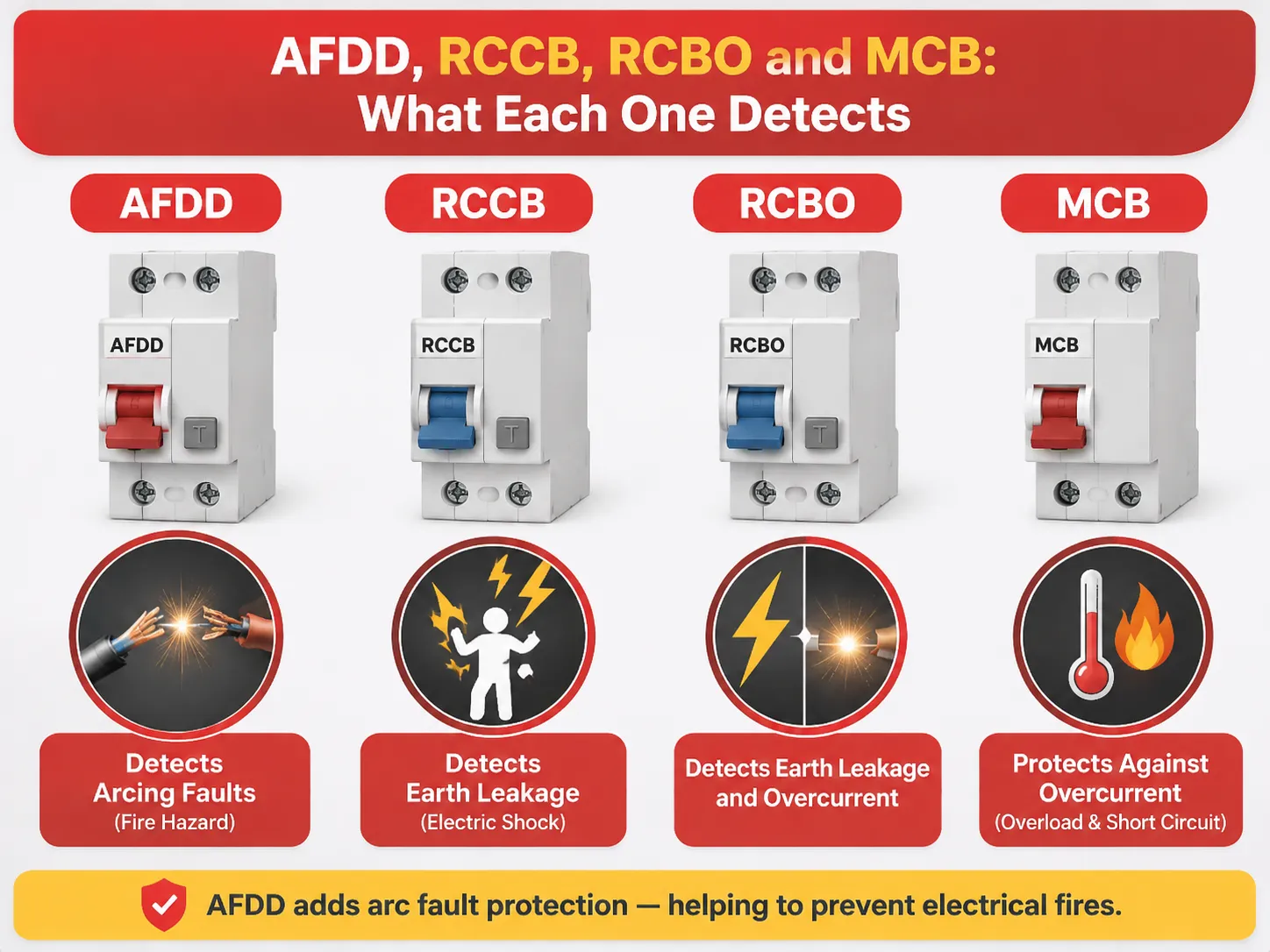
AFDD, RCCB, RCBO and MCB: What Each One Detects
The significance of an AFDD, as compared to an RCCB, is that both devices provide the same protection against electrocution or electrical shock; however, the way in which they operate and the conditions prompting a trip vary. The difference between an AFDD and an RCCB is the “signature” of an arc. The current waveform of an arc is distinctive, therefore the AFDD is able to detect that signature. In situations where the cable insulation is damaged and an arc exists in the cable, it may not leak to earth, thus the RCCB will not detect such an event.
AFDD, RCCB and MCB are the three devices to compare. The purpose for which each of these devices was designed was to protect a circuit from overcurrent – that is to say, protect the conductors against overloads and short circuits.
The MCB provides protection by tripping the circuit when the temperature of the conductor exceeds the temperature at which the insulation material becomes damaged. This is achieved by the MCB being equipped with a bimetallic strip that reacts to the heat generated by the overload to trip the device. The RCCB protects against electric shock and is connected to the earth with a residual current device (RCD). Once the RCCB detects that the current going out of the circuit differs from the current going back to the supply, it trips and disconnects the supply.
To recap,
- An AFDD is designed to provide additional protection to a circuit against potential fire hazards caused by arcing.
- An RCCB is designed to provide protection against electric shock by monitoring the difference in current between phases and earth connections.
- An MCB provides protection to conductors from overheating and short-circuiting.
AFDDs and RCBOs are two distinct types of devices, and therefore, the key difference between them is quite simple: there are no arc detection capabilities with an RCBO and an AFDD will only detect arcs if it is combined with an RCBO. You will find a further comparison between the two devices in an article regarding RCCBs versus RCBOs on the residual current side of things, and that article is especially relevant today as it highlights how many of the circuits that are used in homes today require both types of devices, so there is a debate on whether to purchase one device or two devices to fulfil the requirements.
Ratings and Markings to Check
Devices must meet six requirements to be deemed suitable. The standard, which is either IEC 62606 or the EN equivalent, should not be an endorsement, but rather, a specific number listed. The rated current for an AFDD will be typically between 6 A and 63 A; the rated voltage and frequency will typically be 230 V at 50 Hz (for the European market); and the rated conditional short circuit current is the fault current that will be applied to the device when using the type of upstream breaker specified.
If the AFDD is paired with an RCBO, it will typically detect a residual current of 30 mA for socket circuits. With an MCB, the AFDD will have more electronic components, and this means the terminal space will generally be less, which is important when using a 6 mm² cable.
The seventh requirement for an AFDD is not included on the device’s label. However, this information will appear on the certification document and will detail the testing done on the arc detection capability of the device. The test done to verify arc detection ability would be a type test to IEC 62606, not a routine test. A device that only has a routine test certificate and has not been proven to detect arcs cannot be relied upon to detect anything.
When considering the cost associated with AFDDs, it is commonly assumed that the installation will be more costly than the device itself, which leads to clients being surprised at the end of a quote.
What They Cost, and What the Installation Adds
An itemised breakdown of the costs associated with AFDDs is as follows:
| Mục | Chi phí điển hình | Lưu ý |
|---|---|---|
| AFDD độc lập | £30 to £70 | Per module; will require an additional device to provide residual current protection |
| AFDD + MCB (2 modules) | £45 to £90 | The MCB does not provide residual current protection |
| AFDD + RCBO (2 modules) | £60 to £120 | The normal choice for circuits providing sockets |
| Board increase | £150 to £400 | Increasing board size or installing a new board |
| Tested and certified | £80 to £250 | A fixed price for each installation |
The issue with the costs associated with the board increase is that, when trying to install AFDDs protecting socket outlets from all ten circuits in a ten-way RCBO board, you will require the installation of a new board rather than the installation of ten additional devices; therefore, you will initially have a larger outlay than the device prices alone suggest.
The differential in price of devices when AFDDs are compared to RCBOs will be between £30 to £60 per board way for the next 20 years, allowing approximately a few £ a year for having AFDD protection against a deadly mode of failure, as described in the guide from BEAMA and the reason for the necessity for them.
What Is Nuisance Tripping, and What Causes It?
If an AFDD trips on a normal load, the AFDD has classified a waveform incorrectly, and there is a defined method of how this can occur; specifically, dimmers, when operated at a low wattage, produce a chopped waveform with a high frequency, which is similar to the waveform produced during an arc. Brush motors like the ones in power tools or vacuum cleaners typically generate continuous arcing from the brushes by design. Similar capabilities can be found within the output of poor filter quality on switching mode power supplies (SMPS).
While there are many possible explanations for nuisance tripping, older installations offer additional reasons. When the neutral for two circuits is shared, or if there was ever an intermittent ‘real’ arcing due to poor connection quality, or of damaged insulation in between the arcing cable, these types of faults exist and the device is justified in tripping, thus a nuisance trip must not be assumed as a fault with the device and must be explored further.
The diagnostic process employed will be the same as that used with an RCBO. To isolate your loads, you must first reset the device and connect them back one at a time. If a tripped device continues when a specific appliance is connected, then the appliance and/or its cord are at fault. If a tripped device continues without anything connected, then the wiring is at fault. If a tripped device continues only in wet weather conditions, then moisture penetration into the outdoor circuit must exist.
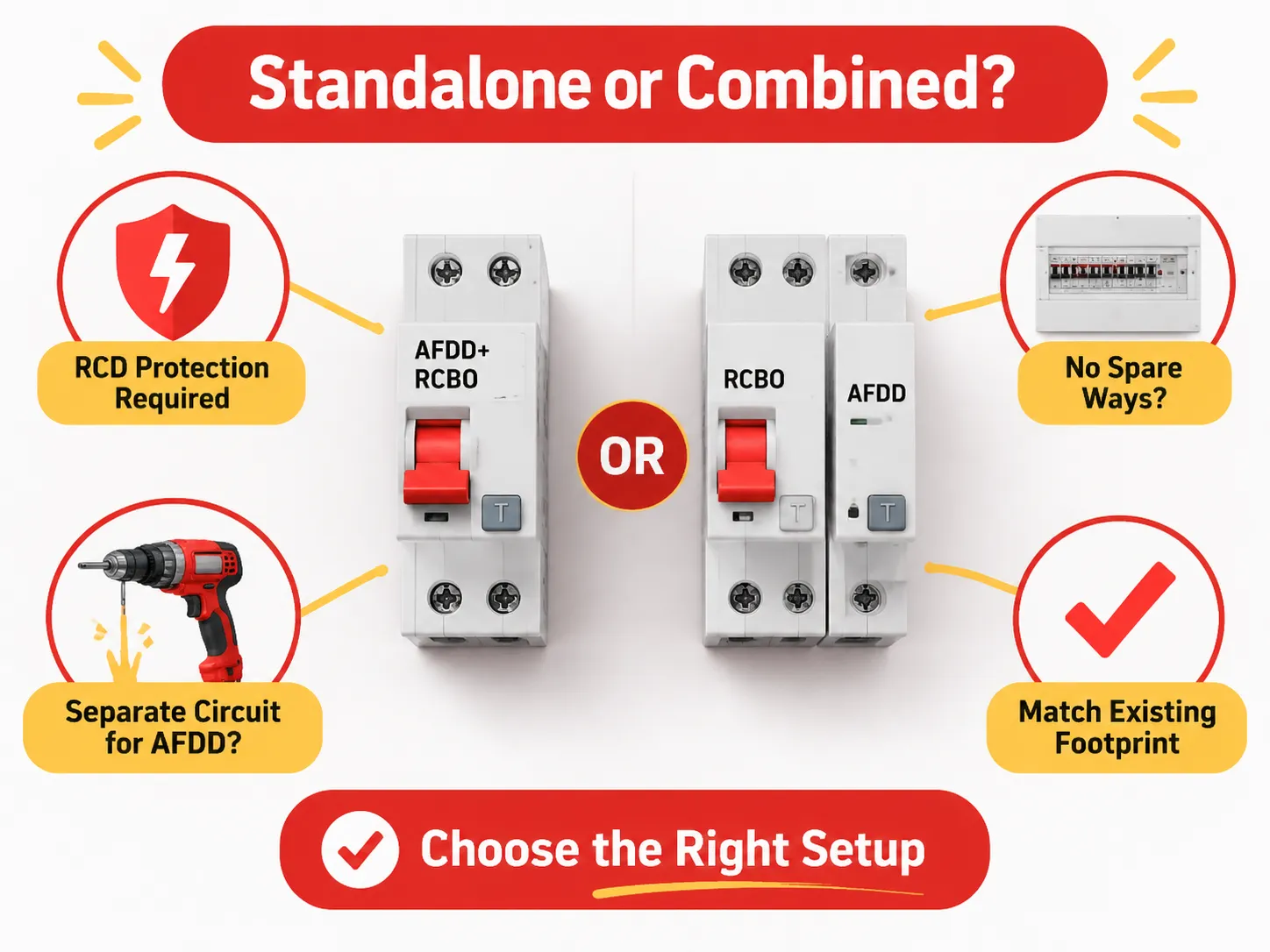
Choosing Between Standalone and Combined
Four different variables will determine whether to choose between standalone devices versus combined devices:
- A socket outlet circuit must provide residual current protection, either combined with an AFDD within a single unit or separate.
- An existing circuit that already possesses an RCBO, and now also needs an AFDD, must therefore have a stand-alone AFDD added.
- In a board containing zero spare ways, a new installation of whatever configuration must take place – therefore providing the specification of the board would be paramount versus the device.
- Because of the spark-like sounds produced in some applications (e.g., a woodworking shop with tools built with brushes) the load circuit may have to have an AFDD on a different circuit than where the tools are plugged in.
As such, AFDD’s use of the RCBO format on most current boards provides a reference for the combined device. The footprint and terminal arrangement of each type of AFDD matches as such; therefore, any project that standardises on the same footprint can add the arc protection without the need to redesign the board.
Where HUYU Fits into this Picture
We manufacture the AFDD in the combined 1 phase + Neutral format, with the MCB and RCBO in the same footprint. The construction of the AFDD complies with IEC 62606 for the function of detection of arc and IEC 61009-1 for the function of overcurrent and residual. The combination is what actually will provide a socket circuit in a home.
For a specification, we can supply the type test report for arc detection, the residual current test data, and the conditional short-circuit rating with the upstream device used in the test. These three documents are what a certifying body or inspector will require and what a low-cost AFDD typically cannot provide.
In terms of bộ ngắt mạch mini, there are circuits throughout most buildings that do not require arc protection. The majority of circuits will not need an AFDD, and specifying an AFDD for every circuit means spending money where the potential risk does not warrant such an expense.
Checklist to Comply with Specifications
There are 5 items that are to be included when making a specification, to conform to IEC 62606. These include the formats of the device (combined or stand-alone), the rated current and residual current sensitivity if combined; the conditional short circuit rating (the upstream device that the combined device assumes is used); and type test evidence (evidence of testing) to be included with the order, not requested.
At the time of commissioning, 3 checks are required. These checks include the test button to verify the operation of the trip mechanism, however, not the operation of the arc detection mechanism; the residual current test (if a combined device) with an external tester, not the test button; and a load test with appliances that may be connected to the device, as it is better to discover if a dimmer switch or brushed motor will trip the device upon delivery rather than at 12:00 am.
The 4th check is documentation. A schedule is required for the installation to be maintainable. The schedule should indicate which devices are connected to which circuits and when the last test was performed. An AFDD is a safety device with a defined service life. A device that has never been tested is a device that cannot be vouched for.
Câu hỏi thường gặp
What Are Arc Fault Detection Devices?
They are devices designed to detect high-frequency signatures from electrical arcs generating heat to ignite surrounding combustibles in the vicinity of an electrical circuit and automatically isolate the electrical circuit from its electrical supply prior to combustion. They are specified to the IEC 62606 standards; they are available as individual components or as part of an RCBO; and they provide protection for an arc or failure mode that cannot be detected by either the trip or residual current device.
What Methods Are Used to Detect Arc Faults?
Arc faults are detected by periodically sampling the current flowing in the circuit and examining the characteristics of the sampled waveform for certain defined features based upon high-frequency contents, sudden changes in current patterns, the stop time between cycles and whether the sampled waveform exhibits randomness in its pattern. A microcontroller compares these characteristics to those of a) the arc detection system and b) the associated load that is not supposed to cause a trip.
What Is an AFCI?
The AFCI (Arc Fault Circuit Interrupter) is the equivalent of an AFDD as defined in the North American UL 1699 standard. An AFCI performs the same function as an AFDD, but is tested to a different standard and rated to operate at 120 Volts in North American branch circuits. Therefore, AFCIs and AFDDs may not be replaced with one another or by a device that complies with one of the two standards.
Which Rooms Need AFCI Protection?
In England, the BS 7671 amendment 2 requires the installation of AFDD protection on socket circuits of 32 A or less at greater risk of electrical shock, which occur generally in HMOs, student accommodation and care homes but do not need to be installed in each room of every house. In Scotland, new houses must have an AFDD fitted as part of the electrical installation. In the United States of America, the National Electrical Code requires that most dwelling branch circuits must be protected by AFCIs.
Is an AFDD Used Instead of an RCBO?
No. AFDDs are designed to detect arcs in the circuit and an RCBO detects overloads, shortages and earth leakage of current. Typically, socket circuits will require both devices, which is why a combination of an AFDD and an RCBO in a single module is most commonly used. Standalone AFDDs are generally installed on the load side of an RCBO.
Why Does My AFDD Keep Tripping?
AFDD tripping can be caused by a load that creates arc-like sounds; e.g. a dimmer switch on a low setting; a vacuum cleaner; or a power drill; or from an actual fault, such as a loose connection or damaged cable. You can isolate all loads and reconnect them one by one to determine which appliance is causing the trip. If the trip occurs when nothing is connected, the problem may lie with the wiring.
Tài liệu tham khảo
- Hager — AFDD Protection Devices and BS 7671 Guidance
- Siemens — AFDD Technology and Protective Devices
- Legrand — Arc Fault Protection in Residential Boards
- UL Solutions — Arc Fault and Residual Current Device Certification
- Electrical Engineering Portal — Arc Fault Detection and Protection Coordination
Kết luận
AFDDs are the only devices within a circuit board that detect the arc itself rather than the current produced by the arc. This is what enables AFDDs to detect a failing terminal connection that a circuit breaker would ignore, and which cannot be detected by an RCD. That is why the requirement was introduced into the regulations for buildings where persons sleep. The decision is based on the choice of format and proof. The combination of an AFDD and an RCBO can create a single module that protects a socket circuit, and the only proof that these detection devices work is the fulfillment of the type test to IEC 62606; everything else on the label is simply a rating, which is a much less rigorous process than testing for compliance with a standard.