
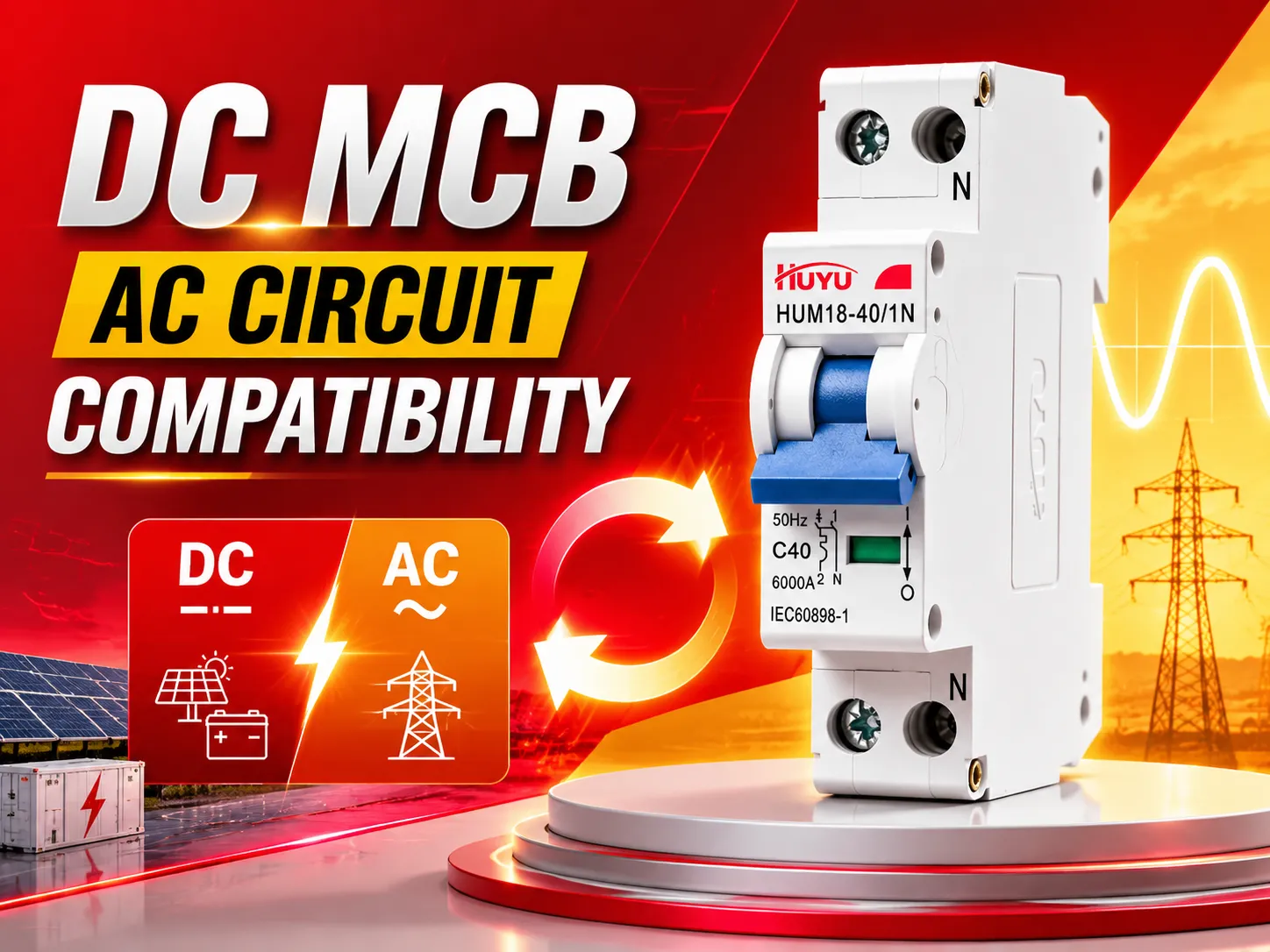
A solar installer located in Arizona contacted our technical support department regarding a challenge with his installation that had halted execution of the entire project. A small battery energy storage system was ready for commissioning and the installer required a 63 amp circuit breaker to protect the AC output of the inverter. The installer had a DC circuit breaker on the shelf that was rated for 63 amps, configured to work with the number of poles required, and rated to operate at the correct voltage; it also fit onto the DIN rail correctly. The installer installed the break, switched it on and the system operated correctly for approximately 3 weeks until the day when the breaker tripped under maximum load. The installer reset the breaker after it tripped and it tripped again with the circuit breaker contacts fused w/-closed position. After conducting further investigation, it was discovered that the installer accidently installed a single phase circuit breaker (DC) in an alternate current circuit. The design of the internal arc-suppressors in the MCB that’s specifications were written for DC generated an unacceptable condition for shutting off AC under load in an acceptable manner (i.e. safely).
As DC systems – solar PV, battery energy storage systems and off-grid systems become more prevalent and DC rated breakers start to be available, this story often retells itself because some electricians and technicians who have only worked with AC electricity at some point in their career assume that all breakers are the same. They are not. The compatibility of a DC MCB with an AC circuit is a question where giving the wrong answer could cause a fire instead of simply being a nuisance trip.
The Fundamental Difference Between AC and DC Arc Interruption
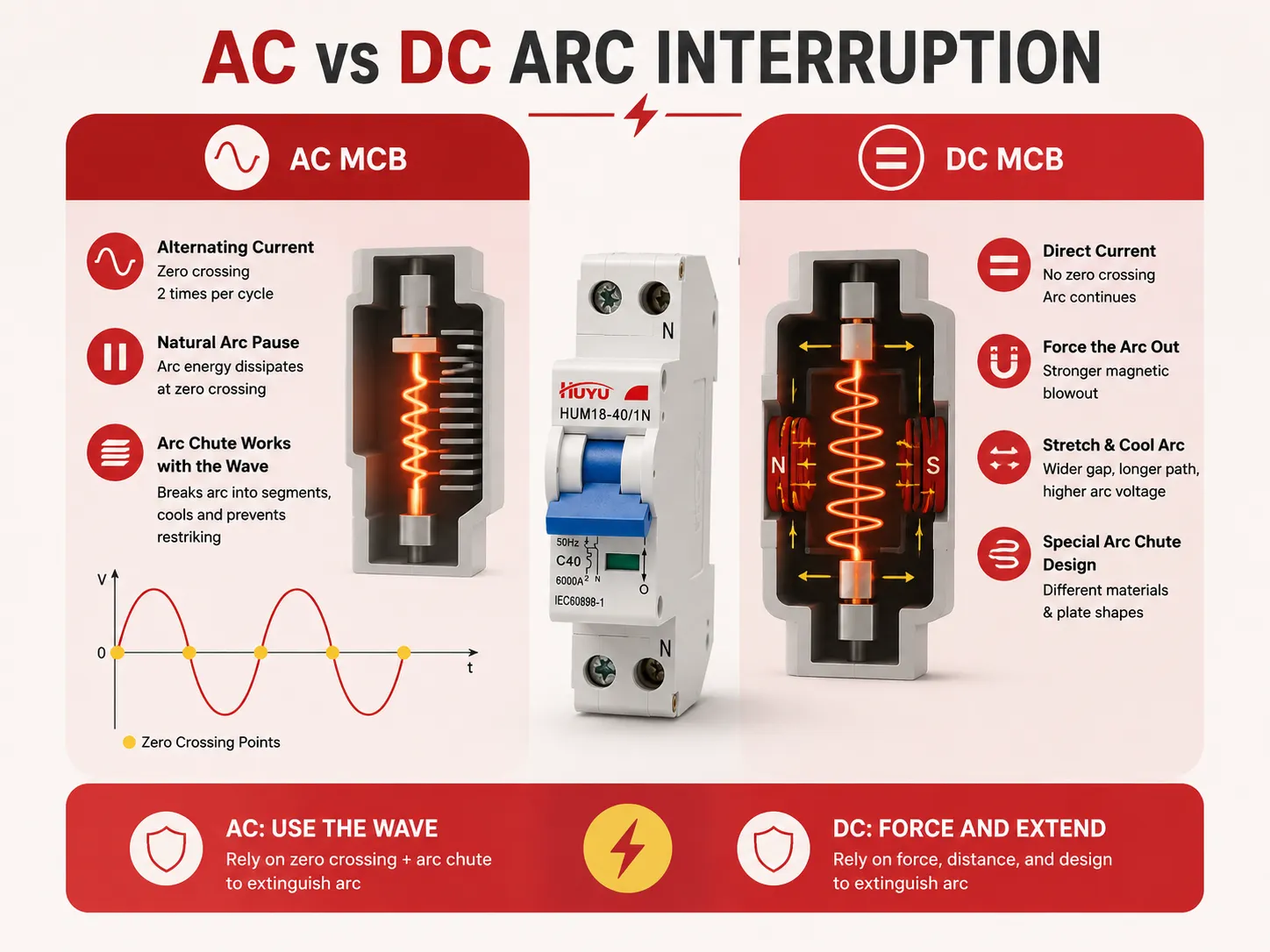
Before you can determine if a DC MCB will function properly within an AC circuit you need to understand how the MCB must extinguish the arc that develops when the circuit’s contacts are opened under load (while current is flowing through the circuit). The electrical arc created by separating contacts will continue to conduct electricity as long as the ionized air remains conductive (the heat energy generated by the arc causes air between the two contacts to become ionized). When the breaker opens (or “trips”) it’s important for the breaker to extinguish the arc before the flow of current through the electrical circuit becomes damaging; the breaker accomplishes this by extinguishing the arc based on whether you are using alternating current (AC) or direct current (DC).
Due to the alternating current of a periodic wave cycle that goes from negative to positive through zero voltage 2 times per cycle or 100/120 times per second (50/60Hz), at every zero crossing there is an opportunity for the arc energy to dissipate. The arc chute (a series of metal plates) take advantage of this natural pause or interruption in the arc’s continuation by breaking the arc into smaller segments, cooling it off, and preventing it from restriking — essentially using the AC breaker with its arc chute spacing and plate geometry that optimizes an arc’s potential to extinguish itself at the next zero crossings (no more than 8.3-ms away).
In a DC circuit, the current is steady, and there is no zero crossing. Once an arc has been started, it will continue to burn for as long as there is enough voltage to support it. In order for a DC breaker to extinguish that arc, the breaker must exert force in order to stretch the arc further from the contact surfaces, cool it down more effectively, and increase the voltage of the arc until the voltage of the source will no longer support it. Some of the ways that DC breakers accomplish this are by using stronger magnetic blowout coils, wider gaps between the contacts, and arc-chutes with different plate materials and shapes. Some designs also use permanent magnets that push the arc into a longer, spiral arc, which has no equivalent in a standard AC MCB.
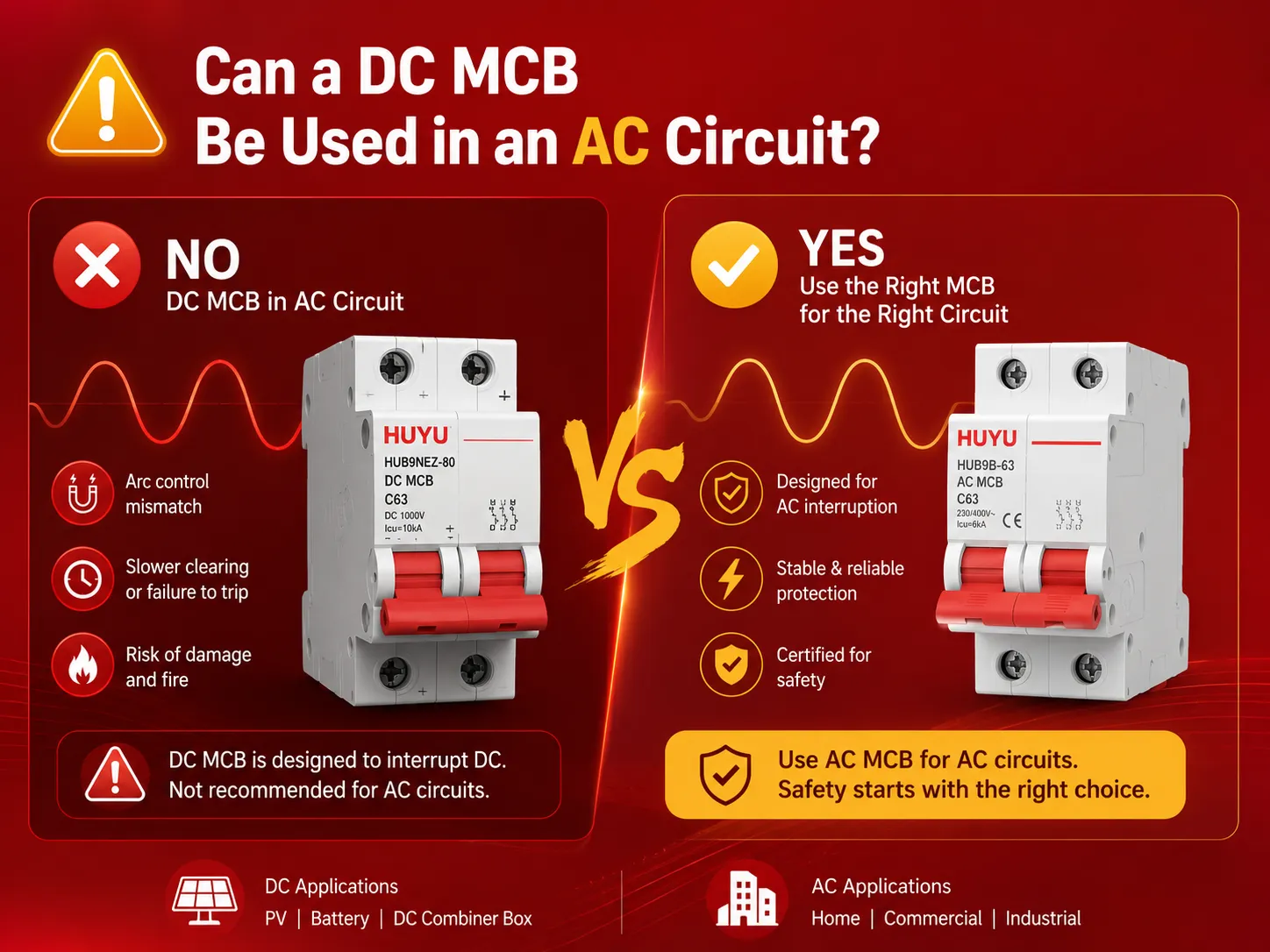
Can a DC MCB Be Used in an AC Circuit?
The simple answer is “No, standard DC MCBs (Miniature Circuit Breakers) are not suitable for use on AC (Alternating Current) circuits unless the manufacturer has clearly rated and certified the product for (AC) as well as DC operation. Because of the physical properties of the DC arc-extinguishing system, the DC breaker is designed to interrupt DC; however, the same physical component can impede the operation of the breaker when trying to interrupt AC. For example, the magnetic field surrounding the DC breaker (used to stretch the DC arc) may have negative effects on the arc-chute cooling system of a DC breaker (used to cool the AC arc) and therefore, either slow down the total clearing time or create a failure to clear the circuit.)
When using DC MCBs in applications other than what they were designed for (e.g. AC circuits), it is important to verify that the polarity of the circuit matches that of the MCB. If the MCB is installed with the wrong polarity, it can lead to incorrect operation of the device and serious damage due to an electrical fault. For example, installing a DC MCB in an AC circuit with reverse polarity would cause the magnetic fields generated by the MCB to push the arc in the wrong direction during the reverse half-cycle, which could result in damage to the MCB or any equipment connected to the MCB.
Some manufacturers produce breakers that are rated and certified for both AC and DC, or “non‑polarity” DC breakers that are less sensitive to current direction, but these are specifically engineered and tested for dual use. Our HUYU DC MCB product line, including the HUB9NEZ‑80, is designed for pure DC applications — PV arrays, battery banks, DC combiner boxes — and carries TUV and UL certification specifically for DC service. For AC circuits, we supply standard AC MCBs and MCCBs that are built and certified to the applicable AC standards. Using the correct breaker for the current type is not a suggestion; it is the foundation of safe circuit protection. For a deeper understanding of the certification framework that governs breaker selection, our article on what UL 489 breakers are explains the testing standards that both AC and DC breakers must meet.
AC MCB vs. DC MCB: A Side‑by‑Side Comparison
The differences between an AC MCB and a DC MCB are not cosmetic. They reflect fundamentally different design philosophies driven by the different arc‑interruption requirements:
| Characteristic | AC MCB | DC MCB |
|---|---|---|
| Arc extinction | Relies on natural current zero crossing; arc chute splits and cools the arc | Must force arc extinction with stronger magnetic blowout, longer arc path, and wider contact gap |
| Polarity sensitivity | Non‑polarized; current direction reverses each half‑cycle | Often polarity‑sensitive; must be connected with correct polarity for safe interruption |
| Contact gap | Smaller; adequate because of zero‑crossing assistance | Larger; necessary to stretch the arc to extinction voltage |
| Typical voltage rating | 230/400V AC, up to 690V AC for some MCCBs | 12V to 1200V DC, depending on poles and series connection |
| Magnetic trip | Set for AC‑specific inrush (transformers, motors) | Set for DC‑specific inrush (inverter capacitors, battery charging) |
| Typical standards | IEC 60898, UL 489, CSA C22.2 | IEC 60947‑2 Annex P, UL 489B, UL 1077 DC |
These differences matter in practice. An AC MCB that is installed on a DC battery circuit may fail to clear a fault because the arc never extinguishes. A DC MCB installed on an AC load may clear the first few faults but degrade rapidly as the reverse half‑cycles work against its arc‑extinguishing design. Neither situation is acceptable in a safety device.
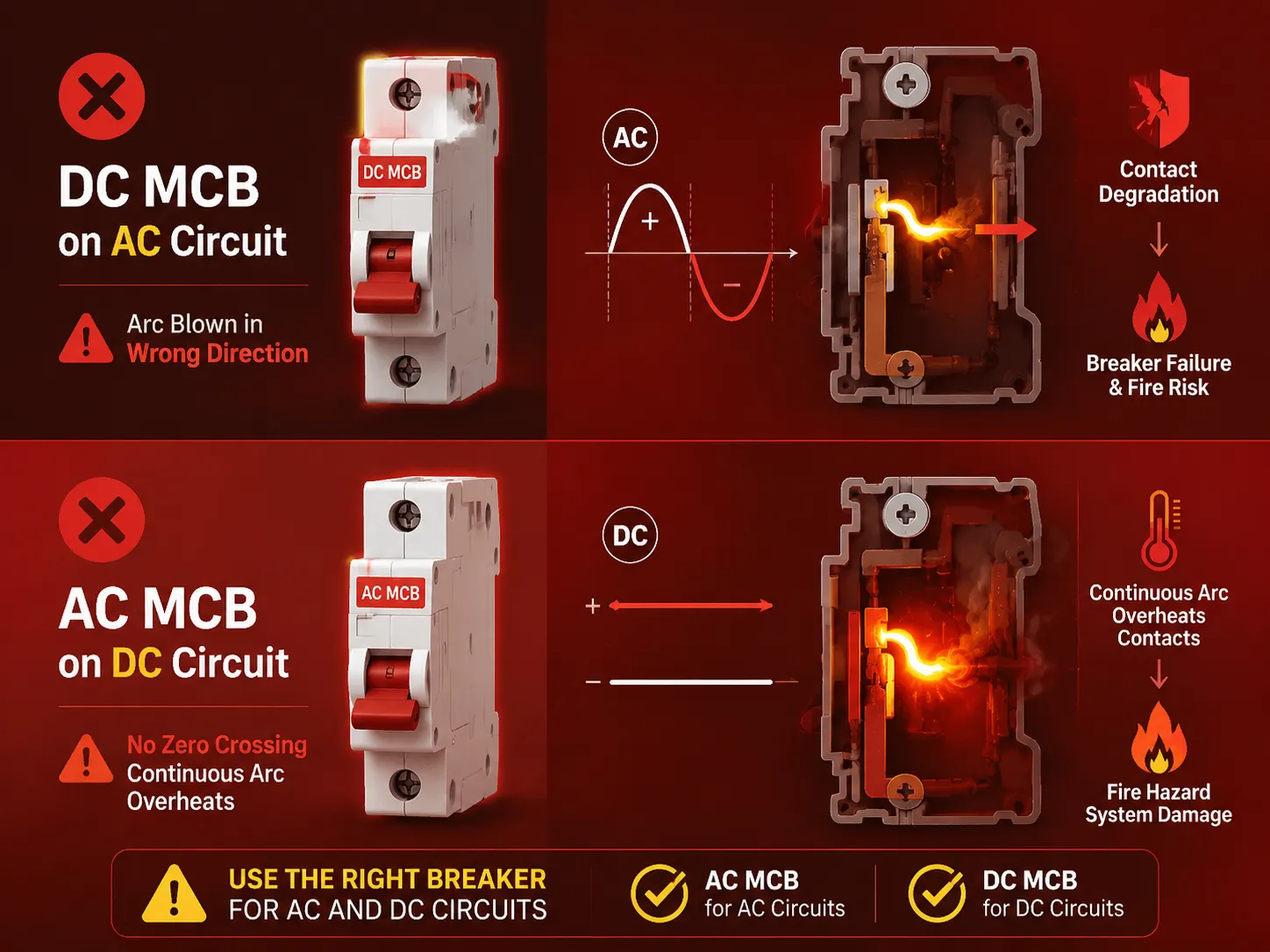
What Happens When the Wrong Breaker Is Used
The consequence of using a DC MCB on an AC circuit can be shown by the experience of an Arizona solar installer. In this case, the magnetic blowout field may cause the arc to be pushed in the wrong direction during the reverse half-cycle due to the incorrect installation of the breaker into an AC circuit. On each fault before this occurred, the breaker may have operated properly and cleared the fault; however, due to the degradation of the contacts caused by the initial fault, the breaker will likely fail on the subsequent fault and potentially cause catastrophic damage.
Using an AC MCB in a DC circuit means that there is no zero crossing for the arc to extinguish in its natural way. The arc chute is designed for an arc that collapses twice a cycle, meaning it cannot sufficiently cool down the continuous DC arc that will persist as well as overheat the contacts resulting in either the breaker not interrupting current flow at all or catching fire. The ramifications of this are not just theoretical; they are documented not only in product test reports, but also real-world failure investigations. For a broader understanding of how breakers interact with other protective devices in a system, our comparison of circuit breaker vs surge protector explains the layered protection strategy that every installation needs.
Dual‑Rated Breakers: The Exception to the Rule
Some small circuit breakers can be rated to work with both alternating current (AC) as well as direct current (DC). They are not just your regular alternating current miniature circuit breakers with a sticker saying that they have been tested and rated to work with a direct current system. Miniature circuit breakers designed for dual rating have undergone separate tests specific to the AC or DC application (i.e., have been tested both ways) and are then certified by an appropriate testing agency (such as UL) to be able to function according as intended under both types of circuit conditions. The nameplate of a dual rated miniature circuit breaker will indicate the breaker’s dual ratings (e.g., 250 volts AC / 60 volts DC for each pole) in addition to specifying that the breaker has been tested to the applicable standards for each application.
If you work on a project that utilizes both alternating current (AC) and direct current (DC) circuitry—such as a solar system with an AC inverter and a battery bank—you can use dual-rated circuit breakers to make things simpler. Just make sure the voltage and interrupting capacity ratings of the dual-rated breaker are appropriate for both applications. Dual-rated circuit breakers should be treated as the exception rather than the rule. Do not assume that either DC-rated or AC-rated circuit breakers are permissible for use in the other direction without specific manufacturer approval and certification markings that clearly indicate the appropriate usage for both types of current.
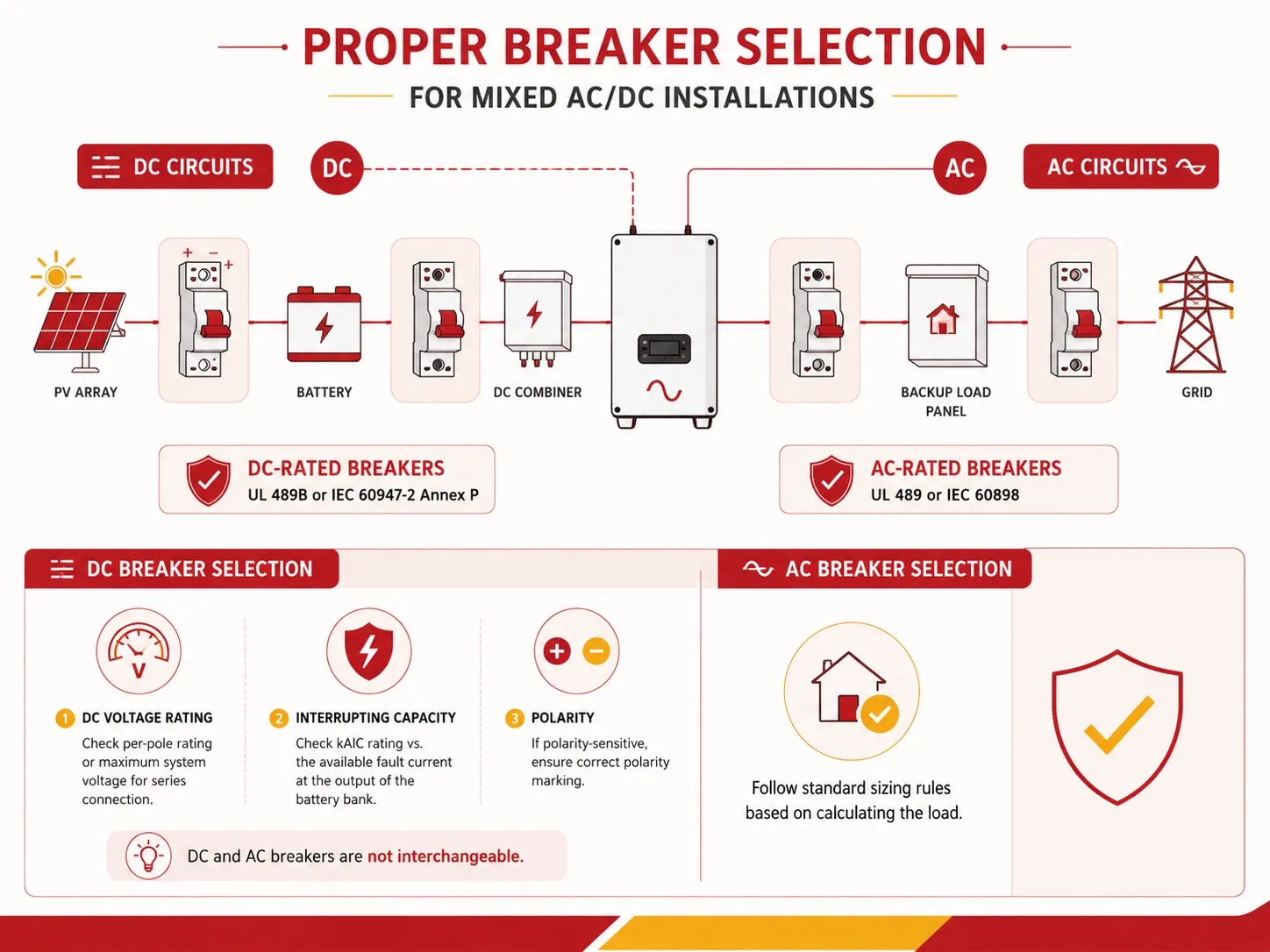
Proper Breaker Selection for Mixed AC/DC Installations
A standard solar- plus- storage solution will consist of both direct current (DC) and alternating current (AC) electrical circuits. The DC circuits may consist of the photovoltaic (PV) array, battery, and DC combiner; while the AC circuits may include the inverter output (from the inverter to the AC load), the backup load panel, and the connection to the grid. Each type of circuit requires a breaker that is rated per the type of current, voltage, and interrupting capacity of that particular circuit. The DC circuits employ DC rated breakers that are compliant with UL 489B or IEC 60947-2 Annex P certification; whereas the AC circuits utilize AC-rated breakers that are certified by UL 489 or IEC 60898. The breakers are not interchangeable.
When choosing a DC MCB for a solar or battery application, check the DC voltage rating which will be either listed as individual per-pole ratings or as maximum system voltages for multiple poles connected in series. Next, check the interrupting capacity (kAIC) rating (also known as short-circuit current interrupting capacity) versus the amount of fault current at the output of the battery bank. Finally, if the breaker is polarity-sensitive, check that it has been marked correctly for polarity. For the AC side of the installation, follow standard sizing rules based on calculating the load. Our guide on what size circuit breaker you need walks through the calculation for both general and motor loads.
Frequently Asked Questions
Can we use DC MCB in AC circuits?
Do not use a standard DC MCB with an AC circuit or other AC systems. Such breakers have their arc‑extinguishing mechanism designed to work with DC voltage and, therefore, cannot safely interrupt AC voltage. The magnetic protection used in conjunction with the blowout field and a polarity-sensitive design, can cause an AC fault to not be cleared by the breaker. The only time you should use a DC MCB on an AC circuit is if the manufacturer has explicitly rated and certified the MCB for both AC and DC service.
Can MCBs be used for DC?
AC miniature circuit breaker (MCB) can safely handle AC loads. However, if the MCB has not been tested, certified, or rated for DC use, it does not have the ability to safely interrupt DC. The reason a current zero crossing occurs in AC systems is due to the sinusoidal waveform that is used in AC systems. Because there is no current zero crossing with DC, the MCB is unable to extinguish the arc with AC designed arc chutes, therefore failing to interrupt the current in a DC application. Because of this issue, the breaker must have been specifically designed, tested, and marked for DC application with a specified DC voltage and interrupting capability.
What is the difference between AC MCB and DC MCB?
Arc extinction is one of the key differences between both types of Miniature Circuit Breakers (MCBs). An alternating current (AC) MCB achieves its arc extinction by using the natural current zero crossing during each half-cycle. A direct current (DC) MCB has to force its arc extinction with a much stronger magnetic blowout field, wider contact gap, and an internal design of the arc chute allowing for cooling of the arc after it has been extinguished. MCBs that are designed for use with DC will generally be polarity sensitive, whereas AC MCBs do not have this requirement. There are also differences in the voltage ratings, test standards, and trip characteristics across both types of MCBs.
Are DC and AC circuit breakers the same?
DC and AC circuit breakers differ from one another. Each type has its own unique means of interrupting arcs; they are also designed to meet various testing standards and rated to operate safely at distinct voltage and interrupting capacity levels. A circuit breaker engineered only for the purpose of interrupting direct current (DC) will not be able to safely interrupt alternating currents (AC) therefore the breaker that was intended exclusively for use with AC will not limit dangers if an attempt were made to use it to interrupt current composed of DC; exception being in cases where manufacturer has specified and tested such equipment suitable for both applications.
The question of DC MCB AC circuit compatibility is one where the engineering fundamentals deliver a clear answer: the breaker must match the current type. A DC MCB is built to force an arc to extinction against a steady‑state current. An AC MCB is built to let the natural zero crossing do much of the work. Using one in the other’s circuit defeats the protection the breaker exists to provide. In an electrical installation — whether a residential panel, a solar combiner box, or an industrial control cabinet — the label on the breaker tells you where it belongs. A DC rating means DC circuits only. An AC rating means AC circuits only. The rare dual‑rated breaker carries both markings and both certifications. Respecting that label is the simplest, most effective way to ensure that when a fault occurs, the breaker does exactly what it is designed to do: open safely, clear the fault, and protect everything downstream.