
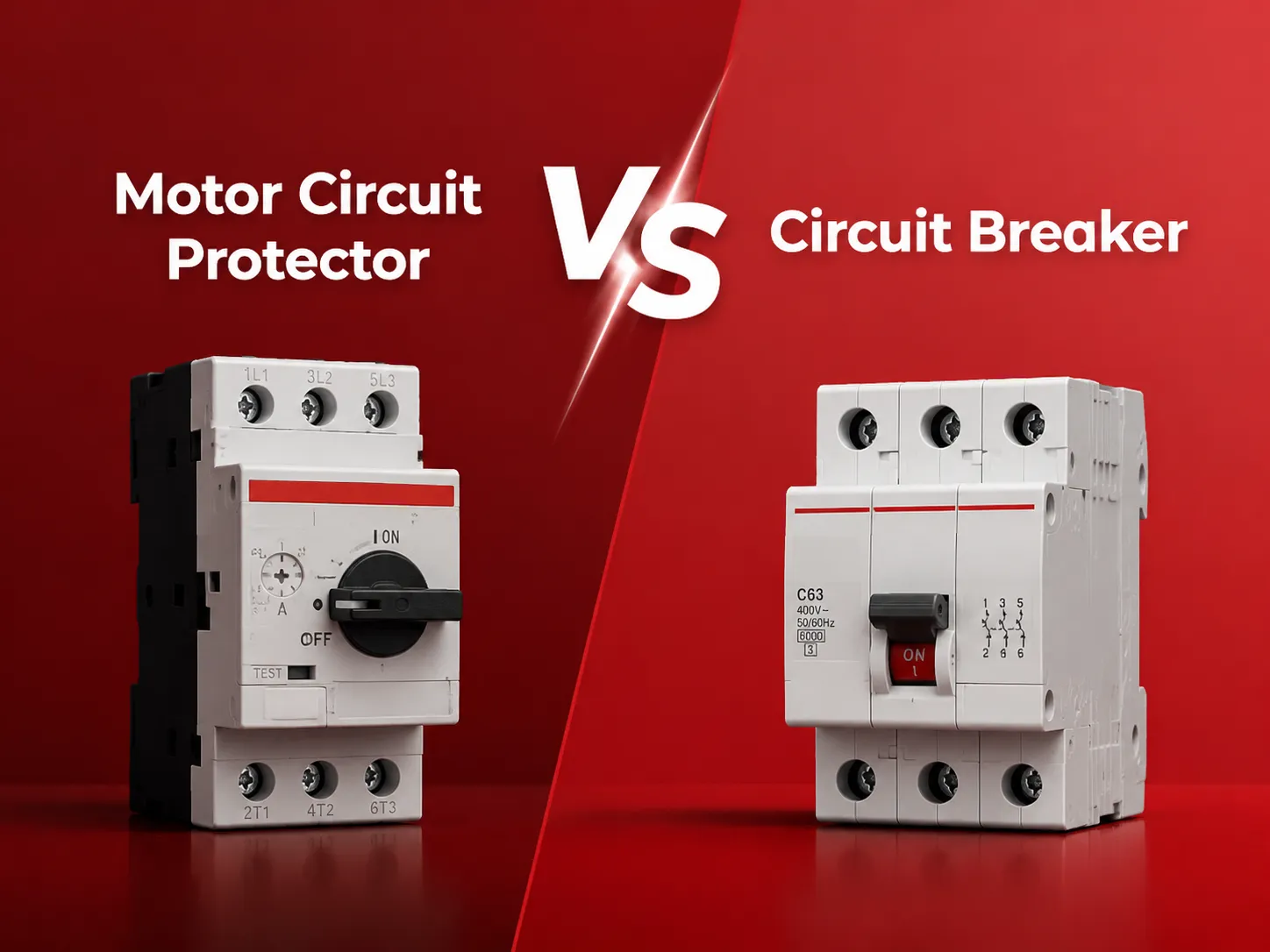
There are many occasions that illustrate how different the load characteristics of a motor are compared with those of a heater or lighting circuit. One such example is a case that occurred a few years ago, when a maintenance electrician was called to a food processing facility due to an unexpected production line shutdown. The electric motor powering the entire packaging section (20 horsepower) had tripped its circuit breaker. Upon resetting the circuit breaker, the electrician attempted to start the motor again, only to find that it had tripped again upon start-up. After diagnosing the problem, the electrician discovered that someone had installed a new circuit protective device (circuit breaker) in place of the original motor circuit protector device (also known as a motor starter).
The newly installed circuit protective device was a standard thermal magnetic circuit breaker with an amperage rating equal to the original motor starter; however, it had a magnetic trip setting that was too low to allow sufficient time for the motor’s normal inrush current to settle to a steady-state level. On the other hand, the magnetic trip setting of the newly installed circuit protective device was set high enough to provide an excessive inrush current at startup, which ended up damaging the motor (degrading the winding insulation), that would ultimately end up requiring a rewind of the motor for a cost of $1,200. As engineers and technicians enter the professional world, they eventually discover one of the fundamental truth of design, that is, the protection for a motor load must be selected based on the distinctive characteristics of the motor, as compared to the distinctive characteristics of a heater or a lighting load.
Two Devices, Two Distinct Functions
Although the terms motor circuit protector and circuit breaker can be used interchangeably, they actually describe two different types of devices with very different internal designs that serve different functions in a motor branch circuit. A standard circuit breaker, most often a miniature circuit breaker (MCB) or molded-case circuit breaker (MCCB), is a device that has been designed to provide general-purpose protection for wires and connected general loads from overload and short-circuit conditions by providing both overload and short-circuit protection through its bimetallic thermal element and electromagnetic coil, respectively, housed in a single unit. In contrast, a motor circuit protector (MCP) is a device that has been specifically designed to provide only magnetic (electromagnetic) short-circuit protection. An MCP has an adjustable instantaneous trip and must be used as part of a listed combination motor controller when used with a contactor and separate overload relay to provide both thermal protection for the motor and short-circuit clearing by the MCP. Neither device will provide the functions of the other, and using the two incorrectly is one way to get the kind of failure experienced by the food plant.
Why a Standard MCB Fails on Motor Duty
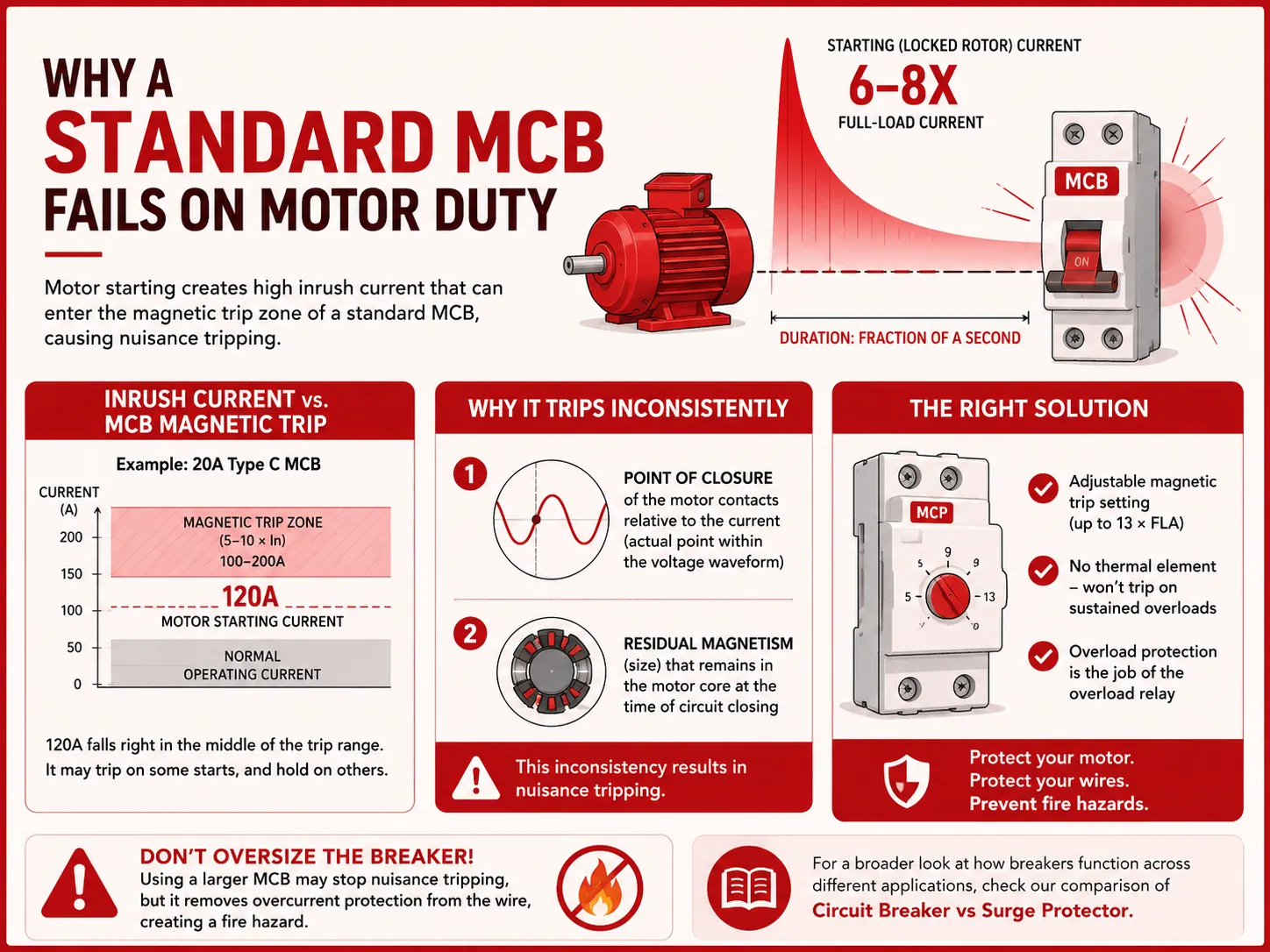
When starting up, a motor will have a starting (or locked rotor) current that can run anywhere from 6 to 8 times the full-running load current. This inrush current will only last for a fraction of a second when using direct-on-line starting, however, it may last just long enough to enter the magnetic trip zone of a standard Miniature Circuit Breaker (MCB). An example of a 20-amp Type C MCB has an instantaneous trip threshold between 5 to 10 times its rating, meaning it could trip anywhere from 100 to 200 amperes. Based on the 120 amperes of current that a motor draws at startup, it occurs right in the middle of the MCB’s trip threshold. Consequently, the breaker may trip on some motor starts and may hold on others, based upon 2 factors: 1) the point of closure of the motor contacts relative to the current (i.e. the actual point within the voltage waveform when the contacts close), and 2) the level of residual magnetic (size) that remains in the motor core at the time of circuit closing. This inconsistency is what results in nuisance tripping.
Often, uninformed troubleshooters will try to fix nuisance tripping problems by adjusting to a larger breaker; which in turning removes the overcurrent protection from the wire, thereby creating a fire hazard.
The magnetic trip mechanism of an MCP will address this nuisance tripping issue by having an adjustable magnetic trip setting (up to 13 times full-load of the motor) without any thermal element that will trip due to sustained overloads; that is the job of the overload relay. For a broader look at how breakers function across different applications, our comparison of circuit breaker vs surge protector explains where overcurrent protection ends and surge protection begins.
The Coordinated Motor Protection Trio
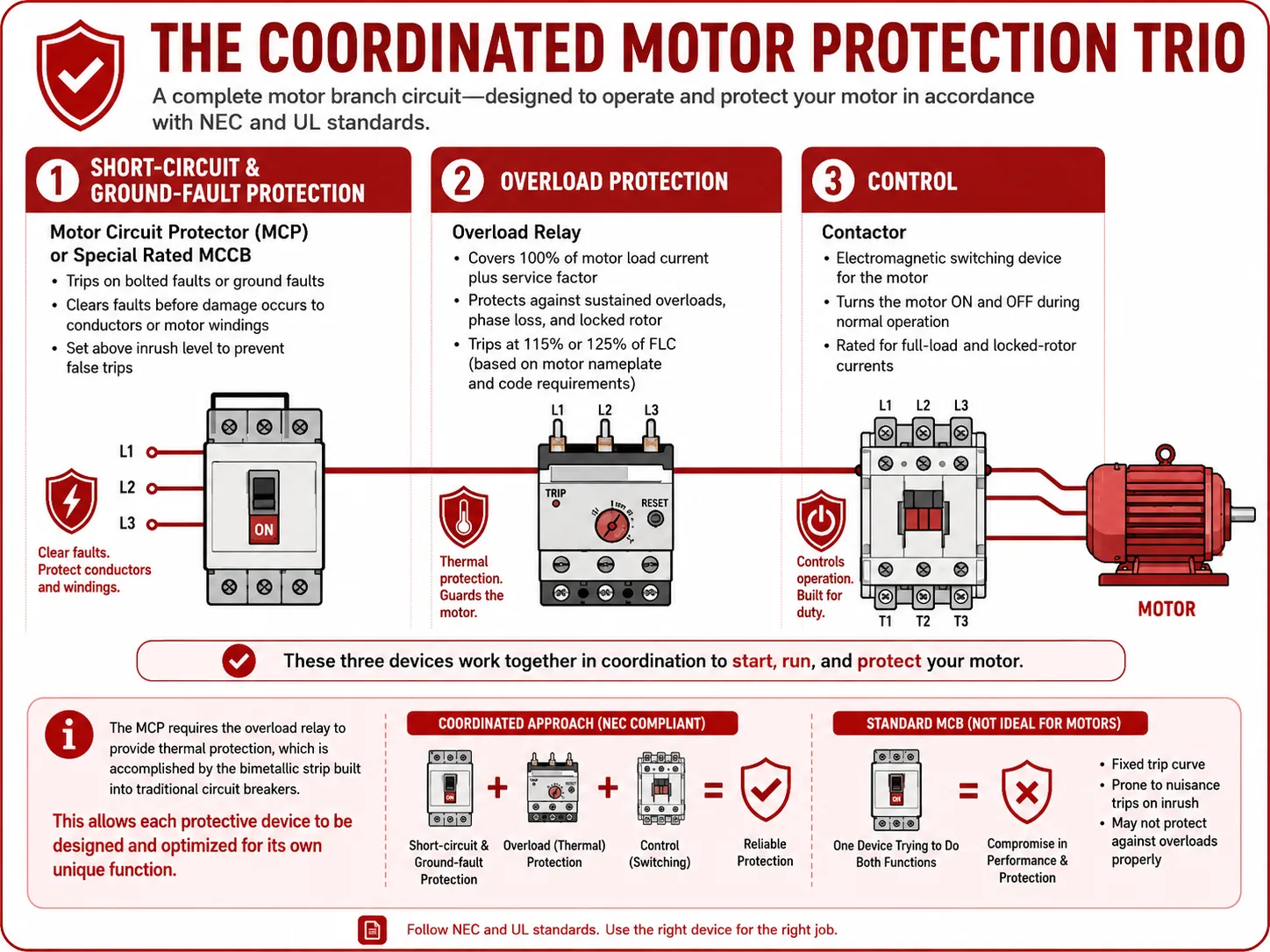
In accordance with the NEC and UL standards, a complete motor branch circuit includes three devices that work together (to operate your motor, not merely operate it):
- Short‑circuit and ground‑fault protection: The purpose of the motor circuit protector or the special rated MCCB (Molded Case Circuit Breaker) is to trip when there is a bolted fault or ground fault and to clear those faults before the current can cause damage to conductors or motor windings. It is set above the inrush level to prevent false trips.
- Overload protection: The overload relay covers the complete load current of the motor as well as its service factor. This will protect the motor from sustained mechanical overloads, the loss of one or multiple phases, and locked rotor conditions which extend beyond starting up. The overload relay will trip at either 115% or 125% of the motor’s full load current depending on both how the motor is labeled (service factor) and what is required by the code.
- Control: The contactor acts as an electromagnetic switching device for the motor and turns the motor on and off during normal operating conditions. The contactor is rated for the full‑load and locked‑rotor currents of the motor.
The MCP requires the overload relay to provide thermal protection, which is accomplished by the bimetallic strip built into traditional circuit breakers. This is done on purpose to allow each protective device to be designed and optimized specifically for their own unique applications. A standard MCB attempts to serve both functions using one constant characteristic, thereby placing it out of range for use as a motor circuit breaker, other than with very small fractional-horsepower motors where starting current is too small to affect performance.
Motor Protection Circuit Breakers: A Third Option
Motor Protection Circuit Breakers (MPCBs) have the following rounded aspects due to the requirements of the Canadian Electrical Code (CEC) and the National Electrical Code (NEC):
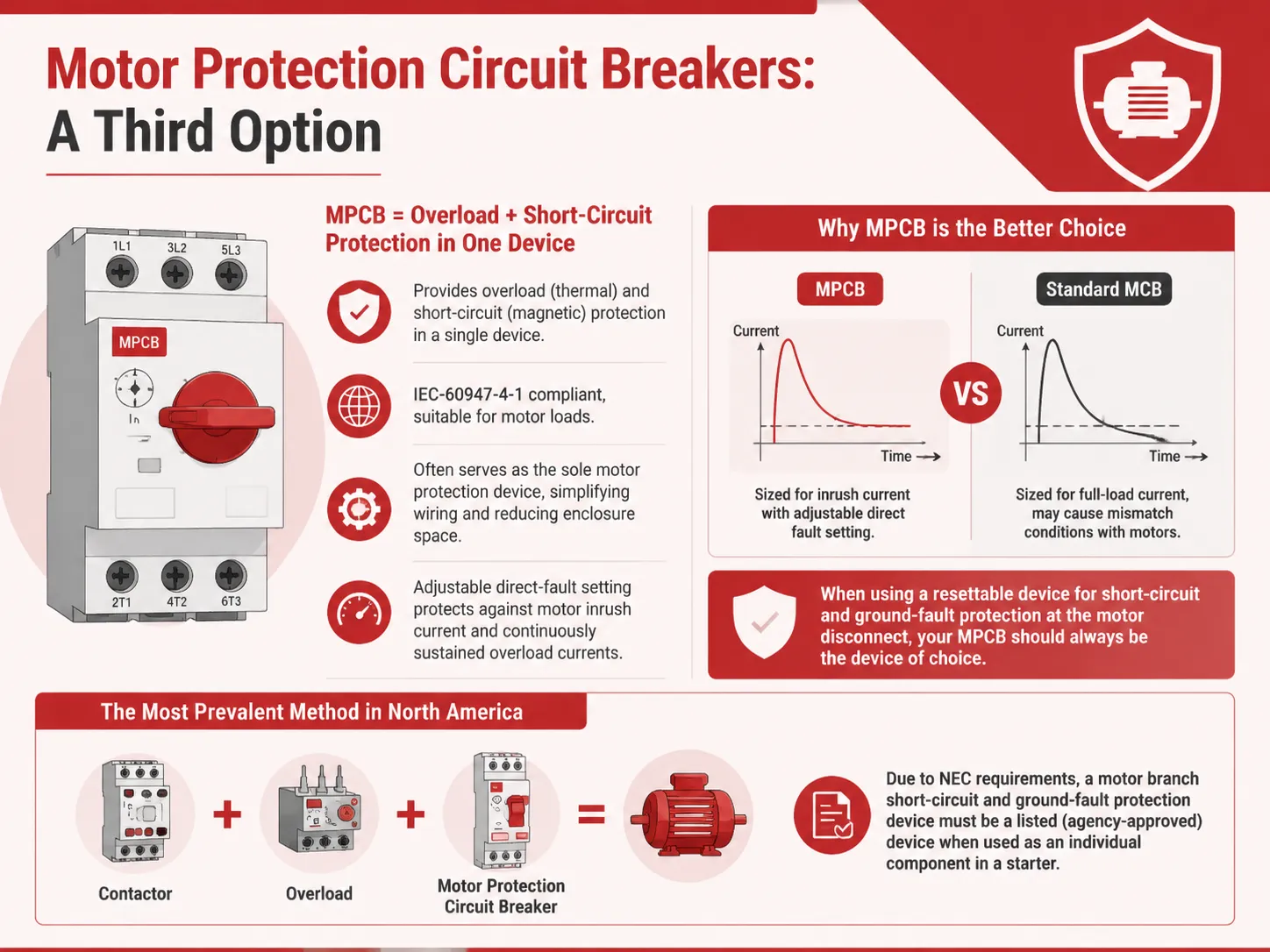
• MPCBs, commonly found in both North American and IEC markets, provide overload (thermal) and short-circuit protection (magnetic) in a single device, are classified under IEC-60947-4-1 as being suitable for motor loads, and serve many applications as the sole motor protection device simplifying the wiring and reducing the enclosure space.
• The direct-fault setting of your MPCB provides a flexible means to protect against both the inrush current of the motor, as well as its continuously sustained overload currents.
• The standard MCB may provide a direct fault setting; nevertheless, it will create a mismatch condition when used with motors due to the problem of the MCB being sized for full-load current (FLC), while your MPCB is sized for inrush current.
When using a resettable device for short-circuit and ground-fault protection at the motor disconnect, your MPCB should always be the device of choice.
However, in the context of generally accepted methods for controlling industrial AC motors in North America, the combination of Contactor, Overload, and Motor Protection Circuit Breaker still represents the most prevalent method for achieving motor control; this is primarily due to the NEC maintenance of the requirement for a motor branch short circuit and ground fault protection device as a listed (agency-approved) device when used as an individual component in a starter.
The 125% Rule and Its Role in Motor Protection
In the National Electrical Code (NEC), overload protection should be sized incorrectly for motors that have a service factor larger than 1.15 at no more than 125% of the full load. On the other hand, the maximum overload adjustment on the overload relay of a motor having a service factor of 1.0 or a temperature rise of 40 degrees Celsius will be at 115% of full load. The intent of this article is to provide motor overload protection that will not trip the overload relay under normal running conditions, but the overload relay will trip before the winding insulation of the motor reaches a temperature that will shorten the lifetime of the motor. This rule applies only to overload relays and does not govern a motor’s short-circuit device. The setting of a magnetic trip on an MCP is much higher (normally between 700–1300% of full load) than the setting of the overload relay (125% of full-load) according to NEC Article 430.52. Article 430 establishes the maximum amount of short circuit protection for instantaneous trip breakers that can be used in combination with an overload relay with rating of 1300% of full load. The 125% rule and the high setting associated with the MCP’s magnetic trip support each other: the overload relay protects against slow thermal damage to the motor, while the MCP protects the motor against rapid fault currents. Neither of these values can be interchanged between devices without invalidating the coordination that will ensure that the motor continues to operate safely.
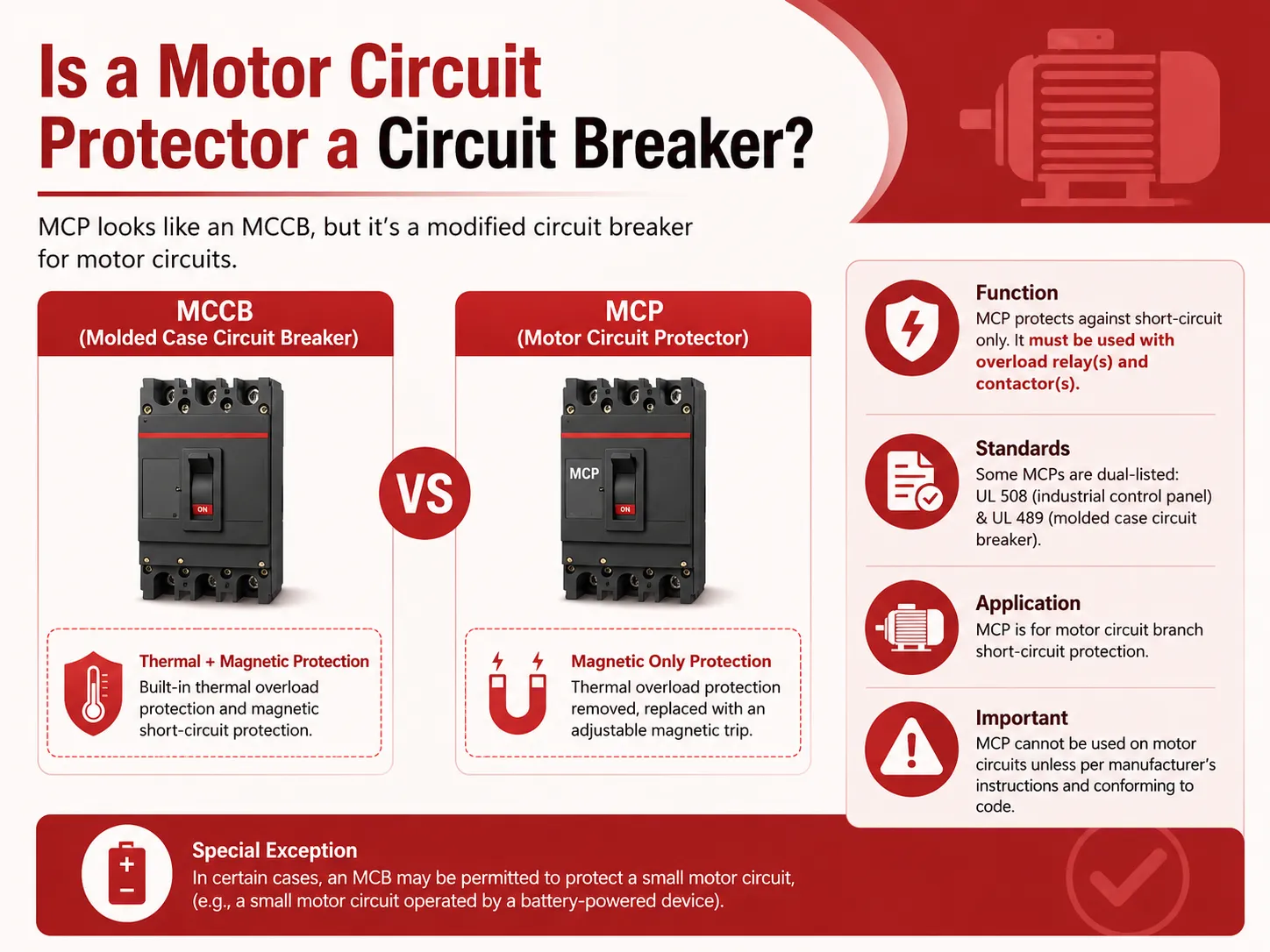
Is a Motor Circuit Protector a Circuit Breaker?
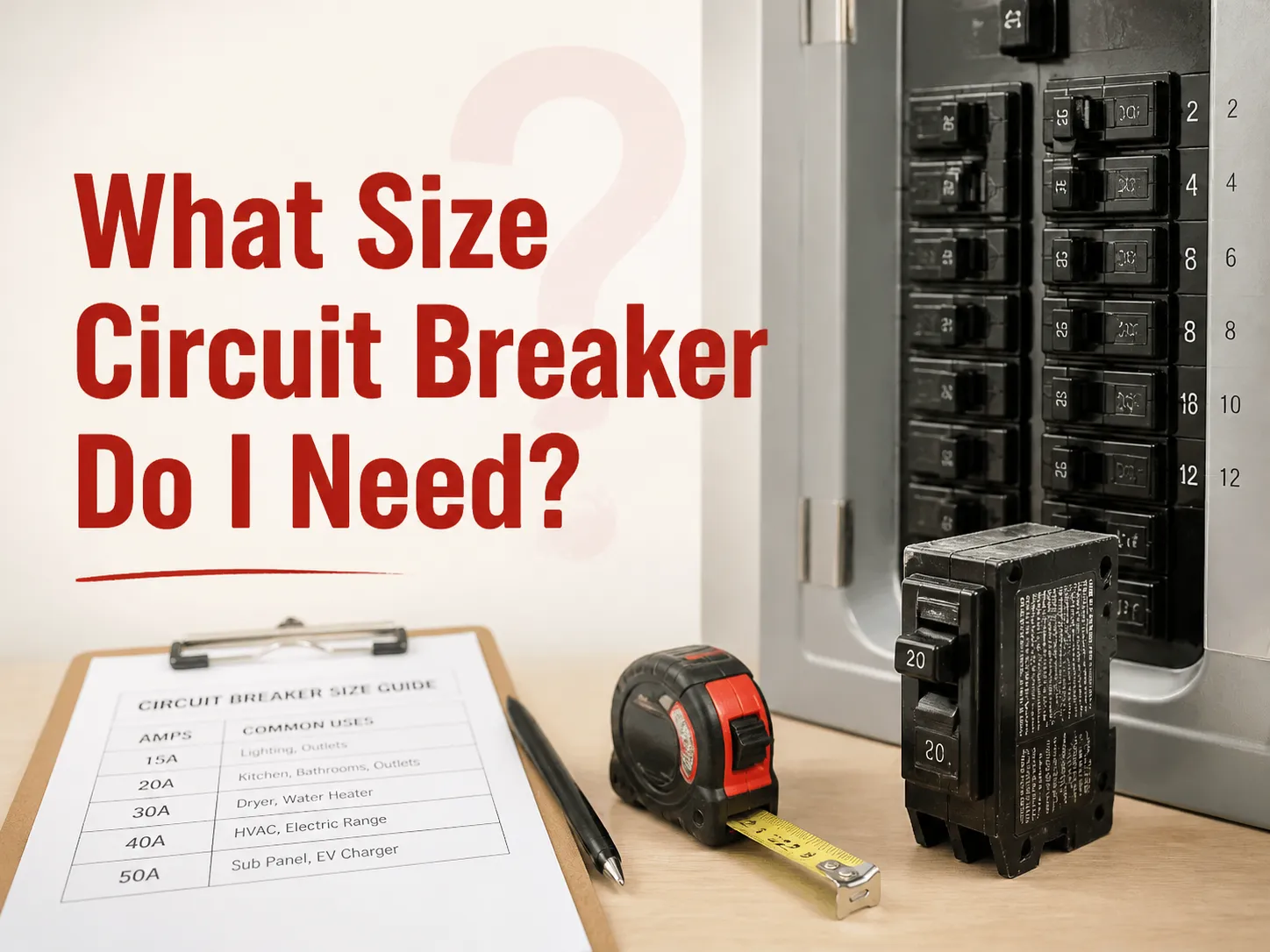
When installation project questions arise, they require a differentiation between the physical characteristics and overall functionality as well as configuration type and model number used for identified purposes. In appearance, the modified circuit protector (MCP) has the same enclosure and toggle switch configuration as a molded case circuit breaker (MCC); however, functionally, the MCP is a type of circuit breaker that has been modified to remove its thermal overload protection device and was replaced with an adjustable magnetic trip device. Although some MCPs are dual-listed products that meet UL 508 (for use in an industrial control panel) and UL 489 (to be used as a molded case circuit breaker), the MCP will fulfill its role as the branch circuit short-circuit protector for the motor circuit; however, they must always be used with appropriate overload relay(s) as well as contactor(s). An MCP cannot be used on the motor circuits unless per the manufacturer’s installation instructions and conforming to the appropriate code; there are certain special instances that will permit an MCB to protect a small motor circuit (e.g., a small motor circuit operated by a battery-powered device). If you need help sizing a breaker for any application, our guide on what size circuit breaker you need explains the calculation process for both general and motor loads.
How HUYU Supports Correct Motor Circuit Protection
HUYU offers a complete assortment of circuit protection devices employed in motor control systems, including molded case circuit breakers for feeder and branch circuit protections; UL 489 listed breakers that meet entrance and branch service requirements; and multiple trip characteristics to provide engineers with choices to match the protective device with the load — such as resistive heater banks or lighting panel circuits, or high inrush current motors. HUYU has mini circuit breakers to provide circuit protection for General Load applications to molded case breakers that have interrupting ratings and adjustable trip curves designed for protecting industrial motor circuits. If you select a manufacturer who provides complete test documentation and clearly labeled trip characteristics, you will eliminate the uncertainty of the food processing plant scenario — slow and costly deterioration of a motor that was never protected properly.
Frequently Asked Questions
Is a motor circuit protector a circuit breaker?
A motor circuit protective device (also called an MCP) is an electronic form of protection against motor circuit failure. An MCP is different from a standard circuit breaker because it provides only short circuit protection via magnetism —therefore it doesn’t include a thermal overload device to protect the circuit against thermal overload. It is also used together with a separate overload relay, contactor(s), and sometimes also as a dual listed product to UL998 and UL948.
Is circuit protector the same as circuit breaker?
No, “circuit protector” means a variety of different electrical devices such as fuses, supplementary protectors, and motor circuit protectors; however, a circuit breaker is an actual type of electrical device that can be reset by the user and protects against both over-currents, or over-loads, and short circuits. An MCP is also an example of an electrical device that is a type of circuit protector; however, the only function it performs is protection from short circuits and it is designed for use only with motor loads.
Why is MCB not used for motor protection?
A traditional MCB has a predetermined magnetic trip position which usually corresponds with that of the starting in-rush current of a motor therefore also causes nuisance tripping. In addition, the MCB’s thermal element is also not calibrated correctly to meet the individual motor’s specific thermal damage curve. The MCP or MPCB with their adjustable trip limits eliminate both of these mismatches while providing reliable protection from unnecessary trips.
What is the 125% rule in electrical?
According to Article 430.32 of the NEC, the 125% rule states that for motors with a service factor greater than or equal to 1.15, the overload protection must be rated no higher than 125% of the full-load current. This relates only to the overloads and not to the short circuit protection, since it is designed to protect the motor against sustained thermal overloads from use under the above average conditions of normal operation.
The difference between a standard circuit breaker and a motor circuit protector is not simply a technicality. A motor circuit protector (MCP) will provide for years of reliable and trouble-free starts. A standard circuit breaker on the other hand will either trip every other time the motor attempts to start or will quietly fail when the motor overheats due to inadequate overload protection. By providing an adjustable magnetic trip in conjunction with a properly-sized overload relay, the MCP has been validated and documented by the National Electrical Code (NEC) as well as decades of dedicated motor protection engineering as the right solution for protecting a motor from damage. A standard circuit breaker (MCB), while useful for the protection of lighting and heating loads, is an incorrect application for this purpose. At HUYU, we offer all types of protection devices that are properly rated according to the load type to ensure that the correct combination of protection and load is the foundation of a safe, dependable, and code-compliant electrical system.