
Eski konut hizmetinizi 60A'dan 100A'ya yükseltiyor, ayrık bir garaja besleyici hattı kuruyor veya yeni bir atölye tesis ediyorsanız, ilk soru her zaman aynıdır — 100 amper hizmet için ne tür kablo (bakır veya alüminyum) gerekir? Cevap, iki farklı koda bağlıdır; çünkü konut hizmeti NEC 310.12'yi kullanabilir ve böylece 83% amperajı (4 AWG bakır veya 2 AWG alüminyum) gerektirirken, ticari hizmet ya tam amperajı sağlamak için 3 AWG bakır ya da 1 AWG alüminyum gerektirir. Doğru yaparsanız muayeneden geçersiniz; yanlış yaparsanız ya muayeneden kalırsınız ya da inşaat alanınızdaki en kritik kablo aşırı ısınır. Aşağıdaki rehber, ihtiyacınız olan tüm kablo boyutlarını, bunların arkasındaki kodları, bakır ve alüminyum kablo ile ilgili çeşitli hesaplamaları ve kurulum süreci hakkında tüm detayları sağlayacaktır.
Kısaca: NEC 310.12'ye (83% kuralı) göre, konut tipi 100A tek fazlı 120/240V hizmet için bakırda minimum 4 AWG, alüminyumda ise 2 AWG gereklidir. Ticari kullanım, üç fazlı hizmetler veya 100A alt panel besleyicileri için tam NEC 310.16 amperaj gereksinimleri geçerlidir: bakırda minimum 3 AWG, alüminyumda ise 1 AWG. NEC 240.4(B)'ye göre 2 AWG bakır (115A) birçok 100A devresi için de uygun olabilir. 6 AWG, 75 °C'de 65A ile yetersiz kalır ve gereksinimleri karşılamaz. Boyutlandırmayı 75 °C sütunundaki değerlere göre ayarlayın, ~100-150 ft'den uzun mesafeler için daha büyük boyuta geçin ve projenizde yerel denetçi ile yerel hizmet sağlayıcılarıyla çift kontrol yapın.
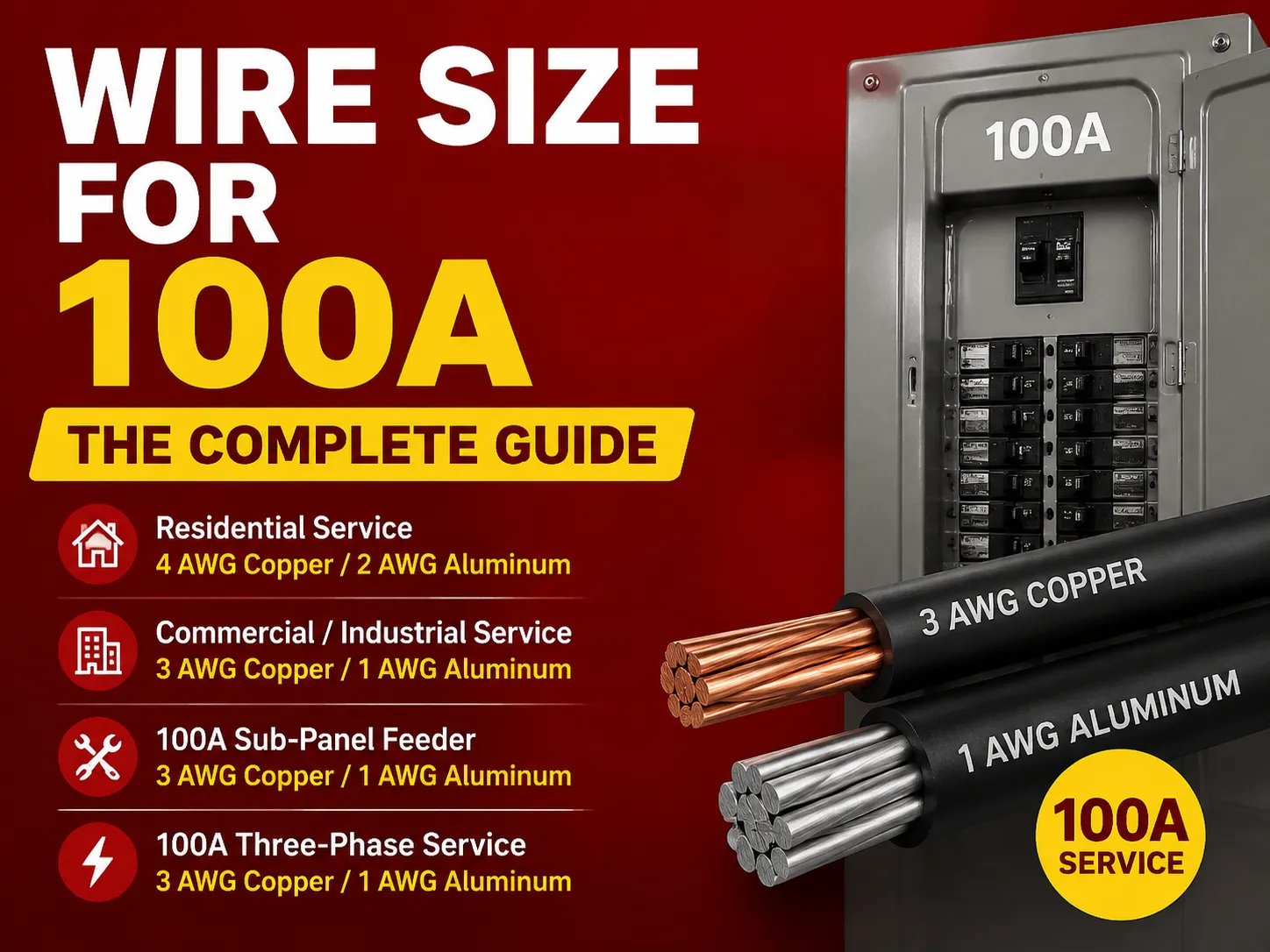
Doğrudan Cevap: 100A Hizmet için Kablo Boyutu
İşte tek bir tabloda tam cevap. Hangi satırın gerektiği yapının türüne ve bunun hizmet girişi mi yoksa besleyici mi olduğuna bağlıdır.
| Senaryo | Bakır | Alüminyum | Kod Temeli |
|---|---|---|---|
| Konut tipi konut hizmeti (tek fazlı 120/240V, çoğu ev) | 4 AWG | 2 AWG | NEC 310.12 (83% kuralı) |
| Ticari / endüstriyel hizmet (tek veya üç fazlı) | 3 AWG | 1 AWG | NEC 310.16 (tam amperaj) |
| 100A alt panel besleyicisi (garaj, atölye, ADU) | 3 AWG | 1 AWG | NEC 310.16 (konut istisnası yok) |
| 100A üç fazlı hizmet (herhangi bir kullanım) | 3 AWG | 1 AWG | NEC 310.16 (konut istisnası yok) |
İşte dikkat edilmesi gereken üç açıklama:
- 6 AWG, 75 derece sıcaklıkta sadece 65A taşıyabildiği için 100A yük taşımaya uygun değildir. Bu nedenle 50-60A devresinin bir parçası olmalıdır.
- 3 AWG bakır kablo, 75 derece sıcaklıkta tam olarak 100A taşıyabilir.
- 2 AWG bakır da uygundur çünkü 75 derecede 115A kapasiteye sahiptir, bu nedenle NEC 240.4(B)'ye göre 100A kesici kullanan devrelere bağlanabilir.
NEC 310.12 ve 83% Kuralı (Konut Servisleri)
NEC 310.12, tek fazlı 120/240V sistemle beslenen tek ailelik konut (veya bireysel konut birimi) için hizmet ve tüm ev besleyici iletkenlerinin hizmet derecesinin 83%'si olarak boyutlandırılmasına izin verir. Kuralın arkasındaki mantık, evdeki yüklerin çeşitlendirilmiş olmasıdır. Gerçekten de, tüm elektrik yüklerinin aynı anda çalışması mümkün değildir. Bu nedenle NEC, genel tablolarda belirtilenlerden daha küçük iletken boyutlarının kullanılmasına izin verir.
100A için hesaplama şu şekildedir: 100 x 0.83 = 83A gerekli akım taşıma kapasitesi. Akım taşıma kapasitesini kontrol etmek için, sıcaklık derecesini bulmamız gerekir ‒ eğer 75°C’den bahsediyorsak:
- 4 AWG bakır (85A) → 83A taşıyabilir → 100A konut hizmetleri için standart bir bakır boyutudur.
- 2 AWG alüminyum (90A) → 83A taşıyabilir → 100A konut hizmetleri için standart bir alüminyum boyutudur.
Bu yüzden insanlar “100A hizmet 4 AWG bakır veya 2 AWG alüminyum eşittir” der – kural, genel tablolardaki boyuttan bir kalıp daha küçük olduğunu belirtir. Ancak, bu şu durumlarda geçerli değildir:
- Ticari, perakende, ofis, depo veya üretim binaları.
- Üç fazlı hizmetler.
- Alt panellere besleyiciler ‒ aynı konutta kullanılsa bile tam 310.16 akım taşıma kapasitesini kullanırlar.
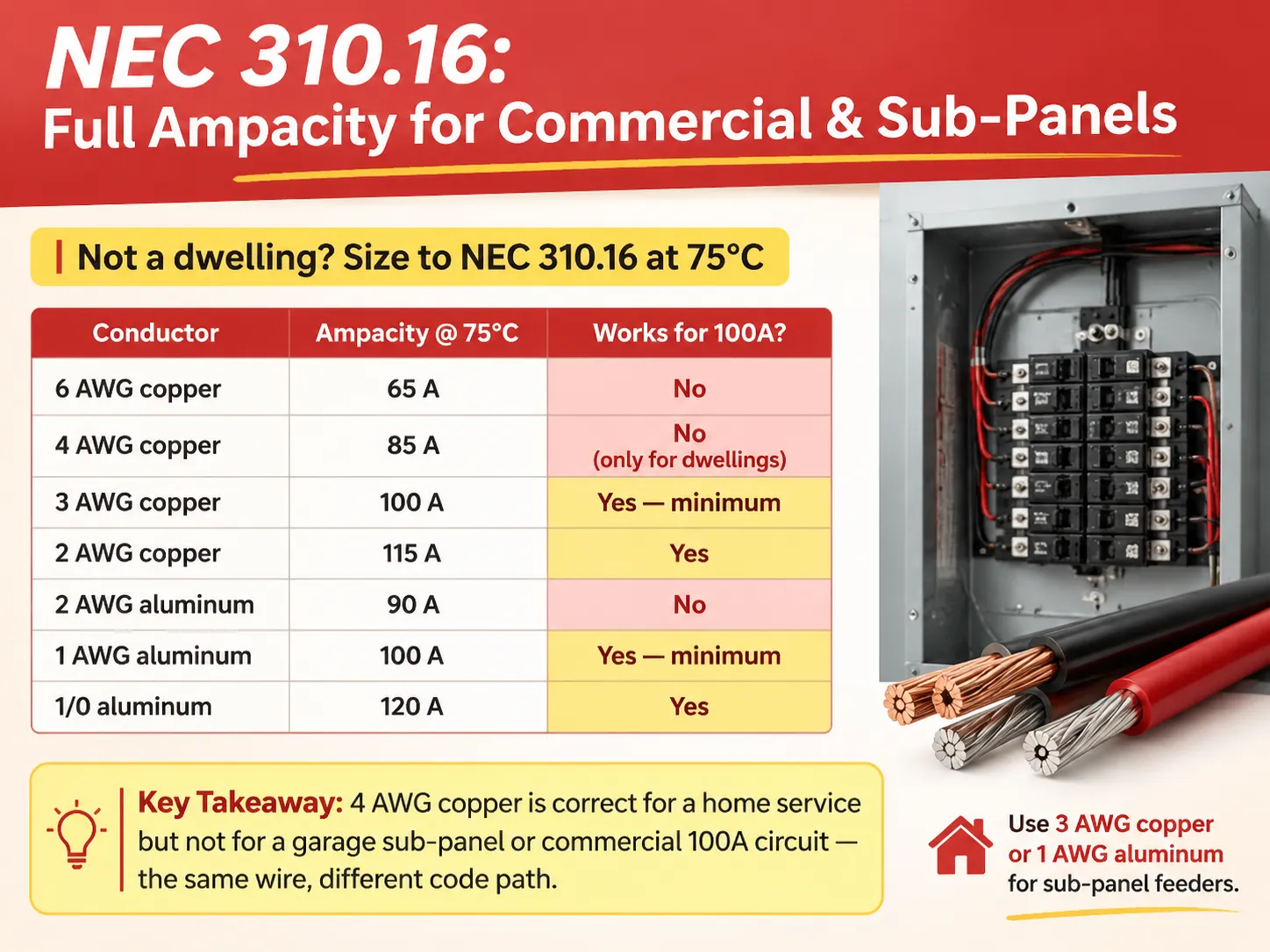
NEC 310.16: Ticari ve Alt Paneller için Tam Akım Taşıma Kapasitesi
Konut istisnası geçerli olmadığında, boyutlandırma NEC 310.16’ya göre 75°C’de yapılır (hizmet ekipmanı terminasyonları için standart):
| İletken | 75°C'de Amperaj Kapasitesi | 100A için uygun mu? |
|---|---|---|
| 6 AWG bakır | 65 A | Hayır (50-60A devre) |
| 4 AWG bakır | 85 A | Hayır, 310.16 altında değil (sadece 310.12 konutlarda geçerli) |
| 3 AWG bakır | 100 A | Evet — minimum |
| 2 AWG bakır | 115 A | Evet (genellikle tercih edilen) |
| 2 AWG alüminyum | 90 A | Hayır, 310.16 altında değil (sadece 310.12 altında) |
| 1 AWG alüminyum | 100 A | Evet — minimum |
| 1/0 alüminyum | 120 A | Evet (ekstra marj) |
Ana sonuç: 4 AWG bakır ev hizmeti için kabul edilebilir olsa da, garaj alt paneli veya ticari 100A devre kablosu için uygun değildir — bu kablo onaylanabilir ancak alt panel besleyici standart yöntemiyle değil. Bu durum çoğu karışıklığın kaynağıdır ve bu yüzden alt panel besleyici bakır kablolama standardı 3 AWG bakır veya 1 AWG alüminyumdur.
Bakır ve Alüminyum: Fark Nedir
Her ikisi de kod uyumludur; seçim ekonomi ve montaj disiplini ile ilgilidir:
| Faktör | Bakır | Alüminyum |
|---|---|---|
| Göreceli maliyet | Temel (pahalı) | Bu boyutta yaklaşık -60 daha az |
| 100A için gereken boyut (310.16) | 3 AWG | 1 AWG (iki boyut daha büyük) |
| Ağırlık | Daha ağır | Yaklaşık 1/3 ağırlığında — çekmesi daha kolay |
| İletkenlik | Daha yüksek | Bakırın yaklaşık ’i |
| Termination rules | Standart | Anti-oxidant compound, AL-rated lugs, correct torque — mandatory |
| Corrosion | Minimum | Oxidizes at terminations if untreated |
Aluminum is practically the most popular material used for both the 100A service entrance as well as for long feeders. Its installation is also common knowledge among certified electrical workers. There are three essentials that have to be used in all aluminum installations: an anti-oxidant joint connecting compound, terminals with AL/CU rating, and a torque wrench according to the manufacturer’s recommendations.
What Does “2-2-2-4” Wire Mean?
If you are picking a residential 100A feeder, the cable is noted to be “2-2-2-4” (this might appear as “2-2-2-4 SER” or “2-2-2-4 AL”). This notation breaks down the conductors in it: 2 conductors of 2 AWG are the 2 hot legs, and another 4 AWG is the neutral type of conductor along with one conductor of 4 AWG for grounding purpose.
- Two 2 AWG hots + 2 AWG neutral provide the 120/240 volt circuit.
- 4 AWG is the ground for the equipment.
- Since this is aluminium type of SER cable, it fulfills the standard 100A residential requirement of electrical installations per NEC 310.12 (2 AWG = 90A, more than enough voltage output of 83A).
To the question, “does 2-2-2-4 wire suffice for 100 amps?” the answer is “yes” for residential service and 100A feeder, where the 83% regulation would apply. However, it wouldn’t work for commercial services at 100A that would be needing 1 AWG cables for the hots.
Will 6 Gauge Wire Handle 100 Amps?
6 AWG copper wire is appropriate for 65A at 75°C (55A at 60°C) jobs which is not sufficient for a 100A service since this wire overheating can damage the insulation and create a serious fire risk. It is preferable to use this wire in low amperage circuits, up to 50-60A. For jobs with 100A or more workloads one has to use wire sizes of 3 AWG of copper or 1 AWG of aluminum.
Is #3 Copper Good for 100 Amps?
Indeed. 3 AWG copper is rated for 100A at 75°C; making it the exact minimum for a 100A general circuit, commercial service, or sub-panel feeder under NEC 310.16. Many electricians choose 2 AWG copper (115A) for ample room, derating, or long runs; which is indeed acceptable. For residential service only, 4 AWG copper is sufficient. In a nutshell, when asked is #3 copper good for 100 amps; this wire is indeed rated properly.
Run Length & Voltage Drop
Ampacity isn’t the only constraint — long runs lose voltage. Recommended maximums to stay within a 3% drop at 240V:
| İletken | Yaklaşık maksimum tek yön koşu (3% düşüş) |
|---|---|
| 3 AWG bakır | ~147 ft |
| 2 AWG bakır | ~185 ft |
| 1 AWG bakır | ~234 ft |
| 1 AWG alüminyum | ~142 ft |
| 1/0 alüminyum | ~178 ft |
| 4 AWG copper (310.12 dwelling) | ~116 ft |
| 2 AWG aluminum (310.12 dwelling) | ~112 ft |
General information: ampacity is good for lengths up to around 100 ft, consider going one size up from 100-150 ft, and for lengths of around 150 ft and beyond, ampacity will need at least one size up (for example, from 3 AWG copper to 2 AWG or from 1 AWG aluminum to 1/0). In general, long runs in rural areas usually need more than one size increase.
Neutral & Grounding Conductor Sizing
A full installation of 100A must include neutral and grounding conductors as follows:
- Neutral: Correctly determined as per the calculated unbalanced loading (NEC Table 220), it is equivalent to the circuit hots for a 100A service in most cases, whereas one size lower in case allowed by the calculations.
- Grounding electrode conductor (GEC) – sized as per NEC table 250.66 – GEC is usually 8AWG copper minimum for 4AWG copper or 2 AWG aluminum service conductors; check the table for your proper wire size.
- Equipment ground (subs): sized as per NEC table 250.122 – typically 8 AWG copper or 6 AWG aluminum for 100A feeder.
- Grounding electrodes: for a building service grounded by two rods at decent distance from one another (NEC table 250.52).
It is one of the most common manageable mistakes in the service work to confuse tables 250.66 (GEC) and 250.122 (equipment ground) – pick the correct table for the right wire.
Sub-Panel Specifics: Detached Garage & Workshop
Running 100A to a detached garage, workshop, or ADU has additional codes and regulations to consider:
- A 4-wire feeder must be installed; this includes two hots going from the main panel, one neutral, and an equipment ground (NEC 250.32). Remember that the installation of a 3-wire feeder in a detached building is not acceptable.
- The neutral must be isolated. You must ensure that the neutral bar in the sub-panel is separately placed from the ground bar. The main panel provides the bonding of these two.
- Grounding is necessary for the new structure. The detached building should have its own grounding system (typical grounding rods in place to be used).
- The cable type will typically be 1 AWG SER aluminum or 3 AWG copper in the conduit for the 100A feeder; this has to adhere to 310.16.
- Make load calculations – it’s essential to perform load calculations before purchasing the wiring. An ADU with electric heats and an EV charging unit may require 125A and not 100A.
Common Mistakes on 100A Installations
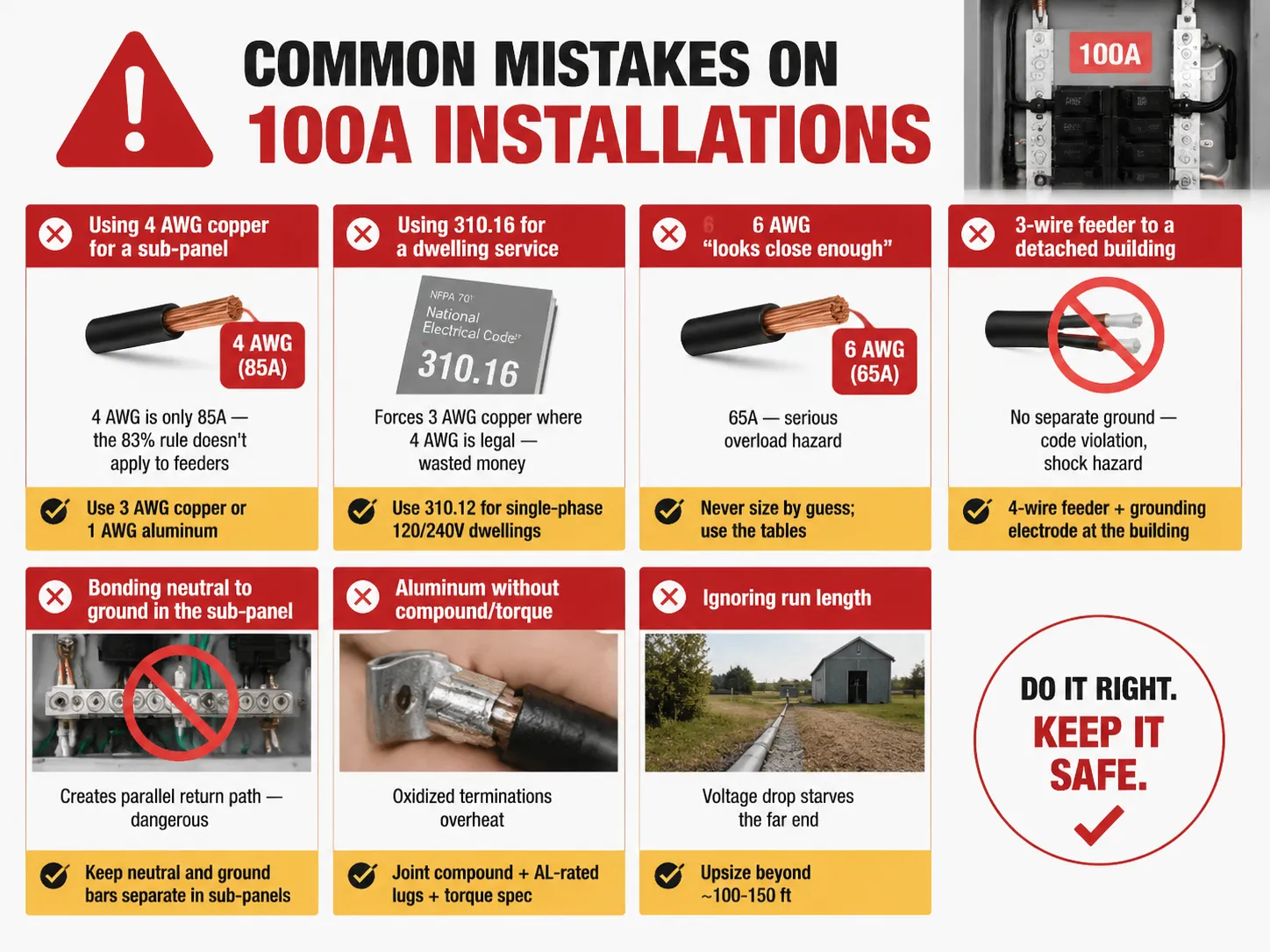
| Hata | Neden Yanlış | Doğru Yaklaşım |
|---|---|---|
| Using 4 AWG copper for a sub-panel | 4 AWG is only 85A — the 83% rule doesn’t apply to feeders | 3 AWG copper or 1 AWG aluminum for 100A feeders |
| Konut hizmeti için 310.16 kullanmak | Forces 3 AWG copper where 4 AWG is legal — wasted money | Tek fazlı 120/240V konutlar için 310.12 kullanın |
| 6 AWG “looks close enough” | 65A — serious overload hazard | Never size by guess; use the tables |
| 3-wire feeder to a detached building | No separate ground — code violation, shock hazard | 4-wire feeder + grounding electrode at the building |
| Bonding neutral to ground in the sub-panel | Creates parallel return path — dangerous | Keep neutral and ground bars separate in sub-panels |
| Aluminum without compound/torque | Oxidized terminations overheat | Joint compound + AL-rated lugs + torque spec |
| Kablo uzunluğunu göz ardı etmek | Voltage drop starves the far end | Upsize beyond ~100-150 ft |
Maliyet ve İzin Hususları
Upgrade to a 100A service or installation of a new electrical feeder has the following costs:
- Materials include: panel – $60-$200, 100A main breaker – $30-$80, 2-2-2-4 aluminum SER – $1.50-$3 per foot, 3 AWG copper – $3-$6 per foot, meter base and hardware – $50-$150.
- Jobs will run at $800-$2,500 for a service upgrade and $500-$1,500 for a sub-panel feeder, based on run distance and access through walls.
- The permit and inspection normally cost $50-$300 and are required. Inspectors check wire and grounding size and bonding to be finished.
- Utility coordination is needed as the utility will own the meter and service connection.
When the project also involves panelboard and breakers, matching certified protection devices — and understanding the breaker types involved, from the basics of MCBs and MCCBs Raporlara göre, UL 489 devre kesici standartları — keeps the whole install compliant end to end. And once the 100A main is in, every branch circuit behind it follows the same sizing discipline — the limits explained for a 15-amp circuit’s wattage apply at every level of the panel.
Uluslararası Standartlar: Kısa Bir Not
Outside of North America, the determination of 100A wiring is done differently as most of the world implements methods consistent with IEC/BS 7671 standards (current and correction factor method) instead of using a simplified service table.
- In the UK (BS 7671), cable sizes are determined based on the installation method. For instance, a 100A single-phase connection usually requires a copper wire of between 25 and 50mm² depending on how long the cable is.
- In Europe (IEC 60364), the straightforward method is used.
- In Australia (AS/NZS 3000), method-based calculations are used for insulation and often result in use of 25 to 35mm² wires.
- In Canada (CE Code), a similar argument to that put forth by the NEC is used; installations may be based on 83%-like formulas.
The NEC procedure is based on rules pertaining specifically to the US and/or Canada installations; hence, if the location of the job is different from those two places it would be wise to hire an engineer or electrician to carry out the calculations.
Sıkça Sorulan Sorular
What size wire do we need for a 100 amp service?
According to NEC 310.12 for residential systems with 100A service (single phase), it is allowed to use 4 AWG copper or 2 AWG aluminum conductors. Whereas in commercial systems with three-phase or 100A sub-panel system, the full ampacity from the NEC 310.16 has to be applied, which means a minimum of 3 AWG copper or 1 AWG aluminum conductors. In terms of size for the GEC, 8 AWG copper conductor must be used as per 250.66 along with upsizing for distances of more than 100-150 feet.
Is #3 copper good for 100 amps?
Indeed – 3 AWG copper is rated precisely as 100A at 75°C, it is exactly the minimum required for 100A regular circuit, commercial service or sub-panel feeding based on NEC 310.16. However, a large number of electricians use 2 AWG copper (115A) instead to provide more headroom due to derating. For household services only, 4 AWG copper is considered okay.
Is 2-2-2-4 wire good for 100 amps?
Indeed, when it comes to residential applications, “2-2-2-4” SER cable (2 AWG hot wires, 2 AWG neutral wire, and 4 AWG ground wire) is considered as the standard aluminum type for 100A residential service as stated in NEC 310.12 (it should be noted that 2 AWG aluminum wire is rated at 90A, which is more than enough for the 83A needed). But when it comes to commercial applications, 1 AWG aluminum wire or 3 AWG copper wire needed for 100A commercial service is required.
Will 6 gauge wire handle 100 amps?
No. 6 AWG copper wire has a rating of just 65 amperes at a temperature of 75°C (55 amperes at 60°C), which is not suitable for 100 amperes. The wire will get hot, allowing for very high risks of fire. 6 AWG copper is appropriate for circuits carrying 50-60 amperes (for example with ranges, ovens, or small sub-panels). For 100A use either 3 AWG copper or 1 AWG aluminum wire (in general) or 4 AWG copper or 2 AWG aluminum wire (for dwelling services).
Referanslar
- NFPA 70 — National Electrical Code (NEC): Articles 230, 240, 250, 310
- Mike Holt — NEC 310.12 83% Rule and Conductor Sizing
- OSHA 1910.303 — General Electrical Requirements
- EC&M Magazine — Service and Feeder Sizing Articles
- IEC 60364 — Low-Voltage Electrical Installations (International)
- NEMA — Conductor and Wiring Standards
Sonuç
The process of determining appropriate wire sizes for a service rated at 100 A depends on how you answer the question: does the 83% dwelling rule apply? According to NEC 310.12, in the case of residential applications, the standard wire sizing practice requires the use of 4 AWG copper wire or 2 AWG aluminum wire. In the case of commercial installations, systems equipped with three-phase motors, and hundred-amp sub-panels, the applicable wire sizes that comply with the code requirements concerning their ampacity correspond either with 3 AWG copper wire or with 1 AWG aluminum wire; therefore, in practice, 2 AWG copper wire is often used. When the panel and breakers are part of the job, understanding the protection devices — like recognizing a failing breaker and the practical pricing in breaker replacement cost — keeps the whole project safe, legal, and on budget.