

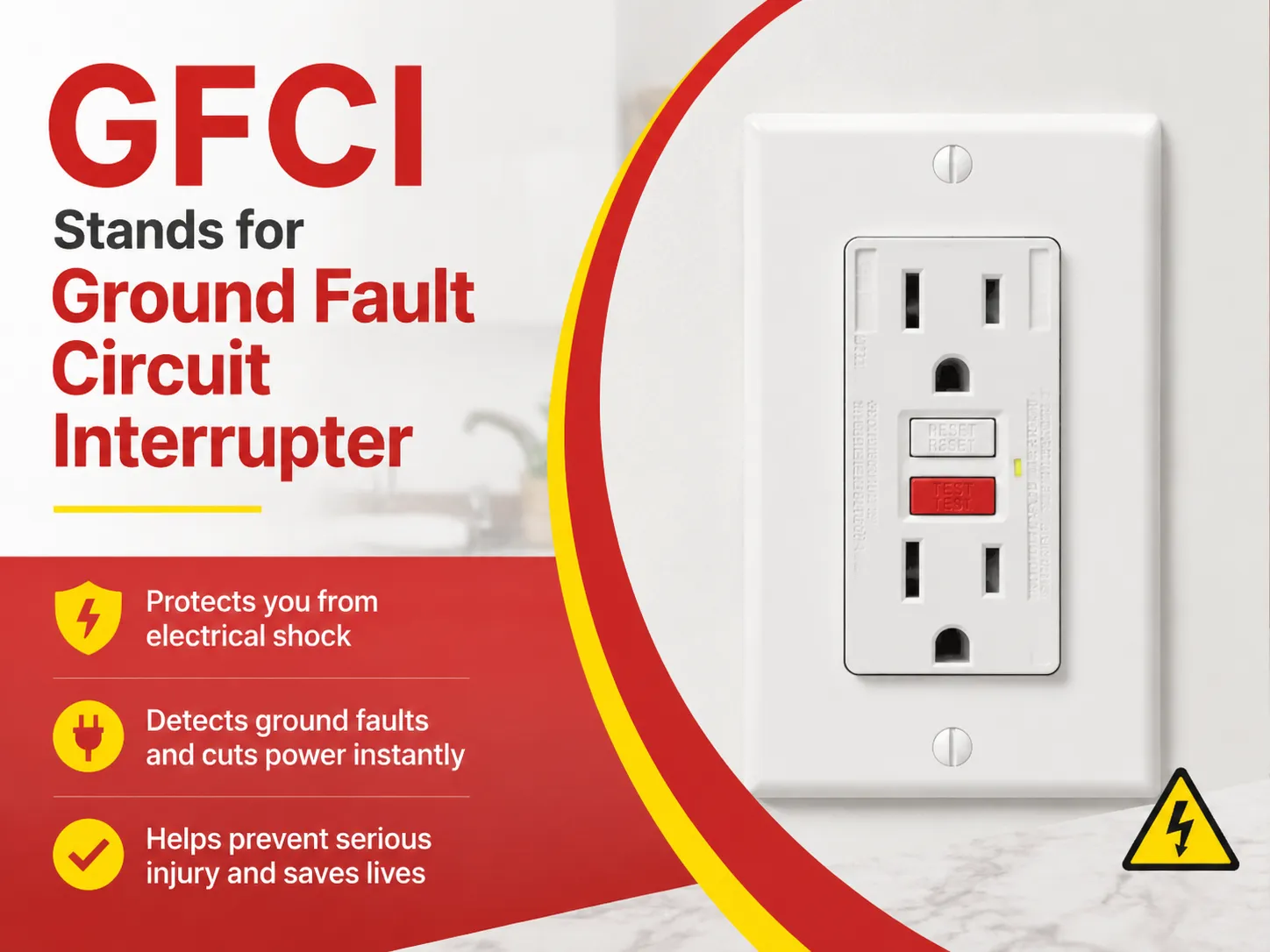
Vous êtes peut-être en train de lire une fiche technique, de vous préparer à un test en électricité, ou simplement d’essayer de comprendre comment fonctionnent vos prises de cuisine lorsque vous tombez sur l’affirmation selon laquelle “ GFCI signifie interférence de circuit de défaut à la terre ”. Cela peut sembler correct, mais c’est faux. Ce que signifie réellement GFCI, c’est disjoncteur de circuit de défaut à la terre. Vous pourriez penser que la différence entre les mots “ interrupter ” et “ interference ” réside uniquement dans l’orthographe, mais il ne s’agit pas seulement de l’orthographe ; c’est une différence de sens. Dans cet article, vous trouverez des explications sur ce qu’est un GFCI, pourquoi « interférence de circuit de défaut à la terre » est incorrect, comment fonctionne le GFCI, ce qui peut provoquer le déclenchement de l’appareil et ce que vous ne devez pas brancher sur un GFCI.
Réponse rapide : Le terme correct GFCI, qui signifie Ground Fault Circuit Interrupter, est souvent mal compris et confondu avec d’autres appellations telles que ground fault circuit interference et grand fuse circuitry dans la terminologie électrique. Ce terme désigne l’appareil qui interrompt le circuit électrique lorsqu’il détecte un défaut à la terre. Selon le National Electrical Code et les normes UL, la signification de GFCI peut être correctement comprise de cette manière.
Ce que signifie réellement GFCI
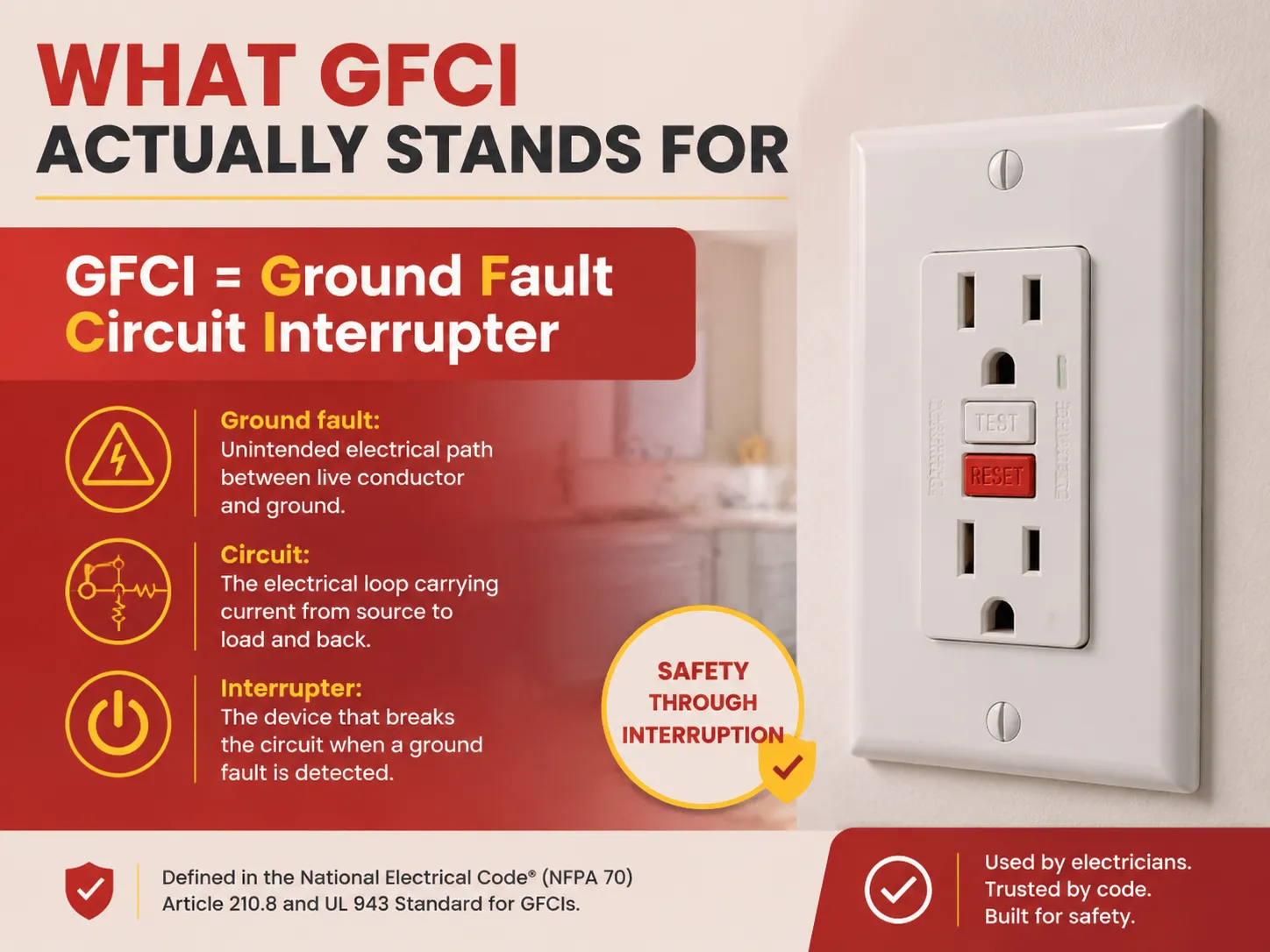
L’acronyme GFCI signifie : Ground Fault Circuit Interrupter.
Examinons les définitions de chacun des mots :
- Défaut à la terre : un cheminement involontaire de l’électricité entre un fil sous tension et la terre (c’est-à-dire, à travers une personne, à travers l’eau, à travers un fil cassé ou à travers le boîtier d’un appareil).
- Circuit : le chemin électrique qui permet au courant de circuler de N à L en boucle.
- Interrupter : une unité qui interrompt un circuit dès qu’un défaut à la terre se produit.
Ce n’est pas qu’une opinion. C’est inscrit dans le National Electrical Code (NFPA 70), où le terme “ ground-fault circuit-interrupter ” est utilisé dans l’Article 210.8 et d’autres articles connexes. Il est également utilisé dans la norme UL 943, qui est la norme de sécurité pour les GFCI. De plus, tous les programmes de formation électrique, la documentation des fabricants (par exemple, Leviton, Eaton, Legrand) et les rapports d’inspection utilisent le terme ’ interrupter “.”
Pourquoi “ Ground Fault Circuit Interference ” est incorrect
Le terme “ interference ” implique l’interruption, l’obstruction ou l’interférence d’un circuit par l’appareil, comme les interférences électromagnétiques (EMI). Ce n’est pas ce que fait le GFCI. Le GFCI n’interfère pas avec le fonctionnement normal du circuit puisqu’il reste silencieux et invisible dans le circuit tout en laissant le courant circuler normalement. Sa seule fonction est d’arrêter le flux de courant dès qu’il détecte un défaut à la terre. Ainsi, il ne s’agit en aucun cas d’une interférence.
Mais d’où vient la confusion ? Voici quelques explications :
- Son : les mots “ interrupter ” et “ interference ” commencent par les mêmes lettres et ont une sonorité assez similaire, ce qui entraîne la confusion.
- Autocomplétion : les correcteurs orthographiques et l’IA remplacent parfois “ interference ” par ce mot parce qu’il est plus couramment utilisé.
- Confusion avec EMI : les gens ont tendance à confondre “ interference ” avec “ electromagnetic interference ” (EMI).
Le mot exact, vérifié selon le NEC et UL, est interrupter, et GFCI ne peut pas signifier “ ground fault circuit interference ”. Un exemple de cette erreur serait que GFCI soit écrit comme signifiant “ ground fault circuit interference ”.
Qu’est-ce qu’un GFCI et que fait-il ?
Un dispositif d’interruption de circuit de défaut électrique est un dispositif de précaution à action rapide utilisé pour protéger les personnes contre les risques de choc électrique. Le dispositif compare le courant dans la source qui circule dans le fil de phase avec le courant dans le fil neutre. Normalement, ces courants sont égaux. Cependant, lorsqu’un certain flux de courant est perdu à travers la terre, comme lorsqu’une main mouillée touche un appareil, qu’un sèche-cheveux tombe dans l’eau, ou qu’un fil est endommagé. Le GFCI détecte le déséquilibre de courant et arrête le flux d’électricité en un maximum de 1/40 de seconde.
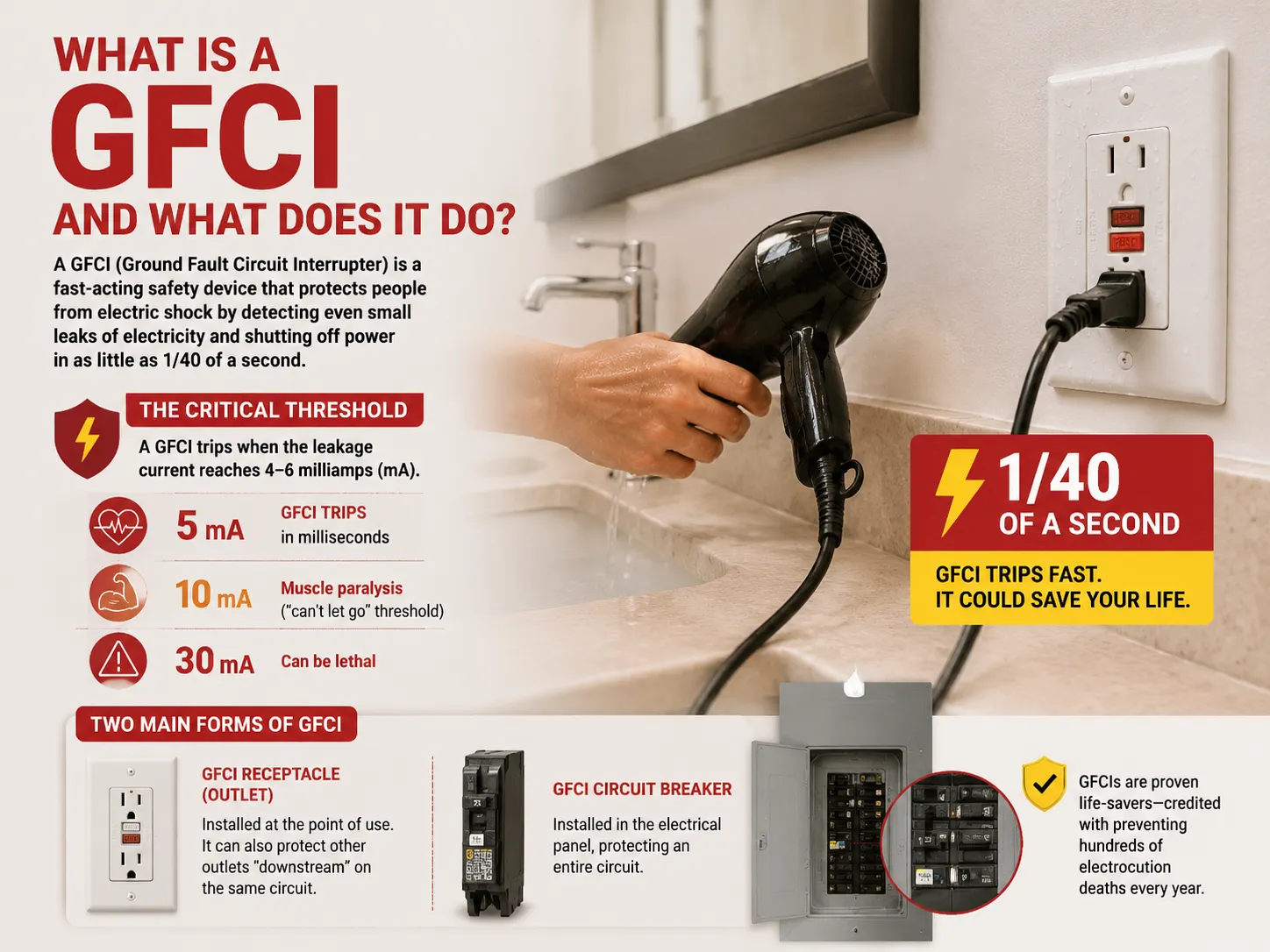
Le niveau critique : le GFCI se déclenche à la marque de 4 à 6 mA. Pour comparer, 10 mA peuvent provoquer une paralysie musculaire (le seuil du “ ne peut pas lâcher ”), tandis que le niveau létal est d’environ 30 mA. En millisecondes, les GFCI s’activent à 5 mA et arrêtent le choc avant qu’il ne soit trop tard. C’est pourquoi la Consumer Product Safety Commission attribue principalement aux GFCI le mérite d’avoir sauvé des centaines de personnes de l’électrocution. Les GFCI ont deux types principaux :
- Prise GFCI : la prise avec les boutons TEST et RESET que nous connaissons et que l’on peut trouver aux emplacements de leur utilisation. Elle peut également protéger d’autres prises sur son circuit.
- Disjoncteur GFCI : situé au tableau électrique, protégeant tout le circuit des dangers.
Notre article sur les disjoncteurs et les interrupteurs de circuit de défaut à la terre explique comment les deux fonctionnent ensemble.
Comment un GFCI détecte un défaut à la terre
Le GFCI contient un petit transformateur connu sous le nom de transformateur de courant (CT) qui entoure à la fois les fils de phase et neutre. Voici comment cela fonctionne :
- Fonctionnement normal : Le courant circule dans le fil de phase et revient par le fil neutre en quantités égales de courant. Les champs magnétiques s’annulent, et donc le transformateur ne détecte aucun courant.
- Défaut à la terre : Le courant est détourné à travers une personne, de l’eau ou une rupture vers la terre au lieu de suivre son cours habituel. Ainsi, le fil de phase reçoit plus de courant que le fil neutre.
- Déséquilibre : Le transformateur détecte la différence de 4 à 6 milliampères.
- Signal : Le transformateur de courant déclenche un solénoïde qui ouvre mécaniquement les contacts et déconnecte l’alimentation de la prise.
- Réinitialisation : L’utilisateur doit appuyer sur le bouton de réinitialisation pour rétablir l’alimentation car le GFCI conserve l’information sur le défaut.
Le GFCI est un type de protection complètement différent du disjoncteur car il détecte les fuites à la terre et non les surcharges.
Les faits et preuves : normes et codes
Voici les preuves documentaires qui tranchent la question une fois pour toutes :
| Source | Ce qu’elle dit |
|---|---|
| NFPA 70 (Code National de l’Électricité) | Définit et exige les “ ground-fault circuit-interrupters ” dans l’Article 210.8 (unités d’habitation), l’Article 210.12 (arc-fault), et l’Article 680 (piscines). Le terme officiel est “ interrupter ”.” |
| UL 943 | La norme de sécurité s’intitule “ Standard for Safety for Ground-Fault Circuit-Interrupters ”. Les GFCI listés UL sont testés pour déclencher à 4–6 mA en moins de 25 ms. |
| NEC 210.8 | Exige une protection GFCI pour les prises de salle de bains, les plans de travail de cuisine, les garages, les extérieurs, les sous-sols, les vides sanitaires, les buanderies et les bars humides. |
| Documentation du fabricant | Leviton, Eaton, Legrand, Hubbell — toutes les pages produits et manuels d’installation des principaux fabricants utilisent “ ground fault circuit interrupter ”.” |
| Usage dans le dictionnaire/industrie | Les glossaires de l’industrie électrique (IEEE, ESFI, OSHA) définissent tous GFCI comme “ ground fault circuit interrupter ”.” |
Toutes les autorités reconnues en électricité évitent le terme “ interference ”. Si vous passez un quiz ou un examen de licence basé sur cet acronyme, la réponse correcte est toujours le mot “ interrupter ”.”
Où les GFCI sont requis
Conformément à NEC 210.8, les zones suivantes dans les environnements résidentiels doivent être équipées d’une protection Ground Fault Circuit Interrupter (GFCI) :
- Les salles de bains doivent être équipées d’une protection GFCI pour toutes les prises.
- Pour les plans de travail de cuisine, toutes les prises situées à moins de 6 pieds de l’évier doivent être protégées par un GFCI.
- Une protection GFCI doit être fournie dans tous les garages ou sous-sols non finis.
- Toutes les prises extérieures, y compris celles utilisées dans les vides sanitaires et les bâtiments non finis, doivent être équipées d’un GFCI.
- Les buanderies doivent respecter les exigences de protection GFCI.
- Les bars humides doivent être équipés d’une protection GFCI.
- La protection GFCI est également requise pour les hangars à bateaux, les piscines et les spas.
Cependant, des exigences étendues en matière de GFCI s’appliquent également dans les environnements commerciaux et industriels. Les codes actuels sont devenus plus stricts (2020 et 2023) concernant les appareils qui auparavant ne nécessitaient pas de GFCI fonctionnel.
Qu’est-ce qui provoque le déclenchement d’un GFCI ?
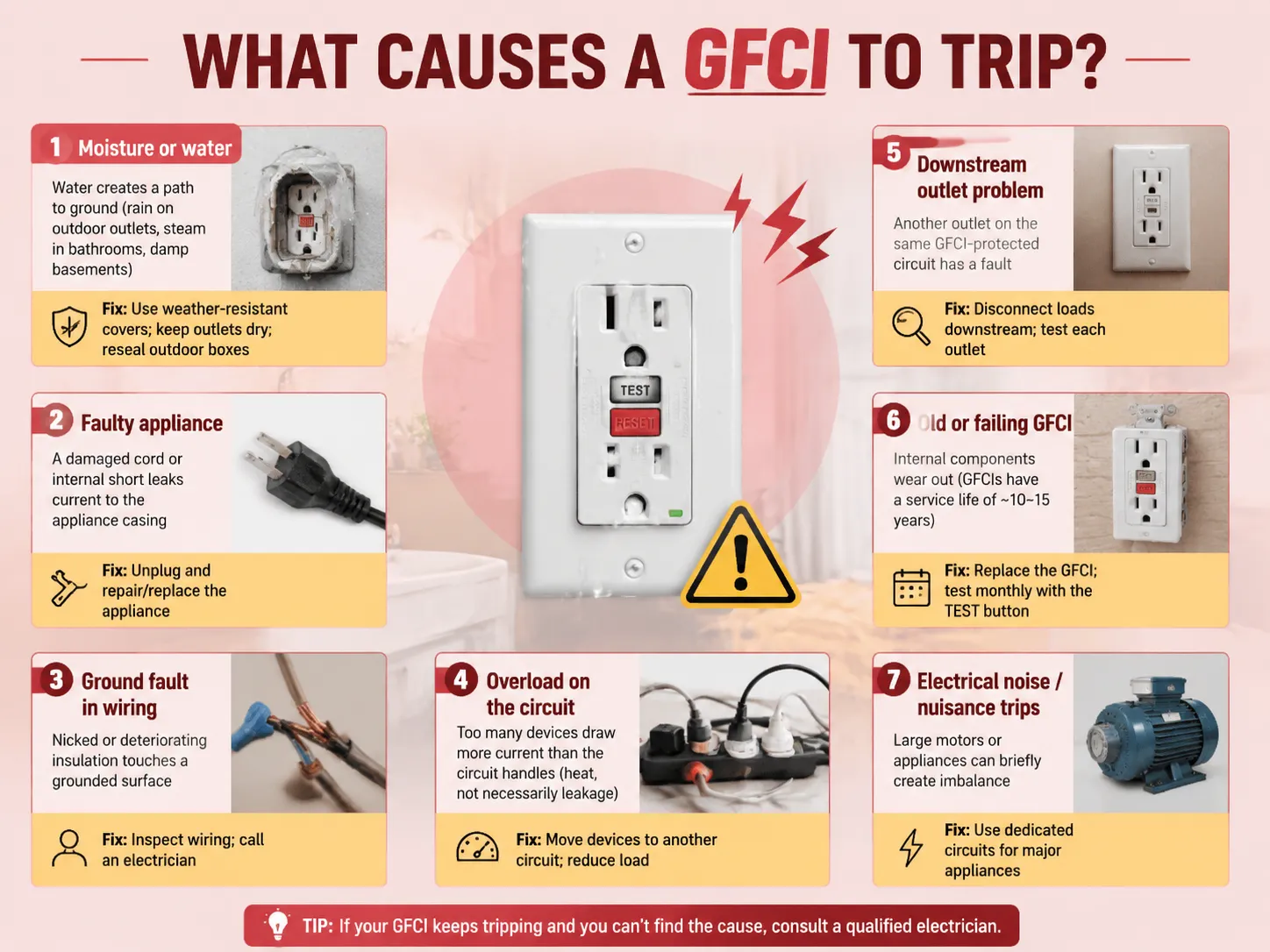
Un GFCI déclenche dès qu’il détecte un courant de fuite vers la terre. Les causes les plus courantes :
| Cause | Ce qui se passe | Solution |
|---|---|---|
| Humidité ou eau | L’eau crée un chemin vers la terre (pluie sur les prises extérieures, vapeur dans les salles de bains, sous-sols humides) | Utiliser des couvercles résistants aux intempéries ; garder les prises sèches ; resealer les boîtes extérieures |
| Appareil défectueux | Un cordon endommagé ou un court-circuit interne provoque une fuite de courant vers le boîtier de l’appareil | Débrancher et réparer/remplacer l’appareil |
| Défaut de terre dans le câblage | Une isolation entaillée ou détériorée touche une surface mise à la terre | Inspecter le câblage ; appeler un électricien |
| Surcharge sur le circuit | Trop d’appareils tirent plus de courant que ce que le circuit peut supporter (chaleur, pas nécessairement une fuite) | Déplacer les appareils sur un autre circuit ; réduire la charge |
| Problème sur une prise en aval | Une autre prise sur le même circuit protégé par GFCI présente un défaut | Déconnecter les charges en aval ; tester chaque prise |
| GFCI ancien ou défaillant | Les composants internes s’usent (les GFCI ont une durée de vie d’environ 10–15 ans) | Remplacer le GFCI ; tester mensuellement avec le bouton TEST |
| Bruit électrique / déclenchements intempestifs | Les gros moteurs ou appareils peuvent créer brièvement un déséquilibre | Utiliser des circuits dédiés pour les appareils majeurs |
Pour plus d’informations sur le diagnostic des déclenchements répétés au niveau du disjoncteur, voir nos articles sur ce qui cause le déclenchement d’un disjoncteur et si un disjoncteur qui déclenche à répétition est dangereux.
Ce qui ne doit pas être branché sur un GFCI
C'est un détail important auquel il faut prêter attention. Les codes du bâtiment stipulent la nécessité de la sécurité GFCI dans certains cas, mais plusieurs appareils ne doivent pas fonctionner sur des circuits équipés de la sécurité GFCI car leur arrêt inattendu peut entraîner des dommages.
- Réfrigérateurs et congélateurs : si un GFCI déclenche de manière inattendue, le réfrigérateur s'éteint sans que vous en soyez informé, ce qui entraîne la détérioration des aliments. Dans de nombreux cas, les électriciens placent généralement les réfrigérateurs sur des circuits dédiés et s'assurent que la protection GFCI existe uniquement là où le code l'exige, par exemple, s'ils sont situés à moins de 6 pieds d'un évier.
- Pompes de puisard : en cas de déclenchement du GFCI, la pompe s'arrête et le sous-sol est inondé. Le code actuel stipule que les circuits des pompes de puisard doivent être équipés de protection GFCI ; il est donc conseillé d'utiliser soit des disjoncteurs GFCI avec alarme, soit des pompes de puisard alimentées par batterie.
- Appareils de maintien en vie et machines médicales : ceux-ci doivent rester opérationnels et nécessitent une alimentation électrique garantie.
- Congélateurs et congélateurs de garage : le même problème que pour les réfrigérateurs.
- Ordinateurs/serveurs (dans certains cas) : un déclenchement non désiré des circuits peut entraîner la perte d’informations importantes, d’où la nécessité d’installer des circuits ininterrompus.
L’essentiel ici est que le respect des directives NEC est obligatoire si une protection GFCI est indiquée dans votre cas, car certains appareils disposent de circuits dédiés séparés des autres et équipés de disjoncteurs GFCI avec alarmes pour vous notifier en cas de déclenchement. Si vous n’êtes pas sûr des exigences en vigueur, il est toujours préférable de contacter un électricien agréé.
GFCI vs. Disjoncteur : même chose ?
Non — ils protègent contre des risques différents :
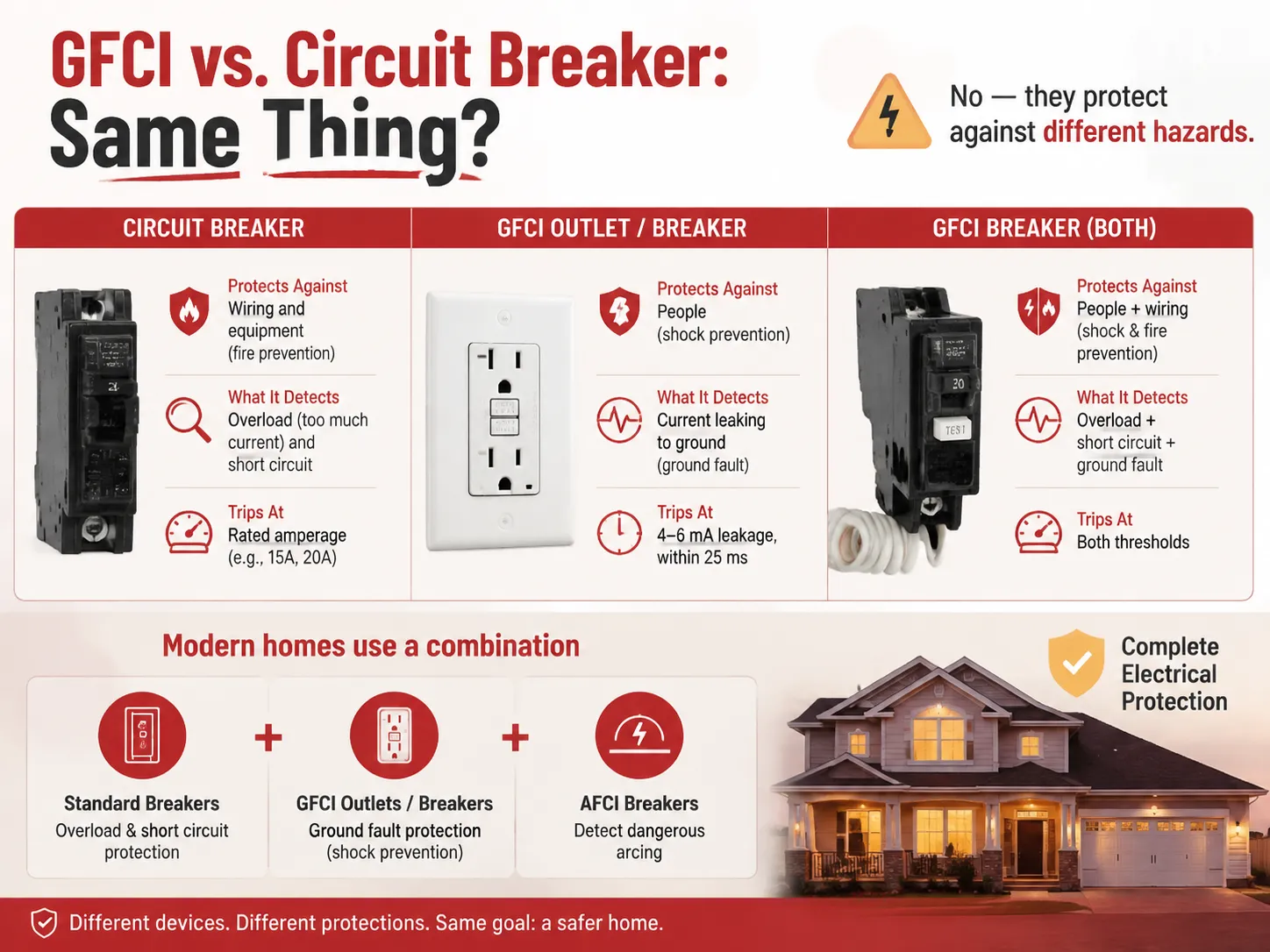
| Dispositif | Protège contre | Ce qu’il détecte | Déclenche à |
|---|---|---|---|
| Disjoncteur | Câblage et équipement (prévention incendie) | Surcharge (courant trop élevé) et court-circuit | Intensité nominale (ex. : 15A, 20A) |
| etc. | Personnes (prévention des chocs) | Courant de fuite à la terre (défaut à la terre) | Fuite de 4–6 mA, en moins de 25 ms |
| Disjoncteur GFCI (les deux) | Personnes + câblage | Surcharge + court-circuit + défaut à la terre | Seuils combinés |
Les habitations actuelles intègrent des disjoncteurs standard pour la protection contre les surcharges de circuit, des prises ou disjoncteurs GFCI (Ground Fault Circuit Interrupter) pour la protection contre les chocs électriques, et des disjoncteurs à arc pour détecter des niveaux dangereux de courant d’arc. Si vous souhaitez comprendre les dispositifs à courant résiduel utilisés dans d’autres régions du monde, notre comparaison de DDR vs DDRC couvre les versions internationales du même concept.
Questions Fréquemment Posées
GFCI signifie-t-il ground fault circuit interrupter ?
En effet — GFCI signifie ground fault circuit interrupter. C’est la version correcte donnée par le National Electrical Code (NFPA 70), UL 943 et tous les principaux fabricants. Le GFCI surveille le courant circulant dans le fil chaud par rapport au retour sur le fil neutre, et déconnecte le circuit en moins d’1/40 de seconde si la différence atteint environ 4-6 milliampères (défaut à la terre). Toutes les autres interprétations comme ground fault circuit interference sont incorrectes.
Que ne faut-il pas brancher sur un GFCI ?
Les appareils pouvant être dangereux en cas de coupure de courant sont les réfrigérateurs (périssabilité des aliments), les pompes de puisard (inondations), les équipements médicaux et de maintien en vie (risque vital), ainsi que les ordinateurs/serveurs importants (risque de perte de données). Cependant, le code exige toujours la présence de GFCI dans beaucoup de ces endroits. Dans la plupart des cas, cela peut être réalisé via un circuit dédié, un disjoncteur GFCI avec alarme ou une alimentation de secours ; la protection ne doit pas être négligée. Consultez un expert pour votre situation et vérifiez les codes locaux.
Que signifie GFCI pour good for circuit installations grand fuse circuitry impulse ground fault circuit interrupter ground fault circuitry installation ?
La bonne réponse est le disjoncteur différentiel. Toutes les autres alternatives sont incorrectes ; “ grand fuse circuitry ” confond le GFCI avec des fusibles ; “ impulse ” n’a rien à voir avec le fonctionnement du GFCI ; et “ ground fault circuitry installation ” décrit une installation générique et non l’appareil. Le terme qui correspond à la définition donnée dans le NEC et UL est uniquement disjoncteur différentiel — l’appareil qui interrompt un circuit dès qu’il détecte une fuite à la terre.
Qu’est-ce qui peut provoquer le déclenchement d’un disjoncteur différentiel (GFCI) ?
Lorsqu’un GFCI détecte une fuite de courant électrique vers la terre (4–6 mA), il déclenche. Les raisons habituelles sont les suivantes : la présence d’humidité ou d’eau dans la zone des prises (comme la pluie, la vapeur, les sous-sols humides) ; des appareils défectueux avec des fils endommagés ou des courts-circuits internes ; une fuite à la terre dans le câblage (isolation entaillée) ; des surcharges de circuit causées par la connexion de trop d’appareils ; des dysfonctionnements sur les prises en aval protégées par le même GFCI ; des GFCI défectueux, anciens ou usés (durée de vie d’environ 10-15 ans) ; et le bruit produit par de gros moteurs. Si le GFCI déclenche trop souvent, il est nécessaire de débrancher tout l’équipement sur le circuit. Il faut le réarmer et rebrancher les appareils un par un afin d’identifier la source de la défaillance, ou faire appel à un électricien professionnel.
Références
- NFPA 70 (Code National de l’Électricité) — Le code officiel définissant “ disjoncteur différentiel ” et précisant où la protection GFCI est requise (Article 210.8, Article 680).
- UL 943 — Norme de sécurité pour les disjoncteurs différentiels — La norme de sécurité UL qui certifie les GFCI, spécifiant le seuil de déclenchement de 4–6 mA et le temps de déclenchement de 25 ms.
- Sécurité électrique OSHA — Guide de sécurité au travail américain sur l’utilisation des GFCI dans la construction et l’industrie générale, renforçant la terminologie correcte et les applications requises.
- Fondation internationale pour la sécurité électrique (ESFI) — Organisation à but non lucratif fournissant une éducation aux consommateurs sur le test, l’installation et le rôle vital de la protection différentielle.
- Sécurité électrique CPSC — Données de la Commission américaine de sécurité des produits de consommation sur les électrocutions évitées grâce aux GFCI et conseils de sécurité électrique domestique.
- Département américain de l’Énergie — Fonctionnement des prises GFCI — Conseils pratiques sur le fonctionnement des prises GFCI, leur test mensuel et les causes de déclenchement.
Conclusion
Il est évident que GFCI signifie Ground Fault Circuit Interrupter et NON “ ground fault circuit interference ”. Le mot “ interrupter ” est utilisé car il définit la fonction de cet appareil particulier — couper temporairement le circuit après détection d’une fuite à la terre. Le mot “ interference ”, en revanche, désigne quelque chose qui perturbe le fonctionnement normal, ce qui est absolument l’opposé de ce que font les GFCI.
Voici ce qu’il faut retenir :
- Le terme est interrupteur, ce qui a été officiellement confirmé par le NEC, UL 943, OSHA et tous les fabricants.
- Le GFCI compare les courants sortants et entrants ; il déclenche à 4-6 mA en quelques millisecondes.
- Il protège une personne mais pas les fils car, tandis que la protection du circuit empêche la surcharge, les GFCI fonctionnent pour prévenir les chocs.
- Assurez-vous que les GFCI sont testés mensuellement avec les boutons TEST, et sont remplacés tous les 10-15 ans.
- Évitez de connecter des équipements de maintien en vie et de stockage alimentaire aux circuits GFCI où un déclenchement pourrait être nuisible — choisissez plutôt des circuits sans GFCI ou ceux qui disposent de signaux d’alarme lorsque le code le permet.
La prochaine fois que vous verrez “ GFCI signifie interférence de circuit de défaut à la terre ” sur le web, vous saurez avec certitude que c’est faux et pourquoi.