
Apakah Anda sedang meningkatkan layanan rumah tinggal lama Anda dari 60A ke 100A, memasang saluran feeder ke garasi terpisah, atau memasang kabel untuk bengkel baru, pertanyaan pertama selalu sama — jenis kabel (tembaga atau aluminium) apa yang saya butuhkan untuk layanan 100 amp? Jawabannya bergantung pada dua kode berbeda yang berlaku, karena layanan rumah tinggal dapat menggunakan NEC 310.12 dan dengan demikian memerlukan ampacity 83% (tembaga 4 AWG atau aluminium 2 AWG), sementara layanan komersial berarti Anda memerlukan tembaga 3 AWG (untuk memastikan ampacity penuh) atau aluminium 1 AWG. Jika benar, Anda lulus inspeksi; jika salah, Anda akan gagal inspeksi atau kabel paling kritis di lokasi konstruksi Anda akan terlalu panas. Panduan berikut akan memberikan semua ukuran kabel yang Anda butuhkan, kode di baliknya, berbagai perhitungan yang melibatkan kabel tembaga dan aluminium, serta detail tentang proses instalasi.
Singkatnya: Menurut NEC 310.12 (aturan 83%), untuk layanan rumah tinggal 100A satu fase 120/240V, minimum untuk tembaga adalah 4 AWG dan untuk aluminium adalah 2 AWG. Untuk penggunaan komersial, layanan tiga fase, atau feeder sub-panel 100A, persyaratan NEC 310.16 penuh berlaku untuk ampacity: minimum untuk tembaga adalah 3 AWG dan untuk aluminium adalah 1 AWG. Tembaga 2 AWG (115A) juga dapat cocok untuk banyak sirkuit 100A menurut NEC 240.4(B). 6 AWG tidak memenuhi persyaratan karena kurang (65A pada 75 °C). Sesuaikan ukuran ke nilai pada kolom 75 °C, sesuaikan ke ukuran lebih besar untuk jarak lebih dari ~100-150 kaki, dan periksa ulang dengan inspektur lokal serta utilitas lokal pada proyek Anda.
Jawaban Langsung: Ukuran Kabel untuk Layanan 100A
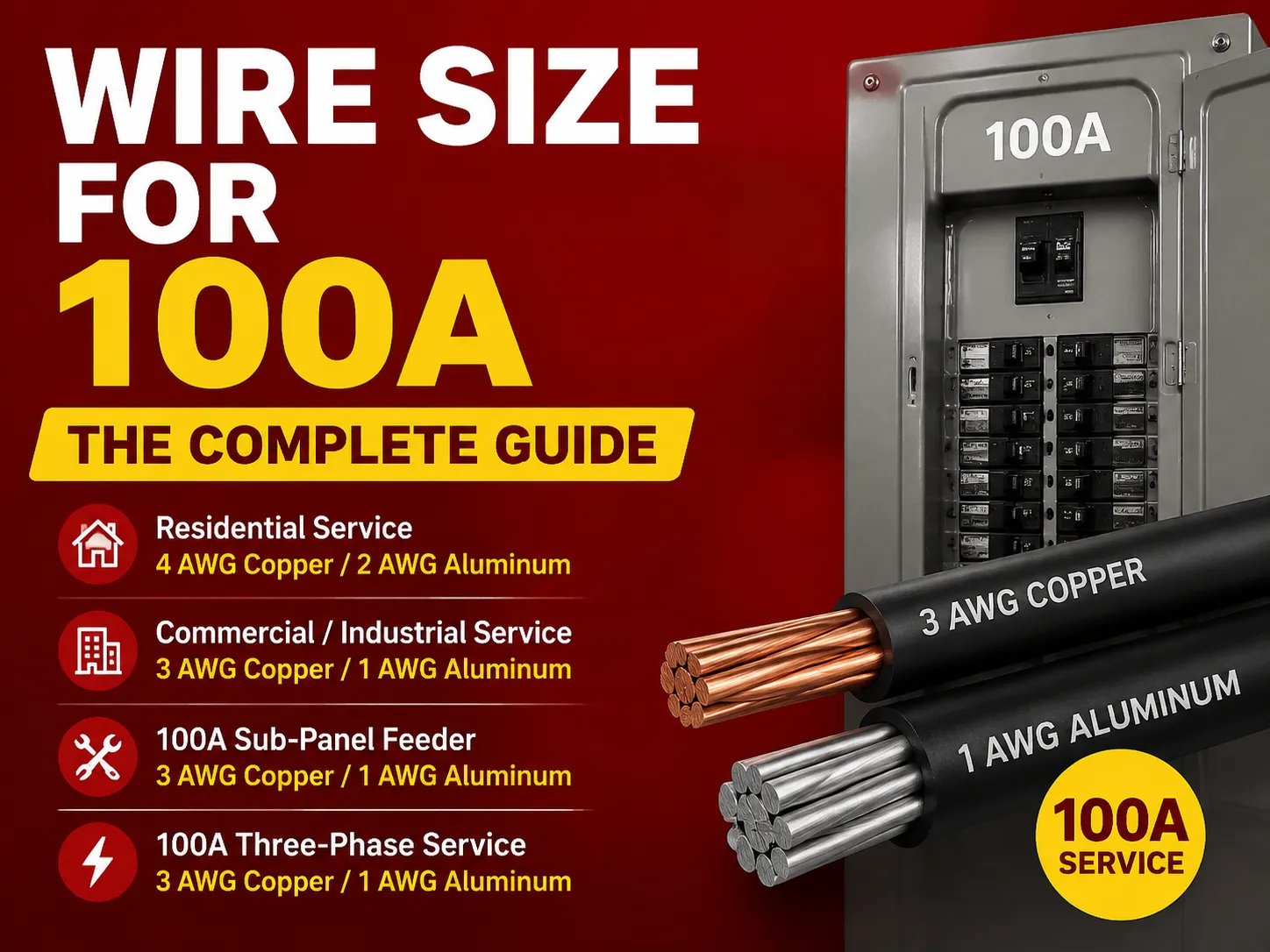
Berikut adalah jawaban lengkap dalam satu tabel. Baris mana yang Anda butuhkan tergantung pada jenis struktur dan apakah ini pintu masuk layanan atau feeder.
| Skenario | Tembaga | Aluminium | Dasar Kode |
|---|---|---|---|
| Layanan rumah tinggal (fase tunggal 120/240V, sebagian besar rumah) | 4 AWG | 2 AWG | NEC 310.12 (aturan 83%) |
| Layanan komersial / industri (fase tunggal atau tiga fase) | 3 AWG | 1 AWG | NEC 310.16 (ampasitas penuh) |
| Feeder sub-panel 100A (garasi, bengkel, ADU) | 3 AWG | 1 AWG | NEC 310.16 (tanpa pengecualian tempat tinggal) |
| Layanan tiga fase 100A (setiap okupansi) | 3 AWG | 1 AWG | NEC 310.16 (tanpa pengecualian tempat tinggal) |
Berikut tiga klarifikasi yang perlu diperhatikan:
- 6 AWG tidak cocok untuk membawa beban 100A karena tembaga 6 AWG hanya dapat membawa 65A pada suhu 75 derajat Celsius. Oleh karena itu, sebaiknya menjadi bagian dari sirkuit 50-60A.
- Kabel tembaga 3 AWG berguna untuk membawa tepat 100A pada suhu 75 derajat Celsius.
- Tembaga 2 AWG juga berfungsi karena memiliki kapasitas 115A pada 75 derajat, jadi menurut NEC 240.4(B) dapat dipasang pada sirkuit yang menggunakan pemutus 100A.
NEC 310.12 & Aturan 83% (Layanan Tempat Tinggal)
NEC 310.12 mengizinkan konduktor layanan dan feeder seluruh rumah untuk diukur pada 83% dari rating layanan untuk rumah satu keluarga (atau unit tempat tinggal individu) yang diberi daya oleh sistem satu fase 120/240V. Alasan di balik aturan ini adalah fakta bahwa beban di rumah tangga bervariasi. Memang, tidak mungkin semua beban listrik bekerja bersamaan. Oleh karena itu, NEC mengizinkan penggunaan ukuran konduktor yang lebih kecil daripada yang ditentukan dalam tabel umum.
Perhitungan untuk 100A adalah sebagai berikut: 100 x 0,83 = 83A ampacity yang dibutuhkan. Untuk memeriksa ampacity, kita perlu menemukan rating suhu ‒ jika kita berbicara tentang 75°C:
- 4 AWG tembaga (85A) → dapat menangani 83A → ini adalah ukuran tembaga standar untuk layanan residensial 100A.
- 2 AWG aluminium (90A) → dapat menangani 83A → ini adalah ukuran aluminium standar untuk layanan residensial 100A.
Itulah alasan mengapa orang mengatakan “layanan 100A sama dengan 4 AWG tembaga atau 2 AWG aluminium” – aturan menyatakan fakta bahwa ini adalah satu ukuran gauge lebih kecil dari yang ada di tabel umum. Namun, ini tidak berlaku untuk
- Bangunan komersial, ritel, kantor, gudang, atau manufaktur.
- Layanan tiga fase.
- Feeder ke subpanel ‒ mereka menggunakan ampacity penuh 310.16 meskipun digunakan di rumah yang sama.
NEC 310.16: Ampacity Penuh untuk Komersial & Sub-Panel
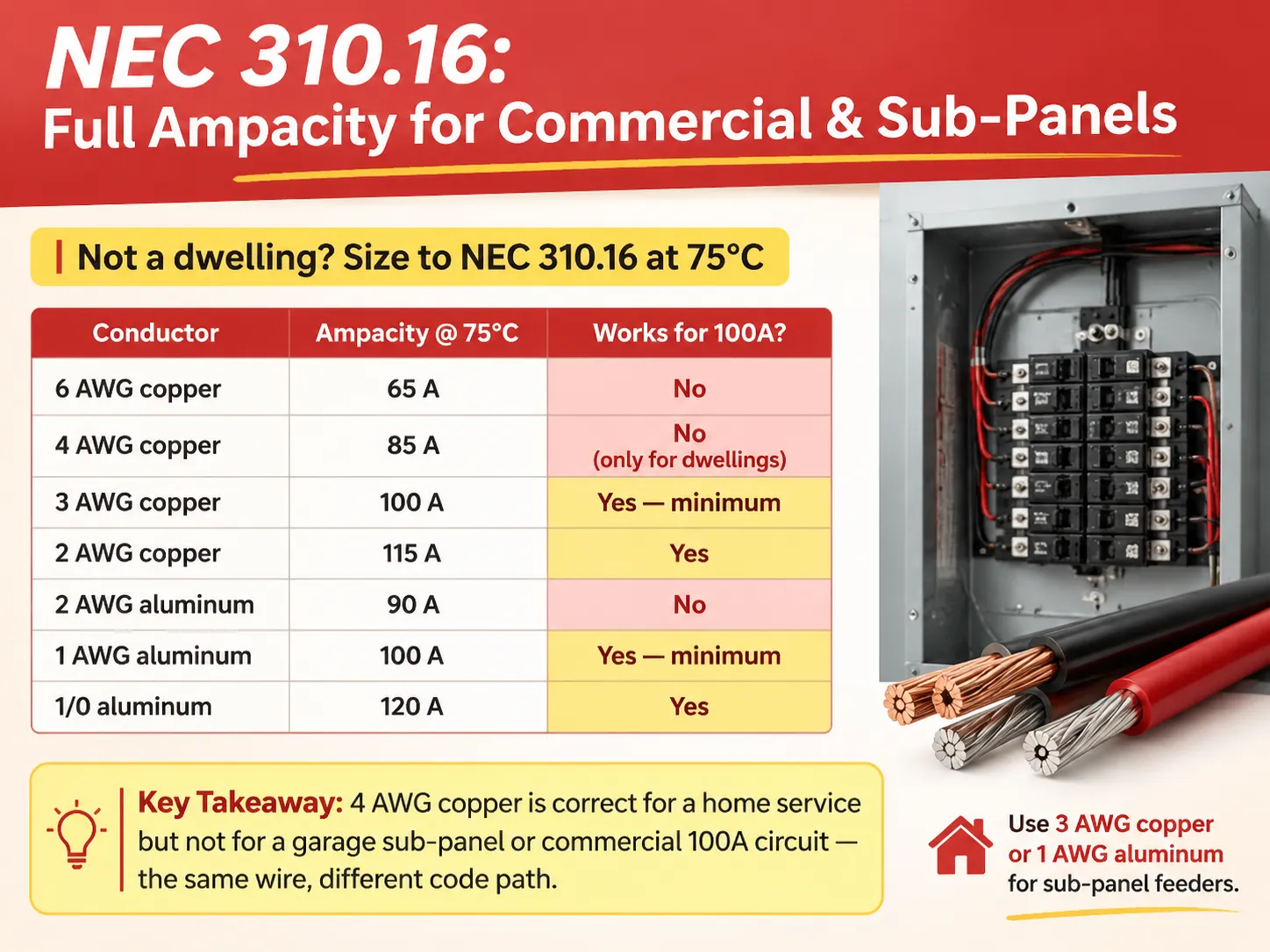
Ketika pengecualian tempat tinggal tidak berlaku, ukur ke NEC 310.16 pada 75°C (standar untuk terminasi peralatan layanan):
| Konduktor | Ampacity @ 75°C | Berfungsi untuk 100A? |
|---|---|---|
| 6 AWG tembaga | 65 A | Tidak (sirkuit 50-60A) |
| 4 AWG tembaga | 85 A | Tidak di bawah 310.16 (hanya di bawah 310.12 untuk tempat tinggal) |
| 3 AWG tembaga | 100 A | Ya — minimum |
| 2 AWG tembaga | 115 A | Ya (pilihan umum untuk headroom) |
| 2 AWG aluminium | 90 A | Tidak di bawah 310.16 (hanya di bawah 310.12) |
| 1 AWG aluminium | 100 A | Ya — minimum |
| 1/0 aluminium | 120 A | Ya (margin ekstra) |
Hasil utama: Meskipun 4 AWG tembaga dapat diterima untuk layanan rumah, ini tidak berlaku untuk sub-panel garasi atau kabel sirkuit komersial 100A — kabel ini dapat disetujui tetapi bukan melalui metode standar feeder sub-panel. Di sinilah sebagian besar kebingungan muncul dan itulah mengapa standar untuk kabel feeder sub-panel tembaga adalah 3 AWG tembaga atau 1 AWG aluminium.
Tembaga vs Aluminium: Apa Bedanya
Keduanya sesuai kode; pilihan adalah ekonomi plus disiplin instalasi:
| Faktor | Tembaga | Aluminium |
|---|---|---|
| Biaya relatif | Dasar (mahal) | Sekitar 40-60% lebih murah pada ukuran ini |
| Ukuran yang dibutuhkan untuk 100A (310.16) | 3 AWG | 1 AWG (dua ukuran lebih besar) |
| Berat | Lebih berat | Sekitar 1/3 berat — lebih mudah ditarik |
| Konduktivitas | Lebih tinggi | ~61% dari tembaga |
| Termination rules | Standar | Anti-oxidant compound, AL-rated lugs, correct torque — mandatory |
| Corrosion | Minimal | Oxidizes at terminations if untreated |
Aluminum is practically the most popular material used for both the 100A service entrance as well as for long feeders. Its installation is also common knowledge among certified electrical workers. There are three essentials that have to be used in all aluminum installations: an anti-oxidant joint connecting compound, terminals with AL/CU rating, and a torque wrench according to the manufacturer’s recommendations.
What Does “2-2-2-4” Wire Mean?
If you are picking a residential 100A feeder, the cable is noted to be “2-2-2-4” (this might appear as “2-2-2-4 SER” or “2-2-2-4 AL”). This notation breaks down the conductors in it: 2 conductors of 2 AWG are the 2 hot legs, and another 4 AWG is the neutral type of conductor along with one conductor of 4 AWG for grounding purpose.
- Two 2 AWG hots + 2 AWG neutral provide the 120/240 volt circuit.
- 4 AWG is the ground for the equipment.
- Since this is aluminium type of SER cable, it fulfills the standard 100A residential requirement of electrical installations per NEC 310.12 (2 AWG = 90A, more than enough voltage output of 83A).
To the question, “does 2-2-2-4 wire suffice for 100 amps?” the answer is “yes” for residential service and 100A feeder, where the 83% regulation would apply. However, it wouldn’t work for commercial services at 100A that would be needing 1 AWG cables for the hots.
Will 6 Gauge Wire Handle 100 Amps?
6 AWG copper wire is appropriate for 65A at 75°C (55A at 60°C) jobs which is not sufficient for a 100A service since this wire overheating can damage the insulation and create a serious fire risk. It is preferable to use this wire in low amperage circuits, up to 50-60A. For jobs with 100A or more workloads one has to use wire sizes of 3 AWG of copper or 1 AWG of aluminum.
Is #3 Copper Good for 100 Amps?
Indeed. 3 AWG copper is rated for 100A at 75°C; making it the exact minimum for a 100A general circuit, commercial service, or sub-panel feeder under NEC 310.16. Many electricians choose 2 AWG copper (115A) for ample room, derating, or long runs; which is indeed acceptable. For residential service only, 4 AWG copper is sufficient. In a nutshell, when asked is #3 copper good for 100 amps; this wire is indeed rated properly.
Run Length & Voltage Drop
Ampacity isn’t the only constraint — long runs lose voltage. Recommended maximums to stay within a 3% drop at 240V:
| Konduktor | Perkiraan maksimal jalur satu arah (penurunan 3%) |
|---|---|
| 3 AWG tembaga | ~147 ft |
| 2 AWG tembaga | ~185 ft |
| 1 AWG tembaga | ~234 ft |
| 1 AWG aluminium | ~142 ft |
| 1/0 aluminium | ~178 ft |
| 4 AWG copper (310.12 dwelling) | ~116 ft |
| 2 AWG aluminum (310.12 dwelling) | ~112 ft |
General information: ampacity is good for lengths up to around 100 ft, consider going one size up from 100-150 ft, and for lengths of around 150 ft and beyond, ampacity will need at least one size up (for example, from 3 AWG copper to 2 AWG or from 1 AWG aluminum to 1/0). In general, long runs in rural areas usually need more than one size increase.
Neutral & Grounding Conductor Sizing
A full installation of 100A must include neutral and grounding conductors as follows:
- Neutral: Correctly determined as per the calculated unbalanced loading (NEC Table 220), it is equivalent to the circuit hots for a 100A service in most cases, whereas one size lower in case allowed by the calculations.
- Grounding electrode conductor (GEC) – sized as per NEC table 250.66 – GEC is usually 8AWG copper minimum for 4AWG copper or 2 AWG aluminum service conductors; check the table for your proper wire size.
- Equipment ground (subs): sized as per NEC table 250.122 – typically 8 AWG copper or 6 AWG aluminum for 100A feeder.
- Grounding electrodes: for a building service grounded by two rods at decent distance from one another (NEC table 250.52).
It is one of the most common manageable mistakes in the service work to confuse tables 250.66 (GEC) and 250.122 (equipment ground) – pick the correct table for the right wire.
Sub-Panel Specifics: Detached Garage & Workshop
Running 100A to a detached garage, workshop, or ADU has additional codes and regulations to consider:
- A 4-wire feeder must be installed; this includes two hots going from the main panel, one neutral, and an equipment ground (NEC 250.32). Remember that the installation of a 3-wire feeder in a detached building is not acceptable.
- The neutral must be isolated. You must ensure that the neutral bar in the sub-panel is separately placed from the ground bar. The main panel provides the bonding of these two.
- Grounding is necessary for the new structure. The detached building should have its own grounding system (typical grounding rods in place to be used).
- The cable type will typically be 1 AWG SER aluminum or 3 AWG copper in the conduit for the 100A feeder; this has to adhere to 310.16.
- Make load calculations – it’s essential to perform load calculations before purchasing the wiring. An ADU with electric heats and an EV charging unit may require 125A and not 100A.
Common Mistakes on 100A Installations
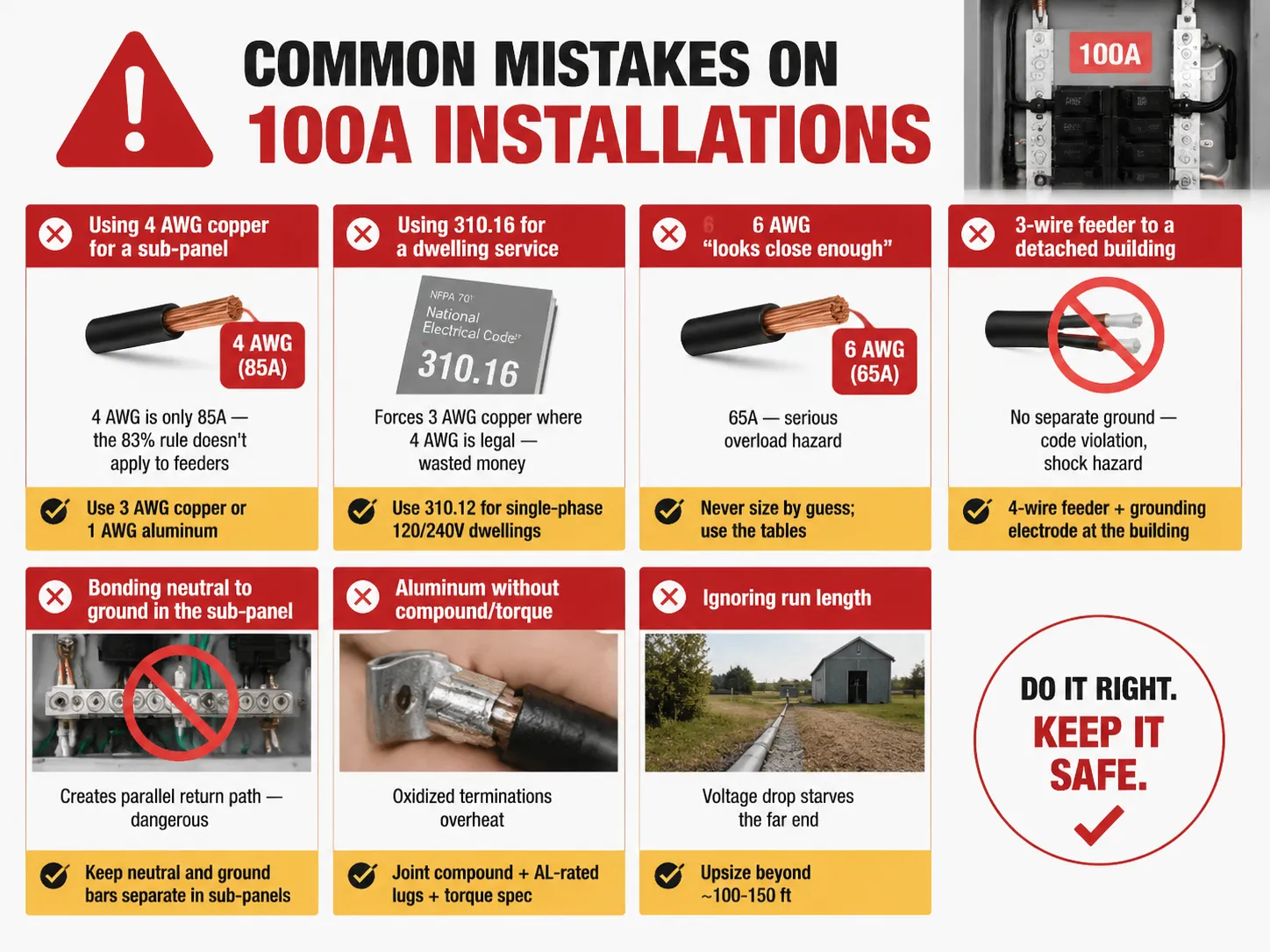
| Kesalahan | Mengapa Salah | Pendekatan yang Benar |
|---|---|---|
| Using 4 AWG copper for a sub-panel | 4 AWG is only 85A — the 83% rule doesn’t apply to feeders | 3 AWG copper or 1 AWG aluminum for 100A feeders |
| Menggunakan 310.16 untuk layanan hunian | Forces 3 AWG copper where 4 AWG is legal — wasted money | Gunakan 310.12 untuk hunian fase tunggal 120/240V |
| 6 AWG “looks close enough” | 65A — serious overload hazard | Never size by guess; use the tables |
| 3-wire feeder to a detached building | No separate ground — code violation, shock hazard | 4-wire feeder + grounding electrode at the building |
| Bonding neutral to ground in the sub-panel | Creates parallel return path — dangerous | Keep neutral and ground bars separate in sub-panels |
| Aluminum without compound/torque | Oxidized terminations overheat | Joint compound + AL-rated lugs + torque spec |
| Mengabaikan panjang jalur | Voltage drop starves the far end | Upsize beyond ~100-150 ft |
Pertimbangan Biaya & Izin
Upgrade to a 100A service or installation of a new electrical feeder has the following costs:
- Materials include: panel – $60-$200, 100A main breaker – $30-$80, 2-2-2-4 aluminum SER – $1.50-$3 per foot, 3 AWG copper – $3-$6 per foot, meter base and hardware – $50-$150.
- Jobs will run at $800-$2,500 for a service upgrade and $500-$1,500 for a sub-panel feeder, based on run distance and access through walls.
- The permit and inspection normally cost $50-$300 and are required. Inspectors check wire and grounding size and bonding to be finished.
- Utility coordination is needed as the utility will own the meter and service connection.
When the project also involves panelboard and breakers, matching certified protection devices — and understanding the breaker types involved, from the basics of MCBs and MCCBs ke standar pemutus UL 489 — keeps the whole install compliant end to end. And once the 100A main is in, every branch circuit behind it follows the same sizing discipline — the limits explained for a 15-amp circuit’s wattage apply at every level of the panel.
Standar Internasional: Catatan Singkat
Outside of North America, the determination of 100A wiring is done differently as most of the world implements methods consistent with IEC/BS 7671 standards (current and correction factor method) instead of using a simplified service table.
- In the UK (BS 7671), cable sizes are determined based on the installation method. For instance, a 100A single-phase connection usually requires a copper wire of between 25 and 50mm² depending on how long the cable is.
- In Europe (IEC 60364), the straightforward method is used.
- In Australia (AS/NZS 3000), method-based calculations are used for insulation and often result in use of 25 to 35mm² wires.
- In Canada (CE Code), a similar argument to that put forth by the NEC is used; installations may be based on 83%-like formulas.
The NEC procedure is based on rules pertaining specifically to the US and/or Canada installations; hence, if the location of the job is different from those two places it would be wise to hire an engineer or electrician to carry out the calculations.
Pertanyaan yang Sering Diajukan
What size wire do we need for a 100 amp service?
According to NEC 310.12 for residential systems with 100A service (single phase), it is allowed to use 4 AWG copper or 2 AWG aluminum conductors. Whereas in commercial systems with three-phase or 100A sub-panel system, the full ampacity from the NEC 310.16 has to be applied, which means a minimum of 3 AWG copper or 1 AWG aluminum conductors. In terms of size for the GEC, 8 AWG copper conductor must be used as per 250.66 along with upsizing for distances of more than 100-150 feet.
Is #3 copper good for 100 amps?
Indeed – 3 AWG copper is rated precisely as 100A at 75°C, it is exactly the minimum required for 100A regular circuit, commercial service or sub-panel feeding based on NEC 310.16. However, a large number of electricians use 2 AWG copper (115A) instead to provide more headroom due to derating. For household services only, 4 AWG copper is considered okay.
Is 2-2-2-4 wire good for 100 amps?
Indeed, when it comes to residential applications, “2-2-2-4” SER cable (2 AWG hot wires, 2 AWG neutral wire, and 4 AWG ground wire) is considered as the standard aluminum type for 100A residential service as stated in NEC 310.12 (it should be noted that 2 AWG aluminum wire is rated at 90A, which is more than enough for the 83A needed). But when it comes to commercial applications, 1 AWG aluminum wire or 3 AWG copper wire needed for 100A commercial service is required.
Will 6 gauge wire handle 100 amps?
No. 6 AWG copper wire has a rating of just 65 amperes at a temperature of 75°C (55 amperes at 60°C), which is not suitable for 100 amperes. The wire will get hot, allowing for very high risks of fire. 6 AWG copper is appropriate for circuits carrying 50-60 amperes (for example with ranges, ovens, or small sub-panels). For 100A use either 3 AWG copper or 1 AWG aluminum wire (in general) or 4 AWG copper or 2 AWG aluminum wire (for dwelling services).
Referensi
- NFPA 70 — National Electrical Code (NEC): Articles 230, 240, 250, 310
- Mike Holt — NEC 310.12 83% Rule and Conductor Sizing
- OSHA 1910.303 — Persyaratan Listrik Umum
- EC&M Magazine — Service and Feeder Sizing Articles
- IEC 60364 — Instalasi Listrik Tegangan Rendah (Internasional)
- NEMA — Conductor and Wiring Standards
Kesimpulan
The process of determining appropriate wire sizes for a service rated at 100 A depends on how you answer the question: does the 83% dwelling rule apply? According to NEC 310.12, in the case of residential applications, the standard wire sizing practice requires the use of 4 AWG copper wire or 2 AWG aluminum wire. In the case of commercial installations, systems equipped with three-phase motors, and hundred-amp sub-panels, the applicable wire sizes that comply with the code requirements concerning their ampacity correspond either with 3 AWG copper wire or with 1 AWG aluminum wire; therefore, in practice, 2 AWG copper wire is often used. When the panel and breakers are part of the job, understanding the protection devices — like recognizing a failing breaker and the practical pricing in breaker replacement cost — keeps the whole project safe, legal, and on budget.