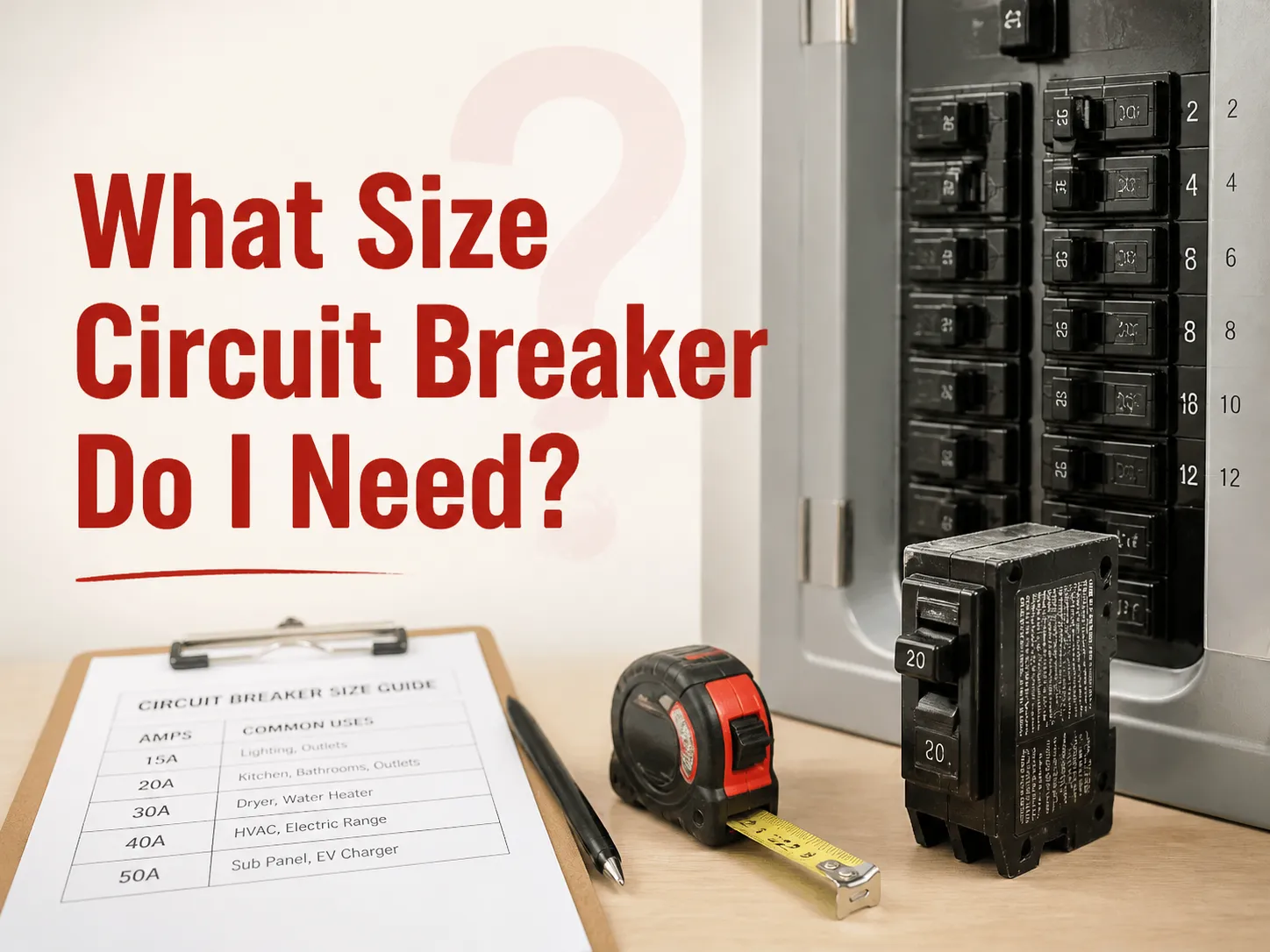

Tidak masalah apakah Anda sedang menentukan ukuran sirkuit, mendiagnosis pemutus sirkuit yang trip, memilih baterai Anda, atau membeli generator, pertanyaannya selalu kembali ke ampere – berapa banyak arus yang sebenarnya dibutuhkan? Mungkin terdengar seperti satu hal, tetapi saat membicarakan amperase, yang benar-benar Anda butuhkan adalah tiga cara untuk mengetahuinya: Anda bisa membacanya, menghitungnya, atau mengukurnya.
Ringkasan: Anda dapat mengetahui amperase dengan berbagai cara: (1) dengan memeriksa nameplate – sebagian besar perangkat memberi tahu Anda amperenya; (2) dengan menghitungnya – Jika beban diketahui, rumus I = P ÷ V dapat diterapkan atau hukum Ohm I = V ÷ R; (3) dengan melakukan pengukuran – Anda dapat menggunakan ammeter untuk menjepit kabel atau memutus sirkuit dan menggunakan multimeter untuk melakukan pengukuran secara seri.
Tiga Cara untuk Menentukan Amperase
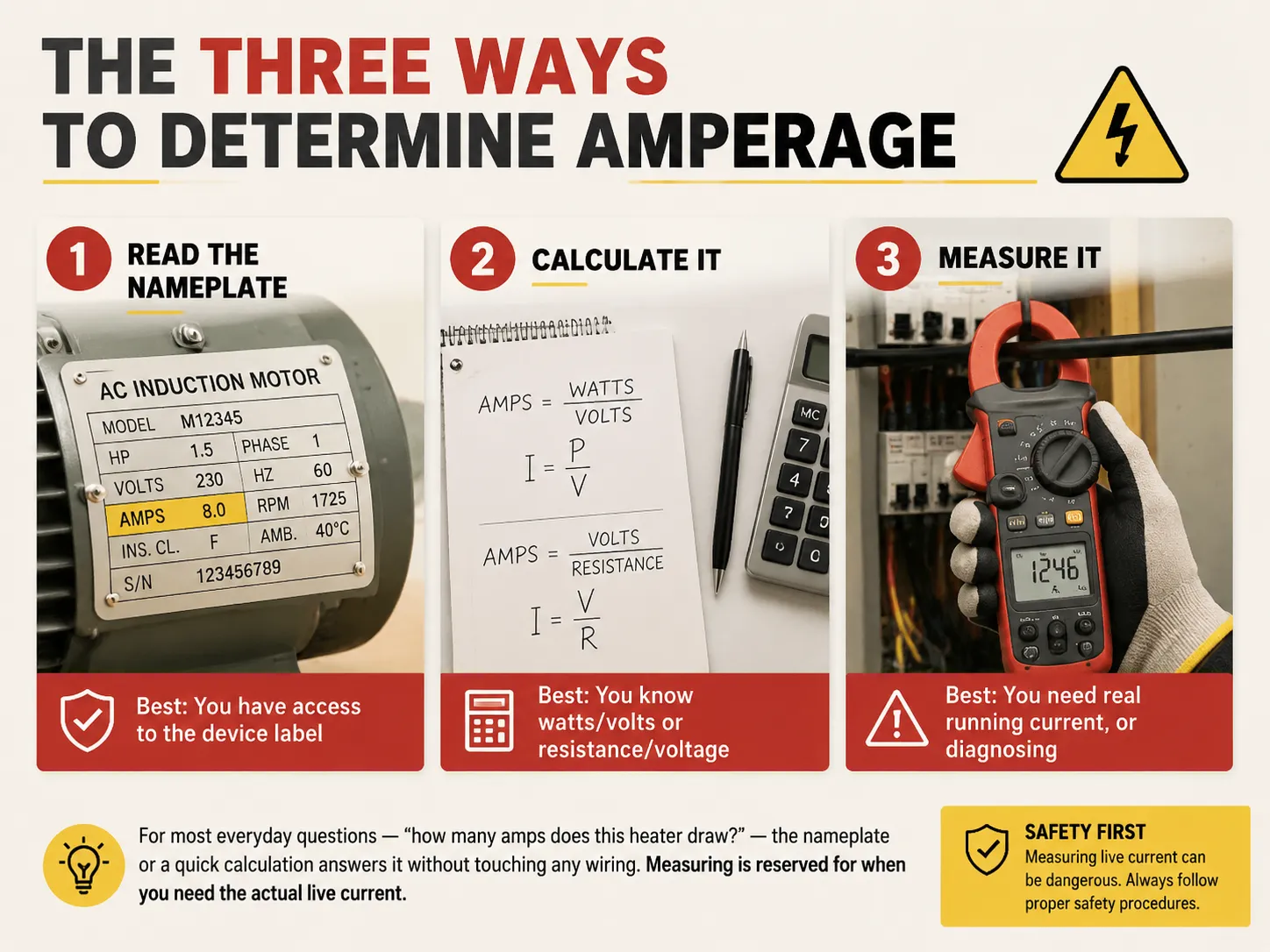
Ada tiga metode nyata untuk mengetahui amperase dari beban atau sirkuit apa pun, dan mengetahui metode tersebut menghemat waktu serta menghilangkan risiko.
| Metode | Terbaik Saat | Akurasi | Risiko |
|---|---|---|---|
| Membaca nameplate | Anda memiliki akses ke label perangkat | Baik (nilai tertera) | Tidak ada |
| Menghitungnya | Anda mengetahui watt/volt atau resistansi/tegangan | Baik (tergantung input) | Tidak ada |
| Mengukurnya | Anda membutuhkan arus berjalan nyata, atau untuk diagnosis | Sangat baik (pembacaan aktual) | Bahaya listrik — harus mengikuti aturan keselamatan |
Dalam kebanyakan kasus, misalnya, “berapa ampere yang digunakan pemanas ini”, nameplate atau perhitungan cepat akan memberikan jawaban tanpa menyentuh kabel. Pengukuran hanya boleh dilakukan ketika Anda perlu mengetahui kesalahan sebenarnya; hanya clamp meter atau multimeter seri yang dapat memberikan informasi tersebut.
Metode 1: Membaca Nameplate
Label adalah cara tercepat dan teraman untuk mengetahui amperase. Setiap perangkat, alat, motor, dan charger memiliki nameplate yang menampilkan spesifikasi listriknya:
- Ampere tertera: beberapa nameplate menentukan ampere dalam format “Amps: X A” dan “Current: X A”.
- Watt dan Tegangan: beberapa label memberikan pembacaan dalam watt (atau kW) dan volt; gunakan rumus di bawah ini untuk mengonversinya.
- Kombinasi tertera: perangkat HVAC menunjukkan FLA (full-load amps), RLA (rated load amps), dan MCA (minimum circuit ampacity) — FLA adalah untuk arus berjalan dan MCA adalah untuk ukuran kabel sejauh menyangkut amperase.
- Motor: coba cari tahu rating FLA pada tegangan yang diperlukan (ampere untuk motor bervariasi pada 120V dan 240V).
Misalnya, pemanas ruangan yang diberi tanda “1,500W, 120V” dapat dihitung sebagai berikut: Ampere = 1,500 ÷ 120 = 12,5A. Inilah alasan mengapa pemanas memiliki instruksi yang mengatakan, “Jangan gunakan pada sirkuit 15A bersama beban lain” — 12,5A mendekati ampere maksimum yang diizinkan dari 80% sebesar 12A.
Metode 2: Menghitungnya (Rumus)
Jika Anda diberikan watt, kilowatt, atau resistansi pada nameplate, ada dua rumus dasar untuk menghitung amperase:
Penerapan rumus daya yang dapat digunakan dalam sebagian besar situasi.
Ampere = Watt ÷ Volt (I=P÷V)
- Pemanas dengan daya 1500W dan tegangan 120V menghasilkan 12,5 ampere.
- Oven 3000W dengan tegangan 240V memiliki 12,5 ampere (daya sama tetapi ampere setengahnya)
- Generator 5kW dengan tegangan 240V memiliki arus yang dalam kasus ini adalah 5.000 ÷ 240 ≈ 20,8A.
Hukum Ohm berlaku ketika resistansi diketahui.
- Amps = Volt ÷ Ohm (I=V÷R)
- Misalnya dalam rangkaian 12V dengan beban 4-ohm, perlu dihitung: 12 ÷ 4 = 3 A.
Penerapan perhitungan tiga fasa dalam mode industri.
- Amps = Watt ÷ (Volt × 1,732 × Faktor Daya)
- Contohnya, motor 10kW yang mengonsumsi daya tiga fasa 400V, Power Factor 0,85 → 10.000 ÷ (400 × 1,732 × 0,85) ≈ 17A. (Untuk angka perkiraan, abaikan faktor daya dan hitung dalam kisaran 15%)
Metode 3: Ukur Langsung (Alat & Langkah)
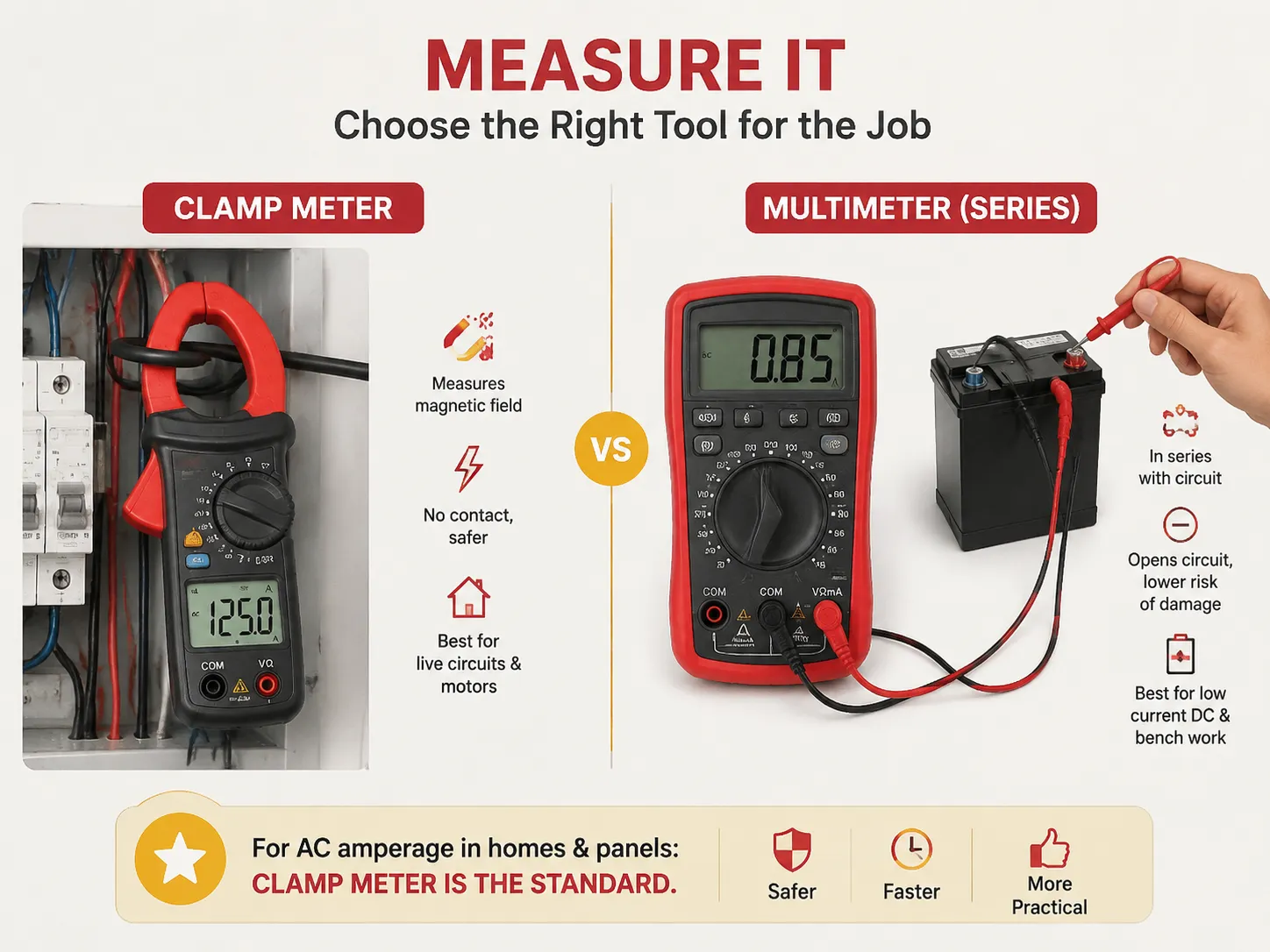
Jika Anda memerlukan arus beban aktual untuk motor yang dimuat, rangkaian yang mempertahankan titik pemutusnya, atau untuk pengujian pelepasan baterai, maka Anda melakukan pengukuran arus. Dua cara:
| Alat | Cara Kerjanya | Terbaik Untuk | Harga |
|---|---|---|---|
| Clamp meter (ammeter) | Rahang penjepit mengelilingi satu konduktor; mengukur medan magnet — tanpa kontak langsung | Rangkaian hidup, motor, arus perangkat secara keseluruhan | $30-$150 |
| Multimeter (seri) | Membuka rangkaian dan melewatkan arus melalui meter | DC arus rendah (baterai, sensor), pekerjaan meja | $20-$100 |
Clamp meter adalah instrumen yang disukai untuk amperase AC karena mengukur arus tanpa memutus rangkaian atau melakukan kontak dengan komponen hidup. Oleh karena itu, jauh lebih aman dan lebih mudah digunakan dibandingkan multimeter dasar dalam membaca arus rumah dan panel.
Cara Menggunakan Clamp Meter dengan Benar
Berikut adalah panduan langkah demi langkah tentang cara menggunakan ammeter penjepit:
- To start with, whether measuring with AC Amps (A~) or DC Amps should be determined.
- Next, if the meter has a zero button, it needs to be zeroed.
- When measuring the current, only one conductor should be clamped at a time.
- After taking care of that, we need to take a reading on the display.
- In order to take an accurate reading, the jaws of the clamp must be firmly held and in a perpendicular position.
- Finally, remember that although a specific motor nameplate indicates its FLA rating, under an actual load, the current may be more than what the nameplate said.
Using a Multimeter in Series
When working with DC circuits (batteries, solar panels, sensors) and low current AC on the test bench, you will likely use a multimeter in series.
- First turn off the power to the circuit and disconnect one wire so you can open it up.
- Next connect the wires: black to COM and red to the A (amps) socket and set the dial.
- Connect the multimeter in series with the load, so that the circuit flows through the multimeter: supply → multimeter → load.
- Start to measure on a high current I range (like 10A) first then when the reading is low go for lower currents. But do not start with a low current otherwise you would blow the fuse!
- Then turn the power and take the reading.
Never connect a multimeter set for the amps across a power source as that would result in a dead short!
Safety Rules When Measuring Current
- Clamp meters are safe when working around energized wires; series multimeters are not. To measure house/panel AC, you should use a clamp meter only—you won’t even come in contact with the wires.
- Never use a clamp meter on a cable with multiple wires, because you’ll get a false reading (close to zero) and this won’t give you any useful insight.
- Remember: breaking the panel rule is dangerous; even touching the breaker panel means live work; if you are not trained for this, stop doing it right away.
- Before starting to check your meter, ensure that it is rated according to CAT III in the case of a distribution circuit and CAT IV for a service entrance.
- For series measurements, switch off the power first, connect your meter, and then switch on again.
- If you have doubts, calculate or check the nameplate information, because in most cases, the amperage measurement does not come down to live measurements.
Interpreting Amperage: Watts, Voltage & the 80% Rule
Here’s what to do with the amperage:
- Watts = Amps × Volts — power calculation for energy and costs.
- Amp rating vs. breaker rating – loads must not exceed the circuit rating, for example, a 15A circuit breaker limiting total load of 1,800W
- 80% rule for loads working continuously for over three hours – the load is limited to 80% of circuit rating. For example, if you use a 15A circuitry, your max power consumption is equal to 1,440W. If you use a 20A circuitry, the power consumed should not be higher than 1,920W.
- Motor inrush – motors draw up to 5-8 times more than the running current when they are started.
- Voltage and amperage interplay – with 1,500W heater amp draw depending on voltage, if the heater is plugged into 120V, it takes 12.5A, while plugged into 240V, the amps drop down to 6.25.
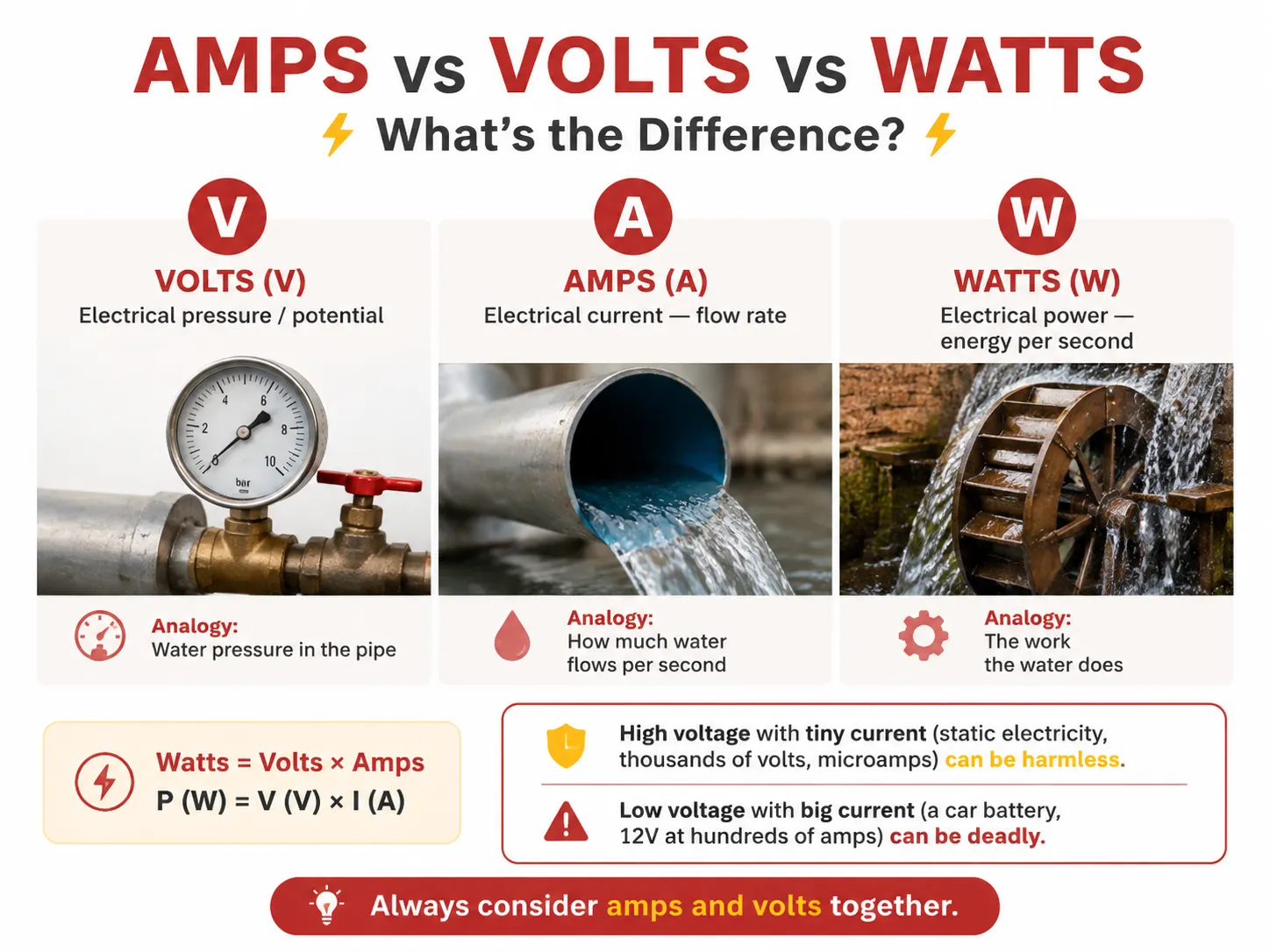
Amps vs Volts vs Watts: What’s the Difference?
The three units describe three different things, and confusing them causes real mistakes:
| Satuan | Measures | Analogy |
|---|---|---|
| Volts (V) | Electrical pressure / potential | Water pressure in the pipe |
| Amps (A) | Electrical current — flow rate | How much water flows per second |
| Watts (W) | Electrical power — energy per second | The work the water does |
Volts force, amps navigate and wattage is the power factor, meaning Watts = Volts × Amps. If a voltage is high and the current is low (as with static electricity, thousands of volts and microamps) it can be harmless. However, if a voltage is low and the current is high (for example, a car battery of 12 volts operating on hundreds of amps) it can be lethal. Always take into account the fact that amps and volts must go together.
How to Tell if Your House Is 100A or 200A
Simple steps require no equipment:
- To read the main breaker, locate the visible breaker in the panel. It bears a number such as “100” or “200” which indicates its capacity.
- To read the meter base, there might be a reading on the meter socket or a utility tag.
- Look at the interior label which usually indicates the size of the main breaker and that of the electrical bus.
- Call the electricity provider and request information about the size of your service.
Importance of the information: a 100A service would prevent you from adding any gadgets that use a lot of energy such as electric vehicles, heaters, and ovens; a 200A service is a modern standard.If breakers trip regularly when you add load, and the main is 100A, an upgrade may be the real fix — and if a breaker is misbehaving, knowing how to tell if a breaker is bad separates a worn device from a genuinely overloaded circuit. For sizing and cost details, our guide to what a 15-amp circuit can carry dan yang breaker replacement cost numbers help with the practical math.
Pertanyaan yang Sering Diajukan
What is 20 amps equal to?
20 amps at 120V translates to a power output of 2,400 watts (Watts = Amps × Volts). Then we have 4,800W at 240V. A 20A circuit breaker in a 120V circuit allows carrying a maximum power of 1,920W (according to the 80% rule) or even 2,400W in non-continuous operation. 20A is comparable to such appliances as any large microwave (consuming 1,000-1,200W at 120V) or an electric kettle since it is a standard kitchen circuit indicator.
How to tell if house is 100 or 200 amp?
One definitive way of determining the amount of electrical service you have is to simply open the electrical panel and check the number imprinted on your main breaker (the large switch located at the top of the panel). This number is either 100, 120, or, at times, 150 or 225. The main breaker rating indicates the electrical service size. You can also check the label on the meter base as well as the label on the inside of the electrical panel for an estimate of the amount of service provided. Electricity supplied from the utility is typically 100A in older homes and 200A in any new construction.
How do I figure out the amperage?
There are three options for figuring out how many amps your device needs to operate: (1) check the name plate because most devices will list amp usage; (2) use the formula Amps = Watts ÷ Volts (using Ohm’s law, I = V ÷ R); or (3) measure the amperage with a meter. The last option either entails clamping an ammeter around one of the wires carrying current in the circuit, or hooking up a multimeter in series with a device that uses relatively little power. In most cases, the nameplate or a calculation is all that is necessary here and it is safe because there is no danger.
Is 5 amps the same as 5 volts?
No — they measure different things. Amps measure current (electricity in transit), volts measure electric pressure (voltage difference). Five amps is measurement of current; five volts provides measurement of pressure. Also power they deliver together in Watts is calculated using: , Watts = Volts * Amps: 5V * 5A = 25W. 5V source can provide current from microamps to many amps depending on the load; amps and volts can never be equal.
Referensi
- NFPA 70 (NEC) — Circuit Sizing and the 80% Continuous Load Rule
- OSHA — Electrical Safety and Current Measurement Guidance
- Fluke — How to Measure Current with a Clamp Meter
- U.S. Department of Energy — Power and Energy Calculations
- IEC 61010 — Safety Requirements for Electrical Measurement Equipment
- IEC — SI Units: Ampere, Volt, and Watt Definitions
Kesimpulan
Finding the amperage relies on three steps that you need to know in advance: the nameplate can be read (the fastest and safest way), you can calculate amperage according to the formula A= (W/V) (or using the Ohm’s law), and you can measure amperage with the help of either a clamp meter (for a live circuit, it is important to follow all safety precautions), or a multimeter (for a direct current circuit) while keeping the 80% safety limit. One thing to remember is that amps and volts are two different things (in a 20A circuit you will get 2,400W from the 120V circuit).Understanding amperage — and how it relates to the protection devices behind it, from the basics of MCBs vs MCCBs ke standar pemutus UL 489 — is the foundation of safe electrical work.