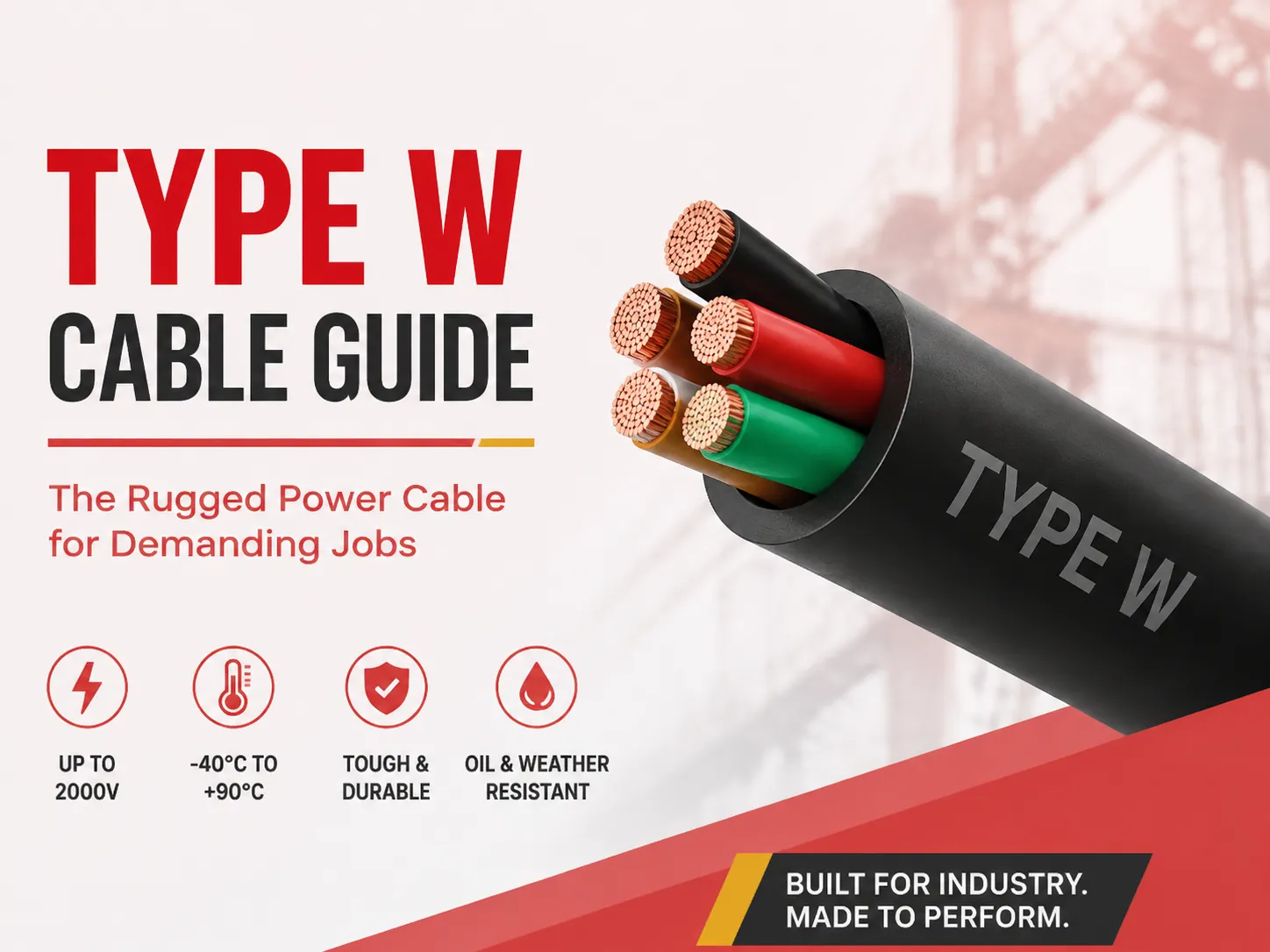
Se você já se viu especificando cabo para um canteiro de obras, um gerador, uma operação de mineração ou um sistema portátil de distribuição de energia, provavelmente já se deparou com o termo “Type W” e enfrentou a confusão que ele traz. “W” de quê? Água? Tempo? Fio? E qual é a diferença dele para SOOW, que também contém “W”? Aqui está a informação que você precisa saber: Type W refere-se a uma designação UL de cabo portátil de energia pesada com uma classificação de tensão de até 2000 volts, feito com isolamento espesso de EPDM e uma capa rígida de CPE adequada para as condições industriais mais extremas. O artigo discute o que o Type W realmente significa, suas aplicações, como distingui-lo do SOOW e outros cabos portáteis e como escolher o correto.
Nota breve: Type W está relacionado à classificação UL de um cabo portátil de energia adequado para alta tensão de até 2000V (já que condutores individuais também recebem simultaneamente a classificação RHH/RHW para 600V). Type W apresenta isolamento de borracha EPDM termofixa e capa feita de materiais CPE ou CSPE, e a faixa de temperatura de operação varia de -40°C a +90°C, enquanto a construção é perfeita para uso em ambientes severos como mineração, canteiros de obras, perfuração de sondas ou em bombas. A letra ”W” indica que este é um tipo específico deste tipo de cabo que não pode ser confundido com o significado de ”W” em SOOW, porque aqui significa que o cabo é resistente às intempéries. Type W tem grandes vantagens sobre SOOW, pois oferece classificação de tensão mais alta, melhor isolamento e maior durabilidade.
O que significa “Type W”?
Estabelecida pelo Underwriters Laboratory, a designação Type W classifica um tipo de cabo que é durável o suficiente para suportar aplicações mais severas. Também é conhecido como cabo portátil de energia, e é um dos principais tipos de cabo usados para fornecimento de energia em ambientes comerciais.
Propriedades definidoras do cabo Type W:
- Classificações de tensão: Type W é classificado para alta tensão de até 2000 volts AC ou DC (quando vários condutores são usados), o que é significativamente mais do que os cabos padrão de baixa tensão são classificados. Condutores individuais também atendem à classificação dupla RHH/RHW em uma tensão de 600 volts.
- Isolamento: borracha EPDM (etileno propileno dieno monômero) termofixa fornece material de isolamento resistente e com alta resistência à temperatura.
- Capa: capa de CPE (polietileno clorado) ou CSPE oferece proteção confiável contra materiais corrosivos e umidade.
- Faixa de temperatura: -40°С a +90°С.
- Condutores: de 1 a 5 condutores (preto, branco, vermelho, verde, laranja) adequados para alta flexibilidade; AWG variando de 8 AWG a 500 MCM quando usados como condutores individuais e de 8
- AWG a 4/0 AWG quando usados como fios multicondutores.
Para resumir, os cabos Type W são aqueles usados quando o cabo de extensão padrão ou mesmo o cabo SOOW não suportam as aplicações de corrente e tensão exigidas em um local de trabalho, mina, etc.
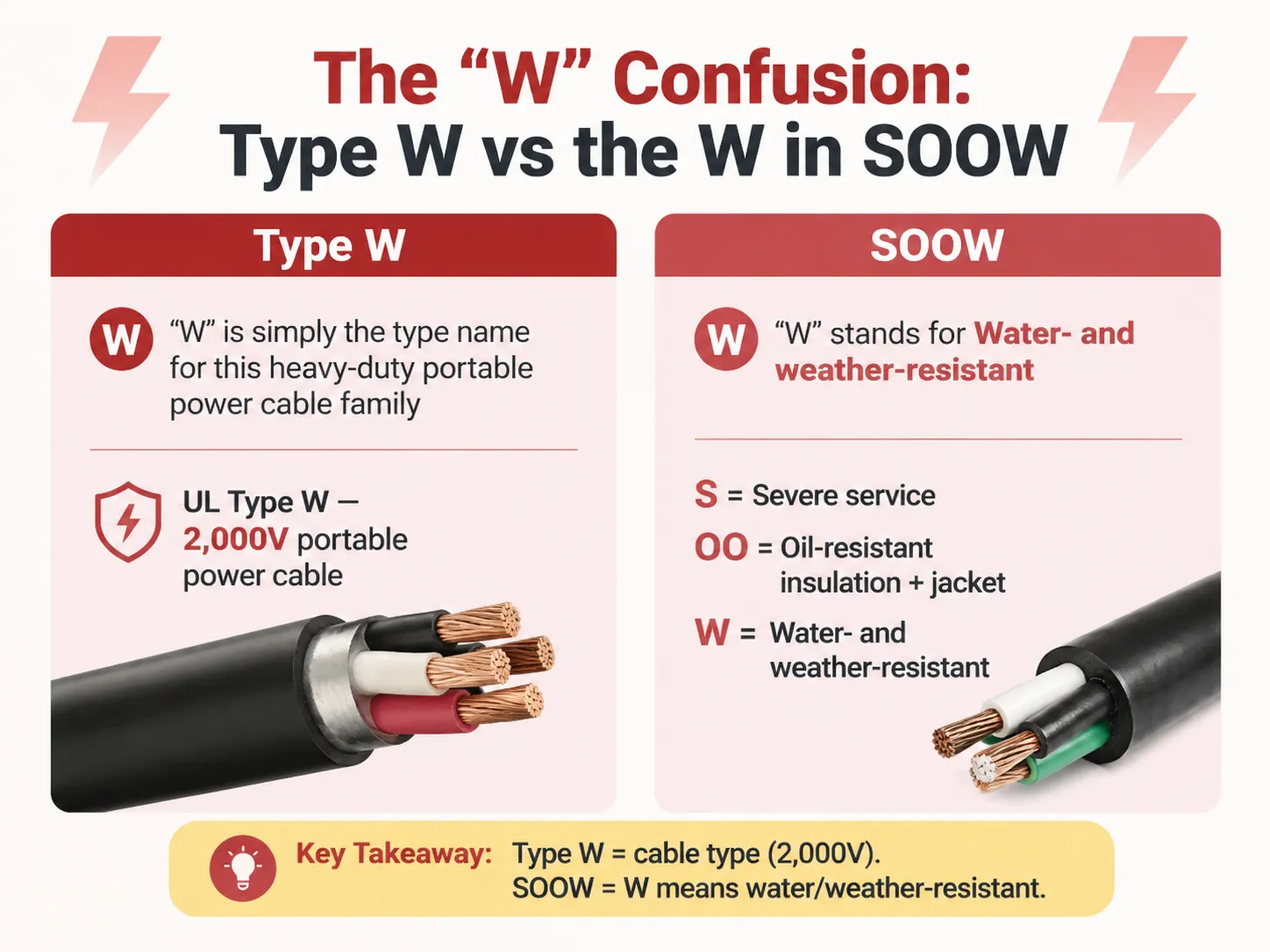
A confusão do “W”: Type W vs o W em SOOW
A letra “W” aparece em dois tipos diferentes de designações de cabos e refere-se a dois significados completamente distintos, sendo a maior fonte de confusão.
| Designação | O que o “W” Significa | Significado Completo |
|---|---|---|
| Tipo W (cabo de energia portátil) | “W” é simplesmente o nome do tipo para esta família de cabos de energia portátil de serviço pesado | UL Tipo W — cabo de energia portátil 2.000V |
| SOOW (cordão de serviço) | “W” significa Resistente à água e ao tempo | S = Serviço severo, OO = isolamento + jaqueta resistente a óleo, W = resistente ao tempo/água |
Assim, embora tanto “Tipo W” quanto “SOOW” tenham um “W” em seus nomes, no primeiro “W” é um elemento do nome do cabo, assim como existem tipos como “Tipo G” e “Tipo SC.” Por outro lado, em “SOOW,” “W” funciona como um adjetivo indicando que o cabo é resistente à água. Portanto, qualquer pessoa que procure por “significado do tipo w” em relação a cabos estará quase sempre buscando o cabo de energia portátil UL Tipo W em vez da resistência à água.
Especificações do Cabo Tipo W
Aqui está a visão completa de um cabo Tipo W típico:
| Parâmetro | Valor |
|---|---|
| Tipo de cabo | UL Tipo W (cabo de energia portátil) |
| Classificação de tensão | 000V AC/DC (multi-condutor); condutor único com dupla classificação RHH/RHW 600V |
| Isolamento | Borracha EPDM termofixa |
| Jaqueta | CPE ou CSPE |
| Faixa de temperatura | -40°C a +90°C |
| Número de condutores | 1-5 (preto, branco, vermelho, verde, laranja) |
| Torção | Cobre torcido em corda (flexível) |
| Tamanhos de condutor único | 8 AWG a 500 MCM |
| Tamanhos multi-condutor | 8 AWG a 4/0 AWG |
| Resistência | Excelente resistência à abrasão, impacto, óleo, produtos químicos e intempéries |
| Aprovações | UL 1650, teste de chama MSHA, teste de chama UL, ICEA S-75-381 / NEMA WC-58, CSA, RoHS |
The notable features here are the 2,000V rating (approximately 3.3 times that of the 600V SOOW), along with a thick and sturdy jacket that has no trouble with rocks, vehicles or bad weather.
What Is Type W Cable Used For?
Type W is preferred everywhere portable machinery needs high voltage, high current, and strong construction:
- Mining — energizing drills, conveyors, pumps, and transport equipment (MSHA-approved for mining).
- Construction — temporary electrical supply from generators to panels, welders, and heavy machines.
- Rental of generators — connecting generators to distributing boxes and transferring equipment.
- Oil, gas, and drilling rigs — energizing mud pumps, winches, and devices on the drilling sites.
- Marine transportation — providing shore power and heavy marine operations.
- Entertainment — ensuring high-power distribution from production trucks.
- Industry— temporary electrical supply for maintenance, downtime, and transport machinery.
- Pumps and cranes — motors that use a lot of current over a long distance.
Being rated as RHH/RHW, Type W can act as versatile connection wire in conduits.
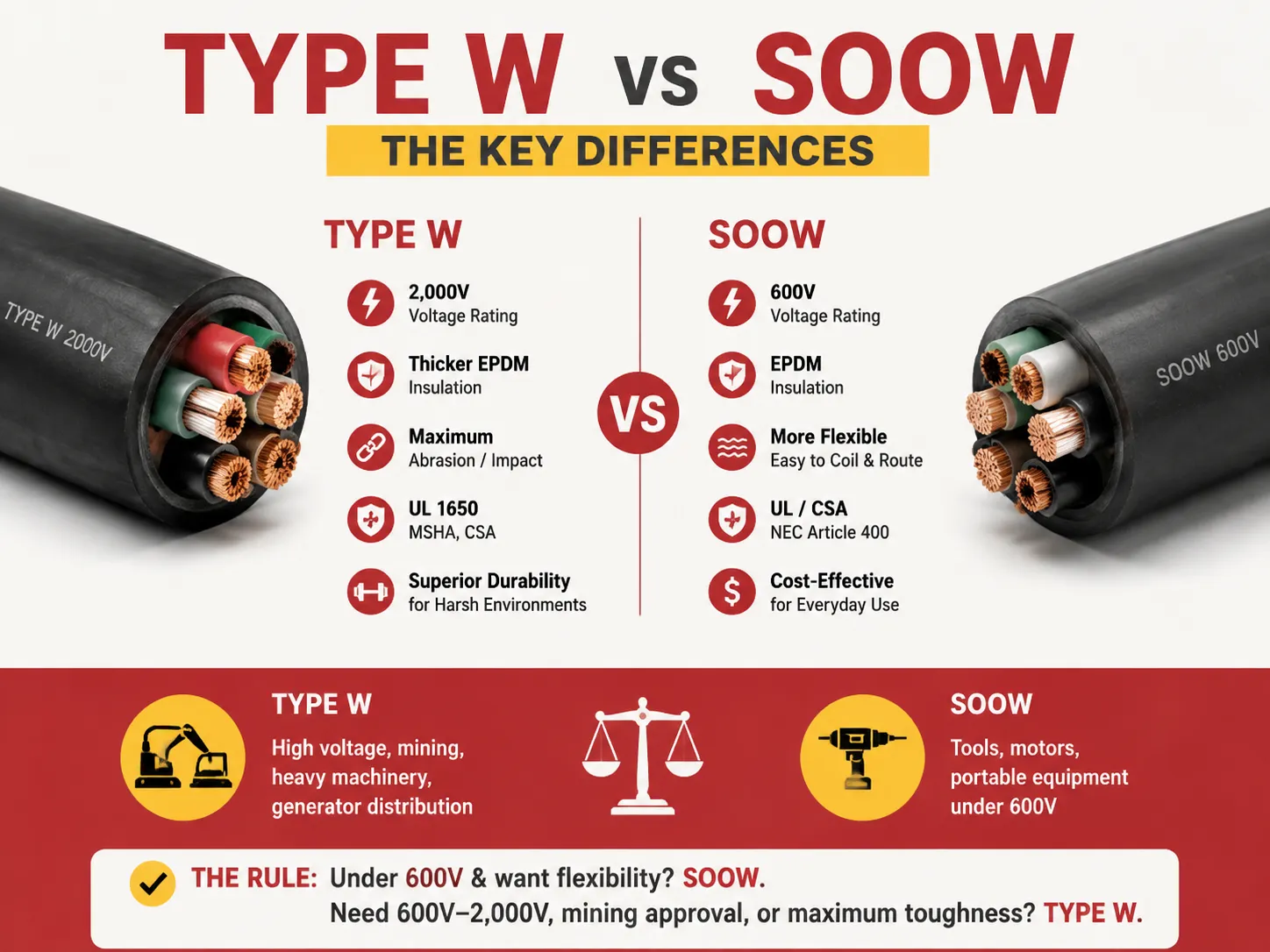
Type W vs SOOW: The Key Differences
| Característica | Tipo W | SOOW |
|---|---|---|
| Categoria | Portable power cable | Service cord |
| Classificação de tensão | 2,000V | 600V |
| Isolamento | Thicker EPDM | EPDM (thinner) |
| Jaqueta | Heavy CPE/CSPE — maximum abrasion/impact | CPE — tough but more flexible |
| Flexibilidade | Stiffer, heavier | More flexible, easier to coil and route |
| Durability | Superior — survives vehicles, rocks, crushing | Good — suited to most job sites |
| Typical sizes | 8 AWG to 4/0 (multi-conductor); up to 500 MCM single | 18 to 6 AWG typical |
| Key approvals | UL 1650, MSHA, CSA | UL/CSA, NEC Article 400 |
| Custo | Higher per foot (more copper + insulation) | Menor |
| Melhor para | High voltage, mining, heavy machinery, generator distribution | Tools, motors, portable equipment under 600V |
In a nutshell: be below 600V and need flexibility? Choose SOOW; need 600V-2,000V, can afford having its mining suitability certified or functions at its maximum tensile strength? Choose Type W.
Type W vs Other Portable Cables (SJOOW, SEOOW, STOW, Type G)
The portable-cable family has many members; here’s how Type W stacks up:
| Cable Type | Tensão | Key Feature | Melhor Uso |
|---|---|---|---|
| SJOOW | 300V | “Junior” service cord — thin, flexible | Light tools, small appliances |
| SOOW | 600V | Severe-service cord, oil + water resistant | General industrial tools and equipment |
| SEOOW | 600V | Thermoplastic elastomer jacket | Freezing environments, extreme cold |
| STOW | 600V | Thermoplastic (PVC) jacket | Consumer-grade extension cords |
| Tipo W | 2,000V | Heavy portable power cable, MSHA | Mining, high-voltage distribution, heavy equipment |
| Type G | 2,000V | Very similar to Type W; ground conductors included in the assembly | Portable power distribution with integrated ground |
Type W and Type G can almost be regarded as siblings as both of them are portable power cables rated at 2,000V, which means they can withstand and endure a lot of wear and tear. What separates Type W from Type G however is that Type G constructions typically come with grounding conductors as part of the package while Type W depends on the conductor arrangement that has been specified to achieve grounding. In most instances high voltage portable work can be achieved through the usage of either dressing; it is just important to check which dressing is most appropriate for the job at hand.
Approvals & Standards
Type W cable possesses numerous certifications that guarantee its success in many applications:
- UL 1650 — This is the portable power cable standard.
- UL Type W listing — Rated for 2,000V in any configuration.
- UL dual rated RHH/RHW — indicates that the single conductors are rated for 600V as general building wire.
- MSHA flame test — Approved for mining use (needed for underground applications).
- ICEA S-75-381 / NEMA WC-58 — They are recognized portable cables standards.
- CSA approval — The Canadian qualification.
- RoHS — This means that the restricted hazardous substances are not present.
If your project is connected to MSHA, you will need Type W cable — SOOW won’t make it through the inspection.
How to Choose: Type W or SOOW?
Proceed to ask the following questions in order:
- What is the required voltage for the equipment? For any voltage greater than 600V, Type W is the choice. For voltages equal to or below 600V, both options would suffice.
- How severe is the working environment? If mining is involved (severe pressure from rocks, equipment being dragged over cables, heavy crushing etc.), it is advisable to go with Type W since its jacket is thicker.
- Do you need permission from MSHA? If the application is taking place underground, choose Type W.
- How flexible should your cable be? If flexing around tight corners, twisting and turning is required, it is preferable to go for SOOW.
- Working under how much money? Type W has a higher price than SOOW, if less than 600V is needed, choose SOOW.
Safety & Usage Rules
- Examine before every use — look for any damage such as cuts, scrapes, compression areas, or exposed wires; Type W is durable, but it is not indestructible.
- Do not use as a permanent building wire within walls — it is a portable wire; for permanent electrical work, the wiring used is THHN/THWN with conduit.
- Do not direct bury unless the construction is designed to be buried — check the jacket markings and local requirements.
- Choose the correct ampacity according to the load — Type W wire can take 2,000V but this refers to the voltage capacity and not the ampacity.
- Prevent damage — use ramps or elevated ways where trucks and cars travel on the cable; avoid putting the cable in standing and stagnant water.
- Scrape off the oil and other chemicals immediately after the cable is overexposed to them — the coat of the cable can be oil-resistant, but it will hold longer without these chemicals.
Prices & Where to Buy
The reason behind the higher price of Type W in comparison to SOOW is that Type W uses more copper and heavier insulation material. Typical pricing estimates per foot for 2025-2026 (for multi-conductor copper wire) is as follows:
| Conductor Size | Typical Price per Foot |
|---|---|
| 8 AWG (3-4 conductors) | $4-$8 |
| 6 AWG | $6-$12 |
| 4 AWG | $8-$16 |
| 2 AWG | $12-$24 |
| 1 AWG | $15-$30 |
| 1/0 AWG | $18-$38 |
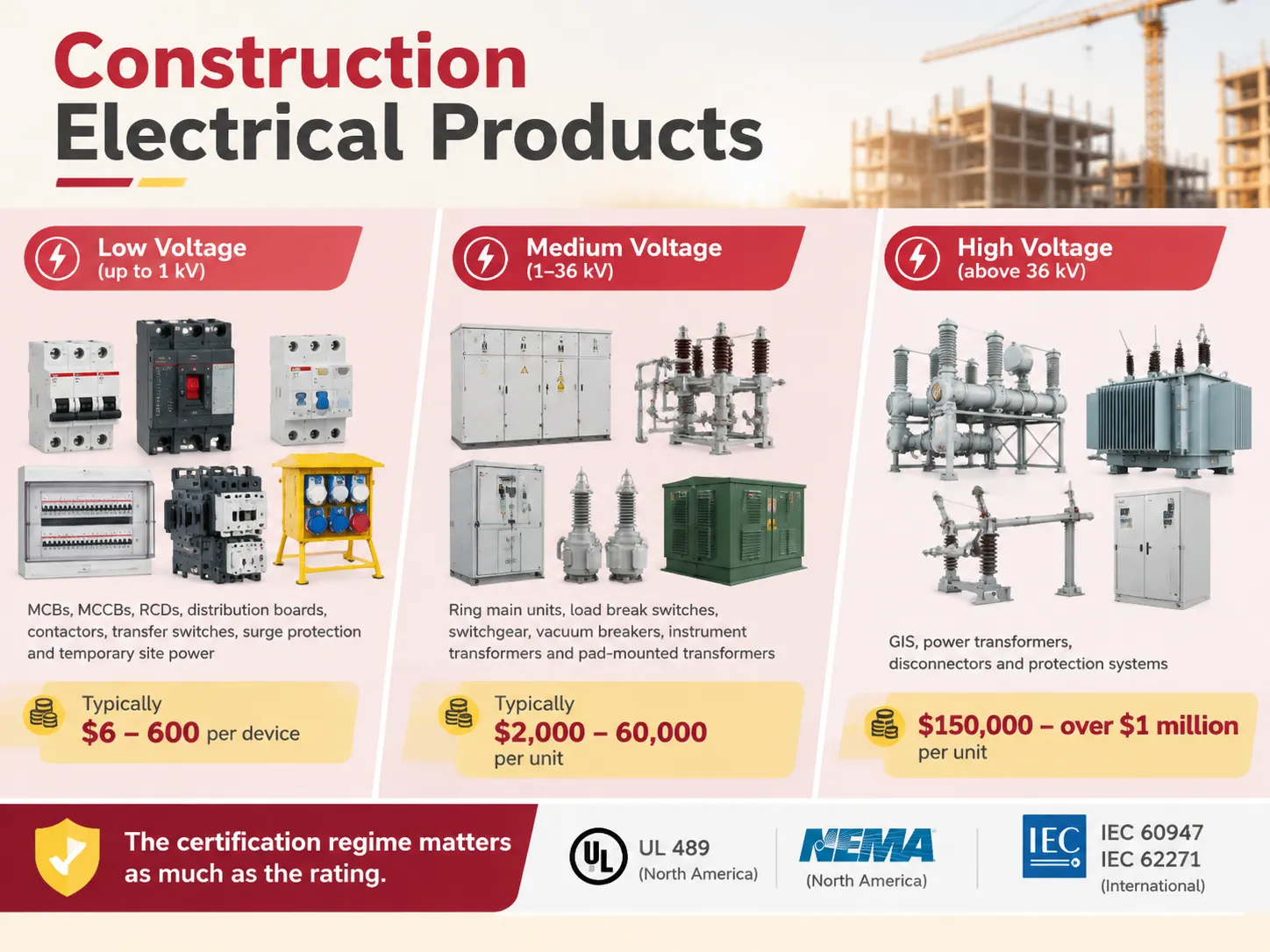
Different pricing applies depending on the wiring installation, based on the conductor number, insulation material, and supplier; however, the cost is lowered greatly when purchased in bulk from the wire distributor.For buyers building distribution systems around portable power — generators, transfer switches, and the protection gear behind them — pairing the right cable with the right MCB/MCCB protection and a certified UL 489 keeps the whole power chain safe and code-compliant — and when a breaker eventually needs replacing, the costs in our breaker replacement guide help you budget the job.
Perguntas Frequentes
What is the main difference between Type W and SOOW cables?
The differences between them consist of their ratings and durability: Type W has a tough portable power cable rated for extreme use with voltages of up to 2,000V thanks to its thick layers of EPDM insulation and CPE jacket while SOOW is a more flexible and less costly cable rated for 600V use. Type W is also MSHA-approved for use in mines. Use SOOW at less than 600V if flexibility is required; choose Type W for any higher voltage or maximum durability.
Does SOOW cable need to be in conduit?
NO – SOOW is a service cord that makes it possible to operate without conduit’s help in a flexible application (NEC Article 400). Its use for permanent installation is not permitted, and it is not approved for underground installation. Permanent installation requires the use of building wires (THHN/THWN) and conduit, while SOOW can be employed for portable power supply tasks.
What voltage is SOOW rated for?
SOOW has a voltage rating of 600 volts (plus 300V versions referred as junior SJOOW). SOOW cable can be used for applications involving most power tools, motors as well as machinery. However, Type W cable is required for higher voltage systems as well as for mining operations requiring MSHA approval.
Can Type W cable be used as building wire?
Single conductor Type W is a dual rated cable with both RHH and RHW ratings up to 600 volts. For this reason, single conductor Type W can be used as industrial hook-up wire in conduit up to 600 volts. However, while multi-conductor Type W is meant to be used for temporary power, using this type for permanent installation is not recommended. Always check local codes in accordance to the specific use of the cable.
Referências
- Allied Wire & Cable — Type W Cable Specifications and Applications
- UL — UL 1650 Portable Power Cable Standard & Type W Listing
- MSHA — Mine Safety and Health Administration Cable Requirements
- NFPA 70 (NEC) — Article 400 Flexible Cords and Cables
- NEMA — NEMA WC-58 Portable and Power Feeder Cables
- AutomationDirect — Portable Cord and Type W Selection Guide
Conclusão
Type W is the UL designation used for the heavy-duty flexible power cable that is sought after in industrial environments when the task is major and the surroundings difficult: rated for 2000 volts, made of the EPDM rubber material and CPE plastic, able to work in the temperature range from -40 to +90 degrees Celsius, MSHA compliant for mining applications. The “W” refers to the type of the cable and not to the “water resistant” W in SOOW, which is a different cable type working on 600 volts with higher flexibility and lower cost. Use SOOW cable for general-purpose portable tools, and Type W for high voltage power distribution, mining, generators, and heavy machinery — and always combine this cable with approved safety equipment.