
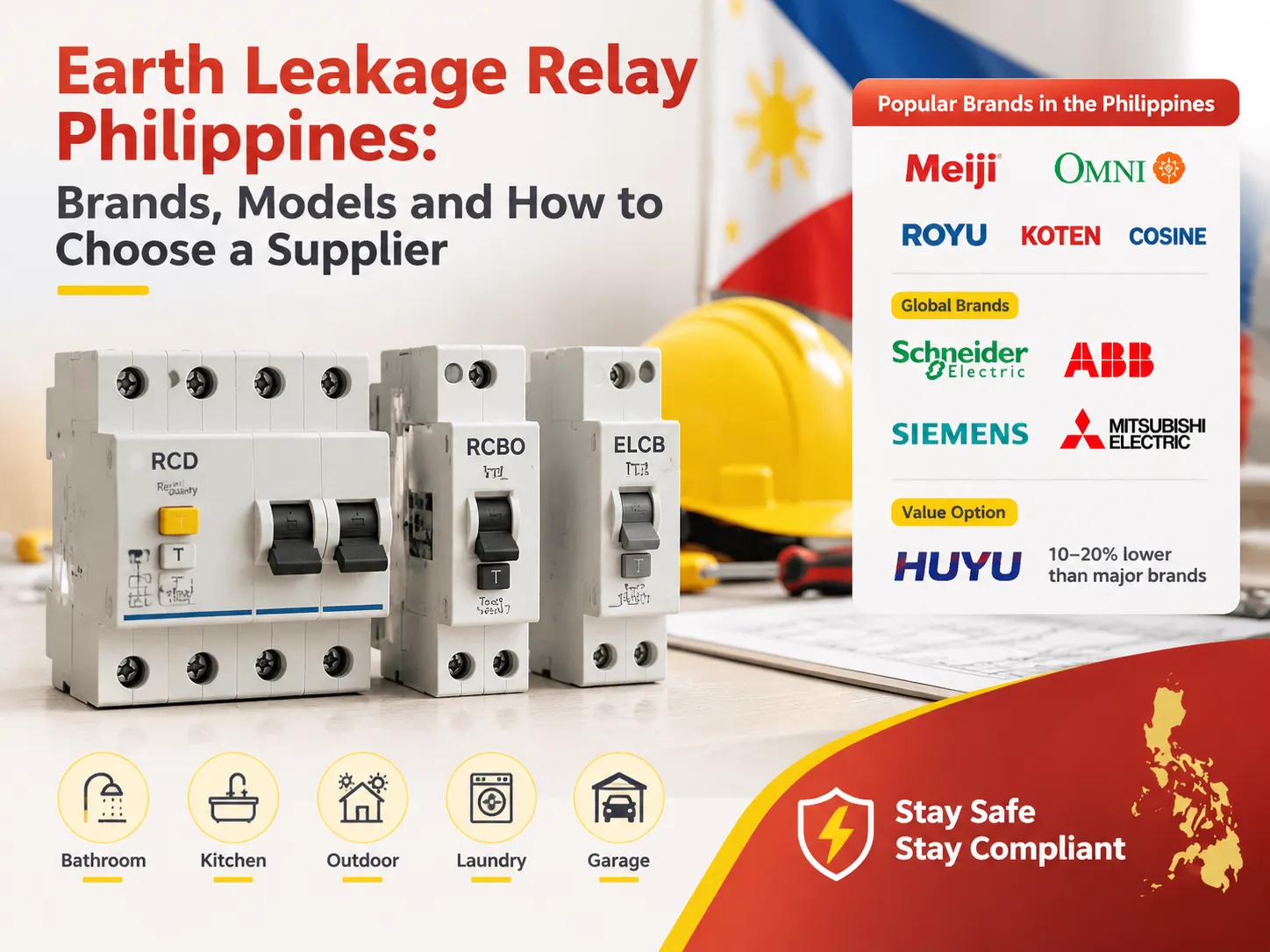
La compra de dispositivos de protección contra fugas a tierra en Filipinas difiere de la compra de interruptores automáticos debido a varios factores, incluyendo el voltaje de 230 V a una frecuencia de 60 Hz, el código aplicable (PEC en lugar de NEC), la presencia obligatoria de una marca PS o una etiqueta ICC en cada dispositivo vendido en el mercado filipino, y la decisión sobre qué tipo de sensibilidad usar para que sea un dispositivo que proteja a una persona o solo un aparato. Esta guía le ayudará a entender el significado de la terminología utilizada, los requisitos del Código Eléctrico Filipino, las marcas disponibles en el mercado local, sus precios y los medios para elegir al proveedor sin encontrarse con fraudes.
Resumen: Los relés de fuga a tierra, RCD, RCCB y ELCB se refieren a dispositivos que disparan cuando la corriente fluye fuera del circuito en lugar de regresar por el neutro. Según el PEC 2017 (Artículo 2.10.1.8), los hogares filipinos deben contar con protección GFCI Clase A para baños, cocinas, áreas exteriores, lavanderías y garajes, a un nivel de 4-6 mA, y protección de corriente residual de 30 mA para circuitos de tomacorrientes. Un RCD de 30 mA no es un sustituto exacto de un GFCI de 4-6 mA y el PEC requiere que se obtenga la aprobación de la AHJ en caso de que se use un RCD o RCBO en lugar de un receptáculo. Espere gastar ₱300 – ₱1500 en un dispositivo doméstico de 2 polos, ₱1500 – ₱4500 en un RCBO de 30 A, y ₱2500 – ₱9000 en un equipo industrial de 4 polos. Meiji, Omni, Royu, Koten y Cosine son populares entre los usuarios locales, mientras que Schneider, ABB, Siemens y Mitsubishi Electric están posicionados por encima de ellos, y HUYU ofrece los mismos productos pero cobra menos por los modelos 10% – 20% que los principales competidores internacionales.
Qué es realmente un relé de fuga a tierra
Primero, discutamos la terminología porque los compradores filipinos se refieren a varios términos diferentes que probablemente denotan dos o tres artículos distintos.
Un relé de fuga a tierra es un término general que se refiere a un dispositivo que mide la suma vectorial de las corrientes en todos los conductores usando un transformador de corriente de núcleo balanceado (CBCT). Las corrientes que salen por los conductores de fase deben ser iguales a la suma de las corrientes en los conductores neutros. Por lo tanto, si faltan algunos miliamperios, indica que la corriente se está fugando por otro camino como una persona, agua o el chasis de un aparato defectuoso.
Existen muchos tipos de dispositivos basados en este concepto y que comparten los mismos acrónimos.
| Término | Nombre completo | Lo que hace | Disparo por sobrecorriente |
|---|---|---|---|
| ELR | Relé de fuga a tierra | Solo detección de corriente residual, a menudo un relé separado que acciona un disparo por derivación | No |
| RCCB / RCD | Interruptor automático de corriente residual | Detección de corriente residual, montado en riel DIN | No |
| RCBO | Interruptor de corriente residual con protección contra sobrecorriente | Corriente residual más sobrecorriente en un solo módulo | Sí |
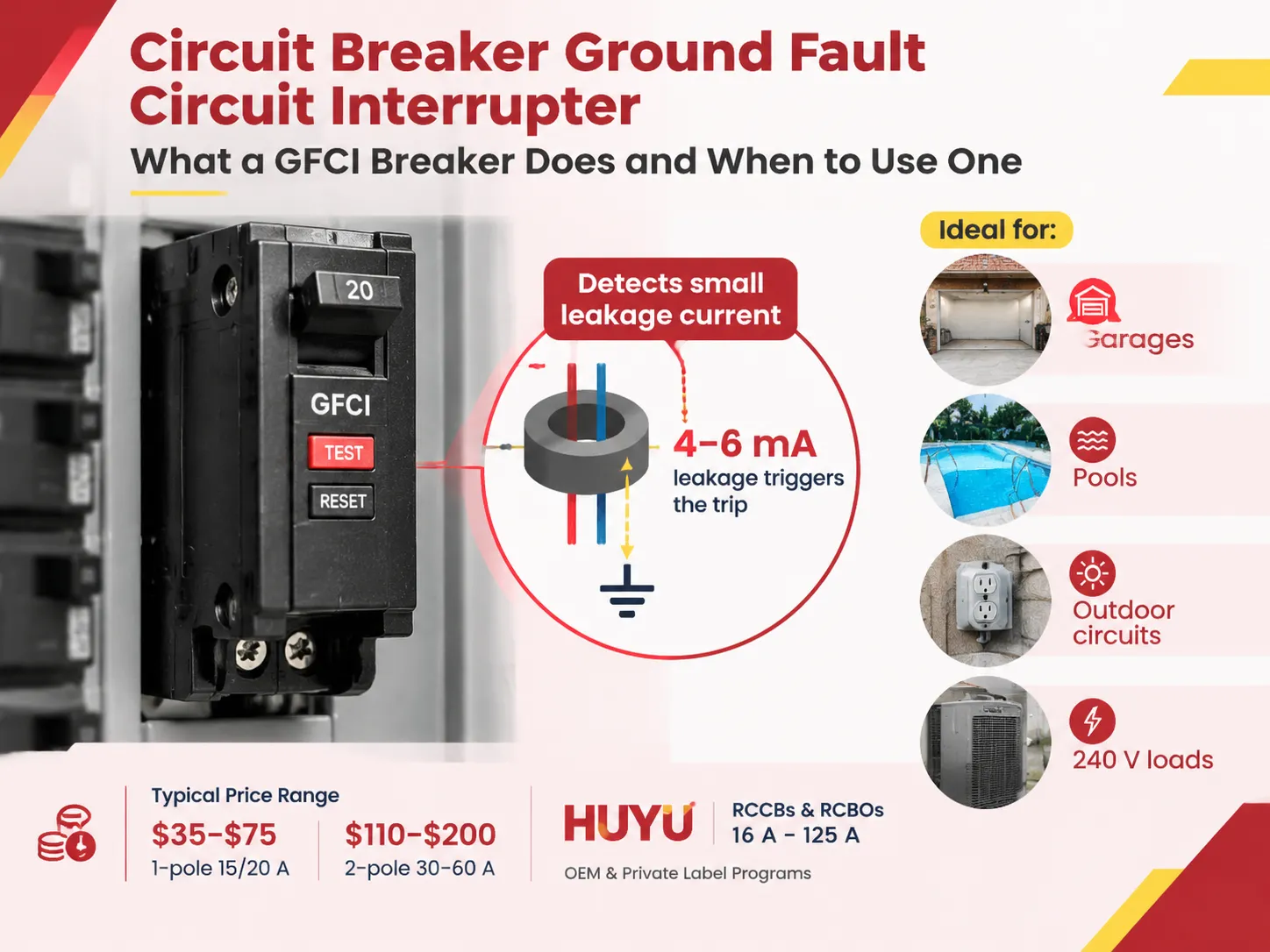
| GFCI | Interruptor de circuito por falla a tierra | Protección personal a 4–6 mA, según UL 943 | A veces |
| ELCB (operado por corriente) | Interruptor automático de fuga a tierra | Nombre antiguo para un RCD moderno | No |
| ELCB (operado por voltaje) | Interruptor automático de fuga a tierra | Detecta un aumento de voltaje en el chasis de un aparato | No |
La última fila es más significativa de lo que parece. Los ELCB operados por voltaje son de tecnología anticuada. Su funcionamiento dependía de que el camino a tierra fuera perfecto, por lo que podían fallar silenciosamente en la misma circunstancia que se suponía debían prevenir. No cumplen con las normas actuales según el PEC, y cualquier proveedor que los considere equivalentes a un RCD revela cierta falta de criterio en su catálogo.
La explicación completa del acrónimo y cómo funciona la bobina de detección vale la pena leerla antes de especificar cualquier cosa, y está cubierta en este desglose de lo que significa ELR.
Lo que requiere el Código Eléctrico Filipino
El Código Eléctrico Filipino es producto del Instituto de Ingenieros Eléctricos Integrados de Filipinas en conjunto con la Junta de Ingeniería Eléctrica y el fundamento legal de la Ley Republicana 7920. La versión actual del PEC es PEC 2017, que está basada en el NE C 2017.
Hay dos artículos que se refieren a la protección contra fallas a tierra. El primero es el Artículo 2.10.1.8 que trata sobre interruptores de circuito por falla a tierra que protegen a las personas y el segundo es el Artículo 2.30.7.6 que se refiere a la protección contra fallas a tierra de los aparatos.
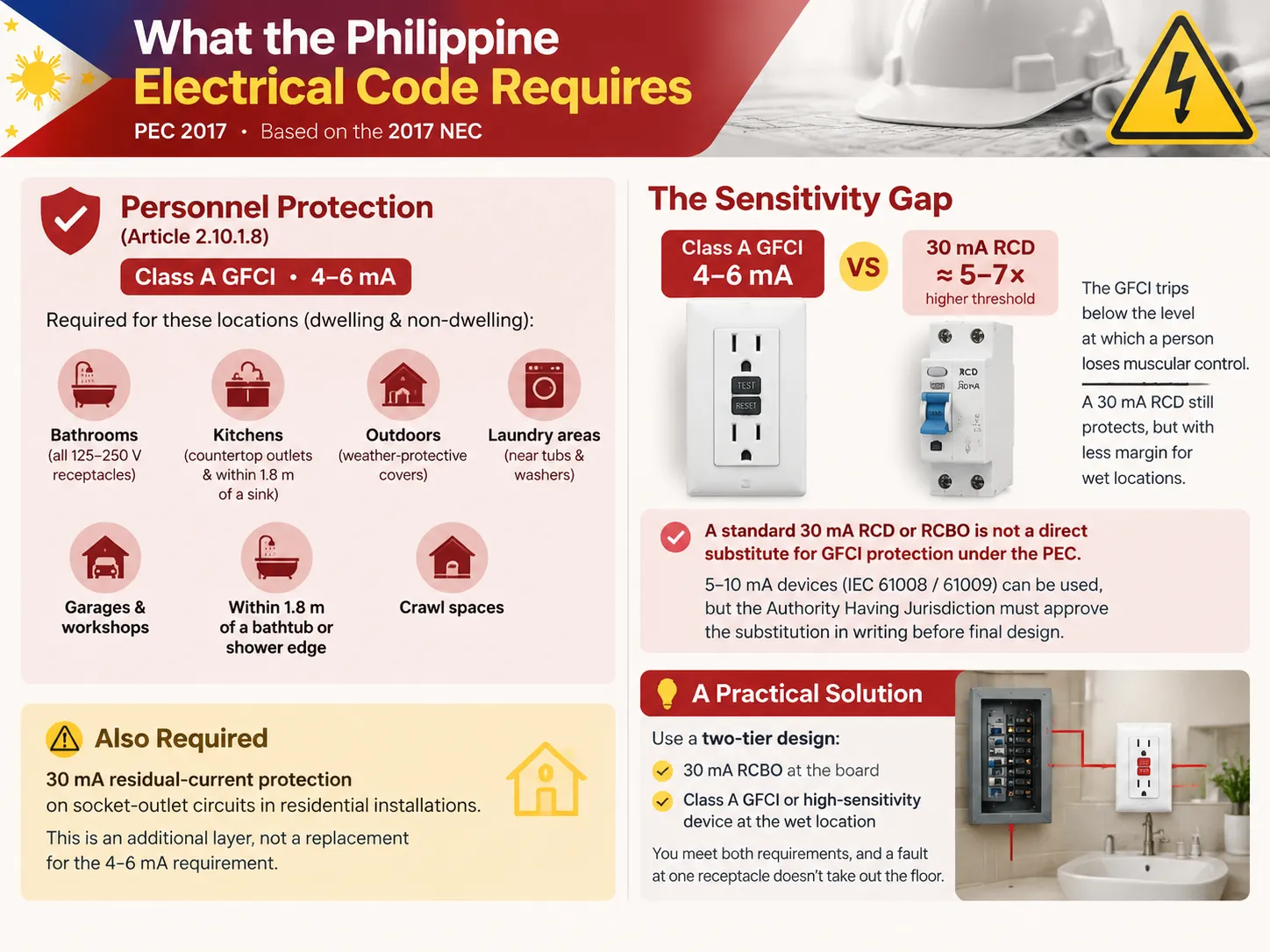
La regulación respecto a la protección personal es particular, ya que no funciona exactamente como el RCD de 30 mA común en Europa. Según el PEC 2017, tanto las viviendas como los locales no residenciales deben contar con sistemas de interruptores de circuito por falla a tierra Clase A con sensibilidad entre 4 mA y 6 mA para cualquier aparato en los siguientes locales:
- en baños, todos los enchufes de 125–250 V en uso
- en cocinas, receptáculos de encimera y cualquier enchufe ubicado a menos de 1.8 m de los lavabos
- en las áreas exteriores del edificio donde todos los enchufes y clavijas exteriores están ubicados bajo cubierta
- en áreas de lavandería, todos los enchufes ubicados cerca de lavaderos y lavadoras
- en garajes y talleres
- a menos de 1.8 m de bañeras y duchas
Además, el PEC estipula medidas de seguridad con corriente residual de 30 mA en circuitos de enchufes domésticos. Esta es una opción adicional y no un reemplazo para el requisito de 4-6 mA.
Lo que los compradores malinterpretan es la diferencia entre los RCD de 30 mA y los GFCI Clase A en términos de sus niveles de sensibilidad. El RCD de 30 mA opera a una corriente aproximadamente cinco a siete veces mayor, pero cumple el mismo propósito, solo que de diferentes maneras: un GFCI está ajustado para desconectarse antes de que una persona pierda la capacidad de controlar sus músculos, mientras que un RCD de 30 mA tiene un margen de seguridad menor y aún puede proporcionar cierta protección a una persona cuando se encuentra en una zona de riesgo por agua. De la misma manera, el PEC considera que el tipo de dispositivo es estándar y no trata este tipo de dispositivo como un sustituto equivalente del GFCI. Los dispositivos que tienen clasificaciones de 5-10 mA y que cumplen con las normas IEC 61008 o IEC 61009 pueden ser capaces de lograr los mismos resultados bajo condiciones adecuadas, pero el código requiere un acuerdo previo por escrito de las autoridades correspondientes antes de que se complete el diseño final.
Una solución muy simple que elimina la necesidad de todas estas disputas es el uso de un sistema de dos etapas. Con este enfoque, se instala un RCD de 30 mA en el panel de control eléctrico y un GFCI Clase A o dispositivo super sensible inmediatamente en el área húmeda. Este enfoque ayuda a cumplir ambos conjuntos de requisitos, y una falla en uno de los puntos no tendría consecuencias graves.
Sensibilidad, Tipo y Dónde Pertenece Cada Uno
Dos especificaciones deciden lo que un dispositivo puede hacer realmente: su sensibilidad de disparo y su designación de Tipo.
| Sensibilidad | Lo que protege | Uso típico en Filipinas |
|---|---|---|
| 4–6 mA (GFCI Clase A) | Personas | Baños, cocinas, tomas exteriores, lavanderías |
| 10 mA | Personas, margen mayor | Aplicaciones especiales, ubicaciones médicas |
| 30 mA | Personas | El estándar para circuitos de tomacorrientes y circuitos finales |
| 100 mA | Equipos y fuego | Protección subprincipal donde se requiere selectividad |
| 300 mA | Incendio | Entrada principal, además de — nunca en lugar de — 30 mA aguas abajo |
La designación del Tipo indica las ondas de corriente de falla que son reconocidas por el equipo, y aquí es donde muchas instalaciones hoy en día fallan. Con inversores solares, variadores de frecuencia y cargadores de vehículos eléctricos convirtiéndose en la norma en edificios en todo Filipinas, un dispositivo Tipo AC solo detectará corriente residual alterna sinusoidal y no puede reconocer el componente de corriente continua suave producido por estos dispositivos. El Tipo A puede detectar tanto corriente alterna como pulsante continua. El Tipo B detecta también corriente continua suave. El Tipo B es la especificación correcta para cualquier equipo que incluya un rectificador, inversor o enlace de CC, y esto no es simplemente una mejora con un nombre elegante.
Condiciones en Filipinas que cambian la especificación
Tres elementos locales hacen que el diseño se desvíe del estándar europeo.
230 V a 60 Hz. La electricidad suministrada en Filipinas es usualmente de 230 V monofásica a 60 Hz, con 400 V trifásicos como opción. Los dispositivos vendidos en estos territorios deben funcionar a la frecuencia de 60 Hz; los dispositivos que solo operan a 50 Hz tienen un desempeño impredecible, lo que hace que la información del tiempo de disparo sea poco confiable.
Variedad de sistemas de puesta a tierra. Las instalaciones eléctricas en Filipinas consisten en diferentes combinaciones de sistemas TT y TN-C-S dependiendo del suministro eléctrico y la fecha de construcción. El tipo de puesta a tierra utilizada define si un RCD por sí solo es suficiente o si debe complementarse con un electrodo de tierra que cumpla con las normas requeridas y ayude a calcular la impedancia del lazo de falla. Suposiciones erróneas sobre esto son una de las principales razones por las que los RCD recién instalados a veces no funcionan como se espera. La explicación de tales sistemas se proporciona en la visión general de TN-C-S y algunos otros tipos de sistemas de puesta a tierra.
Rayos. El número promedio de días con tormentas eléctricas en áreas bajas de Filipinas es de 25 a 50 al año, y en regiones montañosas es aún mayor. Hay dos consecuencias directas de las tormentas eléctricas para la colocación de dispositivos de corriente residual. Primero, se debe considerar un electrodo de tierra, y los requisitos mínimos establecen que debe ser de acero recubierto de cobre y tener 2.4 m de longitud y 15.87 mm (5/8 pulg) de diámetro. El cumplimiento del código puede indicar alrededor de 25 Ohmios, aunque para un funcionamiento confiable del RCD, es favorable un valor de 5 Ohmios o menos. Segundo, la protección contra sobretensiones debe estar aguas arriba del dispositivo de corriente residual.
Marcas que realmente encontrará en Filipinas
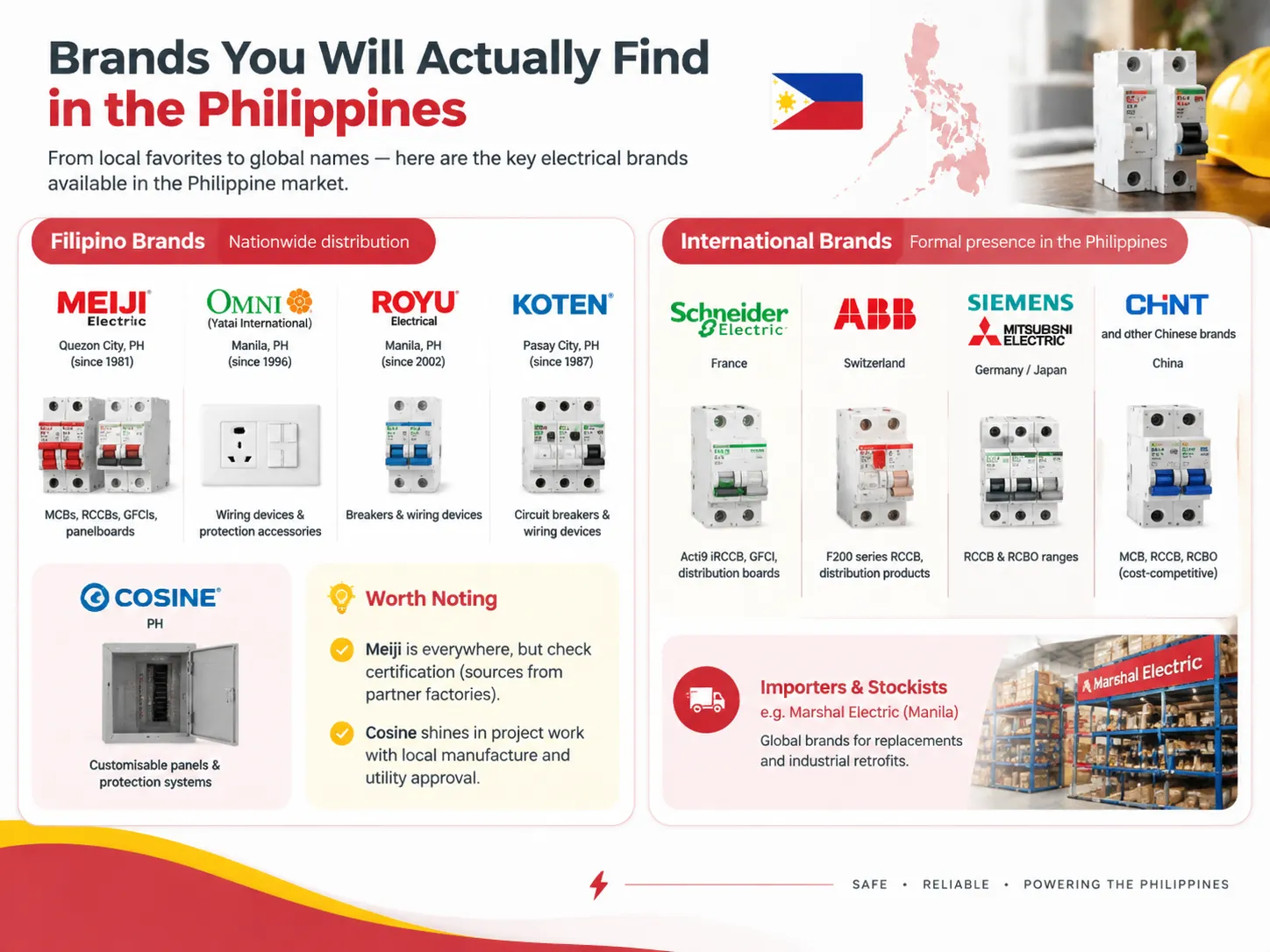
El mercado local está perfectamente dividido entre marcas filipinas con distribución nacional y aquellas que son extranjeras pero tienen presencia formal. Las siguientes cifras muestran algunos precios de calle en 2026 para un dispositivo doméstico de 2 polos que varían según la clasificación de amperaje y sensibilidad.
| Marca | Origen | Lo que suministran | Rango típico de precios | Notas |
|---|---|---|---|---|
| Meiji Eléctrico | Quezon City, PH — desde 1981 | MCBs, RCCBs, GFCIs, tableros, dispositivos de cableado | ₱400–₱2,500 | Cumple con PEEP y DOE; diseños basados en IEC; amplio stock en ferreterías |
| Omni (Yatai Internacional) | Manila, PH — desde 1996 | Dispositivos de cableado y accesorios de protección | ₱350–₱2,000 | Marcado PNS e ICC; la red de distribución más fuerte a nivel nacional |
| Royu Eléctrico | Manila, PH — desde 2002 | Interruptores (terminal de tornillo de 2 polos, 220 V), dispositivos de cableado | ₱300–₱1,200 | Bajo el grupo FELCO; certificado BPS; policarbonato retardante de fuego |
| Koten Empresas | Pasay City, PH — desde 1987 | Interruptores automáticos y dispositivos de cableado estándar | ₱300–₱1,800 | Favorito en viviendas masivas e institucionales; piezas siempre disponibles |
| Cosine Industrias | PH | Paneles personalizables y sistemas de protección | Basado en proyectos | Fabricado localmente, fuerte aprobación de servicios públicos, coetiquetado disponible |
| Schneider Electric | Francia | Acti9 iRCCB, AvatarOn GFCI, tableros de distribución | ₱700–₱4,500 | Mayor presencia en especificaciones para proyectos comerciales |
| ABB | Suiza | Serie F200 RCCB, productos de distribución | ₱900–₱5,000 | Común en trabajos industriales y de servicios públicos |
| Siemens / Mitsubishi Eléctrico | Germany / Japan | RCCB and RCBO ranges | ₱800–₱4,500 | Premium pricing; strong on OEM panels |
| Chint and other Chinese brands | China | MCB, RCCB, RCBO | ₱250–₱1,500 | Cost-competitive; certification varies enormously by product line |
There are two that require mentioning. Among the infamous brands in the Philippines, Meiji is the first choice for many domestic electricians. That’s because it’s available A-to-Z and with understandable labeling, which means that it has got the production from various factories rather than manufacturing everything on its own. Thus, the importance of checking certifications only increases. Cosine is the unique one for projects, given that it has the ability to produce things locally with the utility approval.
On the importers and the stockists level, there are companies like Marshal Electric in Manila that would have global brands for replacement and retrofitting. For the time being, being in need of a simple RCBO replacement, this layer is often faster than trying to get the replacement through the distributor order.
Common Models and What Each One Is For
Devices in this group do not have decorative design because they give you information on pole number, the type of current and other characteristics.
This means that encountering with a model such as 2P, 30mA, Type A, 6kA, you see a two-pole RCD with 30mA sensitivity that works with pulsating DC current and has a maximum short-circuit current of 6kA. Substitute 30 with 300, and a device turns into one that protects from fire and electric shock. Replace 2P with 4P, and the device protects you not only against electric shocks but also indicates if you have a three-phase circuit.
In case of a single-phase 230V domestic distribution board, you would typically encounter a 2-pole 30mA type A RCCB and a number of 16-32 A RCBOs. In commercial kitchens or wet areas of hospitals, you would be protected with devices with 10 mA GFCI. Any system with a drive or anything similarly requiring a type B device will make the specifications different.
HUYU’s residual-current range covers that spread in one family rather than piecemeal: a 16–125 A Type AC/Type A RCCB for the sub-main position, plus RCBOs from 6 A to 125 A, Type B and Type F variants for inverter and drive loads, and the MCB and AFDD lines that sit alongside them in the same board. The point of buying one family is that the accessories, busbars and enclosure widths are already matched.
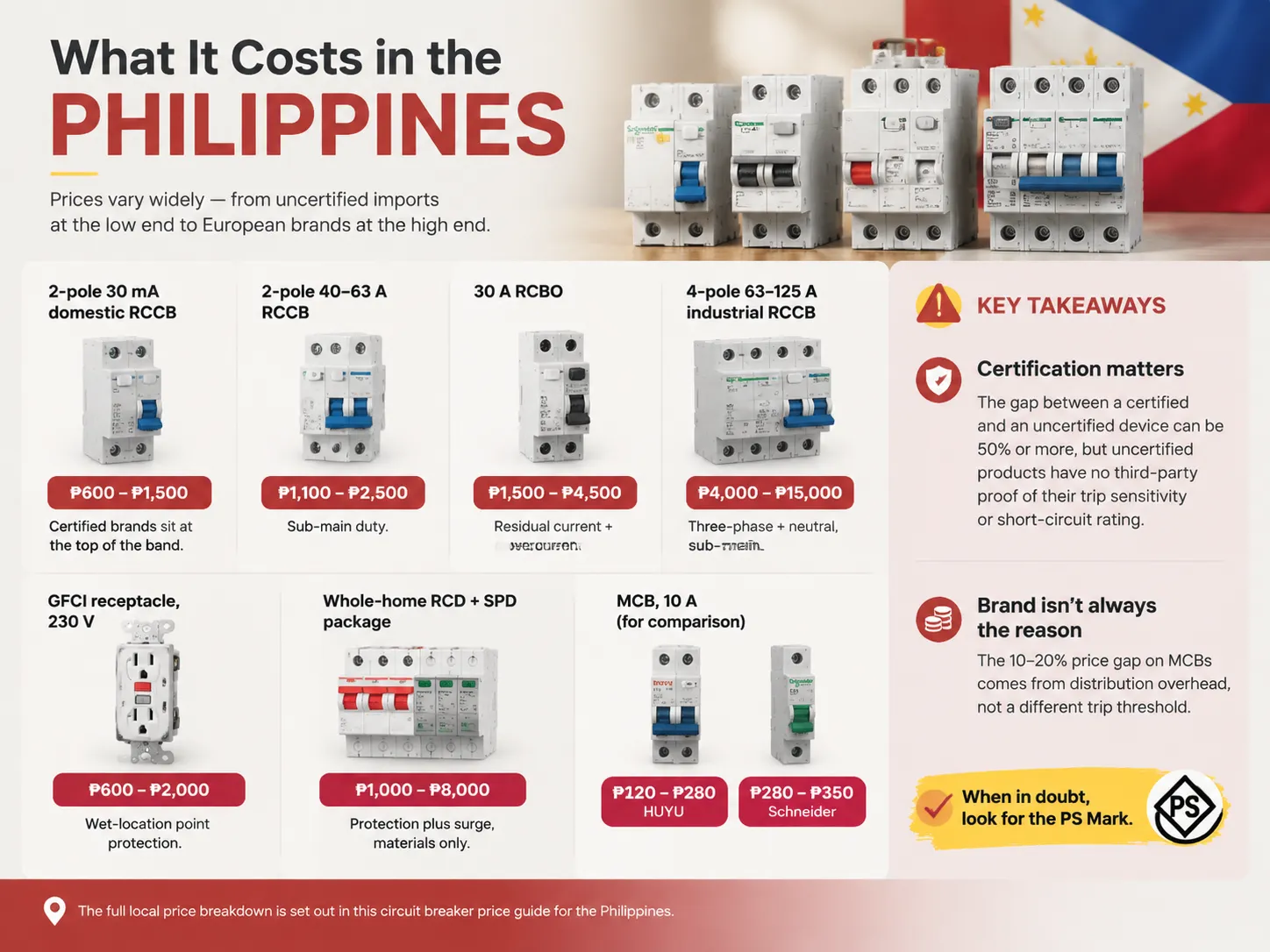
What It Costs in the Philippines
Philippine pricing is lumped because the cheaper side of the market is crowded by uncertified imports and the expensive one by European brands, leaving very limited possibilities in between. The bands below show 2026 street pricing, so regard the low end of any range with caution unless there is a visible PS Mark.
| Dispositivo | Typical price (PHP) | Notas |
|---|---|---|
| 2-pole 30 mA domestic RCCB | ₱600–₱1,500 | Certified brands sit at the top of the band |
| 2-pole 40–63 A RCCB | ₱1,100–₱2,500 | Sub-main duty |
| 30 A RCBO | ₱1,500–₱4,500 | Residual current plus overcurrent |
| 4-pole 63–125 A industrial RCCB | ₱4,000–₱15,000 | Three-phase plus neutral, sub-main |
| GFCI receptacle, 230 V | ₱600–₱2,000 | Wet-location point protection |
| Whole-home RCD + SPD package | ₱1,000–₱8,000 | Protection plus surge, materials only |
| MCB, 10 A, for comparison | ₱220–₱400 | HUYU ₱220–280; Schneider ₱280–350 |
There are two noteworthy patterns. The difference between an approved unit and one that is not may appear on paper to be more than fifty percent, however, the uncertified item has no verification that it will break at the values stated in its specifications or withstand short-circuit current of the same value. Therefore, the calculated difference is only a difference on paper. Similar situation can be observed in the table presented above, where HUYU offers its product at a price level of ₱220–280 while major European brands sell their devices for ₱280–400.The full local price breakdown is set out in this circuit breaker price guide for the Philippines.
How to Choose a Supplier
Philippine procurement depends on certifications more than on manufacturers, so figure out this checklist before worrying about price.
- PS Mark or ICC. Electrical equipment available in the Philippines is expected to be marked with the Philippine Standard Mark or an Import Commodity Clearance sticker. Without that, an appliance cannot be mentioned in a valid installation, no matter what kind of datasheet is provided.
- Specify standards. RCCB has to be certified according to IEC 61008, while RCBO has to provide IEC 61009. An offer saying “It conforms to IEC standards” is not definitive.
- Sensitive rating and Type. Make sure the offer indicates that it is 30 mA and appropriate Type A or B. If a drive, inverter or an adapter is included in the installation, Type B is obligatory.
- Breaking capacity. Ask what conditional short-circuit current a device is rated for and which protective device is used. The difference between a 10 kA unit and a 6 kA unit is not visible.
- 60Hz specification. Make sure the part complies with the specifications for 60Hz, not 50 Hz only.
- Warranty. It is better to ask for two-year warranty with some possibility of replacement rather than a one-year.
- Documentation. Make sure you obtain the test report and Declaration of Conformity each time the shipment arrives, not just once per inquiry.
This way a manufacturer like HUYU operates successfully. We are not well-known brand among Filipino customers, and if the specification mentions Schneider or ABB, it means that this specification involves these brands and not our company. In that case, we are able to compete based on performance specifications — 30 mA, Type A or B, PS Mark or ICC, IEC 61008/61009, two-year warranty according to the specifications strictly. The range and the OEM terms are set out on the RCCB manufacturing programme page.
Preguntas Frecuentes
Is an earth leakage relay the same as an RCD or RCCB?
So functionally the two devices are the same as they both sense the current flowing in the live conductors and trip on residual current. However the difference between them comes in terms of the form factor and their application. The earth leakage relay is usually a standalone equipment which is combined with a core balance current transformer and is responsible for the operation of the relay which is utilized when it is required to have a variable action of the device or to trip a large circuit breaker. RCCB is in fact a single DIN event component that performs the switch. In electrical works in the Philippines one will be faced with installation of RCCB or RCBO while earth leakage relays are used in industry and beyond.
Does the Philippine Electrical Code require an RCD in homes?
Yes, in two different ways. The requirement of PEC 2017 Article 2.10.1.8 is that Class A grounding fault circuit interrupters (GFCIs) should be applied when the current range is 4 to 6 mA in outlets located in bathrooms, kitchens near sinks, where water is used outdoors, in laundry areas, garages, and within 1.8 meters of a bathtub or shower. In addition to this, the code specifies that circuitry for socket-outlet circuits has a requirement of 30 mA for the residential output. Both of these requirements are applicable, and one may not replace the other because the thresholds of sensitivity are already different with these two requirements as well as the principles of protection.
Can a 30 mA RCD be used instead of a GFCI in the Philippines?
Rather than a straightforward substitute for the 4-6 mA requirement. It should be noted that PEC specifically mentions that the device with 30 mA rating does not comply with the GFCI regulation as 30 mA is about five to seven times more than the GFCI compliance level. Devices with 5-10 mA rating which are in accordance with IEC 61008 or IEC 61009 are compliant to requirements when the right type is utilized based on the load, but there is a limitation in the sense that prior written approval from AHAJ is necessary before the design completion. Thus, it will be more prudent to provide both: a 30 mA RCBO installed in the electrical panel and a Class A GFCI used in moist locations.
What Type should I specify — AC, A, B or F?
Type AC responds only to sinusoidal alternating residual current and is only used in simple resistive and lighting circuits. Type A adds pulsating DC to its sensing range and is the sensible minimum for modern installations with electronic equipment. Type B is required whenever the circuit contains any of the following: a variable frequency drive, a solar inverter, an EV charger, or any other equipment that can create smooth DC leakage because neither Type AC nor Type A will detect it. Type F is between types A and B when it comes to mixed frequencies from single-phase drives and some inverter loads. If there is any inverter on the load list, specify Type B and stop haggling.
Do I need surge protection as well as earth leakage protection?
Absolutely, and the two are not the same things, as an RCD reacts as regards to any residual current, but does not shield devices from voltage surge. Considering that there can 25-50 storm days every year in the Philippines flat regions, the usage of Type 1 SPD at the point of supplies with the use of Type 2 devices at the switches is common and advisable for anything what has sensitive loads. The distance between these two levels of SPD should be at least 10 m or they can be connected with the help of decoupling elements.
Why does a newly installed RCD trip for no apparent reason?
There are four reasons that can account for the majority of the instances. An included neutral conductor connecting ahead two circuits divides the return path and takes on the characteristics of a ground fault for the coil responsible for sensing the fault. A bootleg ground or neutral conductor that has inadvertently been grounded also produces the same results. Cable insulation that has absorbed moisture, typical for the older Philippine buildings, leads to the presence of a true leakage. Finally, a device that is installed incorrectly because of the type may trigger an alarm on the DC component of the load. In order to localize the source of the issue, disconnect the load first and then check the individual circuits.
Referencias
- International Electrotechnical Commission — IEC 61008 and IEC 61009, residual current operated circuit-breakers
- Normas y participación de UL — UL 943, Interruptores de circuito por falla a tierra
- UL Solutions — testing and certification for residual current devices
- NFPA — NFPA 70, National Electrical Code (the basis of the PEC structure)
- ISO — ISO 9001 quality management, the framework behind IEC 61008/61009 certification
Conclusión
When looking to purchase earth leakage protection in the Philippines, you will have to think about three different specifications as well as one certificate. The specifications include the sensitivity of the device (i.e. it should be 4–6 mA for personnel protection in compliance with PEC 2017, 30 mA for socket circuits and 300 mA for fire protection), number of poles and the Type of the device (AC means basic protection, A is the most common there is and B is suitable only when the inverter or the drive is used in the device). The certificate you need is either a PS Mark or ICC sticker — without the certificate, you cannot use the device in your installation even if the datasheet states otherwise.
As for the suppliers, you can choose from Meiji, Omni, Royu and Koten companies as they will provide you with fast replacement regardless of the device illness; Cosine company manufactures at local factories and has a range of strong utility approvals; Schneider, ABB, Siemens and Mitsubishi Electric are known for the presence of all specifications required for proper device functioning according to the consultants expectations. HUYU is competing on costs and OEM terms – our prices are 10–20% lower than those of the leading brands but since we are not a well-known brand we have to admit that.
Whichever option you choose to shop for, ask for the data you need (the standard number, declared sensitivity of the device, type of the device and its safety performance) in writing so that at least four points indicated in the quotation would not allow you to deal with most possible troubles.