
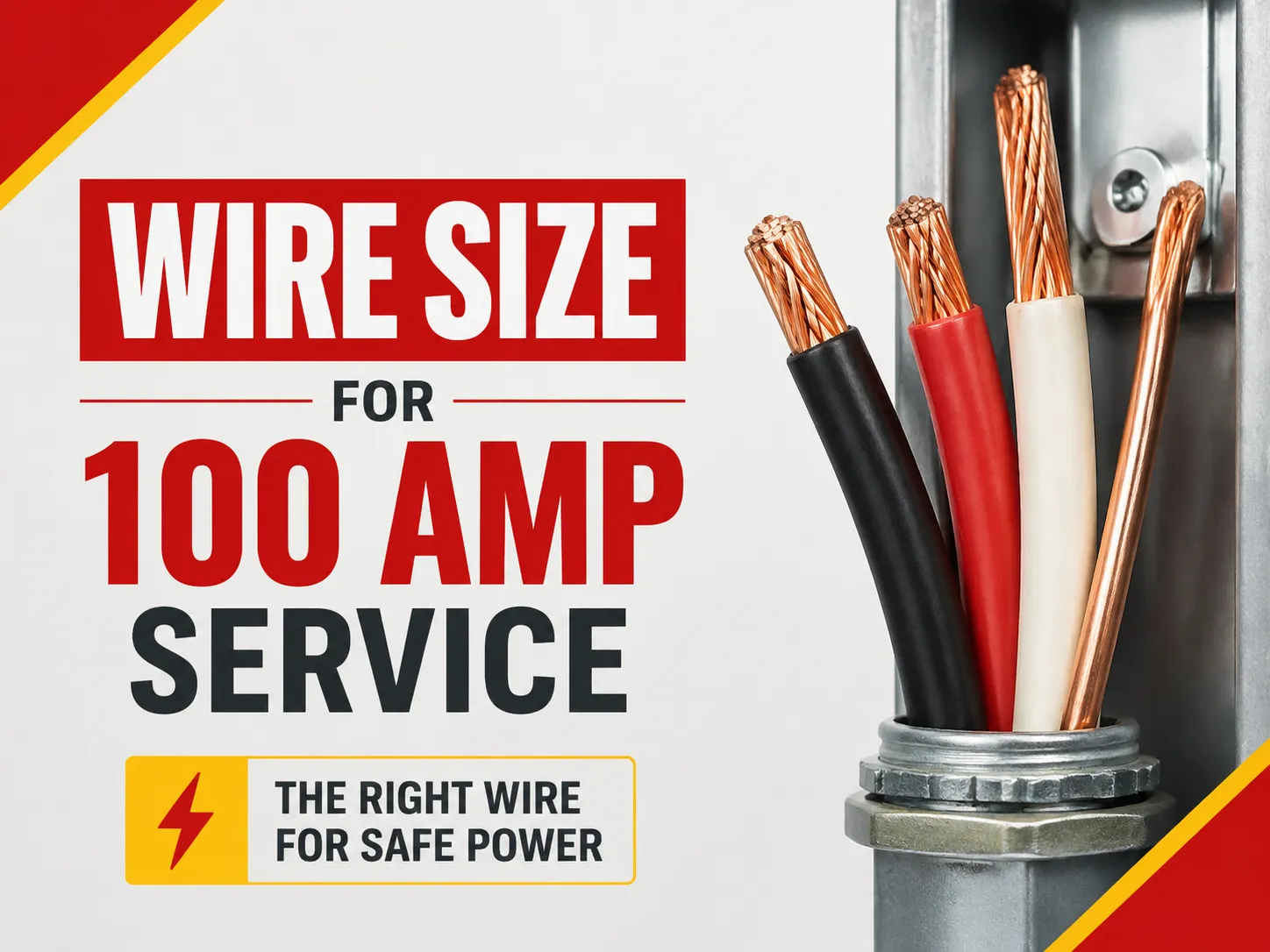
Quer você esteja atualizando o serviço residencial antigo de 60A para 100A, instalando uma linha alimentadora para uma garagem destacada ou fiação de uma nova oficina, a primeira pergunta é sempre a mesma — que tipo de fiação (cobre ou alumínio) eu preciso para um serviço de 100 ampères? A resposta depende de dois códigos diferentes que se aplicam, já que um serviço residencial pode usar o NEC 310.12 e, portanto, requerer ampacidade 83% (4 AWG cobre ou 2 AWG alumínio), enquanto um serviço comercial significa que você precisa de 3 AWG cobre (para garantir ampacidade total) ou 1 AWG alumínio. Faça corretamente e você passa na inspeção; faça errado e você ou falhará na inspeção ou superaquecerá o fio mais crítico no seu canteiro de obras. O guia a seguir fornecerá todos os tamanhos de fio que você precisa, os códigos por trás deles, vários cálculos envolvendo fios de cobre e alumínio, e detalhes sobre o processo de instalação.
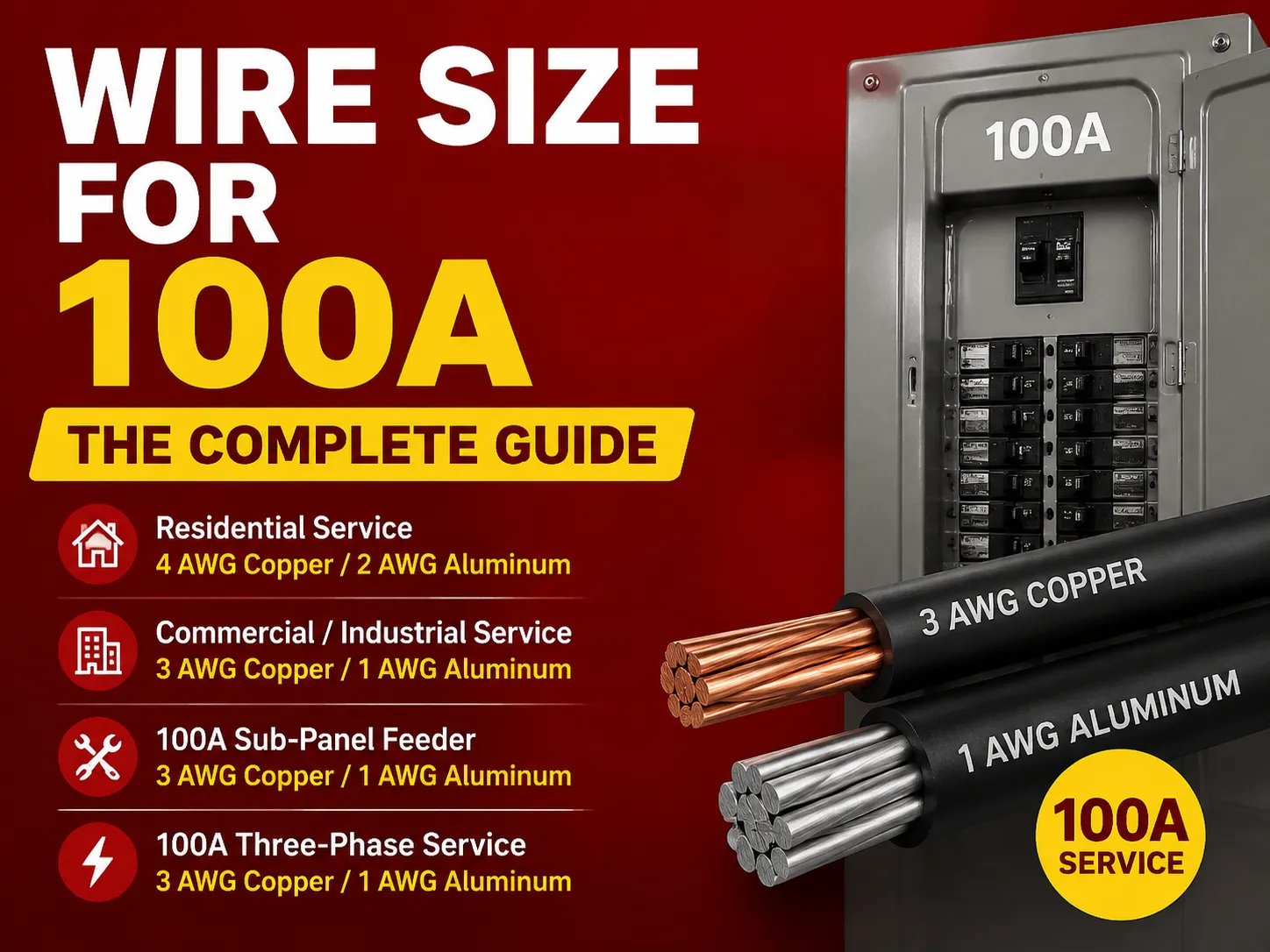
Em resumo: De acordo com o NEC 310.12 (a regra 83%), para um serviço residencial monofásico 100A 120/240V, o mínimo para cobre é 4 AWG e para alumínio é 2 AWG. Para uso comercial, serviços trifásicos ou alimentadores de subpainel de 100A, aplicam-se os requisitos completos do NEC 310.16 para ampacidade: o mínimo para cobre é 3 AWG e para alumínio é 1 AWG. 2 AWG cobre (115A) também pode ser adequado para muitos circuitos de 100A conforme NEC 240.4(B). 6 AWG não atende aos requisitos pois fica abaixo (65A para 75 °C). Ajuste o dimensionamento para os valores na coluna de 75 °C, ajuste para tamanho maior para qualquer distância superior a ~100-150 pés, e verifique novamente com um inspetor local e as concessionárias locais no seu projeto.
A Resposta Direta: Tamanho do Fio para Serviço de 100A
Aqui está a resposta completa em uma única tabela. A linha que você precisa depende do tipo de estrutura e se este é o ponto de entrada do serviço ou alimentador.
| Cenário | Cobre | Alumínio | Base do Código |
|---|---|---|---|
| Serviço residencial de moradia (monofásico 120/240V, a maioria das casas) | 4 AWG | 2 AWG | NEC 310.12 (regra 83%) |
| Serviço comercial / industrial (monofásico ou trifásico) | 3 AWG | 1 AWG | NEC 310.16 (capacidade total) |
| Alimentador de subpainel de 100A (garagem, oficina, ADU) | 3 AWG | 1 AWG | NEC 310.16 (sem exceção para residência) |
| Serviço trifásico de 100A (qualquer ocupação) | 3 AWG | 1 AWG | NEC 310.16 (sem exceção para residência) |
Aqui estão três esclarecimentos a observar:
- 6 AWG não é adequado para transportar uma carga de 100A porque cobre com 6 AWG só pode transportar 65A a uma temperatura de 75 graus Celsius. Portanto, deve fazer parte de um circuito de 50-60A.
- Fio de cobre 3 AWG é útil para transportar exatamente 100A a 75 graus Celsius.
- 2 AWG cobre também funciona, pois tem capacidade de 115A a 75 graus, então, de acordo com NEC 240.4(B), pode ser usado em circuito com disjuntor de 100A.
NEC 310.12 & a Regra 83% (Serviços Residenciais)
NEC 310.12 permite que condutores de serviço e alimentadores de toda a casa sejam dimensionados em 83% da classificação do serviço para uma moradia unifamiliar (ou unidade habitacional individual) alimentada por um sistema monofásico 120/240V. A razão por trás da regra é o fato de que as cargas em uma residência são diversificadas. De fato, é impossível que todas as cargas elétricas funcionem simultaneamente. Portanto, o NEC permite usar tamanhos de condutores menores do que os especificados nas tabelas gerais.
O cálculo para 100A é o seguinte: 100 x 0,83 = 83A de ampacidade requerida. Para verificar a ampacidade, precisamos encontrar a classificação de temperatura ‒ se estivermos falando de 75°C:
- 4 AWG cobre (85A) → pode suportar 83A → é um tamanho padrão de cobre para serviços residenciais de 100A.
- 2 AWG alumínio (90A) → pode suportar 83A → é um tamanho padrão de alumínio para serviços residenciais de 100A.
Essa é a razão pela qual as pessoas dizem “serviço 100A equivale a 4 AWG cobre ou 2 AWG alumínio” – a regra indica que é um tamanho de bitola menor do que o das tabelas gerais. No entanto, não se aplica a
- Edifícios comerciais, varejo, escritórios, armazéns ou manufatura.
- Serviços trifásicos.
- Alimentadores para subpainéis ‒ eles utilizam a ampacidade total da 310.16 mesmo se usados na mesma residência.
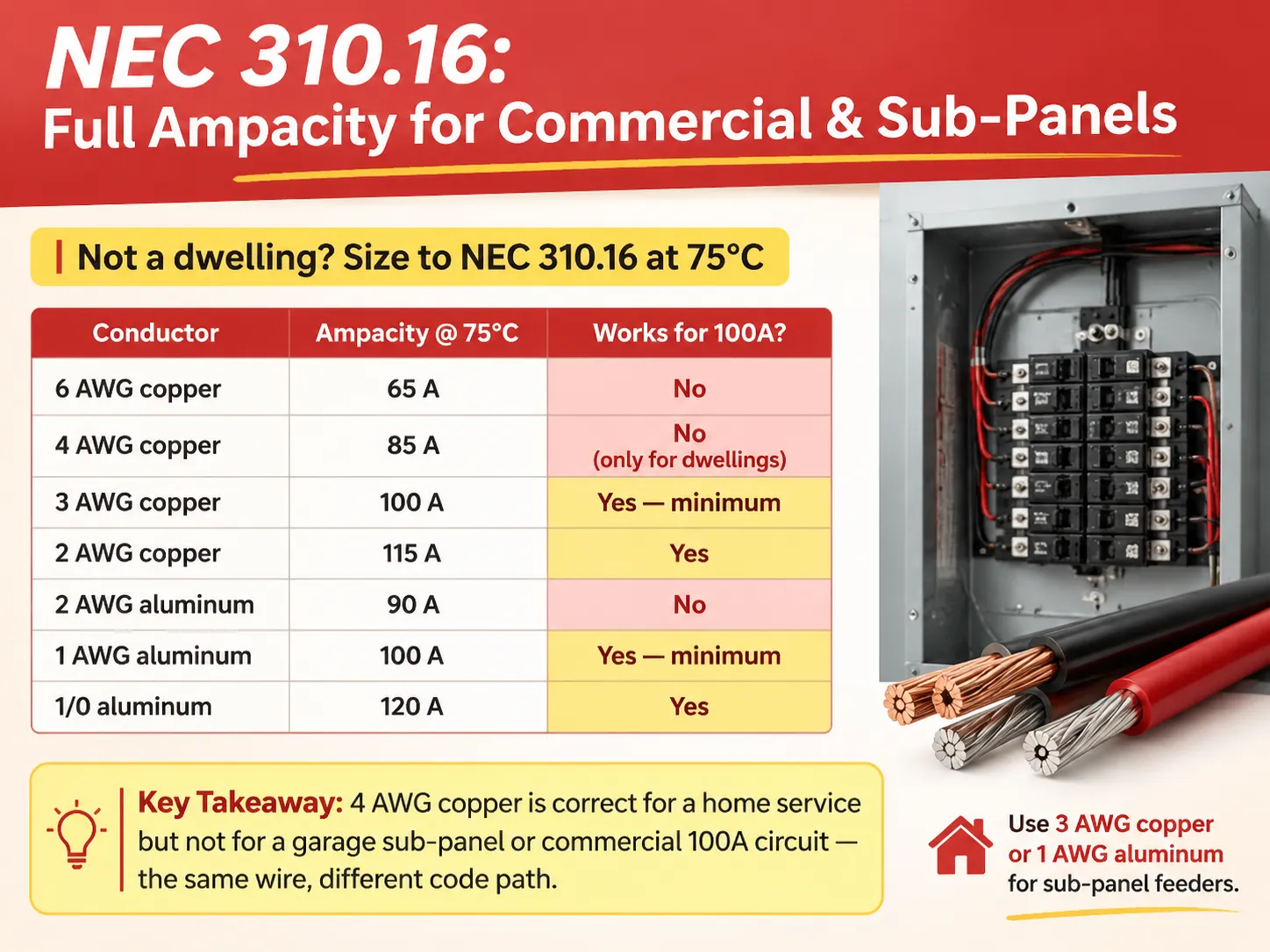
NEC 310.16: Ampacidade total para painéis comerciais e subpainéis
Quando a exceção para habitação não se aplica, dimensione para NEC 310.16 a 75°C (o padrão para terminais de equipamentos de serviço):
| Condutor | Capacidade de corrente @ 75°C | Funciona para 100A? |
|---|---|---|
| 6 AWG cobre | 65 A | Não (circuito de 50-60A) |
| 4 AWG cobre | 85 A | Não sob 310.16 (apenas sob 310.12 para habitações) |
| 3 AWG cobre | 100 A | Sim — mínimo |
| 2 AWG cobre | 115 A | Sim (escolha comum para margem de segurança) |
| 2 AWG alumínio | 90 A | Não sob 310.16 (apenas sob 310.12) |
| 1 AWG alumínio | 100 A | Sim — mínimo |
| 1/0 alumínio | 120 A | Sim (margem extra) |
Resultado principal: Embora 4 AWG cobre seja aceitável para serviço residencial, não funciona para um subpainel de garagem ou fio de circuito comercial de 100A — este fio pode ser aprovado, mas não pelo método padrão de alimentador de subpainel. É daí que surge a maior parte da confusão e é por isso que o padrão para fiação de alimentador de subpainel em cobre é 3 AWG cobre ou 1 AWG alumínio.
Cobre vs Alumínio: Qual a diferença
Ambos estão em conformidade com o código; a escolha é economia mais disciplina de instalação:
| Fator | Cobre | Alumínio |
|---|---|---|
| Custo relativo | Base (caro) | Aproximadamente 40-60% menos neste tamanho |
| Tamanho necessário para 100A (310.16) | 3 AWG | 1 AWG (dois tamanhos maiores) |
| Peso | Mais pesado | Cerca de 1/3 do peso — mais fácil de puxar |
| Condutividade | Maior | ~61% da do cobre |
| Termination rules | Norma | Anti-oxidant compound, AL-rated lugs, correct torque — mandatory |
| Corrosion | Mínimas | Oxidizes at terminations if untreated |
Aluminum is practically the most popular material used for both the 100A service entrance as well as for long feeders. Its installation is also common knowledge among certified electrical workers. There are three essentials that have to be used in all aluminum installations: an anti-oxidant joint connecting compound, terminals with AL/CU rating, and a torque wrench according to the manufacturer’s recommendations.
What Does “2-2-2-4” Wire Mean?
If you are picking a residential 100A feeder, the cable is noted to be “2-2-2-4” (this might appear as “2-2-2-4 SER” or “2-2-2-4 AL”). This notation breaks down the conductors in it: 2 conductors of 2 AWG are the 2 hot legs, and another 4 AWG is the neutral type of conductor along with one conductor of 4 AWG for grounding purpose.
- Two 2 AWG hots + 2 AWG neutral provide the 120/240 volt circuit.
- 4 AWG is the ground for the equipment.
- Since this is aluminium type of SER cable, it fulfills the standard 100A residential requirement of electrical installations per NEC 310.12 (2 AWG = 90A, more than enough voltage output of 83A).
To the question, “does 2-2-2-4 wire suffice for 100 amps?” the answer is “yes” for residential service and 100A feeder, where the 83% regulation would apply. However, it wouldn’t work for commercial services at 100A that would be needing 1 AWG cables for the hots.
Will 6 Gauge Wire Handle 100 Amps?
6 AWG copper wire is appropriate for 65A at 75°C (55A at 60°C) jobs which is not sufficient for a 100A service since this wire overheating can damage the insulation and create a serious fire risk. It is preferable to use this wire in low amperage circuits, up to 50-60A. For jobs with 100A or more workloads one has to use wire sizes of 3 AWG of copper or 1 AWG of aluminum.
Is #3 Copper Good for 100 Amps?
Indeed. 3 AWG copper is rated for 100A at 75°C; making it the exact minimum for a 100A general circuit, commercial service, or sub-panel feeder under NEC 310.16. Many electricians choose 2 AWG copper (115A) for ample room, derating, or long runs; which is indeed acceptable. For residential service only, 4 AWG copper is sufficient. In a nutshell, when asked is #3 copper good for 100 amps; this wire is indeed rated properly.
Run Length & Voltage Drop
Ampacity isn’t the only constraint — long runs lose voltage. Recommended maximums to stay within a 3% drop at 240V:
| Condutor | Percurso máximo aproximado em um sentido (queda 3%) |
|---|---|
| 3 AWG cobre | ~147 ft |
| 2 AWG cobre | ~185 ft |
| Cobre 1 AWG | ~234 ft |
| 1 AWG alumínio | ~142 ft |
| 1/0 alumínio | ~178 ft |
| 4 AWG copper (310.12 dwelling) | ~116 ft |
| 2 AWG aluminum (310.12 dwelling) | ~112 ft |
General information: ampacity is good for lengths up to around 100 ft, consider going one size up from 100-150 ft, and for lengths of around 150 ft and beyond, ampacity will need at least one size up (for example, from 3 AWG copper to 2 AWG or from 1 AWG aluminum to 1/0). In general, long runs in rural areas usually need more than one size increase.
Neutral & Grounding Conductor Sizing
A full installation of 100A must include neutral and grounding conductors as follows:
- Neutral: Correctly determined as per the calculated unbalanced loading (NEC Table 220), it is equivalent to the circuit hots for a 100A service in most cases, whereas one size lower in case allowed by the calculations.
- Grounding electrode conductor (GEC) – sized as per NEC table 250.66 – GEC is usually 8AWG copper minimum for 4AWG copper or 2 AWG aluminum service conductors; check the table for your proper wire size.
- Equipment ground (subs): sized as per NEC table 250.122 – typically 8 AWG copper or 6 AWG aluminum for 100A feeder.
- Grounding electrodes: for a building service grounded by two rods at decent distance from one another (NEC table 250.52).
It is one of the most common manageable mistakes in the service work to confuse tables 250.66 (GEC) and 250.122 (equipment ground) – pick the correct table for the right wire.
Sub-Panel Specifics: Detached Garage & Workshop
Running 100A to a detached garage, workshop, or ADU has additional codes and regulations to consider:
- A 4-wire feeder must be installed; this includes two hots going from the main panel, one neutral, and an equipment ground (NEC 250.32). Remember that the installation of a 3-wire feeder in a detached building is not acceptable.
- The neutral must be isolated. You must ensure that the neutral bar in the sub-panel is separately placed from the ground bar. The main panel provides the bonding of these two.
- Grounding is necessary for the new structure. The detached building should have its own grounding system (typical grounding rods in place to be used).
- The cable type will typically be 1 AWG SER aluminum or 3 AWG copper in the conduit for the 100A feeder; this has to adhere to 310.16.
- Make load calculations – it’s essential to perform load calculations before purchasing the wiring. An ADU with electric heats and an EV charging unit may require 125A and not 100A.
Common Mistakes on 100A Installations
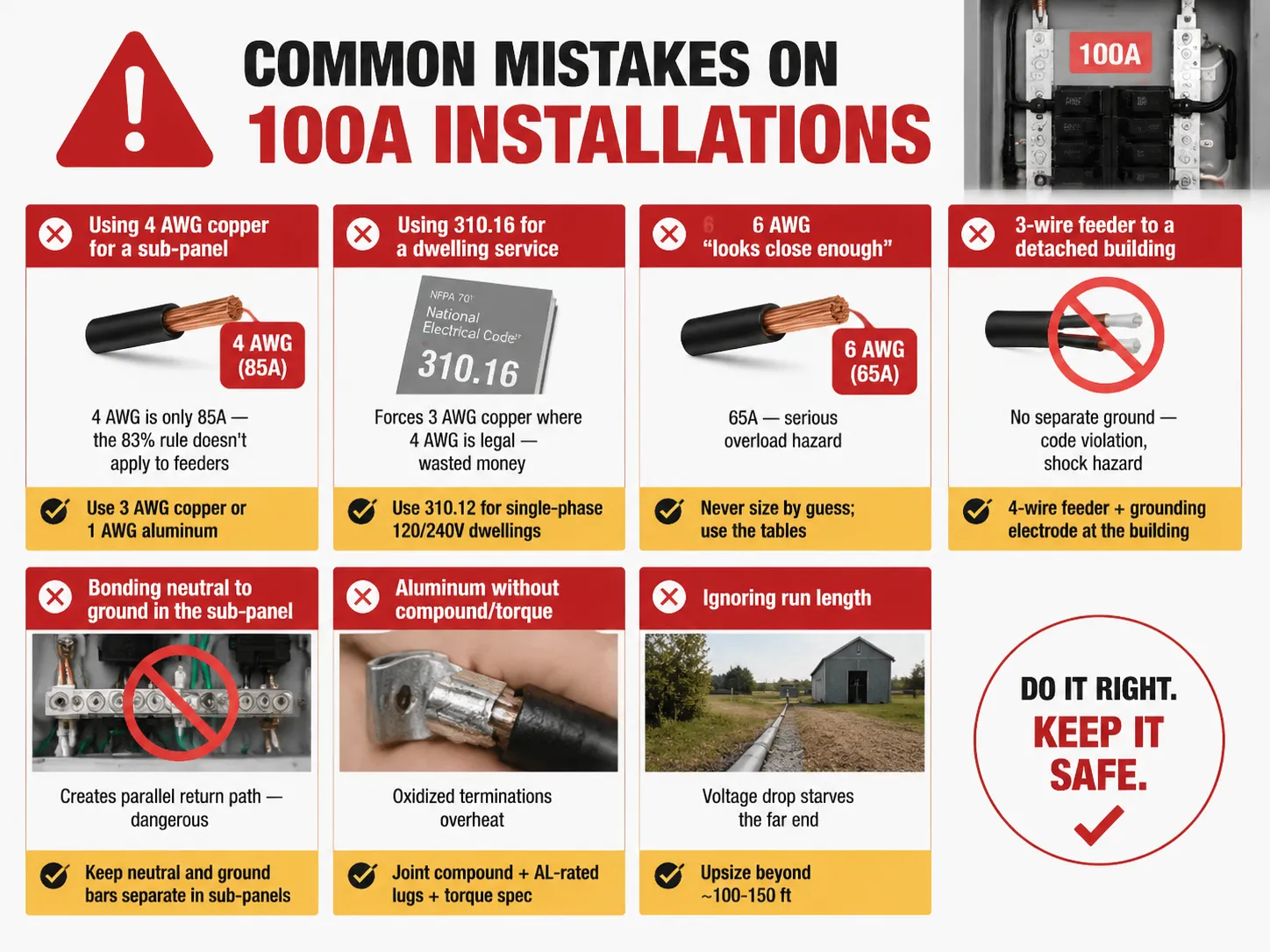
| Erro | Por Que Está Errado | Abordagem Correta |
|---|---|---|
| Using 4 AWG copper for a sub-panel | 4 AWG is only 85A — the 83% rule doesn’t apply to feeders | 3 AWG copper or 1 AWG aluminum for 100A feeders |
| Usar 310.16 para serviço residencial | Forces 3 AWG copper where 4 AWG is legal — wasted money | Use 310.12 para residências monofásicas 120/240V |
| 6 AWG “looks close enough” | 65A — serious overload hazard | Never size by guess; use the tables |
| 3-wire feeder to a detached building | No separate ground — code violation, shock hazard | 4-wire feeder + grounding electrode at the building |
| Bonding neutral to ground in the sub-panel | Creates parallel return path — dangerous | Keep neutral and ground bars separate in sub-panels |
| Aluminum without compound/torque | Oxidized terminations overheat | Joint compound + AL-rated lugs + torque spec |
| Ignorar comprimento do percurso | Voltage drop starves the far end | Upsize beyond ~100-150 ft |
Considerações de Custo & Permissão
Upgrade to a 100A service or installation of a new electrical feeder has the following costs:
- Materials include: panel – $60-$200, 100A main breaker – $30-$80, 2-2-2-4 aluminum SER – $1.50-$3 per foot, 3 AWG copper – $3-$6 per foot, meter base and hardware – $50-$150.
- Jobs will run at $800-$2,500 for a service upgrade and $500-$1,500 for a sub-panel feeder, based on run distance and access through walls.
- The permit and inspection normally cost $50-$300 and are required. Inspectors check wire and grounding size and bonding to be finished.
- Utility coordination is needed as the utility will own the meter and service connection.
When the project also involves panelboard and breakers, matching certified protection devices — and understanding the breaker types involved, from the basics of MCBs and MCCBs as padrões de disjuntores UL 489 — keeps the whole install compliant end to end. And once the 100A main is in, every branch circuit behind it follows the same sizing discipline — the limits explained for a 15-amp circuit’s wattage apply at every level of the panel.
Normas Internacionais: Uma Nota Rápida
Outside of North America, the determination of 100A wiring is done differently as most of the world implements methods consistent with IEC/BS 7671 standards (current and correction factor method) instead of using a simplified service table.
- In the UK (BS 7671), cable sizes are determined based on the installation method. For instance, a 100A single-phase connection usually requires a copper wire of between 25 and 50mm² depending on how long the cable is.
- In Europe (IEC 60364), the straightforward method is used.
- In Australia (AS/NZS 3000), method-based calculations are used for insulation and often result in use of 25 to 35mm² wires.
- In Canada (CE Code), a similar argument to that put forth by the NEC is used; installations may be based on 83%-like formulas.
The NEC procedure is based on rules pertaining specifically to the US and/or Canada installations; hence, if the location of the job is different from those two places it would be wise to hire an engineer or electrician to carry out the calculations.
Perguntas Frequentes
What size wire do we need for a 100 amp service?
According to NEC 310.12 for residential systems with 100A service (single phase), it is allowed to use 4 AWG copper or 2 AWG aluminum conductors. Whereas in commercial systems with three-phase or 100A sub-panel system, the full ampacity from the NEC 310.16 has to be applied, which means a minimum of 3 AWG copper or 1 AWG aluminum conductors. In terms of size for the GEC, 8 AWG copper conductor must be used as per 250.66 along with upsizing for distances of more than 100-150 feet.
Is #3 copper good for 100 amps?
Indeed – 3 AWG copper is rated precisely as 100A at 75°C, it is exactly the minimum required for 100A regular circuit, commercial service or sub-panel feeding based on NEC 310.16. However, a large number of electricians use 2 AWG copper (115A) instead to provide more headroom due to derating. For household services only, 4 AWG copper is considered okay.
Is 2-2-2-4 wire good for 100 amps?
Indeed, when it comes to residential applications, “2-2-2-4” SER cable (2 AWG hot wires, 2 AWG neutral wire, and 4 AWG ground wire) is considered as the standard aluminum type for 100A residential service as stated in NEC 310.12 (it should be noted that 2 AWG aluminum wire is rated at 90A, which is more than enough for the 83A needed). But when it comes to commercial applications, 1 AWG aluminum wire or 3 AWG copper wire needed for 100A commercial service is required.
Will 6 gauge wire handle 100 amps?
No. 6 AWG copper wire has a rating of just 65 amperes at a temperature of 75°C (55 amperes at 60°C), which is not suitable for 100 amperes. The wire will get hot, allowing for very high risks of fire. 6 AWG copper is appropriate for circuits carrying 50-60 amperes (for example with ranges, ovens, or small sub-panels). For 100A use either 3 AWG copper or 1 AWG aluminum wire (in general) or 4 AWG copper or 2 AWG aluminum wire (for dwelling services).
Referências
- NFPA 70 — National Electrical Code (NEC): Articles 230, 240, 250, 310
- Mike Holt — NEC 310.12 83% Rule and Conductor Sizing
- OSHA 1910.303 — Requisitos Elétricos Gerais
- EC&M Magazine — Service and Feeder Sizing Articles
- IEC 60364 — Instalações Elétricas de Baixa Tensão (Internacional)
- NEMA — Conductor and Wiring Standards
Conclusão
The process of determining appropriate wire sizes for a service rated at 100 A depends on how you answer the question: does the 83% dwelling rule apply? According to NEC 310.12, in the case of residential applications, the standard wire sizing practice requires the use of 4 AWG copper wire or 2 AWG aluminum wire. In the case of commercial installations, systems equipped with three-phase motors, and hundred-amp sub-panels, the applicable wire sizes that comply with the code requirements concerning their ampacity correspond either with 3 AWG copper wire or with 1 AWG aluminum wire; therefore, in practice, 2 AWG copper wire is often used. When the panel and breakers are part of the job, understanding the protection devices — like recognizing a failing breaker and the practical pricing in breaker replacement cost — keeps the whole project safe, legal, and on budget.