
Si votre installation utilise des appareillages électriques obsolètes, vous vous demandez peut-être si vous pouvez rénover vos disjoncteurs ou si vous devez acquérir des équipements neufs. La réponse n’est pas si simple, car elle dépend du type de disjoncteur présent dans votre installation. Comme indiqué par le National Electrical Code (NEC) de 2020, les disjoncteurs basse tension, moyenne tension et haute tension peuvent être restaurés, tandis que les disjoncteurs moulés (MCCB), les disjoncteurs GFCI et AFCI ne doivent pas être renouvelés selon l’Article 210.15 et la Section 240.88 du NEC. Par conséquent, cette distinction est très importante pour les responsables d’usines, les entrepreneurs électriciens et les ingénieurs de maintenance qui doivent équilibrer les coûts avec la sécurité et la conformité au code.
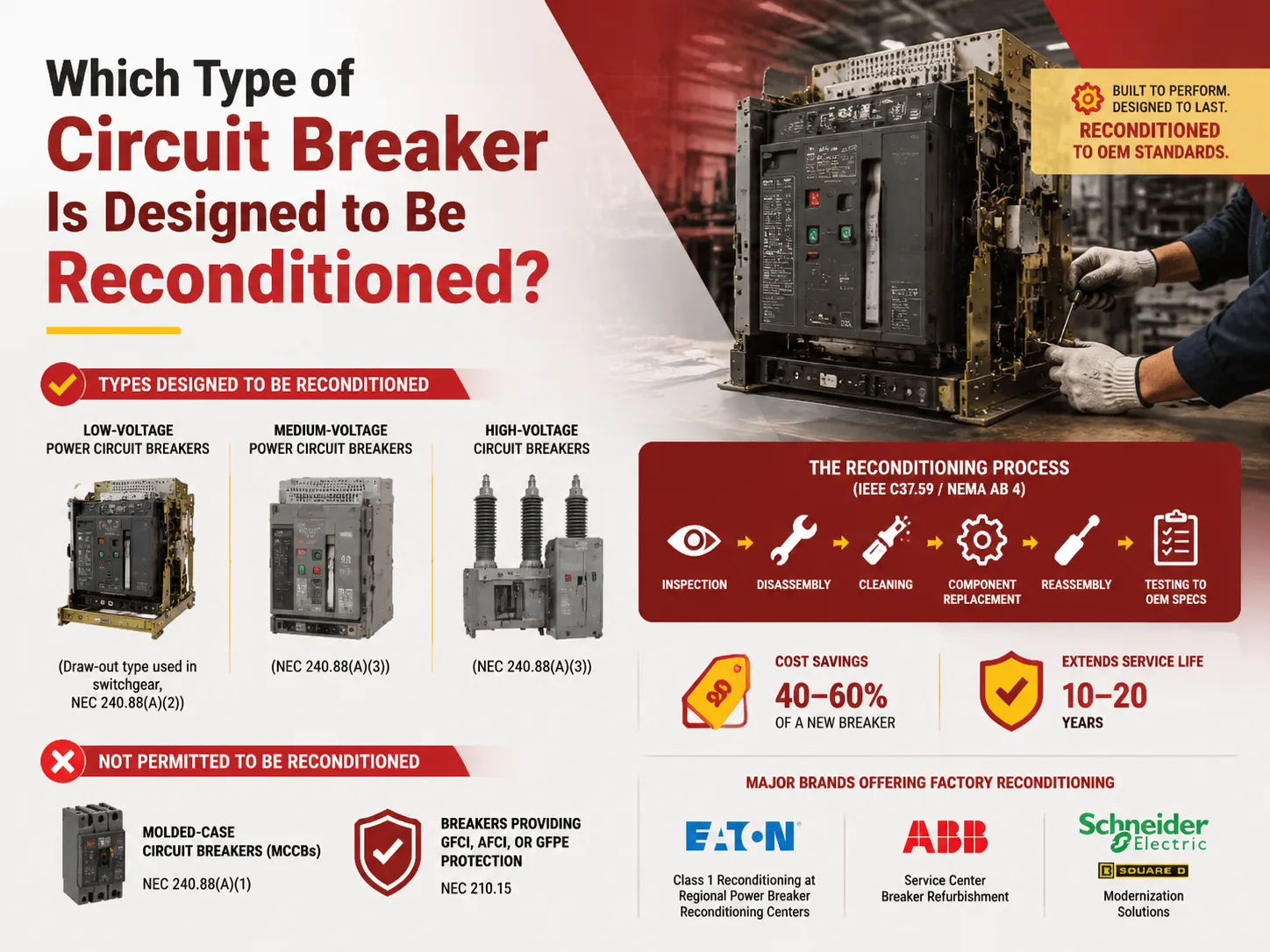
Réponse rapide : Les disjoncteurs pouvant être rénovés incluent les disjoncteurs basse tension, moyenne tension et haute tension. Les disjoncteurs moulés ne peuvent pas être rénovés comme indiqué par NEC 240.88(A)(1), et tout disjoncteur fournissant une protection GFCI, AFCI ou GFPE est interdit par NEC 210.15. Les fabricants notables proposant une rénovation en usine incluent : Eaton, ABB, et Schneider Electric / Square D. Le processus de rénovation est conforme aux normes IEEE C37.59 et NEMA AB 4. En général, la rénovation coûte entre 40 et 60 % du prix d’un disjoncteur neuf et ajoute 10 à 20 ans de durée de vie.
Types de disjoncteurs autorisés pour la remise en état
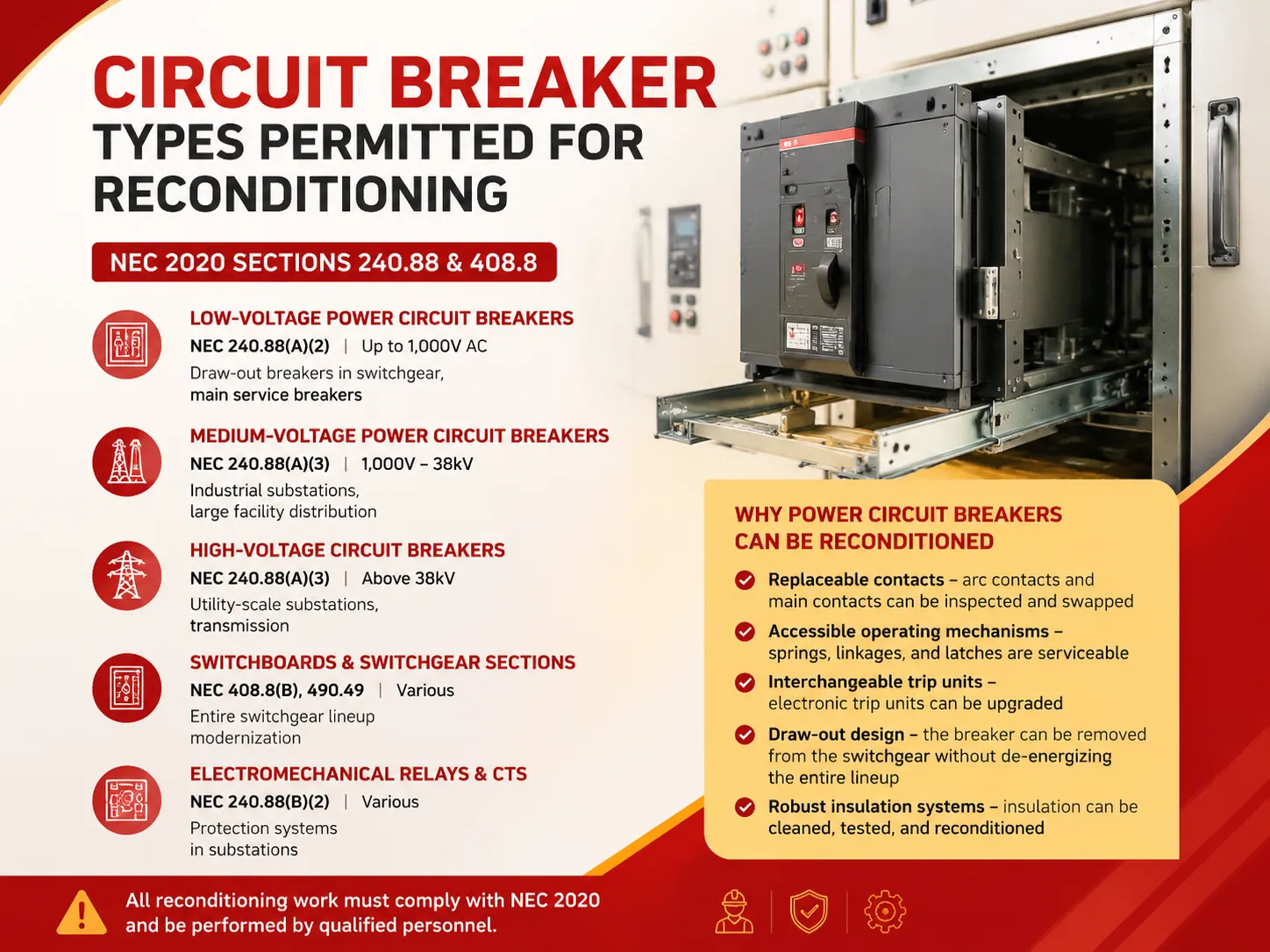
Selon la Section 240.88(A) du NEC 2020, les types de disjoncteurs suivants sont explicitement autorisés à être remis en état :
| Type de disjoncteur | Référence NEC | Application typique | Plage de Tension |
|---|---|---|---|
| Disjoncteurs basse tension | 88(A)(2) | Disjoncteurs extractibles dans les appareillages, disjoncteurs principaux | Jusqu’à 1 000 V AC |
| Disjoncteurs moyenne tension | 88(A)(3) | Postes industriels, distribution dans les grandes installations | 1 000 V – 38 kV |
| Disjoncteurs haute tension | 88(A)(3) | Postes à l’échelle des réseaux, transmission | Au-dessus de 38 kV |
| Tableaux et sections d’appareillages | 8(B), 490.49 | Modernisation complète des appareillages | Divers |
| Relais de protection électromécaniques & TC | 88(B)(2) | Systèmes de protection dans les postes | Divers |
La caractéristique clé partagée par tous les disjoncteurs reconditionnables est qu’ils sont de type extractible ou amovible conçus pour la maintenance — pas des unités scellées. Les disjoncteurs basse tension, tels que ceux utilisés dans les disjoncteurs à air jusqu’à 6300 A, sont spécifiquement conçus avec des mécanismes réparables sur site, des contacts remplaçables et des unités de déclenchement accessibles. Cela diffère fondamentalement des disjoncteurs moulés, qui sont scellés en usine.
Pourquoi les disjoncteurs de puissance peuvent être remis en état
Les disjoncteurs sont conçus pour permettre la maintenance. Leurs caractéristiques incluent :
- Contacts remplaçables – l’inspection et le remplacement des contacts d’arc et principaux peuvent être effectués
- Mécanismes d’opération accessibles – la maintenance peut être réalisée sur les ressorts, les liaisons et les verrous de l’interrupteur
- Unités de déclenchement interchangeables – la mise à niveau des unités de déclenchement électroniques des disjoncteurs est possible
- Conception extractible – le disjoncteur peut être retiré du panneau sans couper l’alimentation
- Systèmes d’isolation étendus – l’isolation existante peut être nettoyée, testée et réhabilitée
Pour en savoir plus sur la différence entre les catégories de disjoncteurs, notre guide sur ce que sont les MCCB et MCB couvre les différences structurelles qui déterminent la réparabilité.
Types de disjoncteurs interdits de reconditionnement
Selon la NEC 2020, certains équipements sont interdits de reconditionnement. Ces interdictions découlent du fait que la nature critique pour la sécurité de cet équipement rend impératif que toute modification interne affecterait ses caractéristiques de sécurité.
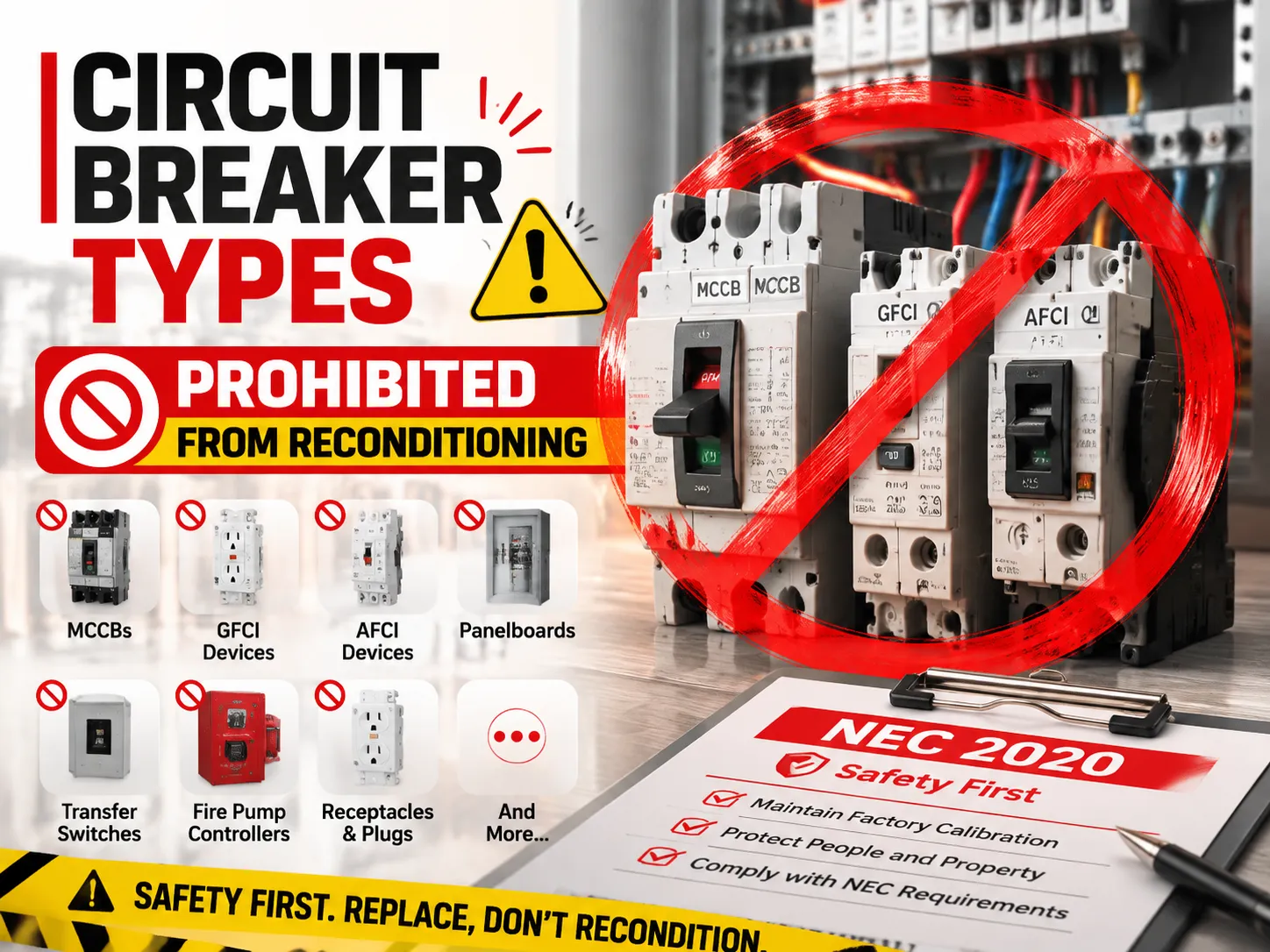
| Équipement interdit | Référence NEC | Raison |
|---|---|---|
| Disjoncteurs moulés (MCCB) | 88(A)(1) | Scellés en usine ; la rupture du sceau annule la certification UL et la calibration |
| Dispositifs de protection GFCI | 210.15(1) | Protection du personnel critique pour la sécurité ; la calibration ne peut pas être vérifiée après reconditionnement |
| Dispositifs de protection AFCI | 210.15(2) | L’électronique complexe détecte les signatures d’arc ; le reconditionnement pourrait ne pas détecter une dégradation subtile |
| Protection contre les défauts à la terre des équipements (GFPE) | 210.15(3) | La fonction de protection de l’équipement doit rester calibrée en usine |
| Unités de déclenchement électroniques pour disjoncteurs basse tension | 88(B) | L’électronique ne peut pas être reconditionnée de manière fiable ; doit être remplacée par du neuf |
| Tableaux électriques | 8(A) | L’intégrité structurelle et les connexions de barres omnibus ne peuvent pas être vérifiées après reconditionnement |
| Commutateurs de transfert (systèmes d’urgence) | 5(C), 701.5(C), 702.5(A) | Les applications de sécurité vitale nécessitent un équipement neuf |
| Contrôleurs de pompe incendie | 695.10 | Équipements critiques de sécurité vitale |
| Prises et fiches d’attache | 3(A), 406.7 | L’usure et la dégradation des contacts ne sont pas détectables de manière fiable |
Insistant sur le point concernant les disjoncteurs MCCB : même si auparavant certaines inspections et pratiques de maintenance préventive étaient autorisées selon les normes NEMA AB 4, il convient de noter que le reconditionnement des disjoncteurs moulés est interdit dans la dernière édition 2020 du NEC. La maintenance (nettoyage, manœuvre, vérification du couple) reste valide, mais tout démontage de la structure interne et reconstruction des disjoncteurs moulés n’est pas autorisé.
Marques qui supportent le reconditionnement des disjoncteurs
Différents fabricants bien connus gèrent les programmes de reconditionnement autorisés par leurs usines. Ils n’utilisent pas de reconditionneurs travaillant pour le compte d’autres entreprises.
| Marque | Nom du programme | Couverture | Garantie |
|---|---|---|---|
| Eaton | Reconditionnement de classe 1 (Centres de reconditionnement de disjoncteurs) | Disjoncteurs Eaton et non-Eaton basse et moyenne tension ; remanufacturation Magnum DS ; mises à niveau VCP-W FAME | 3 ans (1 an pour les applications de démarreurs moteurs) |
| ABB | Rénovation de disjoncteurs en centre de service | Disjoncteurs ABB et non-ABB ; nucléaire et non nucléaire ; basse et moyenne tension | 1 an pièces et main-d’œuvre |
| Schneider Electric / Square D | Solutions de modernisation / Reconditionnement de disjoncteurs | Square D et la plupart des grandes marques OEM ; disjoncteurs basse et moyenne tension ; modernisation des appareillages | Variable selon le périmètre |
| Siemens | Programmes de service et de reconditionnement | Siemens et marques héritées (ITE, Gould) ; disjoncteurs basse et moyenne tension | Variable selon le programme |
| GE / Vertiv | Services de reconditionnement | Disjoncteurs GE et marques héritées ; disjoncteurs moyenne et haute tension | Variable selon le programme |
Ce que chaque marque propose
En Amérique du Nord, Eaton a fondé cinq centres de reconditionnement de disjoncteurs. Leurs protocoles de classe 1 incluent le démontage complet des pièces, le nettoyage conforme aux normes des composants, le resurfaçage, et enfin, les tests de performance finaux. Ils ont également développé le concept de mise à niveau FAME pour certains disjoncteurs moyenne tension spécifiques ainsi que la modernisation des disjoncteurs avec l’unité de déclenchement Digitrip RMS et le système de maintenance de réduction des arcs électriques Arcflash. Chaque disjoncteur reconditionné est ajouté à la base de données centrale Pow-R-DB.
Dans leurs centres de service, ABB propose des services de retesting pour leurs propres modèles de disjoncteurs ainsi que pour ceux d'autres fabricants. Leurs services incluent la réception de l'équipement, son inspection et test, ainsi que son démontage. En plus du nettoyage de toutes les pièces, ABB vérifiera également la présence de fissures, s'assurera de remplacer les pièces déjà endommagées, appliquera une lubrification sur tous les points mobiles, puis procédera au remontage.
Dans son programme Modernization Solutions, Schneider Electric a proposé le service de reconfiguration des disjoncteurs basse et moyenne tension. La remise à neuf est réalisée en suivant les étapes suivantes : à travers toutes les phases, y compris le remplacement partiel des composants, le lavage et la peinture des détails, ainsi que la lubrification.
Normes clés : NEC, NEMA AB 4, IEEE C37.59 & UL 489
Plusieurs normes régissent la remise à neuf des disjoncteurs. Comprendre laquelle s'applique à votre situation est essentiel pour la conformité au code :
| Norme | Éditeur | Portée |
|---|---|---|
| Article NEC 210.15 & 240.88 | NFPA | Définit ce qui peut et ne peut pas être reconditionné ; exige un classement en tant que “ reconditionné ” |
| NEMA AB 4 | NEMA | Directives pour l’inspection et la maintenance préventive des disjoncteurs moulés (pas le reconditionnement) |
| IEEE C37.59 | IEEE | Norme pour le reconditionnement des équipements de commutation électrique ; définit le processus de reconditionnement |
| UL 489 | UL | Norme pour les disjoncteurs moulés ; pertinente comme référence de test |
| Politique NEMA sur les équipements reconditionnés | NEMA | Positions de l’industrie sur l’aptitude et la sécurité des équipements reconditionnés |
| Normes PEARL | PEARL | Normes accréditées ANSI pour l’inspection, les tests et le reconditionnement des appareils électriques |
Le facteur essentiel : le marquage initial doit être retiré et l’équipement doit être identifié comme reconditionné lorsqu’il est remis à neuf. UL fournit une procédure de certification pour les équipements reconstruits. Les dispositifs rénovés conformément à la procédure sont marqués avec la marque UL contenant les mots “ Rebuilt ”, “ Remanufactured ”, “ Rebuilt ” ou “ Reconditioned ”. Pour plus d’informations sur les normes des disjoncteurs, voir notre article sur Exigences UL 489 pour les disjoncteurs.
Le processus de reconditionnement étape par étape
Selon Eaton Classe 1 et IEEE C37.59, voici le processus entrepris lorsque le disjoncteur nécessite un reconditionnement :
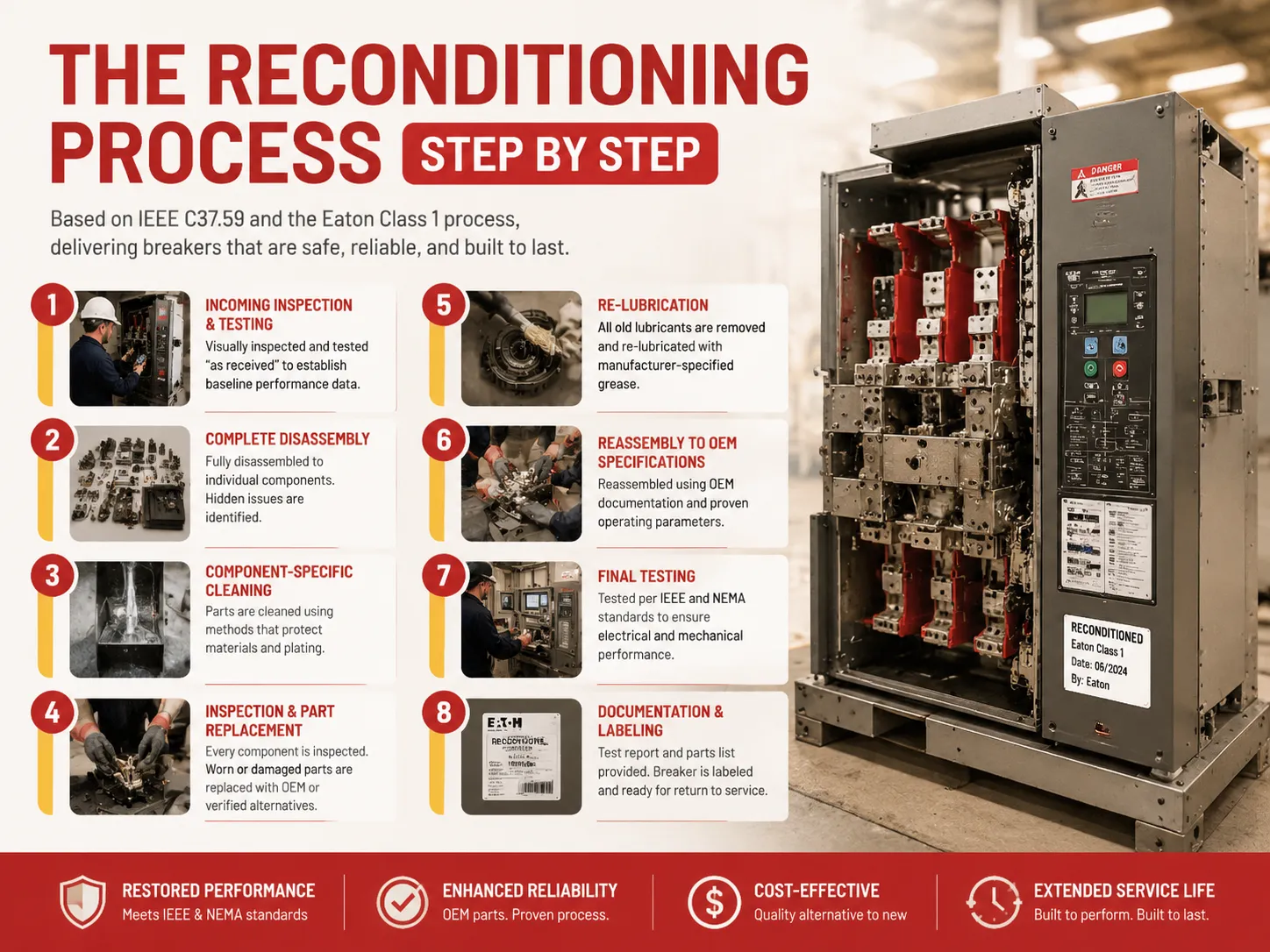
Étape 1 : Inspection et test à la réception
Le disjoncteur est reçu, inspecté visuellement et testé dans son état “ tel que reçu ” afin de documenter les performances de référence. Les mesures importantes prises incluent la résistance de contact (en millivolts), la résistance d’isolement, l’effort mécanique de fonctionnement et les dimensions. Les informations obtenues sont documentées.
Étape 2 : Démontage complet
Le démontage du disjoncteur est complet et le disjoncteur a été séparé en ses composants, y compris : le système de commande, le canal d’arc, la barrière d’isolation, le cadre et d’autres systèmes. C’est à cette étape que l’on identifie les défauts tels que le lien d’entraînement défectueux, les contacts désalignés, l’isolation endommagée qui rend l’ensemble de l’appareil susceptible de défaillance lors de la détection d’un défaut.
Étape 3 : Nettoyage spécifique aux composants
Divers types de matériaux nécessitent différents types de processus de nettoyage. Les composants non porteurs de courant sont nettoyés minutieusement de manière à ce qu’aucun matériau étranger ne subsiste tout en préservant les caractéristiques diélectriques et structurelles. Les composants porteurs de courant sont nettoyés sans endommager le placage d’origine. Les surfaces de contact sont régénérées afin que la métallurgie et la pression de contact jouent correctement leur rôle.
Étape 4 : Inspection et remplacement des pièces
Toutes les pièces doivent être vérifiées pour détecter fissures, détérioration, rouille et précision dimensionnelle. Les pièces usées sont remplacées par des pièces OEM neuves, tandis que les pièces qui ne sont plus en production doivent être remplacées par des composants rétroconçus qui doivent être conformes aux normes énoncées dans IEEE C37.59. Ces composants peuvent nécessiter une vérification dans des conditions de laboratoire strictes, telles que des tests haute puissance. Les substituts typiques pour les pièces usées peuvent être des ressorts, des contacts, des shunts et des bagues d’étanchéité.
Étape 5 : Relubrification
Tous les lubrifiants obsolètes ont été éliminés, et la machine ainsi que les points de connexion sont relubrifiés avec une graisse spécifiée par le fabricant. L'une des principales raisons de défaillance des disjoncteurs est une lubrification inappropriée — des mécanismes rigides ralentissent le processus de coupure des défauts, ce qui entraîne une énergie d'incident d'arc électrique beaucoup plus élevée.
Étape 6 : Réassemblage selon les spécifications OEM
Lors du réassemblage du disjoncteur, la documentation OEM est utilisée. Cependant, si les informations OEM ne sont pas disponibles, par exemple si le fabricant d'origine est en faillite, Eaton utilisera à la place la base de données centralisée Pow-R-DB contenant des enregistrements de disjoncteurs similaires ayant démontré des résultats souhaités.
Étape 7 : Test final
Le disjoncteur reconstruit subira des tests conclusifs conformément aux directives IEEE et NEMA, incluant :
- Évaluation de la résistance d'isolation
- Test de résistance de contact (chute de millivolts)
- Évaluation du fonctionnement mécanique (temps d'ouverture-fermeture)
- Test de déclenchement de surintensité (longue durée, courte durée, déclenchement instantané)
- Évaluation de la tenue diélectrique
Étape 8 : Documentation et étiquetage
La production du rapport de test est réalisée afin d'établir un contraste entre les résultats “ à la réception ” et “ finaux ”, appuyé par des informations mentionnant tous les composants réparés. Le disjoncteur est muni d'une étiquette de traçabilité indiquant qu'il est reconditionné, précisant le nom ainsi que la date de l'entreprise de reconditionnement. Le disjoncteur est de nouveau opérationnel.
Quand choisir le reconditionnement plutôt que le remplacement
La décision de reconditionner ou de remplacer dépend du type de disjoncteur, de son âge, de sa criticité et du coût. Voici une matrice de décision pratique :
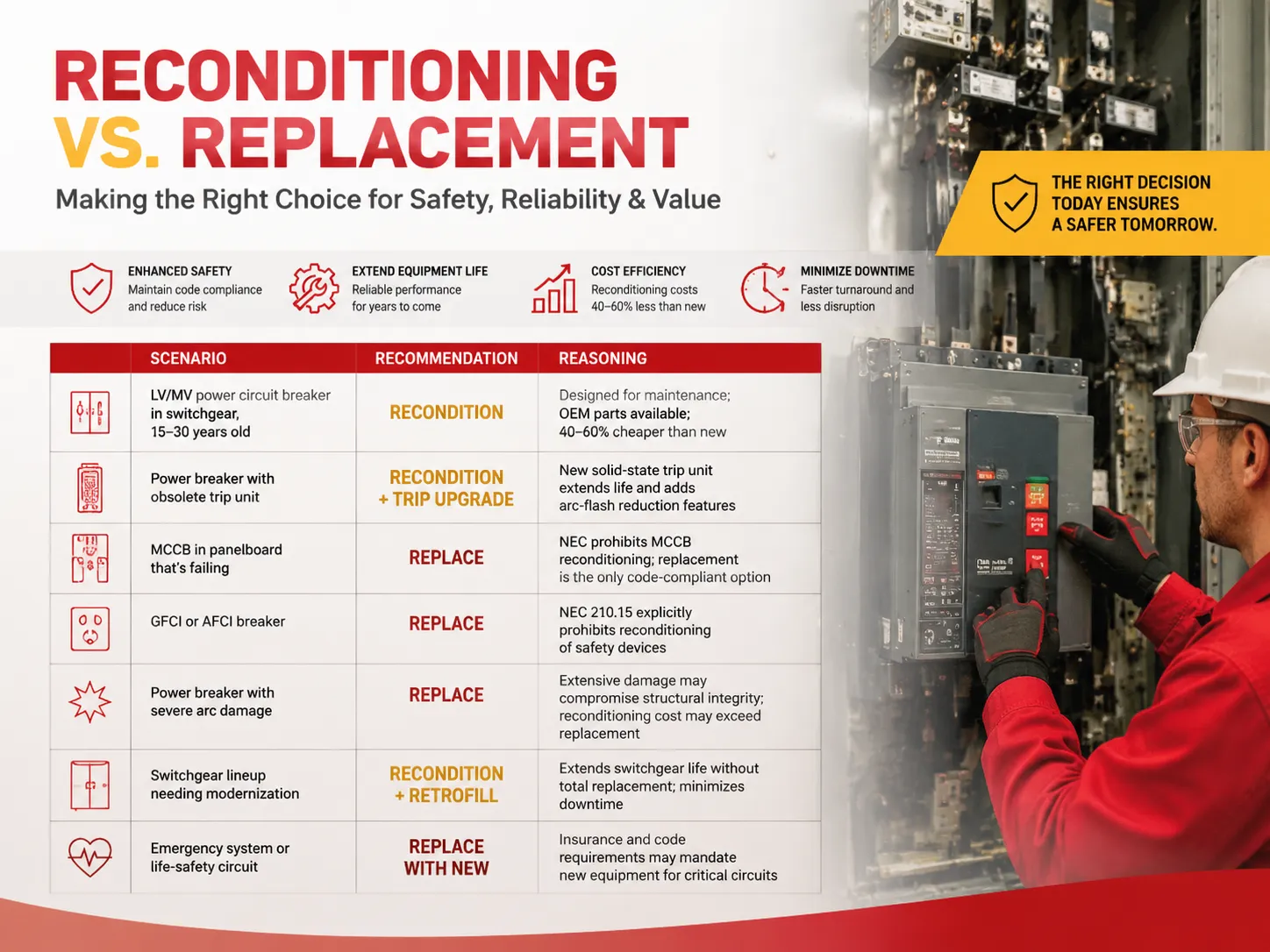
| Scénario | Recommandation | Raisonnement |
|---|---|---|
| Disjoncteur de puissance BT/MT dans un tableau de distribution, âgé de 15 à 30 ans | Reconditionner | Conçu pour la maintenance ; pièces OEM disponibles ; 40–60% moins cher que du neuf |
| Disjoncteur de puissance avec unité de déclenchement obsolète | Remise à neuf + mise à niveau du déclencheur | Nouvelle unité de déclenchement à semi-conducteurs prolonge la durée de vie et ajoute des fonctionnalités de réduction des arcs électriques |
| Disjoncteur MCCB dans tableau électrique défaillant | Remplacer | Le NEC interdit la remise à neuf des MCCB ; le remplacement est la seule option conforme au code |
| Disjoncteur GFCI ou AFCI | Remplacer | Le NEC 210.15 interdit explicitement la remise à neuf des dispositifs de sécurité |
| Disjoncteur de puissance avec dommages sévères d’arc | Remplacer | Des dommages importants peuvent compromettre l’intégrité structurelle ; le coût de la remise à neuf peut dépasser celui du remplacement |
| Gamme d’appareillage nécessitant une modernisation | Remise à neuf des disjoncteurs + rétrofit | Prolonge la durée de vie de l’appareillage sans remplacement total ; minimise les temps d’arrêt |
| Système d’urgence ou circuit de sécurité de vie | Remplacer par du neuf | Les exigences d’assurance et de code peuvent imposer un équipement neuf pour les circuits critiques |
Pour vous aider à diagnostiquer si votre disjoncteur nécessite réellement une intervention, consultez notre guide sur comment savoir si un disjoncteur est défectueux. Et si le remplacement est la bonne décision, notre article sur combien coûte le remplacement d’un disjoncteur couvre les prix selon les types de disjoncteurs et les calibres d’intensité.
Comparaison des coûts : remis à neuf vs neuf
En ce qui concerne la remise à neuf des disjoncteurs, les dépenses varient généralement entre 40 et 60 % du coût total d’acquisition d’un équipement neuf. Cela est particulièrement vrai pour les modèles plus grands qui permettent de réaliser d’importantes économies :
| Type de disjoncteur | Coût neuf (approx.) | Coût remis à neuf (approx.) | Économies |
|---|---|---|---|
| Disjoncteur basse tension, cadre 800A | 8 000–15 000 | 3 200–9 000 | 40–60% |
| Disjoncteur basse tension, cadre 3200A | 20 000–40 000 | 8 000–24 000 | 40–60% |
| Disjoncteur à vide moyenne tension, 5 kV | 15 000–30 000 | 6 000–18 000 | 40–60% |
| Disjoncteur à vide moyenne tension, 15 kV | 25 000–50 000 | 10 000–30 000 | 40–60% |
| Mise à niveau de l’unité de déclenchement (Digitrip/AC-PRO) | 3 000–8 000 | Inclus dans la remise à neuf | Économies groupées |
Dépenses supplémentaires : Le processus de remise à neuf permet d’économiser les coûts liés à la modification de l’appareillage qui serait nécessaire en cas de changement de taille d’un nouveau disjoncteur, minimise les délais puisque les disjoncteurs remis à neuf arrivent en 2 à 4 semaines contrairement aux neufs livrés en 12 à 20 semaines, et réduit les temps d’arrêt grâce au fait que le disjoncteur remis à neuf peut être immédiatement installé dans le compartiment actuel.
Considérations de sécurité et exigences documentaires
La remise à neuf ne peut être effectuée que par du personnel certifié conformément aux normes acceptées. Voici les exigences à vérifier avant l’installation d’un disjoncteur remis à neuf :
- Étiquetage : Le disjoncteur remis à neuf est marqué “ Remis à neuf ” avec le nom de l’entreprise de remise à neuf et la date.
- Test : Obtenez un rapport complet attestant des résultats des tests “ à la réception ” et “ finaux ” ainsi qu’une liste des pièces remplacées.
- Certification : En cas de certification UL requise, vérifiez que le disjoncteur porte la marque UL avec la mention “ Rebuilt ” ou “ Reconditioned ”.”
- Approbation par l’AHJ : L’Autorité Compétente (inspecteur électrique) peut exiger une preuve de remise à neuf par une entreprise certifiée – soyez prêt.
- Garantie : Vérifiez les conditions et la durée de la garantie (Eaton : 3 ans ; ABB : 1 an ; autres selon cas).
- Traçabilité : L'entreprise de reconditionnement doit tenir un registre lié au numéro de série du disjoncteur pour référence future.
- Ne pas installer le disjoncteur reconditionné dans le circuit de sécurité-vie sauf si l'AHJ et votre agent d'assurance ont approuvé l'installation.
De plus, OSHA 29 CFR 1910.334(b)(2) stipule qu'une fois que le circuit est désexcité avec le dispositif de protection, il n'est pas permis de le réactiver manuellement tant qu'il n'a pas été déterminé que l'équipement et le circuit peuvent être mis sous tension en toute sécurité.
Questions Fréquemment Posées
Qu'est-ce qu'un disjoncteur reconditionné ?
Un disjoncteur de puissance reconditionné désigne un disjoncteur de puissance ayant subi un processus de restauration dans une installation agréée par le fabricant. Selon les exigences définies par la norme IEEE C37.59, l'ensemble de l'activité comprend une inspection entrante, un démontage complet, un nettoyage des composants, le remplacement des pièces, la réapplication des lubrifiants, le remontage des composants conformément aux spécifications du fabricant d'origine (OEM), et des tests finaux. De plus, le disjoncteur doit être étiqueté comme étant reconditionné avec le nom et la date de l'entreprise de reconditionnement, et la liste d'origine doit être retirée conformément aux exigences du NEC.
Quels sont les disjoncteurs de type B, type C et type D ?
Les types B, C et D sont des classifications des disjoncteurs modulaires (MCB) concernant les caractéristiques de déclenchement et non des types de disjoncteurs classés selon le NEC 240.88. Les disjoncteurs de type B déclenchent à trois à cinq fois le courant nominal ; ils sont utilisés dans les applications résidentielles pour des circuits à charges purement résistives. Ensuite, nous avons les disjoncteurs de type C, qui déclenchent à cinq à dix fois le courant nominal et sont utilisés dans les systèmes électriques commerciaux et industriels, ainsi que dans les circuits à charges inductives, tels que les lampes fluorescentes et les petits moteurs. Le troisième type est le type D, qui déclenche à dix à vingt fois le courant nominal et gère le courant d'appel dans les transformateurs, les gros moteurs ou les machines à souder. Tous les types de disjoncteurs mentionnés ci-dessus sont des disjoncteurs modulaires, moulés, et ne peuvent pas être reconditionnés conformément au NEC 240.88(A)(1).
Les disjoncteurs moulés sont-ils autorisés à être reconditionnés ?
Selon la section 240.88(A)(1) du NEC en 2020, il n'est pas permis de remettre à neuf les disjoncteurs moulés. Les MCCB sont des unités scellées, donc briser les scellés signifie perdre la certification UL et la garantie du fabricant. Bien qu'il existe des directives pour l'inspection et la maintenance préventive des MCCB dans les lignes directrices NEMA AB 4, cela ne correspond pas à un reconditionnement. La maintenance de routine est acceptable, mais le démontage ou la modification de la structure interne du MCCB n'est pas autorisé.
Quel type d'équipement n'est pas autorisé à être reconditionné selon l'article 210 ?
Le NEC stipule dans l'Article 210.15 qu'il existe trois types d'équipements qui ne sont pas autorisés à être reconditionnés. Ceux-ci incluent (1) les équipements qui fournissent une protection par disjoncteur différentiel à courant de défaut à la terre (GFCI), (2) les équipements qui fournissent une protection par disjoncteur à défaut d'arc (AFCI), et (3) les équipements qui assurent une protection contre les défauts à la terre pour les équipements (GFPE). La raison de ces interdictions est que les dispositifs devant être reconditionnés sont également des dispositifs critiques pour la sécurité qui possèdent des exigences de calibration et de sensibilité qui ne peuvent être garanties même après reconditionnement. Ainsi, si l'un des dispositifs reconditionnés (GFCI, AFCI ou GFPE) ne déclenche pas au seuil requis, un danger pour la vie sera créé. De plus, le NEC stipule que les disjoncteurs moulés ne peuvent pas être reconditionnés selon la Section 240.88(A)(1), ni les unités de déclenchement électroniques des disjoncteurs de puissance basse tension selon la Section 240.88(B).
Références
- NFPA 70 — Code National de l'Électricité (NEC) 2020, Articles 210.15 et 240.88
- ANSI/NEMA AB 4-2023 — Lignes directrices pour l'inspection et la maintenance préventive des disjoncteurs moulés
- IEEE C37.59-2018 — Norme pour le reconditionnement des équipements de commutation de puissance
- UL 489 — Norme pour les disjoncteurs moulés, les interrupteurs moulés et les boîtiers de disjoncteurs
- UL — Équipements électriques reconditionnés : un guide NEC 2020
- Eaton — Reconditionnement de disjoncteurs de classe 1 pour disjoncteurs de puissance basse et moyenne tension
- ABB — Services de rénovation de disjoncteurs en centre de service
- Schneider Electric — Solutions de modernisation et de mise à niveau de la distribution électrique
- PEARL — Ligue professionnelle de reconditionnement des appareils électriques
Les disjoncteurs reconditionnables incluent les disjoncteurs basse, moyenne et haute tension de type extractible et réparable sur site, couramment utilisés dans les postes et les appareillages de commutation. La conception du disjoncteur utilise des contacts remplaçables, un mécanisme facilement accessible et des unités de déclenchement interchangeables permettant un reconditionnement pratique conforme au NEC 240.88. Les principaux fabricants tels que Eaton, ABB et Schneider Electric proposent le service de reconditionnement selon les normes IEEE C37.59 garantissant des garanties comparables à celles des équipements neufs.
En revanche, les disjoncteurs moulés, les dispositifs GFCI, AFCI et GFPE sont formellement interdits d'être reconditionnés selon le NEC 210.15 et 240.88 et doivent être remplacés s'ils sont défectueux. Le NEC 2020 a clairement indiqué que les disjoncteurs conçus pour être entretenus peuvent l'être tandis que les disjoncteurs scellés critiques pour la sécurité ne le peuvent pas. Lors du choix entre reconditionnement ou remplacement, identifiez d'abord le type de disjoncteurs et comparez le coût de la défaillance, afin de comprendre ce qui vaut le plus la peine — reconditionner ou remplacer le disjoncteur.