
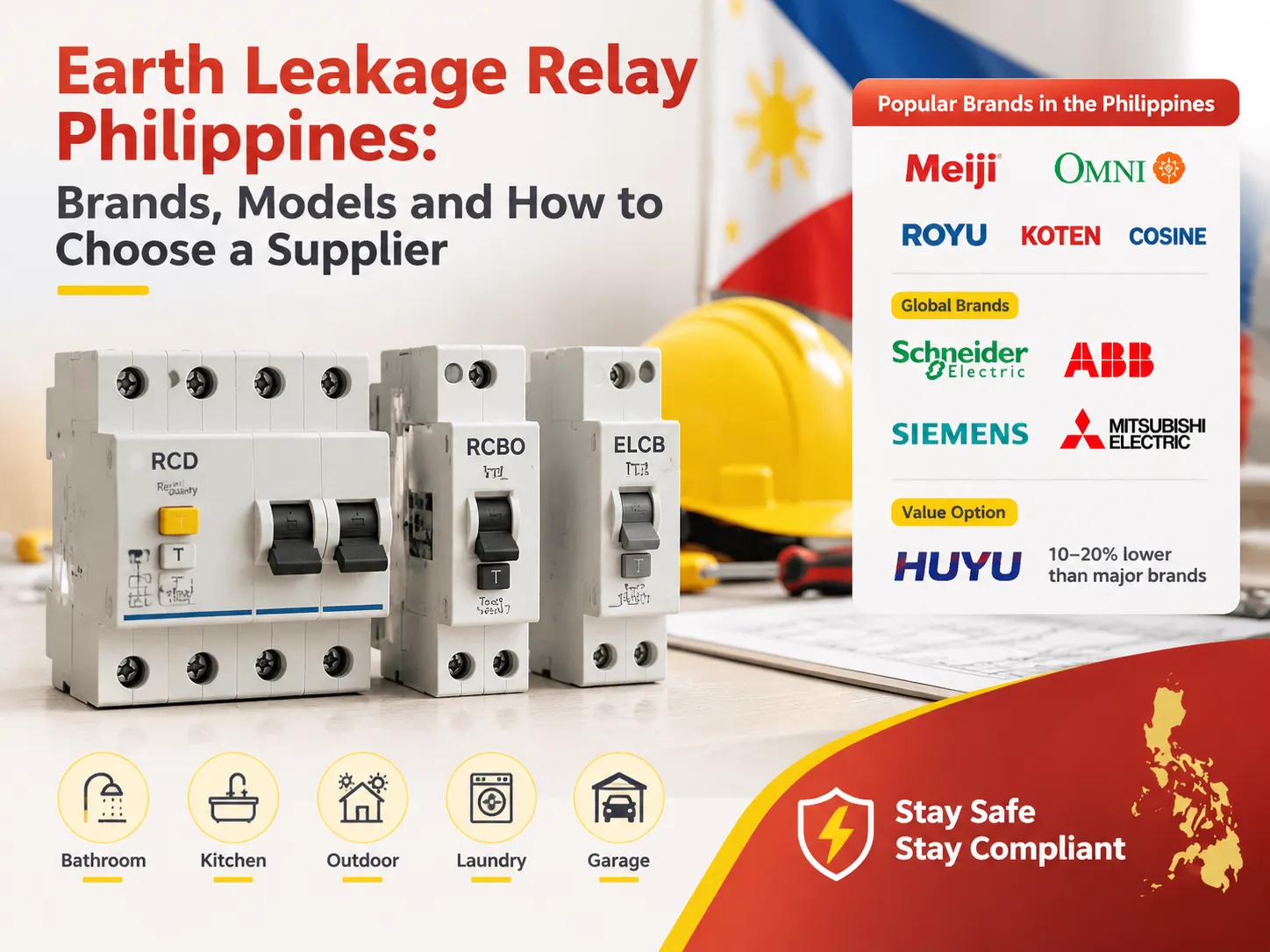
Покупка устройств защиты от утечки тока на землю на Филиппинах отличается от покупки автоматических выключателей по нескольким причинам, включая напряжение 230 В при частоте 60 Гц, применимый кодекс (PEC вместо NEC), обязательное наличие маркировки PS Mark или наклейки ICC на каждом устройстве, продаваемом на филиппинском рынке, а также решение о выборе типа чувствительности для обеспечения защиты либо человека, либо только прибора. Это руководство поможет вам разобраться в значении используемой терминологии, требованиях Филиппинского электротехнического кодекса, доступных на местном рынке брендах, их ценах и способах выбора поставщика без риска мошенничества.
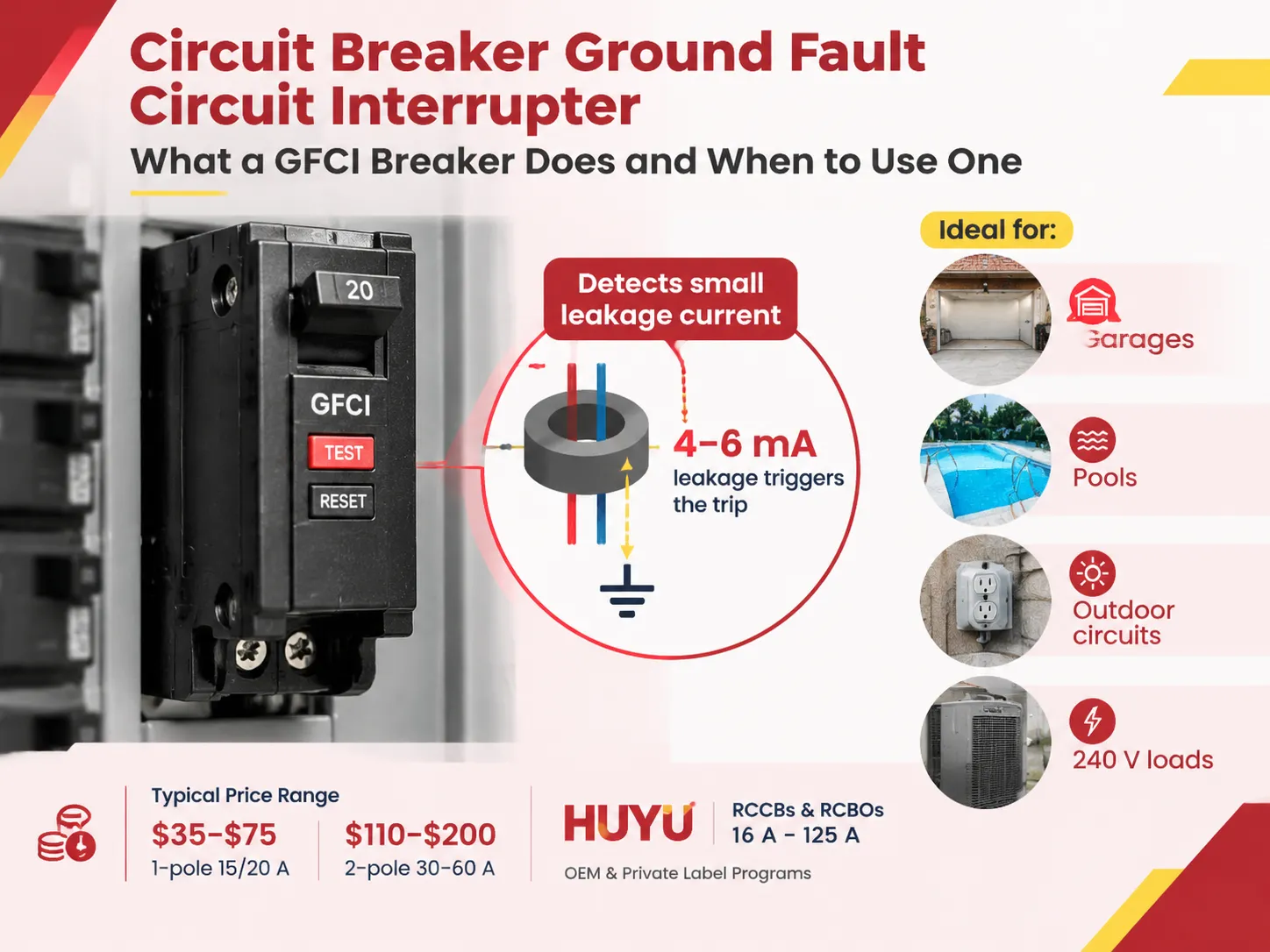
Резюме: Реле утечки тока, RCD, RCCB и ELCB — все это устройства, которые срабатывают при протекании тока вне цепи вместо возврата через нейтраль. Согласно PEC 2017 (статья 2.10.1.8), в домах на Филиппинах должна быть обеспечена защита класса A GFCI для ванных комнат, кухонь, наружных зон, прачечных и гаражей на уровне 4-6 мА, а также защита от остаточного тока 30 мА для цепей розеток. RCD на 30 мА не является точной заменой GFCI на 4-6 мА, и PEC требует получения одобрения AHJ в случае использования RCD или RCBO вместо розетки. Ожидайте затраты от ₱300 до ₱1500 на бытовое двухполюсное устройство, от ₱1500 до ₱4500 на RCBO 30 А и от ₱2500 до ₱9000 на промышленное оборудование с четырьмя полюсами. Meiji, Omni, Royu, Koten и Cosine популярны среди местных пользователей, в то время как Schneider, ABB, Siemens и Mitsubishi Electric занимают более высокие позиции, а HUYU предлагает те же продукты, но по цене на 10% – 20% ниже, чем ведущие международные производители.
Что такое реле утечки тока на самом деле
Сначала обсудим терминологию, поскольку филиппинские покупатели используют несколько различных терминов, обозначающих, вероятно, два или три разных устройства.
Реле утечки тока — это общий термин, обозначающий устройство, которое измеряет векторную сумму токов во всех проводниках с помощью токового трансформатора с сердечником баланса (CBCT). Токи, выходящие по фазным проводам, должны быть равны сумме токов в нейтральных проводниках. Таким образом, если отсутствует несколько миллиампер, это указывает на утечку тока по другому пути, например через человека, воду или неисправный корпус прибора.
Существует множество типов устройств, основанных на этой концепции и использующих одинаковые аббревиатуры.
| Термин | Полное наименование | Что оно делает | Отключение при перегрузке |
|---|---|---|---|
| ELR | Реле утечки тока | Только обнаружение остаточного тока, часто отдельное реле, управляющее шунтовым расцепителем | Нет |
| УЗО / УЗМ | Автоматический выключатель остаточного тока | Обнаружение остаточного тока, монтаж на DIN-рейку | Нет |
| RCBO | Автоматический выключатель остаточного тока с защитой от перегрузки | Остаточный ток плюс перегрузка в одном модуле | Да |
| защиты для ванных комнат, кухонь, гаражей, наружных розеток, | Устройство защитного отключения (GFCI) | Защита персонала при 4–6 мА, согласно UL 943 | Иногда |
| ELCB (токовое) | Автоматический выключатель утечки тока | Старое название современного RCD | Нет |
| ELCB (напряженческое) | Автоматический выключатель утечки тока | Обнаружение повышения напряжения на корпусе прибора | Нет |
Последняя строка более значима, чем кажется. ELCB с управлением по напряжению — устаревшая технология. Их работа зависела от идеального состояния заземляющего контура, поэтому они могли молча выходить из строя именно в тех условиях, которые должны были предотвращать. Они не соответствуют текущим стандартам согласно PEC, и любой поставщик, который считает их эквивалентом RCD, явно выдает уровень интеллекта своего каталога.
Полное объяснение аббревиатуры и принципа работы измерительной катушки стоит прочитать перед тем, как что-либо указывать, и оно изложено в этом разборе что означает ELR.
Что требует Филиппинский электротехнический кодекс
Филиппинский электротехнический кодекс является продуктом Института интегрированных электротехников Филиппин совместно с Советом по электротехнике и юридической основой Закона Республики 7920. Текущая версия PEC — PEC 2017, которая основана на NE C 2017 года.
Существуют две статьи, касающиеся защиты от замыканий на землю. Первая — статья 2.10.1.8, которая касается прерывателей цепи замыкания на землю для защиты людей, и вторая — статья 2.30.7.6, которая касается защиты от замыканий на землю бытовых приборов.
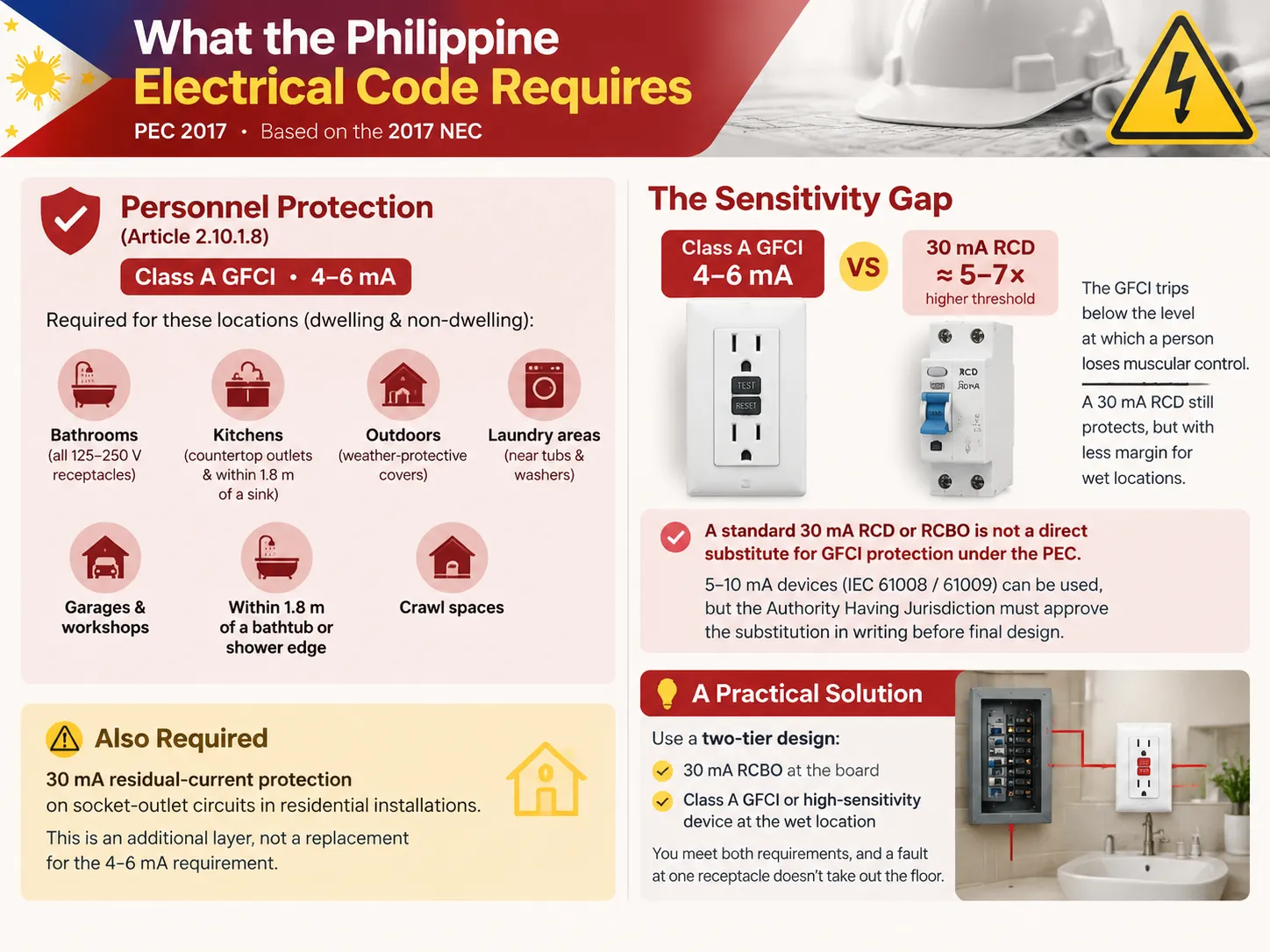
Регламент по персональной защите особенный, так как он фактически не работает как 30 мА RCD, распространенный в Европе. Согласно PEC 2017, как жилые, так и нежилые помещения должны иметь системы прерывателей цепи замыкания класса A с чувствительностью от 4 мА до 6 мА для любого оборудования в следующих помещениях:
- в ванных комнатах — все используемые розетки 125–250 В
- на кухнях — розетки на столешницах и любые розетки, расположенные менее чем в 1,8 м от раковин
- на территориях вне здания, где все наружные розетки и вилки расположены под навесом
- в прачечных — все розетки, расположенные рядом с раковинами и стиральными машинами
- в гаражах и мастерских
- на расстоянии менее 1,8 м от ванн и душевых кабин
Кроме того, PEC предусматривает меры безопасности с остаточным током 30 мА в цепях бытовых розеток. Это дополнительная опция и не замена требованию 4-6 мА.
Что покупатели неправильно понимают, так это разницу между 30 мА УЗО и УЗИП класса A с точки зрения их уровней чувствительности. УЗО на 30 мА срабатывает при примерно в пять-семь раз большем токе, но выполняет ту же функцию, только разными способами: УЗИП настроен срабатывать до того, как человек потеряет способность контролировать мышцы, тогда как 30 мА УЗО имеет меньший запас безопасности и все же может обеспечить некоторую защиту человеку, находящемуся в зоне водной опасности. Аналогично, PEC рассматривает тип устройства как стандартный и не считает этот тип устройства эквивалентной заменой УЗИП. Устройства с номиналом 5-10 мА, соответствующие стандартам IEC 61008 или IEC 61009, могут достигать тех же результатов при правильных условиях, но кодекс требует предварительного письменного согласия соответствующих органов на такую процедуру до завершения окончательного проекта.
Одно очень простое решение, которое устраняет необходимость всех этих споров — использование двухступенчатой системы. При таком подходе устанавливается 30 мА УЗО на электрощите и УЗИП класса A или сверхчувствительное устройство непосредственно в зоне с повышенной влажностью. Такой подход помогает выполнить оба набора требований, и неисправность в одной из точек не приведет к серьезным последствиям.
Чувствительность, тип и где каждый из них применяется
Две характеристики определяют, что устройство может фактически делать: его чувствительность срабатывания и обозначение типа.
| Чувствительность | Что оно защищает | Типичное применение на Филиппинах |
|---|---|---|
| 4–6 мА (УЗИП класса A) | Людей | Ванные комнаты, кухни, наружные розетки, прачечные |
| 10 мА | Людей, с большим запасом | Специальные применения, медицинские объекты |
| 30 mA | Людей | The standard for socket-outlet circuits and final circuits |
| 100 mA | Equipment and fire | Sub-main protection where selectivity is needed |
| 300 mA | Пожар | Main incomer, in addition to — never instead of — 30 mA downstream |
The Type designation indicates the fault current waves that are recognized by the equipment, and this is where many installations today fail. With solar inverters, variable frequency drives and EV chargers becoming the norm in buildings all over the Philippines, a Type AC device will only detect sinusoidal alternation residual current and cannot recognize the smooth DC component produced by these devices. Type A can detect both alternating and pulsating DC. Type B detects smooth DC as well. Type B is the right specification for any equipment comprising a rectifier, inverter or DC link, and this is not merely an upgrade with a fancy name.
Conditions in the Philippines That Change the Specification
Three local elements cause the design to deviate from the European standard.
230 V at 60 Hz. The electricity provided in the Philippines is usually 230 V single-phase at 60 Hz, with 3-phase 400 V being an option. Devices sold in these territories must work at the frequency of 60 Hz; devices that run only at the frequency of 50 Hz perform in an unpredictable manner, which makes the trip-time information unreliable.
Variety of earth arrangements. Electrical installations in the Philippines consist of different combinations of TT and TN-C-S systems depending on the power supply and the construction date. The type of earthing used defines whether an RCD by itself is sufficient or it has to be supplemented with an earth electrode that corresponds to the required standards and helps to calculate the fault-loop impedance. Mistaken assumptions about this are among the main reasons why newly installed RCDs sometimes fail to function as expected. The explanation of such systems is provided in the overview of TN-C-S and some other types of earthing systems.
Lightning. The average number of thunderstorm days in low-lying areas of the Philippines amounts to 25-50 a year, and those in mountainous regions experience even more. There are two direct consequences of thunderstorms for the placement of leaking-current devices. First of all, an earth electrode should be taken into account, and the minimum requirements state that it should be made of copper-plated steel and have 2.4 m and 15.87 mm (5/8 in) in diameter. Code compliance may indicate about 25 Ohms, although for reliable RCD operation, the value of 5 Ohms and over is favorable. Secondly, surge protection should be upstream of the leaking device.
Brands You Will Actually Find in the Philippines
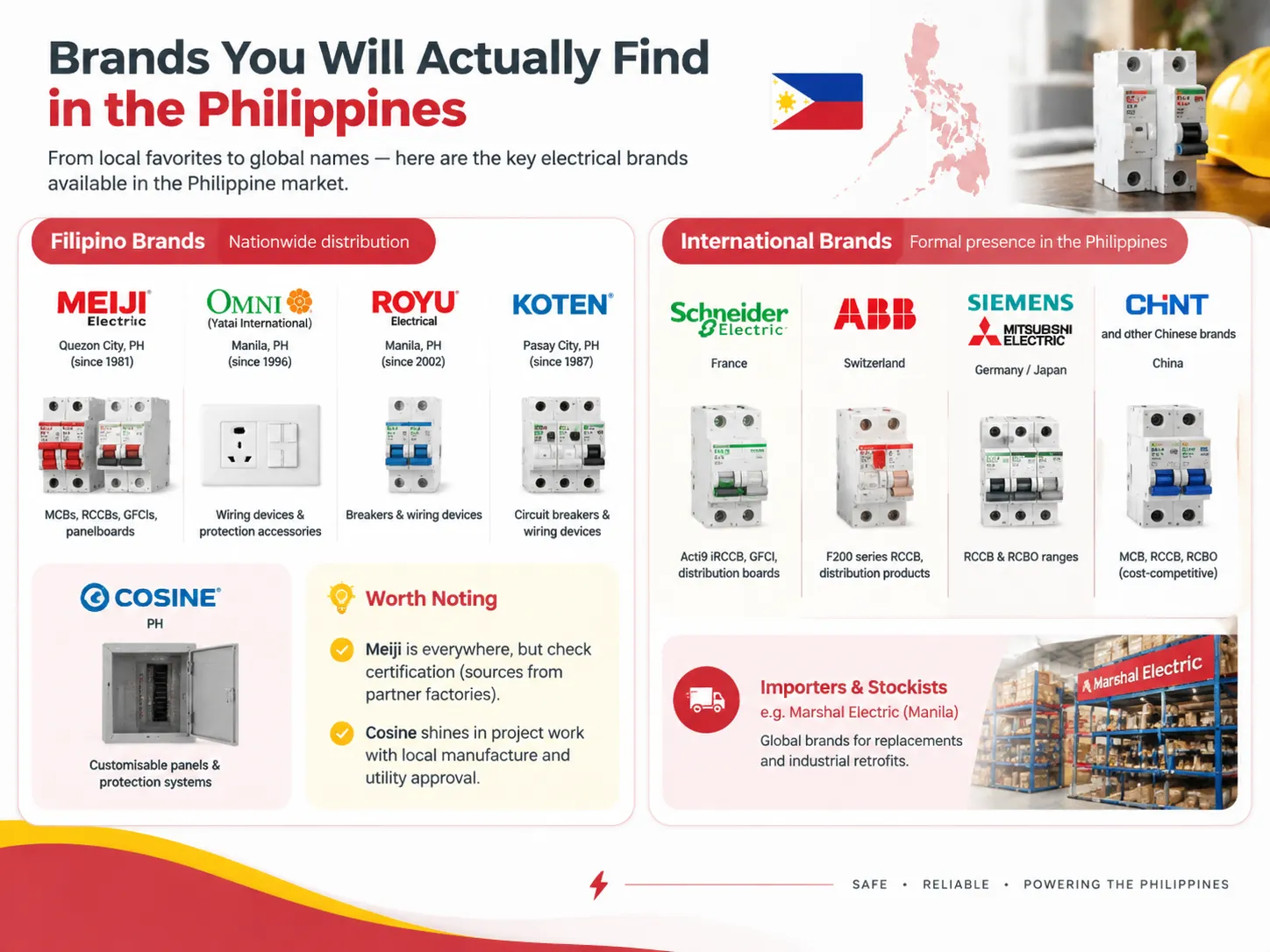
The local market is perfectly divided between Filipino brands with national distribution and those that are foreign but have a formal presence. Below figures show some street prices in 2026 for a domestic device of 2 poles that vary on the basis of ampere rating and sensitivity.
| Бренд | Origin | What they supply | Typical price band | Примечания |
|---|---|---|---|---|
| Meiji Electric | Quezon City, PH — since 1981 | MCBs, RCCBs, GFCIs, panelboards, wiring devices | ₱400–₱2,500 | PEEP and DOE compliant; IEC-based designs; wide hardware-store stock |
| Omni (Yatai International) | Manila, PH — since 1996 | Wiring devices and protection accessories | ₱350–₱2,000 | PNS and ICC marked; the strongest nationwide distributor network |
| Royu Electrical | Manila, PH — since 2002 | Breakers (2-pole screw terminal, 220 V), wiring devices | ₱300–₱1,200 | Under the FELCO group; BPS certified; fire-retardant polycarbonate |
| Koten Enterprises | Pasay City, PH — since 1987 | Circuit breakers and standard wiring devices | ₱300–₱1,800 | Mass-housing and institutional favourite; parts always available |
| Cosine Industries | PH | Customisable panels and protection systems | Project-based | Locally made, strong utility approval, co-labelling available |
| Schneider Electric | Франция | Acti9 iRCCB, AvatarOn GFCI, distribution boards | ₱700–₱4,500 | Widest specification presence on commercial projects |
| ABB | Швейцария | F200 series RCCB, distribution products | ₱900–₱5,000 | Common on industrial and utility work |
| Siemens / Mitsubishi Electric | Germany / Japan | RCCB and RCBO ranges | ₱800–₱4,500 | Premium pricing; strong on OEM panels |
| Chint and other Chinese brands | China | MCB, RCCB, RCBO | ₱250–₱1,500 | Cost-competitive; certification varies enormously by product line |
There are two that require mentioning. Among the infamous brands in the Philippines, Meiji is the first choice for many domestic electricians. That’s because it’s available A-to-Z and with understandable labeling, which means that it has got the production from various factories rather than manufacturing everything on its own. Thus, the importance of checking certifications only increases. Cosine is the unique one for projects, given that it has the ability to produce things locally with the utility approval.
On the importers and the stockists level, there are companies like Marshal Electric in Manila that would have global brands for replacement and retrofitting. For the time being, being in need of a simple RCBO replacement, this layer is often faster than trying to get the replacement through the distributor order.
Common Models and What Each One Is For
Devices in this group do not have decorative design because they give you information on pole number, the type of current and other characteristics.
This means that encountering with a model such as 2P, 30mA, Type A, 6kA, you see a two-pole RCD with 30mA sensitivity that works with pulsating DC current and has a maximum short-circuit current of 6kA. Substitute 30 with 300, and a device turns into one that protects from fire and electric shock. Replace 2P with 4P, and the device protects you not only against electric shocks but also indicates if you have a three-phase circuit.
In case of a single-phase 230V domestic distribution board, you would typically encounter a 2-pole 30mA type A RCCB and a number of 16-32 A RCBOs. In commercial kitchens or wet areas of hospitals, you would be protected with devices with 10 mA GFCI. Any system with a drive or anything similarly requiring a type B device will make the specifications different.
HUYU’s residual-current range covers that spread in one family rather than piecemeal: a 16–125 A Type AC/Type A RCCB for the sub-main position, plus RCBOs from 6 A to 125 A, Type B and Type F variants for inverter and drive loads, and the MCB and AFDD lines that sit alongside them in the same board. The point of buying one family is that the accessories, busbars and enclosure widths are already matched.
What It Costs in the Philippines
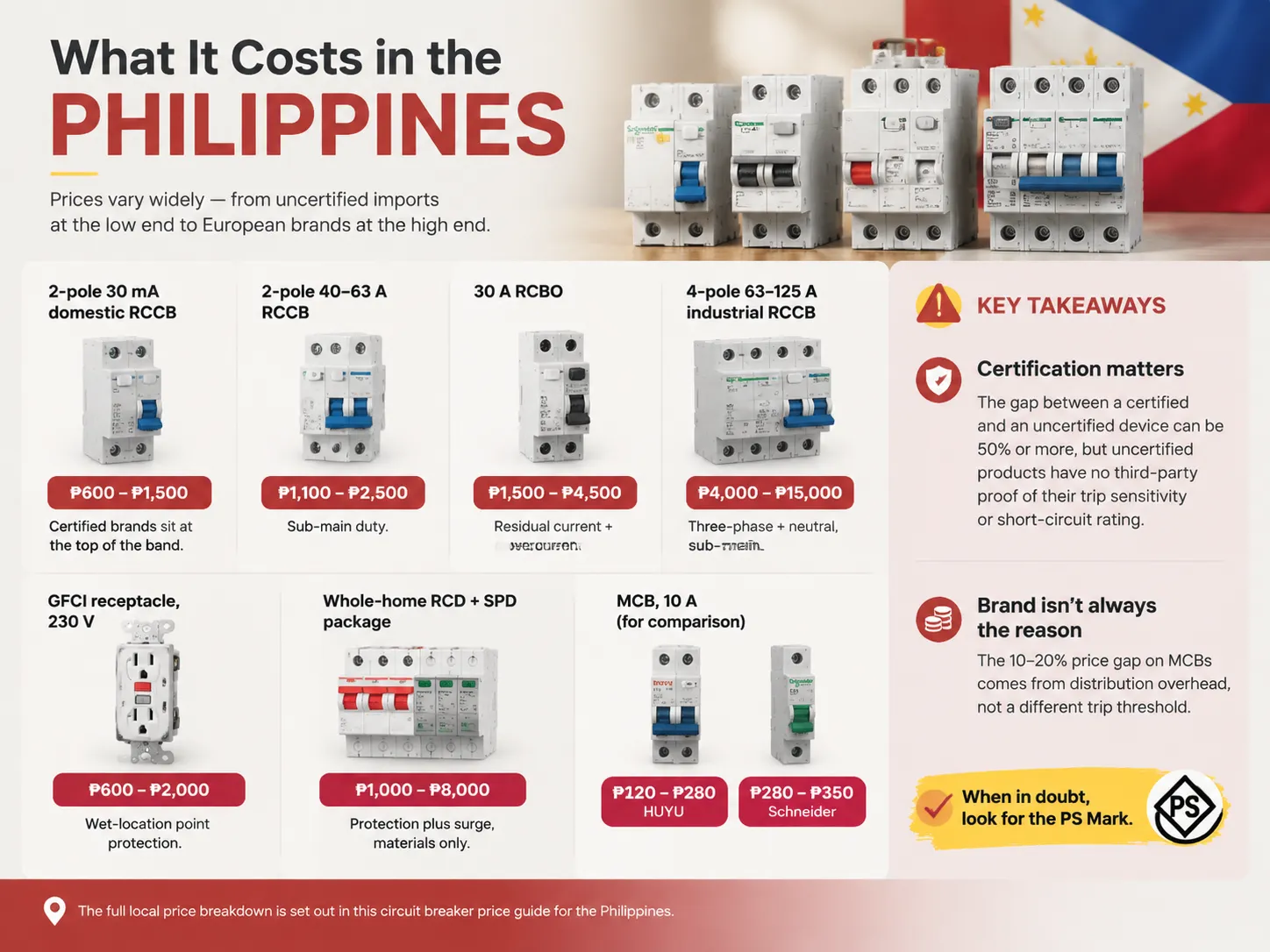
Philippine pricing is lumped because the cheaper side of the market is crowded by uncertified imports and the expensive one by European brands, leaving very limited possibilities in between. The bands below show 2026 street pricing, so regard the low end of any range with caution unless there is a visible PS Mark.
| Устройство | Typical price (PHP) | Примечания |
|---|---|---|
| 2-pole 30 mA domestic RCCB | ₱600–₱1,500 | Certified brands sit at the top of the band |
| 2-pole 40–63 A RCCB | ₱1,100–₱2,500 | Sub-main duty |
| 30 A RCBO | ₱1,500–₱4,500 | Residual current plus overcurrent |
| 4-pole 63–125 A industrial RCCB | ₱4,000–₱15,000 | Three-phase plus neutral, sub-main |
| GFCI receptacle, 230 V | ₱600–₱2,000 | Wet-location point protection |
| Whole-home RCD + SPD package | ₱1,000–₱8,000 | Protection plus surge, materials only |
| MCB, 10 A, for comparison | ₱220–₱400 | HUYU ₱220–280; Schneider ₱280–350 |
There are two noteworthy patterns. The difference between an approved unit and one that is not may appear on paper to be more than fifty percent, however, the uncertified item has no verification that it will break at the values stated in its specifications or withstand short-circuit current of the same value. Therefore, the calculated difference is only a difference on paper. Similar situation can be observed in the table presented above, where HUYU offers its product at a price level of ₱220–280 while major European brands sell their devices for ₱280–400.The full local price breakdown is set out in this circuit breaker price guide for the Philippines.
How to Choose a Supplier
Philippine procurement depends on certifications more than on manufacturers, so figure out this checklist before worrying about price.
- PS Mark or ICC. Electrical equipment available in the Philippines is expected to be marked with the Philippine Standard Mark or an Import Commodity Clearance sticker. Without that, an appliance cannot be mentioned in a valid installation, no matter what kind of datasheet is provided.
- Specify standards. RCCB has to be certified according to IEC 61008, while RCBO has to provide IEC 61009. An offer saying “It conforms to IEC standards” is not definitive.
- Sensitive rating and Type. Make sure the offer indicates that it is 30 mA and appropriate Type A or B. If a drive, inverter or an adapter is included in the installation, Type B is obligatory.
- Breaking capacity. Ask what conditional short-circuit current a device is rated for and which protective device is used. The difference between a 10 kA unit and a 6 kA unit is not visible.
- 60Hz specification. Make sure the part complies with the specifications for 60Hz, not 50 Hz only.
- Warranty. It is better to ask for two-year warranty with some possibility of replacement rather than a one-year.
- Documentation. Make sure you obtain the test report and Declaration of Conformity each time the shipment arrives, not just once per inquiry.
This way a manufacturer like HUYU operates successfully. We are not well-known brand among Filipino customers, and if the specification mentions Schneider or ABB, it means that this specification involves these brands and not our company. In that case, we are able to compete based on performance specifications — 30 mA, Type A or B, PS Mark or ICC, IEC 61008/61009, two-year warranty according to the specifications strictly. The range and the OEM terms are set out on the RCCB manufacturing programme page.
Часто задаваемые вопросы
Is an earth leakage relay the same as an RCD or RCCB?
So functionally the two devices are the same as they both sense the current flowing in the live conductors and trip on residual current. However the difference between them comes in terms of the form factor and their application. The earth leakage relay is usually a standalone equipment which is combined with a core balance current transformer and is responsible for the operation of the relay which is utilized when it is required to have a variable action of the device or to trip a large circuit breaker. RCCB is in fact a single DIN event component that performs the switch. In electrical works in the Philippines one will be faced with installation of RCCB or RCBO while earth leakage relays are used in industry and beyond.
Does the Philippine Electrical Code require an RCD in homes?
Yes, in two different ways. The requirement of PEC 2017 Article 2.10.1.8 is that Class A grounding fault circuit interrupters (GFCIs) should be applied when the current range is 4 to 6 mA in outlets located in bathrooms, kitchens near sinks, where water is used outdoors, in laundry areas, garages, and within 1.8 meters of a bathtub or shower. In addition to this, the code specifies that circuitry for socket-outlet circuits has a requirement of 30 mA for the residential output. Both of these requirements are applicable, and one may not replace the other because the thresholds of sensitivity are already different with these two requirements as well as the principles of protection.
Can a 30 mA RCD be used instead of a GFCI in the Philippines?
Rather than a straightforward substitute for the 4-6 mA requirement. It should be noted that PEC specifically mentions that the device with 30 mA rating does not comply with the GFCI regulation as 30 mA is about five to seven times more than the GFCI compliance level. Devices with 5-10 mA rating which are in accordance with IEC 61008 or IEC 61009 are compliant to requirements when the right type is utilized based on the load, but there is a limitation in the sense that prior written approval from AHAJ is necessary before the design completion. Thus, it will be more prudent to provide both: a 30 mA RCBO installed in the electrical panel and a Class A GFCI used in moist locations.
What Type should I specify — AC, A, B or F?
Type AC responds only to sinusoidal alternating residual current and is only used in simple resistive and lighting circuits. Type A adds pulsating DC to its sensing range and is the sensible minimum for modern installations with electronic equipment. Type B is required whenever the circuit contains any of the following: a variable frequency drive, a solar inverter, an EV charger, or any other equipment that can create smooth DC leakage because neither Type AC nor Type A will detect it. Type F is between types A and B when it comes to mixed frequencies from single-phase drives and some inverter loads. If there is any inverter on the load list, specify Type B and stop haggling.
Do I need surge protection as well as earth leakage protection?
Absolutely, and the two are not the same things, as an RCD reacts as regards to any residual current, but does not shield devices from voltage surge. Considering that there can 25-50 storm days every year in the Philippines flat regions, the usage of Type 1 SPD at the point of supplies with the use of Type 2 devices at the switches is common and advisable for anything what has sensitive loads. The distance between these two levels of SPD should be at least 10 m or they can be connected with the help of decoupling elements.
Why does a newly installed RCD trip for no apparent reason?
There are four reasons that can account for the majority of the instances. An included neutral conductor connecting ahead two circuits divides the return path and takes on the characteristics of a ground fault for the coil responsible for sensing the fault. A bootleg ground or neutral conductor that has inadvertently been grounded also produces the same results. Cable insulation that has absorbed moisture, typical for the older Philippine buildings, leads to the presence of a true leakage. Finally, a device that is installed incorrectly because of the type may trigger an alarm on the DC component of the load. In order to localize the source of the issue, disconnect the load first and then check the individual circuits.
Ссылки
- International Electrotechnical Commission — IEC 61008 and IEC 61009, residual current operated circuit-breakers
- Стандарты и нормативы UL — UL 943, прерыватели цепей с защитой от замыканий на землю
- UL Solutions — testing and certification for residual current devices
- NFPA — NFPA 70, National Electrical Code (the basis of the PEC structure)
- ISO — ISO 9001 quality management, the framework behind IEC 61008/61009 certification
Заключение
When looking to purchase earth leakage protection in the Philippines, you will have to think about three different specifications as well as one certificate. The specifications include the sensitivity of the device (i.e. it should be 4–6 mA for personnel protection in compliance with PEC 2017, 30 mA for socket circuits and 300 mA for fire protection), number of poles and the Type of the device (AC means basic protection, A is the most common there is and B is suitable only when the inverter or the drive is used in the device). The certificate you need is either a PS Mark or ICC sticker — without the certificate, you cannot use the device in your installation even if the datasheet states otherwise.
As for the suppliers, you can choose from Meiji, Omni, Royu and Koten companies as they will provide you with fast replacement regardless of the device illness; Cosine company manufactures at local factories and has a range of strong utility approvals; Schneider, ABB, Siemens and Mitsubishi Electric are known for the presence of all specifications required for proper device functioning according to the consultants expectations. HUYU is competing on costs and OEM terms – our prices are 10–20% lower than those of the leading brands but since we are not a well-known brand we have to admit that.
Whichever option you choose to shop for, ask for the data you need (the standard number, declared sensitivity of the device, type of the device and its safety performance) in writing so that at least four points indicated in the quotation would not allow you to deal with most possible troubles.